• Skip to primary navigation
  • Skip to main content

International Salsa Magazine

  • HOME
  • Previous editions
    • 2026
      • ISM / April 2026
      • ISM / March 2026
      • ISM / February 2026
      • ISM / January 2026
    • 2025
      • ISM / December 2025
      • ISM / November 2025
      • ISM / October 2025
      • ISM / September 2025
      • ISM / August 2025
      • ISM / July 2025
      • ISM / June 2025
      • ISM / May2025
      • ISM / April 2025
      • ISM / March 2025
      • ISM / February 2025
      • ISM / January 2025
    • 2024
      • ISM / December 2024
      • ISM / November 2024
      • ISM / October 2024
      • ISM / September 2024
      • ISM / August 2024
      • ISM / July 2024
      • ISM / June 2024
      • ISM / May 2024
      • ISM / April 2024
      • ISM / March 2024
      • ISM / February 2024
      • ISM / January 2024
    • 2023
      • ISM / December 2023
      • ISM / November 2023
      • ISM / October 2023
      • ISM – September 2023
      • ISM – August 2023
      • ISM July 2023
      • ISM Edition June 2023
      • ISM – May 2023
      • ISM April 2023
      • ISM March 2023
      • ISM February 2023
      • ISM January 2023
    • 2022
      • ISM December 2022
      • ISM November 2022
      • ISM October 2022
      • ISM September 2022
      • ISM August 2022
      • ISM July 2022
      • ISM June 2022
      • ISM May 2022
      • ISM February 2022
      • ISM January 2022
    • 2021
      • ISM December 2021
      • ISM November 2021
      • ISM October – 2021
      • ISM September 2021
      • ISM August 2021
      • ISM July 2021
      • ISM May 2021
      • ISM April 2021
      • ISM June 2021
      • ISM March 2021
      • ISM February 2021
      • ISM January 2021
    • 2020
      • ISM December 2020
      • ISM November 2020
      • ISM October 2020
      • ISM September 2020
      • ISM August 2020
      • ISM July 2020
      • ISM June 2020
      • ISM May 2020
      • ISM April 2020
      • ISM March 2020
      • ISM February 2020
      • ISM January 2020
    • 2019
      • ISM December 2019
      • ISM November 2019
      • ISM October 2019
      • ISM Septembre 2019
      • ISM August 2019
      • ISM July 2019
      • ISM June 2019
    • 2016
      • ISM December 2016
  • Spanish
  • Download Salsa App
    • Android
    • Apple

Search Results for: Trumpet and Percussion

“El Caballero de la Salsa” Kicks Off “Íntimo” in Puerto Rico

With performances on February 14 and 15, 2026, at the Coliseo de Puerto Rico, Gilberto Santa Rosa started the year “at home” with two sold-out shows and the successful launch of his “Íntimo” tour. That is always the goal. On the island, the audience is as demanding as they are generous and the singer knows it. Following the concerts, “El Caballero” posted on social media: “Puerto Rico, thank you for giving us two nights full of love, dancing, and so much music at home! What a thrill it is to sing at home!”

“El Caballero de la Salsa” Kicks Off "Íntimo" in Puerto Rico
“El Caballero de la Salsa” Kicks Off “Íntimo” in Puerto Rico

On January 30 of this year, the album that shares the tour’s title was released. In Puerto Rico, two shows were scheduled for Valentine’s Day weekend. The first coincided with Valentine’s Saturday; the second was added for the following day due to how quickly the first round of tickets sold out.

At exactly 6:46 PM on Sunday, February 15, 2026, the stage of the Coliseo de Puerto Rico welcomed Gilberto Santa Rosa’s orchestra to begin the second concert, marking the salsa singer’s long-awaited reunion with the Puerto Rican public. According to a press release from Edumil Ruiz’s agency: “These performances are part of a series of special concerts celebrating the month of love (…) and represent the long-awaited reunion of ‘El Caballero de la Salsa’ with his Puerto Rican audience after two years since his last performance on the island.”

A Night of Rhythms and Ovations

The performance began with high energy and impact from the very first track. The opening bars were seasoned with the sounds of the Puerto Rican cuatro, played by Fabiola Muñoz. “Déjate querer” featured a timbal solo by Pete Perignon, while “Cartas sobre la mesa” highlighted Saviel Cartagena’s saxophone. These were followed by “Ahora o nunca,” “Tú,” “Amor para la historia,” “Quiéreme,” and “Almas gemelas,” which featured Juan Carlos Vega on an aerophone solo; followed by “Yo no te pido” and “Conciencia,” for which the audience gave the artist a thunderous standing ovation.

Between songs, Santa Rosa took a moment to address the crowd: “I was born, raised, and live here. And it moves me to know that here in Puerto Rico, I am still dearly loved.” He added that he is a fan of singing to the brokenhearted with “scorned” lyrics set to savory, danceable arrangements. Addressing the contradiction of that combination, he stated, “We Puerto Ricans are capable of crying and dancing at the same time,” capping the explanation with: “That’s just how passionate we are.”
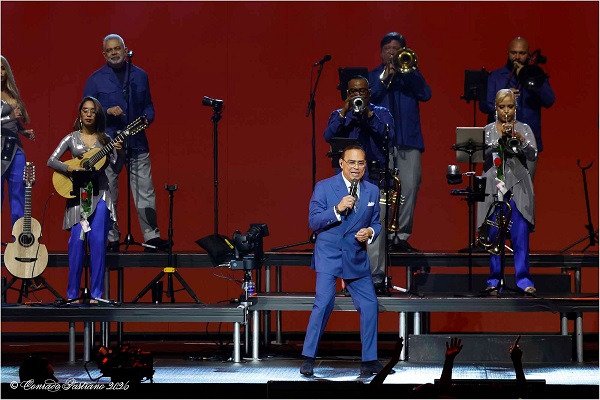
152 With the performances on February 14 and 15, 2026 at the Coliseo de Puerto Rico, Gilberto Santa Rosa began the year in "his home" with two sold-out shows.

152
With the performances on February 14 and 15, 2026 at the Coliseo de Puerto Rico, Gilberto Santa Rosa began the year in “his home” with two sold-out shows.

After his remarks, “Gilbertito” explained he would welcome a beloved artist to sing “Misterio,” an urban salsa track with lyrics “about a relationship where you don’t know if it’s coming or going, starting or ending.” Gerardo Rivas took the lead in his solo role, which required Pete Perignon to fill in on the congas while Pedro Marcano took over the timbales.

Tributes and Special Guests

Later, Gilberto Santa Rosa dedicated a segment of the concert to a legend Puerto Rico bid farewell to last December. He stated that Rafael Ithier was a musical genius whom he considered a mentor and a father in music, dedicating the iconic “Las hojas blancas” to him. Notably, the production featured a team of sign language interpreters who translated the entire concert in real time.

The repertoire also included “Vino tinto,” “Cosas nuevas” highlighting Pedro Marcano on the flugelhorn and “No me dejes solo,” which kicked off with a mozambique rhythm and rumba clave on the drums, courtesy of Gerardo Rivas and Tito Echevarría. The most anticipated moment arrived when Santa Rosa asked the crowd to join him in a chorus that allowed “El Caballero” to pay his respects to special guests. The “Choliseo” vibrated as the crowd chanted: “Mira quien llegó / Quién está ahí / Qué bueno que te vino a ver” (Look who arrived / Who is there / How good they came to see you). The tenacious sonero greeted the following guests in perfect rhyme and with his trademark elegance: Don Perignon, Luisito Ayala, Luis Vázquez, Juan José Hernández, Elwood Cruz, Marilin Pupo, Cucco Peña, Lissette Álvarez, Willie Chirino, his wife Alexandra Malagón (whom he called “The owner of my heart”), and Ismael Miranda, among others.

The evening continued with “No pensé enamorarme otra vez” and “Para vivir,” for which he was joined by Yeika Álvarez and “a representation of the Arturo Somohano Philharmonic Orchestra of Puerto Rico.”
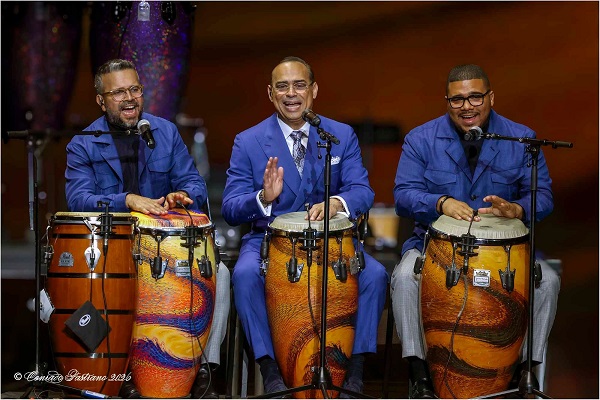
Gerardo Rivas (Hijo de Jerry Rivas el reemplaso de Jimmie Morales), Gilberto Santa Rosa y Pete Pergnon

A Monument to Nostalgia

“Tengo una muñeca,” followed by a fusion that progressed from boogaloo to cha-cha-cha and finally to salsa with Gilberto showcasing his skill on the maracas led us into a monument of nostalgia. The memory of the conga player Santa Rosa had worked with since their days in Willie Rosario’s orchestra until his passing in 2021 was honored with “Impaciencia.” The song showcased the Jimmie Morales Signature Series drums by Remo Percussion©, which sponsored “El Rey del Seco” (The King of the Dry Hit) from 2005 to 2016.

During this segment, “El Caballero” displayed his own skills as a talented conguero while singing, accompanied by Gerardo Rivas (the orchestra’s conga player) and Pete Perignon (the timbalero) on either side. While the audience was spellbound by the sight of the three musicians at their drums, this writer wondered if Gilberto was reminiscing about the days when he used to imagine he was a singer, using an upside-down trash can as a drum in the group led by Don Perignon.

The “Army of One”

This intervention was followed by “La agarro bajando,” which preceded the introduction of the band members, “musically directed by the master of the trombone,” Georgie Torres. The lineup included:

  • Backing vocals: Yeika Alvarez and Gino Ramírez.
  • Puerto Rican Cuatro: Fabiola “The one who holds her own” Muñoz.
  • Trumpet: Rebecca Zambrana (with the orchestra for 29 years) and Pedro Marcano.
  • Trombone: Anthony Rosado (also a ballroom dance champion).
  • Saxophone/Flute: Francisco “Paquito” Cruz and Saviel Cartagena.
  • Piano: Luis Marín.
  • Congas: Gerardo Rivas.
  • Timbales: Pete Perignon Morales.
  • Bongos: Rafael “Tito” Echevarría.
  • Bass: The legend Johnny Torres.
  • Keyboard/Aerophone: Dr. Juan Carlos Vega.
  • Vocals: Michael Pérez.

Santa Rosa also praised the technical and audiovisual teams, producer Rafo Muñiz, and Edumil Ruiz, noting that “all these people make this work.”

After identifying his team who gave a masterclass in what the military calls an “Army of One” the hits “Conteo regresivo,” “Perdóname,” “Que alguien me diga,” and “Que manera de quererte” rang out. Gilberto Santa Rosa celebrated Valentine’s weekend by once again proving why he holds the loyalty and preference of his Puerto Rican fanbase.

From the start, the energy never wavered. The crowd sang and danced along with the artist, the musicians, and the dancers on stage. The vast repertoire serves as a reminder of the countless hits “El Caballero de la Salsa” has collected throughout his prolific career.

Bella Martinez Puerto Rico


Also Read: Bandleader and conga player Tony Rosa tells us how he built his career
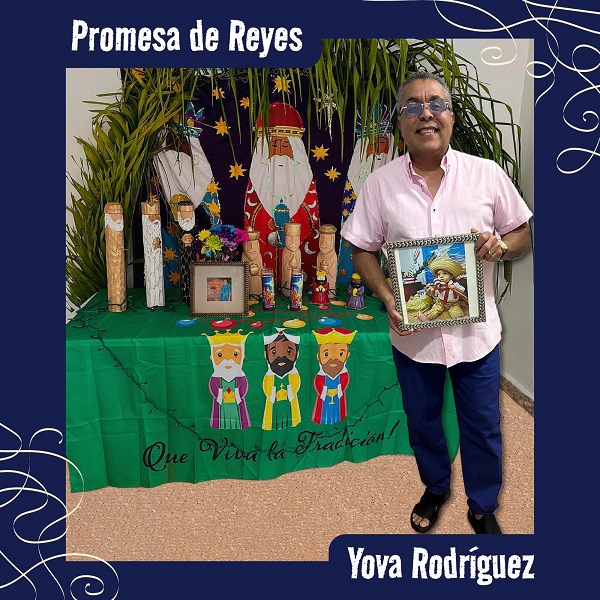
“Promesa de Reyes” from the pen of Yova Rodríguez “The Jibarito of Mayagüez in New York”

International Salsa Magazine, through salsagoogle.com, has the privilege and immense honor of presenting the most recent musical work titled “Promesa de Reyes” from the pen of the Puerto Rican singer-songwriter Yova Rodríguez “El Jibarito de Mayagüez.”

Promesa de Reyes de la pluma del Yova Rodríguez “El Jibarito de Mayagüez en New York”

The most recent track, titled “Promesa de Reyes,” is something I’ve wanted to do for a long time. I have to tell you that producing a Christmas production is a bit difficult because the season is so short, and it’s hard to develop the theme as it should be. But I was determined to do it because it’s a gift or tribute to the memory of my mother, Doña Delia Ruiz.

The inspiration for “Promesa de Reyes,” in reality, when you listen to the song, what you’ll realize is that it’s a narration. That is, in this track, I’m going to describe, from when I was a child, how I used to watch my mom carry out the process of her “Promesa de Reyes,” from the time they sent someone to cut the palm leaves to make the altar, until that altar with the Three Wise Men was completed, and the next day, well, we knew we had the party.

I’ve been incredibly lucky because the track was arranged by Leo Morales, originally from Colombia. It turns out that Leo is influenced—he learned to play the trombone and became a musician because of Willy Colón’s Asalto Navideño records. So, he told me that since then, he started studying the authentic, folk music of Puerto Rico to find out where Willy got those kinds of ideas. This is a very special track because we managed to include Puerto Rican danza (dance), Puerto Rican bomba (drumming and dance), and salsa.

It’s a track that gathers a lot of little things, and obviously, we added the music of the Puerto Rican countryside (música del campo). It starts with different rhythm changes, and you’ll hear one part that has Puerto Rican danza, another that has Puerto Rican bomba, and another that has salsa.

Anthony Carrillo y Yova Rodriguez

I sing and I wrote the song. On piano is Vicente Báez, the current pianist for Sonora Ponceña. On bass is Puri Matos, a master based in New York. He was recommended by Anthony Carrillo and has been doing all my projects with me for two years. Anthony Carrillo did all the percussion. On trumpet is Agustín Someillan from the Cuban National Sextet. The chorus singers are Nino Segerra, Danny Dávila, and Caneca Rosa. Manny Trinidad, recommended by Nino Segarra, played the Puerto Rican cuatro.

The recording studio was Nino Segarra’s. This is about the fourth or fifth track we’ve done there in his studio with Nino.

Nino, besides being a singer, is a professional teacher. He’s an expert who knows how to guide you, how to explain things the way they should be; he doesn’t pressure you; he lets you develop. In other words, I feel extremely comfortable working with Nino; the experience of working with Nino is very satisfying.

People tell me, “Yova, you’re crazy. You get on a plane just to go record a voice track,” and I tell them yes, for two reasons:

First, because I feel secure. And second, because I know I won’t fail with Nino, so the sacrifice is worth it. Recording with Nino was thanks to Herman Olivera, my compadre, who told me, “Look, Yova, I’ve been recording with Nino for two years, and I’m not recording with anyone else.” And look, I got on the plane, I did it, and now I have five productions with Nino Segarra.

Nino Segarra y Yova Rodriguez en Puerto Rico

Yova, the time in the studio to make the track is very important. Talk a little about that.

Look, Augusto, remember that depends on the type of musician you have there, right? There are musicians who are sight-readers of the first caliber.

These musicians tell you, “Send me the charts two days before,” they skim them. When they get to the studio, they’re done with their part in half an hour, 20 minutes, 15. But there are others who you have to take at a slower pace. For example, in Anthony’s case, Anthony told me, “Send me the demo, and I’ll listen to it.”

But Carrillo is from another planet. I send him his demo; he listens for two days beforehand. And he tells me, “Let’s go to the studio.”

And Anthony recorded flawlessly. Anthony didn’t take three hours to do four instruments; he did it in about two hours, and everything was excellent.

The track’s release? The video will be released on Friday, October 31st. The track will also be launched on radio stations that same Friday, confirmed in Venezuela, Colombia, Peru, Florida, and Puerto Rico.

Danny Dávila, Yova Rodriguez y Caneca Rosa

Yova, you brought in a Venezuelan graphic designer for this, your most recent track. How was it working with that graphic designer? The good thing about Victoria is that she listens, right? Sometimes you work with not only the graphic designer—it often happens even with the arrangers; I compare them. They do something, and you tell them, “No, wait, wait, that’s not what I want, this is.” “Oh, but no, I think that’s what should be.”

Victoria listens to you and works with what you ask for. The experience with her was excellent, and I hope it continues to happen many more times.

“Promesa de Reyes”

Piano: Vicente Báez

Bass: Puri Matos

Puerto Rican cuatro: Manny Trinidad

Conga: Anthony Carrillo

Bongó: Anthony Carrillo

Snare Drum (Redoble): Anthony Carrillo

Puerto Rican güiro: Anthony Carrilllo

Cuban güiro: Edwin Caneca Rosas

Trumpets: Agustín Someillan

Chorus: Nino Segarra, Edwin Caneca Rosas, Danny Dávila

Singer: Yova Rodríguez

Studios: Sonority in New Jersey (Recording of all Percussion). Engineers: Nino Segarra

Mix: Héctor Mora, HM

Producción Medellín Colombia

Arrangement: Leo Morales

Video Production: Jhonatan Chávez

Composition: Yova Rodríguez.

Graphic Designer: Victoria Rivas Rojas. 

Also Read: Yova Rodríguez. The jibarito of Mayagüez

Jeremy Bosch Releases New Single “¿A dónde iré?”

The renowned musician, vocalist, composer, and arranger, Jeremy Bosch, has announced the release of his new single, “¿A dónde iré?” (Where Will I Go?). The song is the first promotional cut from his upcoming album, scheduled for release in October of this year.

“¿A dónde iré?” was written by Bosch, who is also a virtuoso flutist. For the lyrics, he drew inspiration from Psalm 139. In a press release, Jeremy commented on his inspiration, “This song was born from a moment of introspection and gratitude. I wanted to capture how God finds and accompanies us everywhere, even when we don’t perceive Him. I hope that those who listen can feel that closeness and trust in Him.”

The lyrics “combine biblical verses with Jeremy’s personal experience, intertwining his life’s testimony with the spiritual richness of scripture,” according to the artist’s team.

With this composition, the talented salsa artist whose work spans various musical genres seeks to invite listeners “to reflect on the presence of God (…) and the intimacy of a relationship with Him, through an authentic and moving musical expression.”

Jeremy Bosch lanza su nuevo sencillo “¿A dónde iré

Jeremy Bosch’s commitment to this production is evident. He is the composer of both the lyrics and melody, as well as the arranger, producer, vocalist, and background vocalist, in addition to playing the flute. The song features Álex “Apolo” Ayala on bass, interacting with Gabriel Chakarji on piano. Marcos Torres is on congas and minor percussion, and Marcos López is on timbales and bongos. The trumpets were handled by “Maneco” Ruiz and Jesús Ricardo. Doug Beavers played the trombone and Mario Castro the tenor saxophone. Edmar Castañeda is on harp, Roman Lajara on guitars and banjo, while Ali Bello played the violins, Samuel Marchan the violas, and Mara Navas the cellos.

About the Artist

Jeremy Bosch is a proud Puerto Rican. He was born in Ponce and raised in Las Piedras. He is a 2013 graduate of Berklee College of Music, with a degree in Jazz Composition.

Jeremy was the singer and flutist for the Spanish Harlem Orchestra from 2015, when director Óscar Hernández recruited him to replace Ray De La Paz, until early 2025, when he left SHO to focus on his solo career. In 2016, his compositions earned him recognition as a great writer, with the album Hecho a mano by Buena Vibra Sextet, released through Salsaneo Records. In 2020, while reviewing Pequeño Johnny Rivero’s album Golpe duro, I came across Jeremy’s credit as a background vocalist on the record. At that point, we already identified him as one of the new, promising salsa artists to watch. In Puerto Rico, in addition to his solo career, he is associated with the contemporary percussionist and orchestra director Pete Perignon, with whom he collaborated on the single ‘Sería una pena’ (2020).

Previously, Jeremy had the good sense to venture into a tribute to another notable Ponce native: Cheo Feliciano. The work, published under the title Prefacio, was recorded live at the Dizzy Club in New York. For this feat, he shared the stage with special guests such as Óscar Hernández, Johnny “Dandy” Rodríguez, and Nelson González. On that occasion, he stood out among compositions by Tite Curet Alonso, such as ‘Si por mí llueve,’ ‘Pa’ que afinquen,’ and ‘Los entierros’—to name a few—with arrangements by vibraphonist Felipe Fournier.

JB con flauta El reconocido músico, vocalista, compositor y arreglista Jeremy Bosch

Another notable production from his distinguished career allowed him to share the studio with Luis Enrique and Alain Pérez for the production of Prólogo hoy. This was followed by Epílogo, an Afro-Caribbean music album. Jeremy doesn’t want to be associated solely with salsa. In fact, his musical journey has been bold and varied, experimenting with “salsa mixed, produced, and arranged from a more synthesized and minimalist perspective,” as he described in an interview for the National Foundation for Popular Culture of Puerto Rico.

From his corner, this artist who has chosen to get to work—overcoming the temptation to complain—invites “a reconciliation between generations” for a healthy coexistence to enrich and diversify the contemporary musical talent pool.

Bella Martinez Puerto Rico


Also Read: Long live music! Repeat after me: “Long live the musicians so they can keep making it”. And I add: “Long live SALSA”.

Creator of Afro-Rican Jazz William Cepeda talks about this subgenre

When we talk about the best characteristics of Puerto Rican artists, innovation is definitely one of them, and our guest is an excellent example of this. Grammy nominee and composer William Cepeda was born and raised in Loiza, known as the heart of “Little Africa” in Puerto Rico, so we can sense that this had much to do with his later artistic inclinations. We will talk about this and other things in the next paragraphs of this gripping story. 

Musician William Cepeda
This is Puerto Rican Grammy nominee, composer, and musician William Cepeda

What got William interested in music

The environment in which William grew up had everything to do with his interest in music as a serious profession. In Loiza, Puerto Rican bomba was one of the most listened genres by the community, and cultural events based on it were passed down through generations. It was there that a very young William began attending the colloquially known as “bombazos” and connecting with this music from an early age.

Practically the whole town was involved in these traditions, including his family, so he could not escape all these activities carried out year after year. In fact, his grandparents and some of his uncles and cousins were musicians, so it was common for the young boy to see them play their instruments and know what that was about.

When he turned 14, he finally began seriously studying music, especially the theory part. Although one of his options to study was accounting, this career would never overcome his enormous taste for music, so he never materialized this interest.

How William got started professionally in music 

While still an inexperienced teenage musician, William started playing percussion with some local groups, one of them being La Orquesta Zodiac, composed of a group of salsa veterans with more than 50 years of professional experience. Although these gigs were already paid, the young man still saw music as a side hobby. 

However, long time later, he would completely change his mind after noticing that his skills and opportunities could take him further than he thought possible.

William Cepeda at the festival
William Cepeda at the Luminato Festival in Toronto

Afro-Rican Jazz

Having already a more or less consolidated career, William was part of the invention of Afro-Rican Jazz, which can be defined as a concept that celebrates Puerto Rico’s heritage and its African roots while offering a new version of the jazz that everyone knew, giving it a touch of modern flavor that was absolutely innovative for the time. 

Growing up in an environment where traditional Puerto Rican music was so present and having experience only with local groups, he still had a long way to go as an artist. His outlook started to broaden by going to study at Berklee in Boston and then to do a master’s degree in New York, which in turn led him to play with American groups and musicians such as Dizzy Gillespie, James Brown, Miriam Makeba, and many other famous jazz musicians.

Gillespie became one of his biggest mentors when playing with him and his group The United Nations Orchestra, which included Cuban, Colombian, Dominican, Panamanian, and Brazilian musicians. It was precisely because of this great diversity of nationalities and influences that the orchestra received this name. However, there were no Puerto Rican musicians or music, so Gillespie gave William the opportunity to become the youngest member and create a subgenre product of a mixture of jazz and some styles from his place of origin. 

William told us that many Boricuan musicians used to play Latin jazz based on Cuban music, but none of them had ever ventured to create a subgenre of jazz with a Puerto Rican base. That was when the artist realized that something had to be done about it, so he chose to fuse jazz with Puerto Rican music and later named his group Afro-Rican Jazz.

He also continued to experiment with genres until he found something he called “Plena jazz,” the name he used for one of his albums and the result of mixing plena, another traditional genre born in the neighborhoods of Puerto Rico, and jazz. He also made a symphonic rumba album at the time. 

William Cepeda and his doctorate
William Cepeda receiving his honorary doctorate from Berklee College of Music

Dizzy Gillespie’s protégé

Although William was influenced by a number of artists, when we check out his story his history, there is no denying that the South Carolinian trumpeter was the greatest influence and role model for the young man. 

With respect to this stage of his life, William recalls with affection that Dizzy was always very attentive to his development within the group, to the point that he came to see him as an artistic father. As we said before, he knew nothing about jazz or American music when he left Puerto Rico, but Dizzy and his musicians were “a second university” where he learned what no educational institution could teach him, something he thanks to them.

“Dizzy saw talent in me, so he always pushed me to be better every day. He encouraged me, protected me, and guided me in my development as a musician,” he said of his teacher.

Artists he has collaborated with

William has collaborated with countless great Latin artists such as Celia Cruz, Rubén Blades, Eddie Palmieri, Tito Puente, Marc Anthony, Oscar D’León, and many others. Most of these contacts came about thanks to references of acquaintances, combined with the percussionist becoming known to the public for some time, which generated many recommendations. 

All the above artists also influenced him to a certain extent, but he also says that he liked and still likes other genres such as classical music, jazz, the folklore of other countries, and many others.

Read also: Argentine tango bassist and Latin Grammy winner Pedro Giraudo returned to his roots

Julio Albino Y Su Secreto A Voces released ‘‘Pasaporte A Rumbero’’

After a few months of absence, we’re finally back with the batteries recharged to put a magnifying glass on the current projects of the best soneros right now. Today it is the turn of percussionist Julio Albino, who, as usual, delights us with every project he releases. 

But before that, we are going with a bit of the artist’s story so that everyone can know him better.

Julio during an event
Julio Albino during a live event

A little bit about Julio Albino’s beginnings

Julio Albino, also known artistically as Junito, became interested in music in his homecity of New York, and after his subsequent return to Puerto Rico, this curiosity did nothing but grow as time went by. It was then that he started listening to the music of legendary names in the industry such as “El Rey de Los Timbales” Tito Puente and Oreste Vilato, who inspired him to join the San German’s school band to some extent. He would later pursue an artistic career through collaborations with more experienced artists.

He ventured into this world professionally in the 1960s, when he began to be taken into account by several of the greatest salseros of the time, such as Frankie Ruiz, Hector Tricoche, Marvin Santiago, Paquito Guzman, Junior Gonzalez, Los Hermanos Colon, Joe Quijano, among others.

There is no denying that each of these collaborations contributed to Julio making known his great talent as a percussionist, but he would not rest until he was able to form his own project, which he eventually achieved. That was how he founded his own orchestra, Julio Albino Y Su Orquesta Secreto A Voces.

Secreto A Veces

Thanks to all the effort invested in his career, Julio has managed to secure a place for his orchestra in the salsa scene, and his best-known musical works are proof of this. His big debut came in 2005 with the album ‘‘Bailalo’’, which ranked high on the charts in countries such as Italy.

Ten years later, he also released the album “Haciendo Ruido” and, the following year, he came with his single “Chachara Con Cua” and the promise of a new album. In 2018, he released “Edén Borinqueño” as his second promotional single, and shortly after, Julio released the full album, which he named “El Secreto Ya No Es Secreto”.

secreto a voces
Cover art of the song ”Pasaporte de Rumbero”

Pasaporte de Rumbero

In 2025, Julio once again showed why he deserves the place he has earned and released his new single “Pasaporte de Rumbero”, with which he looks to consecrate himself as a worthy heir to the soneros who previously gave him the opportunity to join their ranks. Similarly, he shows absolute respect for Afro-Caribbean culture and its deepest roots. 

This joyful and energetic piece is not only a reflection of the Puerto Rican artist’s talent, but also of the strength and modernity of his orchestra, which is deeply connected to the Cuban musical tradition. From the very first seconds of the song, listeners can appreciate a festive street atmosphere, but at the same time with sophisticated percussion led by Julio himself, who boasts incredible technique that serves as a guide for the rest of the musicians accompanying him.

Among the members of the orchestra, we can mention trombonist Juan Colón, trumpeter Juan “Junito” León, saxophonist Ricardo Dávila, pianist Gabriel Rodríguez, and bassist Luis Rodríguez. Likewise, the lead vocalist is the charismatic singer Ángel Ríos, who contributes his exquisite phrasing and an enviable dominance of the clave at all times. 

Johnny Cru ISM corresponde in New York City

Read also: Our friend Tito Allen supports the Salsa Museum

  • « Go to Previous Page
  • Page 1
  • Interim pages omitted …
  • Page 14
  • Page 15
  • Page 16
  • Page 17
  • Page 18
  • Interim pages omitted …
  • Page 33
  • Go to Next Page »

International Salsa Magazine (ISM) is a monthly publication about Salsa activities around the world, that has been publishing since 2007. It is a world network of volunteers coordinated by ISM Magazine. We are working to strengthen all the events by working together.