• Skip to primary navigation
  • Skip to main content

International Salsa Magazine

  • HOME
  • Previous editions
    • 2026
      • ISM / August 2026
      • ISM / July 2026
      • ISM / June 2026
      • ISM / May 2026
      • ISM / April 2026
      • ISM / March 2026
      • ISM / February 2026
      • ISM / January 2026
    • 2025
      • ISM / December 2025
      • ISM / November 2025
      • ISM / October 2025
      • ISM / September 2025
      • ISM / August 2025
      • ISM / July 2025
      • ISM / June 2025
      • ISM / May2025
      • ISM / April 2025
      • ISM / March 2025
      • ISM / February 2025
      • ISM / January 2025
    • 2024
      • ISM / December 2024
      • ISM / November 2024
      • ISM / October 2024
      • ISM / September 2024
      • ISM / August 2024
      • ISM / July 2024
      • ISM / June 2024
      • ISM / May 2024
      • ISM / April 2024
      • ISM / March 2024
      • ISM / February 2024
      • ISM / January 2024
    • 2023
      • ISM / December 2023
      • ISM / November 2023
      • ISM / October 2023
      • ISM – September 2023
      • ISM – August 2023
      • ISM July 2023
      • ISM Edition June 2023
      • ISM – May 2023
      • ISM April 2023
      • ISM March 2023
      • ISM February 2023
      • ISM January 2023
    • 2022
      • ISM December 2022
      • ISM November 2022
      • ISM October 2022
      • ISM September 2022
      • ISM August 2022
      • ISM July 2022
      • ISM June 2022
      • ISM May 2022
      • ISM February 2022
      • ISM January 2022
    • 2021
      • ISM December 2021
      • ISM November 2021
      • ISM October – 2021
      • ISM September 2021
      • ISM August 2021
      • ISM July 2021
      • ISM May 2021
      • ISM April 2021
      • ISM June 2021
      • ISM March 2021
      • ISM February 2021
      • ISM January 2021
    • 2020
      • ISM December 2020
      • ISM November 2020
      • ISM October 2020
      • ISM September 2020
      • ISM August 2020
      • ISM July 2020
      • ISM June 2020
      • ISM May 2020
      • ISM April 2020
      • ISM March 2020
      • ISM February 2020
      • ISM January 2020
    • 2019
      • ISM December 2019
      • ISM November 2019
      • ISM October 2019
      • ISM Septembre 2019
      • ISM August 2019
      • ISM July 2019
      • ISM June 2019
      • ISM May 2019
      • ISM April 2019
      • ISM March 2019
      • ISM February 2019
      • ISM January 2019
    • 2018
      • ISM December 2018
      • ISM November 2018
      • ISM October 2018
      • ISM September 2018
      • ISM August 2018
      • ISM July 2018
      • ISM June 2018
      • ISM May 2018
      • ISM April 2018
      • ISM March 2018
      • ISM February 2018
      • ISM January 2018
    • 2017
      • ISM December 2017
      • ISM November 2017
      • ISM October 2017
      • ISM September 2017
      • ISM August 2017
      • ISM July 2017
      • ISM June 2017
      • ISM May 2017
      • ISM April 2017
      • ISM March 2017
      • ISM February 2017
      • ISM January 2017
    • 2016
      • ISM December 2016
      • ISM November 2016
      • ISM October 2016
      • ISM September 2016
  • Spanish
  • Download Salsa App
    • Android
    • Apple

Search Results for: Van+Van

Isadora Duncan, destined for a life of freedom and the avant-garde, of beauty and tragedy

Isadora Duncan was born in San Francisco in 1877. Her father, Joseph, abandoned the family shortly after her birth. Left in extreme poverty, her mother, Mary Isadora Gray, worked tirelessly to support her four children.

Isadora Duncan, destined for a life of freedom and the avant-garde, of beauty and tragedy

Nevertheless, she always told them, “We can do without bread, but never without Art,” and consistently encouraged her children’s artistic vocations.

From a very young age, her mother introduced her to the works of Beethoven, Schubert, Schumann, Mozart, and Chopin, and to the writings of Shakespeare, Shelley, Keats, and Whitman. She also taught her about classical Greek culture, paganism, and feminism.

The family lived like a small artistic troupe. Mary gave piano lessons, and Isadora taught dance while her mother played Mendelssohn on the piano.

Then her sister Elizabeth would recite poems by Theocritus, and their brother Raymond would conclude with a short talk about the Greeks or about dance and its effects on the society of the future.

Although she auditioned as a dancer in various theaters, she found no success. Isadora perceived dance very differently. She believed in improvisation, with movement like waves of a sea reflecting the very Soul, a concept almost mystical and spiritual, far removed from the formal technique of Classical Ballet.

As she recounted in her autobiography:

“I was born by the sea. My first idea of movement and dance surely came from the rhythm of the waves and also from nature; clouds carried by the wind, trembling trees, flying birds, whirling leaves…” This living nature is what she sought to express through dance.

Isadora Duncan was born in San Francisco in 1877.Her father, Joseph, soon after left the family.
Isadora Duncan was born in San Francisco in 1877.
Her father, Joseph, soon after left the family.

Early Struggles and European Dreams

Shortly after, a fire destroyed their home, leaving the family destitute again. Isadora secured a small role in a pantomime in New York: Madame Pygmalion. She had to borrow money for the train ticket and rehearsed unpaid for over a month. During lunchtime breaks, Isadora had no money for food and would hide in the facilities to sleep before continuing to rehearse.

Eventually, her family moved to New York, where in 1896, Isadora joined the company of playwright John Augustine Daly, taking ballet lessons with Marie Bonfanti. Due to her rejection of an academicism she considered limiting and unnatural, she managed to travel to Europe in 1898.

She arrived in England, where, always self-taught, she studied arts at the British Museum. There, she found great inspiration for her dances, which evoked ancient Greek movements and attire. She observed the movements of dancers on Greek vases, and from there adopted one of her characteristic postures: tilting her head back like the maenads. She then went to France, where she met Löis Fuller, who shared her ideas. Löis, like Isadora, was an alternative dancer whose performances incorporated elements of circus acts and variety shows.

Breakthrough and Artistic Vision

Together, they embarked on a tour of Munich and Vienna, creating new performances: “Dance Serpentine,” “Dance of Fire,” and “The Divine Shoe,” all embodying an absolutely modern concept. Finally, in Budapest, Isadora signed her first contract to dance solo on a large stage. She achieved great success, establishing herself on all European stages.

“Dance of Fire”, and ‘The Divine Shoe’, of an absolutely modern concept Isadora finally in Budapest.

After one of her shows, a great admirer came to greet hernone other than Konstantin Stanislavski, the creator of the famous acting method and one of the founders of Russian Theater. When he asked who had taught her to dance, Isadora replied, “Terpsichore.”

Nevertheless, her dance remained transgressive. She wanted to free dancers from pointe ballets, tutus, and corseted figures, to give expression to the soul through Art. The “costume” for her choreographies consisted of loose, transparent tunics, and bare feet to maintain direct contact with the earth.

A great admirer of Hellenic culture, she began constructing a Dance school in Greece, on the hill of Kopanos. Others followed in Germany and Paris. These schools often accepted girls from very humble backgrounds, charging them no fees. Over time, expenses became almost unsustainable, but Paris Singer, heir to the sewing machine empire, appeared offering financial assistance to allow them to continue.

Teaching, Tragedy, and Legacy

She embarked on tours across Europe, Russia (where she was invited by Lenin), and America, though what she loved most was teaching. She used to say, “First, we teach the children to breathe, to vibrate, to feel, and to become one with the general harmony and movement of nature. First, we are going to create a beautiful Human Being, a dancing child!”

After two marital breakups, in 1913, in a tragic accident, her children, Deirdre and Patrick, drowned in the Seine. The following year, a third child died shortly after birth. From then on, in all her choreographies, a long red scarf would appear over her white tunic, like a permanent, unclosed wound. In 1917, she adopted six of her students, “The Duncan Dancers.”

On International Dance Day, we remember the creator of the Isadora Duncan Contemporary Ballet.

While Isadora had many romantic liaisons, her most stable relationships were with Oscar Beregi, Gordon Craig, Paris Singer, and Sergei Esenin. But to maintain her Freedom, she never wanted to marry.

At the peak of her fame, on September 14, 1927, as she was about to give a concert in Nice, she greeted the public from her car: “Goodbye friends! I’m off to glory!” Shortly after, the very red scarf that never left her became entangled in the rear wheel, causing her death. Her legend began.

Ana and Irma, two of her adopted daughters, continued to disseminate the Duncan technique, which is still taught and danced today. A diva ante litteram, a rebel and pioneer of the dance revolution that erupted during the 20th century, an ultimate symbol of independence and purity: Isadora Duncan, in addition to being the mother of modern dance, is an anticipation of the free, ideal, nonconformist, and independent woman who would still have to wait decades to appear.

International Dance Day (April 29)

This date, proclaimed by UNESCO in 1982, commemorates the birth of Jean-Georges Noverre, an innovator and dance master considered the creator of modern ballet. On International Dance Day, we remember the creator of Contemporary Ballet.

Fania All Stars

Album: Crossover

Song: Isadora

Arranged By: Louie Ramirez

Arranged By: (All Strings) Vincent Montana, Jr.

Producer: Jerry Masucci

Written-By: C. Curet Alonso.


Fania All Stars Crossover 1979

By:

Angel A. Padron Hernandez

Dj. Augusto Felibertt

Also Read: Yolanda Moreno “the People’s Dancer”

Canada / Vancouver

Mangos Kitchen Bar
Mangos Kitchen Bar
1180 Howe Street
Vancouver, BC, Canada V6Z 1R2
+1 604 559-5533

Baza
Baza Dance Studios
1304 Seymour Street
Vancouver, BC, Canada V6Z 1R2
+1 778-379-2292

Studio Nightclub
Studio Nightclub
919 Granville street
Vancouver, BC, Canada V6Z 1L3
+1 604 620-6604

Exclusive with tres player Iván Camblor from the group Pellejo Seco

Cuban musicians have always found the way to stand out in the entertainment world thanks to their talent and commitment and one of those examples is Ivan Camblor, tres player and vocalist with whom we have had the privilege to talk about his career and what was achieved with the group led by him right now, which is Pellejo Seco. 

During the conversation, the artist elaborated on a few topics we found relevant to discuss and we were pleased to hear some of the most important data of one of the most important Cuban son groups in the Bay Area today.   

Ivan playing the tres
Cuban musician Iván Camblor playing the Cuban tres live

Iván Camblor’s beginnings in music   

As is the case of many other artists of his kind, Ivan showed a very early interest in music, specifically since he was at school in his hometown, Havana, Cuba. He defines himself as a self-taught composer who began his musical learning on the street, while he attended classes like any child his age.   

From a very young age, many veteran musicians saw in him the enormous potential he had for music, so they began teaching him all they knew, leading him to the path of Cuban son and traditional Cuban music. Today, these genres is still his north after so many decades. 

The Felix Varela School of Music 

When he was old enough, Iván attended the Félix Varela School of Music, where he studied music appreciation theory, but unfortunately the island’s economic situation affected that part of his learning. Over time, the conditions of the institute started to worsen, making many teachers resign and leave students without chances to continue their studies, including Ivan, who could not see the classes he wanted because of the lack of staff. 

Being unable to study what he wanted, Ivan decided to continue learning on his own with the musical groups he had contact with and that is how it continued until today. 

His singing, composition and ability to play the Cuban tres came with the experience he acquired on the street and with friends who knew more about music than he did. He refers to guitarist and tres player Octavio Sánchez ”Cotán” and El Niño Rivera as his greatest teachers and influences.   

With the experience gained, he had the opportunity to go through all the Cuban music companies, since there were not many tres players at that time and tres teaching was very new.  

Ivan with Chucho Valdez
Pellejo Seco vocalist Sulkary Valverde, Cuban pianist Chucho Valdez, and Iván Camblor

Music composed by Iván for films 

Just as Iván was in several groups, he also had the opportunity to compose original music for films and such was the case of the film ”Hacerse El Sueco” directed by his great friend Edesio Alejandro, who contacted him to support him in the musical part of the production.   

It is then when he proposed him to write four or five original tracks to be used for the film, but Ivan did not mind getting credit, but helping his great friend with his project, so all the material is under his label Orula Music.    

However, he is grateful for the experience and the opportunity to help a good friend who needed his talent at that moment.   

Ivan’s coming to the United States   

Ivan remembers his coming to the United States as one of the most difficult things he had to do, since it is not easy to leave his roots and everything he knows to seek a different kind of future in other lands.   

At first, Ivan was not at all convinced of this decision, but his then partner and mother of his only son made him see that it was the best for them to leave Cuba and go to the United States to try their luck, to which the artist finally agreed.    

For many years, the tres player thought the worst of his host country because of the ideas the he grew up with in Cuba, but upon arrival, he found that the reality was very different from the propaganda he was bombarded with in his childhood and youth.   

Once he was there, he started working on the area of music that he liked most since he was in Cuba, composition. It was then that the idea of forming his own musical group started going round his head.    

Iván creó el Pellejo Seco
Iván Camblor conceived Pellejo Seco as a Cuban son and traditional Cuban music group

How the group Pellejo Seco was created   

Ivan conceived Pellejo Seco as a project in which he would pay homage to the Cuban community, so he tried to find the best musicians for the task. One of them was Cuban trumpeter Marcos Diaz, Puerto Rican Hector Lugo, trumpeter Mario Silva, Liban Montoya, Mexican singer Rogelio Maya and singer German Donatien. This is the original group with which the artist started his band, but others have already joined other orchestras or have started something on their own.   

That was more than 20 years ago and, today, Pellejo Seco has managed to consolidate itself as one of the main Cuban music groups in the Bay Area. Now, it is the most required traditional Cuban music sextet in the area. 

As for the name of the band, Ivan chose the name ”Pellejo Seco” as a tribute to the Cuban peasants whose skin is hard and dry as leather due to the sun and the working conditions that they are exposed to. 

Read also: Israel Tanenbaum from The Latinbaum Jazz Ensemble in ISM 

Los Van Van in Europe

Europe

Los Van Van in Europe 2018

For decades, Los Van Van has been a world-class salsa orchestra that no one can keep silent about. The sixteen-strong formation continues to connect with this time through irresistible Cuban rhythms and Caribbean passion.

Los Van Van
Los Van Van

The band has been one of the first Cuban groups to use synthesizers and drum machines and has even created a completely new style: a superswing mix of a traditional charanga set-up (flute and violin combination), wind instruments and modern electronics, called ‘Songo’ by the Cubans.

In addition to Changui and Son Montuno, two traditional Cuban styles, Los Van uses different kinds of music such as rock, funk, disco and hip hop. Today Los Van Van consists of a selection of the best musicians of the first generation and new Cuban talents and vocalists. , led by Samuel Formell, son of the legendary founder of the band, Juan Formell.

In November you can enjoy to seventeen unmissable concerts for lovers of latin and salsa all around Europe!

Oskar Cartaya “My Music, My Friends, My Time” He counted with the collaboration of illustrious friends such as Eddie Palmieri, Giovanni Hidalgo, Dave Valentín and Justo Almario.

Friendship and personal relationships seem to have always played a key role in Oskar Cartaya‘s recording career.

This was demonstrated Cartaya in his first recording, “My Music, My Friends, My Time” (2004) in which he had the collaboration of illustrious friends such as Eddie Palmieri, Giovanni Hidalgo, Dave Valentín and Justo Almario.

Bajista, arreglista, compositor y productor neoyorquino de nacimiento y bayamonés

This is also demonstrated by the second one, “Lifetime Friends”, which he co-led with trumpeter Humberto Ramírez and which was chosen as one of the best Puerto Rican productions of 2015.

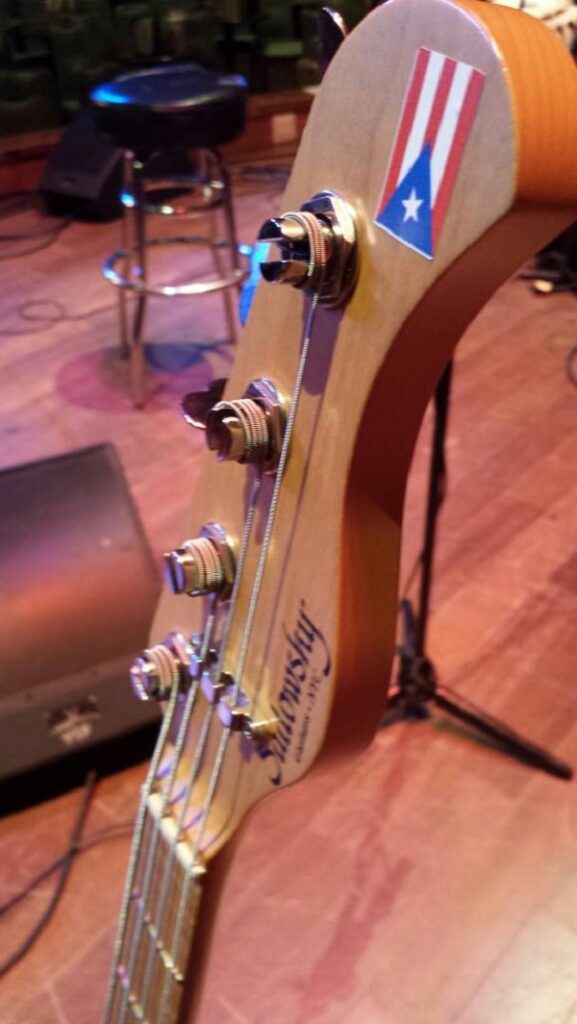
For the bassist, arranger, composer and producer – born in New York and raised in Bayamon – connections with other people are a vital element for the development of any musician.

Those connections coupled with the tenacity Cartaya has always shown to continually improve himself as a musician allowed him to be part of the legendary progressive jazz-rock group Spyro Gyra for five years, produce albums for Willie Colón or Herb Alpert, and play with a long list of stars including Jennifer López, Christina Aguilera, Rubén Blades, Héctor Lavoe, Tito Nieves, Tania María, Arturo Sandoval, Steve Winwood and Randy Brecker, among others.

To all of them he has lent the sound of his electric bass, able to insert itself with total naturalness in modern jazz, Cuban rumba, Spanish flamenco or Brazilian cadences, but without ever losing its funky essence, which gives rhythmic impulse to the musical genre before him. For Cartaya, music is not a profession, but a passion of life.

That passion manifested itself at a very early age, when he told his Cuban-born father that he wanted to be a musician when he was just 10 years old. He completed his initial studies at the Escuela Libre de Música de San Juan, which he remembers with pride and affection.

Oskar Cartaya
Oskar Cartaya

However, he has affirmed that his first real musical school were the records of Willie Colón and Héctor Lavoe, which he listened to at full volume in his room.

At the Escuela Libre de Música he was able to meet teachers and classmates who today are great masters of Latin music and colleagues of his, such as Humberto Ramírez himself. He also studied at the Conservatorio de Música de Puerto Rico.

Cartaya recalls that, although he studied chamber music in school, his real passion was Latin music…until he discovered jazz, thanks to an album by the great bassist Stanley Clarke. A new world opened up to his ears.

“I found a freedom in jazz that I didn’t find in Latin styles,” the musician said in an interview. “In salsa, for example, the maximum is when you are playing as part of a unit. Unlike jazz, whose pinnacle is when all the musicians improvise and go crazy playing, but everyone knows what they are doing.”

At 18, Cartaya moved to Los Angeles, where he began studying at the Musicians Institute of Technology. There he practiced for 15 hours a day, a devotion that brought him his first recognition: being accepted as a professor at the prestigious institution, two years after graduating from it.

However, his restless spirit and continuous desire to improve led him to make what he has described as the best decision of his life, moving to New York City. In the Big Apple – the place many consider the jazz capital of the world – he had the privilege of playing and recording with the late Argentine pianist Jorge Dalto; with Willie Colón and Rubén Blades; Celia Cruz, Tito Puente and Dave Valentín.

“I learned a lot, matured and saw firsthand what it was like to be on my own,” the bassist said in an interview about this period of his life. “If the opportunity was going to be given to me, it wasn’t going to come to my house. I would have to look for it.” And so he did.

At that time he also had the opportunity to meet the late rock icon Prince, at his Paisley Park, Minneapolis studios, and to become a member of Spyro Gyra. By being accepted into that group over 10 other bass players auditioning for the position, Cartaya realized that success belongs to those who work hard and have faith in themselves.

“I was able to show a lot of people that there’s nothing worse than feeling bad about yourself if you don’t try,” he said in an interview. “All the nights I played for free or for five bucks to earn a chance were well worth it.”

In 1997, the bassist produced the “Passion Dance” recording project for veteran trumpeter Herb Alpert, an experience he has described as a new learning experience in his career, as well as a chance to expose himself to a wider audience.

“My Music, My Friends, My Time,” released in 2004, is a fusion of Latin, Brazilian, American and Flamenco rhythms that was very well received by critics.

“My Music, My Friends, My Time”

“I wanted to do a project that would fill that gap that exists between Latin music and the world. I truly believe that the world needs to know that Latin musicians can do countless things within music, without throwing away their roots,” Cartaya said of the recording.

“Lifetime Friends,” produced alongside Ramirez, was described upon its release in 2015 as “an album of a cohesive and jubilant band,” in which all participating musicians – representatives of the new jazz generation in Puerto Rico – have a chance to stand out. “It’s the album we always wanted to make… to describe almost 40 years of friendship,” Cartaya and Ramírez indicated.

Cartaya
Cartaya

In 2017, Oskar presented the production “Bajo mundo” in tribute to the great Cuban bassist Israel “Cachao” López. This intense, exuberant album, with a multiplicity of rhythms, colors and guest musicians was distinguished as one of the most outstanding productions of the year by the National Foundation for Popular Culture.

It also won a Latin Grammy Award nomination in the category of Best Latin Jazz Album.

Source: Rafae Vega Curry

National Foundation for Popular Culture

“This biography is part of the archives of the National Foundation for Popular Culture. In our interest to disseminate knowledge about our great figures, it may be cited as a basis for research studies or as an assignment for pedagogical purposes, as long as credit is given to the Foundation and its author, if indicated. All rights reserved. The reproduction of the same in any printed, technical or mass media, with or without commercial purposes, is not authorized without prior written request to the Foundation and its consequent approval”.

Also Read: “The Sun of Latin Music” the first Grammy Award for Salsa Eddie Palmieri’s historic album

  • « Go to Previous Page
  • Page 1
  • Page 2
  • Page 3
  • Page 4
  • Interim pages omitted …
  • Page 146
  • Go to Next Page »

International Salsa Magazine (ISM) is a monthly publication covering salsa activities around the world and has been publishing since 2007. It is a worldwide network of volunteers coordinated by ISM Magazine. Together, we work to strengthen salsa events around the world.