• Skip to primary navigation
  • Skip to main content

International Salsa Magazine

  • HOME
  • Previous editions
    • 2026
      • ISM / April 2026
      • ISM / March 2026
      • ISM / February 2026
      • ISM / January 2026
    • 2025
      • ISM / December 2025
      • ISM / November 2025
      • ISM / October 2025
      • ISM / September 2025
      • ISM / August 2025
      • ISM / July 2025
      • ISM / June 2025
      • ISM / May2025
      • ISM / April 2025
      • ISM / March 2025
      • ISM / February 2025
      • ISM / January 2025
    • 2024
      • ISM / December 2024
      • ISM / November 2024
      • ISM / October 2024
      • ISM / September 2024
      • ISM / August 2024
      • ISM / July 2024
      • ISM / June 2024
      • ISM / May 2024
      • ISM / April 2024
      • ISM / March 2024
      • ISM / February 2024
      • ISM / January 2024
    • 2023
      • ISM / December 2023
      • ISM / November 2023
      • ISM / October 2023
      • ISM – September 2023
      • ISM – August 2023
      • ISM July 2023
      • ISM Edition June 2023
      • ISM – May 2023
      • ISM April 2023
      • ISM March 2023
      • ISM February 2023
      • ISM January 2023
    • 2022
      • ISM December 2022
      • ISM November 2022
      • ISM October 2022
      • ISM September 2022
      • ISM August 2022
      • ISM July 2022
      • ISM June 2022
      • ISM May 2022
      • ISM February 2022
      • ISM January 2022
    • 2021
      • ISM December 2021
      • ISM November 2021
      • ISM October – 2021
      • ISM September 2021
      • ISM August 2021
      • ISM July 2021
      • ISM May 2021
      • ISM April 2021
      • ISM June 2021
      • ISM March 2021
      • ISM February 2021
      • ISM January 2021
    • 2020
      • ISM December 2020
      • ISM November 2020
      • ISM October 2020
      • ISM September 2020
      • ISM August 2020
      • ISM July 2020
      • ISM June 2020
      • ISM May 2020
      • ISM April 2020
      • ISM March 2020
      • ISM February 2020
      • ISM January 2020
    • 2019
      • ISM December 2019
      • ISM November 2019
      • ISM October 2019
      • ISM Septembre 2019
      • ISM August 2019
      • ISM July 2019
      • ISM June 2019
    • 2016
      • ISM December 2016
  • Spanish
  • Download Salsa App
    • Android
    • Apple

Search Results for: World Salsa

Leader of K’ndela Salsa Band Eric Cabanilla and all his entertainment company has to offer

We are very pleased to be able to talk to the leader of K’ndela Salsa Band, a salsa group which has been gaining ground in New Jersey despite the great competition it faces. 

Eric Cabanilla is a talented musician who, in addition to founding a successful band, has also managed to build an entertainment company with a solid team that has put its talents at the service of large audiences eager to enjoy a quality show. The artist has told us some of the most important details of his career, and we bring them here for all of you.
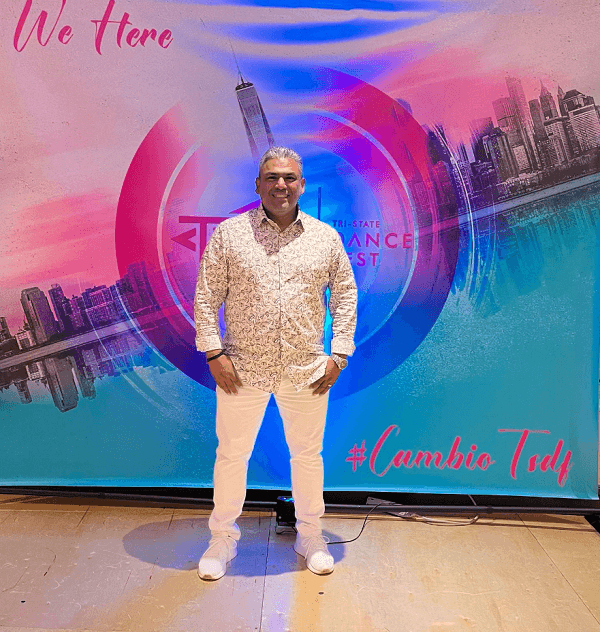
Eric Cabanilla posing for the amera
Leader of K’ndela Salsa Band Eric Cabanilla posing for the camera at an event

How Eric started to like music 

Eric started his story saying that he and his siblings listened to the music their mother played as she cleaned the house and her children helped her with household duties. Back then, there were many romantic artists and groups such as Los Iracundos and La Sonora Matancera. These melodies helped him understand his love for salsa today.

One important thing to mention is that there were no musicians in his family to teach him about the professional part of this craft, so it can be said that he was the first to make this his way of life till today. His first impulse in this regard was to start writing poems at school, and he even won some poetry contests, which awoke in him the taste for putting words together to create pleasant sounds for others.

It was his great friend and musician Mike Pérez who encouraged him to put these compositions to songs, so he took those poems and rhymes he had created and added music to them. He worked alongside Mike for about seven years singing backup for the Orquesta Swing Combo until his sudden passing, which led to the dissolution of the group. Fortunately, the musicians were not left unprotected and could get a job in a new orchestra with new sound.

During this time, he had the opportunity to learn a lot about how the music biz works, as his responsibilities included institutionalizing the orchestra and formalizing its schedule through emails, business cards, written contracts, and that sort of thing. 

Angel Peguero, Eric Cabanilla, and Stephany Moore
Dancer Angel Peguero, Eric Cabanilla, and dancer Stephany Moore

Thanks to all this acquired knowledge, once Swing Combo broke up, Eric already had an accurate idea of what to do when creating his own orchestra and how to manage it, so he jumped into action from there. 

K’ndela Salsa Band

After all the experience he had gained, Eric finally decided to build something of his own, as he felt ready to take on such a challenge.

One of the first people he counted on was maestro Jimmy Bosch, “El Trombón Criollo,” who has a 50-year career and his own orchestra, Salsa Masters. He is always traveling the world with his orchestra, but whenever he is required to play with Eric and K’ndela Salsa Band, he makes an appearance without hesitation. He describes Bosch as a very professional man, to the point that he is the first to arrive and the last to leave at any rehearsal. 

Together with Eric and Bosch, K’ndela also leverages the talent of other great musicians like bassist Edgar “Danny” Rosado, pianist Ray “El Loco” Cabrera, Xabi “El Chamo” Estrada, Eric Pizza, Brian ‘Tibiri’ Pozo, Jimmy “El Nene” Feliciano, and Daniel “El Gato” Arboleda.

This orchestra project was his first professional goal, but once he made it, he did not want to be confined to that. He also wanted to offer a complete package that offers more comprehensive entertainment than just playing and singing. That is when he took advantage of their closeness to a dance school where he sometimes performed to be in touch with dancers who wanted to join their shows.
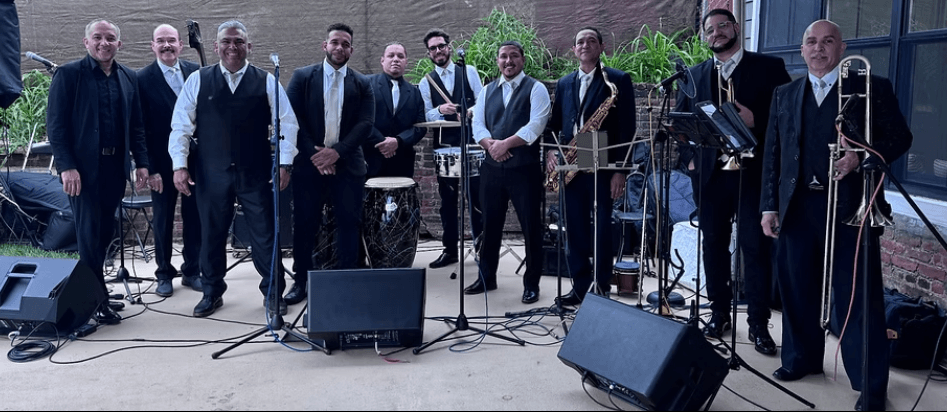
Eric and the rest of the band
From left to right Ray “El Loco” Cabrera, Danny Rosado, Eric Cabanilla, Xavi “El Chamo” Estrada, Erik Piza, Brian “Tibiri” Pozo, Jimmy “El Nene” Feliciano, Daniel “El Gato” Arboleda and Jimmy “El Trombón Criollo” Bosch

Additionally, he hired a relative who worked as a mariachi, who in turn introduced him to other artists who did the same thing so he could hire them. Over time, he also included DJs who would liven up all kinds of events with their diverse mixes.

Something Eric wanted to clear up is that all these professionals are permanent workers in his company. He has a very good relationship with many dance schools in New Jersey, to which he offers his packages, and there is always a very generous group of its dancers that accepts the proposal. Whenever Eric is involved in a festival or private event, he never has any problem finding talent in the field of dance to accompany him thanks to his reliability, professionalism, and great respect for the work of others.

Read also: The Cajón throughout history

Salsa and Casino Ecuador Festival 2017

Latinoamerica / Ecuador / Quito

“Ecuador is a country located in South America, bordered to the north by Colombia, to the south by Peru, and to the west by the Pacific Ocean. Here, we can appreciate a rich cultural and natural heritage, boasting numerous rivers of unparalleled beauty.”

“‘Hecho Salsa’ is a dance community founded on April 21, 2013. In 2015, it began operating as a dance academy, and starting March 20, 2016, it expanded as an ‘event organizer,’ organizing the 1st International Flashmob for ‘World Rueda de Casino Day,’ which took place on a single day in ‘La Carolina’ park in Quito, Ecuador. As of this year (2017), it became the official organizer of the Salsa y Casino Ecuador Festival, which was the 2nd International Giant Rueda de Casino Flashmob in Ecuador.”

Salsa and Casino Ecuador Festival 2017

“It’s worth mentioning that there was a demand from those in the world of Salsa and dance in general for a dance competition, which led to the start of the 1st Ecuador Dance Contest. This was an open dance competition in the Salsa, Bachata, and Casino categories across two divisions: couples and groups.”

“The Salsa y Casino Ecuador Festival 2017 took place on March 24, 25, and 26, 2017. Its objective and intention were to promote Salsa in general, as well as dance culture, and to strengthen the bond that unites salseros within the community.”

“This interesting event was held first and primarily at the Best Western CPlaza Hotel (located at Av. De Los Shyris N37-53 and Av. Naciones Unidas) and secondarily at the same location where the event took place last year (the aerobics track in ‘La Carolina’ park).”

“We will soon be providing more details about the now-concluded event.”

For more information:

  • Website: www.festivalsalsaycasino.com
  • Facebook: festivalsalsaycasino
  • Instagram: hechosalsa
  • Twitter: hechosalsa
  • YouTube: https://www.youtube.com/channel/UC2x76mai4gCfa7QoYiF979A

Creator of Salsa Vida Takeshi Young graced us with his presence in International Salsa Magazine

In International Salsa Magazine, we have always tried to cover all types of Latin music artists, including producers, arrangers, composers, singers, musicians, dancers, and club owners. However, it is also important to talk to other platforms that promote Latin music as we do, so we contacted the creator of the website Salsa Vida, Takeshi Young, to learn a little more about this online media site and everything it has to offer the public.

Takeshi with a painting
Takeshi Young with a painting of Hector Lavoe

Takeshi’s relationship with Latin music

In view of the trouble digital marketing specialist, dance teacher, and competitor Takeshi Young went to create a site like Salsa Vida, we obviously had to ask what relationship he had with Latin music. He replied that he loves to dance and has been doing so for about 19 years. His attendance at various salsa events led him to create a calendar for the San Francisco Bay Area, where he currently resides.

The acceptance he had led him to include much more content like articles, events, guides, and much more. The main goal was to show salsa lovers all the places they could go to enjoy this genre, but over time, Salsa Vida was turning into a sort of online newspaper that provided information on many other things related to the same topic, especially dance academies. For its operation, it uses tools like WordPress, iTools, and Chat GPT as an information bank to his writings, most of which are of his authorship.

He used the name “Salsa Vida” because of the lifestyle that he associated with salsa, which he considered to be unifying, nourishing, and joyful.

Greatest challenges in creating Salsa Vida

One of the most annoying parts about creating Salsa Vida was the calendar, as Takeshi always had to keep an eye on updates, date changes, and event cancellations. Fortunately, he always received information from many of the organizers, who told him when there were any changes in their schedules.

Takeshi at the San Francisco SBK Congress
Takeshi Young dancing with the San Jose State Salsa Team at the San Francisco SBK Congress

Salsa Vida’s most important goal today

Takeshi pointed out that, at present, Salsa Vida’s most important goal is to teach and promote salsa around the world, which has led him to write all kinds of articles in which he seeks to educate his community on all kinds of topics related to Latin music, such as “what is pachanga” or “what is cha cha chá.” With this, he wants those interested in learning about dancing or knowing more about this rich world to have a starting point from the theoretical part.

In addition to that, the website still maintains the calendar to help salsa lovers find events related to their passion near their homes. 

Contacts obtained to date

Takeshi claims to have so many contacts with a lot of bands, especially in the Bay Area, which has helped him keep on growing his website. However, the people he interacts with most in this environment are dancers and instructors who give him a lot of information about their work with their academies and students.

Moreover, his work has also helped him gain invites and press passes to all kinds of events and concerts in both San Francisco and the rest of California, allowing him to cover them and bring the latest updates to his loyal readers.

Takeshi and Alyssa
Takeshi Young and dancer Alyssa Aguilar

Goals with Salsa Vida for the coming months

As for Takeshi and Salsa Vida’s goals for the coming months, the creative young man keeps searching for and publishing events from around the world for his readers to see, as well as highlighting the importance of expanding and publishing even more countries in his calendar so that many more salsa fans from other latitudes can use Salsa Vida to find what they want.

Today, the Salsa Vida calendar has events in about 80 countries, but Takeshi says it is not enough and wants to expand much more to other locations. He also wants to add more languages to make visitors to his page feel more comfortable, and new sections such as “Dancepedia” that would come to be a kind of Wikipedia, but focused on dance.

And if that were not enough, he wants to design an app through which those interested can use the same functions of the site in a much more comfortable and interactive way from any mobile device.

Takeshi’s other occupations

As well as handling Salsa Vida, Takeshi is also a digital marketing specialist and teaches salsa at San Jose State University twice a week.

Importantly, he has a BA in philosophy and a BS in software engineering, both from the aforementioned university. During those years, he was also a member of his class’s salsa and mambo clubs. 

Read also: Haitian bandleader and musician Mac Gregore Brunis fulfills his dream in Montreal

Palladium Voyage 2017 International Salsa Festival Bremen

Europe  / Germany / Bremen

Palladium Voyage 2017 International Salsa Festival Bremen – Germany April 7th – 9th

Palladium Voyage 2017 International Salsa Festival Bremen

We invite you to be part of 2 nights of dancing, incredible performers & high quality workshops that will make you more comfortable on the dance floor at Bremen’s longest running Salsa Festival, The 8. Annual Palladium Voyage International Salsa Festival.

The City Hall and St. Petri Cathedral in the Market Square in Bremen Photo: https://www.hotel-hanseatic-bremen.de/en/index.html

The City Hall and St. Petri Cathedral in the Market Square in Bremen

Don’t miss it, because “quality never goes out of style”! This experience is truly one of a kind!

  • International & World Champions performers and teachers!
  • Home of the European Latin Dance Grand Prix!
  • Last year more than 50 confirmed performers/teachers & DJs representing over 17 countries, be excited for this year’s final line up!
  • 27 years of Salsa expertise from his founder & Artistic Director: Gallo Suarez. Him & his team have invited quality performers from around the Globe for great performances, history & dance instruction.
  • 2 very special nights of parties, dancing, learning, drinking, eating & making new friends!
  • Location in the heart of Bremen Friday, Saturday & Sunday: Schaulust Beim Handelsmuseum 9, Güterbahnhof Tor 48, 28195 Bremen.
  • The world’s very first Festival event honoring & celebrating Mambo & Salsa dancing origins… The Palladium Ballroom established in 1948!
  • Bremen Germany’s oldest & world wide recognized Annual Salsa Festival!
  • It is still an intimate event: meet, dance & learn from world champions & world class Salsa talent!
  • A showcase of Germany’s very best Salsa dance schools!
  • Our airport & main train station is only minutes away from our venues.

If you would like to participate at the European Latin Dance Grand Prix, please find all details here: http://eldgp.com

More Information:

  • http://www.palladium-voyage.com/
  • https://www.facebook.com/events/183058339179542/
  • https://www.facebook.com/lasandunguerabremensalsa/l


The Williamsburg Salsa Orchestra: electrifying fusion and salsa flavored with indie rock

The Williamsburg Salsa Orchestra is an 11-member musical group that, as the name suggests, uses salsa as its foundation but also mixes it with other genres such as funk and indie rock to make its music distinct. This combination of beats has led the orchestra to be internationally recognized for its explosive arrangements, modern touches, and repertoire inspired by Anglo-Saxon artists.

Today we are here with arranger and percussionist Gianni Mano (founder) and Argentine singer Solange Prat (vocalist) to find out about their beginnings, the current situation of the orchestra, their roles in the project, and much more. 

Solange Prat and Gianni Mano
Argentine singer Solange Prat and American bandleader Gianni Mano

Gianni and Solange’s musical awakening

Gianni began his first address by sharing that his family had some musicians back several generations, but his own interest in music aroused in his childhood. It was then that his parents enrolled him in piano lessons, but his taste for Afro-Cuban and Afro-Caribbean music settled in when he was a teenager, recently moved to Miami to attend college.

In the late 1980s, he got a job at a nightclub, where he discovered hits from great artists who would inspire him in the future, such as Cuban musician and percussionist Carlos “Patato” Valdés. When he listened to the artist, Gianni could hardly credit how wonderful and different it was what captivated his ears.

By the time, the young man was studying percussion focused mainly on classical music, but the impact of those rhythms he had heard was such that he wanted to know much more about them. This led him to move to New York and hire private teachers to know more about salsa, Afro-Cuban, and Nuyorican music, because when heard them, he discovered that this was what he wanted to dedicate himself on an artistic level. He assured us that it is always best to learn music directly from those who play it, so it was the best decision he could take.

The musician assured us that, at that moment, he could not believe the world he was missing, but when he found it, he did not let it slide.

At this point, Solange joined us and said her interest in music began in her native Argentina, where her parents always listened to Gloria Estefan, Juan Luis Guerra, and other artists of this type. On her mother’s side of the family, some relatives played the guitar and a lot of Argentine folk music such as sambas and chacareras, so she had a lot of contact with that music and eventually started singing at a very young age.

Gianni playing live
Gianni Mano playing live at Brooklyn Bowl

Since the girl used to sing all the time, her mother enrolled her in singing lessons until she got her first opportunity in a band at the age of 15. Added to that she spent about six months on a cruise in the Caribbean, and when she came back, she wanted to continue training on an artistic level, but with a focus on the music she had been listening to during her trip. 

Sometime later, she went to visit a friend in New York, and it was there that she met Gianni, who asked her to join The Williamsburg Salsa Orchestra, which was already founded. It was something very new for her, as she had never sung salsa before, but she accepted the challenge anyway, and Gianni served as a mentor for her at all times.

Gianni as an arranger

As for his role as an arranger, Gianni told us that, when he left his previous job to devote himself entirely to music, he spent oceans of time transcribing arrangements of other artists’ songs to see how they worked. He remembers that the first song with which he tried this was one by Tito Puente, but then he did the same thing with hundreds more.

For a long time, he listened to all these pieces hundreds of times to understand the form of a salsa-based song and how it needs to be structured for the enjoyment of the dancer on the dance floor. That is how he began to write his own arrangements, although acknowledging that they were not all that good at first, so he had to practice a lot.

His coexistence with groups of different genres and practice with various types of instruments helped him greatly to master this area in all styles.

Solange Prat singing
Solange Prat singing at the Sofar Sounds New York

The Williamsburg Salsa Orchestra

In 2009, Gianni was making some demos and garnered rave reviews, so he felt ready to start his own musical project, but obviously he could not do everything alone. He began to place ads in online newspapers to recruit artists to join his band, although there was a subject which worried him: language. He told us that he was looking for musicians who mastered both English and Spanish, and in that sense, Solange pleasantly surprised him with her singing ability in both languages. 

The orchestra’s first show was in 2010, which let it to gaining some popularity in the public of the city.

From Solange’s point of view, she describes her arrival in the orchestra as an unexpected event for her career, since in Argentina she had experienced a lot with soul, R&B, and funk. However, this would change with her move to New York, which is when she met Gianni and discovered a whole new world for her until then, but she loved it a lot.

So, she did his best to learn everything she could about this new music and keep up with required level. Gianni played a big role in this, as he taught her how to play certain instruments and gave him CDs from some of the great salsa legends to take them as a guide. 

She closed the subject by saying that moving to New York, meeting these musicians, and becoming part of this new music scene was great and inspiring.

Gianni, Solange, and the rest of the orchestra
From left to right: Angela Ortiz (piano), Rafael Gomez (bass), Jhohan Hernandez (congas), Felipe Fornier (bongo). Solange Prat (voice), Gianni Mano (Percussion), Alex Asher (trombone), John Challoner (trumpet), Jason Prover (trumpet), and Dimitri Modebacher (baritone sax)

How to maintain an 11-piece orchestra alive

Currently, the Williamsburg Salsa Orchestra has 11 members in total. At a time when bands and musical groups are getting smaller and smaller, we wanted to know what Gianni and his artists do to stay together in an environment that pushes them in the opposite direction. 

The percussionist says that one of his greatest dreams was to have a large salsa orchestra, and he has succeeded, but he admits that things were simpler before COVID-19. After that, far fewer people attended salsa dances or were willing to pay for such an event. Still, they have done everything humanly possible to keep the group together, since in the words of Gianni, an orchestra composed of six or seven people does not sound as good or as complete as one with nine or more musicians.

However, he does not deny that they have had some issues with certain venues due to the orchestra’s size, such as small stages or low ability to pay everyone, but in general, club owners and promoters just want a good show and for people to enjoy it. For this reason, they make an effort to hire bands like the Williamsburg Salsa Orchestra because they know what they have to offer.

Read also: Ania Bartelmus from La Candela Flamenco talks about her performance at the Hispanic Heritage Celebration

  • « Go to Previous Page
  • Page 1
  • Interim pages omitted …
  • Page 4
  • Page 5
  • Page 6
  • Page 7
  • Page 8
  • Interim pages omitted …
  • Page 189
  • Go to Next Page »

International Salsa Magazine (ISM) is a monthly publication about Salsa activities around the world, that has been publishing since 2007. It is a world network of volunteers coordinated by ISM Magazine. We are working to strengthen all the events by working together.