• Skip to primary navigation
  • Skip to main content

International Salsa Magazine

  • HOME
  • Previous editions
    • 2026
      • ISM / March 2026
      • ISM / February 2026
      • ISM / January 2026
    • 2025
      • ISM / December 2025
      • ISM / November 2025
      • ISM / October 2025
      • ISM / September 2025
      • ISM / August 2025
      • ISM / July 2025
      • ISM / June 2025
      • ISM / May2025
      • ISM / April 2025
      • ISM / March 2025
      • ISM / February 2025
      • ISM / January 2025
    • 2024
      • ISM / December 2024
      • ISM / November 2024
      • ISM / October 2024
      • ISM / September 2024
      • ISM / August 2024
      • ISM / July 2024
      • ISM / June 2024
      • ISM / May 2024
      • ISM / April 2024
      • ISM / March 2024
      • ISM / February 2024
      • ISM / January 2024
    • 2023
      • ISM / December 2023
      • ISM / November 2023
      • ISM / October 2023
      • ISM – September 2023
      • ISM – August 2023
      • ISM July 2023
      • ISM Edition June 2023
      • ISM – May 2023
      • ISM April 2023
      • ISM March 2023
      • ISM February 2023
      • ISM January 2023
    • 2022
      • ISM December 2022
      • ISM November 2022
      • ISM October 2022
      • ISM September 2022
      • ISM August 2022
      • ISM July 2022
      • ISM June 2022
      • ISM May 2022
      • ISM February 2022
      • ISM January 2022
    • 2021
      • ISM December 2021
      • ISM November 2021
      • ISM October – 2021
      • ISM September 2021
      • ISM August 2021
      • ISM July 2021
      • ISM May 2021
      • ISM April 2021
      • ISM June 2021
      • ISM March 2021
      • ISM February 2021
      • ISM January 2021
    • 2020
      • ISM December 2020
      • ISM November 2020
      • ISM October 2020
      • ISM September 2020
      • ISM August 2020
      • ISM July 2020
      • ISM June 2020
      • ISM May 2020
      • ISM April 2020
      • ISM March 2020
      • ISM February 2020
      • ISM January 2020
    • 2019
      • ISM December 2019
      • ISM November 2019
      • ISM October 2019
      • ISM Septembre 2019
      • ISM August 2019
      • ISM July 2019
      • ISM June 2019
  • Spanish
  • Download Salsa App
    • Android
    • Apple

Search Results for: salsa in venezuela

José Hildemaro Hugas Amarista “El Sonero del Amor” from Venezuela to the world

José Hildemaro Hugas Amarista, better known artistically as “Hildemaro, El Sonero Del Amor”, was born on November 10, 1957 in Caripito, a city in the eastern Venezuelan state of Monagas.

He is a Venezuelan singer-songwriter whose interest in music began at a very young age, participating in various children’s programs on the radio station in his hometown and in Maturin, the capital of the state of Monagas.

In 1970 he won the first “Festival De La Canción Inédita” held in Caripito.

Then he moved to Carúpano, where he began to sing with different musical groups of that city, such as “Los Bravos” and “Soles De Media Noche”.

"El Sonero del Amor" from Venezuela
“El Sonero del Amor” from Venezuela

Later he was called by the “Combo Melorítmico” of Maturín, where he stayed for a year. He always wanted to sing in the capital.

In 1976 his dream came true when he was called to be a part of the Front Train Orchestra “Los Satélites”, for seven (7) months, the proposed goals began to be different and began to work to achieve them. In 1979 he joined the “Orquesta Ideal”, with which the song “Contigo Besos Salvajes” was played all over the country and was successively imposed among the first places.

In 1981 he joined the “Supercombo Los Tropicales” of Maracaibo, then the “Noche Caliente” orchestra and later the “Porfi Jimenez” orchestra.

In 1985 he joined the orchestra of Renato Capriles: “Los Melódicos”, which gave him the greatest and best experience, given the popularity, prestige and discipline imposed by its director.

In 1986, as a soloist, he recorded his first LP of tropical music under the name “El Jr. de la música tropical” for the record label “Sur Americana del Disco”, , with the name “El Jr. de la música tropical.”

In December 1987 he received a wonderful offer from the record label “Top Hit (T.H.. ) and in 1988 he records his first LP, as a “sensual salsero” for Venezuela, titled “Amanecí Contigo” under the pen of José “El Flaco” Bermúdez, who is also the creator of the style that pushes him towards the international market, where all his songs hit with great acceptance and have his greatest impact in Peru (his second home as he usually calls it), starting his successful career as “Hildemaro, El Sonero Del Amor”.
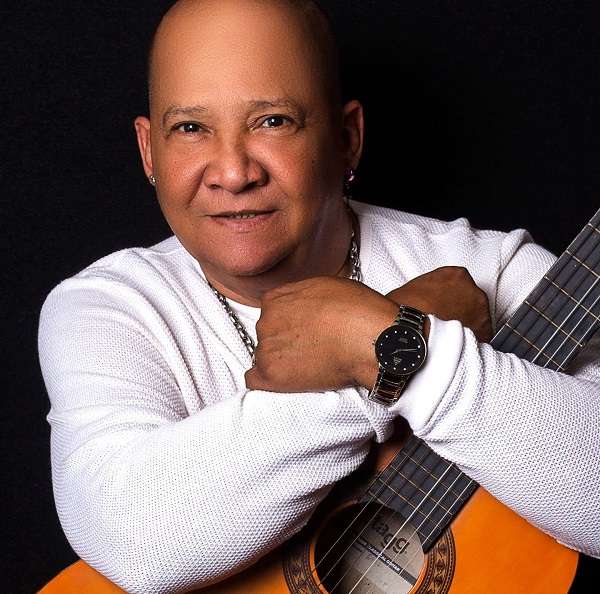
José Hildemaro Hugas Amarista "El Sonero del Amor" from Venezuela to the World
José Hildemaro Hugas Amarista “El Sonero del Amor” from Venezuela to the World

In 1989 he recorded his second LP entitled “Sin Tabú”, which went gold a few weeks after its release, and this album took him back to Peru, where he is considered one of the main idols of Salsa Sensual. Panama, Mexico, Colombia, Ecuador, Argentina, Chile, Dominican Republic, Puerto Rico, Costa Rica, United States, Europe (Spain, Italy, France, Holland, Switzerland, among others), Asia (Japan), among many other countries, have joined his successful career.

In 1990 he recorded his third album called “Romantic and Sensual”, consolidating himself as one of the best voices of Latin American and Caribbean Salsa, qualities that were also reflected in his fourth production entitled “Lo Mejor De Mí” in 1991.

In 1993 he recorded his fifth album under the name “Al Natural”.

In 1994 he was invited to participate in the recording of the album “Con Ganas” by the Cuban Issac Delgado, where he performed a duet of a song composed by José L. Cortes called “Que Pasa Loco”, which quickly became an international success and took him to other latitudes.

In 1995 he released his sixth production with the title “Lo Que Siento”. One year later he signed a contract with the Mexican label “Balboa Records”, where he recorded the album “La Mejor Salsa Con Hildemaro”.

"El Sonero del Amor" from Venezuela and Viti Ruiz
“El Sonero del Amor” from Venezuela and Viti Ruiz

In 1999, he was invited by the Venezuelan group “Melody Gaita”, along with other artists, to record a tribute song to his friend and colleague Oscar D’ León.

In 2001, “Orquesta La Constelación” decided to record an album with several artists, in which he participated with two (2) songs (Peruvian waltzes), “Cuando Llora Mi Guitarra”, in duet with Andy Montañez, and “Jamás Impedirás”, which allowed him to sound nationally and internationally.

In 2002, he is called by another Venezuelan group “Pajarito Vola Show”, along with other artists, this time to participate in a well-deserved tribute to Betulio Medina. In 2002 and 2003 he burst in the national and international radio stations with two (2) singles “Corazón Loco” and “El Celular”.

In 2016, he begins to sound again in the radio stations with the song “Que Voy a Hacer Sin su Amor”.

In addition to his talent to sing Salsa Romántica, he is recognized for his interpretation of the Bolero. And on stage he has shared the stage with artists of the stature of: Oscar De León, Tito Rojas, Tito Gómez, Paquito Guzmán, Andy Montañez, Maelo Ruiz, Viti Ruiz, Gilberto Santa Rosa, David Pavón, Ismael Miranda, El Gran Combo de Puerto Rico, Tony Vega, Nino Segarra, José Alberto “El Canario”, among many others.

"El Sonero del Amor" from Venezuela and El Canario
“El Sonero del Amor” from Venezuela and El Canario

Among his many facets is his love for sports, especially volleyball, which he has practiced since he was very young. He is an honorary member of the FUCUFOCA Foundation, which has been responsible for the organization of the Festival de la Canción Inédita de Caripito for fifty-one (51) years. Faithful collaborator of the Friends of Palencia Foundation and sponsor of several institutions.

Through his foundation HH Productions, he has carried out social actions such as Collaboration in the construction of the Virgen del Rosario Church in Caripito;

Donations of medicines and food to the needy, assistance to sports teams with equipment and clothing, organization of charity concerts and support of the “Amigos de la Palencia” Foundation.

Through his foundation HH Productions, he has carried out social actions such as Collaboration in the construction of the church “Virgen del Rosario” in Caripito;

Donations of medicine and food to people in need, help to sports teams with equipment and clothing; Realization of benefit concerts and concerts of popular attraction in collaboration with the end of year festivities of his hometown.

He has always given value to new talents, helping them in their first steps with his advice and teachings, such as Angel “Tu Angel”, Hildemaro Jr. “La Continuación”, Gilberto Hugas, among others.

Between the years 2022 and 2023 he will celebrate his forty (40) uninterrupted years of artistic life, with a long international tour in countries such as: Colombia, Bolivia,

Peru, Panama, United States, Canada and Europe. He is now promoting the songs “Si Tú Te Vas” and “Amigos Especiales” from his new production, which he is preparing with his inseparable director and producer, José “El Flaco” Bermúdez.


Also Read: Carlos “Nene” Quintero comes from a family of musical prodigies

John Narváez and Elizabeth Rojas from Salsamania

John and Liz from Salsamania  

Between days 23 and 25 March, 2023, the San Francisco Salsa Festival took place, which brought together some of the cream of The Bay Area Latin music scene. One of those attending this great event was the main editor of International Salsa Magazine, Mr. Eduardo Guilarte.   

On site, he had the opportunity to share with other guests and some of the organizers such as Elizabeth Rojas, affectionately known as Liz, and John Narváez. We had the chance to talk with both dance professionals to know more about their beginnings, festivals and projects. Do not miss it!  

John and Elizabeth
Colombian dancers John Narváez and Elizabeth Rojas

Beginnings   

After several attempts to schedule a meeting with John and Liz, we finally managed to talk with these Colombian dancers and entrepreneurs, who began by thanking us for the contact and the opportunity to promote their passion for salsa and the community they represent.   

This love they have for the aforementioned musical genre has much to do with their roots. Both were born in Colombia and left the country when they were 12 years old (they are the same age) because of the violent situation caused by the guerrilla that existed in those years.   

Although those were hard times, John says these were very nice years from which he has fond memories. He remembers almost all his family members singing or playing an instrument, while he was the only dancer. All this influenced him in such a way that Latin music remains his north after so many years.  

Moving to the United States 

Since the social situation did not allow them to live in their country, they decided to move to the United States and apply for political asylum. At the beginning, it was not easy and the focus was on working hard to get ahead in this new country and to learn English. However, all that changed over time. 

With the arrival of economic and family stability, priorities changed. John comments that his interest in music and dance perked back up due to the family gatherings that his relatives celebrated such as birthdays, quinceañeras, weddings, among others. 

Although at the time dancing was not considered a serious profession, both John and Liz began to practice it at amateur level. Once they turned 21, they started going to the most popular salsa clubs, but it was all for recreational purposes. It was years later before they began to analyze all the technical and historical part of dancing to understand it better and take it more seriously.  

John, Liz, and Barbara
John and Liz with Barbara on Despierta América

Dancing as a profession 

John and Liz started to take dancing seriously in 1999. They both attended a three-day salsa event in Los Angeles, but what they did not know is that this was the first world salsa congress in America.   

This gave them the opportunity to share with the best salsa dancers in the world and they saw such impressive things that they were inspired to return next year with a well-established dance team with which they could participate fully in these activities. 

Being full of motivation, they decided to create Salsamania Dance Company and performed with their team at the festival. They started doing the same thing every year, which helped them gain experience and evolve their styles. 

After earning the trust of the festival organizers thanks to their talent and professionalism, they were given the opportunity to start teaching salsa workshops at the aforementioned congress. This is how little by little John and Liz began to build the reputation and credibility they have today.   

 In 2004, it got to a point where John took the important decision to quit his job to devote himself to dancing and Liz was quick to do the same. His resignation came with the opportunity to take a three-month trip to Hong Kong to teach salsa in a community where people did not dance it. 

They managed to build a community from nothing, since at that time, Hong Kong was not a place where people listened to salsa. However, everything went well and the dancers managed to seamlessly connect with the local audience. As John rightly said, ”salsa is a universal language and you don’t have to speak that language to feel the music”. 

On returning to the Bay Area, they began to practice dancing as a profession in the United States. 

On this point, Liz commented that her parents became very upset with her when she quit her job because of dancing, but today, they admit that it was the right decision and support her totally.  

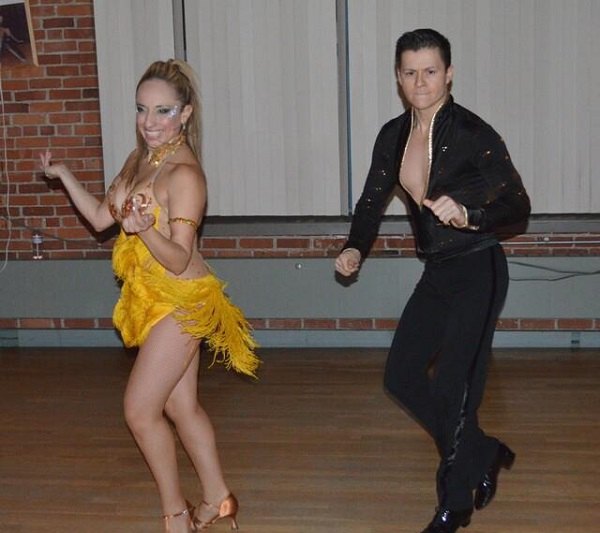
Liz and John dancing
Liz and John during a social dance in Boston

Salsamania Dance Company 

Liz told us that it was difficult to create Salsamania Dance Company because it requires a lot of discipline and healthy coexistance between different types of personalities to create a group like this and keep it together. Fortunately, John is an industrial psychologist, so he helped to prevent these aspects to be a problem. 

Basically, Liz is responsible for the company’s management and John is the one who takes care of the human part of all the staff. 

They started the whole process like any regular company and drew up the contracts for all those who were going to work with them, making Salsamania a much more established, structured and serious project in the eyes of everyone else. Today, it is one of the largest companies in the Bay Area.   

They also took it a step further and built a salsa academic program with a thoroughness and detail that has not been seen in other projects of this kind.   

San Francisco Salsa Festival  

San Francisco Salsa Festival is one of the biggest salsa events in California and the United States in general and we were fortunate to have representation there with our editor Eduardo Guilarte.  

It began to be celebrated in 2008 with the support of international salsa promoter Albert Torres, who was a fundamental piece in the development of the festival and talent recruitment for an event of this size, as there were many things John and Liz had to learn. That is why they are both incredibly grateful for what the congress organizer did for them back then.  

To recruit artists, the dancers only require candidates to be good teachers, to share with the salsa community and to put on a good show for the audience. 

They also often invite colleagues they have known for years and some recommended to whom they give them the opportunity to shine and make themselves known during those days. 

Every year, they look for dancers, dance instructors, DJs and live orchestras. For Liz and John, the thing about live bands is very important, as they are concerned that there are so many clubs and venues that no longer hire these talents. This year, they focused on local bands that play on Thursdays and Fridays in San Francisco and were very happy with the results.  

It is expected that the next San Francisco Salsa Festival is scheduled between days 22 and 24 March, 2024 at the same venue, which is the Marriott Waterfront Hotel.   

The orchestras hired to perform for next year are Cabanijazz, The Latin Rhythm Boys and Orquesta Boyacán. The dancing couples are Alex and Judy from Colombia, Colombians Felipe from Colombia and Kathe and Mauricio and Danny from Mexico.   

John, Liz, and Oscar D’ León
John and Liz with Venezuelan singer Oscar D’ León

Difficulties in the pandemic 

As dancing is an activity with a lot of physical contact and closeness, we were curious to know how they lived the pandemic and what they did to keep their project afloat in this situation. 

Though they admit that those months were not easy, they have always been very disciplined with their money and had enough to resist as long as possible without working.   

They tried to make up for lost time by teaching classes via Zoom as did most of their colleagues and designing new choreographies to apply when they went back to their usual activities. 

In addition to this, both had not spent time with their respective families in a long time, so they also took advantage of the absence of work to reunite with their loved ones and take up those important contacts that were lost due to stress and routine. 

Read also: Here we have Salseros With Attitude 

Venezuela Directory 2023

Cerro del Avila
Cerro Avila Sala Show
Av. Urdaneta, con Av Fuerzas Armadas, Caracas, Venezuela

El Marchante
El Marchante
Av. Alameda, San Bernardino, Caracas, Venezuela
+58 424-1890654

Latinos
Latino’s Disco & Pool
C.C. Chacaito, Nivel Sotano Local 9 y 10 – Chacao, Caracas, Venezuela
+58 212-9535083

Bahia Caribe
Bar Bahía Caribe
Av ventuari. Edificio Tosca. Valle Abajo, Caracas 1041, Venezuela
+58 424-2823693

Juan Sabastian bar
Camaleón Gastro Bar
Torre América, Avenida Venezuela, PB 1050 Caracas, Capital District, Venezuela
+58-0412-9981264

Camaleon
Camaleón Gastro Bar
Torre América, Avenida Venezuela, PB 1050 Caracas, Capital District, Venezuela
+58-0412-9981264

Cito Bar Live
Citobar Restaurant
Avenida José Casanova Godoy, Maracay 2101, Aragua, Venezuela
+58 243-2326441


The decade in which Eddie Palmieri faced the Erotic or Romantic Salsa

There are leaders in all the activities that man develops in his daily life: Sports, Labor, Student, Political, Musical, even in comic strips you can see these leaders all the time, showing the way to follow and saving humanity from its natural dangers.

El Zorro with his friend Bernardo, his father Alejandro and even with Sergeant Garcia and Corporal Reyes, saved California from the clutches of El Aguila, marking the way forward for the peace and freedom of his people.

In salsa, the same thing happens; there are musicians who set themselves up as leaders who dictate the path, the routes, the itinerary and the route where salsa should go, establishing through their musical performances where others should be guided on their way to certain triumph.

For salseros in general, Eddie Palmieri represents El Zorro of the comics, the leader to follow, the paladin of salsa, only that instead of looking like Diego de la Vega in physique, he looks more like Sergeant Garcia; backed by Ismael Quintana who would be El Cabo Reyes and Barry Rogers who would be Alejandro de la Vega.

Eddie Palmieri y Dj. Augusto Felibertt

It is no secret that Eduardo Palmieri is one of the initiators of the salsa movement in New York; but more than that, this master of the piano has established the paths along which salsa has walked since the 1960s.

Eddie was one of the first musicians to use the trombone as a determining instrument in the conformation of an orchestra, giving it a preponderance never seen before and with a sharp and hurtful sound that forced a large number of musicians to follow this type of orchestration that ended up imposing itself in the so-called salsa boom.

La Perfecta determined the path to follow; they recorded anthological albums in the 60’s that were the delirium of the salsa movement lovers; many musicians began to see and hear how the tonality of this orchestra sounded different from those big bands of the 50’s; the people of the neighborhood immediately identified with this sound because, they thought, it sounded like a neighborhood, a slum, poverty, marginality, inequality, it sounded like spite, nonconformity, injustice; in short, with this sound they perceived the most expensive needs of a population marginalized from the great plans of the State that entailed advancement and progress.

The decade of the 70’s meant the explosion of a salsa boom that swept the entire Caribbean basin; orchestras came and went; they came and disappeared; they recorded and were immediately lost in anonymity, but most of these orchestras chose the musical patterns of a common denominator to carry out their musical proposals: A Crazy, Bearded and Barrigón Orate named Eddie Palmieri, as the Colombian writer José Arteaga called him.

Eddie, throughout this decade, was practically on the sidelines of the salsa boom and it could not be otherwise: Too much irreverence from a superior musician who, being clear where salsa should walk, refused to be part of all the outrages that were committed during that salsa explosion.

Too much rebelliousness from an artist who refused to be told what he should and had to record: “Nobody tells me what I have to record and how I have to record; I’m the one who knows how to make music, the label bosses can go to hell with their desks”, an angry Palmieri would say.

The record label Epic signed him in 1978, telling him that he had complete freedom to record the music he wanted: a lie. He recorded the Lp Lucumi, Macumba and Vodoo where he was practically forced to work on an album where rhythms and trends were mixed.

He took advantage of the only freedom he was given to record two legendary songs: Colombia Te Canto and Mi Congo Te Llama.

Bad management and ill-advised decisions put an end to the whole salsa movement that was born in the 70’s and the unthinkable happened for all the lovers of this tasty way of life: the whole musical scaffolding that represented the Fania label collapsed, leaving everyone with clear eyes and without sight.

Clouds of disbelief and uncertainty hung over the entire salsa movement, musicians, producers, artist managers, arrangers, record label owners and, those who were most hurt by all this, the lovers of this superb spectrum of hard and powerful salsa that was experienced in the 70s.

In the 80’s, faced with this dilemma and the perplexity of the moment, most of the orchestras took refuge in the so-called Salsa Erotica or Salsa Monga, which although it is true that it gave oxygen to salsa in general, it inflicted a death blow to salsa dura or gorda as it has been called since the 70’s.

As if that were not enough, the merengueros with: Fernandito Villalona, Jerry Legrand, Jossie Esteban y la Patrulla 15, Wilfrido Vargas, Rubby Perez, Las Chicas del Can and stop counting, colluded with salsa erotica (as El Aguila colluded with El Magistrado), to try to wipe salsa dura off the map and at any price.

At the beginning of the 80’s; under all this conglomerate of adverse circumstances; the merengueros and “salseros eroticos” making a killing and the hard salsa artists not knowing which direction to take, Líder Palmieri appeared with his stocky and ungainly figure, a huge cigar in his mouth, his madness (we are even madder) and his voice saying clearly, categorically and confidently: “Follow me, this is the road to follow”.

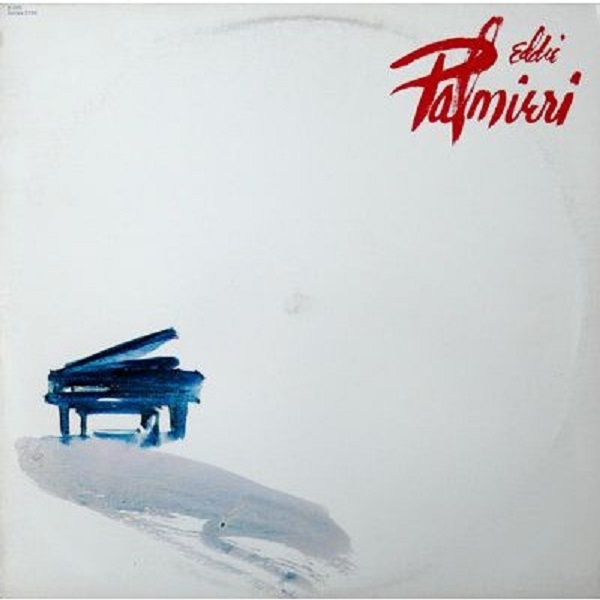
And so that there would be no doubt about this call against Salsa Erotica and Merengue, in 1981 he recorded the Lp “Eddie Palmieri” which, almost 30 years after its release, we are still studying and listening to it to digest what El Sapo did in these 5 memorable songs: El Día que me Quieras; Ritmo Alegre, Paginas de Mujer, No Me Hagas Sufrir and Ven Ven.

Poster salsa on all four sides, atrabiliary percussion, indescribable trombones and trumpets, legendary voices, in short, a priceless LP. By the way, a certain current of opinion maintains that salsa is nothing more than Cuban music.

Under this prism, then we would have to say that this Palmieri’s version of Carlos Gardel’s El Día que me Quieras, is a full-fledged Tango. 

Eddie Palieri 1981
Eddie Palieri 1981

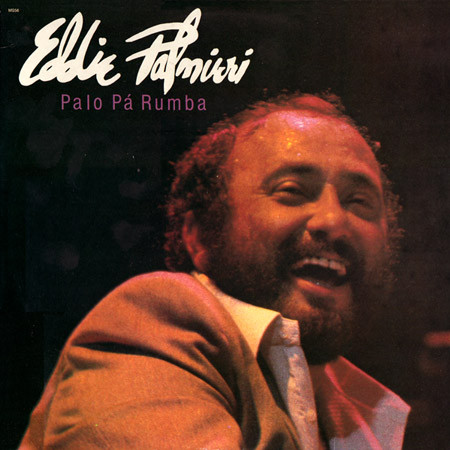
In 1984 and when the “erotic” ones were widening their tentacles, Palmieri came with more fuel and that added to the bad experience lived in Venezuela with some businessmen who were determined to finish with him, musically speaking, allowed him to release the Lp “Palo Pa Rumba”, containing the pieces: 1983, Bomba de Corazón, Bajo con Tumbao, Pensando en Ti, Palo Pa Rumba and two songs dedicated to Venezuela because of the bitter and vexatious experience he had in our beloved homeland of names: Venezuela and Prohibición de Salida.

Eddie Palmieri Palo Pa' Rumba Ganador del Grammy's 1985
Eddie Palmieri Palo Pa’ Rumba Ganador del Grammy’s 1985

In 1985 the Lp “Solito” was released, a song that allowed Palmieri to tell the “eroticos” that there was a formula for arranging music that sounded strong and powerful, even if the content of the lyrics could suggest a certain shade of erotic salsa; that the trombones could sound energetic and strong without the sweetening and softness to which these hardened instruments were subjected in this decade; that it was not necessary to be bonitillo (as the Boricuas say) to succeed in this salsa environment and that, no matter what happened, he, Eddie Palmieri, was not going to be subjugated no matter how much salsa erotica the record companies demanded and played on the radio, emphasizing this statement with an abysmal piano solo.

To complete the LP: Justicia, Yo No Soy Guapo, Cada Vez que te Veo, Lindo Yambú and Pa Los Congos, round out his confrontation with “aquella” salsa.

Eddie Palmieri Solito Ganador del Grammy's 1986
Eddie Palmieri Solito Ganador del Grammy’s 1986

To top off the decade, in 1987 he recorded the Lp “La Verdad”, in which with the piece El Cuarto in the voice of Tony Vega ratified his point of view regarding “erotic” salsa; that it is not necessary to fall into pornography to say “nice things” and arrange the music with enough flavor and sandunga and that, finally, nothing would prevent him from continuing to crush his opinion based on hard and powerful salsa.

As if that were not enough, for this album he made use of a beastly orchestra made up of four trumpets, two trombones and a saxophone that left on the acetate: Conga Yambumba, La Verdad, Lisa, Noble Cruise and Buscándote.

The result of all this decade of salsa gorda music for Eddie Palmieri? Three Grammy awards and the recognition of a whole legion of hardcore salseros, who were not intimidated by the onslaught of the “erotic” and “merenguera” fashions of the moment and decided, in the face of so much sweet, effeminate and subtle trombone, to follow in the footsteps of the leader: El Zorro, sorry I made a mistake, by El Sapo Eduardo Palmieri.

Source: Larry Daniel Cabello Guzmán

Dj. Augusto Felibertt

Read Also: Bebo Valdés is considered one of the central figures of the golden age of Cuban music

Eddie Palmieri

Alex Sánchez “Salsa has always had a special place. It is a genre that will never go out of style ”.

Latin America / Venezuela / Miranda

Mulato en Rumba his greatest bet Alexis José Sánchez:

He is a versatile artist, who like many other musicians begins his training from home, with his brothers he learned to play the cuatro and the guitar, this motivated him to continue his formal studies at the School of Music “José Lorenzo Llamozas”, where he also studied trumpet alongside maestro José “Cheo” Rodríguez; He jointly studies Afro-Latin percussion with maestro Orlando Poleo, Barloventeña percussion with Alfredo “Pandilla” Bolívar and Arturo Piñango, African percussion with José Shalons and Yonder Rodríguez.

At the “Nicomedes Marrero” Cultural Training Center in Tacarigua, he took piano lessons with professor Manuel Sepúlveda, Afro-Venezuelan percussion with maestro Alexander Livinalli and Choral Direction in the free art workshop of “Río Chico”.

Photo- Alex Sánchez
Photo by Alex Sánchez

Although he was born in the city of Caracas, all his life he has lived in the Barlovento region, an area with a great cultural and musical richness, there he also performs the role of teacher, being a facilitator of the Afro-Barloventeña, Afro-Venezuelan and Afro-Venezuelan percussion chairs. Afro-Latin, in School District No. 4.

From a very young age he has been linked with the traditions of his town; Tacarigua. This young man is an active part of the cultural development of the area and together with his wife Yermy Martínez and his mother-in-law Zenaida Gamboa, founders of the group “Danzas Tacarigua”, they are in charge of training the youth of relief, in order to keep the demonstrations alive. traditional barloventeñas for many generations.

Sánchez, assures us that he has a great responsibility, to preserve the legacy that the Africans left in their path through our land, that despite the obstacles he gets along the way to carry out his work, he is overcoming them one by one with perseverance and dedication. that love he feels for music, his family, his traditions and his other passion for teaching.

Salsa and Venezuelan Folklore, two different worlds, each rich and varied in rhythms and styles, however, it takes them by the hand, something that is not strange in a country where the mixture abounds, that we Venezuelans are the product of an ethnic and cultural mix.

How were your beginnings in music?

“I started in music at home with my brothers. I learned with them to play cuatro and guitar. That was the fundamental basis of what has been my musical career up to now and it also inspired me to continue with formal studies in music ”.

Your musical training has been very broad. Why did you decide precisely to specialize with the trumpet?

“I decided on the trumpet, since it has been the traditional instrument in my family, first my great-grandfather Gregorio Machado, then my great-uncle“ Perucho ”Machado and my brother Wilman”.

A man from Caracas who decides to emigrate to Barlovento Why not Barquisimeto or another region?

“My whole family is from Barlovento, since I was born I have lived here in Tacarigua, Brión municipality. After studying music I realize the musical wealth that exists in this region. That is why I decide to bet on the musical production of my homeland and also be part of that artistic movement that represents Barlovento and that has given so much to our country ”.

Composing and arranging music, the work that leads its creators and orchestras to position themselves in the first places. Which of your works as a composer and arranger have been positioned in that place?

“That is the dream of every arranger, to achieve that an orchestra reaches the first places of popularity and in sales. I haven’t had that luck yet, but it’s my dream as a songwriter. I have arranged for many orchestras that have been quite popular and are playing in various countries ”.

Alex Sánchez
Mulato in Rumba your biggest bet

There are many orchestras for which you have done this work, could you name them?

“I have arranged for orchestras and singers such as: Bailatino, Cheo Linares and his Orchestra, Víctor Cardona and the Salsa Machine, Cheo Navarro and his Tribute, Francisco Pacheco and his People, Hildemaro Jr., Orquesta Sarayé (Colombia), Orquesta La Suprema (Panama), Orlando Watussi and my musical project “Mulato en Rumba”, among other national artists “.

Percussion is another of its virtues, of the different rhythms. Which of them is more difficult to teach or learn?

“Percussion is a world that allows you to express yourself and make contributions based on its rhythmic quality. All rhythms have difficulties, but their great musical richness and the magic of the ancestral charge make it possible for us to digest them naturally ”.

“I invite the musicians and the community in general to come to Barlovento to learn about the regional culture, so that they learn to play Mina, Culo e puya, Quitiplás, Fulía and Parranda.”

In the vineyard of the Lord there is everything and for everyone. What has been the most difficult thing about this profession?

“Music gives you a lot of satisfaction, but around it there are circumstances that create disappointments – they can scam you, you have friction with colleagues, etc. – you will find obstacles, but I think that all this is overcome with perseverance and dedication to work. That is what it takes to stay in the musical world ”.

The Music Producer is the architect of a record. What do you feel at the end of each record? What do you feel at the end of each work done?

“Music production is hard work, bringing together musicians, writing and selecting songs, directing, molding and creating a pleasing product for the public, where feelings are reflected on paper, which in turn become sounds that will mark the life of anyone who is a music lover. That is the greatest satisfaction ”.

Each era has its ups and downs, do you think you can make a living from music?

“Of course, if we think of music as an industry we can find that starting from being a composer, arranger, through instrumentalist, singer, among other things, always keeping in mind the quality of the work to be able to sell it, it can be said that we are prepared to live from what we love to do ”.

How does it feel to be part of the cultural development of Barlovento?

“It is a great responsibility to know and feel that you are the bearer of such an important heritage for the development of the culture of an area where the legacy of the Africans who populated our lands will always prevail. Maintaining, disseminating and promoting the culture of my people through workshops, talks and exhibitions will guarantee that tradition is not lost and that these children and young people, just like I started, will be the future protagonists of the traditional Barlovento demonstrations. ”

Tell us about the Black Theater of Barlovento and Danzas Tacarigua. How do you undertake the preparation of the new generations so that the traditions last over time?

“The Black Barlovento Theater, a group that has 43 years of artistic experience, also proudly carries the cultural heritage of the Miranda State. It is and has been a great school for me for 27 years when I made my first presentation with this great family. I say that it is a great school because it is characterized by being an avant-garde group and that it has given me the green light and total confidence to develop and put into practice all the knowledge acquired musically throughout my career through the different productions of the theatrical works brought to the scene ”.

“Following this example and great experience with the Black Theater of Barlovento, we have been working with the Danzas Tacarigua group, directed and founded by my wife Yermy Martínez and my mother-in-law Zenaida Gamboa for 20 years, training children and adolescents in terms of traditional Venezuelan culture, emphasizing the Barloventeña. They are currently part of the main actors in the traditions of my Tacarigua people. It is an arduous work in favor of the diffusion of the same ”.

His wife is an active part of the Cultural development of the young people of Barlovento, here we could say that “Next to a great man goes a great woman”?

“When one is passionate and responsible with what he does, with his profession, his home, that is accompanied by a great companion, I thank my wife very much, a large part of who I am and what I have achieved is accompanied by her great support, she is passionate about what she does, and that gives me a lot of strength ”.

Salsa and Venezuelan Folklor take you by the hand, how does it unfold between these two worlds?

“Despite the fact that they are two different worlds and from different markets, I have tried to take them by the hand, since from a very young age I was linked with the tradition of my town and the Barloventeño region in general, participating in the demonstrations held throughout of the holiday calendar. The salsa world has helped me understand and handle our culture in a more respectful way through arrangements, compositions, and also when interpreting it”.

Flyer Alex Sánchez
Alex Sánchez & Mulato in Rumba

How do you see the sauce right now?

“Salsa has always had a special place. It is a genre that will never go out of style. We must thank the DJs very much, who, whether they like it or not, have been a fundamental part of the salsa being maintained over time, since the media have lost that interest in promoting and promoting new salsa talents for their music. respective development.

In Venezuela the salsa movement has suffered a lot, since orchestras and producers have had little support at the level of the music industry, since it has diverted its attention to urban genres, which according to them is the most commercial. Despite all this panorama, many musicians, singers, producers have made efforts to continue working in favor of Venezuelan salsa with what we call “record pocket” -hahaha-. All this so that his musical work does not remain only in a dream ”.

Barlovento and its sauce, what can you tell us about “Trabuco Barlovento”? “Trabuco Barlovento is an initiative of my cousin Richard Frías. He told me one day at a salsa concert held in Mamporal, seeing that the great stars were accompanied by musicians from Barlovento, -with all those musicians who are there you can make a blunderbuss that represents Barlovento- and that is how the group was born ” Trabuco Barlovento ”, with more than 10 years of artistic life and 1 recording production to be finished.

I remember that among those musicians who accompanied the artists were Rodolfo Rada (trumpet), Ángel González (saxophone), Darlin Palacios (trombone), among others who are today the fundamental pillar of this group. It has 14 members, where I work as the musical director and main arranger of this prestigious group”.

Orlando Poleo, a national and international percussion reference. What anecdotes do you have of his training with him?

“Orlando Poleo arrived in Tacarigua in 1986 as a percussion teacher at the” Nicomedes Marrero “Cultural Training Center, which was a great experience for me, since he was venturing into the world of Afro-Caribbean music”.

“I remember that once he came with his orchestra“ Casino ”and as he was quite advanced in his classes, he rewarded me by playing a song. It was the glory for me to play with the maestro. It was a great experience for the musicians of Tacarigua and other nearby towns because it helped improve playing techniques and understanding of the use of the clave. Much of that learning I apply to create arrangements. ”

He is a teacher and a student, what is more difficult for you to teach or learn?

“Both are difficult, because to teach well you must learn well.”

You are working with a new musical proposal. What do you have in store for us with the Mulato en Rumba project?

“Mulato en Rumba is my biggest bet. This movement has more than 15 years, began as “Alex Sánchez and his Orchestra” to accompany artists and participate in ¬estas and salsa events in the area. One day recording for another orchestra, we met my brother Edward Plater, my compadre Yoryi Pacheco and I fine-tuning details of what we had already recorded. We saw each other’s faces and said -Why don’t we make an orchestra that is ours? -; we always record and produce for others ”.

“It is then that we decided to set up and start this musical project with our own songs composed by Yoryi Pacheco and myself and arrangements made by me as well. The main members are: Yoryi Pacheco (singer), Edward Plater (trumpet), José Madera Niño (tumbadora), Jonal Rivero (trombone), Rodolfo Frías (bassist) and Alex Sánchez (trumpet, piano and musical direction). Soon our first record production will be ready, which has been done uphill because it is financed by “Pocket record”

–”jajajajajajaja”-.

That name sounds like ¬esta, joy and sauce. How was the name Mulato born in Rumba?

“This name was given to him by my friend and brother Cheo Linares. I told him that we had a new project and he told me

-The mulattoes are going to start partying in Barlovento- and from that moment we call ourselves “Mulato en Rumba”.

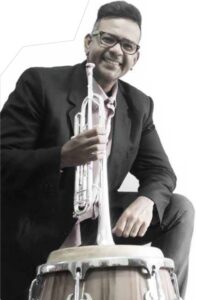
Alex Sánchez
Alex Sánchez playing the trumpet

Creativity is in decline in Venezuela, you are a composer and arranger and many of the Salsa orchestras are betting on versions or tributes, they do not risk innovating, creating or inventing. What do you think about this matter?

“I think that covering is very fashionable, I think that for many people it is easier to live attached to the shadow of another than to risk producing their own.

Perhaps it is fear of failure due to the lack of support for the artist that exists in our country. There are those who do take risks and bet on other markets (other countries), where the appetite for good music is always thanks to the fact that in those countries there are people eager for new things. In our country that culture of wanting to hear something new and as the saying goes: “-No one is a prophet in his land-” has been lost.

If you bet on innovating and creating, what are the themes of your production?

“We have 10 songs, 2 versions and the other 8 songs are unpublished, we bet on ourselves, not to be in the shadow of others, here the lyrics and music are by José Madera Niño, and my person, Yoryi Pacheco also writes some of the topics. In the version of “Tú mi Delirio” I sing ”.

“The song, get ready, Dancer, the lyrics and the music are by Freddy Junior Solórzano.”

The support of the media is important to show the work done by national talent. Do you feel that there is little dissemination by the media to show the work done by the different groups?

“-Well-, in previous questions I have said that there is no support from the mass media. Hopefully that will end one day and they give importance to Venezuelan music and talent as much as they give it abroad.

La Payola, many criticize it and want it to disappear, however, there are musicians who contribute to this scourge that hurts everyone. Would you ever pay to play?

“I don’t agree with the Payola. Colleagues have told me that if they have done it that it is a rather shameful situation, since many times they have to play without any remuneration in exchange for playing on the radios several times a month. Personally, I would never pay for what he calls Payola ”.

What would be the good and not so good things about this beautiful but tough profession?

“I think there are more good things than bad things, and more when we take music as a profession. The musical world is very satisfying, since it makes you live unique experiences that fill your soul and spirit with joy ”.

Teacher, musician, arranger, music producer What do you feel you need to do?

“Learn, learn and keep learning to make good music and also be able to make” Mulato en Rumba “recognized nationally and internationally.”

His daughters have grown up in an environment full of music, tradition, folklore, they have the musical vein Sánchez, would you like them to be musicians, what legacy would you leave them?

“Hopefully they decide to be musicians, I would never force them to do something they don’t want to, because I think that everyone should do what they really like and are passionate about. The legacy that I will leave you will be all I can do in my musical life, since a large part of what I do is for my family. My daughters at their young ages have already been immersed in the artistic world, they sing, dance and participate in the cultural manifestations of our people. ”

In a word, who is Alex Sánchez?

“A fighter”.

Barlovento and Venezuela in one sentence

“My homeland, My Dear Homeland”.

Eiling Blanco Latin America Corresponded


  • « Go to Previous Page
  • Page 1
  • Interim pages omitted …
  • Page 9
  • Page 10
  • Page 11
  • Page 12
  • Page 13
  • Interim pages omitted …
  • Page 94
  • Go to Next Page »

International Salsa Magazine (ISM) is a monthly publication about Salsa activities around the world, that has been publishing since 2007. It is a world network of volunteers coordinated by ISM Magazine. We are working to strengthen all the events by working together.