

Directory of North American nightclubs |
||
|
|
||
|
|
|
|
|
|
||

CALIFORNIA |
|

ILLINOIS |

MICHIGAN |

NEW JERSEY |

NEW YORK |
|
|
|
|
|
|
|
|


Directory of North American nightclubs |
||
|
|
||
|
|
|
|
|
|
||
|
CALIFORNIA |
|
ILLINOIS |
|
MICHIGAN |
NEW JERSEY |
NEW YORK |
|
|
|
|
|
|
|
|
Cuba has an extensive list of talented musicians and a great musical and artistic tradition that are truly the envy of many countries, so it is impossible to cover all the exponents of this land of talents. However, in this opportunity, we talked to one who sets the bar very high among them all, the incredible arranger, composer, sound engineer and multi-instrumentalist Kiki Valera, whom we have been able to interview for the March edition.
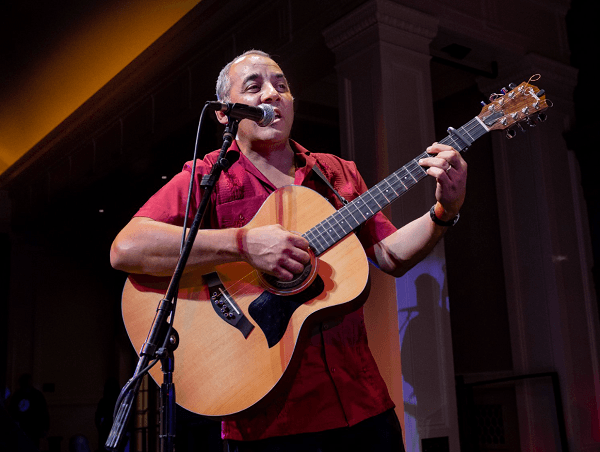
The first thing to point out about Kiki is that he was born into a very musical family in the easternmost part of the island of Cuba, specifically in Santiago de Cuba, which is an area well known for the presence of the now world famous Cuban son. In addition to that, his father, Don Felix Valera, inherited from his family and ancestors those musical genes that came from his grandparents, great-grandparents and further back.
So much so that Don Felix was a music teacher in the small town of San Luis, which was 30 kilometers from Santiago de Cuba, while his mother was a dance teacher. Both were recent graduates of the first national school of art instructors that was founded in the country in the early 1960s, while Kiki was just being born.
Growing up surrounded by all this environment, music was the first thing he heard and lived, not to mention that the artist already had the necessary conditions and abilities to dedicate himself to this world professionally. When he was six years old, his father gave him a Cuban tres, one of the most iconic instruments of the son, and taught him his first songs, melodic motifs, tumbaos, among other things.
One thing to mention is that the Valera Miranda family does not consist of professional musicians as such, but rather empiric musicians who frequently get together at family events such as birthdays, Christmas, New Year holidays and vacations to play the tres, the bongo, the maracas, the guitar, among many other instruments.
As a child, this was all very normal for him until he realized that his interest in music was genuine and he entered the Conservatorio Esteban Salas in Santiago de Cuba to study classical guitar. It was thanks to his studies that he realized that his family’s thing with music was something really authentic that had been developing a very long time ago, more precisely since the 19th century.

It turns out that a now deceased musicologist named Danilo Orozco was conducting a sociological survey in the eastern part of the country and happened to be a good friend of his father. In one of their many talks, Don Felix told him much about the family history with music for several generations, which caused Orozco’s curiosity and he got to the rural area where the family had lived. These visits determined that the oldest ancestors were true carriers of the roots of son in the eastern region, to the point that this researcher even made a documentary and the Valeras of that time recorded two albums with a didactic approach to show the cultural phenomenon that happened in that family nucleus.
After all this, Kiki felt even more destined to continue the legacy of his ancestors in music, but with a little more academic training and more modern touches in keeping with the times. That was more than 40 years ago.
There is a whole resurgence of genres, already thought forgotten, by the passage of time, but thanks to tributes by certain fashion artists, they have risen from the ashes to occupy the place that should never have been taken away from them. We have the example of Bad Bunny with his album ”DeBÍ TiRAR MáS FOToS”, which focuses on the cultural and musical heritage of Puerto Rico and makes use of salsa, plena, and boleros to show the musical richness of the Island of Enchantment. We can also mention Desorden Público’s upcoming album ”Salsa All-Ska” which pays homage to salsa as part of the celebration of its 40 years of musical trajectory. Not to mention the 2024 Latin Grammy Awards which paid tribute to salsa and counted with the presence of Oscar D’ Léon, Tito Nieves, Marc Anthony and La India among its guests.
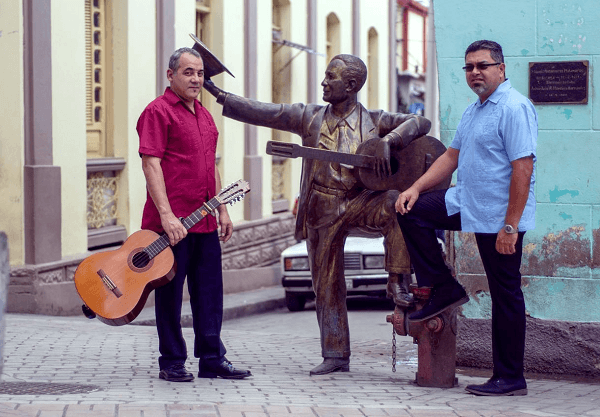
On this phenomenon, Kiki considers that artists in general are the reflection of their time and the manifestation of the environment in which they develop. For the same reason, he believes it is inevitable wanting to look back to understand where we come from, no matter how many years pass. ”After you study a genre such as reggaeton, you can tell that it has been nourished by other musical manifestations that preceded it. Moreover, when musicians are given the task of acquiring technical and theoretical knowledge of music, they always try to innovate by recreating the foundations of the genres in which they work” said Kiki on this interesting and important subject.
”There is a saying that if we don’t know where we come from, it’s hard for us to know where we are going and this is the case. Contemporary musicians generally provide their vision of music and create new concepts, fusions and rhythmic patterns, but all this always comes from the past to a certain extent. To build something new, you need a base” he continued.
Changing the subject radically, we wanted to know when Kiki decided to leave his country to settle in the United States, specifically in Seattle, to which he replied that he arrived here on April 2, 2013. The main reason why he left was due to his partner Naomi Bierman, who convinced him to move to start a life together in another place.
With that decision, the musician had to make a total shift in mindset, since he had lived in Cuba all his life and came from a very close-knit family. He had to give up the closeness he had with his loved ones, culture, values and climate to adapt to a completely different way of life in a territory that was nothing like his own.

Read also: His father’s love for music rocketed him to stardom
The United States is and will remain the land of opportunities for artists from all over Latin America, and Dominican producer, composer, and guitarist Oscar Almonte is one more of those examples of what effort and discipline can achieve on fertile ground. We could talk exclusively with Mr. Almonte about the most important aspects of his prolific career, and we want to make them known to our readers, who always honor us by visiting to our content each month.

Oscar began telling us that music as such has drawn his attention since he was very little, more specifically, the ones he was listening to at home and that some relatives played, as several of them are professional and amateur musicians. That mix of rhythms and melodies always intrigued him, especially those from Cuban music, which was very popular at that time.
Family parties were the perfect occasion for the young man to show his strong interest in music, as it was not uncommon for one of his uncles to bring out his guitar, play, and sing to lighten the mood. This was one of the things that led Oscar to learn to play as he saw adults do it.
Not to mention that Caleo López, his grandfather, was a guitar maker and played them as well.
Oscar’s primary education in music was given in a self-taught way, In fact, their parents bought him his first guitar at just nine years of age, and he took some classes with this instrument. He stopped for a while and resumed his interest in the guitar at age 14, which is when he learned his first chords and memorized some rock songs he liked to play them.
When he had the right age, he began studying music at the Culture and Art Institute in his hometown, Santiago de Los Caballeros, where he completed a bachelor’s degree in classical guitar.
Today, Oscar is based in New Jersey City, where he moved for the purpose of seeking new horizons personally and professionally. He wanted to soak up the musical culture that exists in the New York area, which is very close to where he is now.
When asked about the job opportunities he had upon arrival, he told us that he had the fortune of having contacts and friends with whom he had already traveled to the country, which allowed him to play with some bands he knew. However, he does admit that it took him a while to find a balance in his economy, so he had to work in family automotive businesses while his situation stabilized. He was working in that until he could devote himself exclusively to music, just as he did in his country.

The main difference he noticed between the music scene in New Jersey and the Dominican Republic is that, in his home country, it is easier to live exclusively from music as a simple artist. There are things that are easier to do because the budget allows it, and certain places where musicians play cover some elements such as sound engineers and show producers. When he arrived to his new destination, he had to learn many of these things to be able to do them himself and not have to spend what he did not have.
Just as Oscar has taken great pains to make his own project, he has also been involved in others belonging to artists such as Pavel Nuñez, Felle Vega and La Orquesta de Las Danzas Mezcladas, Xiomara Fortuna, Irka Mateo, El Prodigio, and many others.
He has managed to make contact with several of them because they live in the same city as him. It also happens that he played with several jazz musicians through whom he got to know others, something which took advantage to develop contacts and friendships with whom he could work in the future.
Among the most important things he learned from them, one is audience management, repertoire management, certain vocal techniques that he did not know and, mainly, everything that has to do with the responsibilities an artist who is already the head of his own project should have.
The artist has also been nominated for the famous Soberano Awards in the category of Merengue of the year in 2012 thanks to the song ”Levántate”, which was recorded by Héctor Acosta ”El Torito”. An interesting aspect of this piece is that Oscar wrote it with the purpose of showing it to Ricky Martin so that he would finally record it, but unfortunately it was not possible to make contact with the Puerto Rican.

Over time, he learned that Héctor was looking for songs to add to his new album ”Corazón Abierto”, so Oscar got down to business and contacted his musical director to see if Acosta would be interested. Fortunately, he was and the song enjoyed very acceptance among the public, so he managed to get the nomination at that time.
Finally, in the year 2020, Oscar was ready for his debut as a singer-songwriter and, at finally, to do things other than what a simple musician does. Although he was writing since he was 14 years old, always thinking for other artists, he decided to change his approach and focus on himself and his career.
It is then when he made his debut in this facet with the song ”Mi Tierra”, in which he describes his hometown Santiago de Los Caballeros as the title indicates. Something interesting about ”Mi Tierra” is that it fuses rhythms from many parts of the world with Dominican pambiche.
Oscar defines pambiche as one of the sounds of merengue, but softer and calmer when compared with the more lively merengue.
As for the rest of the colors it has, the artist used elements of African music and very different tempos to those often used in merengue.
He is also promoting the song ”Bermudas” with the young singer Carolyn Rodriguez. A mutual friend introduced them and thought that their voices would work well together, so they gathered and made a romantic song based on urban bachata with hints of reggae and some electronic touches.

Read also: Joshua Levine and his quartet have a lot of Guataca


Directory of European nightclubs |
||
|
|
||
|
|
||
|
|
||
|
|
|
|
|
|
|
|
|
|
|
|
|
|
||
|
|
|
 Adenauerallee 3 20097 Hamburg, Germany |
|
|
|
|
|
|
||
|
|
||
|
|
||
|
|
||
|
|
||
|
|
|
|
|
|
|
|
|
|
|
|
 Av. del Vallès, 117 08223 Terrassa, Barcelona, Spain |
 C/ Olvido 15 28026 Madrid, Spain |
 Carrer del Perill 10 08012 Barcelona, Spain |
|
|
||
|
|
||
|
|
|
|
|
|
|
|
| Karina Bernales present |
APRIL 2025 |
FESTIVALS |
|
|
 |
¡Meneate! Viena Cuban DanceApr 10 / 13 2025 Fanialive From €159 |
|
|
 |
Kizz Me BachAmore CongressApr 11 / 14 2025 Palais des Congrès Mons From € 70 |
|
|
 |
World Stars Salsa FestivalApr 24 / 28 2025 Maritim Hotel Paradise From € 79 |
|
|
 |
Bachata Magic FestivalApr 05 / 06 2025 OX Club Prague From $79 |
|
|
 |
Baila Baila Salsa FestivalApr 17 / 20 2025 Tanssikoulu-Dance School Baila Baila From € 150 |
|
|
 |
Paris International Salsa CongressApr 11 / 13 2025 La Palmeraie Hotel From € 164 |
 |
Lyon BachataApr 18 / 20 2025 Espace Ecully Bar From € 97 |
|
|
|
 |
Bachata Festival StuttgartApr 09 / 14 2025 Sängerhalle From € 99 |
|
|
 |
AloCubano Salsa FestivalApr 24 / 27 2025 Golden Coast Hotel From € 140 |
|
|
 |
SPRING WeekendApr 11 / 13 2025 Hotel Annabella From € 110 |
 |
Diamond KizombaApr 03 / 07 2025 Hotel D50 From € 92.31 |
|
|
|
 |
Zeno Latin FestivalApr 11 / 13 2025 Zeno Complex From € 55 |
|
|
 |
Nordic Salsa & BachataApr 25 / 27 2025 Samfunnssalen Event & Konferanse From KR 390 |
 |
Oslo Kizomba FestivalApr 10 / 12 2025 Dancecity From KR 850 |
|
|
|
 |
El Sol Bachata FestivalApr 11 / 13 2025 Sound Garden Hotel |
|
|
 |
Bachata Takes Over BucharestApr 04 / 07 2025 NORD Events Center by Globalworth From € 100 |
|
|
 |
Corazon y MezclaApr 11 / 18 2025 Don Angel Hotels From € 100 |
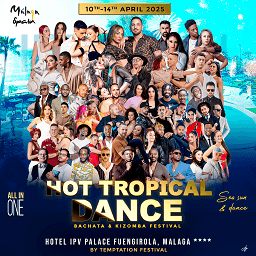 |
Hot Tropical Dance MálagaApr 10 / 14 2025 Hotel IPV Palace & Spa From € 79 |
|
 |
Kizomba Barcelona CongressApr 11 / 13 2025 Hotel Evenia Olympic Park From € 75 |
|
 |
KizCon
|
|
 |
Fever Bachata World CongressApr 24 / 28 2025 Hotel Gandia Palace From € 105 |
Europe
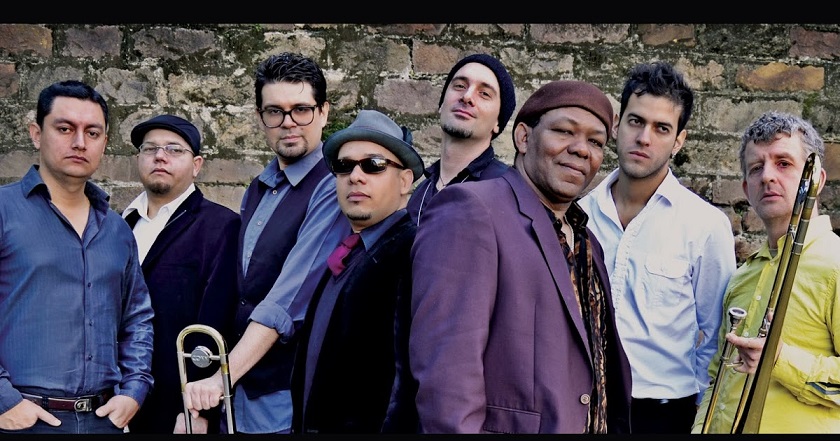
A band formed in Spain to share rhythm, music and soul around the world. As a part of the new generation of independent Latin orchestras around the world, Tromboranga is the pure essence of “Salsa Dura”. Tromboranga´s spicy ingredients are the trombones sound, solid and strong percussion, and they recover the essence of “soneos” (voice improvisation among the chorus). With influences from the salsa music from the 60s and 70s, maintaining a raw, strong and a very danceable sound.
Their original songs like “Humildad”, “Palo pa la campana”, “Ah Caraj”, “Mi China Colombiana”, talks about stories that can describe the life of any of us, and they have become number one in Latin radios and dance floors worldwide.
Tromboranga is made up of musicians from the Caribbean and Europe, all residents of Barcelona, Spain.
Its members are:
Joaquín Arteaga, Band leader, Timbal and composer from Venezuela, known for his long career as a percussionist and also as band leader of the orchestra “Bloque 53”.
Diego Coppinger, traditional “Sonero”, with an extensive carrer that includes “Tropicana” in Cuba, gives color and Cuban flavor, with great force and experience in his amazing soneos.
Freddy Ramos, young singer from Venezuela, also arranger with a wide impresive musical career.
Rafael “Madagascar” Arciniegas adds Colombian flavor with his piano and arrangements.
Lorenzo “El diablo” Barriendos, Venezuelan musician on bass, with tastefull tumbaos, known for his interventions with orchestras such as Trabuco Venezolano, Mango group Guaco among others.
The strong and colorful trombone section, which offers a distinctive mark on the band: Vladimir Peña (Venezuela), Josep Blanes (Spain) and Albert Costa (Catalunya), all supported by the taste and the conga afinque Oriol Martinez and the spicy bongo of Climent Campa.

Their first EP “Agua que va caer” hits the market in November 2011 in anticipation for the first official cd “Salsa Dura” (April 2012), considered by Latin music lovers, DJs, dancers and specialize salsa bloggers among the 10 best CDs of 2012. Also recorded a CD together with Bloque 53 “Tumba Puchunga” where the song “Me alborotas” and also “Tumba Puchunga” reached number one in many Latin radios listings.
In April 2013 the new cd “Al mal tiempo buena salsa”, take them to do their first world tour in Spain, France, Belgium, Switzerland, Netherlands, Tunisia, Germany and Colombia.
In November 2013 they release a L.P. Vinyl Special Limited Edition (only 300 copies) called “Solo para coleccionistas Vol. 1”. They are invited to do 4 concerts at one of the biggest salsa festivals in the world “La Feria de Cali” and Pereira, Colombia. The 4 concerts were filled in its entirety. Since then the followers and fans of the band call themselves “Salseros Tromborangueros”.
In 2014 visit Mexico on a tour of four dates, all concerts were sold out and the public had the opportunity to hear some songs from the 4th Album called “Salsa pa’ rato”, with 10 new original tracks.
From “Salsa pa´rato” album the track “Palo pa la campana” is already a hit among salsa dancers, been between top 10 salsa dancing songs of 2014. Also “Sentimiento Caleño”, a song dedicated to the city of Cali. Songs with social messages like “Esclavo de tu apariencia”, “No tengo pa pagar” and “Como la marea” also known for their catchy tune.
2015 arrives with new album “Golpe con Melodía” , with 8 new hard and raw salsa tunes, and great swing for dancers, with songs like “Golpe con Melodía”, son montuno “Carretera” and a cover of “La mafia”. And a extensive tour in Colombia, Ecuador and in USA for the first time in cities like New York, Miami, Los Angeles, Las Vegas and many more.
In 2016 the songs “Ah Caraj, aquí que pasó”, “Cambumbo”, “El rey sin corona”, “No me vuelvo a enamorar”and “Mi China Colombiana” from new album “Sangre Sudor y Salsa” are already on every salsa Dj set. Also they release amazing new videos from this songs. In 2016 they have long tour from Japan to Russia, from USA to United Kingdom and all Europe.
Other songs like “Agua que va caer”, “Humildad”, “Te provoca”, “Adios que te vaya bien”, “Mama Calunga”, “amigo el raton”, “Boogaloo Marilu”, “Rompe colchon” are danced currently on the dance floor of salsotecas, dance schools, salsa parties and salsa festivals worldwide.
THE 2018 TOUR
JANUARY
FEBRUARY
APRIL
MAY
JUNE
AUGUST
OCTOBER

Discography:
-Tromboranga EP “Agua que va caer” (2011)
-Bloque 53 & Tromboranga “Tumba Puchunga” (2012)
-Tromboranga “Salsa dura” (2012)
-Tromboranga “Al mal tiempo buena salsa” (2013)
-Tromboranga “Solo para coleccionistas” (2013)
-Tromboranga “Salsa Pa´Rato” (2014)
-Tromboranga “Golpe con Melodía” (2015)
-Tromboranga “Sangre Sudor y Salsa” (2016)
Web & Social Network:
Music available at:
@cdbaby: http://www.cdbaby.com/Artist/Tromboranga
@iTunes: https://itunes.apple.com/es/artist/tromboranga/id484381251
Production and Bandleader: Joaquin Arteaga
Musicians:
Joaquin Arteaga: Director and Timbal.
Diego Coppinger : Voice
Freddy Ramos: Voice
Oriol Martinez: Congas
Climent Campa: Bongo
Lorenzo Barriendos: Bass
Rafa Madagascar : Piano
Vladimir Peña: Trombone
Josep Blanes: Trombone
Albert Costa: Trombone