The Secretary of International Salsa Magazine hereby requests all whom it may concern to extend all journalistic courtesies and permits to the journalist of ISM named herein
The Secretary of International Salsa Magazine hereby requests all whom it may concern to extend all journalistic courtesies and permits to the journalist of ISM named herein




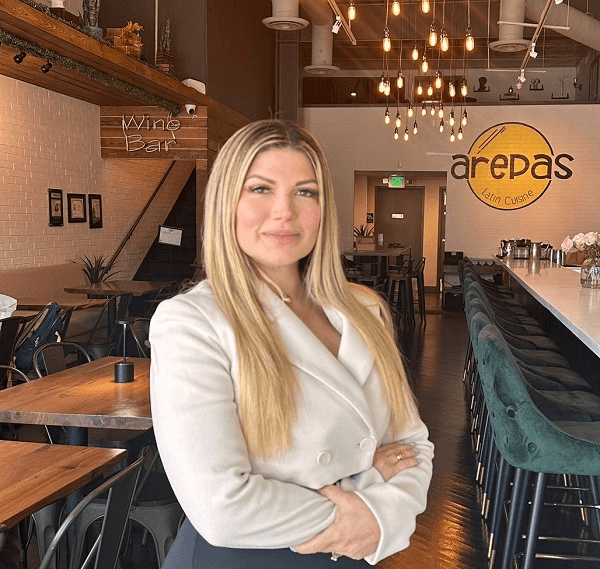
There are many Venezuelans who, due to the economic and political crisis that has affected their country in recent years, have had to set off for new horizons and leave their homeland to look for a better future for themselves and their family. Such is the case of the businesswoman and founder of Arepas Latin Cuisine Joanna Torres, with whom we had the pleasure of conversing with recently.
This talented young woman has a fascinating history of success and is a true inspiration to any Latino wanting to open paths in the United States or anywhere else in the world. That is why, from International Salsa Magazine, we decided to contact her and share her journey in the land of opportunities.
The first American city where Joanna arrived was Miami and her goal was to do a master’s degree, since she had studied her undergraduate career in Venezuela. Once there, she realized that she had a lot of trouble learning to speak English and there were few opportunities to practice it, since all with whom she interacted with spoke Spanish.
It was then when a friend suggested the idea of moving with her to the city of San Jose, where it would make it easier for her to learn the language and spend time with people who spoke it all the time.
Two years after Joanna arrived in San Jose, she began working in a clinic and, together with her experience in administration and accounting, she learned everything she could about medical coding and the way medical procedures were coded. This gave her enough experience to dare to open his own medical consulting firm which has more than 22 years of operation and a total of 150 employees in Venezuela.
The entire staff of the consulting firm residing in the South American country speaks English and takes care of serving all customers in the United States. Joanna even took it upon herself to provide her workers with their own fiber optic internet by contacting some telecommunications engineers, since this service in Venezuela is extremely poor.
Since the medical consulting firm gave her the necessary experience as a businesswoman, she decided to expand into another area she was very passionate about: cooking. Joanna had been wanting to start a food truck in parallel to her current company for some time and saw the opportunity to do so through a friend and former college classmate who owned restaurants and food businesses. She proposed to Joanna to buy one of her restaurants and partner with her, which she finally accepted and that is how the first Arepa Latin Cuisine restaurant was born.

Joanna was aware that the possibilities of failure of her idea were high, but she told us that her extensive knowledge of finance was fundamental to overcome all obstacles.
She was always clear that she had to look for ways to generate more income within the same company. That is why she and her staff have been responsible for providing lunch to employees from technology companies, making food for events such as birthdays or weddings, organizing pop-ups (temporary restaurants created to promote new menus and specific events) in order to innovate and always earn a stable income in the corporation.
The businesswoman points out that she always tries to innovate, and with regard to this, she said ”I have invented some taco-arepas with which I use arepa flour to make the tacos and give them a different touch, so it would be a combination of both dishes. I always try to innovate and do different things to surprise people and keep them from getting bored”.
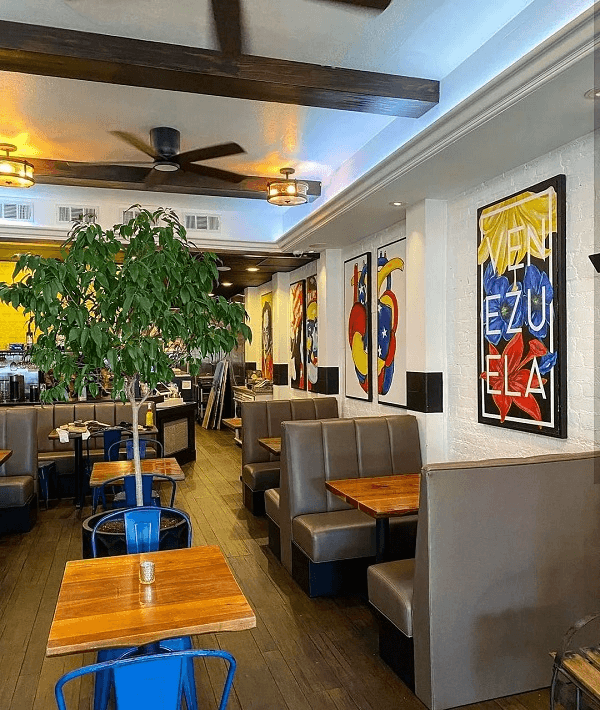
”At the San Francisco headquarters, we have chosen the strong liquor license to start offering Venezuelan typical drinks and rum such as Diplomático or Ron Santa Teresa. We are also doing some remodeling in the place to make it much more pleasing to the eye” she continued.
In addition, both the San Jose and San Francisco headquarters offer live music for diners to enjoy good Latin music while tasting their food. There is also a dance floor for those who wish to move to the rhythm of the orchestra of that day.
After taking the required steps, the first Arepas Latin Cuisine restaurant headquarters were opened in October 2021, but it was not easy. This was an effort made over many years in which Joanna did her best to be able to reach that point.
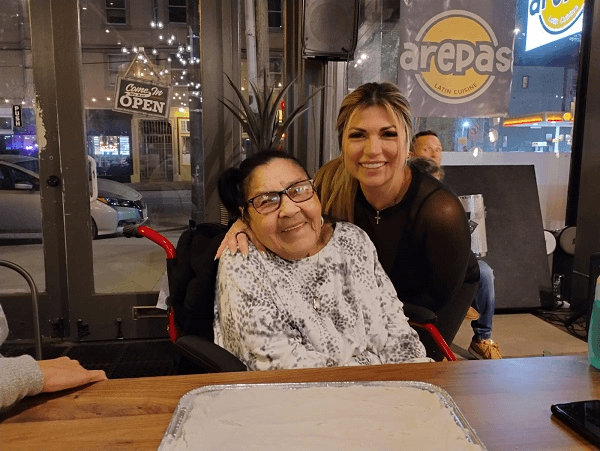
The beginning of everything was her grandmother, with whom the Venezuelan learned everything she knows about cooking. She was a cook, a cooking teacher and taught cookery courses and workshops to support her 12 children because she was widowed at a very young age. Joanna tells us that, at that time, she and her children made ground corn arepas to sell to markets and restaurants.
All this made her an inspiration to Joanna and led her to learn to cook since she was just nine. As a child, she knew that cooking would be important in her life.
Lots of secrets that Joanna learned from her, such as the way in which the dough has to be kneaded, the difference between making homemade arepas and arepas to sell, the amounts of ingredients to be used, the way to prepare the fillings for the dishes, among other things.
Joanna ensures that her recipes have been a boom in California, since there was no authentic Venezuelan food in San Jose, so her project was a pioneer in this area.
The reception her food has got with Americans, Chinese, Indians, Vietnamese and many other nationalities has been truly amazing because dishes from Arepas Latin Cuisine, besides being extremely delicious, were something that has never been seen before.
The taste for food at Arepas reached such a point that the restaurant provides lunch to more than 300 employees in several technology companies such as Netflix, Snapchat and Tinder. It is worth noting that workers who are benefited greatly appreciate being able to enjoy a rich and varied menu every day.
One of the biggest challenges Joanna has faced is to find employees who know the Venezuelan and Colombian cuisine (there are also several Colombian dishes on the menu) as it should be. ”Finding cooks with great experience has been complicated, but with the arrival of Venezuelan and Colombian migrants in California, we have been able to find staff with knowledge in the culinary arena” said the businesswoman on this topic.
For her, it is vitally important to employ people who are very clear about how to cook the main Colombian and Venezuelan dishes, so she takes this into account when recruiting her talents.
In addition to that, Joanna also sells Venezuelan products and has a hard time finding them in San Jose, so she has to bring them directly from Florida in order to sell them in California.
When Joanna was asked to give advice to future Latino migrants who wish to move to the United States, the first thing that she pointed out was that they must work very hard in that country to get ahead. In her particular case, she claims to have had three jobs at the same time, since she was alone in the United States and lived only from what she earned.
She also added that ”you have to make sacrifices to succeed in life and always do things well according to the laws of the country that welcomes you. I think that there are many Venezuelans who confuse ‘native cunning’ (taking advantage or others and the economic, political and judicial system failures to do whatever you want without consequences) with intelligence, which makes them believe that they are above others and make serious mistakes. You have to do things well and eventually the much-desired success will come,” said Joanna on such an important issue.
Read also: Young Puerto Rican singer Jeremy Bosch supports the Spanish Harlem Salsa Museum
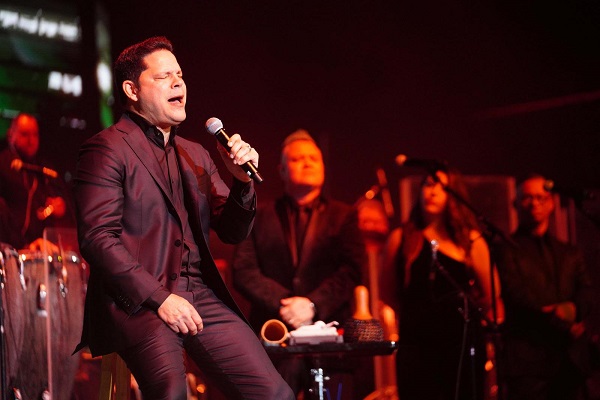
Before the concert, we were counting on hearing the songs that the salsero’s fans turned into hits. Certainly, the Coca Cola Music Hall witnessed how the euphoria with which Rey Ruiz catapulted in the early 90’s was revived. We knew we would hear the usual hits, such as ‘No me acostumbro’, ‘Si me das un beso’, ‘Amiga’, ‘Si te preguntan’, ‘Mi media mitad’, ‘Luna negra’ and ‘Creo en el amor’. To these were added ‘El Rey del mundo’, ‘Mal momento’, ‘El hombre de tu vida’, ‘Así se compone un son’, ‘Es difícil de explicar’ and a medley that included ‘Miénteme’, ‘Estamos solos’ and ‘Eso digo yo’.
An emotional Rey Ruiz sang ‘Cuba y Puerto Rico’, a song of his own authorship, arranged by Papo Lucca, which was included in his 4th album (Destino, 1996). For this special performance he was accompanied by the Puerto Rican cuatro player Prodigio Claudio. The concert was brought to a close with a tasty rendition of ‘Mañana por la mañana’.
Rey Ruiz was one of the soloists who firmly established himself in the salsa scene when salsa romántica was taking over the changing spaces of Latin music. Salsa dura was evolving to give way to the new trend we know today as salsa romántica. With the repertoire with which Tommy Villariny’s production and Jorge Luis Piloto’s pen were shaping the salsa artist’s career, the success was epic. That great takeoff in the career of the icon of salsa romántica was given with the impulse of the person Rey Ruiz calls “the daddy of the chicks”, his promoter: Edgardo Barreras. During the concert, Rey Ruiz made a stop to thank Edgardo and the late Tommy Villariny, who was represented by his son Oscar, for the success of his career.
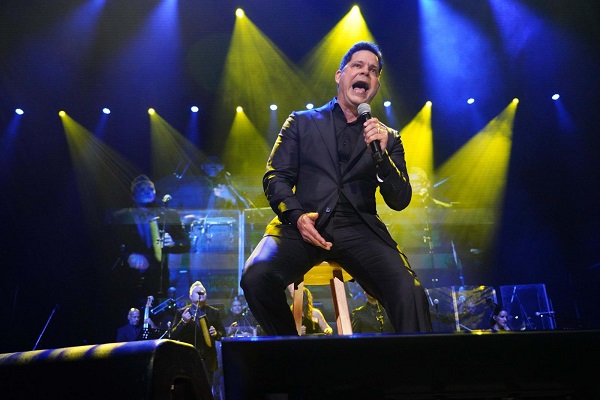
The performance at the Coca Cola Music Hall of the production by Rosalis Torres exceeded all expectations. It had been anticipated that there would be “a unique experience, a magical night with Rey Ruiz as part of his Contigo tour. The promise of an evening with the incomparable energy of Rey Ruiz on stage was fulfilled. Indeed, Rey Ruiz is a legend. His voice is unique, soft and romantic. However, that “softness” does not detract from his vocal strength, which he managed to show off accompanied by a large orchestra and symphonic sound.
The super orchestra that accompanied Rey Ruiz included Erick Castañeda on congas and musical direction, Elías Lopés, Jr. on timbales, Idelfonso Correa on bongo, Sergio Munera on bass, Héctor Ortiz on piano; Iván Odio, Mario Ortiz and Alfredo Pérez on trumpets; Alexander Zapata and Ramón Benítez on trombones; as well as Alain García, Laura Ruiz and Juan Carlos Gonzales on backing vocals. For the symphonic sound, the chamber orchestra featured Sarli Delgado on double bass and conducting the string ensemble; Leticia Medina, Olga Juliá, Stephanie Berríos Carla Berríos, Mariel Pagán and Emily Reyes on violins; Chrystal Villalongo and Gina Flaz on violas; and Keren Torres and Ruth Brin on cellos.

Also Read: Jerry Ferrao says in salsa key: “My life is a drum”.

 |
 |
 |
 |
 |
|
 |
|
 |
|
 |
|
 |
|
 |
|
 |
|
| Do you enjoy Latin music? Would you like to get more involved in this genre and share your passion for Salsa, Bachata, Kizomba, Merengue and more. Why not joint our Global Team of volunteers as a correspondent? You can ask for more details with no obligation and we’ll be happy to talk to you about the benefits that come with the role |
|