• Skip to primary navigation
  • Skip to main content

International Salsa Magazine

  • HOME
  • Previous editions
    • 2026
      • ISM / September 2026
      • ISM / August 2026
      • ISM / July 2026
      • ISM / June 2026
      • ISM / May 2026
      • ISM / April 2026
      • ISM / March 2026
      • ISM / February 2026
      • ISM / January 2026
    • 2025
      • ISM / December 2025
      • ISM / November 2025
      • ISM / October 2025
      • ISM / September 2025
      • ISM / August 2025
      • ISM / July 2025
      • ISM / June 2025
      • ISM / May2025
      • ISM / April 2025
      • ISM / March 2025
      • ISM / February 2025
      • ISM / January 2025
    • 2024
      • ISM / December 2024
      • ISM / November 2024
      • ISM / October 2024
      • ISM / September 2024
      • ISM / August 2024
      • ISM / July 2024
      • ISM / June 2024
      • ISM / May 2024
      • ISM / April 2024
      • ISM / March 2024
      • ISM / February 2024
      • ISM / January 2024
    • 2023
      • ISM / December 2023
      • ISM / November 2023
      • ISM / October 2023
      • ISM – September 2023
      • ISM – August 2023
      • ISM July 2023
      • ISM Edition June 2023
      • ISM – May 2023
      • ISM April 2023
      • ISM March 2023
      • ISM February 2023
      • ISM January 2023
    • 2022
      • ISM December 2022
      • ISM November 2022
      • ISM October 2022
      • ISM September 2022
      • ISM August 2022
      • ISM July 2022
      • ISM June 2022
      • ISM May 2022
      • ISM February 2022
      • ISM January 2022
    • 2021
      • ISM December 2021
      • ISM November 2021
      • ISM October – 2021
      • ISM September 2021
      • ISM August 2021
      • ISM July 2021
      • ISM May 2021
      • ISM April 2021
      • ISM June 2021
      • ISM March 2021
      • ISM February 2021
      • ISM January 2021
    • 2020
      • ISM December 2020
      • ISM November 2020
      • ISM October 2020
      • ISM September 2020
      • ISM August 2020
      • ISM July 2020
      • ISM June 2020
      • ISM May 2020
      • ISM April 2020
      • ISM March 2020
      • ISM February 2020
      • ISM January 2020
    • 2019
      • ISM December 2019
      • ISM November 2019
      • ISM October 2019
      • ISM Septembre 2019
      • ISM August 2019
      • ISM July 2019
      • ISM June 2019
      • ISM May 2019
      • ISM April 2019
      • ISM March 2019
      • ISM February 2019
      • ISM January 2019
    • 2018
      • ISM December 2018
      • ISM November 2018
      • ISM October 2018
      • ISM September 2018
      • ISM August 2018
      • ISM July 2018
      • ISM June 2018
      • ISM May 2018
      • ISM April 2018
      • ISM March 2018
      • ISM February 2018
      • ISM January 2018
    • 2017
      • ISM December 2017
      • ISM November 2017
      • ISM October 2017
      • ISM September 2017
      • ISM August 2017
      • ISM July 2017
      • ISM June 2017
      • ISM May 2017
      • ISM April 2017
      • ISM March 2017
      • ISM February 2017
      • ISM January 2017
    • 2016
      • ISM December 2016
      • ISM November 2016
      • ISM October 2016
      • ISM September 2016
      • ISM August 2016
  • Spanish
  • Download Salsa App
    • Android
    • Apple

Interviews

Julian Silva from La Excelencia has overcome the typical difficulties of the music business

American composer, producer, and musician of Colombian descent, Julian Silva, offered us a very pleasant conversation in which we touched all kinds of topics related to his career and the group he currently leads, Orquesta La Excelencia.

The artist has been received by any number of international markets and has been responsible for sold-out tours and performances in more than 16 countries in total, so we are honored to have spent some time with the musician and heard what he has to share with us.

Composer Julian Silva
This is composer, producer, and musician Julian Silva

What inspired Julian to get started in music?

Despite not having any family musicians, Julian emphasizes that his father used to play and sing with his brothers as a hobby, but what they did was not professional at all. It was mere entertainment. Due to this deep love for music, he would always listen to all kinds of artists, especially salseros, with his kids while they were young, which sparked Julian’s desire to learn to play.

That was how the young man born in Cali, Colombia, and nationalized in the United States, began playing guitar at the age of 11 and formed a small group with some friends in trio format. He also wanted to learn to play wind instruments such as the saxophone and trombone, as well as percussion. He also took other music classes in high school, but after that, all he learned by ear and practice. The same thing happened when writing and composing music, for which he did not need any formal training to help him with that.

Music and Psychology

After graduating in psychology from Louisiana State University, Julian moved to New York, as it was in this city that he could truly discover his Latin roots through art. It is worth noting that, thanks to this knowledge acquired during his university education, he has been able to combine the two careers he is passionate about.

After completing his undergraduate studies, he also finished a master’s degree in music therapy, which is why he defines himself as both a professional musician and a music therapist. In other words, he uses music to help people, especially children and older adults, improve their physical and emotional health.

Julian and his band
Julian Silva and his band La Excelencia

One of the things that inspired him most to use music as a form of therapy was his own experience as an immigrant. As a child who had recently arrived in Louisiana and did not speak English, he found it very difficult to connect with others because of the language barrier, so he started using music to achieve this.

First professional opportunities in music

While Julian was still in Louisiana, he noticed that there were not many Latinos in that state, but there was a fairly large group of Hondurans and Dominicans, so merengue was quite popular in that area. That was not what the young man was looking for, and many of these merengue groups, due to lack of experience with the genre, did not want to accept him, so he was always very clear that he wanted to start his own band to avoid such problems.

That was how, at just 17 years old, he had his own band and played at various venues across the United States, until he finally had to go to Austin, Texas, where they opened for Larry Harlow and his Latin Legends Band. It was that day that he had the opportunity to meet Harlow himself and timbalero Chino Núñez. During his talk with these stars, Julian shared his intentions to develop his career and Harlow and Núñez advised him that, if he truly wanted to play salsa and be successful, he had to move to New York, which he finally did after graduating from college.

Orquesta La Excelencia

While it is true that the official founding year of the band La Excelencia was 2005, it was in 2001 that he arrived in New York with a group he already had (Los Calientes del Son) which had previously been signed by a record label and was in the process of releasing its first album. However, the terrible and world-famous events of September 11th caused tourism to plummet dramatically and force New York’s arts to make a temporary stop. It is worth adding that reggaeton and bachata started to gain immense popularity, leaving salsa in oblivion.

La Excelencia at tempo Latino
La Excelencia performing at Tempo Latino in 2023

The facts described above caused the record label to leave off the album until conditions improved. In 2004, seeing that the situation never changed, Julian decided to deviate from his contract, form a new group he named La Excelencia, and create what he himself called “salsa with a social conscience.”

Since he did not know many experienced musicians, he recruited young aspiring musicians, some of whom had not even finished high school. At that point, he started writing more seriously, composed his first song, “La Lucha,” and faced one of the biggest challenges his fledgling orchestra would encounter: anonymity. He nor his bandmates were not at all famous because they had not studied with great musicians nor had any relatives with connections in the industry, which made everything much more difficult for them.

As they were gaining more and more recognition, they released albums such as “Salsa Con Conciencia,” “Mi Tumbao Social,” and “Ecos del Barrio.” In 2012, they took a break because the guys wanted to focus on their own careers, other projects, and starting families, but they were never completely apart. They got back together between 2018 and 2019, when they released their fourth album, “Machete,” which would be released in March 2020. However, fate surprised Julian again with the COVID-19 pandemic.

Although worried, they did not let the circumstances get them down and went ahead with the release so that people could enjoy their music from their homes during quarantine, which worked out pretty well in numbers and popularity.

Today, La Excelencia consists of Julian himself, bassist Luis Orona, pianist Willie Rodríguez, and singer Gilberto Velázquez.

Read also: Hector Rivera ‘‘Riverita’’ tells the story of how he created Riverita Y Su Orquesta Noche Caliente


Here is how the 2nd Edition of the “Ponce, Cuna de la Salsa Fest” Unfolded

The 2026 Ponce Cuna de la Salsa Fest honored the work of Don Tite Curet all weekend long.

The second edition of the Ponce Cuna de la Salsa Fest drew and welcomed more than 30,000 attendees to the Ciudad Señorial (The Majestic City), according to reports from the mayor’s office. The festival, which paid tribute to Don Tite Curet Alonso on the occasion of his centennial, took place at the Héctor Lavoe Stage inside the La Guancha Recreational and Cultural Complex, keeping salsa fans captivated throughout the entire weekend.

Willie Rosario
Willie Rosario

On Friday, July 31, 2026, the opening day kicked off right on schedule, delivering an organized, top-tier lineup.

El Junte Ponceño, under the direction of Julito Alvarado accompanying Dakota Flores, Kriptony Texeira, and Wito Colón opened the show, making it clear why Ponce retained its title as the “Cradle of Salsa” (Cuna de la Salsa) for the second consecutive year. To achieve this, the Ponce-born trumpeter, who is the director of the Juan Morel Campos Music Institute and the musical leader of El Gran Combo de Puerto Rico, assembled a roster of master musicians, including: José “Murcy” Reyes on congas, Richie Carrasco on bongo and cowbell, Pablo Padín on timbales, Reynaldo Burgos on piano, Efraín “Frao” Hernández on bass, Víctor “Yuka” Maldonado on baritone sax, Víctor Vázquez on trombone, Carlos Atiles on trumpet, Francisco Javier Quiñones and Juan Bautista on backing vocals, as well as emerging trombonist Carlos Malavé a recent graduate of the Juan Morel Campos Institute who stepped onto a major international stage within the salsa movement for the very first time.

Don Perignon y La Puertorriqueña

El Junte Ponceño was followed by Charlie Aponte and his orchestra, who, as always, kept the stage ablaze. This set the tone for the grand finale led by Luisito Figueroa’s Orquesta Abran Paso, backing Luigi Texidor, Anthony Colón, and the First Lady of Salsa, Yolanda Rivera.

The second day, Saturday, August 1, featured a stellar lineup: Los Guardiola, Don Perignon y La Puertorriqueña proving themselves to be a world-class orchestra in front of an audience represented by delegations from Italy, Venezuela, Mexico, Spain, Colombia, Peru, Costa Rica, Nicaragua, Argentina, Panama, Ecuador, Japan, and Thailand, along with many Puerto Ricans from across the island and the diaspora. Willie Rosario and his crowd-pleasing band showcased the ever-treasured playing of “Míster Afinque” behind his timbales, handing off the drumsticks to his grandson, Yoaquím Cintrón Rosario, between songs. The grand finale of the second night was delivered by Moncho Rivera, who faithfully upheld the legacy of El Sonero Mayor, blending in his now extensive repertoire as always. The municipal administration ensured smooth traffic flow by establishing designated transportation shuttles into the recreational complex.

multitud
multitud

The third and final day of the 2026 edition of this salsa landmark event kept the genre and its Puerto Rican exponents flying high right from its birthplace, Ponce. This was made possible by the Honorable Mayor of Ponce, Marlese Sifre, the Salsoul team under the programming of Ricardo Padilla-Núñez, and the production of Madera Events. Adding to the musical lineup was a cultural exchange with the city of Cali, featured through the voice of Willy García. The artists who kept the Sunday crowd fully locked into Ponce Cuna de la Salsa Fest mode until the very last minute were Papote y su Grupo Esencia, Bobby Valentín and his orchestra, José Alberto “El Canario”, Luis Enrique, and Andy Montañez and his orchestra. The event closed with a tribute to the late, legendary composer from Guayama, Catalino “Tite” Curet Alonso, featuring the Orquesta del Centenario performing his musical repertoire under the direction of Pete Perignon. They backed an extraordinary lineup of vocalists: Tito Allen, Herman Olivera, Papo Sánchez, Jeremy Bosch, and Caleño singer Willy García.

Carmencita DJ kept the music flowing, staying true to the central theme of the Ponce event and keeping Don Tite Curet’s music playing all weekend long.

Photo of Julito Alvarado: (c) Bella Martínez

All other images: (c) Ciudad de Ponce & (c) Visit Ponce

Bella Martinez Puerto Rico

Also Read: Bella Martínez, Salsa’s Irreverent Writer


Colombian producer, composer, and singer Alea: from the Guajira Colombiana to Boston

Colombian singer María Alejandra Jiménez, also known as Alea, has given us the honor of answering our questions to know a little bit more about her and her career, which has us satisfied. We do not always have the opportunity to work with such a versatile and talented artist.

Today the young woman from the Colombian Guajira is an artistic producer, composer, and singer who has experimented with genres such as jazz, Latin jazz, and Colombian folk music, among others.

Composer Alea
Colombian producer, composer, singer and VO actress Alea Jimenez

What drew Alea’s attention to music?

In her response to the same question, Alea said she remembers to be a two or three-years-old girl when she attended her first salsa party in her living room. She also remembers how that music that she heard for the first time put her into a pleasurable trance-like state that had her dancing for hours. It was the rhythms and the beat that she loved so much she would never forget them.

She was just about 15 years old when she played her first paying gig. She describes the process of making herself as an artist as funny and very creative. However, it was not until 2015, when she was already living in Boston, Massachusetts, that she decided to take “Alea” as her stage name.

It was there where she finally became professional in the field by studying music at Berklee College of Music with a special focus on jazz and vocal performance. It is also worth mentioning that, prior to that, Alea had already studied organizational communication at Colegiatura Colombiana in Medellín.

Alea’s First EP

While it is true that official sources indicate that Alea released her first EP, *Alborotá*, in 2010, which, by the way, was nominated for Best Latin Album of the Year, but it is not quite like that. The Colombian artist corrected us, saying that her first EP was actually her graduation project, which was a recording with a strong focus on jazz and some of the typical folklore of her country. However, she still had a lot to learn and discover about music.

Alea singing
Alea singing live

When “Alborotá” was finally released, it was her first approach to the sound she truly wanted to achieve. Alea sought that her music served as tribute to her Latin American roots, to feminism, and to women’s empowerment in this era. Likewise, she wanted to propose a sound coming from the city that inspired her most at the time: New York.

It was a very contemporary acoustic sound produced by the independent vinyl record store, Jarana Records. The artist says she was carried away by how the music made her feel, and, to her surprise, the public welcomed the album incredibly well, much better than she initially expected.

She never in her life expected that her work resulted in one of the best albums in Rolling Stone and the broadcasting and media organization National Public Radio (NPR), but it indeed was so, which means that all her effort was completely worthwhile.

Being an independent artist without the necessary financial resources to invest in promotion or marketing, this triumph made her feel much prouder of herself than she could have ever imagined.

Voice Acting

In addition to singing, something that Alea loves to do, she has also devoted a large part of her career to acting and lending her voice to major productions while still living in Mushaisa, La Guajira, and later in Medellín. She would also do so in the United States, as she always liked this artistic branch.

Singer Alea
Singer Alea Jimenez
Bassist Andres Fonseca Alfonso
Guitarist Gustavo Alfonso Diaz
Saxophonist D.J. Duffy
Trombonist Melisa Raquel
Choreographer Argelia Rossana
Musical director Felipe Fournier

While still in Colombia, she also had the opportunity to learn a bit about radio and television broadcasting when she was studying in her home country, so all these areas were very easy to learn for her. This also served as a second career for her, this in order to take the heat of her having to derive all of her income from music.

First, she worked as a production associate for a music and sound company, and then as a producer, which gave her a very clear visión about how to do things properly in this field.

She also told us that she has her own home studio where she pretty much does all her work and that she has taken workshops with SAG-AFTRA (the leading union of entertainment and communications professionals in the United States) as a member.

She has also lent her voice to various commercials for major companies such as Walmart, Nissan, Verizon, MLB Bobbleheads, LinkedIn, Pepto, Corona Refresca, Google’s Waze, Liberty Mutual, and Denny’s.

Read also: We’ve talked with Elizabeth Meeker Howard, one of the members of Las Sabrosas Latin Orchestra

It is a pleasure to welcome Erim Kardes and Gustavo del Pino from Los Calicubanos to ISM

We are very happy to share a little with musical director, Erim Kardes, and pianist, Gustavo Del Pino, of the band Los Calicubanos, from whom we had the pleasure to hear a bit about their individual careers and the foundation of their current group.

The interview, conducted in both English and Spanish, touched on some very interesting topics about music in general, and we hope all who read it will enjoy it.

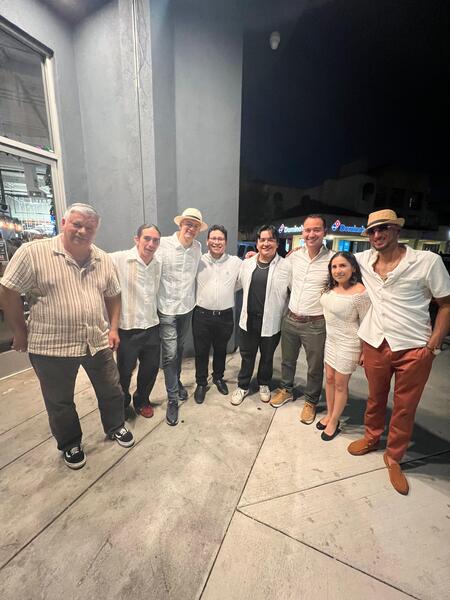
Erim and the rest of the band
From left to right Jim Miranda on Congas, Arturo Ramirez on Timbales, Erim Kardes on bass, Mark Trejo on Trumpet, Andy Garcia on Trombone, Gustavo Del Pino on piano, Marisol Echegoyen on Vocals, Luis Jimenez on vocals

Erim and Gustavo’s beginnings in music

The first to take the floor was Gustavo, who told us that he started playing piano at the age of six. His father played the saxophone and his mother played the piano, but they saw music only as a hobby and were not professional musicians. Throughout his childhood in Peru, he listened to a lot of Latin music at family gatherings, so six years later, at about age 12, he was already performing in front of crowds. Among his family’s most loved artists were El Gran Combo from Puerto Rico, Héctor Lavoe, and Rubén Blades.

After that, he studied classical music in a conservatory, and when he finally moved to the United States and met Erim and the rest of his bandmates, he studied at Berklee College of Music in Boston.

In Erim’s case, he said he started playing the guitar when he was 14 years old in Turkey, the country where he grew up. Like Gustavo, no one in his family was a musician, but that did not stop them from listening to Turkish music all the time, and it was from there that he started to like it beyond entertainment.

By the age of 20, he became interested in Latin music and began experimenting with it. He was in graduate school studying engineering in Los Angeles, where he had been living for some time, and taking some jazz courses at the University of California. One of his professors was the one who finally introduced him to Latin music, and he liked it so much that he never separated from it again. One of his most important teachers was legendary bassist from the band Weather Report, Alphonso Johnson.

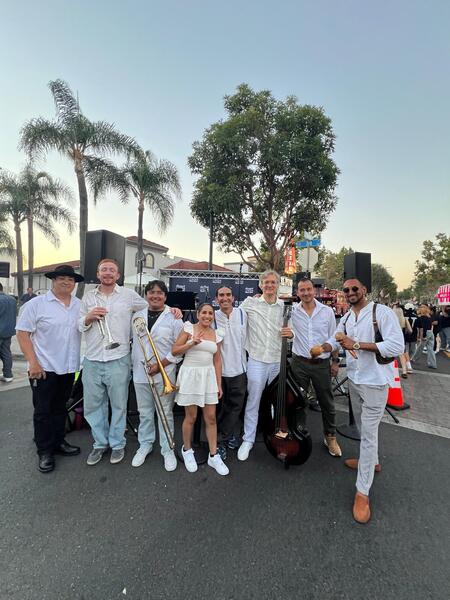
Erim and the rest of the band
From left to right Jim Miranda on Congas, Arturo Ramirez on Timbales, Erim Kardes on bass, Mark Trejo on Trumpet, Andy Garcia on Trombone, Gustavo Del Pino on piano, Marisol Echegoyen on Vocals, Luis Jimenez on vocals
Erim and the band
From left to right: ERNESTO VALENZUELA on Congas, Joseph Dubois on Trumpet, Andy Garcia on Trombone, Marisol Echegoyen on Vocals, Arturo Ramirez on Timbales, Erim Kardes on bass, Gustavo Del Pino on Piano, Luis Jimenez on Vocals

Professional start for both

Coming back to Gustavo, he told us that when he completed his studies at Berklee, he began to get his first jobs as a professional musician. He started making small tours with some of the classmates alongside whom studied there and was involved in the recording of a few albums, but as a session musician. He did not yet have a formal band to be part of, but he did play with some Argentine, Colombian, and Peruvian artists and musicians. Some of them were Colombian singer Alejandra Jimenez “Alea” and the Peruvian band Perú Meztizo.

On the other hand, Erim told us that he first played bass in rock bands in college. He also played funk and jazz in Los Angeles for some time.

Foundation of Los Calicubanos

Erim created the idea of Los Calicubanos and eventually founded the band. The group, as it is known now, was officially launched in August 2025, i.e. that this month would be its first anniversary. Once he knew what he wanted, he placed online ads looking for a pianist to join him, which is when Gustavo contacted him and was tested until finally staying with the job.

At that same time, he met percussionist Arturo Ramírez, so the three of them got together in June 2025, and officially launched Los Calicubanos in August of the same year. They were later joined by conga player Jim Miranda, singer Luis Jiménez, singer Marisol Echegoyen, trombonist Andy García, trumpeter Mark Trejo, and trumpeter Joseph Dubois.

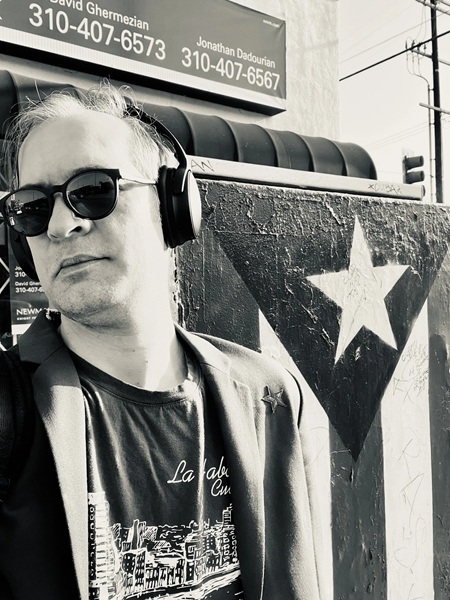
Musical director Erim Kardes
This is music director for Los Calicubanos Erim Kardes

Erim has been in California for the last 25 years and also traveled twice to Cuba, which led him to discover rhythms that fascinated him and changed his perspective on music completely. Therefore, he decided to combine “California” with “Cuba” because of the mix he wanted to make as a result of the music he discovered in both places.

Upcoming events

Los Calicubanos do not have any tours scheduled at this time, but they do have many important performances, such as the LA Jazz Festival, concerts at restaurants, and a few private events.

As for new releases, they are currently writing completely original music and making new arrangements, but they want to have a fair amount of material ready before entering the studio to record.

Read also: Puerto Rican Trombonist and percussionist Arturo Vazquez Jr. from Projecto 7 Salsa & Latin Jazz Band

Hector Rivera ‘‘Riverita’’ tells the story of how he created Riverita Y Su Orquesta Noche Caliente

After several attempts, we finally managed to meet with bandleader and saxophonist Héctor Rivera, known in the industry as Riverita, and ask him all kinds of questions about his artistic career and his current group, Riverita y Su Orquesta Noche Caliente.

Here are some of the most important issues we touch with the artist during our pleasant conversation:

Riverita posing for the camera

Riverita’s inspiration to become a musician

Despite not having musicians in his family, Riverita remembers growing up in an environment where music was always very present. He was born in New York, but spent long periods living with his grandparents in Puerto Rico while his parents settled down and eventually moved to the “Island of Enchantment” to give their son greater stability.

At his grandparents’ house, he used to listen to great artists of the time performing their unforgettable hits on the radio and one of them was Mon Rivera Y Su Orquesta performing “Karakatis-ki,” a song he never forgot, along with so many other musical pieces that gradually got him interested in this world. When his parents returned to Puerto Rico and he returned to live with them, he started listening to Cheo Feliciano, Pete “El Conde” Rodríguez, Felipe Rodríguez, and many others.

All these rhythms led the boy to play a sort of percussion on the table, a biscuit tin, or anything else that served as an instrument for him at the time.

His passion for music grew to the point that he began studying music education at the Escuela Libre de Música in Ponce and, subsequently at the Inter-American University of Puerto Rico in San Germán, where he studied for only about two years. Although he did not complete his studies, this helped him to understand even more the profession and apply what he learned during those years.

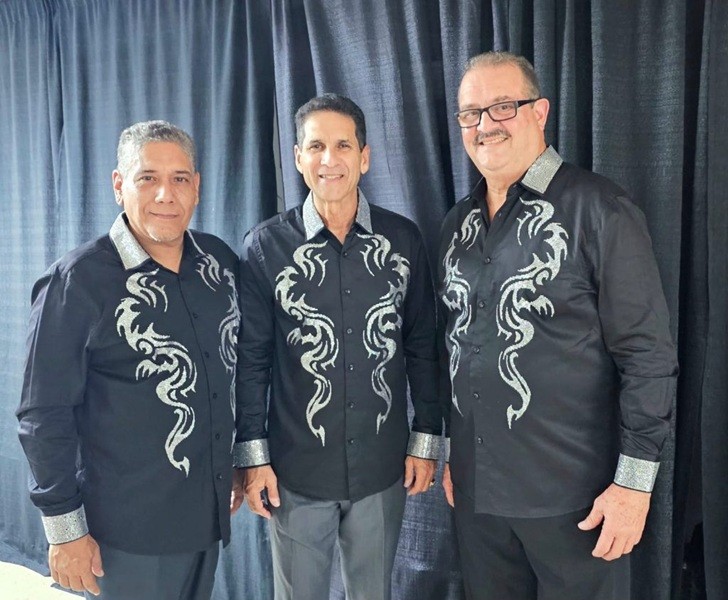
Danny, Riverita, and Jose
Riverita with two maracas

Being in Puerto Rico, he played with a merengue orchestra whose name he does not remember, but with which he learned to play alto saxophone professionally. After that, he moved to the United States permanently.

Year 2013

As he moved to Virginia, he took a long break from music until 2013, which is when his cousin, Michael Valladares, asked Riverita to found an orchestra, which was not in his plans. However, he accepted the challenge and carried forward the project.

Back then, the artist worked as a mailman at a post office, making it difficult for him to reconcile his previous professional activities with the direction of an orchestra. Still, he did not allow that to discourage him and chose to give priority to this new ensemble.

It all started when Michael was looking for an orchestra to perform at a gala event to celebrate 500 years of the city of Melbourne, Florida, so he contacted Riverita and proposed him to create an orchestra in which he would serve as musical director for the sole purpose of performing there. That was when the saxophonist set about finding musicians and producing a repertoire, which was not easy, since he did not know any professional musicians and did not have any arrangements he could use.

Danny, riverita, and Jose
Danny Rivera Jr., Riverita, and Jose Reyes

He was so distressed that he spent sleepless nights thinking about how to proceed to complete the mission entrusted to him. With three months to go, he had no time to spare. That is when he managed to make contact with a group of musicians of different nationalities, of whom only the singer, José Reyes, continues to work with him.

Finally, he relaunched the project with a new group of musicians—since the previous ones had left and called it Orquesta Noche Caliente, a name that it still bears today.

Among the most frequently recurring members, we can mention singer José Reyes, singer Danny Rivera Jr., pianist Kevin Figueroa, and trombonist Derick Harris.

To date, they have recorded three CDs and 26 songs. Some of them are “Noche Caliente,” “En Tiempos de Bolero,” and “Mi Linda Música.” They are also preparing their Christmas song several months in advance and will name it “Rabito de Lechón.”

Read also: Cuban-American dancer and actress Jessica Pacheco presents us her own dance company Flamenco Tropical

  • « Go to Previous Page
  • Page 1
  • Page 2
  • Page 3
  • Page 4
  • Page 5
  • Page 6
  • Interim pages omitted …
  • Page 60
  • Go to Next Page »

International Salsa Magazine (ISM) is a monthly publication covering salsa activities around the world and has been publishing since 2007. It is a worldwide network of volunteers coordinated by ISM Magazine. Together, we work to strengthen salsa events around the world.