On other occasions, we talked to all-female musical groups to promote the tremendous female talent we have in Latin music. The amazing artist we talked to this time is no exception.
We are very happy to chat with trumpeter Elizabeth Meeker Howard, who told us about her fascinating project, Sabrosas Latin Orchestra, and some other aspects of her career worth mentioning.
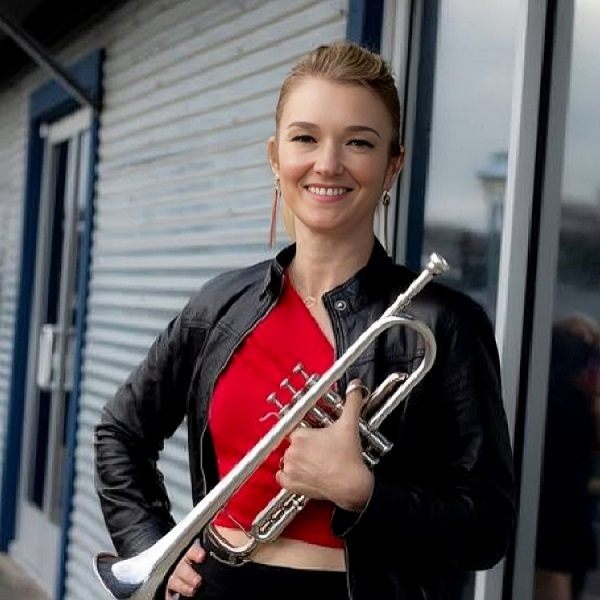
How Elizabeth started her career
The artist began her story telling us that some members of her family are involved into arts as is the case of her grandmother, who was a professional musician. Similarly, her parents instilled in her a love for music, so the young girl developed an appreciation about this world from an early age to the point that she joined the school band in fourth grade. She and her classmates were given the opportunity to choose their own instrument, so she chose the drums, but she soon discovered that it was not what she wanted to play.
When she was about nine years old, she began playing the trumpet and a little piano, but she would never use the latter professionally.
In adulthood, she began studying classical music, specifically, classical trumpet, at Yale University, but she knew she wanted to do something that would appeal much more to the public and make people dance and have fun, which is when salsa came into play. During her academic training, she experimented with other genres such as pop and its derivatives, but that was not what she was looking for her professional future. Today, she plays salsa, funk, rock, and even mariachi quite skillfully.
She also earned her bachelor of music in the área of classical trumpet from Boston University, and later earned a master’s degree in the same subject from Yale.
Beginning of her professional career
Elizabeth’s professional career as a musician began in high school, as she was hired for various small events. In college, she played with various bands and on projects of others, but she was not a regular member of any of them, and that situation continued even after she graduated from college. At that time, she was already working with salsa orchestras.
Once in San Diego, he learned everything he knows today about salsa, as this genre unfortunately is not taught in conservatories, as it happens with classical music and jazz. He added that “the only way to know salsa as a musician is to play in salsa bands. That’s how I learned: joining these groups.”
She does not deny that classical music offers a solid musical training to anyone who wants to study it, learn how to read music, transcribe it, and play the trumpet. If someone gives her a score, she is perfectly capable of playing that music, but it is also important for her to learn how to play that specific style. In the case of salsa, the artist says that it has some nuances that cannot be read in a score, so the attention should be paid to many details such as the joints between notes and the quality if the sound, which are only learned by listening to records and playing with musicians who are good at that style.
Las Sabrosas Latin Orchestra
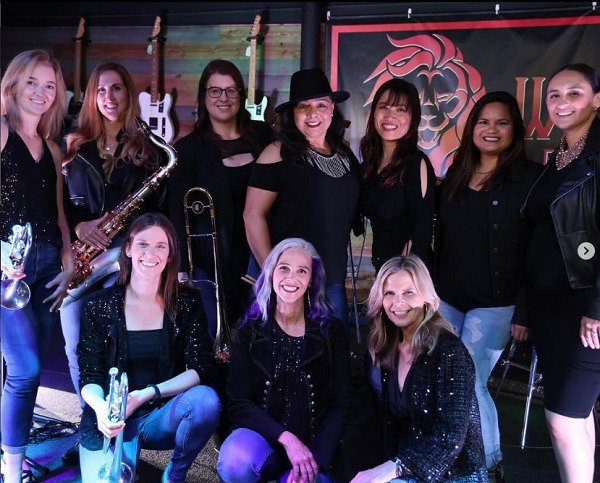
One of the things that spurred the creation of Las Sabrosas Latin Orchestra was the small number of women playing salsa, especially together, so she and other like-minded female artists began meeting up to rehearse and see how they sounded. At first, they were not sure enough how large or small the group would be, but eventually the girls who were already involved invited others to join, which resulted in a large salsa orchestra. Their official debut was scheduled for shortly before the pandemic, so it all got delayed a bit, but once the restrictions of that time fell, they were more than ready to start playing.
Something Elizabeth wanted to emphasize is that people have always been very supportive of them and showed much interest in the project due to the novelty of what they offered and the quality of their performance, which remains even today.
Music teaching
Besides being part of an orchestra, Elizabeth also teaches music at the university level and has led numerous student bands and ensembles, which has given her the experience needed to serve as musical director for various projects. Thanks to what she learned, she knows what can make a group succeed or fail.
Teaching and her work with Sabrosas complement each other perfectly, and one helps her be better every day at the other, which is why she speaks about both activities as a whole in her career.
Read also: Edgardo Cambon will celebrate his 40-year career at Yerba Buena Gardens

- Patrice, Jason, and Rony Perry from Steel Vibrations Steel Band promotes the steel pan in Houston - October 26, 2026
- Panamanian bandleader, composer, and jazz percussionist Ed East puts Iowa to enjoy Latin music - October 23, 2026
- Russian composer, artistic director, and saxophonist Yaacov Mayman conquers New York - October 12, 2026