“A technical and historical analysis of the virtuosity, timbral hybridization, and legacy of one of the most influential percussionists in jazz and global Latin music.”
The Heir to “Mañengue”
Giovanni Hidalgo, born in San Juan, Puerto Rico, in 1963, is universally considered one of the most virtuous and innovative percussionists of all time.
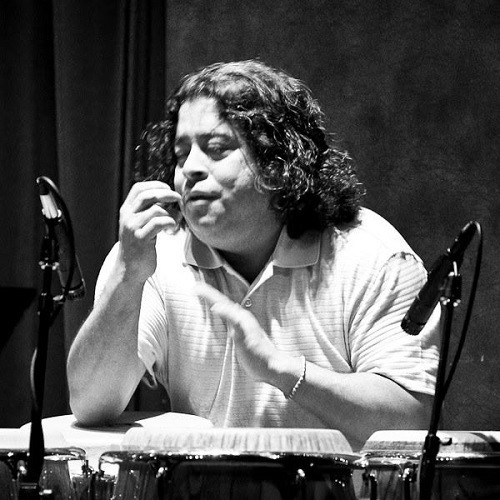
Affectionately known as “Mañenguito” because he is the son of legendary percussionist José “Mañengue” Hidalgo, he grew up in an environment where Afro-Caribbean rhythms were not only heard, but formed an everyday language.
Unlike many percussionists of his generation, Hidalgo’s training combined the rigor of empirical street-level learning with a methodical study of sight-reading (solfège) and formal technique.
From his early years, he displayed hand independence and speed that would redefine the global standard of conga (tumbadora) playing.
Technical Innovation: Rudiments Translated to the Conga
Giovanni Hidalgo’s major revolution within the percussion landscape lies in his adaptation of classic drum set rudiments to the congas.
Traditionally, conga execution relied on structured rhythmic patterns built around open tones, slaps, muted tones, and the heel-toe movement (marcha).
Hidalgo elevated this technique to an entirely new level:
- Hand and Finger Independence: He developed finger and wrist speed capable of replicating five-stroke rolls, flams, paradiddles, and ruffs at blistering speeds on the drumheads.
- Expanding the Set: He popularized the use of 4-, 5-, and up to 6-conga setups tuned melodically, transforming percussion into a harmonic and melodic instrument within the ensemble.
- Multilimb Polyrhythm: The ability to maintain independent clave lines while improvising melodic solos of high mathematical complexity.
Musical Career and Key Collaborations:
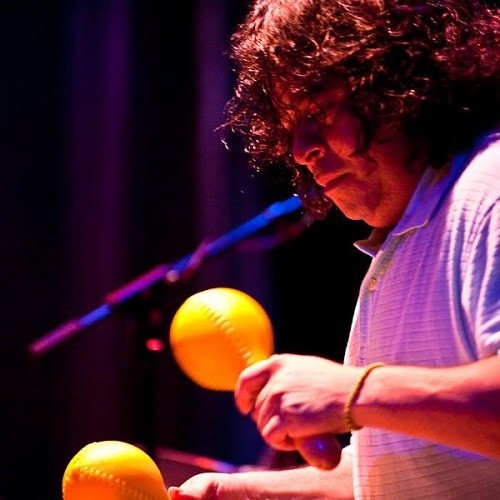
“Mañenguito’s” career is defined by his ability to effortlessly transition between salsa dura, Latin jazz, Puerto Rican folk music, and world music.
Career Highlights:
-
Batacumbele: In the 1980s, alongside musicians like Ángel “Cuqui” Santos and Dave Valentín, Hidalgo was part of the legendary group Batacumbele. The band revolutionized Caribbean music by integrating elements of Cuban songo with bomba, plena, and jazz.
-
Dizzy Gillespie and the United Nation Orchestra: At age 25, he was recruited by bebop icon Dizzy Gillespie. This era catapulted him onto the international jazz stage, performing at the world’s most prestigious festivals.
-
Planet Drum: His collaboration with Mickey Hart (drummer for the Grateful Dead), Zakir Hussain, and other international percussion masters culminated in the Planet Drum project, which won the first-ever Grammy Award for Best World Music Album (1991).
-
Trio with Michel Camilo: His recordings and live performances alongside Dominican pianist Michel Camilo and bassist Anthony Jackson represent one of the pinnacles of contemporary Latin jazz due to the level of energy and technical precision executed.
-
Eddie Palmieri: The union of Giovanni Hidalgo and Eddie Palmieri stands as one of the most explosive and revolutionary partnerships in the history of Latin jazz and Afro-Caribbean music. When Hidalgo’s technical virtuosity and speed on the congas met Palmieri’s aggressive, dissonant, and orchestral piano style, the result forever transformed contemporary percussion.
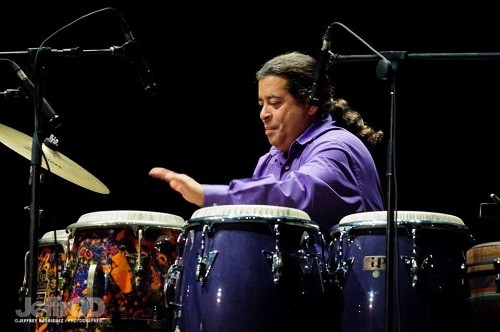
The Clash of Two Worlds (Late ’80s)
In the mid-1980s, Eddie Palmieri already a living legend for his innovations with La Perfecta and his salsa dura and Latin jazz productions brought the young Puerto Rican Giovanni Hidalgo into his group.
- The Impact: Hidalgo introduced a revolutionary language to the ensemble by adapting drumstick techniques to open-hand playing.
- The Synergy: In Giovanni, Palmieri found a percussionist capable of matching the power, polyrhythmic complexity, and harmonic tension he delivered from the piano.
- Highlights: The solidity of Giovanni’s conga work on tracks like “La Libertad / Comparsa” launched Hidalgo onto the international stage as the most influential conguero of his generation.
- The Innovation: Giovanni Hidalgo led the rhythm section with solos that defied the physics of conga playing through sheer speed, subtle dynamics, and refined tuning adjustments.
- Impact: Giovanni served as a generational bridge between the established masters of the Palladium era and the technical avant-garde of the new millennium.
- Award: The album Listen Here! won the Grammy Award for Best Latin Jazz Album in 2006, crowning a golden era of collaborations.
In May 2010, Hidalgo was awarded an Honorary Doctorate of Music from Berklee College of Music and is widely considered one of the leading Latin percussionists in the world today.
Tito Puente (“The King of Timbales”) and Giovanni Hidalgo (“Mañenguito”) represent one of the most powerful intergenerational encounters in the history of Latin music. Puente adopted Giovanni not only as his principal conga player during several key periods, but also as a virtuoso soloist capable of matching his speed, precision, and stage presence.
Golden Latin Jazz Giants and International Projects, among others.
Fania and Latin Jazz Supergroups: Alongside Puente, Giovanni was part of various “All-Star” ensembles that toured the most important jazz festivals in Europe and Japan (such as the North Sea Jazz Festival and Montreux).
The Generational Bridge: Puente represented the golden age of the Palladium Ballroom in New York, while Giovanni contributed the technical avant-garde of the new millennium. This synergy kept Puente’s music relevant to new generations of percussion students.
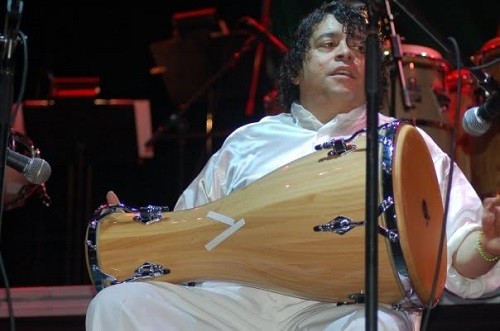
Comparative Chart: Hidalgo’s Contributions to Percussion:
| Technical Dimension | Traditional Execution (Pre-Hidalgo) | Giovanni Hidalgo’s Innovation |
| Finger/Hand Use | Based on wrist and hand weight | Individualized finger control for extreme articulation and speed |
| Setup Configuration | 1 to 3 congas in a primary rhythmic pattern | 4 to 6 congas tuned melodically in intervals |
| Rhythmic Vocabulary | Afro-Cuban claves and regional patterns | Integration of marching rudiments, bebop, and Indian polyrhythms |
Conclusion and Resilience
Giovanni Hidalgo did not merely alter the physics of playing the conga he expanded the creative boundaries of the instrument itself.
Despite the health challenges he has faced over the years, including complications from diabetes that affected his hands, his dedication and technical adaptability have demonstrated the strength of his musical spirit.
His legacy extends far beyond his recordings: “Mañenguito” taught the world that the conga is not just an accompanying rhythmic instrument, but a solo voice with infinite melodic, dynamic, and expressive possibilities.
Also Read: Learn to Play Percussion with Giovanni “Mañenguito” Hidalgo