• Skip to primary navigation
  • Skip to main content

International Salsa Magazine

  • HOME
  • Previous editions
    • 2026
      • ISM / March 2026
      • ISM / February 2026
      • ISM / January 2026
    • 2025
      • ISM / December 2025
      • ISM / November 2025
      • ISM / October 2025
      • ISM / September 2025
      • ISM / August 2025
      • ISM / July 2025
      • ISM / June 2025
      • ISM / May2025
      • ISM / April 2025
      • ISM / March 2025
      • ISM / February 2025
      • ISM / January 2025
    • 2024
      • ISM / December 2024
      • ISM / November 2024
      • ISM / October 2024
      • ISM / September 2024
      • ISM / August 2024
      • ISM / July 2024
      • ISM / June 2024
      • ISM / May 2024
      • ISM / April 2024
      • ISM / March 2024
      • ISM / February 2024
      • ISM / January 2024
    • 2023
      • ISM / December 2023
      • ISM / November 2023
      • ISM / October 2023
      • ISM – September 2023
      • ISM – August 2023
      • ISM July 2023
      • ISM Edition June 2023
      • ISM – May 2023
      • ISM April 2023
      • ISM March 2023
      • ISM February 2023
      • ISM January 2023
    • 2022
      • ISM December 2022
      • ISM November 2022
      • ISM October 2022
      • ISM September 2022
      • ISM August 2022
      • ISM July 2022
      • ISM June 2022
      • ISM May 2022
      • ISM February 2022
      • ISM January 2022
    • 2021
      • ISM December 2021
      • ISM November 2021
      • ISM October – 2021
      • ISM September 2021
      • ISM August 2021
      • ISM July 2021
      • ISM May 2021
      • ISM April 2021
      • ISM June 2021
      • ISM March 2021
      • ISM February 2021
      • ISM January 2021
    • 2020
      • ISM December 2020
      • ISM November 2020
      • ISM October 2020
      • ISM September 2020
      • ISM August 2020
      • ISM July 2020
      • ISM June 2020
      • ISM May 2020
      • ISM April 2020
      • ISM March 2020
      • ISM February 2020
      • ISM January 2020
    • 2019
      • ISM December 2019
      • ISM November 2019
      • ISM October 2019
      • ISM Septembre 2019
      • ISM August 2019
      • ISM July 2019
      • ISM June 2019
  • Download Salsa App
    • Android
    • Apple
  • Spanish

Search Results for: Bobby Cruz

“Sonido Bestial Sinfónico” solidifies classical sound in salsa

The February 27, 2026, performance of Sonido Bestial Sinfónico, which reunited “The Kings of Salsa,” Richie Ray and Bobby Cruz, at Puerto Rico’s Coca-Cola Music Hall, served as a farewell for Bobby Cruz. With a sold-out crowd thanks to Alexandra Fuentes’ production and a promotional alliance with the radio station Salsoul the legendary salsa vocalist said goodbye to the stage, insisting that while death had come looking for him, it had taken Willie Colón instead.

"Sonido Bestial Sinfónico" solidifies classical sound in salsa
“Sonido Bestial Sinfónico” solidifies classical sound in salsa

During Sonido Bestial Sinfónico, the audience also celebrated the 81st birthday of virtuoso pianist Richie Ray (born February 15) and the 88th birthday of singer Bobby Cruz, who celebrated his birthday the day before the event. Midway through the performance, the duo took a moment to blow out the candles on a cake brought onto the CCMH stage.

The concert was conducted by maestro Cucco Peña, featuring the voice of Yanira Torres and the Philharmonic Orchestra of Puerto Rico. From the local salsa scene, standout musicians included timbalero maestro Edwin Clemente, Emanuel Navarro on congas, and Richie Carrasco on bongo and cowbell, alongside the essential bass swing provided by Edwin Morales, director of the Orquesta Mulenze. Richie Ray’s wife, Angie Maldonado, and Jerry Medina were featured on backing vocals.

This symphonic concert, which celebrates more than six decades of “The Kings of Salsa” in music, had been postponed from its original date of October 25, 2025.

The repertoire included major hits popularized by the duo that have become classics of tropical music. Following a symphonic medley opening, the setlist included “Sonido Bestial,” “Agúzate,” “Richie’s Jala Jala,” “La Lluvia,” “Míster Trumpetman,” “El Diferente,” “Mi Amigo Juan,” “Yo Sé Que Te Amo,” “La Zafra,” “Juan en la Ciudad,” “A Mi Manera,” and a reprise of “Sonido Bestial,” among others.
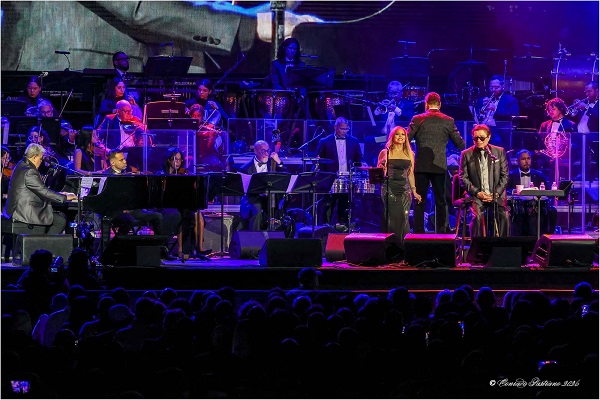
The performance on Friday, February 27, 2026 of the Symphonic Bestial Sound concert that reunited "The Kings of Salsa", Richie Ray and Bobby Cruz
The performance on Friday, February 27, 2026 of the Symphonic Bestial Sound concert that reunited “The Kings of Salsa”, Richie Ray and Bobby Cruz

The show’s pinnacle featured Cucco Peña singing “Idilio” alongside Norberto Vélez in a heartfelt tribute to the late Willie Colón. The conductor acknowledged that figures like Willie Colón have made it possible for Puerto Rico to hold an important place on the global stage, affirming that “music is the face of Puerto Rico to the world.”

Richie Ray interjected a segment in which he shared his testimony of conversion to Christianity, extending an invitation to anyone who wished to join the ministry he now leads as a pastor. During this segment, the song “Hombres de Valor” was performed.

Another significant moment occurred when Bobby Cruz sang “La Novia,” clarifying that he is “free, but not available.” In addition to the hits achieved during the duo’s monumental and historic musical career, Richie Ray led several classical music pieces adapted for salsa.
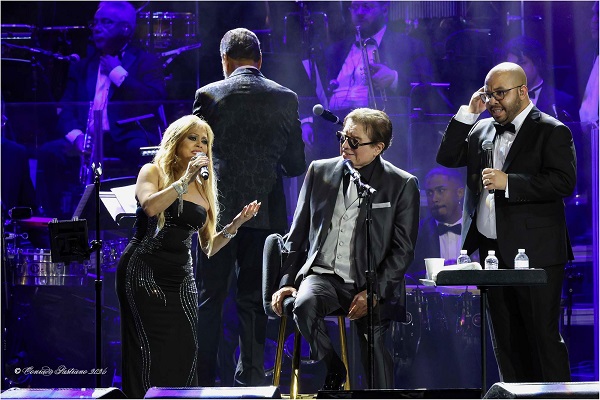
The Coca-Cola Music Hall in Puerto Rico served as Bobby Cruz's farewell concert. It was a sold-out show.
The Coca-Cola Music Hall in Puerto Rico served as Bobby Cruz’s farewell concert. It was a sold-out show.

The patriotic finale featured the performance of “Mi Bandera,” which served as a farewell from both Richie and Bobby to the island, as both artists reside within the Puerto Rican diaspora in the continental United States. Events of this magnitude are what give deep meaning to maestro Cucco Peña’s statement: “Music is the face of Puerto Rico to the world” within the universal musical scene.

Bella Martinez Puerto Rico


Also Read: Don Perignon and La Puertorriqueña Release Classique et Savoureux
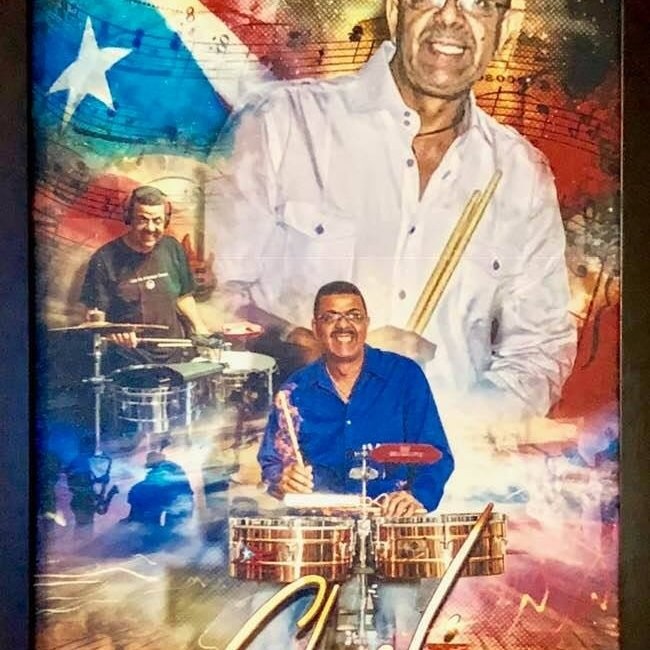
 

Charlie Sierra was a prominent Puerto Rican timbalero, recognized for his long musical career and virtuosity on the instrument

Carlos Manuel Sierra Sánchez, better known in the music world as “Charlie Sierra,” was born on October 10, 1956, in Vega Baja, Puerto Rico.

Charlie Sierra fue un destacado timbalero puertorriqueño

An excellent percussion musician from Barrio Sabana, Charlie Sierra recorded with important figures in music such as Don Mario Ortiz, Andy Montañez, Raphy Leavitt, Marc Anthony, Oscar D’León, Julito Alvarado, and many others. He even recorded the album Bravo by the Fania All-Stars in 1997.

To the worldwide community of salsa fans (salsómanos), he was a member, along with Chago Martínez, Tito De Gracia, Edgardo Morales, and Edwin Clemente, of the Gran Cumbre de Timbaleros (Great Summit of Timbaleros) that emerged in Puerto Rico’s rumbero (Afro-Cuban rhythm/rumba) scene during the penultimate decade of the 20th Century.

Charlie Sierra fue un destacado timbalero puertorriqueño reconocido por su larga trayectoria musical y su virtuosismo en el instrumento

Among these five virtuosos, the majority of the recording sessions in the Puerto Rican market were divided. The others were, practically, second choices for producers.

This fortunate circumstance allowed him to develop an impressive discography as a session musician, which includes the most stellar names in salsa. Likewise, he traveled across a large part of the globe as a member of the backing bands for many of those stars.

Our biographical subject was a child when he began, without a teacher, to learn the bongos and drums which he also played on recordings and on stage and the timbales, leading him to be identified as a fundamentally intuitive musician.

At the age of thirteen, he moved with his family to Bayamón, and it was during his time as a student at the Nuestra Señora del Rosario School that he began to show signs of his talent.

At fourteen, he enrolled in the Ernesto Ramos Antonini Free School of Music (Escuela Libre de Música), where he was a disciple of the Argentine master Samuel Lipchik.

During that time, he also advanced his knowledge of the flute, guitar, and piano, instruments he would never cultivate professionally, as percussion was always his great passion.

Papo Lucca, Charlie Sierra y Cheo Feliciano

However, his time at the Free School of Music was relatively brief (1972-1974). He soon began his professional career, gaining his first experiences with the Orquesta Rica and the Orquesta Tabú.

During this period, he received private lessons from the renowned professor Raúl Berríos Sánchez.

Fully immersed in the music scene, his name began to gain relevance in the salsa world following his tenure with the original Orquesta Mulenze, led by bassist Edwin Morales, during the 1976-1978 period.

At that time, this organization focused its work on providing accompaniment to solo singers affiliated with the genre, both national and foreign, who visited the island. He had the opportunity to travel with several of them: Santos Colón, Celia Cruz, Cheo Feliciano, Chivirico Dávila, Pellín Rodríguez, Yayo El Indio, etc.

From the Orquesta Mulenze, he moved to the lineup of Raphy Leavitt & La Selecta (1978-1979), with whom he had the opportunity to record hits like “La cosquillita,” vocalized by Tony Vega. He later worked with the orchestra led by pianist Tito Valentín, which featured Marvin Santiago as the vocalist.

He then joined trumpeter Mario Ortiz’s orchestra (1982-1984); he collaborated in the founding of the backing bands for the great sonero (Cuban son singer) Carlos «Cano» Estremera (1984) and the equally admired Tony Vega (1988).

In the interim, he worked independently and constantly recorded with other groups and a large number of soloists. He maintained this intense work routine until the present.

In 2009, Charlie Sierra organized his own orchestra, Paso Nivel, with which he recorded the album Ganas de bailar (Paso Nivel, CD-10692).

The album prominently features singer Efraín «Pichi» Gaetán, and included special guests such as Cheo Feliciano, Ismael Miranda, Andy Montañez, and Gilberto Santa Rosa, as well as Primi Cruz, Darvel García, and Héctor Luis «Pichie» Pérez.

Charlie Sierra was a distinguished Puerto Rican salsa timbalero, recognized for his long musical career and his virtuosity on the instrument.

He passed away on October 23, 2024, at the age of 67. Throughout his career, he collaborated with artists of the stature of Andy Montañez, Celia Cruz, Cheo Feliciano, and Bobby Cruz.

Musical Career: He began his career with the Orquesta Mulenze in 1970 and later joined Raphy Leavitt & La Selecta’s band.

Charlie Sierra y Orestes Vilato

Notable Collaborations:

He worked with Andy Montañez for over 25 years, being a key piece in his orchestra. He also collaborated with artists like Celia Cruz, Cheo Feliciano, Gilberto Santa Rosa, Bobby Cruz (on the hit “Sonido Bestial”), Tito Valentín, among others.

Own Orchestra: In 2009, he founded his own orchestra called Paso Nivel, with which he recorded the album “Ganas de bailar” (Desire to Dance).

 Collaborators:

L’Òstia Latin Jazz

Also Read: Orestes Vilato. Cuban multi-percussionist.

Latin America / October 2025

Luis Conte 2025Dave Valentín 2025Sammy Figueroa 2025Roberto "Bobby" Rodríguez 2025Jose Nogueras and Bobby CruzJeremy Bosch 2025Calibrated maracas

OCTOBER EVENTS 2025

Venezuela circular flag
VENEZUELA
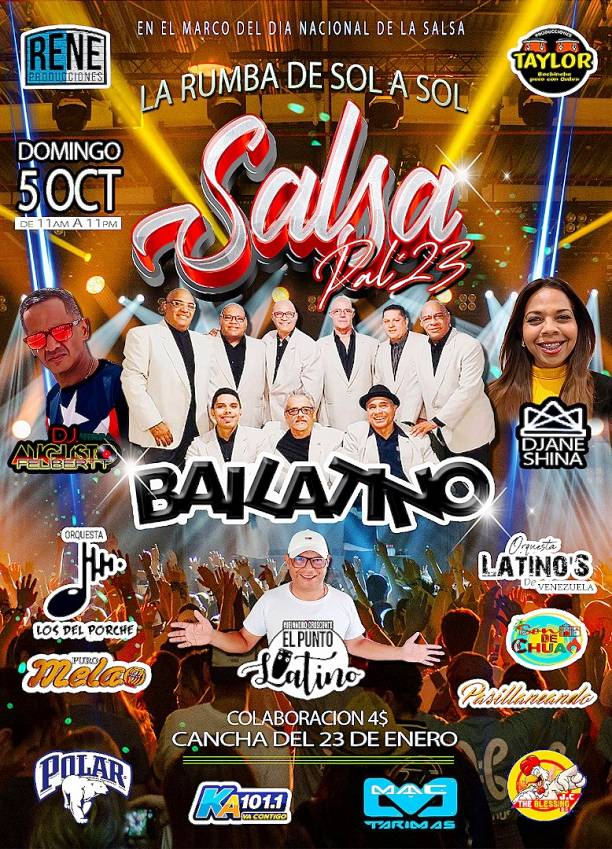
Salsa Pal'23

Puerto Rico circular flag
PUERTO RICO
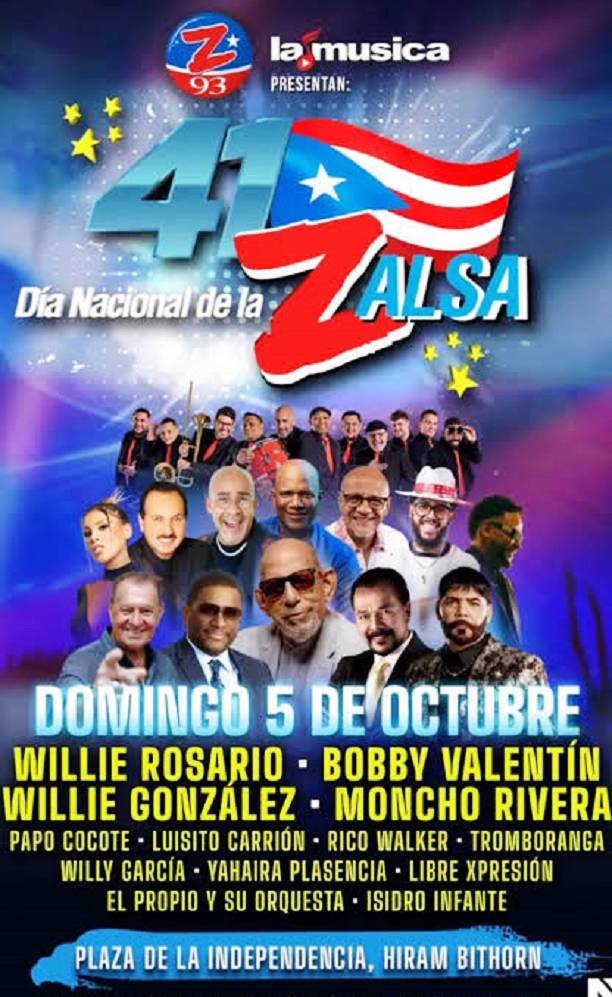
Dia Nacional Zalsa 2025
DIRECTORY OF NIGHTCLUBS

Argentina flag
ARGENTINA

Aruba circular flag
ARUBA

Belize circular flag
BELIZE

Bolivia circular flag
BOLIVIA

Brazil flag
BRAZIL

Chile circular flag
CHILE

Colombia
COLOMBIA

Costa Rica circular flag
COSTA RICA

Cuba circular flag
CUBA

Dominican Republic
DOMINICAN REPUBLIC

Ecuador circular flag
ECUADOR

Guatenala circular flag
GUATEMALA

Mexico Circular flag
MEXICO

Panama circular flag
PANAMA

Peru circular flag
PERU

Puerto Rico circular flag
PUERTO RICO

Venezuela circular flag
VENEZUELA


Melina Almodóvar “La Muñeca de la Salsa”

North America / USA / New York

Melina Almodóvar

Melina Almodóvar
Melina Almodóvar

With an unwavering spirit, melodious voice, Caribbean cadence on her hips, friendly and cataloged by many as sexy, Melina Almodóvar has represented the Latin female son in the US. During her 20 years of artistic career, Melina Almodóvar has conquered audiences in the most imposing scenarios and has shared stages with the most recognized artists of the tropical genre

The nickname as many know she is “La Muñeca de la salsa” and which for a long period of time she sought to have because she had the same name that already identified another Salsa singer. Getting an ideal pseudonym to her was difficult, but not for a fan who, while delighting in her live presentation, cataloged her with this nickname with which they would later recognize her in the whole world.

“I wanted to give myself a nickname for Salsa … But I did not want to change my name … And then one day a gentleman says to me:” Hey, but you are a doll and look how you sing “, and then it was there that I stayed “La Muñeca de la Salsa”. It’s a name that stuck with me and it stayed there, so everyone knows who “La Muñeca de la Salsa” is and sometimes they do not know who Melina Almodóvar is, but I really like that name, I think it’s very beautiful”, she said.

At the age of 14, the interpreter born in San Juan de Puerto Rico lived an experience that marked her life since then. She moved with her mother to Memphis, Tennessee, leaving behind her culture and family, which caused an emotional shock and made her take full refuge in the music.

Melina Almodóvar - Photo
Melina Almodóvar – Photo

“Salsa saved my life.” The Salsa is my way of life. It’s my way of breathing, of doing things “.

“We moved to a very white place to an extremely American place. The south of the US is a very different place from New York or Florida. There are not many Latin people and for me it was very hard … I started studying music at the High School. I got into all the choirs that I could and all the bands in the school where I could be”, told me Melina.

Melina Almodóvar - Photo 2
Melina Almodóvar – Photo 2

This Puerto Rican composer not only prepared in salsa, also studied different musical styles: Blues, Jazz and Gospel. What made her race for only 3 years at the University of Memphis the career of Musical Execution. Studies that she decided to abandon for working at the same time as a receptionist and translator for the City Council and also to continue pursuing her dream of singing Salsa professionally. “I decided to quit my university studies because I was really doing what I wanted to do: that was to be a singer… I thought it was better to leave school and nothing has gone wrong, I have continued doing everything at that moment, but on a slightly larger scale and for me it was the right decision”, commented Amodóvar.

During the 90s, Melina and other music professionals created the first salsa orchestra in Memphis called “La Orquesta Caliente”. With this band toured places like Alanna, Kentucky and Alabama. They played at such iconic venues as Beale Street, one of the most famous music streets in all the US for almost 4 years, just as they did at Young Ave Deli, a place that filled to its maximum capacity just to hear them sing and play Salsa every Monday. In this regard, Melina told me: “That’s when I started singing Salsa. That’s when I fell in love with salsa and I wanted to continue being a professional Salsa singer.”

Melina Almodóvar “La Muñeca de la Salsa” in concert
Melina Almodóvar “La Muñeca de la Salsa” in concert photo

In 2003, she began her musical career as an independent soloist with her first album Rumba’s Salsa Soul Delight, where she exhibited her creative freedom to compose, work with other people in the music industry and create her own identity in this tropical genre. So, her second álbum was La Muñeca De La Salsa Y Más (2008) and Pasión y Salsa Live in 2013.

In all her productions this Puerto Rican singer based in Miami, likes to sing to the love in a very positive way. Each song is a tropical proposal of Latin culture, passion, celebration, dance and happiness that invites the dancer to enjoy. “I like to talk positively about things that make me happy. I do not like to shoot men … Because it’s not what happened to me. “She added: “I have a bolero that’s called Mi Nueva Página de Amor, but it’s very positive.

Melina Almodóvar “La Muñeca de la Salsa” - Cover
Melina Almodóvar “La Muñeca de la Salsa” – Cover

”Although the Salsa is a genre dominated by men, Melina has shown to take firm steps and open field solidly in the music industry, she has sung alongside major figures such as: The Great Combo of Puerto Rico, Andy Montanez, Bobby Cruz, Gilberto Santa Rosa, Marlo Rosa, Tito Puente Jr., el maestro Larry Harlow and Tromboranga.

She has developed a successful musical career of 20 uninterrupted years that has led her to perform at the biggest annual festivals and daily events in the country. For nine years “La Muñeca de la Salsa” performed live shows in South Florida at Tapas y Tintos club located in Miami’s South Beach with el maestro Ricky Torres, where thousands of dancers from all over the world gathered every Tuesday to dance and enjoy her music.

Melina Almodóvar “La Muñeca de la Salsa” - Singing
Melina Almodóvar “La Muñeca de la Salsa” – Singing

In 2010, Melina and approximately more than 600 dancers broke the Guinness Record for the largest number of people dancing Salsa at the same time a song. The idea got with her former manager Frank Nieves. The theme was “Lista pa’ Impresionar” of her authorship and doesn’t rule in the near future to do it again. “We were there seeing how we could do something different for an event that he was doing here for the Broward County Patron Festivities and we said why we did not try to break the Guinness Record. Establish a Guinness Record of the greatest number of dancers dancing a song and then we did it and it was spectacular”, said Melina.

In 2016, she released to the national and international market the salsa version single “Estoy aquí” of the popular Pop singer Shakira, whose arrangement was made by Seferino Cavan. The video of “Estoy Aquí” was shot on the famous beaches of Miami Beach and already has almost 1 million views.

Melina Almodóvar “La Muñeca de la Salsa” - Photo
Melina Almodóvar “La Muñeca de la Salsa” – Photo

Likewise, and in mid of 2017, Almodóvar recorded with Tito Puente Jr. a new version in Salsa Mambo of the song “Mi Socio” created by Tito Puente and Cuban singer La Lupe popularized in 1965. In the same way, she did with the singer and composer Bobby Cruz the song “La Chica del Bling”.

Currently, Melina does live performances every Friday to 6pm at Best Time Wine Shop located on 8th Street at 64th and 8th, a wine warehouse with a large dance floor. “Ándale! Pon a Sonar el Güiro” is her most recent single, it was released since last December and you can find it on all digital platforms. During this month of January, Melina will continue playing her music through the territory of Florida with the event Los Patrones de la Salsa and on April 7 she will produce along with her friend Kristina Moinelo the biggest salsa festival in Miami, the Hollywood Salsa Fest, in which she will also participate as a main star with great figures of salsa music.

la muneca de la salsa - flyers
la muneca de la salsa – flyers

Melina Almodóvar believes that the Salsa will never die because it is in the Latin idiosyncrasy and at some point this AfroCaribbean genre will return to be that people like most. She also commented that she does not rule out the possibility in the future to do a fusion with the new urban musical trends of the moment.

“For me to represent Latin music in the US is a very big honor because I love tropical music more than anything. It’s my life, it’s my way of breathing like all the SALSEROS … For me, it’s the whole world to be able to continue my long-standing career, to go ahead and bring good Salsa for the whole World.” Melina Almodóvar

The Salsa is the NUMBER ONE music genre that is danced around the world. I believe that we are keeping this genre alive with what we are doing every day. “Melina Almodóvar

Melina Almodóvar “La Muñeca de la Salsa”

To more information about La Muñeca de la Salsa, please visit www.melinaalmodovar.com or like her on Facebook: www.facebook.com/pg/MelinaSalsa


Salsa, territory of joy.

Latin America / Venezuela / Caracas

Salsa, territory of joy, language of celebration, enjoyment of the towns and their people, was born from a confluence of facts, geniuses and rhythms. Confluence that happened in the faith of the same religion: Afro-Cuban music.

Salsa pal Bailador
Salsa pal Bailador

And that mixture, which Richie Ray and Bobby Cruz cleverly described as “similar to the tomato sauce that is put on hamburgers to give them flavor”, was summed up in the insightful sentence of the occasional witness, the journalist Phidias Escalona: “the music that you make is salsa. From now on we will call it sauce”.

The year was 1968 and although the new rhythm already existed, there had been no consensus on the name. And that consensus began to emerge -perhaps for the first time- on the album “Los Durisimos The Strong Ones, Salsa y Control”, by Richie Ray and Bobby Cruz. Later, Richie himself would add: “The word was born around us, (however,) if it weren’t for (Jerry) Masucci there would be no salsa, because he brought it to the world.”

In 1960s New York Harlem, black Americans had begun to like Latin music, despite not speaking Spanish.

Ama a tu musa como a ti mismo - Salsa
Ama a tu musa como a ti mismo – Salsa

The guajira dazzled them until they made them dance. Believing that the mixture of boogaloo, blues, mambo, guaguancó or son montuno, was a variant of the boogaloo invented by Chubby Checker, the new rhythm was founded, incorporating the concepts of the Latin spirit in their interpretations and that -technically- they would add to the baggage : percussion, piano, violins, trumpets, trombones and whatever instrument would serve to give it flavor and richness.

Cocola' Wears - Venezuela Salsa
Cocola’ Wears – Venezuela Salsa

Musically, for example, the so-called “blue notes” would be added (that is how the overtones of the acoustically weak E and B notes, last to be added to the scale, where they would be relocated between Lam and Lam) would be added to the new fusions. Then came the downloads and phrases that we know until now as characteristics of salsa.

Thus the sauce was born. And so it has been transformed, always within the circle that encloses joy, passion and enjoyment, history, experiences, fortune or misfortune, seen from different perspectives: urban, social, sensual or everyday.

Tocadisco - musica
Tocadisco – music
  • « Go to Previous Page
  • Page 1
  • Page 2
  • Page 3
  • Page 4
  • Page 5
  • Interim pages omitted …
  • Page 19
  • Go to Next Page »

International Salsa Magazine (ISM) is a monthly publication about Salsa activities around the world, that has been publishing since 2007. It is a world network of volunteers coordinated by ISM Magazine. We are working to strengthen all the events by working together.