• Skip to primary navigation
  • Skip to main content

International Salsa Magazine

  • HOME
  • Previous editions
    • 2026
      • ISM / April 2026
      • ISM / March 2026
      • ISM / February 2026
      • ISM / January 2026
    • 2025
      • ISM / December 2025
      • ISM / November 2025
      • ISM / October 2025
      • ISM / September 2025
      • ISM / August 2025
      • ISM / July 2025
      • ISM / June 2025
      • ISM / May2025
      • ISM / April 2025
      • ISM / March 2025
      • ISM / February 2025
      • ISM / January 2025
    • 2024
      • ISM / December 2024
      • ISM / November 2024
      • ISM / October 2024
      • ISM / September 2024
      • ISM / August 2024
      • ISM / July 2024
      • ISM / June 2024
      • ISM / May 2024
      • ISM / April 2024
      • ISM / March 2024
      • ISM / February 2024
      • ISM / January 2024
    • 2023
      • ISM / December 2023
      • ISM / November 2023
      • ISM / October 2023
      • ISM – September 2023
      • ISM – August 2023
      • ISM July 2023
      • ISM Edition June 2023
      • ISM – May 2023
      • ISM April 2023
      • ISM March 2023
      • ISM February 2023
      • ISM January 2023
    • 2022
      • ISM December 2022
      • ISM November 2022
      • ISM October 2022
      • ISM September 2022
      • ISM August 2022
      • ISM July 2022
      • ISM June 2022
      • ISM May 2022
      • ISM February 2022
      • ISM January 2022
    • 2021
      • ISM December 2021
      • ISM November 2021
      • ISM October – 2021
      • ISM September 2021
      • ISM August 2021
      • ISM July 2021
      • ISM May 2021
      • ISM April 2021
      • ISM June 2021
      • ISM March 2021
      • ISM February 2021
      • ISM January 2021
    • 2020
      • ISM December 2020
      • ISM November 2020
      • ISM October 2020
      • ISM September 2020
      • ISM August 2020
      • ISM July 2020
      • ISM June 2020
      • ISM May 2020
      • ISM April 2020
      • ISM March 2020
      • ISM February 2020
      • ISM January 2020
    • 2019
      • ISM December 2019
      • ISM November 2019
      • ISM October 2019
      • ISM Septembre 2019
      • ISM August 2019
      • ISM July 2019
      • ISM June 2019
    • 2016
      • ISM December 2016
  • Spanish
  • Download Salsa App
    • Android
    • Apple

Search Results for: Cuban music

Omar Ledezma Jr. shares with us the new from his project with Azesu

Today’s guest needs no further introduction because you know him very well. This is the talented Venezuelan percussionist and singer Omar Ledezma Jr., with whom we have been able to talk about his latest projects, one of which gets him focused and excited in equal parts. 

Omar talks to us about his projects
Percussionist and singer Omar Ledezma Jr. talks about his new project with Azesu

What is Omar Ledezma Jr. up to now?

After showing his gratitude for the latest of many invitations we have made to him in International Salsa Magazine, Omar went on to describe the new phase of his career, in which production plays a major role. We are talking about a project he has been involved in since 2011 called Azesu, which includes great musicians and is led by Cuban percussionist Orestes Vilato.

Although the initiative had progressed considerably, Omar and the rest of the group are still waiting for official communication from the social media of the organization that will fund the project by the artists who have applied for it. The group is awaiting approval, although they already have promotion, photos, and a series of details ready to be released once the financing becomes a reality.

What was required of Omar and the rest of the team to present the project

At the beginning, the idea of a recording was floated because this was one of the categories in which artists could apply for funding, so Omar and the others chose to pay tribute to Orestes Vilato. The organization loved the idea, which led them to be one of the groups chosen to receive this financial aid, and they are very happy about that.

However, not everything was rosy, as the members of Azesu could not find the right moment to start recording due to personal situations of some of them and the arrival of the pandemic. After overcoming all that, Jonathan Alford, the group’s pianist and overall director on the project, came to Omar with the idea of recording a second album (they had already recorded one in 2011, also called Azesu) to resume the project they had left behind.

It was then that the Venezuelan artist came up with the idea of paying tribute to Orestes and, in turn, bringing to life some of the lyrics written by his father, who passed away two years ago.

The material also seeks to be a tribute to that generation that is quickly departing, which is why Azesu tries to recreate those concepts and that way of making music, but at this time. 

Omar and the rest of Azesu
These are the members of Azesu from left to right: Sheldon Brown (Saxophone), Orestes Vilató (Percussion), Jonathan Alford (Piano), Maria Marquez (Vocals), David Pinto (Bass), and Omar Ledezma Jr. (Percussion and Vocals). Photo taken by Roddy Blelloch

Timeline and objectives for the project

When Azesu released his first album in 2011, it all started with Orestes calling some of the group’s members, who were pianist Jonathan Alfort, Venezuelan singer María Fernanda Vázquez, Peruvian bassist David Pinto, and American saxophonist Sheldon Brawn.

The project is not conceived as a commercial album in every sense of the word, but as a hymn to Las Americas that has a little bit of everything, including jazz, folklore, popular music, dance music, and many more elements coming together to create a unique and different result.

It is also important to note that Azesu’s new album, next to release in 2016, will feature new tracks and covers with completely new versions in the style of Azesu, some of which will be sung and others instrumental. In addition, the new music was composed and arranged by Jonathan and David, although Omar also played an important role in the creative process when it comes to lyrics and melody. It is anticipated that they will enter the studio to start recording in about three weeks, and the album is expected to be released before the summer of 2026.
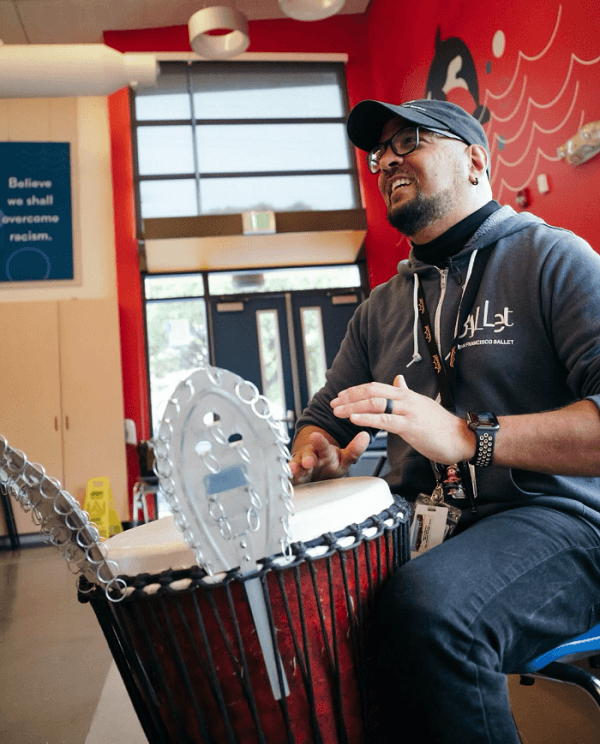
Omar teaching
Omar Ledezma Jr. teaching at the San Francisco Ballet School

Omar and teaching

We have already addressed the issue of Omar and his role as a teacher in previous editions, so we wanted to know if he is still teaching and which capacity he is using. The musician replied that the teaching part has been and will remain very important in his overall project as an artist, as he believes that, due to his profession, he has a great responsibility to showcase the music he grew up with and the instruments that have allowed him to develop his career.

He currently teaches Latin percussion at the California Jazz Conservatory at Berklee, which is basically a summer ensemble where students learn to play congas, timbales, and bongos. During the rest of the year, he focuses on specific instruments and developing the tumbadora curriculum.

He also offers private lessons in which students can enjoy a much wider range of instruments to learn, such as drums, cajón, bongos, timbales, and much more.

Omar concluded this important topic by saying, “I always take on the idea of remaining a student. Just as I teach classes, I want to continue acquiring knowledge and taking classes with teachers who know many things I don’t.”

Read also: Caesar Vera Y Su Sexteto NuevoSon, traditional Cuban music with a touch of modernity

Trombone player Lindsey McMurray from the women’s orchestra Las Chikas

Lindsey McMurray, bandleader of the group Las Chikas, has graciously accepted our invitation to talk about the women’s orchestra she is leading, which makes us very happy and pleased, so we invite our readers to enjoy this interview from beginning to end and learn about the musical journey of this young artist.

Lindsay from Las Chikas singing
Lindsey McMurray singing during a concert with Las Chikas

How Lindsey got started in music

Lindsey’s journey to become an artist began very soon at school, when she was just 10 years old and started learning to play the trombone. Prior to this, she had already studied other instruments such as the keyboard and the recorder, but she ended up trying the trombone.

Soon after, at the age of 11, she joined the school jazz band, but it was not until college that she began experimenting with salsa in orchestras that played this genre. Until then, Lindsey had had virtually no contact with Latin music, as she had only listened to typical U.S. rhythms. However, once she discovered Latin American music, she could not escape her love for it and continues to play it to this very day.

It should be noted that the musician does not have any family member who is too. So she would be the first one to make music her profession and, of course, one of the most important areas of her life.

Professional experiences prior to Las Chikas

Before even getting to know of the existence of Las Chikas, Lindsey was on a TV show called ‘’Noches Con Platanito’’ in the musical side, but she did not really lead anything until the bandleaders of the groups who were there left. Her big break came in 2017, when she finally managed to become a bandleader herself and, in turn, started two groups at the same time. 

This is because Lindsey did not want to depend on anyone be called whenever she was required, but, on the contrary, she wanted to go on developing her autonomy to the point of being the one to create jobs for others instead of looking for them somewhere else.

Whitney and Gabby from Las Chikas
Singers Whitney Hernández and Gabby Tamez from Las Chikas in Carson City

Las Chikas

It is important to clarify that Lindsey is not the founder of Las Chikas, but that the group already existed before she joined during the pandemic. The idea of Las Chikas was born during “Noches Con Platanito” as part of the show, but Lindsey and the other members wanted to have activities outside of the show and what the production asked them to do. At that time, the leader and founder of the group was Eliana Rose who during the pandemic wanted to settle in Southern California, so she asked the artist to take her place, which she accepted.

This posed a significant challenge for her, as she had never led a Latin music orchestra in her life. However, the novelty did not make him get cold feet, but on the contrary, it was an experience she wanted to live in order to learn from it.

The current members joined the group thanks to recommendations from friends and other people in the industry. Already at this point, it can be said that they all are her friends, to the extent that they have shared all kinds of special occasions such as birthdays, trips, and much more. 

Why only women in the orchestra

What catches the attention about Las Chikas is that, as its name suggests, it is only composed of women. One of the reasons is that the industry, despite of the recent social changes, continues to be dominated by men, so these young female talents find support between themselves.

What the original founder wanted was to promote the idea that a group of girls could play Latin music without it being perceived as strange. Lindsey shares this vision with hundred percent and hopes new generations of women never think for a moment that their gender is a limitation to achieve what they want in music.

Las Chikas with its certificate
Marina Panzetta, Shirly Ace, Lindsey Murray, Whitney Hernadez, Gabby Tamez, Maria Vega, Mayelin Vazquez, Alisha Ard Vazquez, Dolores Duran-Cefalu, and Anitta Garay from Las Chikas posing for the camera with its certificate from the City of Los Angeles. Photo taken by Craig Cochrane

While acknowledging that there have been positive changes in recent decades, she thinks there are areas that do not have enough female representation such as percussion, bass, production, arranging, among others. It is very common for women to be vocalists in a band, but it is still unusual to see them in other areas of the project.

Las Chikas as a mix of cultures and ethnicities

On the band’s website, it can be read that the group is a mix of diverse cultures and ethnicities. In this regard, Lindsey pointed out that, while it is true that she is not a Latina, she has always sought to create something as authentic as possible that is rooted in Latin culture, of course with great respect. “Latin music is so joyful, intelligent, and capable of being beautiful to the eyes of any human being who hears it. I also want in a certain way to make non-Latinos enjoy this beautiful music as much as I do,” Lindsey added on the subject.

She also said that diversity plays a very important role, as non-Latino audiences tend to feel that they have permission to be part of the joy emanating from this music. In addition to that, the fact that the members have diverse backgrounds helps the band have different perspectives on what they want to do.

Today, Las Chikas is composed of Cuban singer Mayelin Vázquez, Cuban singer Whitney Hernández, American pianist Dolores Duran-Cefalu, bassist María Vega, Mexican timbalera Anita Garay, Mexican conga player Diana Teixeira, American trumpet player Anne King, Mexican saxophonist Marina Panzetta, and Lindsay herself on trombone.

Read also: The best of Cuban music in Tampa with Cuband Son Band

Latin America / August 2025

David Atanacio: Percussionist, Composer and SingerEduardo Tancredi Miguel Zenón is widely regarded as one of the most innovative and influential saxophonists and composers of his generationIsrael "Cachao" López, a Cuban musician and composer, has been hailed as "the Inventor of Mambo."Trumpeter Davián Raúl Calibrated maracas

DIRECTORY OF NIGHTCLUBS

Argentina flag
ARGENTINA

Aruba circular flag
ARUBA

Belize circular flag
BELIZE

Bolivia circular flag
BOLIVIA

Brazil flag
BRAZIL

Chile circular flag
CHILE

Colombia
COLOMBIA

Costa Rica circular flag
COSTA RICA

Cuba circular flag
CUBA

Dominican Republic
DOMINICAN REPUBLIC

Ecuador circular flag
ECUADOR

Guatenala circular flag
GUATEMALA

Mexico Circular flag
MEXICO

Panama circular flag
PANAMA

Peru circular flag
PERU

Puerto Rico circular flag
PUERTO RICO

Venezuela circular flag
VENEZUELA


Alain Pérez Triumphs in Puerto Rico with a Confident Stride

The exclusive Tropicoro Club at the Fairmont El San Juan Hotel in Isla Verde was overflowing to welcome the multifaceted Cuban musician Alain Pérez, who performed in Puerto Rico for the first time as a solo artist. Before the dance concert, held on Puerto Rican soil, which closed Alain’s first solo tour of the United States, he had performed in New York, Los Angeles, Miami, and Tampa.

Alain Pérez
Alain Pérez

To open the concert, the Cubanísimo concept, led by Puerto Rican bassist and cuatrista Jesús Algarín, set the mood for the audience. The young musician made a confident entrance, accompanying himself with powerful interpretations on his instruments, skillfully directing his own orchestra. Prior to Alain Pérez’s show, the musicians of Cubanísimo—cuatrista, singer, and director Jesús Algarín, trumpeter Miguel Ortiz, vocalists Carmen Jiménez and Gilberto Félix, bassist Félix Juan Algarín, bongos player Freddy Camacho, conga player Jeren Guzmán, and flutist Juan Ortiz—brought to life songs like ‘El yerbero moderno,’ ‘Esa niña,’ ‘El bodeguero,’ ‘La rosa oriental,’ ‘El paralítico,’ ‘Así fue,’ ‘Parampampam,’ ‘Lo que fue no será,’ ‘Que te pedí,’ and ‘El cuarto de Tula.’ Once the musicians, directed by Algarín, finished their set, Alain Pérez made his triumphant entrance.

The singer, bassist, guitarist, percussionist, pianist, orchestra director, arranger, and music producer had been in Puerto Rico on a handful of occasions as a backing musician for artists of the stature of Issac Delgado and Chucho Valdés, to name a few. This time, of course, he arrived as a solo artist and with force, to the rhythm of ‘El cuento de la buena pipa.’ Once on stage, the “guajiro,” who confessed in an interview to having “converted to flamenco,” showed that he felt at home while singing, dancing, guaraching, playing the bass, soneando, and rumbando. Once Alain and his orchestra warmed up the luxurious venue, which was overflowing with people, the virtuous multi-instrumentalist performed songs such as ‘ADN,’ ‘El sabor de mi rumba,’ ‘Amor fugaz,’ ‘Son con moña,’ ‘Hablando con Juana,’ ‘Shorcito,’ ‘Modo avión,’ ‘Batilongo,’ ‘La lámpara,’ ‘Pa’ to’ la vida,’ ‘La moneda,’ the title track from his most recent production: ‘Bingo,’ ‘Andaba solo’—a duet with the “Caballero de la Salsa,” Gilberto Santa Rosa—and ‘Pistolero,’ the latter loudly requested by the elegant audience.

Alain Pérez acompañado de su bajista Mauro Cabrejas

Gilberto joined Alain to sing ‘Andaba solo’ as a duet, but not before giving a “welcome to this beast of music, with whom I had the opportunity to record and whom I had the opportunity to meet in person recently,” clarifying that he already knew him musically, adding that they would sing “without rehearsal, but with affection.”

During the show, the musician who defines himself as a guajiro, sonero, guarachero, and rumbero, delivered fusions characteristic of Alain’s great contribution to Latin music, within Afro-Cuban traditions influenced by his exposure to Hispanic folklore. Pérez built the show using a varied repertoire that included salsa, timba, son, and bolero in interesting fusions. Accompanied by his band—composed of Mauro Cabrejas, Josué Puig, Roberto Medina, Víctor Oliva, Alejandro Sosa, Robelis Arévalo, Julio Puig, Yunnier Stoker, Cristhian Díaz, Darío Andrés, Alejandro Fernández, and Isaac Cambar—Alain Pérez delivered on his promise: “a night full of Caribbean flavor, rhythm, and

Alain Pérez y su orquesta

energy.”

From the moment Alain started the dance, the energy did not wane. The audience connected with the artist and the person, who visibly emotional, repeatedly expressed gratitude “for the affection received and the nobility perceived,” adding that since setting foot on Puerto Rican soil he has “felt a lot of peace” and that he’s going to have to buy “a little ranch here.”

With the Puerto Rico performance, Alain successfully concluded his first solo tour of the United States with resounding success. That was the idea. Here in beautiful Borinquen, the audience while demanding makes sure the artist feels the love and respect with which they are received and celebrated. Congratulations!

Cubanísimo
Cubanísimo

Also Read: Bella Martinez, the irreverent Salsa writer

Bella Martinez Puerto Rico

Bogotá Dances To The Rhythm Of Son Salome

Latin America / Colombia / Bogota

Son Salome, a name governed by the main genre of Cuban popular music, Son, and the memory of the great Poet/Writer Lou Andreas-Salomé, is defined as a Bar with a dance floor, also defined as a large disco, open to lovers dance, connoisseurs of good Latin music as well as for those who wish to attend to enjoy the right environment for a night of guaranteed enjoyment, with first class attention offers visitors a high level of security, highly trained staff , which seeks to provide a space for enjoyment.

Photo 1: Dances To The Rhythm Of Son Salome

During my visit I was able to enjoy the best options in services, cocktails, drinks and first-class drinks, the reference given by the famous Chepe, owner and personality of the city’s salsa world, was to enjoy the specialty, the Cuban Mojito, a house cocktail that will take you to visit the Island of Cuba without getting up from your seat.

This great bar offers us a varied itinerary during the weekends, starting with Cuban music on Thursdays where you could coincide with large groups, on Fridays with the best DJs in the country closing on Saturdays and Sundays with great salsa, Cuban and even beautiful folklore of the country, singers or musicians of the first gala will make your stay a night class moment.

Photo 2: Dances To The Rhythm Of Son Salome

With 34 years of foundation, Son Salome offers a well-distributed place, with a large space to dance or enjoy a good group, a first-class toilet and, above all, an open space to spend a beautiful evening. We can only recommend you to visit Son Salome located in the center, a few meters from the main means of transport in the city, the Transmilenio at its Aguas station, exactly on Calle 19 # 4-20, in a sector called to be the future of Bogotá, due to the number of constructions that are currently under development, opens continuously from Thursday to Sunday from 6:00 pm, you can learn a lot about this beautiful place through the social networks:

Facebook, Instragam and Google through Son Salome, the Latin reference number 1 in the city.

Photo 3: Dances To The Rhythm Of Son Salome

For more information contact them through:

  • Facebook: https://www.facebook.com/sonsalome / https://www.facebook.com/pages/SonSalom%C3%A9-Caribe/1396835567299952
  • Phones: +57 2432506 / +57 3005707722
  • « Go to Previous Page
  • Page 1
  • Interim pages omitted …
  • Page 23
  • Page 24
  • Page 25
  • Page 26
  • Page 27
  • Interim pages omitted …
  • Page 103
  • Go to Next Page »

International Salsa Magazine (ISM) is a monthly publication about Salsa activities around the world, that has been publishing since 2007. It is a world network of volunteers coordinated by ISM Magazine. We are working to strengthen all the events by working together.