• Skip to primary navigation
  • Skip to main content

International Salsa Magazine

  • HOME
  • Previous editions
    • 2026
      • ISM / May 2026
      • ISM / April 2026
      • ISM / March 2026
      • ISM / February 2026
      • ISM / January 2026
    • 2025
      • ISM / December 2025
      • ISM / November 2025
      • ISM / October 2025
      • ISM / September 2025
      • ISM / August 2025
      • ISM / July 2025
      • ISM / June 2025
      • ISM / May2025
      • ISM / April 2025
      • ISM / March 2025
      • ISM / February 2025
      • ISM / January 2025
    • 2024
      • ISM / December 2024
      • ISM / November 2024
      • ISM / October 2024
      • ISM / September 2024
      • ISM / August 2024
      • ISM / July 2024
      • ISM / June 2024
      • ISM / May 2024
      • ISM / April 2024
      • ISM / March 2024
      • ISM / February 2024
      • ISM / January 2024
    • 2023
      • ISM / December 2023
      • ISM / November 2023
      • ISM / October 2023
      • ISM – September 2023
      • ISM – August 2023
      • ISM July 2023
      • ISM Edition June 2023
      • ISM – May 2023
      • ISM April 2023
      • ISM March 2023
      • ISM February 2023
      • ISM January 2023
    • 2022
      • ISM December 2022
      • ISM November 2022
      • ISM October 2022
      • ISM September 2022
      • ISM August 2022
      • ISM July 2022
      • ISM June 2022
      • ISM May 2022
      • ISM February 2022
      • ISM January 2022
    • 2021
      • ISM December 2021
      • ISM November 2021
      • ISM October – 2021
      • ISM September 2021
      • ISM August 2021
      • ISM July 2021
      • ISM May 2021
      • ISM April 2021
      • ISM June 2021
      • ISM March 2021
      • ISM February 2021
      • ISM January 2021
    • 2020
      • ISM December 2020
      • ISM November 2020
      • ISM October 2020
      • ISM September 2020
      • ISM August 2020
      • ISM July 2020
      • ISM June 2020
      • ISM May 2020
      • ISM April 2020
      • ISM March 2020
      • ISM February 2020
      • ISM January 2020
    • 2019
      • ISM December 2019
      • ISM November 2019
      • ISM October 2019
      • ISM Septembre 2019
      • ISM August 2019
      • ISM July 2019
      • ISM June 2019
    • 2016
      • ISM December 2016
  • Spanish
  • Download Salsa App
    • Android
    • Apple

Search Results for: Cuban music

Tribute to Eddie López for his career

How were his beginnings?

On January 10, 2023, the death of Eddie Lopez has been made known, who has been one of the greatest pillars of the radio station KXLU since 1976 when he started his career as a DJ. His arrival came during the third anniversary of the famous program ”Alma Del Barrio”, being a fundamental piece in the huge success the show had during several decades and making it remain part of the programming of the already mentioned radio station.

Host of the radio show ''Alma Del Barrio'' Eddie López
Host of the radio show ”Alma Del Barrio” Eddie López

A little bit of his life

Eddie Lopez was originally from Los Angeles and spent much of his childhood in his father’s photography studio, which may have been one of his greatest inspirations to dedicate his life to the arts in adulthood. After graduating from Cathedra High School, he was admitted to Pepperdine University, but switched to Loyola Marymount University, from where he finally graduated in 1978.

Although much of his professional career was spent at KVEA Channel 52 Telemundo, he spent 46 years working at ”Alma Del Barrio” and streaming the best Afro-Cuban music through the waves of KXLU from 2pm to 6pm. During all these years, Eddie always said that he wanted ”Alma Del Barrio” to be as professional as possible and encouraged all his colleagues to always be better every day to give their best to the audience. He also said that this show was not only a work team with common interests, but a family in which everyone supported each other to achieve their goals.

All those involved in his life who came to know him say that he was a man completely dedicated to his family who deeply loved his wife Vanessa and his daughter Nina, who were always his greatest motivation to get ahead day by day. He was loved by all his family and friends, who are very sorry for this sad loss in the Latino cultural world of Los Angeles and the United States in general.
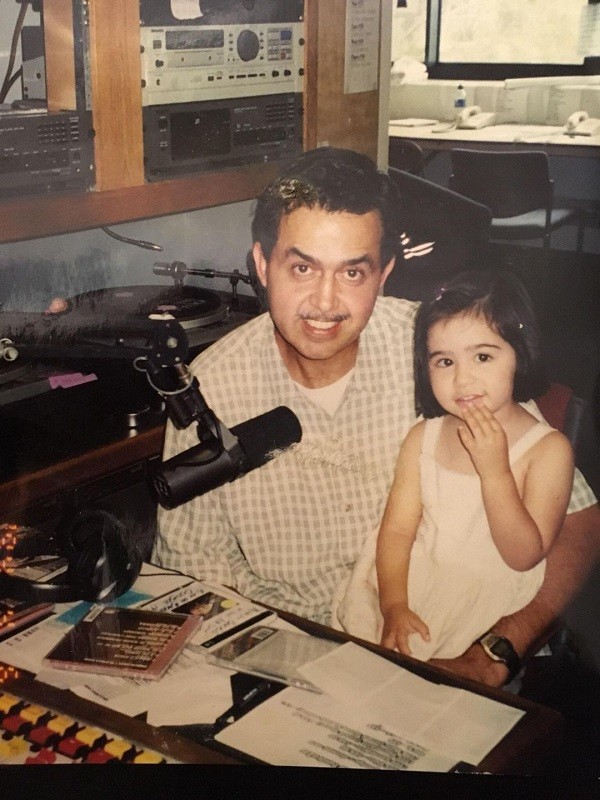
Eddie López with his daughter Nina

Reactions to his passing

In the social networks of ”Alma Del Barrio”, the sorrow of the team over the physical disappearance of the host can be clearly seen. On the Facebook account of the show, there are several messages referring to all that Eddie achieved during his professional life and all that he contributed to the show ”Alma Del Barrio” and to the radio station KXLU. These comments are accompanied by photographs in which Lopez can be seen carrying out his work with the enthusiasm that characterized him in those periods when he practiced the profession he so loved, which was communication.

One of those who mourned the loss of the broadcaster was the host of the program ADB, Alan Geik, who had been his personal friend for decades thanks to the passion for the media they both shared. It all started when Eddie hired Alan to host a evening show called ”Latin Dimensions” at a station that works in a small classroom.

Geik did not have any plans to become a broadcaster at the time, but Lopez convinced him by telling him it could be a great adventure and a learning experience for himself. When he accepted, he never thought that the programme presented by him would multiply the number of audience several times over thanks to the popularity he was gradually acquiring. Not to mention that the station where the program was aired moved to better facilities and became a radio power.

The host ends his note of mourning by expressing that he is proud to have been such a good friend of Eddie and all that they achieved together thanks to the professional team they formed during such a long time.

Eddie López working at the radio station

Read also: ”Salsa Con Sabor’’ and its contribution to salsa music

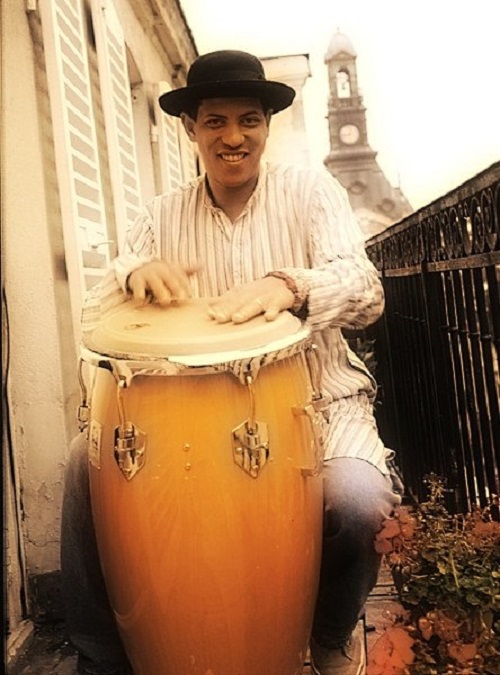
Miguel “Angá” Díaz the percussionist who made his name in the ranks of Cuba’s legendary and enigmatic Irakere group

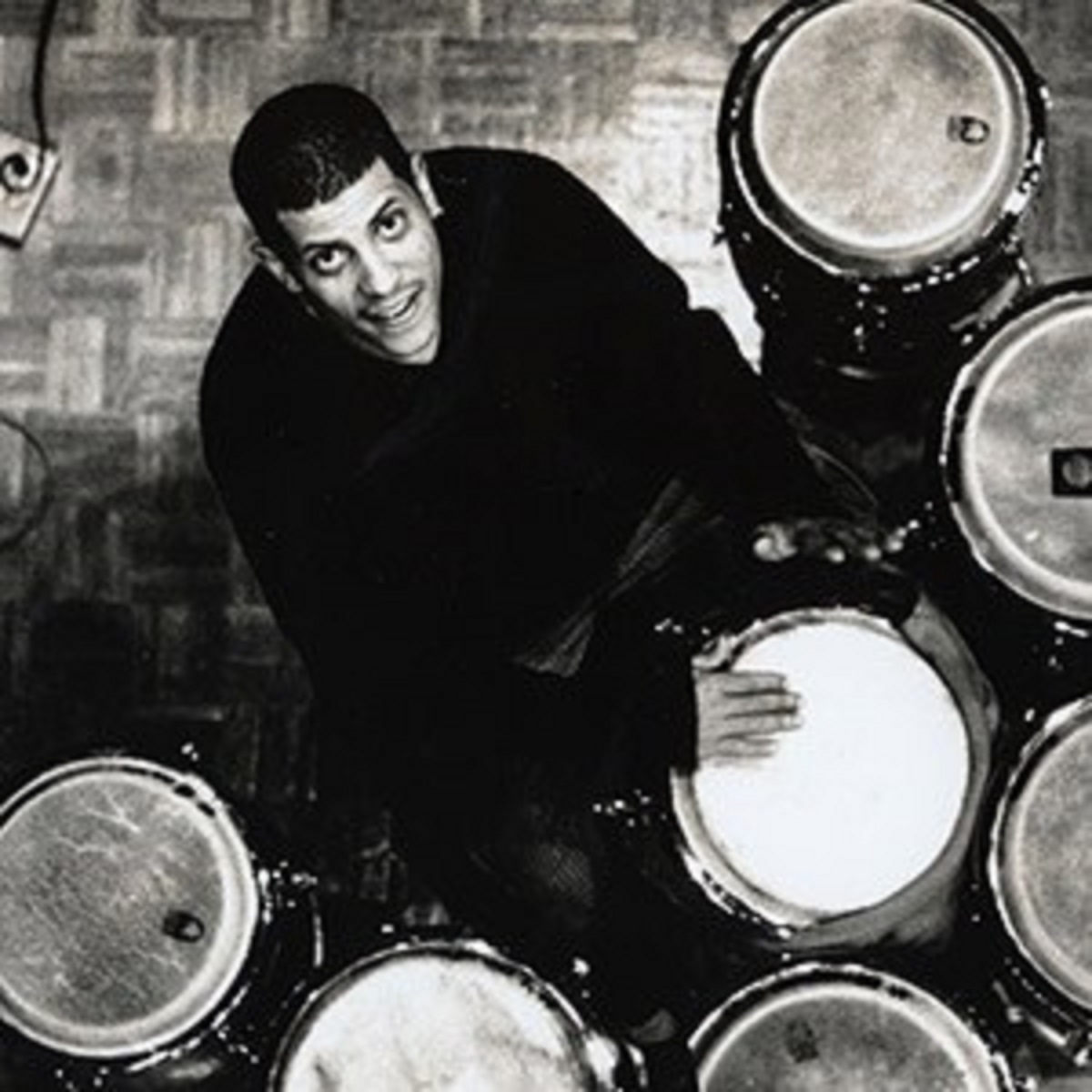
Miguel “Angá” Díaz (1961-2006) was a valuable and prolific Cuban percussionist. With his explosive solos and the creation of five conga toques, “Angá” was widely acclaimed as one of the world’s great congueros.

One of the mainstays of Afro-Cuban rhythm in recent times, Angá played with a multitude of jazz stars, from Chucho Valdés, Chick Corea or Steve Coleman, to Roy Hargrove, Minino Garay, Chano Domínguez and Herbie Hancock, among others.

The claim that he was one of the best percussionists in the world is backed up by the Grammy awards he won, his participation in such important projects as Buena Vista Social Club and the Afro-Cuban All Stars, and his status as sideman of geniuses like Tito Puente, Herbie Hancock, Carlos Santana or Danilo Pérez, as well as his membership in legendary groups like Irakere, according to Más i Más, the organizer of his concerts in Barcelona.

 Miguel "Angá" Díaz el percusionista que se dio a conocer en las filas del legendario y enigmático grupo Irakere de Cuba
 Miguel “Angá” Díaz el percusionista que se dio a conocer en las filas del legendario y enigmático grupo Irakere de Cuba

Father of three daughters – the eldest living in Cuba and the two younger ones in Paris – Angá never stopped searching for new forms of musical expression, experimenting with the fusion of different styles, such as jazz, African sounds, rock and hip-hop.

He was committed to the development of the conga, breaking the traditional barriers of percussion, to introduce them into classic Latin rhythms while preserving their distinctly Cuban roots.

He played with several Cuban artists, including Irakere, Afro-Cuban All Stars, Buena Vista Social Club, Omar Sosa, Omara Portuondo, Tata Güines, Rubén González and Orishas.

Miguel “Angá” Díaz
Miguel “Angá” Díaz

At that time he recorded and toured frequently with international musicians such as Steve Coleman, Roy Hargrove, Baba Sissoko, Ry Cooder, Pascal Coulon, Mezzadri Malik, Montgomery Buddy, Pascal Coulon and John Patitucci. Angá’s musical journey was a personal quest to investigate and create new sounds and rhythmic fusions.

More than just an artist, Angá demonstrated his commitment to the development of his instrument, teaching master classes at various schools and universities in North America and throughout Europe.

For Paris-based Argentine percussionist Minino Garay.

“He is indisputably one of the great percussionists of his generation; the greatest of all. His death causes me enormous sadness, as if it were a story that did not end,” lamented Garay, who will not attend the funeral this Friday, due to the fact that on that day he will give a concert in Vance, in the south of France. “I will certainly dedicate it to him,” he added.

Miguel Angá Díaz (1961-2006) fue un valioso y prolífico percusionista cubano

Angá Díaz received his formal education at the Escuela Nacional de Arte in Havana, Cuba, and after joining the Latin jazz groups Opus 13 and Irakere, where he perfected his conga playing technique, he moved to Europe, where he devoted himself to exploring the fusion of styles, bringing Cuban music closer to other musics and thoroughly investigating the relationship between Afro-Cuban polyrhythms and technology.

In the summer of 2005, Angá released his first solo album EChu Mingua, which the musician himself described as “a musical religious mass. Spiritual music is when the spirits are invoked to come down to earth, inviting them to a party or to talk to them”, and that is “the whole concept of the album”.

Transgressor of conventions, Angá emerged as an independent, free and committed musician with a wide variety of projects, from experimental jazz with Steve Coleman and Roy Hargrove, and hip-hop with the Orishas, to his participation in Omar Sosa’s tours, in addition to participating in numerous alternative projects with musicians from all over the world.

Angá’s musical trajectory was a tireless search, whose main purpose was to explore and create new sounds, as well as rhythmic fusions.

Source: jornada.com.mx

Miguel “Angá” Díaz

You can read: Freddy de Jesús Ortega Ruiz “Coco & su Sabor Matancero”

The multifaceted artist Yamila Guerra and all her projects

Who is Yamila Guerra

Yamila Guerra is a Cuban singer, dancer, actress and TV host who has always felt a great passion for music from an early age and knew she wanted to devote her life to the world of entertainment. She is the daughter of the famous Cuban duo Rosell y Cary and sister of famous producer, bandleader, arranger, composer, classical guitarist Yalil Guerra, who is a great friend of International Salsa Magazine.

Yamila Guerra in a studio

We had the honor of talking with Yamila for a while and know a little more about her both personally and professionally. It was really a pleasure for us to have had her here and to know more about her great career.

Inclination for the arts from an early age and academic background

Yamila reveals that she has always felt very attracted to the art world and started this journey doing impressions of certain Cuban and foreign artists who she saw on TV. Some of them were friends of her parents’or colleagues because they shared the stage with them in all the activities they did in Cuba.

Evidently, the fact that she grew up in an artistic and musical environment included a lot in the inclination she had towards this world, but it was not the only thing that made her dedicate herself to all this. She always felt a natural and organic attraction to the world of entertainment, music and art.

Seeing that her career began at the Cuba’s National Ballet School, it can be said that the first area in which she began to develop was dance. When she took the physical tests, she was admitted to the institution and attended as a listener until she was old enough to be able to participate in the classes. She feels that she had a complete training because, besides studying classical ballet, she learned all the Cuban dances such as contradanza, Cuban son, cha cha chá, danzón, among others.

Yamila Guerra with his brother Yalil Guerra

At the School of Artistic Varieties, she developed in areas such as acting, singing, music and much more. All these disciplines mentioned above helped her a lot with her professional future.

Once in the United States, she studied at Berkley College of Music and took singing lessons in some genres such as blues, jazz, country, ballads, among others. At other schools, she studied art history, marketing, business, sales and other areas that have served her professionally speaking.

Life in Spain

Guerra tells us that she left Spain and moved to Miami because she could not tolerate its cold climate and wanted to be closer to her family in Cuba, but she has many good memories and is thankful to the European country, as it gave her the opportunity to be a TV host on channels such as TVE, Canal Satélite Digital, Antena 3 and Telecinco. Likewise, she was able to take her music to different stages and many parts of Spain. She felt that the Spanish people welcomed her art with open arms.

Once she moved to Miami, she worked on  ”Sábado Gigante” as an actress with Don Francisco, whom she thanks for the opportunity his team gave her.

Yamila Guerra, His brother Yalil Guerra and their parents Rossel and Cary

How business, economics and legality have helped her in her career

One of the first pieces of advice Yamila gives to anyone who wants to work in entertainment in the United States is to master the English language. The artist defines herself as an eternal student because she has always liked to learn everything, especially languages. In fact, when she was in Spain, she paid for an English academy once a week to learn that language because she knew it would be very important in her career in terms of negotiation.

She also stresses that it is important to find out about legal and business issues to deal with clients and partners in the best possible way and avoid loopholes that naturally arise in the entertainment world. Yamila believes that it is very important to separate art from business and ”not to be trusted with money”. The Cuban highlights the importance of being pragmatic about making decisions and not allowing the artistic part to prevent people from making the right decisions at the level of business.

Social media

The talented performer considers that social networks are a fundamental part of her work and promotion, so she thinks it is important to have a presence on each and every one of them and design a strategy depending on the characteristics of each one. She considers that it is very important to post videos and photographs in order to promote her work, but also use her platforms to talk about other more personal topics such as family, beauty, nutrition, love and other things. That variety of facets is what attracts so many people to her content.

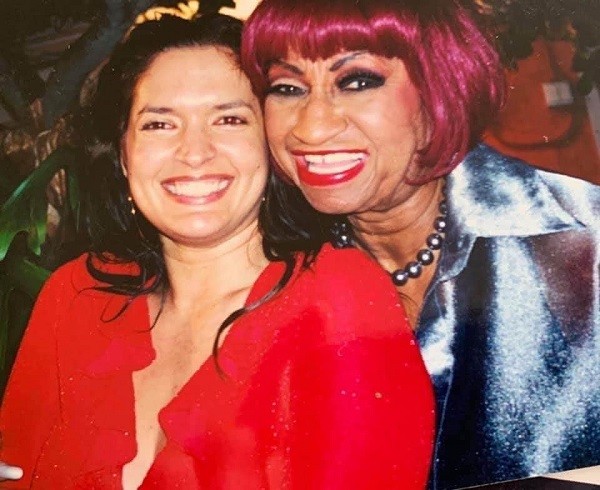
Yamila Guerra with Celia Cruz

As for her personal tastes, she confesses that she loves Tik Tok because she considers it a very organic and authentic platform. This is where she posts videos of herself acting and giving her opinion about all kinds of topics, something that gives her great exposure.

On this same issue, she stated that social networking has become essential to all types of professions and that we must all be present on them as much as possible because they have become part of our letter of introduction to others.

Tradicional Cubano

Yamila had been wanting to make an album fully dedicated to traditional Cuban music, which she considers to be the most flavorful, since it does not need a lot of instrumentation to feel it. It is very old, but it does not lose its flavor and its validity over the years. This is how her latest album ”Tradicional Cubano” came about.

This album includes composers such as Ignacio Piñeiro and Celina González. Guerra wanted to rescue this repertoire that she listened to when she was a child, since it always caught her attention and she was fascinated to be able to portray the Cuban culture and the lives of Cubans.

Read also: We interviewed IndiviDúo singers Tiffany Joy and Maqui Reyes

EFG London Jazz Festival

Commemorates 30 Years With A Display Of International Latin Jazz Artists

The first seasons of the EFG London Jazz Festival took place in May

EFG London Jazz Festival celebrates its 30th birthday with the innovation and musical freedom that has always characterized the London Jazz scene.

This festival, the largest and in constant transition in North London, opens its space from Friday, November 11th to Sunday, November 20th to present a program of live and digital presentations with world-class artists, emerging talents, collaborations specials, avant-garde sounds, and the latest music for a massive audience that has established the EFG London Jazz Festival https://efglondonjazzfestival.org.uk/ as one of the main international Jazz events in Europe.

This emblematic event in the United Kingdom has three outstanding aspects that have characterized it over the years, they are Character, Impulse, and Wealth. The Character is evidenced in each edition with the contribution of special collaborations, discoveries, and exclusive commissions. The second aspect of this festival is the Impulse, being this event the highlight of the Jazz calendar in the capital. Finally, the third aspect is the Wealth that can be easily found in a club or concert hall packed with spectators to enjoy 300 live shows in more than 70 places attracting around 100,000 people daily.

In this 2022 edition, the star lineup is represented by nine international Latin Jazz artists such as Fiona Ross (Friday, November 11th), Katriona Taylor Quintet presenting “La Reina de la Bossa Nova” (Saturday, November 12th), Yuri Hernández (Sunday, November 13th), Colectiva (Thursday, November 17th), Mexico’s Woman of the Year for Arts and Culture, Migdalia Van Der Hoven (Thursday, November 17th), the Jazz/Latin group led by Steve Rubie from the 606 Club, Samara (Friday, November 18th), Trombonist Laura Impallomeni (Saturday, November 19th), Osvaldo Chacón (Sunday, November 20th) and Chucho Valdés (Sunday, November 20th).

L I V E   B A N D S

Fiona Ross

 “Voices celebrate the power, connection, and expression of song, beauty, and aptitude…”

At fourteen she lied about her age to play weekend Jazz clubs in London. Photo: Alexander Barnes-Ross

Vocalist, pianist, songwriter, and producer, Fiona Ross, has become known for having an authentic contemporary Jazz sound obtained by mixing the fast rhythm of Latin Jazz, a brief flirtation with vintage Jazz, a bit of Neo Soul, and a touch of melancholy ballads.

Multi-award-winning Jazz artist, editor-in-chief, journalist, and founder of the award-winning organization Women in Jazz Media Fiona Ross was Director of the British Academy of New Music in London for nearly a decade, where she was responsible for the formation of Ed Sheeran, Rita Ora, among many others. Fiona’s date will be on November 11th at 8:30 PM at the London Polish Jazz Café Posk (238-246 Kings St. W6 0RF), and the ticket is £15.

Yuri Hernández + DJ Flecha

 “…Celebrating unity with the power of music.”

Many describe her album Loco Soñador as “a wild and sensual masterpiece.”

This multifaceted 10-day event brings to its lineup the established singer within the Latin music industry for the last two decades, Yuri Hernández. The establishment that will host it will be Juju’s Bar & Stage (Ely’s Yard, 15 Hanbury St, London E1 6QR) on Sunday, November 13th from 6 PM, and the cost of the ticket doesn’t exceed £9.

Hernández is one of the most sought-after musicians in northern Spain and is introduced to the UK Latin Jazz scene through Loco Soñador, his second studio album released in 2020. Joining this musical genius will be DJ Flecha (Joel Verdecia) with his supporting act promoting Cuban music. This veteran DJ (25 years of career) has been nominated three times as Best Latin Tropical DJ in a European country for his technique and originality when mixing.

Colectiva & Osvaldo Chacón

“Beyond the margins, some of the most innovative artists at the forefront of Jazz are pushing its limits and expanding the definition of the genre while drawing influences from a wide range of other languages.”

Osvaldo Chacón and his band have played at the Royal Festival Hall, among many others.

This Afro-Latin and Jazz music band, Colectiva, reflects on themes of sisterhood and female empowerment. They are rooted in the sounds of Africa, Latin America, and the diaspora, creating a genre that the group has dubbed Jazz Tropicaliente (Hot/Tropical/Jazz). Their debut single is Under The, written in collaboration with pianist María Grapsa and released in April 2021. This track received great support from global radio stations and famous DJs in the music industry.

Colectiva will be presented on November 17th at 8:30 PM at the London Kings Place-Hall Two-(90 York Way, N1 9AG), and tickets have a permanent price of £15.

On the other hand, Osvaldo Chacón’s band is the leading Timba orchestra in the UK and has been nominated multiple times for the prestigious LUKAS awards. Osvaldo Chacón, composer, producer, and singer-songwriter, has shared the stage with great Salsa figures such as Adalberto Santiago, Azuquita, Tito Allen (Fania All Stars), Salsaceltica, Eddie Palmieri, as well as the greatest world-famous stars such as Celia Cruz, Oscar D’León, Rubén Blades, and Alberto “El Canario”. Supporting Osvaldo Chacón will be DJ Javier La Rosa mixing Salsa, Cuban Timba, Reggaeton, Latin Hip-Hop, and R&B. Sunday, November 20th is the date when you can enjoy these presentations. Time: 8 PM. Venue: Juju’s Bar & Stage. Ticket: £10.

Chucho Valdés

 “The Icons are the living legends of Jazz and the leading heroes of the genre who paved the way and continue to create, inspiring artists, and audiences alike.

Valdés, with his valuable contribution, has given direction to Afro-Cuban Jazz

The EFG London Jazz Festival brings the Cuban pianist, composer, and arranger Chucho Valdés, who celebrates his 80th birthday with his extraordinary work La Creación with the Yoruban Orchestra and Hilario Durán & John Beasley.

The winner of six Grammy Awards and three Latin Grammy Awards is the most influential figure in Afro-Cuban Jazz of the 20th and 21st centuries. In an extensive career spanning six decades, Valdés has pushed the boundaries of new expressions in Afro-Cuban music. His influence and inspiration in the genre are immeasurable to the point that his work sets the standard by which new generations are governed and drives their careers. To see Chucho Valdés head to the London Southbank Center (Royal Festival Hall, Belvedere Road SE1 8XX) at 7:30 PM. and tickets range from £30 – £45.

Along with Chucho will be the cellist, vocalist, composer, and niece Ana Carla Maza. Within her discography is the album La Flor (2020) which incorporates Latin rhythms, Pop melodies and Jazz harmonies along with classical techniques. Bahía (June 26, 2022) is her most recent production inspired by Cuban Son, Samba, Bossa Nova, Tango, Jazz, and Chanson with a rich mix of classical cello and voice.

Xiomara Laugart, nicknamed “La Negra” was born in Guantanamo, Cuba

For Xiomara Laugart, the past never goes away; she likes to hide in music. “My faith, I believe in you, you won’t go away,” Alberto Tosca wrote to her in that song and Xiomara seems to have decided to live by those lyrics, to this day.

Her loud laughter filled my kitchen this afternoon, while Omar brewed coffee, many times, and my mother cooked pumpkin flan. She evokes her mother in the sweet, comes back to life and tells.

She tells with astonishing naturalness that she never studied music and goes on and on. She goes on to freedom, and overflows with passion, because for her freedom is music.

Technically she could do whatever she wants, but if she does not feel it, if it does not make her vibrate, Xiomara, “The voice of Cuba”, could not sing.

On September 8, 1960 in Guantanamo, Cuba, XIOMARA LAUGART, nicknamed “La Negra”, was born. Excellent singer, established in Massachusetts.

Before emigrating to the United States, Laugart had an extensive career within the Cuban Nueva Trova movement. He has recorded more than 17 albums.

Representative of Cuban music in various parts of the world. He worked with the group Pisos Nuevos in Nicaragua. Also with Descemer Bueno. He led the group Yerba Buena. She represented Celia Cruz on Broadway.

Xiomara Laugart was born in Guantánamo. She attended university and graduated in Economics, then began her musical career through the nueva trova, a movement of political musical protest, very popular between the sixties and nineties.

He studied music at the Escuela de Superación Profesional Ignacio Cervantes. He began his artistic career professionally in 1985.

His beginnings were quite intense, participating quickly in international stages.

In 1979 he participated in the Festival of Political Song in Berlin. In 1980 he traveled to Nicaragua with the Pinos Nuevos Group, from the Isle of Youth.

The following year she participated again as a guest at the Berlin Political Song Festival and that same year she won third prize at the Political Song Interpretation Contest in Sochi, Soviet Union.

In 1980 she won third place in interpretation at the Adolfo Guzmán Cuban Music Contest; she participated in the V Festival y Activo de la Nueva Trova, the VI Cumbre and Carifesta. He belonged to the Guiñol Theater group of Isla de la Juventud. He was a member of the group Aconcagua and Talla Extra (X-L), and, for a time, worked with Alberto Tosca.

In 1982 he performed at the Café Concert in Mexico, participated in the Festival for Non-Intervention in Central America and Disarmament, held in Holland, Belgium, and the same year, he traveled to France. He became a regular in Mexico and returned to the Aztec country in 1984.

That same year she participated in the Political Song Festival held in Sopot, Poland, and later toured Honduras and Costa Rica.

His voice has a very wide register, although he stands out for his high tones.

She shows a vivid and exceptional sense of rhythm that allows her to interpret from bolero to salsa, from danzón to guaracha to the most sophisticated jazz and funk.

Atrapando espacios, Qué manera de quererte, Hoy mi Habana, Se fue, Ni un ya no estás and Oh melancolía! are some of the songs that are part of her repertoire and that continue to receive a standing ovation every time she performs on the stages of South Florida.

“The first person who introduced me to Miami was the maestro Meme Solis.

Meme has been my mentor in this city and was responsible for opening the doors to a new audience that followed him for years and now goes to my concerts, she says when referring to her close relationship with the legendary Cuban composer.

Source: Hyper Media

Xiomara Laugart

You can read: Israel Kantor was an excellent bassist, arranger and composer who achieved great popularity in Cuba for his vocal technique and original “Sonear” style.

  • « Go to Previous Page
  • Page 1
  • Interim pages omitted …
  • Page 35
  • Page 36
  • Page 37
  • Page 38
  • Page 39
  • Interim pages omitted …
  • Page 103
  • Go to Next Page »

International Salsa Magazine (ISM) is a monthly publication about Salsa activities around the world, that has been publishing since 2007. It is a world network of volunteers coordinated by ISM Magazine. We are working to strengthen all the events by working together.