• Skip to primary navigation
  • Skip to main content

International Salsa Magazine

  • HOME
  • Previous editions
    • 2026
      • ISM / May 2026
      • ISM / April 2026
      • ISM / March 2026
      • ISM / February 2026
      • ISM / January 2026
    • 2025
      • ISM / December 2025
      • ISM / November 2025
      • ISM / October 2025
      • ISM / September 2025
      • ISM / August 2025
      • ISM / July 2025
      • ISM / June 2025
      • ISM / May2025
      • ISM / April 2025
      • ISM / March 2025
      • ISM / February 2025
      • ISM / January 2025
    • 2024
      • ISM / December 2024
      • ISM / November 2024
      • ISM / October 2024
      • ISM / September 2024
      • ISM / August 2024
      • ISM / July 2024
      • ISM / June 2024
      • ISM / May 2024
      • ISM / April 2024
      • ISM / March 2024
      • ISM / February 2024
      • ISM / January 2024
    • 2023
      • ISM / December 2023
      • ISM / November 2023
      • ISM / October 2023
      • ISM – September 2023
      • ISM – August 2023
      • ISM July 2023
      • ISM Edition June 2023
      • ISM – May 2023
      • ISM April 2023
      • ISM March 2023
      • ISM February 2023
      • ISM January 2023
    • 2022
      • ISM December 2022
      • ISM November 2022
      • ISM October 2022
      • ISM September 2022
      • ISM August 2022
      • ISM July 2022
      • ISM June 2022
      • ISM May 2022
      • ISM February 2022
      • ISM January 2022
    • 2021
      • ISM December 2021
      • ISM November 2021
      • ISM October – 2021
      • ISM September 2021
      • ISM August 2021
      • ISM July 2021
      • ISM May 2021
      • ISM April 2021
      • ISM June 2021
      • ISM March 2021
      • ISM February 2021
      • ISM January 2021
    • 2020
      • ISM December 2020
      • ISM November 2020
      • ISM October 2020
      • ISM September 2020
      • ISM August 2020
      • ISM July 2020
      • ISM June 2020
      • ISM May 2020
      • ISM April 2020
      • ISM March 2020
      • ISM February 2020
      • ISM January 2020
    • 2019
      • ISM December 2019
      • ISM November 2019
      • ISM October 2019
      • ISM Septembre 2019
      • ISM August 2019
      • ISM July 2019
      • ISM June 2019
    • 2016
      • ISM December 2016
  • Spanish
  • Download Salsa App
    • Android
    • Apple

Search Results for: Cuban music

His name is: Elio Osácar Douguet, and artistically we know him as: Sonny Bravo

Interview conducted by journalist and music researcher Robert Téllez M., on February 4, 2017 and originally published later on the SONFONÍA portal. Interview provided by the author for International Salsa Magazine (ISM).

His name is Elio Osácar Douguet, and artistically we know him as Sonny Bravo.

Robert: His name is: Elio Osácar Douguet, and artistically we know him as: Sonny Bravo When and where were you born?

Sonny: I was born on October 7, 1936 in West Harlem, New York City.

Robert: Are you of Cuban descent?

Sonny: Yes, my grandparents were born in Havana, three in Santiago de las Vegas and one (maternal grandfather) in Bejucal. My parents were born in Key West, FL, and raised in Tampa, FL.

Robert: Tell me about your father Santiago “Elio” Osacar.

Sonny: Obviously, my first mentor! Santiago Osácar Colomá, born October 12, 1911 in Key West, FL, raised in Tampa, FL. He and his two older brothers, Juan and Tomás, founded the Sexteto Tampeño in 1928. He married my mother, Elisa Douguet Bravo in February 1932 and they settled in New York around 1933. Shortly thereafter he joined the Caney Quartet as bassist and second voice. At that time he also formed and recorded with his own group, the Conjunto Moderno. Later he was also a member of Monchito y su Orquesta. But he always returned to Caney! Until his death in the summer of 1957, from a pancreatitis attack he suffered on the stage of the Chateau Madrid in NY.

Robert: Maestro Sonny, is it true that you played baseball, but due to an injury you turned to music?

Sonny: Yes, it was in an amateur league in Miami where I was raised, my father was the manager! I was a pitcher and after pitching a complete game, while it was drizzling; the shoulder pains started the next day and that’s as far as my brief career went.

Robert: Did you write arrangements for Conjunto Caney?

Sonny: I only wrote one, “Añorado Encuentro” (Piloto y Vera), but it was never recorded.

Robert: What groups did you work with in Miami?

Sonny: My first job was with the Conjunto Casino de Miami. I also worked with several orchestras (Juanito Sanabria) and several combos (Cheo Venero, Gonzalo Barr). From 1959 to 1961 I was with Conjunto Caney. Then (1961-1963) with Mandy Campo, with whom I made my first tour outside the U.S., it was to Aruba and San Juan, Puerto Rico. Between 1963 and 1964 I worked with José Fajardo. He played dances in Miami on Saturdays and in New York clubs the rest of the week. When he decided to stay in New York, he convinced me to return with him.

Elio Osácar Douguet
Elio Osácar Douguet

Robert: Is the Típico Charanga format your favorite?

Sonny: Yes! I would like to have the same format we used on Alfredo de la Fé’s LP (Toca, Alfredo Toca) with the modern harmonies that can be heard in my arrangement of “El casabe,” my adaptation of Humberto Perera’s arrangement of “Que rico bailo yo,” and my arrangement of my own song, “Toca, Alfredo toca.”

Robert: What pianists influenced your playing?

Sonny: Charanga genre: Jesús López. Ensemble genre: Lilí Martínez. Big band and combo genre: Pedro “Peruchín” Jústiz. Variety of genres: Rubén González.

Robert: How did you become involved with the José Fajardo Orchestra?

Sonny: In 1963, bassist Nilo Sierra took me to the Palladium to meet Fajardo. After I married my first wife, I returned to Miami, and was able to contact him. During 1963 I played with him the dances I mentioned above and also toured with him to Venezuela, Mexico, Santo Domingo, and Puerto Rico. Fajardo stayed to fulfill his contract at the San Juan Hotel, but Orestes Vilató and I returned to New York. Orestes because of melancholy, and I, because I found out that my wife was going to give birth in January 1965.

Robert: As I understand it, when you settle in New York, you start playing with: Willie Bobo, Bobby Valentin and Ray Barretto What would you highlight about your work with Barretto?

Sonny: Between 1965 and 1966 I was Raul Marrero’s musical director. Besides what you mentioned, I also played with Vicentico Valdés, Mauricio Smith, Cortijo, Maelo and La orquesta Broadway, at that time. With Ray Barretto (and his charanga format) I only worked for two weeks, that was in October 1966, until the return of his pianist, Edy Martínez, who had stayed in Colombia after a tour. I felt very comfortable with Barretto’s group and I would have liked to continue playing with him.

Sonny was born on October 7, 1936 in West Harlem, New York City.

Robert: How did your integration with La Tipica 73 come about?

Sonny: I was there from the beginning. The group (unnamed) started in the summer of 1972 with musicians from various orchestras in a “jam session” (descarga) format, with the purpose of filling out the week with stews on Mondays, Tuesdays and Thursdays, that is, the laziest days in clubs and dance halls. Alfredo de la Fe was one of the original musicians. He and I played with Fajardo at that time.

There was also Bobby Nelson (flute) from Charlie Palmieri’s orchestra. Instigated by Johnny “Dandy” Rodriguez and with the support of several promoters and club managers, we decided to strengthen the group, create an ensemble and take the risk of competing with the already established groups.

Robert: Where did the idea of making the record production “Intercambio Cultural” come from?

Sonny: Johnny Rodriguez made the connection when he went to Havana on vacation. When he returned, he convinced Jerry Masucci to initiate the arrangements so that he could record at EGREM’s studios.

Robert: Was Típica 73 blocked because they had performed and recorded in Cuba and that’s why the group disbanded? Or were there other reasons…

Sonny: That’s the only reason!

Robert: What do you remember about your experience with Conjunto Clasico?

Sonny:

Side A: A lot of work, good music, good musicians.

Side B: Out of 20 songs, there were 19 solos of three and only one piano solo!

Robert: Maestro Sonny, you were present in several stages of Tito Puente’s orchestra, did you replace Jorge Dalto?

Sonny: Yes, in the Latin Jazz Ensemble. Jorge had his own group called “InterAmerican Band”. In the salsa band, I replaced Ruben Rivera. Eventually, the two formats came together to form a super-combo.

Robert: Of all the arrangements you have done in your career, which is your favorite?

Sonny: I have several, by format.

COMBO:

Typical ’73:

  1. Chachagüere
  2. Tula
  3. Rumba caliente
Típica 73
Típica 73

BIG BAND:

Latin Giants of Jazz:

  1. Gua Cha Rumba
  2. I have to conform
  3. I don’t bother
Latin Giants of Jazz

Mambo Legends Orchestra:

  1. Conmigo, candela brava 2.
Mambo Legends Orchestra

CHARANGA:

Alfredo de la Fé:

  1. Toca, Alfredo Toca
  2. El Casabe
Toca, Alfredo Toca
Toca, Alfredo Toca

Robert: And your favorite piano solo?

Sonny: I have two. El casabe (Alfredo de la Fe LP), because of the relaxed son montuno tempo and because of my favorite format: ¡Charanga moderna! And ¿Adónde vas? (Tito Puente’s LP) because it was recorded live and I could extend the solo, and because it’s the King’s orchestra!

Robert: On January 28, 2003 there was a historic reunion in Puerto Rico, which culminated with the release of the album TIPICA 73 LIVE. How did you live that experience?

Sonny: The audience enjoyed it, but not me. There was flavor and swing, but the piano had a damaged key and I was almost completely out of tune and the choruses were pretty weak. The record was bootlegged before it was released.

Robert: Of today’s pianists, who would you single out?

Sonny: In the Afro-Caribbean Jazz genre (Latin Jazz) there are a ton of Cubans like Chucho Valdés, Gonzalo Rubalcaba, Hilario Durán, Ernán López-Nussa, Harold López-Nussa, Aldo López-Gavilán, Iván “Melón” Lewis, Alexis Bosch, Yan Carlos Artime, Rolando Luna, Ramón Valle, Manuel Valera, Daniel Amat, the Venezuelan Luis Perdomo, the Colombian Edy Martínez, etc. In the genre they call salsa, my favorite: Papo Lucca, the poet of the piano, impeccable flavor and swing. Eddie Palmieri is Eddie Palmieri! Oscar Hernandez, Ricky Gonzalez, Edwin Sanchez and Yeissonn Villamar.

Robert: What future do you see for salsa?

Sonny: Unfortunately, I think it is diminishing with the disappearance of the old guard. We need to remember and respect tradition, but we also need to move forward, developing genres and sub-genres. For example, in Cuba, dance is developed and danzonete and danzón emerge. They develop the son and the son montuno, the guaracha, the mozambique, the mambo, the ritmo pilón, the ritmo pa’ cá, etc., emerge. Then came the songo and the timba, all based on the son. Where is the development of the New York, Puerto Rican, Caribbean or South American “salsa”? It is still more or less the same since the day it was discovered. If it were not for the innovations in Cuba, there would be no groups such as: Los Van Van, NG La Banda, La Ritmo Oriental, Klimax, etc. And please don’t talk to me about “salsa monga” or “bachata” or “reggaeton”, which, in my humble opinion, are not innovations, but aberrations!

Exclusive interview with Sonny Bravo

Interview by music journalist and researcher Robert Tellez M.

Robert Téllez M.
Robert Téllez M.

Also Read: Robert Tellez is undoubtedly “El más que sabe de salsa” (The one who knows the most about Salsa)

Orestes Vilato

North America / USA / New York

Orestes Vilato. Cuban Multi-Percussionist.

Cuban multi-percussionist, Orestes Vilato, is undoubtedly one of the greatest figures in the history of the Cuban drums known as timbales.

Orestes Vilato
Orestes Vilato

During the fifties, the Vilato family moved to New York, salsa capital of the world, where young Orestes would rise to fame as an innovator of his beloved traditional instrument, “Los Timbales”.  While living in New York for 25 years, Orestes was intimately involved with many musical organizations that played seminal roles in shaping the course of Latin Music around the world.

Among the many groups were: Fania All Starts (founding member), Ray Barretto, Tipica 73 (founding member), Los Kimbos (founder-director), Tito Puente, Johnny Pacheco, Cheo Feliciano, Ismael Rivera, Joe Cuba, Eddie Palmieri, Ruben Blades, La Lupe, Celia Cruz, Rolando La Serie, Chico O’Farril, Lionel Hampton, Los Chavales de Espana, Cal Tjader.

Other artists with whom he has recorded or worked include: Winton and Bradford Marsalis, Paco De Lucia, Whitney Houston, Linda Ronstadt, Aretha Franklin, Willie Nelson, Herbie Hancock, McCoy Tyner, Cachao, Andy Garcia, Emilio Estefan, Gloria Estefan, Paquito de Rivera, Dave Valentin, Mongo Santamaria, Armando Peraza, John Santos, Rebeca Mauleon, Giovanni Hidalgo and Raul Rekow.

Orestes Vilato - Photo
Orestes Vilato – Photo

In 1981, Mr. Vilato moved to the San Francisco Bay area, where he still resides with his family.   From 1980 to 1989 he recorded and toured with the renowned Carlos Santana Band.

Orestes was nominated for a Grammy in 1995 (Latin Jazz category) for his CD, Ritmo Y Candela With Patato and Changuito. In 2009 his solo CD Its About Time was nominated for a Latin Grammy.

Orestes has recorded several movie sound tracks that include:  Our Latin Thing, Mambo Kings, Carlito’s Way, Steal Big Steal Little, The Bird Cage, Dance With Me, Just A Ticket, Things To Do In Denver and The Lost City.

He has been a special guest artist in multiple Jazz Festivals around the country and Puerto Rico including the San Jose Jazz Festival.   He has performed and taught at numerous music conservatories including The Berkeley School of Music, UCLA, Fresno University, Standford University as well as many conservatories overseas.

Orestes was given tribute at Yerba Buena Garden, Monterey and San Francisco Jazz Festivals.

Photo of Orestes Vilato

Orestes’ style is one of the most imitated and emulated among recording-performing artists.

The Granada LA

North America / USA / Los Angeles

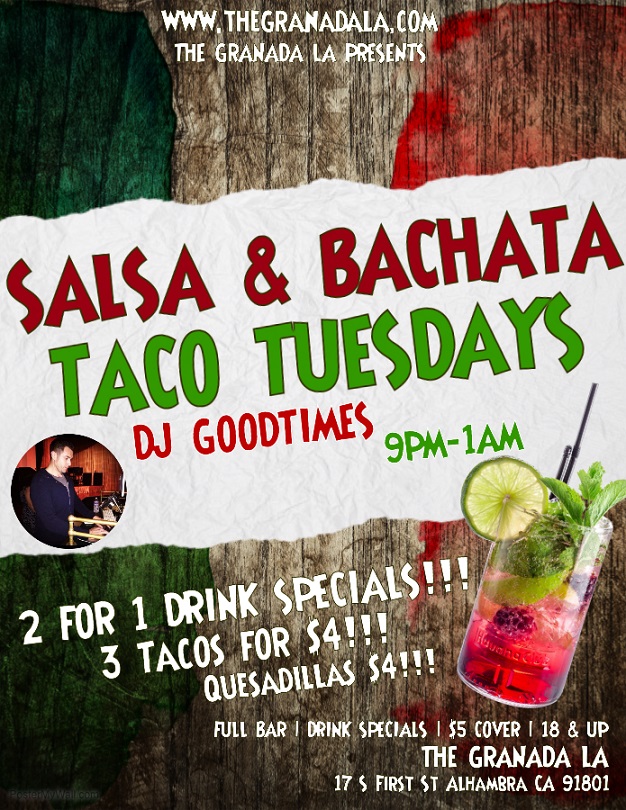
The Granada LA is the home to a Ballroom, Latin, Salsa & Bachata dance studio with Los Angeles hottest dance instruction with classes a week and private lessons available by appointment. Offering several nights with live entertainment and dancing to show off all you have learned.

Salsa & Bachata Taco Tuesday - The Granada
Salsa & Bachata Taco Tuesday – The Granada

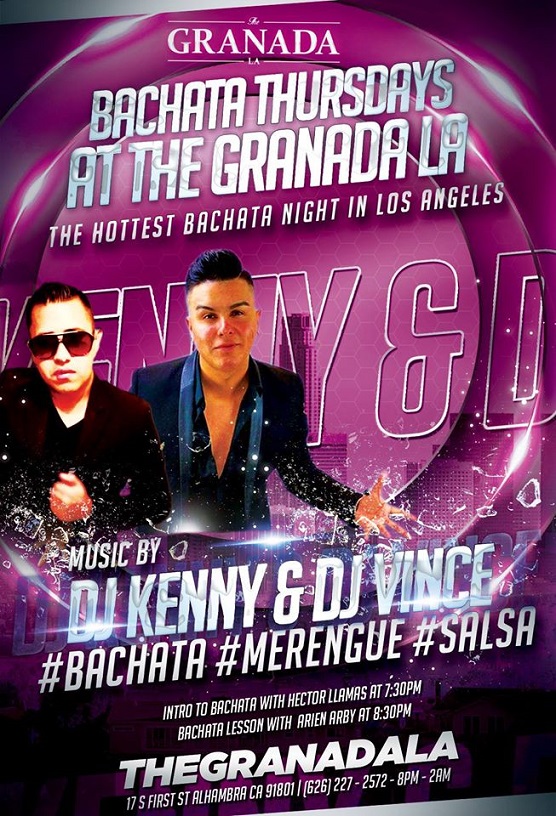
Tuesday is Salsa & bachata Nights, Thursday is Bachata Tropical Nights with 3rd floor Hip Hop/Reggaeton, Friday and Saturday Nights the main dance floor becomes Los Angeles Best Live Salsa Club! Enjoy an extra room on Saturday for bachata and Hip Hop/Top on patio.

Bachata Thursday at the Granada LA

Also the first and third Sunday of the month, live music for the Ballroom Dinner Dance with Two’s Company with all your favorites. Also, offering other special nights once a month on different nights.

Con Mayor Live Salsa Bachata - The Granada LA
Con Mayor Live Salsa Bachata – The Granada LA

Group Classes & Private Dance Lessons go on throughout the building, but it is important to remember that the Granada LA has other activities and groups sharing the space day and night.

Conjunto Oye Live Salsa Saturday - The Granada LA
Conjunto Oye Live Salsa Saturday – The Granada LA

The restaurant is open Thursday thru Sunday for dinner, in addition to being the caterer for rentals. Just as most clubs in Hollywood, enjoy different theme nights, so will the Granada LA.

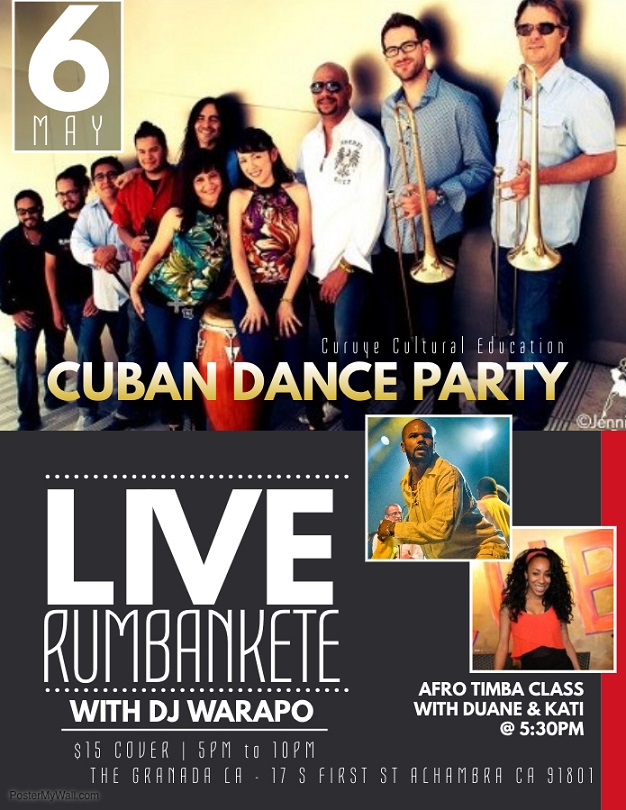
Friday and Saturday night Salsa dance club, Ballroom Dinner Dance, Thursday night Bachata dance club, Cuban Timba party 2nd sunday of the month, Chicago stepping platinum club 4th sunday of the month, Special Dance performances, Concert nights & special events throughout the week and on weekends.

Bachata Concert Dani J - The Granada LA
Bachata Concert Dani J – The Granada LA

Teaching and choreographing for shows, events, parties, celebrations and your first dance. The Ballroom Dance Studio is located in Los angeles and specializes in Ballroom, Latin, Swing, Salsa & Tango dance classes and instruction both privately and in groups.

Cuban Dance Party - The Granada LA
Cuban Dance Party – The Granada LA

Offering an elegant beautiful Banquet Facility in Los Angeles for your upcoming Wedding Reception, Quinceanera, Birthday Party, Anniversary or a Special Occasion in Alhambra.


‘‘La Chiqui Some’’ and ‘’El Some’’ in International Salsa Magazine

Much prominence is given to singers, musicians and the visible part of the entertainment in general, but there is not enough talk of those who make it possible for the aforementioned to record what they have created for their audience. That is why we wanted to talk to Jennifer Freedman, better known as ”La Chiqui Some” and Agustin Someillan, who is known as ”El Some”.   

Jennifer and Agustin El Some
Singer Jennifer Freedman and trompeter Agustin Someillan in the studio

Singer Jennifer Freedman and trumpeter Agustin Someillan in the studio 

Jennifer and Agustin ‘’El Some’’’s first contact with music 

Jennifer started in music with percussion in 2005, but moved away from it for a few years to pursue other activities until other artists and groups called her to play with them. She was then invited to attend some rehearsals at Mam-Ax Studios, where by a twist of fate, there was a man named Someillan who already had a studio at that time. They still did not know each other at that time, but soon, one would be very important for the other’s professional life.   

In 2018, she had to go again to the same building, which is when she finally met Agustin, who tells her that she was in the wrong place and had to go to another office. Her visit to Mam-Ax was intended to participate in the recording of a single for singer Freddy Nieves, but that chance encounter would help her to learn that both she and Agustín had a partner in common, who recommended her to work together. 

After that, both accepted and began to know each other better, which led ”El Some” to advise Jennifer on her singing and other details of the business. At the same time, the girl was beginning to see music as something much more serious, since it was only a hobby for her by then. She had certain doubts because she had not jumped right into music professionally, but Agustín convinced her to try to start a career as such, to which she ended up giving in.   

The owner of the studio did not have the support of anyone at that time, so he had the great idea of partnering with Jennifer and bringing together their qualities in the same project.   

In the case of ”El Some”, he comes from a musical family and studied music in Cuba. He became a trumpet player just like his father. Back in his country of origin, he was fortunate to accompany many orchestras such as the Sexteto Nacional de Ignacio Piñeiro, with which he was nominated for Latin Grammy in 2014.    

Having decided his country did not provide him with all the opportunities he needed as an artist at that time, he tried his luck in New Jersey, where he currently resides as does Jennifer, with whom he currently shares the Sonority Record Studios project.    

At this moment, they are creating the album ”Los Some Son” as an idea of Jennifer herself to get people know ”El Some”’s career. Among the guests of the project, we can mention former Los Van Van singer Pedrito Calvo, former Los Van Van singer Melly Cartero, Jennifer herself, singer Frankie Vazquez, pianist Arturo Ortiz, among many others.    

Chocolate and Agustín El Some
Cuban jazz trumpeter Alfredo ”Chocolate” Armenteros and Agustín Someillan

How Jennifer and ”El Some” created Sonority Music Studios   

Agustin has been in the studio for almost 12 years, while Jennifer has only been there for five, but that has not stopped them from getting together perfectly, of course. He has always liked to play the trumpet, but his neighbors started to complain about the constant noise coming from his house, so he decided to look for a place to make music without disturbing anyone.   

However, before that, he was already working on music at home, to the point that he produced an album for José Mangual from his own home, which he describes as ”a huge odyssey”, since he did not have the conditions to complete a job of that magnitude. That is when he decides to look for a space more conditioned to record and produce, so he acquires half of the space he currently uses and elongated it after partnering with Jennifer. 

There were implements they did not possess the knowledge to use, but little by little, they were learning on their to create the brand they have today and the prestige that they acquired in the Latin music community with so much sacrifice. 

”Although this is not a big studio, great things have happened here. There is a great vibe and we make very good music” said ”El Some” about what has been achieved with this space, which has become their musical home.   

The studio has a vacuum-sealing cabin and everything necessary for mixing, mastering, editing, recording and much more.   

Jennifer during a performance
Jennifer Freedman during a live performance with Los Some Son

Relationship between Los Some Son and Sonority Music Studios 

At the moment of expanding the studio, Agustin had already named the place ”Some Son”, but once he and Jennifer became partners, they started to think about how to market it more effectively in the United States. Since everything they did there had to do with sonority, they opted for something with that word, so the studio ended up being called Sonority Music Studios. 

Both are listed as company managers and ”El Some” focuses on the music, creation, engineering and production side. On the other hand, Jennifer is much more focused on the administrative part, contracts, bookings, among other details of this type. 

Seeing what they were achieving with the studio, they felt they could expand a little more to other facets, so both artists also engaged in founding their own band that they called ”Los Some Son” in homage to the ”El Some”’s family of trumpeters and Cuban salsa music in general.   

In conclusion, both the studio and the band are formed by the same team, so both projects go hand in hand.   

Read also: Today we talk with Susana Y Su Orquesta Adelante 

The “Patio de Tula”

Latin America / Venezuela / Yaracuy

In the Yaracuy state of Venezuela, where nature reigns, salsa is also danced

Meeting point: El Patio de Tula in the city of San Felipe

In the patio of a house in an urbanization in the city of San Felipe, since 2013, there has been a salsa scene that is worthy of recognition. The Patio de Tula is the name of the place, named after the Buena Vista Social Club song: El Cuarto de Tula. It is a space created by music lover and cultural promoter Yony Padilla, inspired by some night spots in Caracas where salsa was danced, such as the emblematic “El Maní es Así en Sabana Grande.”

El Patio de Tula
El Patio de Tula

Apart from having become a point of reference in the Yaracuy state and a meeting place for musicians and passionate salsa lovers, or simply a place to de-stress or have a delicious soup on Sundays, in El Patio de Tula We work diligently to rescue the salsa genre and become an engine of dissemination and a teaching center for the musical education of children, young people and adolescents.

The aim is to create an African-American percussion and dance school, where rhythm and dance are connected in a vital and artistic encounter, through Afro-Caribbean, Afro-Venezuelan percussion workshops and Caribbean dance (salsa) and traditional Venezuelan dance classes. It is important to highlight that this training proposal will be called the Juan Carlos Marín Percussion School, as a living tribute to this musician from Yaracuya, who throughout his career has dedicated himself to the study and research of Latin music and the Yaracuyan drum. It would be well worth it for this project to be taken into account by the region’s cultural organizations to support it.

There are various personalities and groups linked to the salsa and urban music scene that have visited El Patio de Tula, among them we can mention: Edgar “Dolor” Quijada, Orlando “Watussi” Castillo along with Mandinga Star Band, Rodrigo Mendoza, Carlos Hurtado , Jóvito Eduardo, Wilmer Lozano, Edgar “El Abuelo” Rodríguez, Alejandro Mayora, Ray Herrera, David González Jr., Ronald Gómez, Cheo Linares, Aquamarina “La Sirena de la Salsa”, DJ. Augusto Felibertt, Sonora Yambú, Orquesta Salsa Cinco 25, Orquesta Salsa Libre, Orquesta Malecón, the Mango Group, Dame Pa Mátala, Y de Cuba, Sixto Llorente and the Yoruba Andabo Folkloric Group.

Yony ​​Padilla tells us that the salsa scene in the Yaracuy state is on the rise. To do this, they have the Hermandad Salsera de Yaracuy Foundation, which goes hand in hand with El Patio de Tula and at the same time is linked to the radio program Expresion Latina, produced and hosted by Hermes Mejías, and broadcast on the 102.9 FM dial from the central area of ​​San Felipe. Another location that is leading the scene in the area, as Yony tells us, is El Rincón de La Salsa. The large number of musicians and orchestras in Yaracuy are proof of what was said above. Among the musicians the following stand out:

  • Domingo Bracho – piston trombone
  • Jorge Yujere – trombone
  • Harry Ramos –piano
  • Luis Reyes –percussion
  • Kendri Siso –percussion
  • Asael Hernández – piano
  • Darwin González – Cuban three
  • Domingo Suárez – percussion
  • Jimmie Graterol – percussion
  • Jesús Mieres – percussion
  • Manuel Mieres –trombone
  • among others.

The salsa orchestras are: Sonora Yambu, Elegua Son, Yaracuy es Salsa, Orquesta Los Gullet de Marín, where Sonero Orlando “Watussi” Castillo, residing in Milan, Italy, participated as a special guest, Orquesta Trombosis and Escala 78. Among the DJs are: Diego Music, Jesús (Drupy) and Robert Villalobos.

Flyer de Patio de Tula

Further, investigating the salsa scene in the states surrounding Yaracuy, we were able to verify with the promoter Padilla that salsa is picking up in Aragua, this, if we measure it by the number of orchestras that he mentioned to us: Orquesta Mangue, Orquesta Primera Clase, La Foca and his Caribbean Sextet, Enmanuel Orchestra, Latinos Orchestra, Mondys Band, Fascination Orchestra (Recognition from the Universidad Bicentenario de Aragua –UBA–), Sono-Star Orchestra and Roberto Monasterios and his Orchestra.

Likewise, in other nearby states there are orchestras such as Malecón, Sazón Latino, Soneros Latinos, Líder, La Nor-Star in Lara; Osaona, Juramento, Sorongo, Batakum, Son Colón, Adrenalina Latina Puerto Cabello in Carabobo; and the Piri Salsa Orchestra in Falcón.

We invite you, therefore, to attend one of the tremendous rumbas that take place in El Patio de Tula, in a family and calm atmosphere, and in the process visit the greenest and most vibrant state of Venezuela. The Exotic Tropical Flora Park, the San Felipe El Fuerte Archaeological Historical Park and the Cumaripa Reservoir Recreational Park are an exemplary example of how, in Yaracuy, nature reigns.

ADDRESS: El Patio de Tula is located on 3rd street, San Rafael, Independencia, Yaracuy state, Venezuela.

Note: We highly appreciate the collaboration received from Yony Padilla and Augusto Felibertt in the preparation of this text.

  • « Go to Previous Page
  • Page 1
  • Interim pages omitted …
  • Page 61
  • Page 62
  • Page 63
  • Page 64
  • Page 65
  • Interim pages omitted …
  • Page 103
  • Go to Next Page »

International Salsa Magazine (ISM) is a monthly publication about Salsa activities around the world, that has been publishing since 2007. It is a world network of volunteers coordinated by ISM Magazine. We are working to strengthen all the events by working together.