• Skip to primary navigation
  • Skip to main content

International Salsa Magazine

  • HOME
  • Previous editions
    • 2026
      • ISM / April 2026
      • ISM / March 2026
      • ISM / February 2026
      • ISM / January 2026
    • 2025
      • ISM / December 2025
      • ISM / November 2025
      • ISM / October 2025
      • ISM / September 2025
      • ISM / August 2025
      • ISM / July 2025
      • ISM / June 2025
      • ISM / May2025
      • ISM / April 2025
      • ISM / March 2025
      • ISM / February 2025
      • ISM / January 2025
    • 2024
      • ISM / December 2024
      • ISM / November 2024
      • ISM / October 2024
      • ISM / September 2024
      • ISM / August 2024
      • ISM / July 2024
      • ISM / June 2024
      • ISM / May 2024
      • ISM / April 2024
      • ISM / March 2024
      • ISM / February 2024
      • ISM / January 2024
    • 2023
      • ISM / December 2023
      • ISM / November 2023
      • ISM / October 2023
      • ISM – September 2023
      • ISM – August 2023
      • ISM July 2023
      • ISM Edition June 2023
      • ISM – May 2023
      • ISM April 2023
      • ISM March 2023
      • ISM February 2023
      • ISM January 2023
    • 2022
      • ISM December 2022
      • ISM November 2022
      • ISM October 2022
      • ISM September 2022
      • ISM August 2022
      • ISM July 2022
      • ISM June 2022
      • ISM May 2022
      • ISM February 2022
      • ISM January 2022
    • 2021
      • ISM December 2021
      • ISM November 2021
      • ISM October – 2021
      • ISM September 2021
      • ISM August 2021
      • ISM July 2021
      • ISM May 2021
      • ISM April 2021
      • ISM June 2021
      • ISM March 2021
      • ISM February 2021
      • ISM January 2021
    • 2020
      • ISM December 2020
      • ISM November 2020
      • ISM October 2020
      • ISM September 2020
      • ISM August 2020
      • ISM July 2020
      • ISM June 2020
      • ISM May 2020
      • ISM April 2020
      • ISM March 2020
      • ISM February 2020
      • ISM January 2020
    • 2019
      • ISM December 2019
      • ISM November 2019
      • ISM October 2019
      • ISM Septembre 2019
      • ISM August 2019
      • ISM July 2019
      • ISM June 2019
  • Spanish
  • Download Salsa App
    • Android
    • Apple

Search Results for: Latin genres

Fausto Cuevas Y La Moderna in International Salsa Magazine

Who is Fausto Cuevas

Fausto Cuevas is a bandleader and percussionist from the state of Texas who is currently leading the orchestra Fausto Cuevas Y La Moderna, which has been playing in a large number of nightclubs located in the state of California, where Fausto currently resides.

For its part, Fausto Cuevas Y La Moderna is a salsa group whose purpose is to take the old Latin genres and provide a modern twist to them. While it is true that their main genre is and has been salsa, its members also experiment a lot with Cuban guaguancó, yambú, cumbia, son, cha cha chá, among others.

We are proud to have such an artist in our June edition and hope that this conversation will grace all our readers.

Fausto Cuevas next to a drum

Fausto’s beginnings in music

Fausto grew up in Brownsville, a village in Texas very close to the southern border with Matamoros, Tamaulipas, where his father is from. Due to this territorial proximity to Mexico, the artist was always exposed to ranchera instruments and, in particular, drums. The latter would be very important in what would become his professional future.

At the age of 11, he entered the public school system and was assigned to play a snare drum in a symphonic style. It can be said that this is when his fascination for this type of instrument began and continues till this very day.

In fact, Fausto claimed to have not been interested in guitar, piano or bass. He was always very clear that his aspirations were focused on drums, and percussion.

These first steps led him to specialize in playing American music, rock and jazz. Until then, he had not had any contact with Latin or Afro-Cuban music, but that would eventually change.

Moving from Boston to California

Fausto tells us that his biggest dream was always to go to New York, since the music scene was vibrant there at that time, but he could never do it due to some personal issues he encountered, such as the birth of his daughter. This is what made him move to Los Angeles and give up on that dream.

Fausto Cuevas performing on stage

When we asked him if he still wanted to live in ”The Big Apple”, he told us that he had already found his place in California and his career had already taken root in this part of the United States.

Fausto Cuevas Y La Moderna

Fausto Cuevas Y La Moderna was created in a very particular way. One day, Fausto received a call from the department at Berkeley that does concerts for the Boston community and was asked if he had a salsa band to play at the Tito Puente Latin Music Series. He said yes to everything, although he had nothing prepared at the time.

What he did have was a group of friends who were related to music and happened to live in Boston. They were all so well-suited and had so many plans that things worked out in an extraordinary way. That was 25 years ago and they have stayed together to this day despite the obstacles.

Relationships with other artists and genres

Fausto Cuevas Y La Moderna have performed and toured with stars such as Marc Anthony, Jose Alberto ”El Canario”, Celia Cruz, Julio Iglesias, Santana, Tito Nieves, Tito Puente Jr., Stavie Wonder Jennifer Lopez, Britney Spears, among others.

Fausto Cuevas and Tito Puente Jr.

One thing that Fausto feels he has learned from these artists is to be identifiable as a Latino in American genres. He says it is very interesting to create things, always identifying with Latin rhythms when playing soul, R&B or pop.

Having had so much contact with all these musical luminaries has helped him to rediscover himself and be much more creative when mixing Latin and American elements. In this sense, knowing the roots of the genres he plays has helped him a lot to know how to link both worlds.

It is precisely the knowledge of these roots which has made Fausto Y la Moderna stand out among other Californian groups.

Future projects

As to future projects, Fausto Y la Moderna plans to release a few singles this year and record the rest of the album in order to release the whole album in 2024.

He also pointed out that he is about to release an album with Gonzalo Grau Y La Clave Secreta, another group in which he is also involved, so he invites everyone to listen to his music through networks and digital platforms.

Read also: Great conversation with New York singer Ralphy Ray

Carlos David Suarez

North America - USA - Texas - Houston

Carlos David Suarez, Professional dancer, choreographer, instructor and musician

Art has been in his veins since he was born, and Carlos David Suarez has cultivated his artistic gift, going far and traveling the world teaching and learning

He was born in Caracas, Venezuela, and grew up in the west of the city in the 23 de Enero, a well-known area to give birth and raise artists, athletes and talented people.

Carlos knew from a very young age that he wanted to be a musician (timbalero) … At 7 or 8 years old, his parents took him to the house of one of the best percussionists in Venezuela and from that moment he began his career in the art world.

Later, his mother could not take him to music classes anymore and unfortunately had to leave them aside, and continue with his primary studies. Although in one way or another, he was always connected with the stage and the dance. At school, he was part of plays, acts, traditional dances and everything related to the arts.

Photo by Carlos David Suarez

Years later, he started playing soccer, and soon realized that he was in love with the sport, and began training hard to thrive within teams.

One of his main strengths is discipline, so he applied it to both: art and sport. He came to play on good teams and was seen himself playing professionally outside of his native country.

“Yes, I always saw myself outside Venezuela, not because of any specific situation, but because as a child I saw myself traveling the world with music, art, or sports.”

Years later, when he was 14, his older brother took him to Imagenes Latinas, an incredible artistic dance school where he trained, and the only one he attended for at least 8 years. There he studied ballet, contemporary dance, jazz, hip hop, funky, Latin genres and above all; Salsa.

“I had great teachers who gave me the opportunity, seeing that desire to be a better artist every day, especially Arelis Guevara, owner and choreographer of the company”

After many efforts, sacrifices, study and, above all, hours after hours of rehearsals, Carlos become the first dancer of the professional company for three consecutive years. He traveled with the company to many national and international events, conferences and TV shows … South America, USA, Europe and Asia.

After his stay in the company, he decided to take other roads, take his own path and do new things. It was part of a ballet where he made musicals and all kinds of varied shows. He learned a lot about other disciplines such as tap, flamenco, nationalist dance, tango; and even a little acting.

He was in the ranks of this ballet for two years and then took his path as a soloist. For the first time, he had the opportunity to travel outside his country; to Miami.

“I was working on famous nightclub shows; then I went to Los Angeles to work with another dance company that I was in for a short time and then I went to Panama. ”

He worked for a short time in Panama; he returned for a short time to Venezuela, and moved to Casablanca, Morocco, where he worked in Salsa and Bachata shows. After two years, and to continue evolving in his artistic career, he decided to go to Europe. He arrived to the city of Amsterdam, Holland, where he was doing shows and workshops at congresses as a soloist.

Soon, he moved to Germany to pursue his dance training … He lived in Germany for two years, worked at various dance schools, and began to expand his horizons, making himself known at Salsa conferences throughout Germany, Europe and Africa. Then after another job offer, and pursuing more dreams and learning, he moved to Milano, Italy, where he lived for a couple of years and the opportunities to go to conferences and festivals were multiplying, giving classes and workshops in Europe, Africa and the United States.

At the time of this interview, Carlos is based in the United States completing art projects with other companies.

Carlos David Suarez pose

“I have had the joy of playing as a musician, and working with excellent companies, dancers, famous awards and great artists such as Juan Luis Guerra, Gilberto Santa Rosa, Pitbull, Chino & Nacho, El Gran Combo de PR, Los Adolescentes, among others. .. ”

Carlos Suárez continues to study, train and learn more and more from this career, which in his opinion is infinite to learn. He continues to work as an instructor, choreographer and dancer, doing shows at many festivals, giving his best at every step, respecting his work, image, integrity and ethics.

Get to know Carlos David Suarez more closely

International Salsa Magazine (ISM): Define in 5 lines, who is Carlos Suarez?

Carlos Suarez (CS):

A person who respects everyone, considering that we are equal, and each one has a different knowledge, talent and strength. A person who aspired, fought and achieved his dream of being an artist, despite all the experiences. Lover to be able to help and teach everyone. Someone who always gives all the support and love to his family and friends. Very disciplined with himself and with his students.

ISM: What do you enjoy most about your profession?

CS: Being able to get to know many countries, cultures, new people, and above all, being able to inspire others to believe in a discipline such as art.

ISM On what platforms and upcoming events (face-to-face and virtual we will see you)?

CS: To see me on platforms or social media, you can go to my Instagram: @casu__ or my Facebook page: CaSu – Dance & Beats. On these two platforms I always leave all my videos of classes, shows, workshops, musicals, etc. Right now due to the pandemic I do not have specific information on where I will be presenting myself, but if you follow me on the social media, you will know just when I know it.

ISM: How do you see yourself in 5 years?

CS: Good question …

I still see myself exercising my career as an artist and dedicating myself much more to music, which is one of the things that I’m most passionate about, and I haven’t had the opportunity to dedicate myself 100%. I see myself as an even more trained person and with much more knowledge, I also see myself dedicating love to a family and above all … I see myself being happy without hurting anyone.

Carlos David Suarez
Carlos David Suarez

ISM: What is your advice for those young people who, like you, are fighting for their dreams in the dance world?

CS: My advice is to never let anyone make fun of your dreams, nor do you make fun of the dreams of others … I believed, I bet on myself, and I won … I am the artist I wanted to be and I still have a long way to go, but all this does not come alone … It is a process that costs a lot, studying, preparing, always staying mentally and physically fit, learning languages ​​so that they can defend themselves in the world and, above all, be people who love and respect their work … Art.

Eva Gordillo, psychologist by profession and director Salseros Academy

Eva Gordillo: The so-called Cuban style is the original way of dancing “casino” or “rueda de casino”.

The first steps of this dance were developed in the sports casino in Havana and other dance halls in the Cuban capital at the end of the 1950s, hence its name in Cuba: “–“, as it was originally called “El baile del casino”.

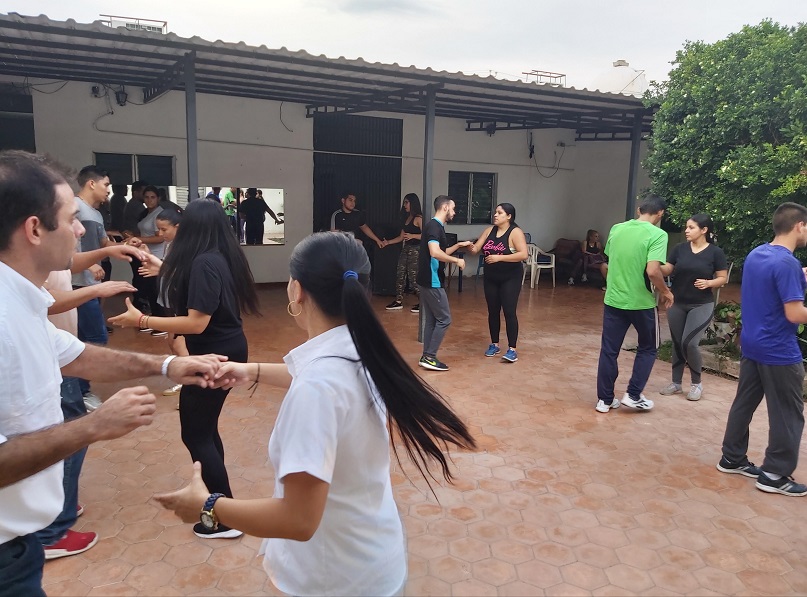
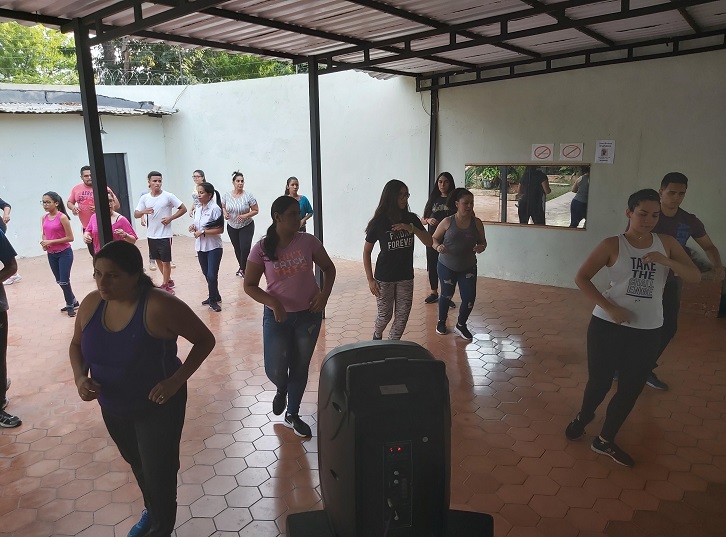
Photo of Salseros Academy Dance Academy

In Barquisimeto, the musical capital of Venezuela, the dancers of Afro-Caribbean rhythms have a place to develop, improve and learn skills with the help of professionals, who achieve the integration of its participants, creating an atmosphere of great joy for all ages.

In this sense, our special guest in Salsa Escrita “La Columna Salsera de Barquisimeto”, through International Salsa Magazine, www.salsamundi.com, is Eva Gordillo, psychologist by profession and director of the dance academy “Salseros Academy”.

Dancers of Salseros Academy Dance Academy

Eva has been a passionate dancer since the age of 13 and today, with only 22 years old, she has toured most of the dance schools in the twilight city and some outside the state of Lara, projecting and developing herself as an instructor of proven hierarchy and reliability.

Welcome Eva to the only salsa magazine in the world, International Salsa Magazine and Salsa Escrita. Thank you, Professor Carlos, for giving me the opportunity to be present in your prestigious salsa column, which is already recognized in my country, the Caribbean, the United States and Europe, thus supporting the entire existing salsa movement in Venezuela.

Eva Gordillo and Members of the Salseros Academy dance academy

Eva, how and when did the idea of having your own dance academy come up? Friend Carlos, on November 26, 2018, I started and materialized my great dream, my own academy and together with my colleagues and friends, Eleazar Hernandez and Manuel Gamez, we started this adventure, from which today, we are harvesting many fruits and we feel extremely happy with this project and grateful, mainly with God, because everything is thanks to Him.

Excellent, very good friend, by the way, what kind of dances do you develop and teach in “Salseros Academy”? In our academy we give group and personalized classes, for all ages, conditions and levels. Our strength is Latin rhythms, especially Salsa, as our name indicates.

We focus on their different dance ramifications, such as New York style mambo, Salsa en Linea or Los Angeles style, Cuban Timba en Linea and En Rueda or “Salsa Casino”. Amiga Eva, in addition to salsa, do you teach other dance rhythms? Indeed Carlos, in addition we teach some Cuban music derivatives such as the chachachá, pachanga and boogaloo.

We are also projecting ourselves strongly with the bachata and its variants, as well as other Latin genres, such as merengue, among others.

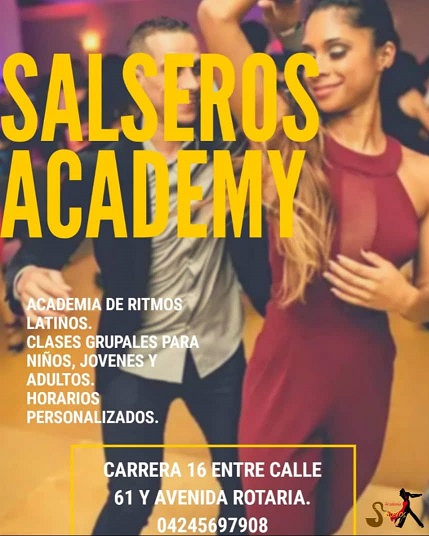
During a visit to the headquarters of “Salseros Academy” in the city of Barquisimeto, by the Latin American correspondent team of International Salsa Magazine, we were able to see the excellent, comfortable and spacious facilities, located on Carrera 16 between Calle 61 and Avenida Rotaria, where Eva is accompanied by four experienced instructors specialized in different dance styles. The attendance and registration of participants is massive, given the proven quality and recognized throughout the city of Barquisimeto.

Dance Academy Salseros Academy

Friend Eva Gordillo, do you also have other projects at a musical and danceable level? That’s right teacher, at present we are heading to be producers of salsa events, thus promoting the Latin dance movement in our state Lara.

By the way, last year we had the pleasure of carrying out an event called “La Gran Gala de la Salsa” (The Great Salsa Gala), on the occasion of the celebration of the 1st anniversary of our academy, in which the dancers were able to enjoy the “Kadencia Latina” and “Jossy y su Banda” orchestras. Digital platforms and contacts for those interested in dancing at Salseros Academy? Friend Carlos, they are: Instagram: @salserosacademy, @evacarolgz, Whatsapp: 0424-5697908, Facebook: Grupo Salseros.

On behalf of the academy, my team and students, we would like to thank you for your support and projection of our work through your column “Salsa Escrita” in International Salsa Magazine. We wish you success and blessings to continue driving the Venezuelan salsa movement.

ISM Salseros Academy Dance Academy Fund

By Carlos Colmenares, ISM Journalist Correspondents, Barquisimeto, Venezuela

Pacifica Radio, history, shows and controversy

This is Pacifica Radio

Pacifica Radio has been one of the largest radio networks in the United States in recent decades and its importance remains enormous today despite the time elapsed. It has given voice to figures of all kinds of political and ideological trends and artists from all genres who sought a platform in order to be heard. However, such popularity does not make this organization to be free from controversy that, like its history and shows, we would also like to explore with the greatest possible respect.

Next, we will talk about the most outstanding to observe about this radio station since its beginnings from 1946 to this day, since talking about Pacifica Radio is also talking about communication in the United States and the role played played by Latino culture and music in all of this.

Logo of Pacifica Foundation

Beginnings of Pacifica Radio

Pacifica Foundation is a non-profit organization that owns five independent radio stations financed from listener contributions. It is widely known for its progressive and liberal tendencies and is located next to KPFK in Los Angeles, California.

This organization is also responsible for managing everything related to Pacifica Network, which, in turn, runs much more than a hundred affiliated stations with all kinds of shows and content, although it specializes on political and social issues to varying degrees. It is the oldest radio network in the country and the oldest non-profit network in the world, which speaks of Pacifica’s relevance compared to other media.

It was founded in 1946 by E. John Lewis and Lewis Hill after the Second World War. Both men were totally anti-war and refused to perform military service as conscientious objectors. They joined other pacifists to create Pacifica Foundation, whose first station started to air on April 15, 1949 in Berkeley, California.

Being true to the beliefs with which they started this project, the founders gave voice to all those who were against the Korean War the following year along with many other minorities who could not find means of communication to express their views contrary to the majority position of the time.

The station started operating in several cities over the years due to its enormous success and the following radio stations were created in several cities: KPFA/94.1 and KPFB/89.3 in Berkeley, California (San Francisco Bay Area), KPFK/90.7 in Los Angeles, WBAI/99.5 in New York, KPFT/90.1 in Houston and WPFW/89.3 in Washington, DC.

Lewis Hill, co-founder of KPFA and Pacifica Radio

Operation

Pacifica is governed by a board of directors that sets out the policies that determine the organization and oversees the network operations. The board is comprised of representatives from each of the stations that comprise the foundation, as well as directors elected by the Pacifica community.

The members of this board are elected and replaced every three years and have regular meetings to discuss issues related to the operation of the foundation and decision-making regarding the management of the network. It is from there that the use of resources donated by the audience is being decided.

The board members are as follows:

Lydia Brazon (Chair), representing KPFT in Houston, Texas

Sabrina Jacobs (Vice-Chair), representing KPFA in Berkeley, California

Alex Steinberg (Secretary), representing WBAI in New York City, New York

Donald Goldmacher (Treasurer), representing KPFA in Berkeley, California

Christina Huggins, representing WPFW in Washington, D.C.

T.M. Scruggs, representing WBAI in New York City, New York

Janet Coleman, representing WBAI in New York City, New York

Cerene Roberts, representing KPFA in Berkeley

Pacifica Foundation’s Latino shows

If there is something Pacifica Radio has stood out is for the enormous space provided to the Latino community to spread its music and culture in general. That is why there have been many shows entirely dedicated to these topics and whose hosts have been Latinos or children of Latinos.

KPFA has Luis Medina and Emiliano Echeverría, who are in charge of hosting the show ”Con Sabor”, which specializes in artists and news related to salsa, Latin jazz, Afro-Cuban and Afro-Caribbean music, among other genres. In addition, they also interview these artists, provide the audience with the musical calendar and offer concert tickets.

Broadcasters Luis Medina, Chata Rodríguez, and Emiliano Echeverria

In the case of KPFK, the Latin community has the well-known show ”Canto Tropical” hosted by Kathy Diaz and Hector Resendez, whose work is focused on promoting the main Latin music genres such as Latin jazz, Afro-Cuban music and salsa. They also focus on interviewing and giving space to both local and foreign artists to promote their talent and be made known to the widest possible audience.

Host of ''Canto Tropical'' Kathy Díaz and host of ''Alma Del Barrio'' Eddie López
Host of ”Canto Tropical” Kathy Díaz and host of ”Alma Del Barrio” Eddie López

On WBAI, ”Salsa Con Candela” is a weekly celebration of the rich history and diversity of the salsa music genre. The show hosted by DJ Candela includes a mix of classic and contemporary songs, as well as interesting and enlightening interviews with artists and important figures in Latin music culture.

Another noteworthy Latin program is ”Salsa y más” on KPFT, which explores in detail the world of salsa and other important Latin genres. The program hosted by DJ Leonard Trujillo, as well as ”Salsa Con Candela” also offers a mix of Latin and contemporary songs along with interviews with local and international artists.

And finally, WPFW has ”Latin Flavor”, a program dedicated to the most important Latin genres such as salsa, Latin jazz and many others. The show hosted by DJ Jim Byers explores the cultural and historical roots of Latin music and provides a platform to present new artists from around the world.

Locutor Jim Byers
Locutor Jim Byers

Controversy

Since the beginning of this foundation, its stations have been embroiled in a series of scandals that have not gone unnoticed by telecommunications and the community at large, especially political and ideological. Among the many events suffered by Pacifica, we cannot fail to mention the requests from the government to obtain the recordings of some shows, controversial interviews such as the one with Che Guevara, reports about embezzlement of funds, financial crisis, among many other things.

In 2020, it was learned that some Pacifica listeners, volunteers and donors have created an organization called Pacifica Safety Net with which they seek to expose mishandling and attitudes of Pacifica’s board members, whom they accuse of compromising the main mission of the station network. The members of this group have filed a lawsuit against this board for prevarication and mismanagement, assuring that the board’s lack of leadership resulted in the loss of many revenues in the station network and, therefore, caused a serious problem of solvency in the organization.

KPFA's building
KPFA’s building

A great example of this mismanagement is the reduction from 120,000 to 40,000 members the network has today, as was the case in just a few years. There are also many complaints about the type of programmes broadcast by the network in recent years due to their high content of hate, conspiracy theories, racism and a lot of things that did not represent the values upon which Pacifica Foundation was based.  

In that sense, the members of the aforementioned committee make an urgent call to all members of the radio network to recover these spaces to go back to the main mission of the foundation, which unfortunately has been taken by other interests completely unrelated to those of the donors, workers and listeners.

In 2019, the network was able to get a $3 million loan that would allow it to pay part of the debt accumulated up to that date, but the possibility of the foundation achieving long-term financial stability is not even close to being a fact. Due to mismanagement, the foundation is not able to pay this amount back, so it is forced to cut costs. This reduction in income is causing the board of directors to seek to sell the building where WBAI operates, which had been given by the Empire State Realty Trust (ESRT) in exchange for a rental agreement that is quite detrimental to the foundation from the point of view of current and former workers.

The Empire State Building, where WBAI FM is located now

Wit regard to this issue, Mexican broadcaster Jesse ”Chuy” Varela, who worked for several years at KPFA, told us a little about the irregularities presented both there and at other stations where he worked. The radio professional points out that there have always been serious communication problems between administrations and workers. ”The board always thinks they can do something better with the money raised and spend a lot of resources without notifying the audience about what they are doing. When you ask for money from the listeners, they have to trust that when they give it to you, you are going to put it to good use” declared Varela.

”I knew of many cases where executives who had meetings in different cities, stayed in expensive hotels and ate in exclusive restaurants. I consider this is an abuse and a lack of respect for those who donate their money. I have seen this in all the stations where I worked unfortunately. In this sense, trade unions play a fundamental role to avoid these kinds of problems” the broadcaster continued.

Announcer Jesse ''Chuy'' Varela at KCSM Jazz 91
Announcer Jesse ”Chuy” Varela at KCSM Jazz 91

As for other announcers and former Pacifica Radio employees or managers, they did not want to make comments in this respect. We presume that this could be because of possible reprisals due to the power accumulated by the largest radio network in the United States.

It should be noted that everything written here is based on testimonies of others that have not yet been confirmed, so we neither confirm nor deny any of the facts as presented here.

Read also: Two radio programs of the salsa movement in California

”Salsa Con Sabor’’ and its contribution to salsa music

Platfoms to promote salsa

Just as we always promote the artists and musicians who keep alive salsa and Latin genres, we also think it is important to highlight the work of communicators who have taken the task of continuing to spread the traditional Latin music through the resources that technology has made available to us. Such is the case of Charlie Perez and the web page ”Salsa Con Sabor”, which he has been running for several years.

We talked to this talented young man, who has illustrated very well how his work has been throughout these years with the management of ”Salsa Con Sabor”, interesting anecdotes and what he earned from all this process.

Charlie Pérez, administrator of ''Salsa Con Sabor''
Charlie Pérez, administrator of ”Salsa Con Sabor”

Conversation with Charlie Perez from ”Salsa Con Todo”

Salsa Con Sabor was born in 2010. I was always a salsa enthusiast and it runs in the family because my father has always loved tropical music, salsa, guaguancó, son montuno, bolero, among others. I became curious about these topics while naving in the social networks, so I created a Facebook page whose aim was to be a music space to share with salsa fans around the world. By this means, we began to share music, artist biographies, salsa history, salsa ephemeris and many more” were the words spoken by Charlie when asked how this project came about.

He also told us that the page was gaining a popularity that he and his team decided to shape this idea through the creation of a website, a YouTube channel and accounts in the rest of social media. All this led several independent artists to send their musical works to ”Salsa Con Sabor” to be shared and diffused.

Important to note that all members of this great team are professionals nothing linked to the world of music. They are simply people who enjoy Latin genres and want them to stay alive over time.

Charlie Pérez and his wife Wilendy Rosario

What do you see in an artist before spreading his or her music?

I like to support all artists, but I don’t deny that I focus a lot on the quality of the work presented. I always check certain aspects such as the cover art, the image and how music was worked, showing whether or not an album will be worth it. We always give the opportunity to all artists to send us their work, but they must have a standard quality” said Charlie on the subject related to unknown artists sending him their albums.

Successes to date

Perez has told us that he feels incredibly grateful for all the doors ”Salsa Con Sabor” has opened for him. He has met many important people in the industry and artists with whom he has developed good friendships, something he really values.

This space has also allowed him to expand to other fields. In the case of Charlie, he is a marketer and always had the desire to start his own business, which added to his knowledge of the music industry and marketing, led him to create his own advertising agency called Tumba Media Productions. The company is dedicated to dissemination activities such as press releases, graphic design, among other things.

Another thing that has been very important for the future career of this young man has been song writing. Composing his own material has earned him contact with great artists such as Venezuelan singer Néstor Pacheco, who motivated him to make music and with whom he has a clase friendship. They even wrote some songs together such as ”Sabor y Guaguancó” and ”Mamá Inés”.

Logo of the website
Logo of the website

The best experiences with the website

Regarding this point, Charlie replied that his reviews have received many positive messages from the public and many artists. He and his collaborators are very glad that so many people keep an eye on their content and that their platform let them know abut new music in terms of salsa, guaguancó, bolero, son montuno and other associated genres.

We are great popuizers of new music that nobody knows about due to the amount of content you can find, which makes us very happy and be satisfied with our work” says Charlie.

Activity during the pandemic

From the pandemic, we started working on interviews a lot more than before and had to focus on making video content. Video editing tools were very important for us at this stage, since it wasn’t just about doing interviews, but also about downloading them and doing all the corresponding editing to show them to the public in the most professional way possible” says the administrator of ”Salsa Con Sabor” about his experience with the pandemic.

He also told us that there were many artists he interviewed with whom he thought would never connect, which was made possible thanks to the tools that technology offers us today. In that sense, his wife Wilendy Rosario was very important in this entire process, as she was in charge of making contacts and conducting many of these interviews in that frame of time. She is described by her husband as a fundamental part of this project thanks to her communication style and charisma.

Read also: Broadcaster and host of Con Sabor Y Amor Latino Tatiana Mezarina

  • « Go to Previous Page
  • Page 1
  • Interim pages omitted …
  • Page 13
  • Page 14
  • Page 15
  • Page 16
  • Page 17
  • Interim pages omitted …
  • Page 62
  • Go to Next Page »

International Salsa Magazine (ISM) is a monthly publication about Salsa activities around the world, that has been publishing since 2007. It is a world network of volunteers coordinated by ISM Magazine. We are working to strengthen all the events by working together.