• Skip to primary navigation
  • Skip to main content

International Salsa Magazine

  • HOME
  • Previous editions
    • 2026
      • ISM / April 2026
      • ISM / March 2026
      • ISM / February 2026
      • ISM / January 2026
    • 2025
      • ISM / December 2025
      • ISM / November 2025
      • ISM / October 2025
      • ISM / September 2025
      • ISM / August 2025
      • ISM / July 2025
      • ISM / June 2025
      • ISM / May2025
      • ISM / April 2025
      • ISM / March 2025
      • ISM / February 2025
      • ISM / January 2025
    • 2024
      • ISM / December 2024
      • ISM / November 2024
      • ISM / October 2024
      • ISM / September 2024
      • ISM / August 2024
      • ISM / July 2024
      • ISM / June 2024
      • ISM / May 2024
      • ISM / April 2024
      • ISM / March 2024
      • ISM / February 2024
      • ISM / January 2024
    • 2023
      • ISM / December 2023
      • ISM / November 2023
      • ISM / October 2023
      • ISM – September 2023
      • ISM – August 2023
      • ISM July 2023
      • ISM Edition June 2023
      • ISM – May 2023
      • ISM April 2023
      • ISM March 2023
      • ISM February 2023
      • ISM January 2023
    • 2022
      • ISM December 2022
      • ISM November 2022
      • ISM October 2022
      • ISM September 2022
      • ISM August 2022
      • ISM July 2022
      • ISM June 2022
      • ISM May 2022
      • ISM February 2022
      • ISM January 2022
    • 2021
      • ISM December 2021
      • ISM November 2021
      • ISM October – 2021
      • ISM September 2021
      • ISM August 2021
      • ISM July 2021
      • ISM May 2021
      • ISM April 2021
      • ISM June 2021
      • ISM March 2021
      • ISM February 2021
      • ISM January 2021
    • 2020
      • ISM December 2020
      • ISM November 2020
      • ISM October 2020
      • ISM September 2020
      • ISM August 2020
      • ISM July 2020
      • ISM June 2020
      • ISM May 2020
      • ISM April 2020
      • ISM March 2020
      • ISM February 2020
      • ISM January 2020
    • 2019
      • ISM December 2019
      • ISM November 2019
      • ISM October 2019
      • ISM Septembre 2019
      • ISM August 2019
      • ISM July 2019
      • ISM June 2019
  • Spanish
  • Download Salsa App
    • Android
    • Apple

Search Results for: Latin genres

Somos Latinos in Mexico

Latin America / Mexico / Ciudad de Mexico

Somos Latinos is a company based in Mexico that has specialized in the production and organization of salsa music events since 2006. We had the opportunity to speak with the General Director, Omar Gonzales, who told us that he is an Audio Engineer. Before starting the company “SOMOS LATINOS,” he worked for another company providing services to most of the international singers or musical groups that came to the country. He also mentioned that he has always liked the salsa genre, even though it’s difficult to find since it’s not the country’s native music. However, this doesn’t mean there aren’t small to medium-sized groups of “Salsa” followers.

Oscar D'Leon - Somos Latinos in México
Oscar D’Leon – Somos Latinos in México

One day, he decided to create his own office with the idea of doing something—promoting “Salsa.” Starting in 2007, they took a chance and organized their first event. After some time, the famous singer Tony Vega came to the country and gave him the opportunity to produce his first event there. Thanks to its success, “Somos Latinos” became his exclusive office in Mexico. One of their biggest successes was an event they organized with the salsa artists N’Klabe and NG2, who were known as “The Pioneers of the Future of Salsa.” The salsa fans who attended the event applauded like never before, as it was a world-class show.

Somos Latinos in Mexico - Roberto Blades and Viti Ruiz
Somos Latinos in Mexico – Roberto Blades and Viti Ruiz

The company currently has 10 years of experience and is known for:

  • An extensive roster of artists.
  • A solid reputation for event production, recognized as a reliable and trustworthy production company, earning the confidence of the public, their clients, and the artists they promote and represent.
  • Broad knowledge of musical genres and an excellent team trained for massive events.
  • Having the necessary equipment and infrastructure for event production (stages, audio, backline, lighting, voltage generators, giant LED screens, and other technology to create top-level shows).

Omar also mentioned that to celebrate their anniversary, they created the “Somos Latinos International Salsa Festival,” their most important event, which has been held 8 times in different parts of Mexico, such as “Mexico City,” “State of Mexico,” and the “State of Veracruz.” In the latter, they participated as organizers and suppliers for the fourth edition of the Boca del Río International Salsa Festival 2014, the world’s largest salsa event, which takes place over 4 days (with an average attendance of 120,000 people per day). This event has earned the State of Veracruz recognition as the world capital of salsa.

Upcoming Event

Somos Latinos in México

On July 14, 2017, the event “Roberto Blades & Viti Ruiz #EntreAmigos” will take place at the “La Maraka” venue located at Mitla No. 410, Esq. Eugenia, Col. Narvarte, 03023 Benito Juarez, Mexico City, Mexico.

If you want to get to know them and learn more, you can contact them through:

  • Website: http://www.somoslatinosmexico.com/eventos.html
  • Email: [email protected] / [email protected]
  • Phone: +52 (55)5082-9580 / +52 1 5523281427
  • Instagram: @somoslatinos
  • Twitter: @somoslatinos
  • YouTube: http://www.youtube.com/channerl/UCzNWbZ7HyIPxE5tmkrwIRag

The Perfect Salsa Alignment - Somos Latinos in Mexico
The Perfect Salsa Alignment – Somos Latinos in Mexico

Argentine tango bassist and Latin Grammy winner Pedro Giraudo returned to his roots

Latin Grammy winner Pedro Giraudo spoke exclusively to us for International Salsa Magazine, so we are very pleased to bring you the best of our conversation with the Argentinian bassist and composer. Next, these are the highlights of his beginnings and his exciting career in his native country and in the United States, where he currently resides.

Pedro Giraudo posing
Argentine bassist Pedro Giraudo posing for the camera

Pedro’s beginnings in music

Pedro comes from a family of musicians. In fact, his father was a bandleader and his mother sang in a choir, so he was surrounded by music practically since he was born. He has memories of him watching his parents rehearse and play instruments when he was very young, so he was always very familiar with this kind of thing.

During his adolescence, he performed recitals with various ensembles, some of which played classical music, jazz, and tango. His professional advancement was very gradual, but he was doing some activities that prepared him for what was to come years later.

His love for this world grew so big that, once he turned 19, he moved to the United States precisely to study music and learn everything he could about what can be expressed through it. His musical interests initially focused on jazz, but that changed over time. 

Already at the end of his last year in college in New York, he was working regularly with various groups of different genres.

Interest in tango

Although, as we have said, Pedro comes from Argentina, he had not been particularly interested in tango at first, but his numerous trips around the world made him feel a little uprooted and detached from his beginnings. For this reason, nostalgia made him reconnect with the traditional music of his homeland. In addition, the fact that he was Argentinean encouraged many groups to call him, even though his knowledge of tango was not yet very deep at that time.

After giving himself the opportunity to play tango more formally, he also set to work to study it much more to learn about its most famous composers, its various styles, its ways to write music in the genre, among other things. In addition to that, he started to transcribe a lot of music to know what it sounded like in different styles and to gain practice. 

This path eventually led the artist to become part of many tango bands and even to lead some ensembles.

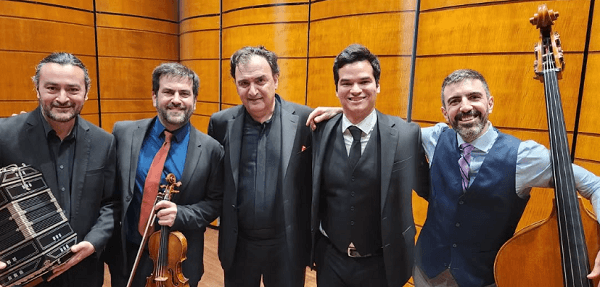
Pedro and friends
Pedro Giraudo, pianist Ahmed Alom, symphonic director Sergio Alessandro Bušlje, violinist Sami Merdinian, and accordionist Javier Sanchez

Groups Pedro was in

Pedro’s main goal in arriving in the United States was to become a double bassist, and after finally achieving it, he graduated from college and started to explore his role as a composer and leader of his own ensemble. From there, the band varied for characteristics and changed members and in size over the next 15 years. The last thing was a 17-piece big band.

Then, in the year 2014, due to the death of a great friend, Argentine pianist Octavio Brunetti, the Lincoln Center for The Performing Arts asked him to lead an event to celebrate his life and music. Therefore, in 2015, the musician started his tango project, which he would name Pedro Giraudo Tango Quartet, taking this request as a starting point. 

Today, he focuses all his efforts on tango ensembles, although he does recognize that he is increasingly angling for the classical side. For example, for his latest album, Pedro used a symphony orchestra, and since the last few months, he has been conceiving his next project with a chamber orchestra. 

Great collaborations in his career

Throughout his career, Pedro has been able to work with great music glories such as Paquito D’ D’Rivera, Rubén Blades, Pablo Ziegler, William Cepeda, and many others. One of the nicest things about this work for the Argentine is that he is always surrounded by very talented people from whom he can learn a lot.

One of them was bandoneonist Hector Del Curto, who was one of the first people Pedro started playing tango with in New York. Del Curto, in turn, had the great honor of playing with the greats of the golden age of Argentine music, such as Osvaldo Pugliese. 

It was through Hector that Pedro was able to meet and play with Pablo Ziegler, who was the principal pianist of Astor Piazzolla’s Second Quintet and greatly influenced the way tango is played on the piano. In fact, playing along with him on the double bass was an experience of which he learned so much, which he appreciated. 

Pedro and his Grammy
Pedro Giraudo holding his Latin Grammy in Las Vegas

In the case of William Cepeda, the artist made some arrangements for him and he received many valuable lessons from him, such as the importance of keeping musicians engaged with sheet music to prevent them from getting too lax. It was also with Zepeda that he made his first arrangements for a symphony orchestra.

On the other hand, Paquito taught him how to be a practical musician and to make perfect, well done arrangements for any occasion. 

Latin Grammy winner

Pedro is fortunate to be a Latin Grammy winner thanks to his album “Vigor Tanguero” in the category Best Tango Album in 2018. When we asked him about his experience, the double bassist said that there are some details he does not fully understand, such as the elements taken into consideration when voting for an artist in a category. However, that did not overshadow the joy of winning such an important award.

He says his victory was a surprise. At the time, he remembers being on tour with Pablo Ziegler, and after a four-hour rehearsal, his phone had about 40 missed calls congratulating him, while he did not even know that the nominations were being announced that day. To his amazement, he was included.

The final event was in Las Vegas, where Pedro finally heard his name and felt a total joy and pride for all he had achieved. In this respect, he said, “I’m not a person who collects awards, but this is a recognition I’m very proud of, to be honest.”

Read also: French flamenco dancer Fanny Ara lets us know the most important details of her career

Los Boleros Latin Band Bandleader Rudy Furlan kindly talked to us

Cuban music has managed to conquer so many hearts around the world that even many who were not born on the island have come to feel a great fascination for it. Such is the case of the bandleader and leader of Los Boleros Latin Band, Rudy Furlan, with whom we were able to talk for a few minutes about his career and his band.

Rudy playing the guitar
Rudy Furlan playing the guitar for the camera

How Rudy got started with music

Although Rudy was born in Guatemala, he moved to the United States when he was just three months old and has lived in the country ever since. His parents loved music and having parties at home, where various members of the family brought out guitars and broke into song to lighten the mood.

Most of his parents’ friends loved to sing boleros and the Latin classics of the time, which Rudy found pleasant and enjoyed musical activities of the adults around him to the point that he wanted to participate in those impromptu gigs within his means.

Soon after, he started taking guitar lessons at the age of nine, but it was at 16 that he started to take music more seriously and realized that he wanted to play the genres his parents always listened to such as bolero, cumbia, Cuban son, danzón, among others. Only drawback he found was that he could not find boys his age who wanted to play that kind of music, added to the fact that the communication possibilities that we enjoy today did not exist. 

So, Rudy had no choice but to start forming small bands with kids who lived on his block and play rock and other local genres that were normally played back then. However, this whole situation changed when he placed an ad on Craigslist (online classified company). That is when he finally managed to get the people he needed to play what he finally wanted to play and how he wanted to play it.

Rudy at the museum
Rudy Furlan at the Motown Museum in Detroit

Los Boleros Latin Band

Rudy finally fulfilled his dream of playing his parents’ favorite music as an adult and managed to recruit a group which he named Los Boleros Latin Band. The artist chose this name as a tribute to the genre he liked to listen to since his childhood, plus he likes how the name sounds.

In the early 2000s, he set up the band’s website to have an internet presence, which was not very common for Latin bands in Northern California in those years. There was so much rock and soul in that area, but Latin music did not have the boom that it has acquired today.

Practically from day one, they managed to have a lot of work in many events, which led several talented musicians to contact Rudy to work with him. One of them is vocalist Felix Samuel, who comes from Cuba and joined Los Boleros Latin Band in 2009. Felix comes from a family of professional musicians, so it was easy for him to integrate into his family’s craft and exercise it with the same talent and momentum as his relatives.

Something interesting to say about Samuel is that his talent began getting noticed, so he was recruited by an HBO producer to soundtrack the film ‘‘Hemingway & Gellhorn’’ with Nicole Kidman and Clive Owen.

Another important member of the band is Zareen Tangerine, who is also a vocalist in the group and joined it in 2000, making her one of the first to join Los Boleros Latin Band.

Another fundamental part of the band is David Somers, who is currently the group’s saxophonist, although he also plays the flute to perfection. 

Among other members, we can also mention bassist David Pinto, percussionist Dominic Cabrera and Oswaldo Carvajal, who also plays for La Moderna Tradición. 

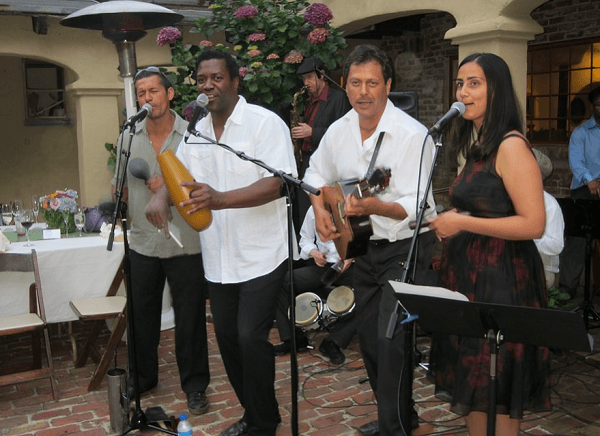
Dominic, David, Felix, David, Rudy, and Zareen
Percussionist Dominic Cabrera, singer Felix Samuel, saxophonist David Somers, bandleader Rudy Furlan, and singer Zareen Tangerine

Great references and inspirations for the music Los Boleros Latin Band makes

A few years ago, Rudy bought an album by Buena Vista Social Club, which he says changed his life completely and made him change direction in terms of the music. He listened to the material every day for months, to the point that he even memorized the songs and started playing them with his guitar.

When forming Los Boleros Latin Band, his musicians played many songs from that album and other great artists such as Eliades Ochoa, Ibrahim Ferrer, Compay Segundo, Omar Portuando and many others. 

Those already mentioned were some of the greatest inspirations Rudy and the members of the band had for their project, this being the vision with which the artist wants to go on through time as far as possible.

Read also: Producer, composer, and guitarist Oscar Almonte innovates with Dominican music

Milonga’s contribution to Latin music in general

There are many Latin genres that have managed to find a place in the USA music scene thanks to the constancy of many of its great exponents, salsa being the genre we talk about the most. However, today we want to change the subject a little bit and analyze what is milonga and how popular it has become in recent years.

Malevo y su dama
Recreation of ”Malevo y Su Dama” in Buenos Aires, 1970

Definition of milonga

The milonga can be defined as a folkloric musical genre coming from the Rio de la Plata region, which is usually performed with a guitar accompaniment in 6/8 time. Usually, it is divided in two modalities that are the milonga campera (the genre in its purest form) and the city milonga (style subsequent to the milonga campera).

Etymology of ”milonga’’

Although the musical genre is known for being originally from Argentina, Uruguay and certain parts of Brazil, ”milonga” means ”word” in the Quimbundu language (a language of Angolan origin that corresponds in several expressions with Portuguese). It is important to mention that this is the language used by some tribes from Angola, which was a colony of Portugal, and that many of the slave population of those lands was transported to Brazil, Uruguay and Argentina.

According to information received from some scholars, after the defeat suffered by the Argentine founding father Juan Manuel de Rosas in Caseros at the hands of Entre Rios Governor Justo José de Urquiza, the Brazilian soldiers caught the porteños off guard while singing guajiras in mockery, at the same time that the porteños sang milongas.

In the ears of Brazilians, these songs sounded like gibberish they could not understand. In the end, as a result, the term had such an impact that locals began referring to their own creolized guajiras as milongas.

La milonga de buenos aires
Yanina Quiñones and Neri Piliu dancing “La milonga de Buenos Aires” at the 4th TangoLovers Festival 2018 in Athens, Greece

A little history of milonga

Milonga is known for its joy, speed and sensuality at the time of being performed by its dancers. Its binary rhythm is of great simplicity, so it is in stark contrast to the four beats of the guitar that gives the melody to the dance and is usually accompanied by lyrics occasionally.

It has always been closely related to paya and tango. In the case of paya, milonga used some of its elements specifically for the dance, while tango uses some details of the rhythm and the melody in milonga for its own dance. Today, the three genres are considered a very important part of the Rio de La Plata music scene and each of them has their own characteristics that distinguish one from another.

Milonga had much to do with the birth of tango, but at the same time, it evolved and maintained its independence. In fact, there is some sort of mix of the two called tango milonga that is almost extinct, although it is known that many musicians wanted to use it to give the rhythm of the tango more strength and sustainability. 

As for the places where milonga could be danced, the genre used to be found in neighborhood clubs, dance halls, tearooms and boites. The music used was usually recorded, although the venue owners hired small bands occasionally to change the modality. The popularity of these groups was so great that several of their musicians managed to join highly recognized orchestras at the time. 

Couples who went to milonga clubs to dance ballroom tango and outskirts tango. The first only consisted of beat and elegance, while the second had beat, elegance and figure. Among the most famous places to dance milonga that remain active to this today, we can mention El Barracas Central, Unidos en Pompeya, El Sunderland and many others.

Se dice de mi in milonga
Theddy Lizama and Pamela Ramos Aracena dancing ”Se dice de mí” in Santiago de Chile, November 2022. Source Fuente General de la Nación Argentina

Milonga at present

Today, milonga has become a genre of big importance for people eager to learn to dance things other than salsa, bachata or merengue. This genre offers them the opportunity to try something completely different thanks to which they can connect with others in ways they would not have imagined due to its peculiar rhythm and overflowing sensuality.

In addition to that, every day there are more and more events also called milongas, which consist of massive dances where couples show their best moves to the rhythm of various genres, such as milonga, tango, and vals criollo. In general, the scheduling of a milonga is divided into blocks of three, four or five dances that are separated by short pieces of light music. Apart from that, each block contains a sort of rhythm that is grouped by orchestra, singer or composer.

These events were very typical in Argentina, but have been gradually spreading throughout various parts of the world, including the United States. Nowadays, it is fairly common to find restaurants, night clubs and academies that offer this kind of entertainment to their attendees such as Alberto’s Night Club (San Francisco), The Tango Room (Los Angeles), Milonga La Paz Tango Club (San Francisco), Tango De Rey (San Diego), Tango La Nacional (New York), Fairmont Tango Club (Philadelphia), Dance Fire Studio (New York), and many more.

Read also: The best marimba band found in Los Angeles

Latin jazz and mambo trumpeter Jonathan Powell and his great collaborations

Trumpeter Jonathan Powell is one of the many examples that show how much so many American artists have looked at Latin music over the last few years, so this is a great opportunity to know one of the many stories about what our heritage has achieved in this country.

Jonathan playing
Musician Jonathan Powell playing the trumpet live

Instruments that caught Jonathan’s attention

An important fact to remember is that Jonathan’s parents were musicians. His father played the electric bass and his mother played the cello, so he obviously has a lot of talent to get from. However, his interest in music turned to a slightly different way.

The instrument through which the artist is best known today is the trumpet due to his great skill at handling it, but it is not the only instrument he has learned to play. He also plays the trombone, the tuba and other bass instruments, but does not have the same fascination with them as with the trumpet.

His interest in music began when he was in high school and became part of a few student bands, resulting in more than 30 years of musical career.

Jonathan’s academic training

Most of what Jonathan has got to learn comes from the experience he has gained through his work, although he does not devalue formal music education. In fact, he attended the North Carolina School of the Arts and studied with that institution’s best teachers in the area of classical music.

When he turned 19, he made the decision to move to New York, where he has lived ever since. While there, he did not care as much about further studying music, but gaining as much experience as he could through practice.

Jonathan recording
Jonathan Powell recording music for his album ”Mambo Jazz Party”

Interest in Latin music

Although Jonathan’s interest in music began with the classical genre, his move to Florida made him seek other horizons. In Florida, he and his brother Jeremy began to make contact with radio stations that played Latin genres and this led them to meet the Garcia-Herreros brothers, Juan and Victor, who are two very experienced musicians in Latin jazz, but also in Latin music in general. The boys returned to Florida after studying at Berklee College of Music and started a band with Jonathan and Jeremy until they had to move to New York.

When Jonathan graduated from high school and also moved to New York, he was reunited with Juan and Victor who offered him to join their orchestra La Creación, with which he played every weekend for several years. This would be what the young musician would describe as his first real experience in the world of music, leading him to participate in the orchestra La Excelencia and to play with Arturo O’Farrill and Eddie Palmieri. 

Learning from other great artists

Just as Jonathan has played with O’Farrill and Palmieri, he has also been able to share the stage with Miguel Zenón, Tito Puente Jr, Oscar Hernández from the Spanish Harlem Orchestra, Israel Tanenbaum and many others.

Despite not having received much academic training, the opportunity to have played with the aforementioned music stars and many more really taught him many things that he would not have learnt in any educational institution. He assures that from whom he learned the most was Maestro Palmieri, since the legendary pianist is very generous when it comes to sharing his knowledge with whoever needs it, thanks to his extensive experience in this rich world.

‘‘Palmieri has been around since the fifties and sixties and has played with the most important artists of his generation, so he has a lot to teach. People have no idea how much he knows and how deep his knowledge on music is,” said the trumpeter about one of his great living inspirations.

However, as a trumpet player, another of his great inspirations was Puerto Rican arranger, composer and producer Juancito Torres for the way he played, since he considers it very special and unique compared to many other musicians.

Jonathan and Palmieri
Maestro Eddie Palmieri and Jonathan Powell smiling for the camera

Nu Shanga

Eager to manage his own musical group, Jonathan gives the public a very interesting proposal which he baptized Nu Sangha, inspired by Tibetan language, since these two words together mean ”new community”. With this group, he had much more freedom when choosing how he wanted to address each rhythm and wanted to give a much more modern approach to the type of jazz he had been playing through electronic elements few times used before.

In the case of Nu Sangha, he enjoyed everything he did professionally and was able to experiment with everything he had learned so far in creative ways, leading him to release the albums ”Transcend” and ”Beacons of Light”.

Mambo Jazz Party

In Jonathan’s own words, Mambo Jazz Party, the artist’s most recent musical work, the entire process of recording it took more than 10 years, since that was the time taken to create all the music that appears in the record material. He started the creation in 2014 and it was not until 2022 that Jonathan added the final details such as some missing vocals, but he assures that all the time spent on the album was worth it.

On the album, we can find Jimmy Bosch, guitarist Nir Felder, flutist Itai Kriss, pianist Manuel Valera, vocalist Ariadne Trujillo, singer Anthony Almonte and many other great artists who embellish this creation.

In other interviews, Jonathan has described this album as a mix of traditional salsa and Latin jazz elements, electronic sounds and a lot of spiritualism, which can summarize very well what this musical work represents for Jonathan Powell. 

Mambo Jaszz Party by Jonathan
Cover of the album ”Mambo Jazz Party” by Jonathan Powell

Read also: Great Christmas salsa songs and their stories

  • « Go to Previous Page
  • Page 1
  • Page 2
  • Page 3
  • Page 4
  • Interim pages omitted …
  • Page 62
  • Go to Next Page »

International Salsa Magazine (ISM) is a monthly publication about Salsa activities around the world, that has been publishing since 2007. It is a world network of volunteers coordinated by ISM Magazine. We are working to strengthen all the events by working together.