• Skip to primary navigation
  • Skip to main content

International Salsa Magazine

  • HOME
  • Previous editions
    • 2026
      • ISM / April 2026
      • ISM / March 2026
      • ISM / February 2026
      • ISM / January 2026
    • 2025
      • ISM / December 2025
      • ISM / November 2025
      • ISM / October 2025
      • ISM / September 2025
      • ISM / August 2025
      • ISM / July 2025
      • ISM / June 2025
      • ISM / May2025
      • ISM / April 2025
      • ISM / March 2025
      • ISM / February 2025
      • ISM / January 2025
    • 2024
      • ISM / December 2024
      • ISM / November 2024
      • ISM / October 2024
      • ISM / September 2024
      • ISM / August 2024
      • ISM / July 2024
      • ISM / June 2024
      • ISM / May 2024
      • ISM / April 2024
      • ISM / March 2024
      • ISM / February 2024
      • ISM / January 2024
    • 2023
      • ISM / December 2023
      • ISM / November 2023
      • ISM / October 2023
      • ISM – September 2023
      • ISM – August 2023
      • ISM July 2023
      • ISM Edition June 2023
      • ISM – May 2023
      • ISM April 2023
      • ISM March 2023
      • ISM February 2023
      • ISM January 2023
    • 2022
      • ISM December 2022
      • ISM November 2022
      • ISM October 2022
      • ISM September 2022
      • ISM August 2022
      • ISM July 2022
      • ISM June 2022
      • ISM May 2022
      • ISM February 2022
      • ISM January 2022
    • 2021
      • ISM December 2021
      • ISM November 2021
      • ISM October – 2021
      • ISM September 2021
      • ISM August 2021
      • ISM July 2021
      • ISM May 2021
      • ISM April 2021
      • ISM June 2021
      • ISM March 2021
      • ISM February 2021
      • ISM January 2021
    • 2020
      • ISM December 2020
      • ISM November 2020
      • ISM October 2020
      • ISM September 2020
      • ISM August 2020
      • ISM July 2020
      • ISM June 2020
      • ISM May 2020
      • ISM April 2020
      • ISM March 2020
      • ISM February 2020
      • ISM January 2020
    • 2019
      • ISM December 2019
      • ISM November 2019
      • ISM October 2019
      • ISM Septembre 2019
      • ISM August 2019
      • ISM July 2019
      • ISM June 2019
  • Spanish
  • Download Salsa App
    • Android
    • Apple

Search Results for: Music Awards

Here we have Brazilian bandleader and composer Paula Maya

Today we have an exclusive that makes us very happy, since it is a talented artist from a country we had never talked about in this section: Brazil. We are talking about none other than the award-winning bandleader, composer, pianist, keyboardist and singer Paula Maya, with whom we had the privilege to talk by Zoom. 

Paula has a very interesting background, since she was born in the South Zone of Rio de Janeiro, the birthplace of the world famous bossa nova genre and the popular composer, pianist and singer Carlos Antonio ”Tom” Jobim. It is clar that this had much to do with artistic inclinations that the woman would show later in her life.   

Under her belt, she has several nominations and awards she received thanks to her talent and effort of so many years as her nomination to the Focus Web News Brazilian International Press Awards in the category of Best Brazilian Musician living in the US, her nomination to the Austin Chronicle Music Awards in the category of Top Ten World Music Bands, Winner of the Seattle Weekly Awards in the category of Best Brazilian Composer, her nomination to the Seattle Hot Rocks TV Show Music Awards in the category of Best Female Singer, among others. 

Here are the most important topics we touched with lovely Paula about her life and career.  

Singer Paula Maya
Brazilian bandleader, composer, pianist, keyboardist and singer Paula Maya

Paula’s early interest in music 

Paula first developed an interest in music when she was only four years old or even younger, as she had musical toys such as pianos or keyboards she used to play with all the time. To this it is added that her mother always listened to classical music, which she already found beautiful back then.   

What is interest about his direct family is the fact that there were no musicians in it. In fact, her father was a lawyer and her mother was a dancer and yoga instructor, but a cousin of hers was a bandleader, composer and music teacher who traveled to the United States and developed quite a big reputation at the time, so he became an example for Paula, who would end up following in his footsteps in the future. 

When she turned 10 years old, she began taking piano lessons, which was her first formal experience with music. Since then, she has continued to learn about a lot of instruments and areas related to this art, which she assures that it is so rich and diverse that you never stop learning new things.  

Paula’s mentors in music 

Paula has been very fortunate to be mentored by some of the most talented musical celebrities in Brazil and one of them was producer and percussionist Teo Lima, with whom she has continued to work on her latest album to the present. Paula met this Brazilian legend in Seattle, where she lived for 17 years, and music led them to form a great friendship that has lasted until today. 

They had wanted to make an album together for many years and it has finally happened, which was a dream for Paula, as she grew up listening to his greatest hits and dreamed about one day meeting him. Not only did she meet him, but also she became his friend and worked with him.   

Another name we can leave out is guitarist Baden Powell, whom Paula met in her early twenties and describes him as someone who supported her a great deal in her career and even came to her shows to watch her sing. 

Another artist who was important in her training was Luizihno Eça, who was one of the greatest exponents of bossa nova at the time and a great reference for all musicians who wanted to follow in his footsteps.  

Paula at ONE-2-ONE BAR
Paula Maya performing at ONE-2-ONE BAR in Austin, Texas

Music theory and the Brazilian Conservatory of Music 

Paula comments that, before entering the Brazilian Conservatory of Music, she had an excellent teacher who was a concert pianist of name Luis Magalhães, who taught her the best piano techniques that she uses today in her performances, meaning that she was admitted to the hous of studies with a solid foundation of knowledge that helped her a lot.  

In addition to that, music theory has been very useful for Paula at the time of teaching her classes, since she is a music teacher and thinks that all this knowledge is fundamental for an artist’s education, since music is very logical and occasionally you must look for quick answers to certain situations that certainly require studying and academic training. 

She also told us that she usually uses music theory when composing because of the theoretical part, but not always.   

Paula as a bandleader, pianist, keyboardist and singer   

When we asked Paula how she has developed and performed in all these areas of music, she laughs and says that this is just the beginning, as she is also in charge of producing, composing, recording her albums, running the business part, making booking arrangements, among other things. ”That’s the life of a musician nowadays, especially when you don’t have a machinery behind you to back you up” Paula said on this topic.   

This means that, apart from all the musical knowledge Paula has, she also takes care of all the details regarding her work, but they do not have to do with her profession directly. She does not have a large team of assistants to back her up, so she manages everything related to her career herself. 

Since there are so many things she should do, she has a calendar in which she arranges the day and time to do every activity and always follows it to the letter. The artist says that the hardest thing about this is finding the time to be inspired and compose, since so many occupations, sometimes, do not let her clear her mind. However, she has learned to take full advantage of those few spaces.  

Paula playing the keyboard
Paula Maya playing the keyboard at Barton Creek Farmers Market in Austin, Texas

Paula’s role as a Grammy Award voting member 

For some time, Paula was a Grammy Awards voting member in its version in English and Spanish, so we could not very well not ask her about this important issue. 

She told us that, although it is true that she is no longer part of the committee responsible for voting, social networks and these new forms of communication have made things much easier, since judges and committee members have groups on Facebook, WhatsApp and other platforms where they can conduct the necessary discussions. 

In her particular case, what she considered when the time comes to vote for a nominee was talent and how much she liked a type of performance, but all member had their own particular approach to choosing a specific artist. 

Something that Paula definitely did not like was that the majority of votes to an artist did not necessarily reward talent, but rather the popularity of the moment and promotion. She thinks this is not entirely fair, since talent, music skills and preparation do not always go hand in hand with popularity, but she is also aware that the ”game” is as well and she had to adapt to it. 

Paula Maya & Bosa Nova Plus 

Paula says laughing that everybody in Seattle expected her to play bossa nova because she was Brazilian, but she refused to do so. Eventually, she ended up doing exactly what the public expected and started playing bossa nova when she moved to Austin, Texas.  

The fact that this Texan city has so many residents and musicians from Brazilian descent living in Austin has been an advantage for this genre to continue to become more popular and this niche to develop more and more. This led her to meet the musicians who have accompanied her in the band, who also came from playing bossa nova and other genres during their respective careers. 

Read also: The Conga Room closes its doors, but says goodbye in style 


Antonio Laya a traditional artist

Latinoamerica / Mexico / Cancun

Antonio Laya  “He tells us a little about his new single Abre que voy”

Today we are pleased to learn a little about the life of Antonio Jose Laya Gonzalez (Antonio Laya), a Venezuelan who with his voice and his particular way of dancing has managed to climb and carve his way to success, this Taurean with a great career as a singer of good salsa and especially son, he presents us his new single, abre que voy, a success that has gradually positioned itself on the best musical platforms from his current hometown, the beautiful city of Mexico.

Antonio Laya
Antonio Laya

Good afternoon friend Antonio, thank you in advance for the time you give us to learn a little about your life and give our great readers a little about your son, but in letters, we know from your artistic review that you come from a cultural world. the dance? Why the singing?

I come from a family of musicians, teachers and athletes, in 1995/96 I started in the popular culture workshops of the “Fundación Bigott” (cultural house of great social impact in Venezuela) in the Afro-Venezuelan percussion workshops with Professor Jesús Raúl Paiva, where he gave me the opportunity to enter this world of culture…

Years later this would bear fruit, when I joined the Vasallos del Sol group, a representative entity of Venezuelan folklore, on one of their tours in Europe “Germany” to be exact, one of its dancers stayed, leaving an open vacancy, it was then that I received the invitation to audition, at a festival of San Juan of the foundation, where I was able to win a spot. From then on I became a vassal of the sun.

All this experience in the middle of the show made me lean towards dance, where I got to venture as direct from my own dance school destined to spread the Cuban casino. With Vasallos del Sol I had the opportunity to travel the world, Colombia, Cuba, Ecuador, Spain, Mexico, Korea, Japan, the United States,

How many years has it been since the idea of ​​entering the cultural world of your country?

22 years since I formally started at the Bigott Foundation.

How did the idea of ​​giving life to singing come about?

On the tour of the United States, I began to sing with the vassals accompanied by the guitar of Luis Gonzalez, assuring me later that it was there that he heard me and knew that I could sing, quickly and a few months later he called me and invited me to participate in a project that neither It didn’t even have a name, which would quickly begin to take shape and to date is known as the seventh bohemian.

I began to sing very badly, I lost my voice because I didn’t know how to use the phonator, I began to take classes with several teachers, the first of them Ronald Gonzalez, fundamental pillar to start singing, placing and improving my vocal technique, successively Fabby Olano, Gladys Salazar, Maigualida Ocaña, Dayan Montiel, Marcial, Gustavo Gerardo. We recorded 3 albums on national tours, the second of which is entitled “She takes me” a song that I believe made the Seventh Bohemia popular. Singing was not in the plans but it ended up being one of my great passions.

Antonio Laya
Antonio Laya

A song that marks you?

She sings: The earrings that the moon lacks, I have them saved to make you a necklace I found them this morning in the mist when I was walking next to the immense sea. Since I was a child I woke up very early listening to music by La Sonora Matancera, Felipe Pírela, Damiron and Danzón de Acerina, it fascinated me.

Let’s talk about the seventh bohemia. How do you join this septet?

I am a founder, just in the second rehearsal when only Luis Freites, Cesar “Chagu” Bolívar and Luis Gonzalez were there I was summoned along with Krlos Gonzalez to be part of the group, from then on I started singing “Bilongo” to be exact, hahaha I’m so in love with the black tomasa……….., El Jamaiquino, Me que, among others.

What is the greatest thing you have experienced so far with music? -You could perhaps refer to a concert or moment to share with an artist-

I think the greatest thing I have experienced in music is having shared the stage with great figures both Venezuelan and foreign, Francisco Pacheco, Canelita Medina, Trina Medina, among, Jose Alberto “el canario”, Cheo Feliciano, Alexander Abreu and his Habana de First, Manolito Simonet and his Trabuco, Tiburón Morales, El Septeto Santiaguero, among others. On the other hand, being at the 2014 and 2015 Pepsi Music Awards, the biggest thing, achieving 4 nominations for the 2015 Latin Grammys, a great privilege.

What has given you and what has taken away the artistic life you lead?

It has given me the satisfaction of feeling and receiving the applause of an audience, feeling the magic of a stage, dancing on the most important stages of Venezuela and the countries I visit, I don’t know if there is another artist who performed in the same weekend in two different facets and groups in the most important venue in Venezuela

The Teresa Carreño Theater where on Saturday I danced in my last Vasallos de Venezuela concert in the concert “Guiados por la Luz” occasion to baptize the latest production, with guests from the cultural movement and the next day singing with La Séptima Bohemia alternating with Francisco Pacheco, El Septeto Santiaguero, Jose Alberto “El Canario” Canelita Medina and El Tiburón Morales and as special guests all the best dance academies in Caracas.

Antonio Laya
Antonio Laya

Antonio let’s laugh a little. Tell us about the funniest thing that has happened to you at a concert and the most painful.

WUUAOOO, too many, Well, a concert with Los Vasallos where I went out to dance and my pants began to drop, at a concert at the Yerba Buena Garden Festival 2008 in San Francisco we got the foot burn of the century since the stage was al pure sun and linoleum floor and at the baptism of the album “She takes me” in the main hall of the Central University of Venezuela after the great presentation of the renowned Ramón Castro We went on stage and I couldn’t see anything through my glasses hahaha and I I put in the place of my partner Miguel Guanchez colliding spectacularly ahaha to start singing. What a laugh.

We know of the great success that you have had in Venezuela with the successes that you have sung and have marked the public, they have gone from a sound to a necessity for the dancer. What do you consider this great impact?

Definitely because I come from the world of dance, I’m a dancer and a dancer and I understood perfectly that I needed the same audience that the casineros came from, those of us who at some point went to the Goiticoa school or the Monagas house. By the way, as a curious fact, I was the one who organized one of the first casino parties in a place called Beisboland, a party where I dare say it was the second presentation of one of the most important dance groups in the Venezuelan casino Son Rumbero, where they danced “Cuentas Verdes y Amarillas de Adalberto Álvarez.

How has your foray into Latin music in Mexico been?

Since my arrival in Mexico I have participated in several musical projects, Los Panas.com, La Formula Perfecta, Swing Latino to mention a few, it has not been easy since musically Cancun has a particularity and that is that the music that is danced is still that of the 80s when they talk about salsa, of course with its exceptions, but it has cost me to adapt but in the end it is what is consumed here. Here the forte is the hotel industry, so the Latin genres that marked an era are what is worked on, that’s why as a salsero it has been difficult for me to adapt, although I have worked anyway.

Antonio Laya and his Orchestra

The Salsa or the Son? Which one do you lean towards?

Definitely La Salsa, I grew up in the middle of the Salsa de La Sonora Ponceña, Willie Rosario and the great Ray Barretto to name a few. Son also became my passion but I have to be realistic! came into my life thanks to the Seventh.

Open, I’m coming. Tell us a little about this great topic?

When I got on the plane to leave my country, in addition to nostalgia, I only had one thought, to make my album as a soloist first, I knocked on many doors, I looked for a lot of help, until I finally reached what today is called “Abre que I’m going” in that search the day came when I remembered that I had a buddy who was Omo Aña (Drummer) Maurice Melo and that after conversations, long conversations we would take a first step, start aggravating a theme, my first promotional single.

What surprise do we have to see from Antonio Laya during this 2019?

With God’s favor, to continue recording my album, including my first music video, if money allows me, hahaha For this 2019 I’m going to release my second single, it’s called… (Thinks) Not yet, let’s leave it as a surprise , do a launch concert and seek my respective nomination for the 2019 Pepsi Music Awards and the 2019 Latin Grammys.

Antonio Laya February 2019

Where can our followers find you?

My social networks Facebook and Instagram through @ToñitoLaya, on twitter as @Negrolaya and through my YouTube channel, Toñito Laya


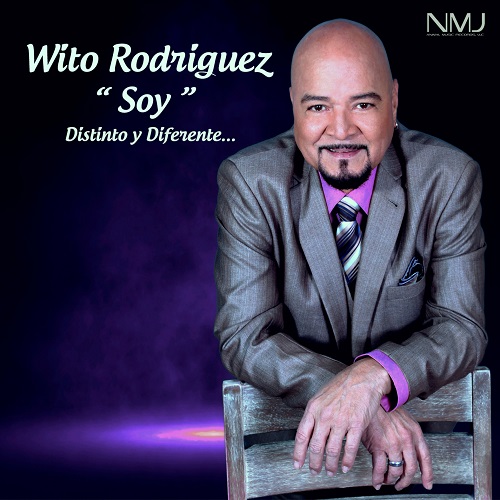
1 New artist Wito Rodriguez “I am distinct and different”

Norte America / Estados Unidos / Florida

Wito Rodriguez. “I am distinct and different”

Irwin “Wito” Rodríguez was born in Chicago to Puerto Rican parents and got his start in the musical field as a singer and musician. During his teenage years, he performed with a Rock and Roll band as a guitarist.

In 1968 Wito Rodriguez decided to move to “La Isla Del Encanto”, Puerto Rico, in order to search for his musical roots and experience the spicy sounds of his beloved Latin Ritmo.

His first encounter in the Salsa genre was with a Puerto Rican percussionist from the 60’s called “Chacón y su Orquesta”, where Wito learned all the Latin rhythms such as Guaguancó, Boogaloo, Mozambique, etc.

Chacón was his coach in Latin percussion instruments and Wito also fell in love with maracas.

Wito Rodriguez returned to Chicago in 1971 to join “Orquesta La Justicia” a local band that opened shows for artists such as: Ismael Rivera, Ray Barreto, Willie Colón, El Gran Combo and the legendary “Fania All Stars”.

Like many young men of that time, in 1973 Wito Rodriguez decided to join the United States Army and was sent to Europe.

During his stay in Germany, Wito Rodriguez took singing lessons with the Opera singer Barbra Sutton, and at the same time he created two bands with the names of “El Conjunto Sabor” and “La Sonora Antillana”.

These orchestras accompanied artists of the Salsa genre such as: Adalberto Santiago, Ismael Miranda, Tito Allen, Santitos Colón, Pete “El Conde” Rodríguez and the queen of Salsa, Celia Cruz.

After his retirement from the army, Wito joined forces with German band leader Rudi Fuesers and created the European Salsa Orchestra “Conexion Latina”.

With Conexion Latina, Wito Rodriguez recorded two albums; “Calorcito” and “Un Poco Loco”.

He also had the great experience of recording two songs with the band of Director and Arranger Peter Herbolzheimer.

During the 80’s, Wito wanted to broaden his horizons by forming his own groups called “Wito Rodriguez y Orchestra” and “Wito Con Cache”.

Missing his family and friends, Wito “crossed the pond” to return to the United States to finish his Army career.

He never gave up his passion for music, a new big band sound was on his mind, and he returns to the spotlight with the Wito Rodriguez Salsa Jazz Orchestra under the musical direction of trumpeter and arranger, Gino Picart.

“What a wonderful world” or “What a Wonderful World” is his third album released in January 2015.

Although busy in 2016 with live performances, a new album had also been produced and recorded between South America Venezuela and Orlando, Florida.

The most recent production called “Como el Viento” will be released in 2017. This album contains a compilation of songs recorded over the years in Europe than ever for the Western Hemisphere. I hope you enjoy your first solo release… What a wonderful world!

In 2018 Wito released another CD called “The Best of Wito” which has a mix of all the songs that fans thought were the best and respected their preferences.

Wito also has four new singles that he has released from his new album, which will be available from February 2019.

Through the internet platforms you can find these releases.

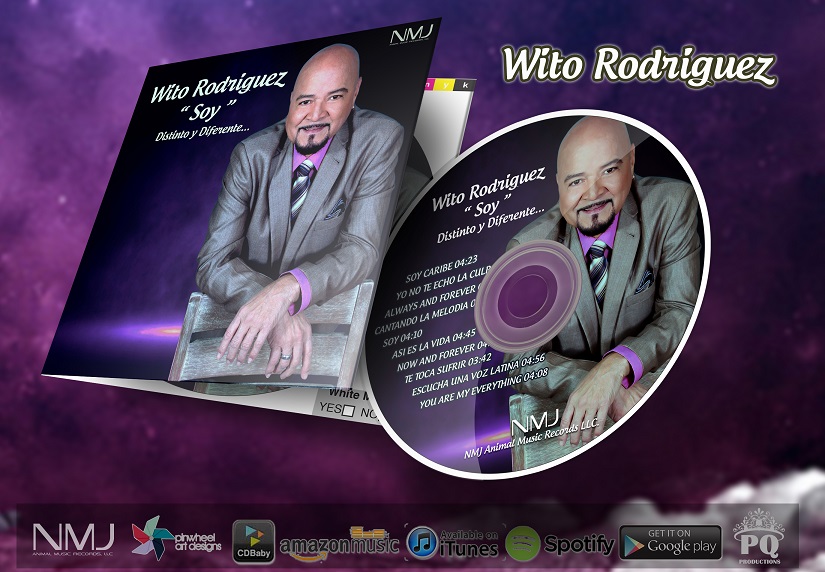
Always and Forever, Soy Caribe, Yo No Te Echo La Culpa and Now and Forever are the ones that have been released so far.

“As a bilingual singer, I am blessed to contribute to the music industry in my songs, singing them in English and Spanish, unity through my music in a mix of salsa and R&B, etc.” Wito Rodriguez

In the year of 2018. Wito Rodriguez was blessed to be nominated at the Hollywood Music Media Awards (HMMA) in Los Angeles, CA in November 2018.

You can also see his certificate as an honoree at the Fox Music Awards USA, Miami in November 2018, who was nominated and honored for being the Army Veteran Salsero Singer.

The Chicago Salsa Congress was one of its great events in 2018.

In March 2019 his new bilingual production Soy Distinto Y Diferente came out with the song Soy Caribe already nominated at the Hollywood Media Music Awards on November 20, 2019 in Hollywood California.

NMJ Animal Music Records LLC. [email protected]

PQ Promotions/Management Jenny Morales [email protected]

(682-554-4851 or (813-785-3086))

Soneros Birthdays Party

Soneros Birthdays Party

Omara Portuondo, Ismael Rivera, Jimmy Bosch, and Luisito Carrión celebrate their birthdays this month

October is filled with talent and it’s that in this month a hurricane of brilliant artists of the Salsero genre was born, who have captivated us and have shown their Gift before hundreds of audiences around the world. These Latin Stars have bathed us in SABOR with their lyrics and infected with joy with their melodies. It for that, this month we celebrate their births and dance to the rhythm of the applause towards them. Happy Birthday, Soneros!

Omara Portuondo (October 29, 1930)

Omara was born in La Habana (Cuba). Her first encounter with music was at a very early age. Just as in any other Cuban home, the future singer and her siblings grew up with the songs which her parents, for lack of a gramophone, sang to them. Those melodies, some of which still form part of her repertoire, were young Omara’s informal introduction to the world of music.

She and her sister Haydee sang well-known American group “Los Loquibambla” and their style, a Cubanised version of the Bossa Nova with touches of American jazz, was known as “Feeling”. In their radio debut, Omara was introduced as “Miss Omara Brown, the girlfriend of Feeling”.

“Magia Negra” was her debut record released in 1959. It combined Cuban music with American jazz and included versions of “That Old Black Magic” and “Caravan”, by Duke Ellington. Later she joined one of Cuba’s most important orchestras, La Orchestra Aragón, with which she recorded several albums, such as the one she did with Adalberto Álvarez in 1984 and “Palabras and Desafíos” on which she was accompanied by Chucho Valdés.

Omara Portuondo
Omara Portuondo

However, Omara Portuondo catapulted to her well-earned fame was in the mid-1990s when she collaborated in the recording sessions for Buena Vista Social Club on which she sang “Veinte Años”.

She was the star of the third launching of the Buena Vista Social Club released in 2000 and she toured Europe, traveled to Japan, and performed in the USA and Canada.

Omara went back to the studio to record her second solo album “Flor de Amor” (World Circuit), which was produced by Nick Gold and Alê Siqueira, signals a change in direction in her career: it is an album marked by a more subtle sound and a richness of texture. Portuondo brought in a mixture of Cuban and Brazilian musicians for this album, and it is this factor which influences the particular style of the music.

Omara returned to Europe in 2004 to promote this album, performing at such illustrious venues as the North Sea Jazz Festival, Marble Hill House in London, Olympia in Paris and the Concertgebouw in Amsterdam. “Flor de Amor” was nominated for a Grammy in the Best Traditional Tropical Record category and the 16th edition of the Billboard Latin Music Awards (2005); this album obtained the Tropical Record of the Year award.

Later, Omara released “Gracias”, the record that marks her sixtieth year in the music business and won the Latin Grammy Award for the Best Contemporary Tropical Album. It was a very special night as Omara was there to receive the prize in person and she also presented one of the awards, the first time that a Cuban artist has done this. The album was also later nominated for a Grammy in the Best Tropical Latin Album category.

After touring with the Orquesta Buena Vista Social Club in Europe during 2010, “the girlfriend of Feeling” released the latest recording, Omara & Chucho (Montuno Producciones) in spring 2011. 14 years after their last joint album, they reunite once again to continue unravelling the thread of their first joint project, and show us their talents in the simplest, most unclad manner on a context that enables them to lay emphasis on some of the features that been characteristic of their music at various stages in their careers.

Omara will also tour with the Orquesta Buena Vista Social Club later in Europe and the U.S.

Ismael Rivera (October 5, 1931 – May 13, 1987)

Puerto Rican singer and songwriter contributed to the dissemination of the island’s native rhythms such as the Bomba and Plena, and he was one of the first standard-bearers of the Salsero movement of the decade, the reason for he was called “El Sonero Mayor” and also known for others by the nickname “Maelo”.

In 1952 he was hired as a singer for the Lito Peña’s Orquesta Panamericana with which he became known and reaped his first hits: “La vieja en camisa”, “La sazón de la abuela” and the most popular “El charlatán”, a song in Plena rhythm that was widely heard through the Puerto Rico’s local radio stations.

Two years later he left this group to join the Combo de Cortijo with whom he popularized “El bombón de Elena” by Rafael Cepeda Atiles, and as well as performed on Puerto Rican television in the “El Show del Mediodía”.

At the end of the ‘50s, they were presenting their shows at the prestigious New York club Palladium Ballroom, where they contributed to making popular the tropical rhythms imported from the island with great hits such as “El negro bembón”, “Maquinó Landera”, “Tuntuneco ”, and others.

Ismael Rivera
Ismael Rivera

Ismael Rivera’s triumphant career was interrupted in 1962 for paying four years under the laws of Puerto Rico for possession of narcotics. Then, after recovering his freedom, Ismael formed his musical ensemble “Los Cachimbos” and immersed himself in the nascent Salsero movement to which he contributed two classics such as “Dime por qué” y “Mi negrita me espera”.

In the mid-70s “El Sonero Mayor” became the ambassador of Salsa throughout America, working for the record label of the genre Fania, and triumphing with emblematic songs such as “De todas maneras rosas”.

In his facet as a composer, he wrote very notable pieces such as “Besito de Coco” (famous song by Celiz Cruz), “El incomprendido”, “Arrecotín, arrecotán”, “El que no sufre no vive”, y “Mi libertad eres tú among many others.

In his last years, he suffered a throat cancer that caused him to lose his voice and he died as a result of a heart attack.  R.I.P MASTER!

Jimmy Bosch (October 18, 1959)

Jimmy Bosch was born in 1959 (New Jersey, U.S.). He is a world-renowned Trombonist, composer, singer, and bandleader in the world music genres. He has been performing professionally since age 13. Jimmy’s first two solo CDs, “Soneando Trombón” and “Salsa Dura” established him as the Ambassador of the Salsa Dura movement. He ignited this movement by combining old school quality salsa arrangements with a modern NY aggressive edge and socially conscious lyrics. “El Avión De La Salsa” demonstrates and solidifies his commitment to dancer centered music, while “A Millón” is the title of Jimmy’s 4th solo record released.

Jimmy Bosch
Jimmy Bosch

Appearing in over 100 recordings, Bosch “El Trombón Criollo de La Salsa” has garnered at least 10 Grammys and has toured with his orchestra, his sextet or as a solo artist, as well as with: Eddie Palmieri, Ruben Blades, Celia Cruz, Ray Barretto, Willie Colon, Manny Oquendo y Libre, FANIA Allstars, and the list goes on.

Jimmy has been featured throughout the world in major venues and festivals, including; Carnegie Hall, Lincoln Center (NYC), Celebrate Brooklyn (NYC), Montreal Jazz (Canada), Madison Square Garden (NYC), Sydney Opera House (Australia), Barranquijazz (Colombia), El Poliedro and Teresa Careña (Venezuela), and many other important places.

Luisito Carrión (OCTOBER 26, 1962)

A native of Arecibo in Puerto Rico, Luisito Carrión has been singing since he was 13 years old. He began his career as a Salsa artist with the Orquesta Kafe, Orquesta La Nativa and Grupo Concepto Latino.

In his first performances, he sang along with Celia Cruz, Adalberto Santiago, and Santitos Colón. Later on, he was a member of Salsa Fever together with Julio “Gunda” Merced, were several hits come from: “Renta de Amor” and “Señores ahí va Julián”. Afterward, he joined the Bobby Valentín Orchestra, where he sang songs, such as: “El Señor de las Señoras”, “Ramos de flores”, “El Gigoló”, “Tributo de Cali” and “Como lo hago yo”. In his evolutionary process, Luisito joined the Orquesta Don Perignon where he sang “La Fuga” and later with the Sonora Porceña, where he performed songs, such as “Yaré” and “A Comer Lechón”.

Luisito Carrión
Luisito Carrión

In 1997, he recorded with Roberto Roena y Su Apollo Sound “Mi música 1997”. At the end of the 90s, Carrión began his career as a soloist with the record company MP Records with Julio “Gunda” Mercéd and Rafael Bodo Torres, which led to hits, such as: “Sin tu amor”, “La Chica Más Popular”, “Nadie Como Tú”, “Porque”, “Amiga Mía”, “Muriendo”, “Como Ave Sin Rumbo” and “Para Ser Real”. Nowadays, Luisito Carrión is one of the best Puerto Rico’s Soneros bringing on “Histeriaaaa…” in his fans.

Omar Negron

USA / Florida / Tampa

Omar Negron, The Virtuoso of Trumpet and Percussion

Omar Negron was born in San Juan, Puerto Rico, on March 3, 1972. Music came into his life as a family legacy.

Omar Negron
Omar Negron

From the age of 3 he began to play percussion “las pleneras y el bongo”, guided by his maternal grandfather, his paternal grandfather who was also a musician and cuatro player and his grandmother who sang Puerto Rican trova.

At the age of 7, he entered the Carolina School of Music where he learned to read music to interpret it in percussion, which he had already mastered.

The first witnesses of his talent were his classmates at the Angel Ramos de Country Club elementary school in San Juan P.R, where he was part of the central show in several of the school activities, in some of them even imitating the singer Oscar de León. .

At the age of twelve, while attending his regular studies, he was alternately accepted at the Ernesto Ramos Antonini Free School of Music in San Juan.

Omar Negron
Omar Negron singing

There he began to study Trumpet since there was no room for percussion.

However, the percussion teacher allowed him to be part of his class, so he (Omar Negron) studied Trumpet and Percussion simultaneously.

Proven his talent, Omar Negron had the opportunity to be part of the School’s dance band, where he began playing Bongo and years later he would play Trumpet.

He was part of some talent competitions where he ranked first as a singer.

Upon graduating from the Escuela Libre de Música, Omar Negrón received the Rafael Hernández medal for his versatility playing different instruments, including his voice.

His musical career

At just 16 years old, Omar Negron makes his first professional recording as a singer, thanks to an opportunity he received from Mickey Cora and his Cabala Orchestra, where he was able to record and perform the songs: “Wanting to Live With You” and “We Will Always Be Friends” .

Omar Negron
Omar Negron

In 1990, Omar Negron was recruited by the Conjunto Chaney after the departure of the singer José Cheo Andújar.

A year later he made his first recording with the Ensemble, in the production entitled “Somos Amigos” where he performed the song “En Trance”.

Omar made three more productions with the Chaney Ensemble under the Hit Makers record label, but unfortunately none were released.

In 1994, Chaney made a recording with the Musical Production label, entitled “La Escuela de la Salsa”, where Omar recorded the songs: “I’m back”, “Impulsos”, “I fell in love”, “You are the vice”, ” Gaining Sensuality”, among others. This production earned them several awards including a Gold Record and an ACE Award.

It was a season of success and presentations in Europe, the United States, Central America and South America.

In 2004 he was invited by maestro Willie Rosario to be part of his orchestra after the departure of singer Rico Walker.

Opportunity that he enjoyed for three years and allowed him to gain experience as a son player and interpreter of many of his hits.

However no new recordings were made during that season.

In 2013 he launched himself as a soloist with the song: “No Son Juguetes”, composition and arrangement by Frank Poupart, a song that was widely accepted among the fans of romantic salsa in Puerto Rico, the United States, the Canary Islands, Venezuela, Panama, Colombia. among others.

Then he recorded the song by Ricardo Montaner and Jorge Luis Chasin “Bésame” which made him the winner of two Fox Music Awards in the city of Houston, Texas.

The same theme was placed number one on the Italian and Swiss tropical music radio charts.

A year later, he recorded “Waiting for you” written by Jesse Villareal and arranged by the great experienced arranger Tommy Villarini.

This single allowed him to open doors in countries like Belgium, Turkey, and Germany in addition to the United States, Central and South America, especially in Panama where his music is well accepted.

In 2016, with much more accumulated experience and with the help of a new work team, Omar Negron launches his new single entitled “Por Si Mañana”, composed by Jorge Luis Piloto and arranged by Ramón Sánchez.

This song is the Salsa version of the ballad recorded by the well-known Colombian group Mojito Lite.

  • « Go to Previous Page
  • Page 1
  • Interim pages omitted …
  • Page 6
  • Page 7
  • Page 8
  • Page 9
  • Page 10
  • Interim pages omitted …
  • Page 37
  • Go to Next Page »

International Salsa Magazine (ISM) is a monthly publication about Salsa activities around the world, that has been publishing since 2007. It is a world network of volunteers coordinated by ISM Magazine. We are working to strengthen all the events by working together.