• Skip to primary navigation
  • Skip to main content

International Salsa Magazine

  • HOME
  • Previous editions
    • 2026
      • ISM / May 2026
      • ISM / April 2026
      • ISM / March 2026
      • ISM / February 2026
      • ISM / January 2026
    • 2025
      • ISM / December 2025
      • ISM / November 2025
      • ISM / October 2025
      • ISM / September 2025
      • ISM / August 2025
      • ISM / July 2025
      • ISM / June 2025
      • ISM / May2025
      • ISM / April 2025
      • ISM / March 2025
      • ISM / February 2025
      • ISM / January 2025
    • 2024
      • ISM / December 2024
      • ISM / November 2024
      • ISM / October 2024
      • ISM / September 2024
      • ISM / August 2024
      • ISM / July 2024
      • ISM / June 2024
      • ISM / May 2024
      • ISM / April 2024
      • ISM / March 2024
      • ISM / February 2024
      • ISM / January 2024
    • 2023
      • ISM / December 2023
      • ISM / November 2023
      • ISM / October 2023
      • ISM – September 2023
      • ISM – August 2023
      • ISM July 2023
      • ISM Edition June 2023
      • ISM – May 2023
      • ISM April 2023
      • ISM March 2023
      • ISM February 2023
      • ISM January 2023
    • 2022
      • ISM December 2022
      • ISM November 2022
      • ISM October 2022
      • ISM September 2022
      • ISM August 2022
      • ISM July 2022
      • ISM June 2022
      • ISM May 2022
      • ISM February 2022
      • ISM January 2022
    • 2021
      • ISM December 2021
      • ISM November 2021
      • ISM October – 2021
      • ISM September 2021
      • ISM August 2021
      • ISM July 2021
      • ISM May 2021
      • ISM April 2021
      • ISM June 2021
      • ISM March 2021
      • ISM February 2021
      • ISM January 2021
    • 2020
      • ISM December 2020
      • ISM November 2020
      • ISM October 2020
      • ISM September 2020
      • ISM August 2020
      • ISM July 2020
      • ISM June 2020
      • ISM May 2020
      • ISM April 2020
      • ISM March 2020
      • ISM February 2020
      • ISM January 2020
    • 2019
      • ISM December 2019
      • ISM November 2019
      • ISM October 2019
      • ISM Septembre 2019
      • ISM August 2019
      • ISM July 2019
      • ISM June 2019
    • 2016
      • ISM December 2016
  • Spanish
  • Download Salsa App
    • Android
    • Apple

Search Results for: Pianist

Guantanamo music director, arranger and composer Julio Avila

Julio Avila Cuban Band 

The Latin music scene in Canada is growing every day thanks to the large number of artists who have decided to move to this beautiful country to try their luck with their talent. Such is the case of Cuban musical director, arranger, composer and singer Julio Avila and the members of his great band Julio Avila Cuban Band.   

Given that we thought his career was very interesting, we decided to contact him to learn more about his work and he was kind enough to accept the invitation. Here are the issues we touched on during this fascinating interview.  
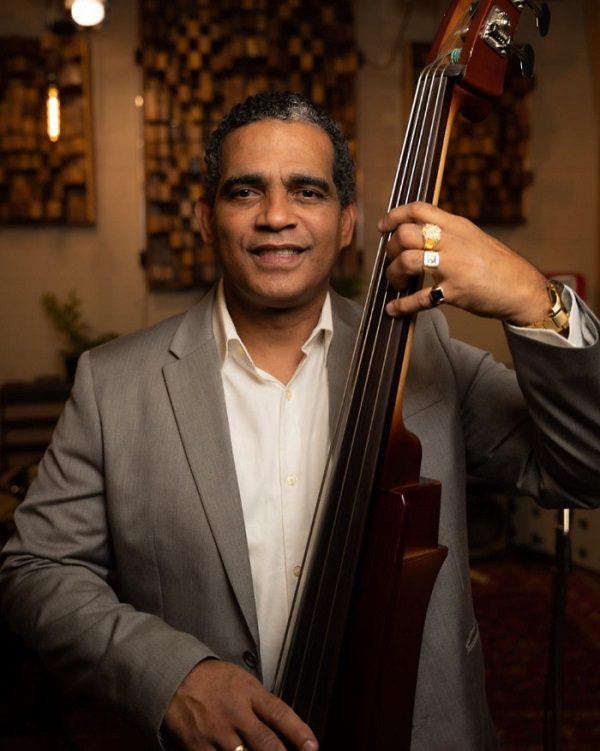
Julio Avila Cuban Band
Julio Avila, musical director of Julio Avila Cuban Band

Life for Julio in Guantanamo, Cuba  

Contrary to the answer we might expect, Julio told us that making music in Cuba at that time was not difficult, as life was not so expensive and the economic crisis was not as severe as it is now.   

In his particular case, things were easier because his mother worked in a radio station and his father was a professional musician and the musical director of the popular music group Por Nuestros Campos for many years until he sadly passed away. It was undeniable that art ran through his veins. 

His sister Isabelita was also involved in popular music for many years and was even awarded on several occasions at the local Eduardo Saborit Festival. Today she is retired, but she was very successful locally at the time.   

Because all the brothers had a penchant for music, they decided to create a group called Los Hermanos Avila until they all went their separate ways and dedicated themselves to their own professions.   

Julio considers that today they would not have been able to devote to this branch of the arts due to the political and economic situation that the island is enduring, and he is thankful that it was not so. 

According to his words, the money was enough to buy the instruments in those times, but things become so complicated that developing an artistic career in the Caribbean country is much more difficult.  

All the members
All the band members with their instruments

Changüí 

Although he says he has played changüí because of his Guantanamo origins, he was never in a group that based its music on this traditional Cuban dance, as the artist has always liked popular music and salsa.   

”Changüí is a genre born in the province of Guantánamo that did not get much popularity, but today, it is impressive the large number of young people who play this dance, since they got a taste for it. In spite of all the years after it was created, there are guys who do not let it die, which makes me very happy” said Julio on this issue. 

When we wanted to know why he thinks that these young musicians have opted for this genre and not for other more modern ones such as trap or reggaeton, he replied that the latter two sound a lot in Cuba, but there have been music teachers and schools that have not let changüí die. They continue to teach it to their students and promote it whenever they can. 

In addition, there are always groups interested in preserving it in time and uniting it with son and other traditional Cuban genres. They even add flutes and violins, which were not present in the original changüí, in order to give it a unique and modern touch.  

Academic background 

Julio started playing the guitar being a child of five years old, as he had always seen his parents and older brothers involved in everything that had to do with music. Therefore, it all started in a very natural way and basically on instinct. It was later that both he and his siblings decided to educate themselves in order to become more complete professionals. 

In Guantánamo itself, he studied at a music school to become a bassist and began working fully on popular music, which had always been to his liking. 

With all that gained knowledge, he decided to move to the city of Havana, to get involved in other projects there and to compose his own material.   

Since he was 16, he earned a living as a bassist in a popular music group, which activity he alternated with his secondary education. It can be said that this is the formal beginning of Julio’s musical career. 

Julio Avila Cuban Band performing
Julio Avila Cuban Band performing at The Carnaval Del Sol in July 2023

Sonora Universal and Brisas Del Palmar 

Before forming his own orchestra, Julio worked with La Sonora Universal and Brisas Del Palmar, which were his first opportunities to shine in the music world.   

When the artist was working in a quintet, a trio from the city of Santiago (Brisas Del Palmar) went to a music festival in Guantanamo and thet had the opportunity to meet in a club in 1999. ‘’The musical director of the trio saw us playing and liked the way I played the bass. He told me about the possibility of playing with them, but it did not happen until 2001 when I went to Havana and we met by chance,” Julio said. 

After having some time worked with the trio, this musical director met the talented tresista Cesar Echevarría, director of Sonora Universal, who needed a bassist because his stayed in Germany. It was then that he told him about Julio and asked him to see him play, which led them to meet and start working together. 

Within a few weeks, Julio was already traveling to Europe with Cesar to tour Germany, Denmark, Holland, Austria and Czechoslovakia. This trip is the one that began to open new doors for him and make him develop as an artist. 

Definitive departure from Cuba 

When Julio had some time with La Sonora Universal, the director of Brisas Del Mar again asked him to join the group for a tour of Canada in 2005. When he was included, the group went from being a trio to a quartet.   

Receptivity from Canadian businessmen was so good that he decided to stay with Brisas Del Palmar permanently until he decided to move from Cuba in 2014 due to the situation which the island was going through. 

The latter coincided with the beginning of his love relationship with the Serbian citizen Natasha Marjanovic, who today is his wife, manager of his orchestra and a great life support. It was she who convinced him to stay in Vancouver, a decision he says it was the right one. 
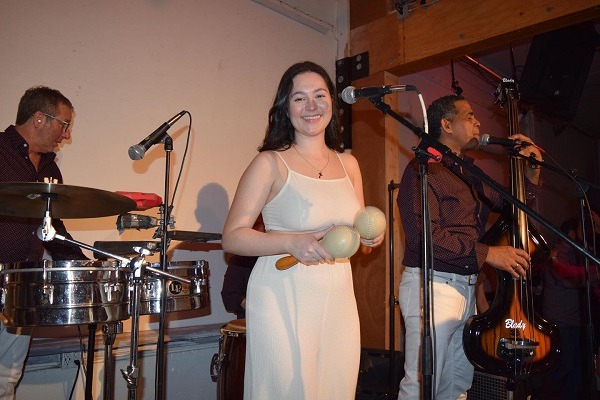
Singer of Julio Avila Cuban Band
Singer of Julio Avila Cuban Band Isidora Bosanovic

Beginnings of Julio Avila Cuban Band 

It all started when Julio needed a pianist for Brisas Del Mar and hired Ernesto Benitez, who, once in Canada, told him that he was not going back to Cuba. That is when he saw the opportunity to start creating his own orchestra from himself and this musician. 

The next to be included was percussionist Norman García, with whom Julio and Ernesto formed a trio and began performing at festivals until Isidora Bosanovic, singer and his wife Natasha’s niece, arrived. Her case is very particular because she did not speak Spanish, but she learned it so she could sing in the orchestra. Today, she speaks and sings in Spanish very well. 

Finally, the band included Denis Barzaga, another musician originating from Guantánamo, who currently lives in Spain, but when required, travels to Canada to play with the orchestra in Vancouver.   

Recently, kettle – drum player Julio Paredes was included to replace Barzaga, who was unable to travel for the time being.  

Read also: Puerto Rican singer and talented sonero Charlie Maldonado 

Medejazz from September 6 to 16 will be held the 27th version of the “International Festival of Jazz and World Music”

Medejazz 2023, to delight the ears, Music and Art in Medellin.

In 1996 the Medellin Jazz “Medejazz” Corporation was founded, which in 2006 changed its name to Medearte Corporation, continuing with the same cultural vision and objectives.  With the work of these years, Medearte Corporation has made it possible that musicians who were once only idols heard on records, today are part of the musical history of Colombia and Medellin specifically.

The Medearte Corporation has developed projects where the main objective is the dissemination and promotion of the arts in its various manifestations, the institution is recognized nationally and internationally for its business management in favor of culture in Colombia and to support projects of young musicians and artists in the cultural work of the city of Medellin.

Medejazz, the 27th version of the International Jazz and World Music Festival will be held from September 6 to 16.

The 27th version of the “International Jazz and World Music Festival” will be held from September 6 to 16. Continuing with the tradition that the Festival has consolidated over the years, our city will host a wide range of artists, performers and groups, who thanks to their talent and creativity, will radiate their music and sounds on the public of Medellin.

The breadth of artistic genres, nationalities, cultures and staging that this Festival “Medejazz” has prepared for everyone will make Medellín the center of a rich diversity and cultural and human plurality, embodied in the multiple sounds that, we are sure, will not disappoint.

The MedeJazz 2023 program, with the support of the Ministry of Culture, the Mayor’s Office of Medellín and La Fiesta del Libro y la Cultura, will offer six in-person concerts, five of which will be free admission. In addition, the Festival will offer four free master classes, as a contribution to the academic-musical training of young musicians.

The Festival will also offer four free master classes as a contribution to academic-musical education, and young people from music schools will have the opportunity to nurture this knowledge. The Festival will be held from September 8 to 17

– Eleven concerts in Medejazz 2023

– Ten concerts with free admission

– Groups and members from France, Holland, Cuba, Brazil, Colombia, the United States, Puerto Rico and Venezuela.

– Four master classes with free admission.

Groups from France, Holland, Brazil, Cuba, Colombia, the United States, New York, Venezuela and Puerto Rico will grace the nights of Medellín.

“Medejazz” From France will be Samy Thiebaut, from Holland Nueva Manteca, from Brazil the female duo of Eloudie Bouny and Iara Ferreira, from the island of Cuba the pianist Ernán López Nussa with his project Havana in The Grand Manner, from New York – Puerto Rico – Venezuela and Cuba the tributes to Héctor Lavoe and Ismael Rivera.

For Colombia, the six winning groups of the 2023 calls: Sara Elisa Villa, Geografías, Mulatas, Groovato, Luis Bernardo Jazz Project and Tomate’s.

Three large stages will witness these great nights: Tarima Carabobo within the Festival of Books and Culture, Plazoleta del Museo de Arte de Medellín MAMM and the Great Hall of Plaza Mayor.

Starting Friday, August 25, you can visit the updated website with all the information about Medejazz 2023.

MEDEJAZZ 2023 PROGRAM

Sara Elisa Villa (Colombia). Friday, September 8 – 6:30 pm – Tarima Carabobo Fiesta del Libro y la Cultura. FREE ENTRANCE.

Geografías (Colombia). Saturday, September 9 – 6:30 pm. – Tarima Carabobo Fiesta del Libro y la Cultura. FREE ENTRANCE.

Mulatas (Cuba-Colombia). Saturday, September 9- 8:00 pm- Tarima Carabobo Fiesta del Libro y la Cultura. FREE ENTRANCE.

Groovato (Colombia). Sunday September 10 – 6:30 pm- Tarima Carabobo Book and Culture Festival. FREE ENTRANCE.

Luis Bernardo Jazz Project (Colombia). Tuesday, September 12- 8:00 p.m. Tarima Carabobo- Book and Culture Festival. FREE ENTRANCE.

Tomate’s (Colombia). Thursday, September 14- 7:30 pm. Plazoleta Museo de Arte Moderno de Medellín- MAMM. FREE ENTRANCE.

Samy Thiébault (France). Friday, September 15- 8:00 pm. Tarima Carabobo- Book and Culture Festival. FREE ENTRANCE.

New Manteca (Holland). Friday, September 15 – 7:30 p.m. Plazoleta Museo de Arte Moderno de Medellín- MAMM. FREE ENTRANCE.

Eloudie Bouny and Iara Ferreira (Brazil). Saturday, September 16- 6:30 p.m. Tarima Carabobo- Book and Culture Festival. FREE ENTRANCE

Lavoe Orquesta + Joseph Amado, Moncho Rivera y Mulatas (New York, Puerto Rico, Venezuela, Cuba and Colombia). Saturday, September 16 -8:00 p.m. Gran Salón de Plaza Mayor. Information: Ticket Express.

Lavoe Orquesta + Joseph Amado, Moncho Rivera

Havana in the Grand Manner with Ernán López Nussa (Cuba). Sunday, September 17- 5:00 p.m. Plazoleta del Museo de Arte Moderno de Medellín- MAMM. FREE ENTRANCE


INFORMATION

www.corporacionmedearte.com

Social Networks

Facebook: (Medearte- Festival Internacional Medejazz) 

YouTube: Festival Medejazz

Twitter: (@MedeJazz) https://twitter.com/MedeJazz

Instagram: (@MedeJazz)

Lavoe Orquesta + Joseph Amado

Also Read: Henry Benavides surprises with “Por Cuenta Propia,” his new project

Founder and owner of Guapacha Productions Gil Tower

Talk with Gil Tower 

From this platform, we have had to interview many famous Latinos who have left their countries and Latin culture in general on high, but today is the turn of a very special one. We are talking about the talented Venezuelan musical director and multi-instrumentalist Gilberto Torres, better known as Gil Tower in the artistic environment.    

Thanks to a mutual friend, we have managed to make contact with Gil Tower, who from the beginning has been very accessible and willing to share everything related to his work in the music industry and his contribution to the Latin cultural scene, so we are very grateful to him for giving us the opportunity to hear his great story.   

Below, we share the topics covered in a conversation that was as enjoyable as it was enlightening.   

Gil talked with us
Talented musical director and multi-instrumentalist Gil Tower kindly talked with us

Musical beginnings in his home country   

Gil Tower always knew that he wanted to devote himself to the world of music. When he was about five years old, he began watching television programs related to classical music and zarzuela. Several of his aunts were zarzuela teachers and took him to see zarzuela orchestras, which was great for him. In fact, several of those musicians he got to see play on these occasions ended up teaching him when he began preparing to become an artist. 

One of the most important institutions in the training of Gil is the National System of Youth and Children’s Orchestras and Choirs of Venezuela (El Sistema), where he was trained directly by maestro José Antonio Abreu, a fundamental part in the path which this young musician would take later in his career.   

He joined the children’s orchestra, advanced all the way to the youth orchestra and finally reached a more professional level in the national orchestra. At about this time, Gil recalls that ”maestro Abreu always said that we were rich because we had an instrument in hand and could change the world through music. As a child, I didn’t understand what he was getting at. Now I do understand and I think he was absolutely right.   

”Abreu was a unique influence on me because he transformed me as a person and musician. He also made me become a leader, as he had always wanted me to be,” he continued.   

Learning from the groups he was in 

As to the learning acquired in the many groups he worked with, Gil singled out Carlos Rojas, who was a musician and jazz lover. Carlos took the initiative to give a workshop in La Pastora (a very important area of the city of Caracas, Venezuela). 

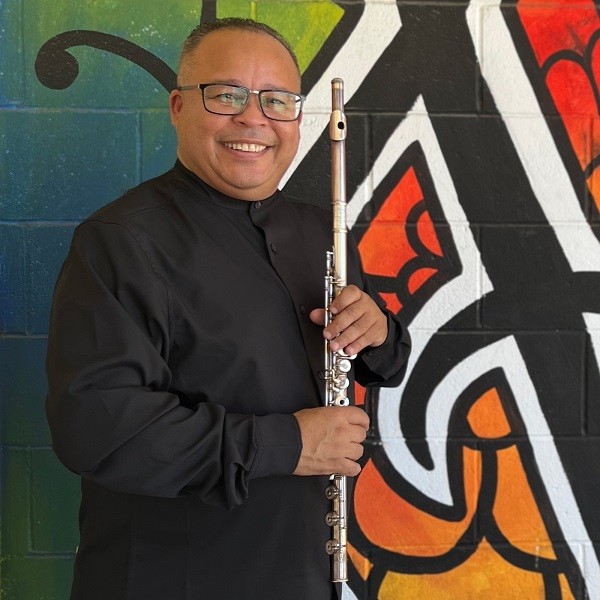
Gil with his flute
Gil Tower with his flute

As a teenager, Gil used to go to La Pastora to learn to improvise with Carlos in salsa, as he liked this genre so much ever since. This is how he started learning about harmonies and taking his first steps as a composer. 

When given the chance to play with the group Los Morrillos, he learned a lot about gaitas and other Venezuelan rhythms from the western region of the country. In the case of the group Madera, he learned (and keeps learning) a lot about Afro-Venezuelan music in general.   

After that, he met Jesús ”Chucho” García, who is an intellectual, activist and author of several books on Afro-Venezuelanity. Together they formed a group called Cimarrón, with which they represented Venezuela at the International Jazz Plaza Festival in 1989. To date, they are still very good friends and continue to learn about this great musical branch from one another. 

Why move to Germany? 

His initial plan was to move to the United States to continue his studies in Berkeley, but he was unable to obtain the required visa at the time. However, that would not be the end of his dream.   

It turns out that some friends of his from the group Madera went on a Germany tour and stayed to live there. Then, one of them, Felipe ”Mandingo” Rengifo offered him to join them to work in that country and try to be admitted in one of their conservatories. At the time, Gil only had a saving of $1,000, with which he took a gamble.    

Although he had to play in the streets and wash bathrooms at the beginning, he achieved his goal of entering a conservatory, an institution that gave him the opportunity to fix his papers to have a legal status in Germany. Having solved this inconvenience, he was able to focus his attention on his musical project Guapacha (name in honor of a great Cuban drummer who lived in the parish of San Agustin del Sur, Caracas).   

All this experience was preparing him for when he could finally achieve his goal of going to the United States.   


Gil and Guapacha
His project Guapacha was named after a great Cuban drummer who lives in Caracas

Arrival in the United States   

While still in Germany, Gil was invited to participate in a jazz festival in the United States, specifically in Montana. He did so well that he amazed many musicians with whom he shared the stage that day and exchanged contact information for future events.   

Later, he managed to play in San Diego and Boston, where he had the opportunity to share the stage with the Boston Power Orchestra and meet Danilo Pérez, Dizzy Gillespie’s pianist. The latter, in turn, recommended him to maestro Tito Puente, whom he met shortly thereafter. 

This was how the artist managed to build a very respectable reputation in the industry through his talent. This is how he ended up playing with ”half the world” and building a great prestige as a musician and composer.   

In addition to singing and playing multiple instruments, Gil has also taught low-income youth in order to spread the knowledge he has gained throughout his career. He even created an orchestra composed of children whose parents have no resources or documents in order to help them learn music and provide them with better work-study opportunities in the future. Some have even got into college and obtained scholarships thanks to this knowledge.    

Parallel to these activities, he began composing and making arrangements for other artists who began to require his services.    

Guapacha Productions   

On the subject of Guapacha Productions, Gil says that the idea came when he began researching on the music industry, licensing, distribution and other things. 

The musician saw an opportunity to achieve his dreams during the pandemic, which is when he noticed that many artists had no idea how to register a composition and how other necessary licenses to collect their royalties from their music works.   

Gil, Guapacha, and major labels
Guapacha was created for the purpose of becoming independent from major labels


Noticing the ignorance of many young talents about the industry, he created the company Guapacha Productions, which is responsible for the musical production and arrangements for artists signed to this label.    

When asked how the economic issue was handled for artists who do not have the resources to launch their career as it should be, he explained that there are three types of music distributors: major labels, labels created by the artists themselves and independent companies like Guapacha Productions. We are a group of independent artists who created our own label and we are trying to have our own distribution, so we would not be obliged to negotiate with any big distribution company” explained Gil. 

Along with that, it is Guapacha Productions that will make agreements with Spotify, iTunes and other digital platforms to distribute the music of its artists without intermediaries. 

The company has been so successful in these efforts that its name will soon be part of the Latin Grammys, which means that the talents signed to the label will have the chance to stand out and be finalists in the various categories.   

Cheo Valenzuela’s ”Salsa Buena” Tour   

With respect to the important issue of Cheo Valenzuela’s ”Salsa Buena” tour (artist signed to Guapacha Productions) in Europe, there are negotiations with some event producers in France, Spain and England so that Cheo Valenzuela can perform at various venues in those countries. There are also talks of taking the artist to Central America and the United States, specifically to San Francisco, where Gil lives.   

In addition to that, Valenzuela is working on an EP with five songs by other artists and another one with five compositions created by himself. Being already a singer with a long-standing career, this last work would also become him a consacrated composer before the world. Once all this material has been released, his name is going to be considered for a Grammy nomination, which Gil has a lot of faith that he will win due to his great talent.   

At the time of doing this interview, Valenzuela is taking a few days off due to the death of his mother, so we send our condolences and solidarity to him and his family at such a difficult time. 

Read also: Musical director of VibraSÓN Jake Jacobs is here 

Joel Uriola

Latino America / Venezuela / Caracas

Joel Uriola “I am the best, because I surpass myself”

Very soon the theme will be released, Cuidadillo there ok

This Venezuelan pianist, arranger and musical producer was born on January 4, 1963 in Caracas, in the popular parish of Antímano, the same one that saw the birth of Sonero del Mundo Oscar D´ León, by chance or his destiny was already written and en route. towards a dream that over the years would come true; be the best and that your work is recognized both nationally and internationally.

In our gathering, Joel tells us that when he is classified as the best, he has nothing to do with competing with others or with airs of greatness, but with surpassing himself in everything he proposes, he tells us that “my path is longer, but I came as Joel Uriola”, his name is a seal that ensures quality work.

With 38 years of musical career, Joel Uriola has plenty of talent, level and experience, in each production he uses the best group of Venezuelan musicians and continues to be at the forefront of music, all this is demonstrated in the more than 1000 musical productions in which he has participated as a performer, director or musical producer, with national and international artists.

Joel Uriola
Joel Uriola

Joel Uriola The best?

“That’s right, metaphysics says that you can’t talk about yourself in a negative way, you can’t sell a product if you don’t have good marketing, you must see beyond, be your own manager, most record companies are in the hands of ignorant people. the music that drive the artist’s work”. “Artists have the obligation to cultivate themselves, learn and not only be musicians, we must project ourselves in a big way”.

How did your childhood develop and what was the atmosphere of the time like?

“I had a good education in my home, with values, a grandmother with character, who told me that no matter where you lived, your behavior would make a difference, she always motivated me, just like my mother who also instilled in me to prepare myself, my grandmother was an enterprising woman, my father was a rumba guitarist and a professor at the Católica”. “I remember that I saw the debut of the Trabuco Venezolano in the CC Propatria, as fate would have it, my mother had an office there, as did the people of the Latin Dimension.”

At what age did you start in music and with which orchestras did you take your first steps?

“My musical beginnings took place at the “Prudencio Esáa” School of Music, starting professionally at the age of 17 with a group called Galaxia, I was the conga player, it was a Son group and we rehearsed at the observatory”. “Then I became part of the Caracuchos of Joseito Rodríguez from 1977 to 1979, whom I met thanks to Jesús “Totin” Rebolledo, later with the Latin Dimension from 1979 to 1980, from Cesar Monges I learned a great deal, and from 83 to 87 with Oscar D´ León.

And why is there that change from the conga to the piano?

“Due to the noise I made in the house when I was rehearsing and the equipment turned on at full volume, my mother subliminally gave me an organ, it was less noise, and then I began to imitate what the pianists did in a self-taught way, I remember the theme of Pete Rodríguez… What things life has, life, life”. “Then my mother bought me a piano and took me to audition at the School of Music and I stayed, I was a student of teacher Tiero Pezzuti, Gerry Well and Samuel del Real”. “In the nightclubs of El Rosal I did many substitutions, there I polished myself, I had a good preparation and some great teachers who are my friends”.

Joel Uriola - piano
Joel Uriola – piano

What anecdotes do you have about your experience of working alongside Oscar D´ León, and about that piano solo on the song “Cuídate bien”, did you ever think that being so young, almost 20 years old, your name would remain forever on the mind of the salsero?

“The time with Oscar was glorious, I got to know many places, we toured for 3 and 4 months, we enjoyed ourselves but we also had a lot of fun, I learned a great deal and disciplined.” “I had the blessing of meeting many musicians that I admired such as Eddie Palmieri, Salvador Cuevas, Barry Rogers, among others, with Domingo Quiñones I made a great friendship.” “As for improvisation, I feel great pride, it was something that came out at that time, I don’t know if it will come out again -laughs-“.

Which musician has been your biggest influence?

Markolino Diamond, Eddie Palmieri, Papo Lucca.

A pianist you admire?

“Markolino Diamond is my idol, a lot of what I do has to do with this guy, if he were alive he wouldn’t exist…”. “He was irreverent, crazy, he broke the schemes.”

How do you see the response of the salsa audience with your productions?

“There will always be admirers and detractors, with the level of awareness that you gain, it doesn’t bother you that there are people who don’t like your work, I make music for everyone”. “Public opinion can kill you if you are not prepared for it, but you must believe in what you do.”

How do you see the support of the media to spread your music?

“Thank God the record companies disappeared, those who knew the least about music controlled them, they decided that it was commercial and that it was not, in the alternative media there is response and support, however, social networks allow you to reach in a matter of seconds many places and you can do your own marketing”.

What do you think about the fusions that you are doing with salsa, for example, salsa and reggaeton?

“It works perfectly, it’s urban salsa, reggaeton with its lyrical content has improved a lot, they’ve softened it, reggaeton artists have great economic and communication support.” “The good things are guaranteed, reggaeton is seen as Salsa was seen in its beginnings, with bad eyes, but you see, Salsa is worldwide even the Chinese dance it, people consume what the radio puts on it, even if it’s bad, there’s room for everyone”.

As a music teacher, what have you contributed to the country?

“Train the next generation, in values ​​and discipline, and that seed continues to germinate, help people regardless of how they sometimes pay you.”

Why musician and not another profession?

“I wanted to be Disip (Venezuela’s intelligence corps), but when one is born marked for something, that’s what goes… My destiny is music.”

How do you see the music industry right now?

“Everyone is recording with their own effort, you make a song, you upload it to the networks, we have that powerful tool in our favor; the record companies limited you, hardly any albums are recorded anymore”.

Can you live from music?

“Well… Thank God I can do it, every day I get up like a conuquero to work, I can live from music.”

Of the 9 productions under your belt, which do you think is the best or the most important for you?

“Babalawo (2009), the best achieved, the best worked in all aspects, was sold in all religious houses.”

What motivated you to form your own orchestra?

“I’ve always been a leader, that’s why I decided to form my own orchestra, everyone has their moment”.

Isn’t it a difficult job to compose and arrange?

“You are born for this, it is not difficult, you must study and prepare yourself, my muse can arrive at 3 a.m., I get up and add or season my music in my own way, I listen to traditional Cuban music, jazz that inspire me.”

What is Joel Uriola doing right now?

“Currently I dedicate myself to producing for other artists of the Salsero genre, always offering quality, the most recent is the work with the Mercadonegro Orchestra with the theme Rumba Negrito”.

You are the arranger of the 3 songs that made the Bailatino orchestra known internationally, you have been the Producer and arranger in five songs of “Rumberos del callejón”, among other Venezuelan artists. What does it feel like to contribute so that other Venezuelans are successful?

“At the moment you do things, you do it with the best intention, and that is the greatest satisfaction, helping others grow regardless of how they pay.”

Do you feel that unity and camaraderie are lacking in the salsa guild?

“Totally, without unity nothing is achieved.”

What do you think of copying, imitating and not creating?

“He who imitates is destined to fail, one must have personality, you must not cling to something foreign to survive, what you do has more value, you must have creative capacity”.

Future plans or present?

“I am recording two songs, Cuidadillo there ok composition by Maurice Melo, a salsa with tasty rhythmic elements, timba and hard sauce, and the second song You are the teacher has a Christian connotation, with the Praise Orchestra, the song is my own. , a cool sauce with Christian sauce”.

Joel reaffirms us “My road is long, but I arrive as Joel Uriola, I am who I am, I am the best”.

Arturo “Chico” O’farrill

North America / United States / New York

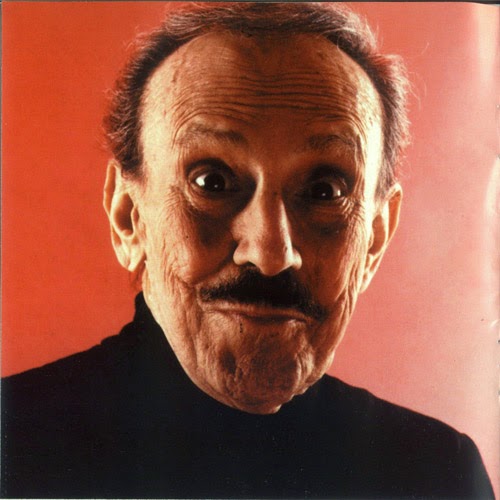
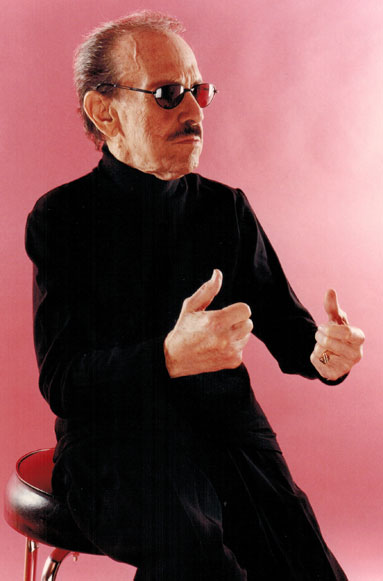
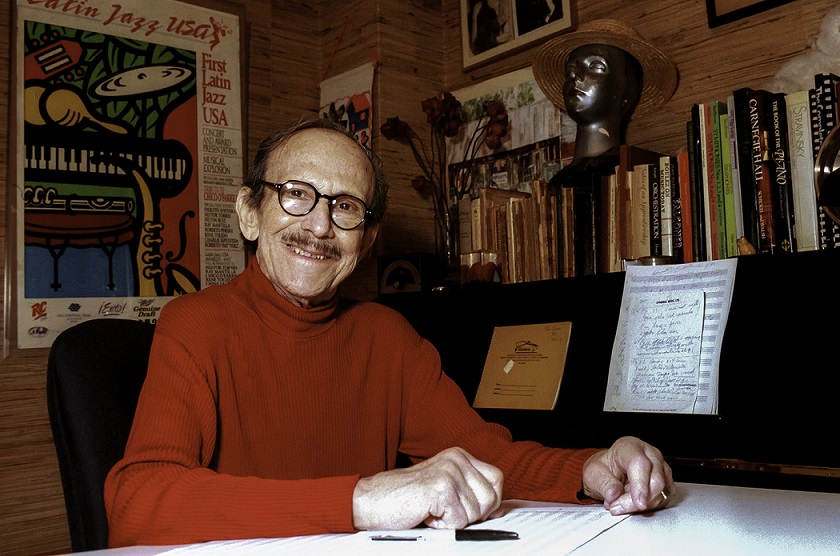
Arturo “Chico” O’farrill  “The Afro-Cuban Jazz Architect” 

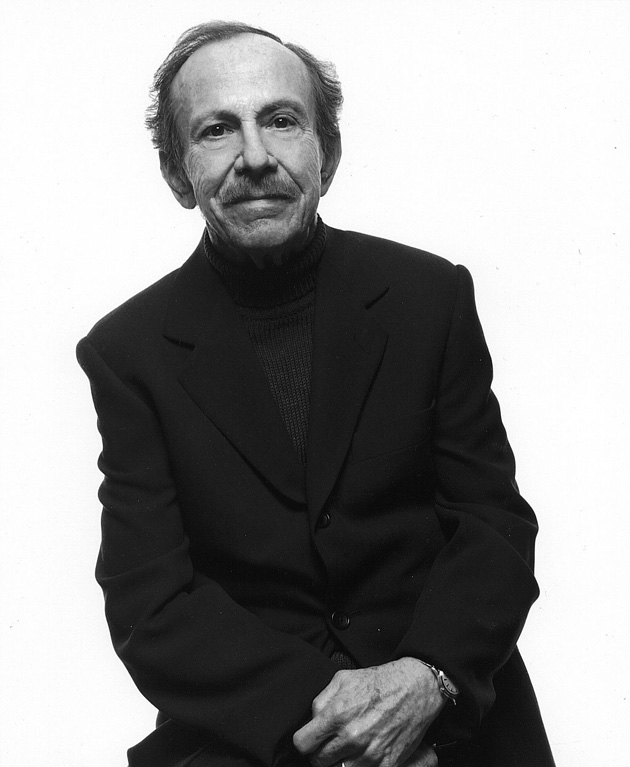
Arturo O'Farrill
Arturo O’Farrill

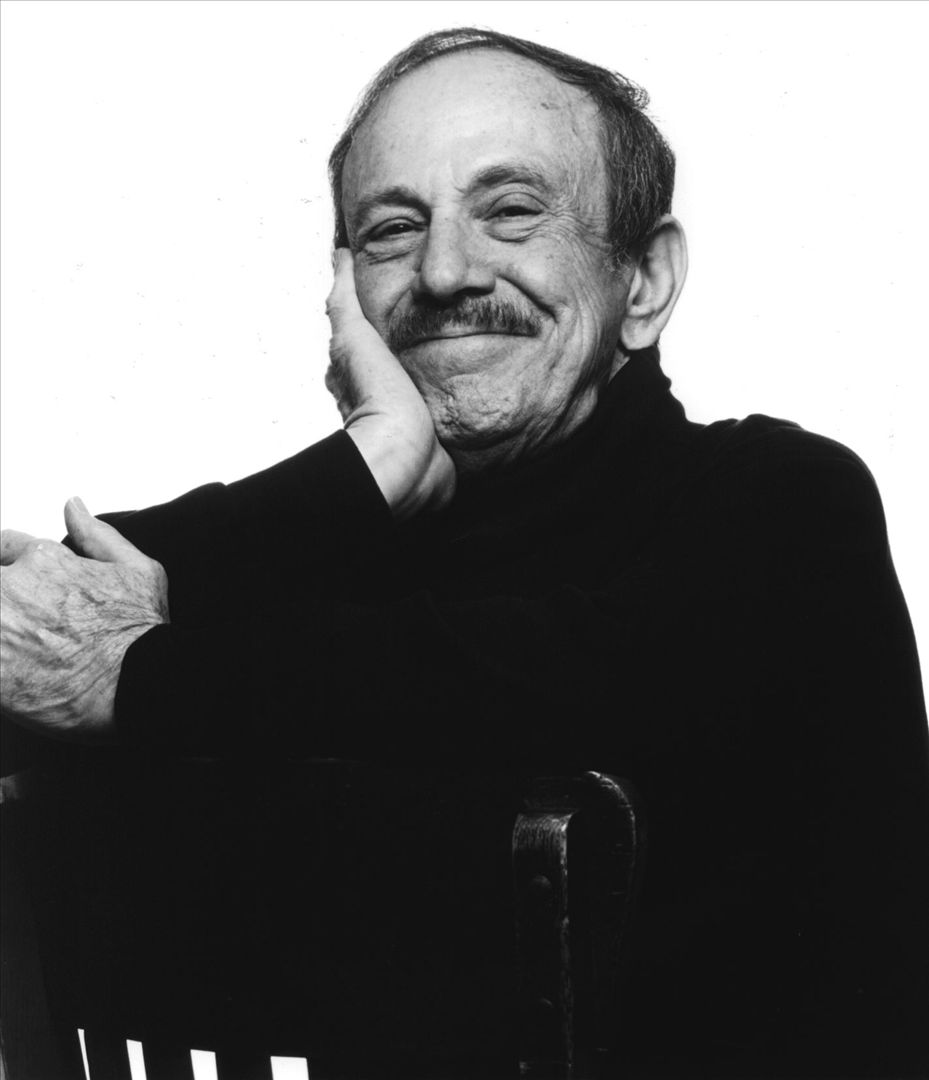
Arturo O’Farrill or better known as “Chico” O’Farrill was born in Havana (Cuba) on October 28, 1921. He was the son of a recognized Jewish family whose father was an eminent lawyer whom one day decided to immigrate to the United States. Arturo undertook his studies at the Riverside Military School in Gainesville, Georgia (interned by his father).

He began to love the jazz orchestras (big bands) and within that environment he fed musically, listening to recordings of Benny Goodman, Artie Shaw, Glenn Miller, and Tommy Dorsey, so much, that in a brief time he learned to plays the trumpet and became the trumpet player of the military band as well as the several dance groups.

Years later, Chico returned to Cuba. He studied law and at the same time developed his facet as a composer, receiving a composition and harmony study with the master, Félix Guerrero. Likewise, he was also Armando Romeu Bellamar Orchestra’s member and the Isidro Pérez Orchestra, when the Son and the Mambo prevailed in the Latin music.


TRAJECTORY

From 1943 to 1947 “The Afro-Cuban Jazz Architect” worked at the cabaret Montmartre. He was a member of Bellamar Orchestra, directed by Armando Romeu and integrated by Luis and Pucho Escalante, Gustavo Mas and Mario Romeu, among others. He traveled to Mexico and Europe as a trumpeter musician as well as he created the band, Los Raqueteros del Swing, being the director and trumpet.

Subsequently, he founded Los Beboppers (the first group of Cuban bop), which was presented at the Saratoga Hotel with Chico again as the director and the trumpet.

Arturo O'Farrill
Arturo O’Farrill

In the ‘50s decade began the successes for Chico as an arranger, working briefly for several orchestra directors, such as Gil Fuller, Noro Morales, Frank “Machito” Grillo, and Benny Goodman.

In the same way, he composed his first great masterpiece “Afro-Cuban Jazz Suite” in five movements: Song, Mambo, 6/8, Jazz and Rumba Open. This masterpiece was made and recorded for the businessman Norman Granz’s label, using the Machito’s Orchestra as an accompanist and rhythmic base.

“Afro-Cuban Jazz Suite”, according to Luc Delannoy: “begins and ends with a hypnotic flute and conga duo that reflects the essence of Cuban treatment; the union of musical universes: the European (the flute) and the African (the conga).

To these two instruments is joined the oboe, followed by the trumpets, saxophones and the “Tumbao” of the double bass… After a return to swing and bebop in the fourth movement, Chico takes us to the origins of Latin jazz with a melody of clear Arabic accents, before sinking back into the universe of Afro-Cuban percussions”. Likewise, for Benny Carter, this Suite was: “The reason for the coherence of the rhythmic parts and their relationships with the solos that have their own life and independence, Masterpiece of a genius.”

In New York and following the success of “Afro Cuban Jazz Suite”, O’Farrill writes “Cuban Fantasy” for Stan Kenton, who later changes its name to “Cuban Episode”.

In 1953 he traveled to California, where he founded his orchestra that included renowned musicians such as Mario Bauzá, Doug Mettome, Jimmy Nottingham, Eddie Bert, Fred Zito, Lenny Hambro, Flip Phillips, and saxophonist Eddie Wasserman. The orchestra used the rhythm section of the Machito’s Afro-Cuban, harp and oboe. With this concept he recorded for Norman Granz, performed in Birdland (New York), and the Hat Ballroom located in Los Angeles. In this period he composed three new movements: “La Jungla”, “Contraste”, and “Rhumba Finale”, baptized as “Manteca Suite” recorded with the Jazz player Dizzy Gillespie and orchestra of 21 excellent musicians in 1954.

Arturo O'Farrill
Arturo O’Farrill

He returns to Cuba again in 1956 to be inspired and immediately began working for the best record companies on the island such as Panart and RCA Víctor, recording “Chico’s Cha-Cha-Cha”, adapting the Charanga rhythm to the big band format. This album is released, one more time, on compact disc by BMG during the last decade of the twentieth century. Chico also made a recording for the popular D’Aida Quartet and arrangements for Bola de Nieve and the famous Orchestra Director, Aldemaro Romero.

In 1958 the restless O’Farrill moved for Mexico, an essential platform for all Latin American musicians at that time. There he returned to create another special sound and appears on television as musical director of the Andy Russell singer, and there his life changed radically. He started a semi-retirement period, but never stopped creating music. At that moment, he composed his famous “Azteca Suite” for trumpeter Art Farmer, and he made history again!

In the 60s he returned to New York and makes arrangements for such important figures as La Lupe (They Call Me La Lupe); Cal Tjader (Along Comes Cal); Clark Terry (Spanish Rice); Count Basie (High Voltage); Gato Barbieri (Chapter Three: Viva Emiliano Zapata); Ringo Starr (Night and Day) and dabbled in the Rock music with David Bowie (I Know It’s Gonna Happen, Looking for Lester), and finally he was director of the Aldemaro Romero´s Orchestra.

This stage extends until the end of the 20th century, although already in the 70s, the big bands go down in history for several genres that would be manifested due to their novelty and immense popularity in the United States and around the world. The architects of the new fashion used new techniques, styles, and sounds, especially in the field of harmonization. Suddenly popular music stopped being exclusively for the ballroom and -of course- “new sound” icons appeared in the Jazz Music. For this reason, Chico O’Farrill begins working in the lucrative field of music for television commercials.

Arturo O'Farrill
Arturo O’Farrill

In the mid-1990s, “The Afro-Cuban Jazz Architect” was contacted by American producer and Jazz director Todd Barkan with Pure Emotion, a compiled of his musical career with which he got a nomination for the 37th edition of the Grammy awards.

O’Farrill toured Europe with his orchestra in 1996 and recorded his latest album titled “Heart Of A Legend”, which contains 14 tracks, a formidable orchestra of 18 masters and a staff of international artists. The arrangements of “Heart Of A Legend”, considered for many as the best album of his career, took care by himself and the musical direction was entrusted to his son, Arturo O’Farrill Jr., a formidable pianist and heir of his legacy.

Arturo “Chico” O’farrill died on June 29, 2001, in New York City at 80 years.

Arturo O'Farrill
Arturo O’Farrill

Undeniably, Chico for more than half a century was a great musical creator. He was at the forefront of an innovative style that many know as Latin Jazz nowadays, which was called at the beginning with many names, such as Cuban bop, Mambo Jazz and Afro-Cuban Jazz.

Our dear “AFRO-CUBAN JAZZ ARCHITECT” Until forever!

In memory of 18 years of his passing!

Balazo de Norteamérica:

Arturo “Chico” O’Farrill

“The Afro-Cuban Jazz Architect”

In memory of 18 years of his passing!

  • « Go to Previous Page
  • Page 1
  • Interim pages omitted …
  • Page 27
  • Page 28
  • Page 29
  • Page 30
  • Page 31
  • Interim pages omitted …
  • Page 55
  • Go to Next Page »

International Salsa Magazine (ISM) is a monthly publication about Salsa activities around the world, that has been publishing since 2007. It is a world network of volunteers coordinated by ISM Magazine. We are working to strengthen all the events by working together.