


Two years after the creation of the Latin Jazz album XYZ with Son Bent Braam

Michiel Braam presented XYZ at the Music Meeting Festival. “The festival takes place in Nijmegen, where I was born (1964), grew up, and still live”. Foto: Marjan Smeijsters
Virtuous pianist, masterful producer, and surprising composer. Winner of the Podium award (1998) and Boy Edgar (1996/1997). Musician trained by conviction and at the ArtEZ Music Academy in Arnhem. His lifestyle is synchrony between freedom, creativity, teaching, and love. It is how he presents us his life and his works in Nijmegen, Michiel Braam.
This friendly artist with a protective childhood where love prevailed always had the support and freedom to develop and create everything he considered necessary to him. Michiel is the only one in his family who turned to music professionally, but the rhythm of melodies runs through his veins. His parents played the piano self-taught. His mother wrote notes while his father just improvised.
During high school, he participated in a band for which he wrote and arranged all the music. He studied at the conservatory and founded his more minor quartet Bentje Braam (“Little Band Braam”) in 1985. In the same year, he traveled with his band to Sweden to be the first Dutch group to open the EBU Jazz Festival and wrote his first composition for the Dutch radio “Cows and Beasts”. A year later, he created the band Bik Bent Braam.
“Music is, as long as I know, everything to me. I feel better with music. I dance when I’m happy, and music comforts me when I’m not doing so well… It seemed like a logical step to pursue what I enjoyed most.” Michiel Braam https://www.michielbraam.com/
By 1988 Braam had had no contact with Latin music until percussionist André Groen asked him to be the pianist for his Orquesta Europea de Danzón. In this regard, this wonderful pianist told us: “He wanted a pianist who had a wild free Jazz attitude and who didn’t only play the well-known Latin patterns because he thought that fitted better with the authentic Cuban music. That music immediately appealed to me, especially because of its rhythmic impact, but also because as a pianist, you have a lot of freedom to go in all directions during improvisations. I have touched on those Latin patterns to some extent and in the course of the 10 years that I played in that orchestra I managed to master them better, but it was mainly the combination of freedom and rhythm. That orchestra lasted ten years and we celebrated the thirtieth anniversary in 2018 with a couple of concerts. Great to do that again and I felt again exactly why I found it so appealing back then”.
In 1988 Michiel won the Podium Prize, an encouragement prize for Dutch Jazz music and in 1996/1997 he won the Boy Edgar, the highest prize for Dutch Jazz.
This pianist, the architect of great projects, built a party based on the Latin alphabet of Western culture on the album XYZ released in 2020, creating a danceable mix that includes Mambo, Rumba, Son, Danzón, Boogaloo, Calypso, Rumba, Bembé, Mozambique, Samba, Afro, Bolero, Cha-cha, Merengue, Bembé, and Samba. Michiel is also the Director of the Jazz and Pop department of the ArtEZ conservatory and founded a Danzón orchestra. Now, I leave you with the rest of this wonderful interview that I had the opportunity to do with the great Maestro Michiel Braam. Enjoy!

They have played on the ZomerJazzFiets tour, North Sea Jazz, and Bimhuis. Likewise, some of the members of the orchestra are fluent in Spanish.
– How did the idea of the Latin jazz album XYZ come about?
In 1995 I wrote “The XYZ of Bik Bent Braam” for my big orchestra at the time, Bik Bent Braam (phonetic Dutch for “Big Band Braam”). I thought it would be fun to make a festive version of it to celebrate the 25th anniversary. The XYZ was (and is) a 26-part suite, with a piece for each letter of the alphabet, starting with Aardedonker (English title Atramentous, Spanish Apagado, both not exact translations…) and ending with Zwoerdspek (Zaftig, Zafio). I revisited all the pieces in 2020 and paired various styles with the original material. In the 1995 original, they were mostly jazz-like styles (bebop, free improv, swing, jazz ballad, etc), but Chachachtig was a rumba even then. It is the only piece that has not changed its mood substantially.
– What happened to the previous members and how did the new members take hold?
The original orchestra Bik Bent Braam was composed of top musicians from the Dutch improvised music scene. The orchestra existed from 1986 to 2013 and had a number of lineup changes. In the final version of Bik Bent Braam there were only a few members left from the very beginning. That the musicians of Bik Bent Braam could read well was not really a requirement, the core was affinity with swing and great improvisational skills. For this new version, it was important not only that the musicians were excellent improvisers, but also that they had to have a feel for Latin music and also that they were outstanding readers, because I did not foresee that there would be very much rehearsal time and the notes are quite challenging. Bik Bent Braam was subsidized with government funding and I could then easily occupy a longer period with many rehearsals. Son Bent Braam, the current line-up, does not have its own subsidy, so we have to look at each concert and hope that everyone can make it. There have been quite a few subs, and they too have to be able to improvise and read well.
– Tell us about your Danzón orchestra.
André (André Groen – Percussionist) wanted to immerse himself in traditional Cuban music. There is so much richness in the danzón with its fixed forms that pass by in each piece with the most beautiful melodies and the wildest spaces for improvising on highly danceable rhythms. We found the instrumentation with violins, cello, flute, percussion, double bass, and piano attractive. After ten years I got too busy with my jazz ensembles, by then I was touring all over the world with Bik Bent Braam and other groups and especially with my Trio BraamDeJoodeVatcher. I could hardly combine it anymore with the Danzón Orchestra and the great pianist Peter van Marle took my place, which made me feel very humble. The European Danzón Orchestra then existed for another year or so. I honestly don’t know why it stopped then. In 2018 we did a couple of reunion concerts, great fun to do.
– How many years have you been in charge of the Jazz and Pop department of the ArtEZ conservatory and what do you teach the new generations based on your experience?
I have been head of the program since 1992. It is part of a broad arts university and is located in a building that also houses dance, theater, fine art, applied art, fashion, and creative writing. As a head, I don’t teach very much… only when students very specifically ask for it a few hours of individual lessons per year and a few group lessons, and I also regularly give master students some lessons. My message is usually quite short and clear: there are millions of people who play an instrument excellently, and you can probably teach an orangutan to play Keith Jarrett better than Keith does himself, but – apart from the fact that that would be a fun YouTube hit – there is no point; in our music, it is almost all about an authentic voice, including all the shortcomings that are in everyone, which also make you a unique musician. Obviously, you must have many skills as a musician, but my life motto is that one’s deficiencies are far more important for one’s personality than one’s skills, and that attitude underlies my whole vision of art education.

“With Nos Otrobanda have started to concentrate on the music of Noro Morales and have his composition Maria Cervantes (single) firmly in our program. His music will probably be the subject of our new album”. Foto: Marjan Smeijsters
– What are your next projects?
Everything is starting up again post-covid. I want to record a solo album on my grand piano, a so-called “Alurip”. That’s an aluminum grand piano made in the fifties with a specific sound. And the album of our trio Nos Otrobanda, which specializes in Antillean music, is almost sold out. That doesn’t matter obviously, if there are no more physical copies then you can always hear the music through iTunes, Spotify, etc, but it’s a great opportunity to make new recordings again and the intention is to go to Curacao and record music in the Fortkerk in Willemstad, the place where we did a couple of concerts in 2018. That was a great experience, what a nice place and sweet audience!
– How was the process to make a living from music?
I stuck pretty firmly to the rule that you have to do what you like and not let yourself be distracted too much from that. And I look for what it takes to make it happen. From 1996 to 2012 I received an annual government subsidy to realize my projects. I am also a real musician in the sense that I have a mixed professional practice (playing, writing, teaching, producing, almost every musician has roughly that mix) which means that it is always possible to make a living out of it and we never had to worry about bread and a place to live.
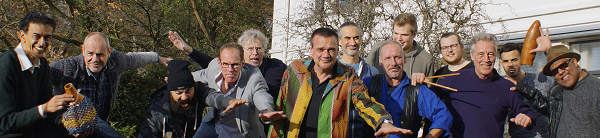
Michiel Braam & Son Bent Braam Orchestra. Foto: Marjan Smeijsters
I make music mainly because I can’t do otherwise. Music is a way to communicate; it makes you a little better… Leitmotiv in everything is that in music, I am free to do anything I want. For example, I did play Purcell’s Dido and Aeneas with the exquisite reed quintet Calefax, also improvising on the various songs from that opera.” Michiel Braam
Gerardo Rosales was born in Caracas Venezuela on July 6, 1964. At the beginning of his musical career he was a percussionist for important figures of his country.
He has been living in Europe since 1992, and has taken up residence in Holland, a country that has served as a base for him to project his music around the world.
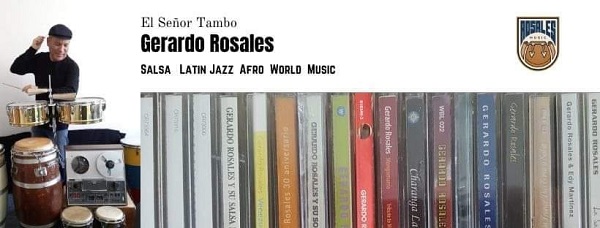
He has recorded 20 albums under his own name and more than 70 productions with other artists.
Gerardo Rosales’ specialty is creating musical projects in the styles of salsa and Latin jazz.
Gerardo Rosales is the creator and producer of El Combo Mundial, Venezuela Masters, Charanga La Crisis, Our Latin Groove, La Gran Charanga, Son del Sofá, Rítmico y Pianístico, Cachao Sounds and many more.
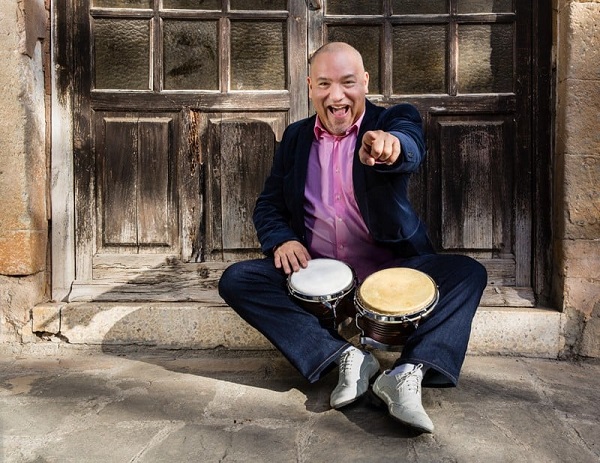
In his beginnings in his country Venezuela he performed with: Orquesta Café, Orlando Poleo, José Rosario, Canelita, Soledad Bravo, Adrenalina Caribe, Ilan Chester, Cecilia Todd, Víctor Cuica, Alberto Naranjo, El Trabuco Venezolano, Joe Ruiz, Tabaco, Los Satélites, Nancy Ramos, Wilmer Lozano,Watussi, Trina Medina etc.
In Europe he has performed with: The Rosenberg Trio, Saskia Laroo, Hans Dulfer, Benjamin Herman, Peter Beets, Tango Extremo, Drums United, Nueva Manteca, New Cool Collective, Fra Fra Sound, Denisse Jannah, Laura Fygi, Izaline Calister, Metropole Orchestra, Holanda Big Band, Cubop City Big Band, Lilian Vieira, Rolf Sanchez, ChaChaChalina y Maite Hontelé etc.
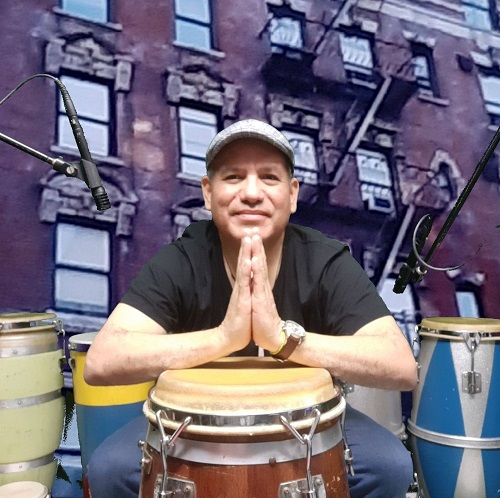
Gerardo Rosales has accompanied on tours, recordings and performances in Europe artists such as Dee Dee Bridgewater, Benny Bailey, Paquito D Rivera, Bebo Valdés, Toots Thielemans, Jimmy Bosch, Juan Pablo Torres, Herman Olivera, Oscar D León, José Alberto El Canario “, Andy Montañéz, Meñique, Edy Martínez, Carlos” Patato “Valdés, Conexión Latina, Orlando Valle” Maraca “, Alfredo Rodríguez, Armando Peraza, Luisito Quintero, Ramón Valle, Larry Harlow, Adalberto Santiago, Frankie Vázquez, Oscar Hernandez, Africando, Chamaco Rivera, Luisito Carrion, Jorge Herrera, Edgar Dolor, Dorance Lorza, Luisito Rosario, Watussi, David Cada, and Tito Allen, etc.
The Records of Gerardo Rosales:
2016 Gerardo Rosales “Salsa Vintage” (Download – CD – LP)
2014 Gerardo Rosales “Son Del Sofa” (Single) ITunes
2013 Gerardo Rosales “Síguelo” (CD).
2011 Gerardo Rosales “Chano Pozo’s Music” (CD).
2011 Gerardo Rosales “30 Aniversario” (CD).
2010 Cachao Sounds “La Descarga Continúa” (CD).
2010 Gerardo Rosales “Buscando Chamba” (CD).
2009 Venezuelan Masters Orchestra “Toros y Salsa” (CD).
2008 Gerardo Rosales “Salsa Mundial” (CD).
2007 Our Latin Groove “Bringin’ it All On Back” (CD).
2005 Gerardo Rosales “Mongomanía” (CD).
2005 Charanga La Crisis “Salsa Antigua” (CD).
2004 Gerardo Rosales “Tribute to Fania” (CD).
2001 Gerardo Rosales “La Salsa es mi Vida” (CD).
2001 Gerardo Rosales & Edy Martínez “Rítmico y Pianístico” (CD).
1999 Gerardo Rosales “El Venezolano” (CD).
1998 Gerardo Rosales “Señor Tambó” (CD).
1996 Gerardo Rosales “Venezuela Sonora” (CD).
1992 Gerardo Rosales “Salsa Pa’lante de Venezuela” (CD).
1991 Gerardo Rosales “Salsa Pa’Lante de Venezuela” (33 RPM Vinyl).
Algunos discos grabados por Gerardo Rosales con otros Artista:
Orquesta Cafe “Criollisima” 1987 (Fama) Venezuela ( Salsa )
Joe Ruiz – Javier Plaza – Jose Torres – Gerardo Rosales
Bebo Valdes “Rides Again” 1994 ( Messidor) Germany ( Latin Jazz )
Paquito D Rivera – Patato Valdes – Amadito Valdes – Gerardo Rosales
Conexion Latina – “La Conexion” 1996 (Enja) Germany ( Salsa )
Rudi Fuesers – Leslie Lopez- Anthony Martinez – Nicky Marrero – Gerardo Rosales
David Rohschild “Looking Up” 1997 (Via) The Netherlands ( Salsa )
Adalberto Santiago – Banjamin Herman – Gerardo Rosales
Leslie Lopez “Bomba Moderna” 1999 (Buitenkunst) The Netherlands (Latin Jazz)
Ramon Valle – Joe Rivera – Nils Fischer – Gerardo Rosales
The Rosemberg Trio “Suenos Gitanos” 2001 (Polydor) The Netherlands ( Latin )
Toots Thielemans – Leonardo Amuedo – Gerardo Rosales
Ronal Snijders “Bijlmerjazz 2004 (Independent) The Netherlands (Jazz)
Randal Corsen – Jesse van Ruller – Gerardo Rosales
Cubop City Big Band “Arsenio 2004 (Tam Tam) 2004 The Netherlands (Cuban)
Lucas van Merwijjk – Edy Martinez – Nelson Gonzalez – Gerardo Rosales
Drums United “World of Rhythm” 2006 (Tam Tam) 2004 The Netherlands (World Music)
Lucas van Merwijk – Nils Fischer – Aly N ‘ Diaye Rose – Gerardo Rosales
Samba Salad – Metropol Orkest “Live Vredenburg” 2006 The Netherlands (World Music)
Herman Link – Dick Bakker – Maurice Luttikhuis – Rita Iny – Gerardo Rosales
Aquilez Baez “ La Patilla” 2007 (Cacao) Venezuela (Latin Jazz)
Anat Cochen – Huascar Barradas – Diego Alvarez – Gerardo Rosales
Maria Catharina “Obsecion” 2010 (Independent) The Netherlands (Jazz)
Adinda Meertins – Thomas Bottcher – Marc Bischoff – Gerardo Rosales
Masalsa “Resurreccion” 2012 (Independent) The Netherlands (Salsa)
Soeshiel Sharma – Ray de La Paz – Marcos Bermudez – Gerardo Rosales
Izaline Calister “Kandela” 2012 (Coast to Coast) The Netherlands (Latin)
Yumarya – Vernon Chatlein – Larc Alban Lotz – Gerardo Rosales
Africando “Viva Africando” 2013 (Sterms Music) France (Salsa)
Boncana Maiga – Oscar Hernandez – Doug Beavers – Luisito Quintero – Gerardo Rosales
Mezcolanza “Headbanger” 2015 (O.A.P Records) The Netherlands (Jazz)
Peter Wenk – Chistof May – David Barker – Mick Paauwe – Gerardo Rosales
Tango Extremo “ Havana” 2015 (JWA) The Netherlands (Latin)
Ben van den Dungen – Rob van Kreeveld – Tanya Schaap – Gerardo Rosales
Orquesta La Potente “ Potente “ 2018 (Independent) Colombia (Salsa)
Coco Ramirez – Guarnizo – Gerardo Rosales
Barry Hay & JB Meijers (Universal Music Group) 2019 The Netherlands ( Pop)
Barry Hay – JB Meijers – Gerardo Rosales
Estrella Acosta “Noche Cubana” 2020 (Independent) ( Cuban) Grammy Nominated
Carlitos Irarragorri – Pedro Luis Pardo – Gerardo Rosales
ChaChaChalina “Mira Antes de Saltar” 2021 (Independent) (Salsa)
Chalina Smit – Dani Brands – Gerardo Rosales
Actuaciones realizadas por Gerardo Rosales en diversos lugares del mundo:
Concerts & Events of Gerardo Rosales:
Poliedro de Caracas: Caracas – Venezuela
Centro Cultural BOD: Caracas – Venezuela
Feria de Cali: Cali -Colombia
North Sea Jazz: Rotterdam – The Netherlands
Toros y Salsa: Dax – France
SOBS: New York – USA
Club Babalu: New York – USA
Expo Sevilla 1992 : Sevilla – España
Festival Latinoamericando: Milano-Italia
Accessible Art Festival: Turquia – Mersin
Bimhuis: Amsterdam – The Netherlands
Melkweg: Amsterdam – The Netherlands
Concertgebouw: Amsterdam – The Netherlands
Paradiso: Amsterdam – The Netherlands
Oosterpoort: Groningen – The Netherlands
Glastonbury Festival: Glastonbury – England
Tabarka Jazz Festival: Tunesia
Music Haal: Berlin – Germany
Las Leyendas Vivas de la Salsa: Medellin – Colombia
Exit Festival: Serbia
La Topa Tolondra: Cali – Colombia
Punto Bare: Cali – Colombia
Cafe Libro: Bogota – Colombia
Bird: Rotterdam – The Netherlands
De Doelen: Rotterdam – The Netherlands
Paard van Troje: Den Haag – The Netherlands
Amazonico:Emiratos Arabes-Dubai
From 1940 to 1957, he was in charge of the arrangements, rehearsals, repertoire, hiring of the vocalists and that very particular sound, so imitated but never equaled that the “Dean of the Conjuntos” possessed.
All that sonority is due to this pianist, composer and arranger born in Matanzas, Cuba, on June 2, 1903.
Severino Ramos Betancourt was born on June 1, 1903 in Matanzas, Cuba. He was a composer, pianist, orchestrator and arranger, one of the great Cuban musicians, he worked as pianist and arranger in the Conjunto Sonora Matancera, later he founded the Sonora Cubana.

Since he was a child, music, musicians and instruments were his passion. In his family, grandparents and uncles, had to do with the bungas of Matanzas (a bunga was a small group that included piano, violin, clarinet and flute). As a child he met Cheo Jiménez and Eduardo Betancourt, trombonist of Miguel Failde’s orchestra.
Later he went to Havana where he worked successively as a tailor’s assistant, insurance collector, doorman in a cabaret, traveling salesman, substitute musician in theaters, radio stations, and a thousand other occupations that appeared along the way before becoming a professional musician, during that time he received lessons from Felix Covarrubias.
Sonora Matancera

Severino Ramos joined the famous Conjunto Sonora Matancera in 1942, as a pianist, after unsuccessful attempts to occupy positions in the Sexteto Mikito (later Conjunto Casino), replacing Enrique Rodriguez, and in other Havana groups.
Severino’s character does not go with the style of intense and nocturnal work of the group, presentations in radio stations, dances (preference of Rogelio Martínez its director), contracts in La Tropical, Cabaret Tropicana, regional Centers: Asturian Center, Galician Center and trips to provinces; so he decides at the request of the director of the Sonora to look for another pianist for the group and he stays to make the arrangements, rehearsals, preparation of repertoire, etc…, From that moment on, the star of the Conjunto Sonora Matancera really began to shine in the firmament of popular acceptance.
He became, in keeping with his calm character, an orchestra man performing all these tasks and some others, such as visiting radio stations, theaters and other places to obtain contracts for the group.
The fruits contributed by Severino Ramos between 1940 and 1957 are of extraordinary value, perhaps what makes his work more visible are his arrangements and the preparation of the regular and guest singers that accompanied the Sonora such as: Bienvenido Granda, Daniel Santos, Myrta Silva, Celia Cruz, Leo Marini, Bobby Capó, Nelson Pinedo, Estanislao Laíto Sureda, Carlos Argentino and Celio González, among others.
After the Sonora Matancera
The last days of Severino Ramos in favor of Cuban Music were as musical director of Radio Progreso since 1957, when he left the Sonora, simultaneously with the prolific and very important work at the head of the many record labels he created.
After 1959, in that first decade, 1960, many record labels emerged in Havana, plus those that came from before and he multiplied himself making arrangements, forming momentary groups, forming groups to accompany Orlando Contreras, Blanca Rosa Gil, Orlando Vallejo, Ñico Membiela, many more. He formed the Sonora de Severino Ramos and helped create the Conjunto Caney.

The following is a small sample of songs that were arranged by Severino Ramos for the Sonora Matancera:
El Tíbiri Tábara with Daniel Santos
Qué corto es el amor, with Mirtha Silva
Burundanga, Yerbero Moderno, Tu Voz, Luna sobre Matanzas, with Celia Cruz
Who will be? With Nelson Pinedo
Yo no soy guapo with Vicentico Valdes
Sujetate la lengua, with Bienvenido Granda
Aunque me cueste la vida, on the 19th, El negrito del Batey with Alberto Beltrán
El gallo, la gallina y el caballo with Manuel Licea
Piel Canela with Bobby Capó
Maringá, with Leo Marini
Who will it be? With Nelson Pinedo
Las Muchachas, with Carlos Argentino
Translated with www.DeepL.com/Translator (free version)
Severino Ramos died in Havana on November 2, 1969.
A Salsero Festival and Tour will be the stars of the summer in the main cities of Europe
Europe welcomes Latin music events in the last month of summer this year with two impressive Salseras parties. During these events, the safety of the attendees will be guaranteed, will be an unbeatable festive atmosphere and lots of fun. So, don’t miss the opportunity to attend the Salsa Latina Istriana Festival in Croatia and the Cuban artist Maykel Blanco y Su Salsa Mayor’s European Tour, and enjoy the heat of August with your favorite Latin music.
Salsa Latina Istriana Festival 2022

DJ Sergio, DJ Marc “El Mágico” and DJ Julián Duke will be in charge of mixing the greatest Salsa hits during the Festival
Salsa Latina Istrian Festival began in 2004 as a free dance workshop with 100 dancers who love and dance enthusiasts to promote Salsa and other Caribbean dances.
This year the eighteenth edition of this festival with tradition and support for the community of European dancers arrives from August 26th to August 29th with four Bootcamps, workshops (Salsa, Bachata, Kizomba, Semba, and Urban Kiz), international instructors, Masterclasses, night parties, boat and beach parties (the farewell party on Monday will be free), 12 famous DJs, two free social dances on four floors, and much more.
Salsa Latina Istriana Festival 2022 http://www.salsalatinaistriana.com will be held under the precautionary measures agreed for events and dance academies.
The workshops, as well as the night parties, will take place over three days at Dom Hrvatskih Branitelja, Leharova 9, in the center of the coastal city of Pula, Croatia, and the cost of the gold pass is €150.
Maykel Blanco y su Salsa Mayor

The singles Qué Hace Que Te Mueve and Ya Tú No Coronas belong to the “Qué Hace Que Te Mueve” album released in 2019
Cuban artist Maykel Blanco and his orchestra will continue their tour of Europe (Part 2) on Saturday, August 27th, at London’s iconic auditorium Electric Brixton with a special six-hour Cuban Salsa show. Javier La Rosa and Dr. Jim will be the evening’s Cuban DJs, while Osbanis and Anneta (Cuban Salsa Dancers and UK and World Champions) will lead a Cuban Salsa class for all levels.
On Sunday, August 28th, they will visit Glasgow (United Kingdom) at The Garage (nightclub) and will end their tour on September 9th at the Transformatorhuis event venue located in Amsterdam (Netherlands).
Maykel Blanco y Su Salsa Mayor made their way into the Havanera capital’s music scene more than a decade ago. This popular band in Cuba combines catchy lyrics with irresistible arrangements that get dancers, fans, and onlookers moving on the dance floor.
They currently have two great hits playing on the popularity charts of the most important radio stations on the Afro-Caribbean Island, Ya Tú No Coronas (2019) and Qué Hace Que Te Mueve (2019).
“Maykel was born in San Leopoldo, a neighborhood of the Centro Habana municipality in the Cuban capital, on January 21st, 1981, the year that began a decade of splendor for Cuban popular music. With academic training at the Guillermo Tomás Music Schools and the Amadeo Roldán Conservatory, at the age of 17, he joined the orchestra “Abel y la Seducción” and a year later created, “Suprema Ley”, thus starting his outstanding career professional.
At this stage, he arouses the interest of the Spanish record label Envidia Record with which he signed his first international contract. With this record company, he managed to produce more than ten phonograms for his group and various other artists, including Tirso Duarte. He also participated in the recording of 40 albums as a percussionist in various productions and created music for various “Latin Jazz” groups, such as “Havana Express”.
Maykel decides on October 10th, 2004 to make his big debut with his new orchestra “Maykel Blanco y Su Salsa Mayor”, made up of talented musicians, who graduated from various art schools in the nation.
Since then and up to the present, he has devoted his energy, creation, and musical talent to this interesting project. Thus, allowing his professional career to continue on the rise, as a pianist, percussionist, composer, music producer, arranger, and cultural promoter reaching a high level of popularity and prestige, in Cuba and the world”. Fragments extracted from Maykel Blanco biography. http://www.maykelblanco.com/