• Skip to primary navigation
  • Skip to main content

International Salsa Magazine

  • HOME
  • Previous editions
    • 2026
      • ISM / April 2026
      • ISM / March 2026
      • ISM / February 2026
      • ISM / January 2026
    • 2025
      • ISM / December 2025
      • ISM / November 2025
      • ISM / October 2025
      • ISM / September 2025
      • ISM / August 2025
      • ISM / July 2025
      • ISM / June 2025
      • ISM / May2025
      • ISM / April 2025
      • ISM / March 2025
      • ISM / February 2025
      • ISM / January 2025
    • 2024
      • ISM / December 2024
      • ISM / November 2024
      • ISM / October 2024
      • ISM / September 2024
      • ISM / August 2024
      • ISM / July 2024
      • ISM / June 2024
      • ISM / May 2024
      • ISM / April 2024
      • ISM / March 2024
      • ISM / February 2024
      • ISM / January 2024
    • 2023
      • ISM / December 2023
      • ISM / November 2023
      • ISM / October 2023
      • ISM – September 2023
      • ISM – August 2023
      • ISM July 2023
      • ISM Edition June 2023
      • ISM – May 2023
      • ISM April 2023
      • ISM March 2023
      • ISM February 2023
      • ISM January 2023
    • 2022
      • ISM December 2022
      • ISM November 2022
      • ISM October 2022
      • ISM September 2022
      • ISM August 2022
      • ISM July 2022
      • ISM June 2022
      • ISM May 2022
      • ISM February 2022
      • ISM January 2022
    • 2021
      • ISM December 2021
      • ISM November 2021
      • ISM October – 2021
      • ISM September 2021
      • ISM August 2021
      • ISM July 2021
      • ISM May 2021
      • ISM April 2021
      • ISM June 2021
      • ISM March 2021
      • ISM February 2021
      • ISM January 2021
    • 2020
      • ISM December 2020
      • ISM November 2020
      • ISM October 2020
      • ISM September 2020
      • ISM August 2020
      • ISM July 2020
      • ISM June 2020
      • ISM May 2020
      • ISM April 2020
      • ISM March 2020
      • ISM February 2020
      • ISM January 2020
    • 2019
      • ISM December 2019
      • ISM November 2019
      • ISM October 2019
      • ISM Septembre 2019
      • ISM August 2019
      • ISM July 2019
      • ISM June 2019
  • Spanish
  • Download Salsa App
    • Android
    • Apple

Search Results for: Salsa Orchestra

Villariny Salsa Project from Puerto Rico

Committed to continuing the legacy of the greats in Salsa

Villariny Salsa Project made its debut on July 25th, 2009, at an international event held in Puerto Rico called “Puerto Rico Salsa Congress” where it was presented twice in the same year, as a prelude to Roberto Rohena and later, to the Gran Combo de Puerto Rico.

Villariny Salsa Project
Committed to continuing the legacy of the greats in Salsa

In the summer of 2010, Oscar Villariny (founder of the group) after working as a professional musician with salsa artists such as Gilberto Santa Rosa, Jerry Rivera, Puerto Rican Power, Viti Ruiz, Rey Ruiz, Anthony Cruz, Jose Alberto “El Canario”, Luigi Texidor, Tito Nieves, Michael Stuart, David Pabon, Johnny Rivera among others; began recording the first musical production which was entitled “En tu tiempo”.

Before making the “relayase” of the musical production, Villariny Salsa Project recorded the Christmas song “Trulla Caliente” to the rhythm of full, being a total success occupying the first positions in the radio lists.

In 2011, the first musical production of the band comes out with 8 songs, which has the hits “Que bien me va”, “Estoy Enamorao”, “Bendita la luz (salsa version)”, “A punto de Caramelo” and “Amigo es un peso en el bolsillo”.

This musical production was in charge of Mr. Tommy Villariny (arranger, musical producer, and trumpet player) who is Oscar Villariny’s father.

Within this production, he had the vocal coaching of Gilberto Santa Rosa, Victor Manuelle, Tony Rivas, Jerry Rivas (singer of the Gran Combo).

Villariny Salsa Project debuted on July 25th 2009 at an international event held in Puerto Rico called "Puerto Rico Salsa Congress".
Music Producer: Tommy Villariny & Oscar Villariny

At the time, it had a great acceptance from salseros and managed to be present in massive concerts such as Luisito Carrión (Roberto Clemente Coliseum), José Alberto El Canario (Tito Puente Theater), and the 2012 National Salsa Day. In 2014, VSP presented its second musical production entitled “De tu mano”.

This production has 10 songs and includes guest artists such as: Manny Trinidad (four Puerto Rican), Prodigio Claudio (four Puerto Rican), Camilo Azuquita, Luisito Carrión, José Alberto “El Canario (We were born in Salsa) and Medina Carrión.

The songs “De tu mano”, “Color Esperanza”, “Nacimos en salsa “and “Con computadora no feat NG2”, occupied the first positions in the radio waves.

In the year 2019, Villariny Salsa Project released a new music single entitled “Homenaje”, in honor of his father’s career and some of his successes by bringing together the same singers who originally recorded them such as Andy Montañez, Eddie Santiago, Rey Ruiz, and Viti Ruiz. “Many artists in the salsa genre have been hand in hand with my father Tommy Villariny to create what are successes today,” said Oscar Villariny.

Villariny Salsa Project released a new musical single entitled "Homenaje", in honor of his father's
Tribute to his father’s career

Our vision at Villariny Salsa Project is to make way for the New Generation and offer new opportunities, which is why Oscar Villariny (Founder of Villariny Salsa Project) is recording his first album with talented young people from the patio, produced by veteran musician Tommy Villariny.

Recently Villariny Salsa Project launched “Agua” available on all digital platforms.

Villariny Salsa Project presenta "Agua" feat. Mari Picorelli
Villariny Salsa Project presenta “Agua” feat. Mari Picorelli

The Villariny Salsa Project orchestra is a group with a lot of projection and refreshing for the industry.


 

Home

The “Caballero de la salsa” delights us with his new album

North America / United States

The story of an artist

Gilberto Santa Rosa, known as “El Caballero de la salsa”, was born in 1962 in Puerto Rico.

The singer has excelled at performing romantic ballads, boleros, and salsa. His first steps in music were at a very young age. Before reaching adolescence he was already forming youth groups within the tropical genre. For about two years, he was part of the band La Grande, from the hand of greats of the genre.

Colegas is the new album of Gilberto Santa Rosa
Gilberto Santa Rosa has a new album

Elías Lopés, famous Puerto Rican trumpet player, became his teacher and tutor. At the age of 14 he traveled to New York to take his first steps in the musical field and his father entrusted him to Lopés. Santa Rosa is very pleased to have received his teachings.

“The greatest legacy for me was discipline, knowledge of the work you are doing and the challenges; He gave me musical challenges that developed the talent I had at that time, “said the salsa singer.

Gilberto participated in the “Homenaje a Eddie Palmieri” with the Puerto Rico All Star, a great opportunity for his career that was on the rise. In addition, he was in the ranks of the Willie Rosario orchestra.

First steps

In 1986, he got his first opportunity as a soloist. Combo Records allowed him to record four albums; giving it a further boost in the salsa genre. Good Vibrations (1986), Keeping Cool! (1987), De Amor y Salsa (1988) and Salsa en Movimiento (1989) were his first record works.

In 1990, he had the opportunity to change record labels. On this occasion, CBS today is known worldwide as Sony Discos. Company with which he has recorded approximately 24 albums and continues to this day.

Sony Discos trusted him and saw him succeed through the years. Punto de vista, the first production made with the label, received a gold and platinum record. The Man and His Music was quite a special production. It was held in 1995 and reflected a presentation held at Carnegie Hall in New York.

Acting is another of the roles that he has developed with great skill. In 1990, he participated in “La pareja dispareja” with Rafo Muñiz and Luis Vigoreaux, Jr.

In the 2000s he was in other theatrical pieces. He starred in the revival of “La verdadera historia de Pedro Navaja”, a musical that demanded a lot from him on a professional level; and with Cuban comedian Alexis Valdés in the play “Atrácame más”.

“Returning to the theater, this time to comedy, fills me with great enthusiasm and even more so to be able to share the stage with one of the greats of comedy in the United States and Latin America. The truth is that “Atrácame más” takes me out of my comfort zone which is music and challenges me professionally. I’m really enjoying this story and I hope people enjoy it a lot more ”, commented Gilberto Santa Rosa, about “Atrácame más”.

Gilberto Santa Rosa is one of the artists who broke paradigms in the United States and in the rest of the world. From the beginning, the Latin public did not hesitate to follow his career and, of course, attend his meetings. He also had the opportunity to travel to Japan.

He presented himself as a worthy representative of his country and surprised the audience by performing “De cara al viento” in Japanese. A feat that surprised critics due to the difficulty of the language. In addition, it was his beginning in the international market, until today he is acclaimed incessantly.

Gilberto had great acceptance and a box office record in his presentations at the First President Festival in the Dominican Republic, the Lincoln Center in New York with Andy Montañez; at the Anayansi Theater in Panama and at the Universal Studios Amphitheater in Hollywood with Olga Tañón.

The accompaniment by the Symphony Orchestra ended up catapulting him among his followers. They considered it an unprecedented presentation and brimming with talent. It was presented under this format in the United States and broke box office records at the Teresa Carreño Theater in Caracas, Venezuela.

Expresión, 1999

It was one of his most popular albums. The album marked the singer’s career as it was nominated for a Latin Grammy Award, for Best Salsa Album, in its first installment. “Que alguien me diga”, original Omar Alfanno, Panamanian composer positioned him for several weeks on the Billboard. The production featured 13 songs with a total of 55 minutes in length.

The album had great renown in the Central American market, giving it a gold record for sales. In addition, he was chosen by the National Foundation for Popular Culture among the most outstanding of the year 1999.

Gilberto, continued to count successes and praise the work of the greats in the industry. He made several tributes such as the concert “Viva Rodríguez” in tribute to Tito Rodríguez; Tribute that the Orquesta Estrellas de la Fania, to Don Tite Curet Alonso and La Guarachera, Celia Cruz, in New York.

40 … y contando, it was released in 2019. It was a live album, with which he commemorated his 40-year career. The idea was born from his concert at the Coliseo José Miguel Agrelot in San Juan, Puerto Rico. 40… y contando it ranked second in sales of Tropical Albums in the United States and first in sales in Puerto Rico.

The Puerto Rican celebrated his 2020 birthday with the launch of a new collectible album.

Colegas, 2020

Gilberto Santa Rosa - New album cover
The album cover was designed for the Venezuelan artist Gilberto Santa Rosa

In this work, he had sixteen collaborations, bringing together “colegas” known to the audience. The first single is “La Familia”, a duet with the singer Tito Nieves, a Puerto Rican recognized within the genre as well as: Tito Rojas, Luisito Carrion, Pirulo, Nino Segarra, Choco Orta, Jose Alberto “El Canario”, Isaac Delgado and Juan Jose Hernandez.

The arrangements are attributed to Ocana Sordi, (El Guateque De Chombo), James Hernandez (La Fonda De Bienvenido), Jose Madera (Bailadores), Rene Gonzalez (Estoy como nunca), Dino Nugent (Apaga la luz), Ricky Gonzalez (Vamos A Bailar El Son, Eque Tumba), Manolito Rodriguez (Medley Boleros), Marty Sheller (Ban Ban Quere, Caminalo), Ramon Sanchez (Que se sepa), Javier Fernández (Masacote, Tremendo Coco), Louis García (Por la Calle Del Medio , Isidro Infante (El Mejor Sonero, Mario Ague, Sonerito),

Singing with Tito Nieves was a pleasure for him because they share a friendship relationship:

“Tito and I have a friendship that transcends the stage and the day to day. He is my dear brother. His sense of humor is incredible. With him everything is very easy. In fact, it only took 45 minutes for us to have the song ready”, said the salsa singer.

Santa Rosa wanted this album to be a very special tribute to his companions of so many years. He looked for the numbers to fit in some way with the relationship with each colleague.

The 58-year-old singer is a winner of a Grammy and five Latin Grammys. He is in his best moment and it appeared that “Colegas” could have a continuation.

“These things excite me and motivate me to do a second part, because other “colegas” were left out,” he said.

Will it be the beginning of your new musical project? We’ll see!

Home

The Club de los Soneros Dorados The Orchestra of the Stars

The Club de los Soneros Dorados The Orchestra of the Stars, where great stars and legends of Cuban music meet

Two years ago, an orchestra made history. For the first time in Cuban music, the greatest legends, singers, and instrumentalists were united in a single project, their songs quickly transcended the world and occupied places in the charts.

The Cuban’s Golden Club

The Golden was born from the hand of the young composer Carlos Sanabia from Santiago de Cuba. The Golden Soneros club  (La Orquesta de las Estrellas) was one of the most awaited realities for all of Cuba.

The news of its 3rd record production is one of the best news in the musical world, its title will be MAESTROS DEL SABOR and it will count with the presence of several international guests, among them the living legend of Salsa Bobby Cruz, will consist of 21 themes in total divided into 3 volumes of 7 Songs Individually.

With a more modern and youthful style, the songs were specifically designed by Sanabia to capture the attention of the dancing public by inserting them in the popular taste.

The Cuban’s Golden Club

With elements of Rumba, Salsa, and Timba and Occurring and Sticky Phrases from the day to day life of the Cuban people.

With the presentation of new talents, singers, and musicians in the Orquesta de las Leyendas, Sanabia insists on the purpose of bringing the secrets of its music to the new generations and thus guarantee the new formation of future stars in the new talents that abound on the island.

They have not yet entered the studio to record and this third album by EL GOLDEN has already made the news. Thanks to Carlos Sanabia and his Soneros Dorados, “Salsa is in fashion again.

The Cuban’s Golden Club
USA Tour The Cuban’s Golden Club

Several established musicians played at the club during the 1930s and 1940s, including bassist Cachao López and bandleader Arsenio Rodríguez.

According to Ry Cooder, “Cuban and Caribbean society and even New Orleans society, as far as I know, was organized around these social clubs.

There were cigarette wrappers clubs, baseball players clubs, and they played cards and sports and had their pets, like dogs.

In the case of the Buena Vista Social Club, there were musicians there, like in the clubs in the United States.

Rodriguez’s pianist, Ruben Gonzalez, who played the piano on recordings in the 1990s, described the 1940s as “an age of true musical life in Cuba, where there wasn’t much money to be made, but they played because they really wanted to.

That era saw the birth of jazz-influenced mambo, charanga, and dance forms such as pachanga and cha-cha-cha, as well as the development of traditional Afro-Cuban musical styles such as rumba and son, which was later modified by Arsenio Rodríguez’s use of additional instruments to become son montuno.2 Son, described as “the foundation of Cuban music,” has transformed much of Latin American music in the 20th century.

Home

Víctor Cuica “The Eternal Breath of Latin Jazz and Venezuelan Identity “

The legacy of a visionary who fused the saxophone with the essence of the Caribbean and national cinema.

Víctor Cuica was more than just a musician; he was a bridge between two worlds. Born on April 19, 1949, in the iconic Caracas neighborhood of La Pastora, Cuica established himself as a preeminent saxophonist and actor, earning global acclaim for his innovative fusion of Jazz with Afro-Caribbean roots.

His presence defined a golden era in Venezuelan culture, as he shared the stage with legends such as Tito Puente, Paquito D’Rivera, Porfi Jiménez, and Gerry Weil.

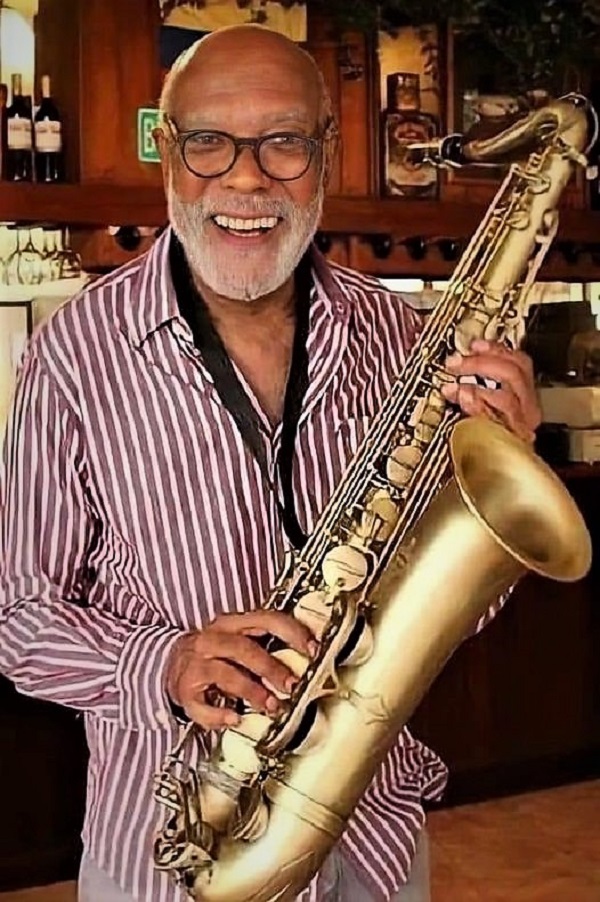
Victor Cuica “The Eternal Breath of Latin Jazz and Venezuelan Identity”

Victor Cuica “The Eternal Breath of Latin Jazz and Venezuelan Identity”

Training and First Steps: The Birth of a Style

The journey of this virtuoso—master of the tenor and soprano saxophone as well as the flute—began in 1963 at the Military Music School of La Victoria. His time in the Venezuelan Navy band served as the catalyst for his love of Jazz, leading him to deepen his knowledge of flute, harmony, and composition at the “José Ángel Lamas” Higher School of Music.

His professional career took off in Chucho Sanoja’s orchestra. Shortly thereafter, he joined Oscar D’León’s ensemble. It was actually Cuica who suggested the name “Dimensión Latina” to replace the group’s former name, “Oscar y sus Estrellas,” thereby christening what would become the most iconic salsa orchestra in Venezuelan history.

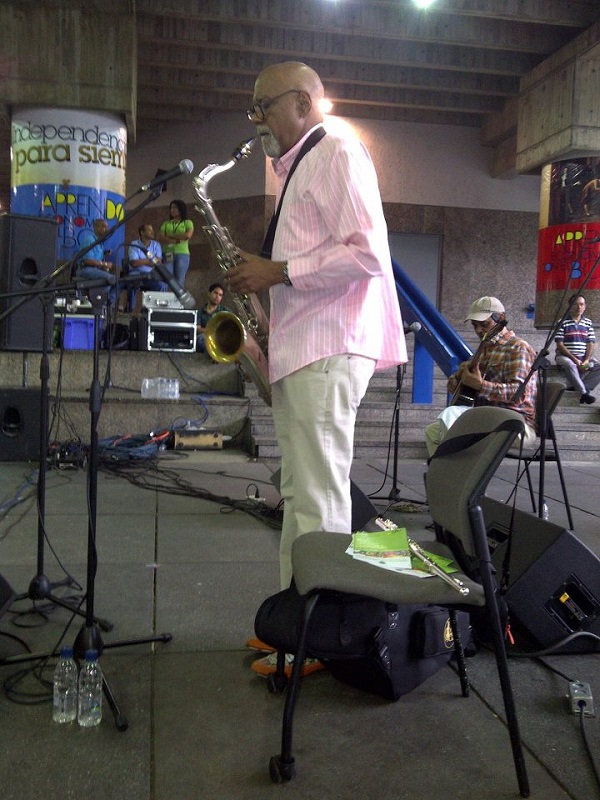
Victor Cuica in concert held on August 22, 2011 in Juan Pedro Lopez Square in Caracas

Victor Cuica in concert held on August 22, 2011 in Juan Pedro Lopez Square in Caracas

Latin Jazz: From the Silver Screen to International Stages

By the late 1970s, Cuica expanded his horizons into the “seventh art.” In 1978, he composed and performed the soundtrack for “The Sea of Lost Time” (El Mar del Tiempo Perdido), based on the short story by Gabriel García Márquez. A year later, he solidified his own group, “Víctor Cuica y su Jazz Latino,” debuting to resounding success at the Alcázar Theater in Caracas and gaining international momentum in Costa Rica.

Throughout the 1980s, critics hailed him as the most important innovator of jazz fusion in the region. His talent brought him to historic venues:

  • 1981: He triumphed at the “Memphis in May” festival in Tennessee.
  • 1982: He performed at the prestigious “Domicile” club in Munich, Germany.
  • 1985: He reached a milestone as the leader of the first Venezuelan group invited to the Montreal International Jazz Festival, where he shared the limelight with the legendary vibraphonist Lionel Hampton.

Artistic Maturity and Recognition

In the 1990s, his music reached new academic heights when Maestro Eduardo Marturet composed the work “Music for Six and Sax” specifically for him. It premiered with the Sinfonietta Caracas and represented Venezuela at the 1992 Universal Exposition in Seville.

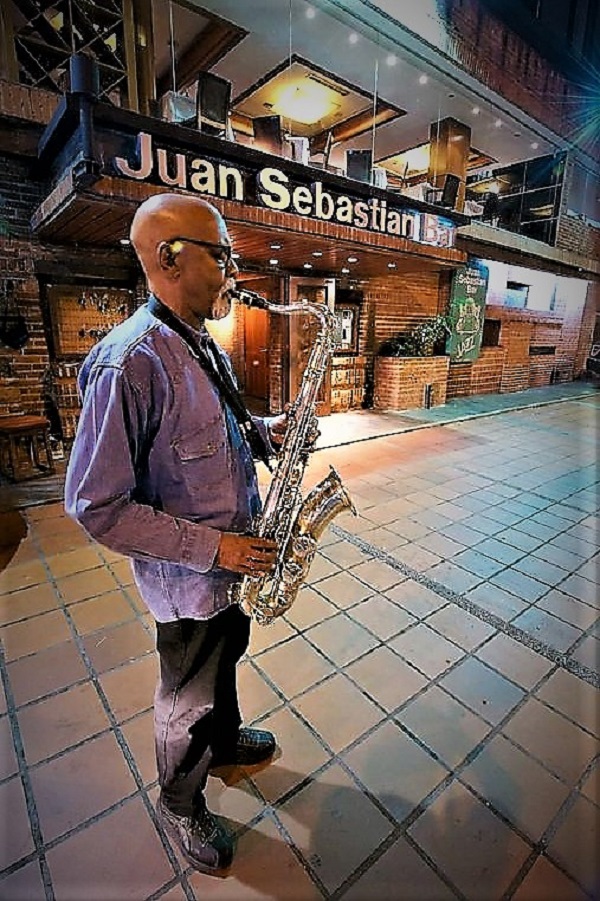
Víctor Cuica was not just a musician; he was a bridge between two worlds. Photograph at Juan Sebastian Bar

Víctor Cuica was not just a musician; he was a bridge between two worlds. Photograph at Juan Sebastian Bar

His discography, which includes gems such as Que sea para siempre (1984), Noctámbulo (1993), Just Friends (1998), and Los Locos de Caracas (1999), stands as a testament to his versatility. In 1995, the Venezuelan Artist’s Guild (Casa del Artista) honored him as Musician of the Year.

A Farewell with the Flavor of the Streets and Bohemia

Víctor Cuica passed away on Saturday, December 26, 2020, at the age of 71 due to a heart attack. His departure left a void in the film industry, where he starred in memorable films such as Santera (for which he also composed the award-winning soundtrack in 1997), and in the bohemian nights of Caracas, where his saxophone was often the soul of the evening.

A Tribute from His Peers

Multi-percussionist José Hidalgo, known as “El Tokun Mayor,” describes Cuica with words that summarize his essence:

“Víctor Cuica is the finest example of an artist intimately linked to his daily reality and cultural origins, without ever losing sight of the cosmopolitan and universal nature of his musical message. Cuica is the expression of genuine jazz performed with the simplicity of the streets.

Víctor is as authentic in his personal character as he is as an artist. This virtue was his companion as he traveled across numerous international stages, spanning the worlds of music, film, theater, and opera always with the transcendence of a bohemian, simple, and bold minstrel.

Cuica never ceases to surprise us, whether through his voice or the sound of his saxophone an instrument that, with his habitual ingenuity, he turned into a centerpiece of performance through his creativity and versatility.

His talent has graced stages across Europe and the Americas. His work projects far beyond the commercial mainstream and, today, leaves us with a brilliant musical improvisation that is truly beyond compare.”

DJ Augusto Felibertt with the one and only virtuoso Víctor Cuica

DJ Augusto Felibertt with the one and only virtuoso Víctor Cuica

Today, the name Víctor Cuica remains etched in history as the man who gave Jazz a Caribbean color and gave the Venezuelan saxophone a voice of its own.

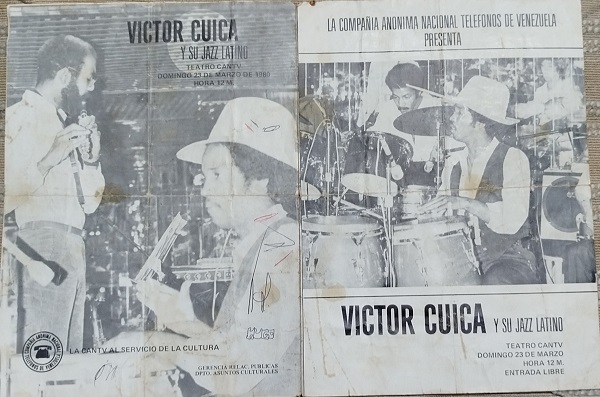
Victor Cuica and his Latin Jazz, March 23, 1980 at the Cantv Theater in Caracas

Victor Cuica and his Latin Jazz, March 23, 1980 at the Cantv Theater in Caracas

Also Read: Oscar Rojas Oscar Rojas has 54 years of musical career full of passion, rhythm and flavor

Cache Live Music puts Miami to dance to traditional Latin music

Roland Cache graced this edition with his presence to tell us about his beginnings, the subsequent creation of his band Cache Live Music, and his current career. The American of Cuban descent honors his roots with the music he and his collaborators play to delight their fans at any event they are hired, indicating the pride he feels in representing his parents’ country and how passionate he is about his craft.

Roland shared many interesting details about his musical life, and we are more than happy to share them with our readers in the following lines.

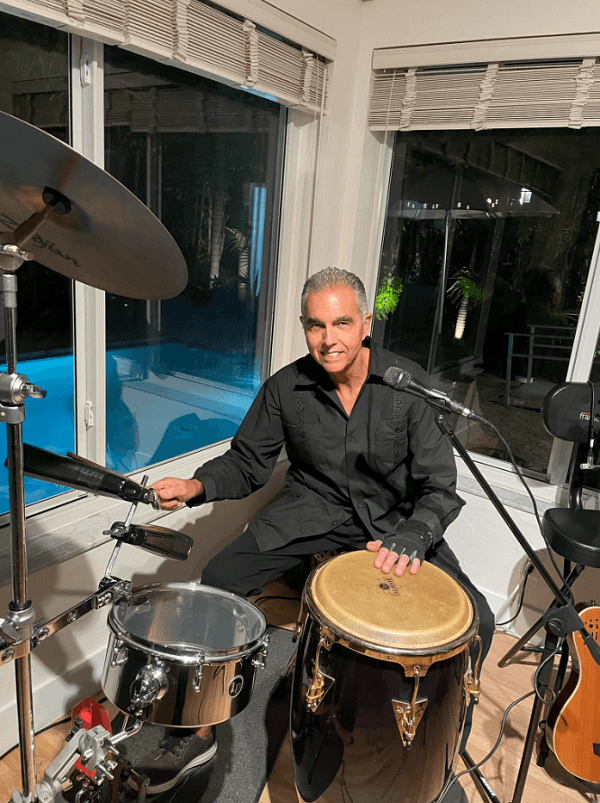
Roland Cache playing
Roland Cache playing drums live at an event

Roland’s musical beginnings as a teenager

As a child, Roland lived in Elizabeth, New Jersey, where some high school friends convinced him to play drums with them. Their favorite genre was the rock of the day, which was the 1960s. A few years later, specifically in 1973, another friend took him to a salsa concert at Madison Square Garden, and he liked what he heard so much that he became more involved in Latin music and left American music aside. 

Seeing great artists such as Tito Puente, Ray Barretto, and other artists of Puerto Rican descent, he learned to play timbales, tumbadora, and bongos, which allows him to play a combination of conga, timbales, and clave at the same time. 

Orchestras prior to Cache Live Music

Before creating his own band, Roland was part of other projects that were training him for what was to come in his career later. One of them was a band from New Jersey, whose members formed La Charanga Casino, which became very popular in that city.

Some time later, Roland could not play for a while, so he has been throwing himself into selling cars and other area businesses. Then, in 1998, he returned to music and created an American band that played rock and jazz with a touch of Latin music.

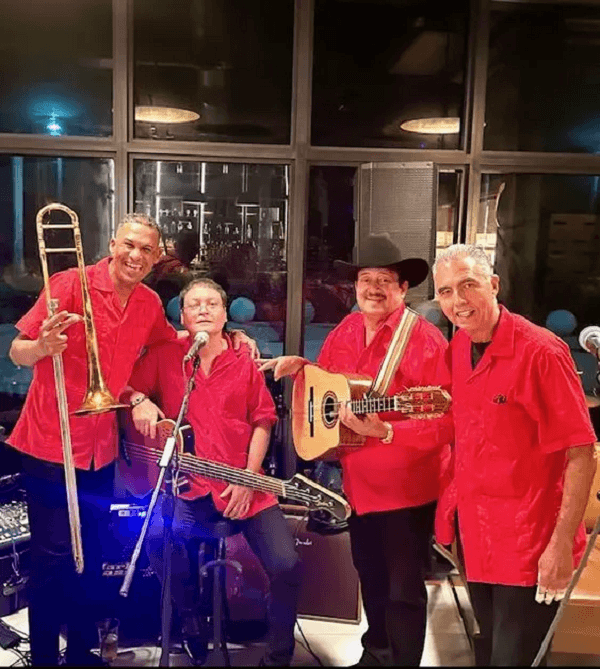
Roland Cache and the rest of the band
Roland Cache and the rest of Cache Live Music

Creation of Cache Live Music 

Eventually, he left the American band and founded a Latin band called Cache Live Music with a group of musicians, some of whom remain alongside Roland to this day. He met most of them through another musician friend who introduced them so he was knowing other artists who joined his project.

Cache Live Music was officially started in 1999, and according to its founder, the hardest thing about keeping a band like this together for so long was the search of opportunities in clubs and other kinds of places. However, Roland says that his experience as a salesman and negotiator has helped him a lot in winning contracts and the best conditions for him and his bandmates.

Current status of Cache Live Music

Today, the core of the band consists are three of its members: the guitarist, the bassist, and Roland, who is a multi-instrumentalist. More recently, Cache included a flutist, a trombonist, and sometimes a singer. This is how, depending on the requirements for a particular event, the group’s leader decides which members and instruments to include for every occasion in order to offer something different.

Cache at an Amazon event
Cache Live Music at an Amazon corporate event

Regarding the repertoire, they only perform covers, but they ensure that each and every song has their personal touch so that they resemble as little as possible to the original versions.

Anyone who wants to hire Cache Live Music can do so through its profile on The Bash by making a deposit and sending a contract to agree on the conditions of the event. However, it is important to note that they are already booked for December and January with corporate parties and weddings, for which we wish them every possible success because they already have the talent.

Tomas Pedro Regalado and Roland
Former Mayor of Miami Tomas Pedro Regalado and Roland Cache

Read also: The Williamsburg Salsa Orchestra: electrifying fusion and salsa flavored with indie rock

  • « Go to Previous Page
  • Page 1
  • Interim pages omitted …
  • Page 36
  • Page 37
  • Page 38
  • Page 39
  • Page 40
  • Interim pages omitted …
  • Page 156
  • Go to Next Page »

International Salsa Magazine (ISM) is a monthly publication about Salsa activities around the world, that has been publishing since 2007. It is a world network of volunteers coordinated by ISM Magazine. We are working to strengthen all the events by working together.