• Skip to primary navigation
  • Skip to main content

International Salsa Magazine

  • HOME
  • Previous editions
    • 2026
      • ISM / June 2026
      • ISM / May 2026
      • ISM / April 2026
      • ISM / March 2026
      • ISM / February 2026
      • ISM / January 2026
    • 2025
      • ISM / December 2025
      • ISM / November 2025
      • ISM / October 2025
      • ISM / September 2025
      • ISM / August 2025
      • ISM / July 2025
      • ISM / June 2025
      • ISM / May2025
      • ISM / April 2025
      • ISM / March 2025
      • ISM / February 2025
      • ISM / January 2025
    • 2024
      • ISM / December 2024
      • ISM / November 2024
      • ISM / October 2024
      • ISM / September 2024
      • ISM / August 2024
      • ISM / July 2024
      • ISM / June 2024
      • ISM / May 2024
      • ISM / April 2024
      • ISM / March 2024
      • ISM / February 2024
      • ISM / January 2024
    • 2023
      • ISM / December 2023
      • ISM / November 2023
      • ISM / October 2023
      • ISM – September 2023
      • ISM – August 2023
      • ISM July 2023
      • ISM Edition June 2023
      • ISM – May 2023
      • ISM April 2023
      • ISM March 2023
      • ISM February 2023
      • ISM January 2023
    • 2022
      • ISM December 2022
      • ISM November 2022
      • ISM October 2022
      • ISM September 2022
      • ISM August 2022
      • ISM July 2022
      • ISM June 2022
      • ISM May 2022
      • ISM February 2022
      • ISM January 2022
    • 2021
      • ISM December 2021
      • ISM November 2021
      • ISM October – 2021
      • ISM September 2021
      • ISM August 2021
      • ISM July 2021
      • ISM May 2021
      • ISM April 2021
      • ISM June 2021
      • ISM March 2021
      • ISM February 2021
      • ISM January 2021
    • 2020
      • ISM December 2020
      • ISM November 2020
      • ISM October 2020
      • ISM September 2020
      • ISM August 2020
      • ISM July 2020
      • ISM June 2020
      • ISM May 2020
      • ISM April 2020
      • ISM March 2020
      • ISM February 2020
      • ISM January 2020
    • 2019
      • ISM December 2019
      • ISM November 2019
      • ISM October 2019
      • ISM Septembre 2019
      • ISM August 2019
      • ISM July 2019
      • ISM June 2019
    • 2016
      • ISM December 2016
      • ISM November 2016
      • ISM October 2016
  • Spanish
  • Download Salsa App
    • Android
    • Apple

Search Results for: Spanish in the United States

Son Cubano is one of the most popular musical styles in Cuba and Kiki Valera is one of its leading exponents

Over the last century, this style of traditional Cuban music has contributed to many other musical genres, including jazz, cha cha cha, mambo, salsa, songo and timba.

Cuban Son is one of the most popular musical styles in Cuba and Kiki Valera is one of its greatest exponents.

Cuban son is the music that made the Buena Vista Social Club worldwide stars in the late 1990s, but Kiki Valera comes from a family of musicians whose involvement with Cuban son predates BVSC by decades.

Kiki Valera is the eldest son of the famous septet La Familia Valera Miranda, a multi-generational traditional music group from Santiago de Cuba.

Since the 19th century, La Familia Valera Miranda has played an important role in Cuban culture by collecting and preserving the deep-rooted traditions of the legendary Sierra Maestra mountain region.

Their debut album, “Antología Integral Del Son”, released in 1982, helped initiate the explosion of interest in traditional Cuban music.

Kiki, like most of her family, is a virtuoso. A multi-instrumentalist, composer, arranger, sound engineer and producer, he is best known as one of the world’s best players of the Cuban cuatro, a medium-sized guitar with 8 strings grouped in sets of 2.

Kiki Valera is the eldest son of the famous septet La Familia Valera Miranda, a multigenerational group of traditional music from Santiago de Cuba.

Kiki learned the Cuban tres under the guidance of his father Felix as a child.

He later attended one of Cuba’s most prestigious music schools, the Esteban Salas Conservatory, in Santiago de Cuba and by the age of 15 was touring internationally.

Kiki continues to conduct, compose, arrange and perform internationally. She also performs and teaches in Seattle, Washington, where she contributes to the vibrant Pacific Northwest music scene.

His current project features several other internationally renowned artists, including Coco Freeman (former singer for Adalberto Alvarez y su Son and NG La Banda), vocalist Carlos Cascante (three-time Grammy Award winning vocalist for the Spanish Harlem Orchestra), trumpeter Alexis Baró (Cubanismo and Omara Portuondo) and bongocero Pedro Vargas (Barbarito Torres’ band). (Kiki Valera)

“Vacilón Santiaguero” is Kiki Valera’s second solo release in the United States after many distinguished years as the director of La Familia Valera Miranda in Santiago de Cuba.

He goes beyond his core group to present collaborations with some Grammy® award winning musicians and features his favorite trumpet players, some born in Cuba, some born in the U.S., but all with reputations jus????ficadas for playing Cuban music for love, if not DNA.

Son Cubano is one of the most popular musical styles in the world.

“Vacilón” is one of those words that doesn’t have a perfect English equivalent to Cuban Spanish, but something that’s a really good time (a little rum or aguardiente always helps).

So what sets this project apart from the vast mountain of excellent traditional albums already out there? Not only is there Kiki’s custom-made Cuban cuatro, which brings a unique texture to the sound, rather than a tres, but, in his jazz-influenced hands, you’ll occasionally hear twists and turns in his improvisations that you probably weren’t expecting when you first glanced at the song titles, which are mostly Cuban evergreens.

Thanks to Kiki’s creative arrangements, this is no mere recycling of covers of these classic songs.

Kiki is as exacting with the recording, mixing and mastering work as he is with the arrangements.

Much of the recording and mixing was done in Kiki’s custom home studio, and Grammy® winner Michael Lazarus mastered the project.

The result will be an audiophile’s delight, a reason, I might add, to want the physical product for your collection (Kiki Valera).

Kiki Valera – Vacilón Santiaguero (2024).

Tracks:

  1. Este Vacilón (Felix Valera Miranda)
  2. El Ají de Cocina (Felix Valera Miranda)
  3. Sobre una Tumba una Rumba (Ignacio Piñeiro)
  4. El Penquito e’ Coleto (Francisco Repilado “Compay Segundo”)
  5. Funfuñando (Arsenio Rodriguez)
  6. La Guajira (Olga de Blanck)
  7. Mari-Juana (Juana María Casas)
  8. Muñequita Feliz (DR)
  9. El Empanadillero (Teodoro Benemelis)
  10. Pájaro Lindo (Felipe Neri Cabrera)
  11. Dos Gardenias (Isolina Carrillo)
  12. El Cuarto de Tula (Sergio Gonzales Siaba)

Musicians:

Kiki Valera (Cuban cuatro, guitar, bass, harpsichord, maracas and backing vocals).

Pedro Vargas (congas, bongos and backing vocals)

Steve Guasch (Backing vocals)

Carlos Cascante (Lead vocals on tracks #1,#4,#5,#7,#9,#10,#12)

Francisco “Coco” Freeman (Lead vocals on tracks #2,#11)

Joshuah de Jesus (Lead vocal on tracks #3,#8)

Raquel Zozaya (Lead vocals on track #6).

Special guests:

Alexis Baró (Trumpet on tracks #1, #3, #4, #6, #9, #11).

Steve Mostovoy (Trumpet on tracks #1, #3, #3, #6, #11)

Michael Rodríguez & Jonathan Powell (Trumpet on track #8)

Pete Nater & Dennis Hernández (Trumpet on tracks #2, #5, #7, #12)

Brian Lynch & Thomas Marriott (Trumpet on tracks #1#0)

Leon Q Allen (Trumpet on track #4)

https://www.kikivalera.com/

Also Read: Yilian Cañizares, an excellent Cuban musician, studied in her hometown in the strictest tradition of the Russian school of violin

Jimmy Bosch. The Creole Trombone of New York.

Norteamerica / USA / Nueva York

Jimmy Bosch was born on October 18, 1959 to a Puerto Rican family in the city of Hoboken in the state of New Jersey.

At the elementary school of his hometown, at the age of eleven Jimmy Bosch was offered a trombone which would give the starting point in his career. According to him, that metallic, valveless, long instrument (which was taller than him) was not necessarily what a child dreamed of; Perhaps, at that time, children dreamed of traveling to the moon, or with an electric guitar that would make them look like The Beatles or, failing that, the Rolling Stones. It didn’t take long for that 11-year-old boy to transform this instrument into an expression of his already visible creativity.

Jimmy Bosch
Jimmy Bosch

At the age of 13, the talented Jimmy was rehearsing with local bands and making his first foray onto the public stage a year or two later. His determination, the Latin blood that ran through his veins and the taste for the genre that had captivated him on so many occasions, led him to play with the most recognized band in the city: Manny Oquendo & Conjunto Libre. His dexterity and ingenuity in playing “moñas” (a section of trombone solos that enrich the melody) helped him to work with them since 1978, which is why it was alongside the Mythical Free Ensemble that Jimmy experienced the freedom to express himself musically with the trombone

On March 11, 1996, Jimmy Bosch debuted with his band at the internationally known S.O.B.’s nightclub. The result was immediate: Publications in the most prestigious newspapers in the Big Apple such as the “New York Times”, praising his excellence and a house full of loyal fans began to crown the dream of this tropical music worker. In this way he becomes a remarkably respected musician and an icon of Latin culture in New York.

His compositions reflect the creativity and depth of who Jimmy Bosch is. He takes his audience on a journey from Bronx-style “funk” to “hot” guajiras, melodious cha-cha-chás, and clearly poetic lyrics awash with feeling. Thus, Jimmy pays tribute to the other teachers who share their presentations generating remembrance and posterity in each one of them.

Jimmy Bosch playing trumpet

In 1998, under the Ryko Latino label, his first solo album, “Soneando trombone”, was released. Jimmy included a “Big Band” with renowned Latin virtuoso artists, such as trumpeter Alfredo “Chocolate” Armenteros, bassist Andy González, and singers like Jimmy Sabater and Pete “El Conde” Rodríguez. They played a mix of Latin styles, including “hard sauce,” of which Bosch is one of its greatest exponents. Bosch not only played a virtuoso trombone, but was also the musical director on that recording.

With his recording debut as a solo artist, Bosch scored a definite success on the international scene. In Europe critics welcomed his musical creations. And in the United States, newspapers such as the Los Angeles Times and The New York Times were full of praise for their brilliant performances.

Jimmy Bosch in concert

At the beginning of 1999, the popular musician returns to the charts with a new production: “Salsa dura“. In this production, including musicians like Steve Turre and Chucho Valdés, it was as diverse, strong, and tough as his first production. The recording also included songs like I’m Still Changing. For the release of “Salsa dura” the Creole trombonist traveled to Europe and performed on countless stages of the Old Continent.

Persevering in his creativity, in 2004 Bosch received new applause in Puerto Rico, presenting his musical proposal at jazz festivals. His bows have accompanied such important figures in the salsa industry around the planet as the aforementioned Free Ensemble of Manny Oquendo and Andy González, Eddie Palmieri, Ray Barretto, Rubén Blades, India, the Lebron Brothers, La Combinación Perfecta, Cachao, Spanish Harlem Orchestra and Celia Cruz among others. He was the musical director of the outstanding Puerto Rican performer Marc Anthony.

The late creator of the Mambo, Israel “Cachao” López, composed for him the song “Lluvia, viento y caña”. The legendary trombone solo can be heard on the Grammy-winning recording, “Master Sessions Vol. 1” produced by Emilio Estefan and Andy García.

This talented musician stamps his signature with his particular way of playing the trombone, becoming his personal stamp in the music industry. Today, Jimmy Bosch is famous for his explosive solos, full of melody, vibration and funk.

Jimmy Bosch live
Jimmy Bosch live

Known by many as “El Trombón Criollo” for the strength of his improvisations, Jimmy radiates his energy to any musical challenge. Jimmy brings us El airplane de la salsa, his latest production, surrounded by high-voltage musicians and soneros.

Grupo Batachá, Houston’s Premier Latin band

Latin talent has been spreading across the United States over the years and every day more salsa bands and orchestras are becoming better known in states where we never would have imagined before. Such is the case of Grupo Batachá, known as ”Houston’s Premier Latin Band”, which is established in the state of Texas and whose director, Oscar Larrañaga, was kind enough to give us some minutes of his time to answer some questions regarding his career and the group lead by him.   

Oscar, Founder of Batachá
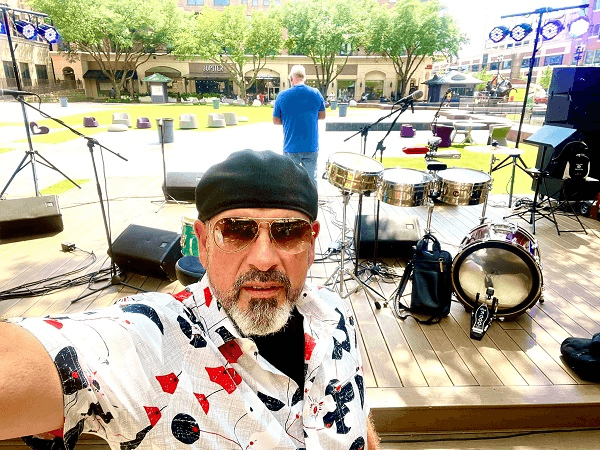
Oscar Larrañaga, founder of Grupo Batachá, playing the güiro in a concert

Oscar’s beginnings in the music world 

Oscar has told us that as a child he always knew he was meant to devote himself to music. Even since he was in preschool, he showed signs of how would be his future in music by showing interest in certain instruments and styles.   

The musical figure who has inspired him most in his family was his great-grandfather, who was part of a philharmonic. Oscar heard many stories about the musician, the way he played and how good he was at what he did, which led his great-grandson to want to be like him someday.    

It should be noted that, at all stages of his formation, he never obtained any academic training related to music. Everything he knows about the job he has learned on his own through constant practice and attention to everything he wanted to emulate.    

However, it was in 1990 that his career officially began many years later in the United States. It was there when he finally decided to create a project with a few musicians he began to perform at Latino family events such as weddings, quinceañeras, birthdays, among other events. This gave him the necessary experience to know how an orchestra works on stage and, of course, fitted for what was to come next in his career.   

Oscar in a performance with Batachá
Oscar Larrañaga showing the stage where Grupo Batachá would perform that day

How Grupo Batachá began   

Oscar revealed to us that Grupo Batachá was founded in 1997 in Houston, Texas, and made up of the artist and four other members who joined him at that time. They all decided together that Oscar was the best choice to lead the band and chose him as their director, a position he still holds today. Many members have come and gone, but he has always managed to ”keep the ship afloat” at all times despite the changes.   

He explained to us that the name ”batachá” is a term that comes from Cuba and its literal meaning is ”fun times”. In addition, when he was in his early twenties, Oscar met the members of a group with the same name in Guatemala and liked it very much from the first time he heard it. For him, ”batachà” is synonymous with fun and having a good time, things he sees represented in his work with the band. That is why his album is called ”Batachando” and would be something like ”disfrutando” in Spanish.   

Languages played by Grupo Batachá   

While it is true that Grupo Batachá makes music in several languages such as Spanish, English and Portuguese, Oscar wanted to make it very clear that everything he and his bandmates do is aimed at salsa influenced by the typical Cuban flavor that comes from drums and Yoruba culture, elements that are primarily handled in Spanish. This is why the main language of the group is and will continue to be Spanish.   

In terms of clave, it is much easier for the group to get into the correct rhythm in Spanish for what we have explained above. For the same reason, English, Portuguese and any other language are not a priority for Batachá at this time.    

Batachá is influenced by the Cuban Flavor
Grupo Batachá’s music is influenced by the typical Cuban flavor that comes from drums and Yoruba culture

How Grupo Batachá manages its performances 

During the band’s 15-year trajectory, Grupo Batachá has performed at more than a hundred weddings, quinceañeras, birthday parties, anniversaries, corporate events, among others. In each and every one of these performances, Oscar and his bandmates have always stood out for their professionalism and great musical quality, so they have no problem to obtain contracts and clients of this kind very often.   

As for the method the band uses to select their clients, there is not much to explain. Oscar simply gives priority to the client who agrees on a date first and then tries to reach an agreement with the one who makes his request later, although he emphasized that this does not happen very often.   

About this, he said he feels very lucky to bring joy to different types of public with what he likes more than anything in the world, which is music. It makes him really happy to be able to live from what he loves and, by extension, to transmit that same happiness to those who have the opportunity to attend one of his shows. 

Read also: Don Perignon and La Puertorriqueña are prides of Puerto Rico 

Venezuelan businesswoman Joanna Torres is an example to follow

There are many Venezuelans who, due to the economic and political crisis that has affected their country in recent years, have had to set off for new horizons and leave their homeland to look for a better future for themselves and their family. Such is the case of the businesswoman and founder of Arepas Latin Cuisine Joanna Torres, with whom we had the pleasure of conversing with recently. 

This talented young woman has a fascinating history of success and is a true inspiration to any Latino wanting to open paths in the United States or anywhere else in the world. That is why, from International Salsa Magazine, we decided to contact her and share her journey in the land of opportunities.  

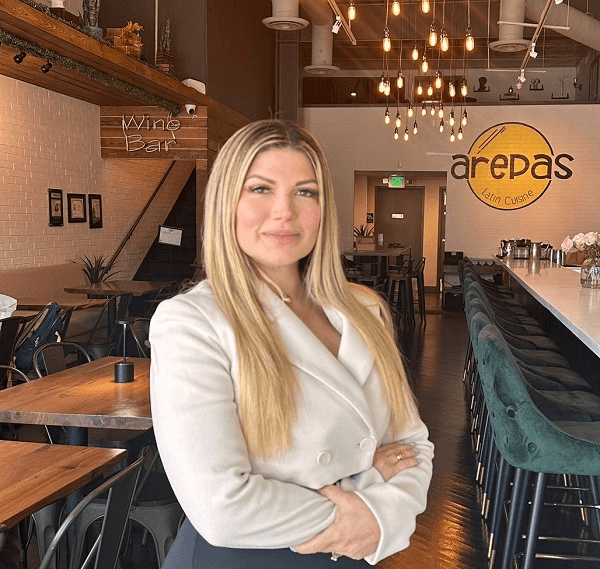
Businesswoman Joanna Torres
Venezuelan businesswoman and founder of Arepas Latin Cuisine Joanna Torres

Arrival in San Jose   

The first American city where Joanna arrived was Miami and her goal was to do a master’s degree, since she had studied her undergraduate career in Venezuela. Once there, she realized that she had a lot of trouble learning to speak English and there were few opportunities to practice it, since all with whom she interacted with spoke Spanish. 

It was then when a friend suggested the idea of moving with her to the city of San Jose, where it would make it easier for her to learn the language and spend time with people who spoke it all the time.  

How Joanna began to conceive the idea of becoming a businesswoman 

Two years after Joanna arrived in San Jose, she began working in a clinic and, together with her experience in administration and accounting, she learned everything she could about medical coding and the way medical procedures were coded. This gave her enough experience to dare to open his own medical consulting firm which has more than 22 years of operation and a total of 150 employees in Venezuela. 

The entire staff of the consulting firm residing in the South American country speaks English and takes care of serving all customers in the United States. Joanna even took it upon herself to provide her workers with their own fiber optic internet by contacting some telecommunications engineers, since this service in Venezuela is extremely poor. 

Since the medical consulting firm gave her the necessary experience as a businesswoman, she decided to expand into another area she was very passionate about: cooking. Joanna had been wanting to start a food truck in parallel to her current company for some time and saw the opportunity to do so through a friend and former college classmate who owned restaurants and food businesses. She proposed to Joanna to buy one of her restaurants and partner with her, which she finally accepted and that is how the first Arepa Latin Cuisine restaurant was born.   

Joanna and her team
Joanna Torres and part of her team in San Jose

Reducing failure possibilities for Arepas Latin Cuisine 

Joanna was aware that the possibilities of failure of her idea were high, but she told us that her extensive knowledge of finance was fundamental to overcome all obstacles. 

She was always clear that she had to look for ways to generate more income within the same company. That is why she and her staff have been responsible for providing lunch to employees from technology companies, making food for events such as birthdays or weddings, organizing pop-ups (temporary restaurants created to promote new menus and specific events) in order to innovate and always earn a stable income in the corporation. 

The businesswoman points out that she always tries to innovate, and with regard to this, she said ”I have invented some taco-arepas with which I use arepa flour to make the tacos and give them a different touch, so it would be a combination of both dishes. I always try to innovate and do different things to surprise people and keep them from getting bored”. 

”At the San Francisco headquarters, we have chosen the strong liquor license to start offering Venezuelan typical drinks and rum such as Diplomático or Ron Santa Teresa. We are also doing some remodeling in the place to make it much more pleasing to the eye” she continued. 

In addition, both the San Jose and San Francisco headquarters offer live music for diners to enjoy good Latin music while tasting their food. There is also a dance floor for those who wish to move to the rhythm of the orchestra of that day.   

Joana’s grandmother as an inspiration to create Arepas Latin Cuisine 

After taking the required steps, the first Arepas Latin Cuisine restaurant headquarters were opened in October 2021, but it was not easy. This was an effort made over many years in which Joanna did her best to be able to reach that point. 

The beginning of everything was her grandmother, with whom the Venezuelan learned everything she knows about cooking. She was a cook, a cooking teacher and taught cookery courses and workshops to support her 12 children because she was widowed at a very young age. Joanna tells us that, at that time, she and her children made ground corn arepas to sell to markets and restaurants. 

All this made her an inspiration to Joanna and led her to learn to cook since she was just nine. As a child, she knew that cooking would be important in her life. 

Lots of secrets that Joanna learned from her, such as the way in which the dough has to be kneaded, the difference between making homemade arepas and arepas to sell, the amounts of ingredients to be used, the way to prepare the fillings for the dishes, among other things.   

Joanna and her grandmother
Joanna Torres posing next to her grandmother, who sadly passed away on April 1, 2023

Reception to Venezuelan food in San Jose 

Joanna ensures that her recipes have been a boom in California, since there was no authentic Venezuelan food in San Jose, so her project was a pioneer in this area.   

The reception her food has got with Americans, Chinese, Indians, Vietnamese and many other nationalities has been truly amazing because dishes from Arepas Latin Cuisine, besides being extremely delicious, were something that has never been seen before.   

The taste for food at Arepas reached such a point that the restaurant provides lunch to more than 300 employees in several technology companies such as Netflix, Snapchat and Tinder. It is worth noting that workers who are benefited greatly appreciate being able to enjoy a rich and varied menu every day.   

The biggest challenges Joanna faces as a businesswoman  

One of the biggest challenges Joanna has faced is to find employees who know the Venezuelan and Colombian cuisine (there are also several Colombian dishes on the menu) as it should be. ”Finding cooks with great experience has been complicated, but with the arrival of Venezuelan and Colombian migrants in California, we have been able to find staff with knowledge in the culinary arena” said the businesswoman on this topic. 

For her, it is vitally important to employ people who are very clear about how to cook the main Colombian and Venezuelan dishes, so she takes this into account when recruiting her talents.   

In addition to that, Joanna also sells Venezuelan products and has a hard time finding them in San Jose, so she has to bring them directly from Florida in order to sell them in California.  

Joanna’s restaurant inside
That is what Arepas Latin Cuisine looks like on the inside

Advice for Latino migrants 

When Joanna was asked to give advice to future Latino migrants who wish to move to the United States, the first thing that she pointed out was that they must work very hard in that country to get ahead. In her particular case, she claims to have had three jobs at the same time, since she was alone in the United States and lived only from what she earned. 

She also added that ”you have to make sacrifices to succeed in life and always do things well according to the laws of the country that welcomes you. I think that there are many Venezuelans who confuse ‘native cunning’ (taking advantage or others and the economic, political and judicial system failures to do whatever you want without consequences) with intelligence, which makes them believe that they are above others and make serious mistakes. You have to do things well and eventually the much-desired success will come,” said Joanna on such an important issue. 

Read also: Young Puerto Rican singer Jeremy Bosch supports the Spanish Harlem Salsa Museum 

Here we have Brazilian bandleader and composer Paula Maya

Today we have an exclusive that makes us very happy, since it is a talented artist from a country we had never talked about in this section: Brazil. We are talking about none other than the award-winning bandleader, composer, pianist, keyboardist and singer Paula Maya, with whom we had the privilege to talk by Zoom. 

Paula has a very interesting background, since she was born in the South Zone of Rio de Janeiro, the birthplace of the world famous bossa nova genre and the popular composer, pianist and singer Carlos Antonio ”Tom” Jobim. It is clar that this had much to do with artistic inclinations that the woman would show later in her life.   

Under her belt, she has several nominations and awards she received thanks to her talent and effort of so many years as her nomination to the Focus Web News Brazilian International Press Awards in the category of Best Brazilian Musician living in the US, her nomination to the Austin Chronicle Music Awards in the category of Top Ten World Music Bands, Winner of the Seattle Weekly Awards in the category of Best Brazilian Composer, her nomination to the Seattle Hot Rocks TV Show Music Awards in the category of Best Female Singer, among others. 

Here are the most important topics we touched with lovely Paula about her life and career.  

Singer Paula Maya
Brazilian bandleader, composer, pianist, keyboardist and singer Paula Maya

Paula’s early interest in music 

Paula first developed an interest in music when she was only four years old or even younger, as she had musical toys such as pianos or keyboards she used to play with all the time. To this it is added that her mother always listened to classical music, which she already found beautiful back then.   

What is interest about his direct family is the fact that there were no musicians in it. In fact, her father was a lawyer and her mother was a dancer and yoga instructor, but a cousin of hers was a bandleader, composer and music teacher who traveled to the United States and developed quite a big reputation at the time, so he became an example for Paula, who would end up following in his footsteps in the future. 

When she turned 10 years old, she began taking piano lessons, which was her first formal experience with music. Since then, she has continued to learn about a lot of instruments and areas related to this art, which she assures that it is so rich and diverse that you never stop learning new things.  

Paula’s mentors in music 

Paula has been very fortunate to be mentored by some of the most talented musical celebrities in Brazil and one of them was producer and percussionist Teo Lima, with whom she has continued to work on her latest album to the present. Paula met this Brazilian legend in Seattle, where she lived for 17 years, and music led them to form a great friendship that has lasted until today. 

They had wanted to make an album together for many years and it has finally happened, which was a dream for Paula, as she grew up listening to his greatest hits and dreamed about one day meeting him. Not only did she meet him, but also she became his friend and worked with him.   

Another name we can leave out is guitarist Baden Powell, whom Paula met in her early twenties and describes him as someone who supported her a great deal in her career and even came to her shows to watch her sing. 

Another artist who was important in her training was Luizihno Eça, who was one of the greatest exponents of bossa nova at the time and a great reference for all musicians who wanted to follow in his footsteps.  

Paula at ONE-2-ONE BAR
Paula Maya performing at ONE-2-ONE BAR in Austin, Texas

Music theory and the Brazilian Conservatory of Music 

Paula comments that, before entering the Brazilian Conservatory of Music, she had an excellent teacher who was a concert pianist of name Luis Magalhães, who taught her the best piano techniques that she uses today in her performances, meaning that she was admitted to the hous of studies with a solid foundation of knowledge that helped her a lot.  

In addition to that, music theory has been very useful for Paula at the time of teaching her classes, since she is a music teacher and thinks that all this knowledge is fundamental for an artist’s education, since music is very logical and occasionally you must look for quick answers to certain situations that certainly require studying and academic training. 

She also told us that she usually uses music theory when composing because of the theoretical part, but not always.   

Paula as a bandleader, pianist, keyboardist and singer   

When we asked Paula how she has developed and performed in all these areas of music, she laughs and says that this is just the beginning, as she is also in charge of producing, composing, recording her albums, running the business part, making booking arrangements, among other things. ”That’s the life of a musician nowadays, especially when you don’t have a machinery behind you to back you up” Paula said on this topic.   

This means that, apart from all the musical knowledge Paula has, she also takes care of all the details regarding her work, but they do not have to do with her profession directly. She does not have a large team of assistants to back her up, so she manages everything related to her career herself. 

Since there are so many things she should do, she has a calendar in which she arranges the day and time to do every activity and always follows it to the letter. The artist says that the hardest thing about this is finding the time to be inspired and compose, since so many occupations, sometimes, do not let her clear her mind. However, she has learned to take full advantage of those few spaces.  

Paula playing the keyboard
Paula Maya playing the keyboard at Barton Creek Farmers Market in Austin, Texas

Paula’s role as a Grammy Award voting member 

For some time, Paula was a Grammy Awards voting member in its version in English and Spanish, so we could not very well not ask her about this important issue. 

She told us that, although it is true that she is no longer part of the committee responsible for voting, social networks and these new forms of communication have made things much easier, since judges and committee members have groups on Facebook, WhatsApp and other platforms where they can conduct the necessary discussions. 

In her particular case, what she considered when the time comes to vote for a nominee was talent and how much she liked a type of performance, but all member had their own particular approach to choosing a specific artist. 

Something that Paula definitely did not like was that the majority of votes to an artist did not necessarily reward talent, but rather the popularity of the moment and promotion. She thinks this is not entirely fair, since talent, music skills and preparation do not always go hand in hand with popularity, but she is also aware that the ”game” is as well and she had to adapt to it. 

Paula Maya & Bosa Nova Plus 

Paula says laughing that everybody in Seattle expected her to play bossa nova because she was Brazilian, but she refused to do so. Eventually, she ended up doing exactly what the public expected and started playing bossa nova when she moved to Austin, Texas.  

The fact that this Texan city has so many residents and musicians from Brazilian descent living in Austin has been an advantage for this genre to continue to become more popular and this niche to develop more and more. This led her to meet the musicians who have accompanied her in the band, who also came from playing bossa nova and other genres during their respective careers. 

Read also: The Conga Room closes its doors, but says goodbye in style 


  • « Go to Previous Page
  • Page 1
  • Interim pages omitted …
  • Page 8
  • Page 9
  • Page 10
  • Page 11
  • Page 12
  • Interim pages omitted …
  • Page 23
  • Go to Next Page »

International Salsa Magazine (ISM) is a monthly publication covering salsa activities around the world and has been publishing since 2007. It is a worldwide network of volunteers coordinated by ISM Magazine. Together, we work to strengthen salsa events around the world.