• Skip to primary navigation
  • Skip to main content

International Salsa Magazine

  • HOME
  • Previous editions
    • 2026
      • ISM / April 2026
      • ISM / March 2026
      • ISM / February 2026
      • ISM / January 2026
    • 2025
      • ISM / December 2025
      • ISM / November 2025
      • ISM / October 2025
      • ISM / September 2025
      • ISM / August 2025
      • ISM / July 2025
      • ISM / June 2025
      • ISM / May2025
      • ISM / April 2025
      • ISM / March 2025
      • ISM / February 2025
      • ISM / January 2025
    • 2024
      • ISM / December 2024
      • ISM / November 2024
      • ISM / October 2024
      • ISM / September 2024
      • ISM / August 2024
      • ISM / July 2024
      • ISM / June 2024
      • ISM / May 2024
      • ISM / April 2024
      • ISM / March 2024
      • ISM / February 2024
      • ISM / January 2024
    • 2023
      • ISM / December 2023
      • ISM / November 2023
      • ISM / October 2023
      • ISM – September 2023
      • ISM – August 2023
      • ISM July 2023
      • ISM Edition June 2023
      • ISM – May 2023
      • ISM April 2023
      • ISM March 2023
      • ISM February 2023
      • ISM January 2023
    • 2022
      • ISM December 2022
      • ISM November 2022
      • ISM October 2022
      • ISM September 2022
      • ISM August 2022
      • ISM July 2022
      • ISM June 2022
      • ISM May 2022
      • ISM February 2022
      • ISM January 2022
    • 2021
      • ISM December 2021
      • ISM November 2021
      • ISM October – 2021
      • ISM September 2021
      • ISM August 2021
      • ISM July 2021
      • ISM May 2021
      • ISM April 2021
      • ISM June 2021
      • ISM March 2021
      • ISM February 2021
      • ISM January 2021
    • 2020
      • ISM December 2020
      • ISM November 2020
      • ISM October 2020
      • ISM September 2020
      • ISM August 2020
      • ISM July 2020
      • ISM June 2020
      • ISM May 2020
      • ISM April 2020
      • ISM March 2020
      • ISM February 2020
      • ISM January 2020
    • 2019
      • ISM December 2019
      • ISM November 2019
      • ISM October 2019
      • ISM Septembre 2019
      • ISM August 2019
      • ISM July 2019
      • ISM June 2019
    • 2016
      • ISM December 2016
  • Spanish
  • Download Salsa App
    • Android
    • Apple

Search Results for: Tempo Latino

Opening of the 28th edition of…

Tempo Latino Social Club presents:

Ana Tijoux,

ANA Tijoux, emblematic figure of Latin rap, joins us at the opening of the festival! A strong and committed French-Chilean artist born in her native Lille to Chilean parents exiled by the dictatorship, ANA has bult her musical style on the fundamental rhythms of Rap and the Chilean folkloric colors of her origin.

Her background, influences and temperament give her an indomitable stage strength to tackle political issues wildly. From Europe to Latin America, singing in Spanish with humor and rebellion has led her to consolidate her presence in the international scene of the Latin Rap wave and win Grammys.

After opening for Iggy Pop, the iconic Stooges figure said that “she knows what she’s doing!”

The Tempo Latino Social Club welcomes her into their circle of shared values with proudly and respectfully.

Tempo Latino

The Conga sets the TEMPO!

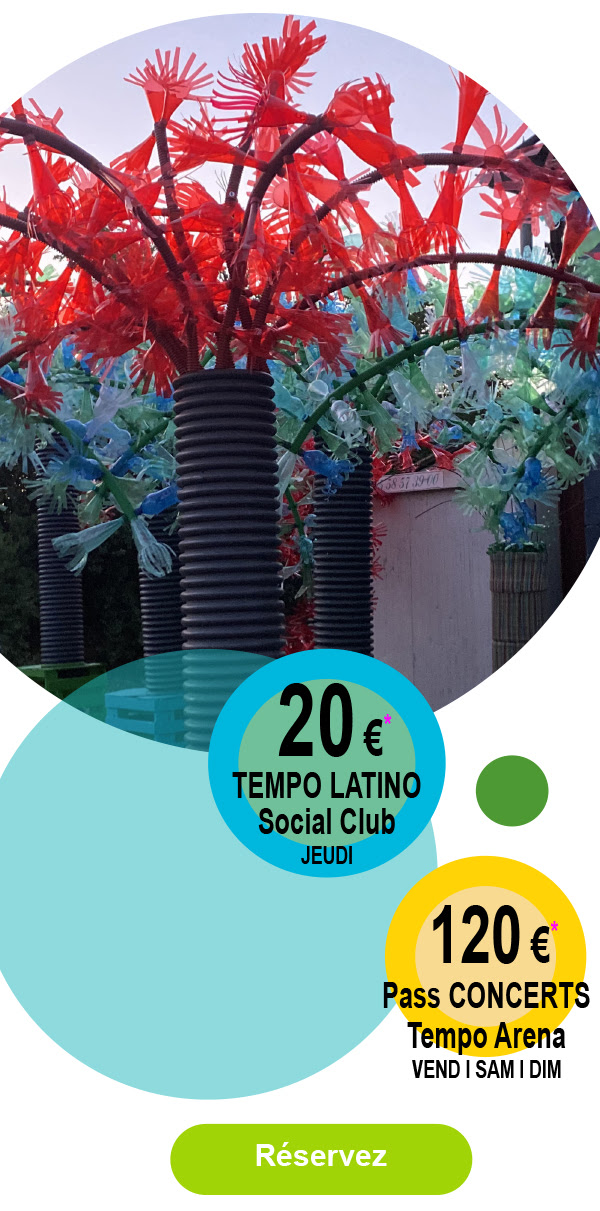
Between psychedelic palm trees, tropical white sand and the first day’s frenzy, we’ll meet at 19h on the Conga stage to embark on the 28th edition.

Imagined in 2022… the Tempo Latino Social Club*, born from our associative, voluntary and committed structure, brings us together to share our values of cultural and musical mestizaje…

*This evening does not cover the pass for the Tempo Arena concert.
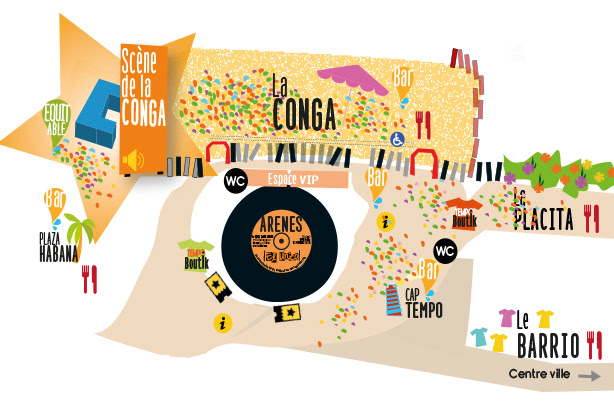
Tempo Latino

Immediate boarding for the Tempo Latino 2023 ¡El Único!
Tempo Latino

Partenaires Tempo Latino

THANKS
Public… Artists… Technicians… Partners… Professionals…
Tempo VOLUNTEERS

Steffen Kuehn and Christian Tumalan talk about their musical roots and orchestra

Preamble

This time, we are going to talk with German producer, arranger, composer and trumpet player Steffen Kuehn and Mexican bandleader, composer and musician Christian Tumalan. Both are at the head of the Pacific Mambo Orchestra and share the role of co-executive director of Pacific Mambo LLC and Pacific Mambo Records. Also, each has his own record label and separate musical achievements, but unify their skills to make the group they have in common one of the best in the United States.

Both expressed their points view about the orchestra, the work they do in it and what each one has done in music in general. These views reveal that quality, professionalism and adaptability are the main values on which the orchestra they lead is based.

Steffen Kuehn at the Tempo Latino Festival in France

A bit of Steffen’s story

The start of the conversation focused on the beginnings of Steffen Kuehn, who ackowledges having been a musician all his life, since he started playing the trumpet when he was just eight years old. He attended the University of North Texas to start his formal music education and learned to arrange music, compose and specialize more in the trumpet. He now focuses on is teaching trumpet, playing for the orchestra, arranging, selling music for television and movies, among other activities (all  have to do with music).

When we talk about his written publications, he mentioned a instruction book to help beginners to play the trumpet some years ago. Today, He is working on a second book and a new record production. What he has planned for Pacific Mambo is to make about 10 songs for its new album, of which two have already been made.

Christian’s musical background

Christian told us a bit about his musical training and confirmed that he studied piano for more than 10 years. He has also played piano since the age of 14 when he was in high school and started much more formal musical training at the age of 15. It can be said that he was already an expert at playing both instruments after a decade of much dedication and practice.

When asked about his roots in jazz, he commented to us that almost all jazz musicians have some training in classical music and direct access to technical elements with the instruments. His goal in learning about classical music was not to become a performer dedicated only to that style, but to gain as much knowledge as possible about music in general and to improve his piano skills.

Christian Tumalan plating the piano

How do you apply German and Mexican heritage to the music of the orchestra?

As for this interesting subject, both artists pointed out that polka music and Mexican banda music were very similar in terms of sounds and instrumentation used for both. In Steffen’s case, he was always very interested in going to the United States to learn and study about jazz, how and where it originated. He comments that, if he had wanted to study classical music, the best places would have been Germany, France and Italy, as many of its greatest exponents come from there.

Both Christian and I went to the root of how the jazz movement started, how it originated and developed over the years. However, I studied Latin music here in the United States and my Colombian roommate at the time explained to me a lot of things and introduced me to a lot of Latin rhythms I have ever heard before,” said Kuehn.

They both started to introduce jazz and this knowledge to the music of the orchestra. About this, Christian said that the mixture of rhythms was like ”a battle of entities” in which they were looking for what works and what does not work, since not everything can be mixed. ”What I usually do is combine my knowledge in classical music with my own Big Band arrangements,” Christian said.

”The fact that we have musicians from various countries in Europe and Latin America has helped us a lot to see different perspectives. Also, due to the number of musicians we are, we can play in different styles that other groups cannot” added Steffen.

Christian Tumalan and Steffen Kuehn during an interview with Jesse Chuy Varela

Skills they look for in their musicians

Steffen pointed out that the first thing they look for in their musicians is the chemistry we can have with them. In this sense, he mentioned that he has met excellent musicians with whom he does not get along with at all, which makes the work environment very heavy. Therefore, he does not take them into consideration for the orchestra because, if there is no chemistry and an atmosphere of respect, everything else does not work.

Another thing that the performer considers important is the spirituality of music, which many times is not attained by all musicians. When a musician opens up to the spirituality of the music, that’s when the magic happens and the chemistry hits us. We are very fortunate to have so many musicians who share this feeling and have reached that point as we have,” he added.

How do you share roles in the orchestra?

Christian commented that both he and Steffen were very good in different areas separately. Steffen has a quite charismatic way of communicating with people and knows how to earn the respect of others very quickly, while I focus more on the technical and musical aspects of the group. I think that complements us very well”. He also said that the German was very good with information and details such as tours, hotels, flights, names, taxes, among other things.

When Steffen’s came to talk about his partner, he said that he knew a lot about everything to do with music technology, stage direction, tempos, editing, mixing, video, audio and many other things. He confesses that he is unable to do many of these things, so they are left to Christian.

Read also: Multi-Percussionist Carlos Navarro and his Son Y Clave Orchestra

Shoemaker and shoe designer Carlo Farroni

We talked with shoemaker and shoe designer Carlo Farroni

In entertainment, singers, musicians and dancers are always the ones who show their faces to the audience, so they usually take the credit that comes from the final result, but there are many other professionals who also do their part so that a stage performance can be carried out, but unfortunately they do not get the recognition they deserve from the mass media.

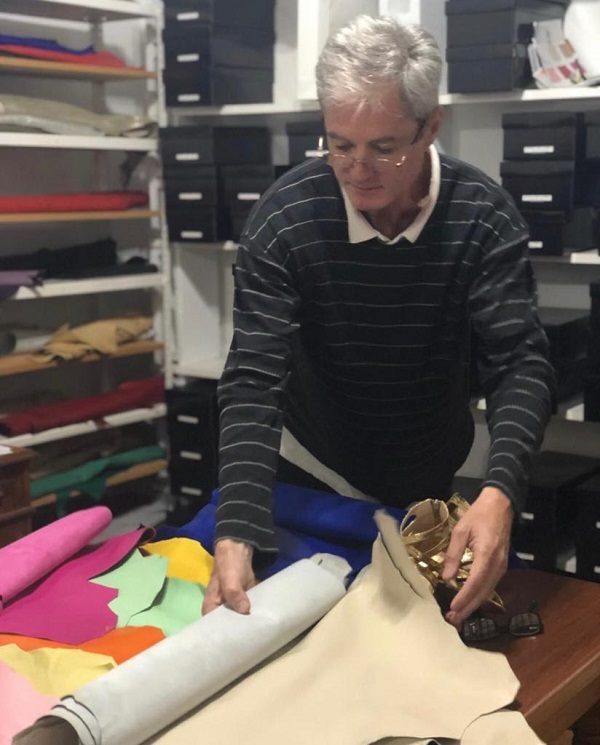
Carlo Farroni checking his materials for shoes

Some of those professionals are shoemakers and shoe modelists, who offer absolute comfort and elegance to artists during their shows, especially when it comes to dancers. Today, we are going to bring the story of Mr. Carlos Farroni, who kindly agreed to talk to us and told us how he began in this interesting and important occupation.

How did you start your career as a shoemaker and shoe designer? (título 3)

Carlos Farroni tells us that he started his apprenticeship at the age of 20, namely more than four decades ago. All this training took place at the shoemaking institute in Buenos Aires, Argentina, Farroni’s native country, but it was not the only place responsible for teaching this man everything he knows today. He also combined his studies with certain tasks in an artisan footwear workshop, something that would be a great support to the knowledge gained within the field of formal education.

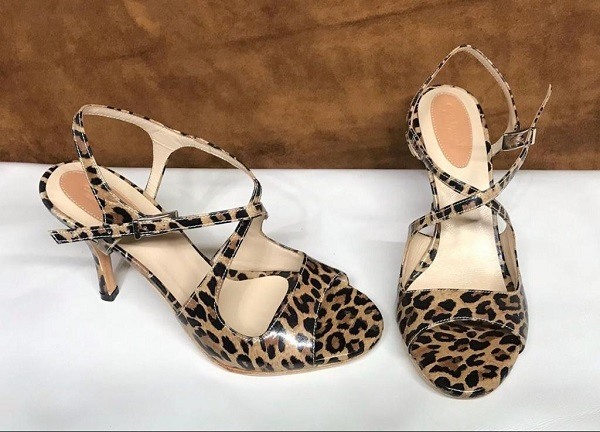
Dancing shoes for women made by Carlo Farroni

A few years later, he enbarked on a trip to Italy, where he worked in various areas of the creation of shoes, such as design and subsequent manufacturing, which was also extremely important for the Argentinean to continue learning how to navigate the world that has made him so well known.

Asked why he dedicates himself to the creation of special shoes to dance, he replied that he was carrying out exclusive footwear for theatre plays for many years, during this time his work started to become known in many parts of the world. After the quality of his products made news in many countries, many dancers started contacting Farroni to design exclusive shoes for them. It can be said that this is how he started the famous brand we know today.

More dancing shoes for women made by Carlo Farroni

How is your working methodology? (título3)

Regarding the production process, Mr. Farroni has revealed to us that everything is hand-made, which means that the tailoring, design, choice of materials, cutting, sewing, assembly and finished are handmade. In the same way, he ensures that the materials used for his products (most of the shoes are made of leather) are of excellent quality both in tanning and in thickness. This whole process is what makes the shoes look so professional and, at the same time, so comfortable and light as to allow the wearer to move freely.

It is also important to underline that the shoes handmade by Mr. Farroni’s brand can be used to dance every kind of musical genre without an problem. Obviously, tango dancers are the ones who most often seek out and promote these products, but there is no limit with regard to this detail. Anyone who wants the greatest elegance, sophistication and comfort at the moment of dance anything can contact Carlo Farroni, who will be happy to assist them and offer them the best of his work.

Dancing shoes for men made by Carlo Farroni

Read also: Omar Ledezma Jr talks about his experience at the Tempo Latino Festival

North America – October2022

Omar Ledezma Jr talks about his experience at the Tempo Latino Festival

A new salsa talent with Latin parents and born in Boston

The interesting story of French percussionist Dominique Patrick Noel

We interviewed IndiviDúo singers Tiffany Joy and Maqui Reyes

Meet The Dates Of Havana D’ Primera – Europe Tour 2022

Alexander Abreu & Havana D’ Primera will begin their concert tour in Serbia celebrating their 15-year artistic career

cinco personas cantando
Alexander Abreu with the Van Van at Tempo Latino 2022

Alexander Abreu & Havana D’ Primera will visit Europe in September with their 2022 tour to celebrate their 15-year career with love and music, starting on Saturday, September 3rd in Belgrade (Serbia), and two days later they will step on the Bulgarian salsa stage (Monday, September 5th).

Subsequently, they will sing their repertoire in Spain (Seville, Madrid, Bilbao, and Barcelona) on September 8th, 9th, 23rd, and 30th, and will continue in France with two concerts: on Sunday 11th, they will be on stage on the Cabaret Sauvage (Paris), while the Sunday, September 25th, they will do so in the Patio de Camargue (Árles). In the same way, their tour of Germany (Hamburg) continues on Thursday, September 15th, and the 16th of this month, they will be in Finland, specifically in the capital city Helsinki.

The 2022 Tour continues in Italy (Florence and Naples) on September 17th and 21st. The latter will be in the Sweet Life concert hall located in the Somma Vesuviana municipality of the Neapolitan city.

On Thursday the 22nd, they will do the same at the Cuban Latin Festival in the Netherlands (Amsterdam) and will end their 2022 Tour 400 miles from Europe in Tunisia in the Yasmine Hammamet neighborhood located in the north of the African continent on Saturday, October 1st.

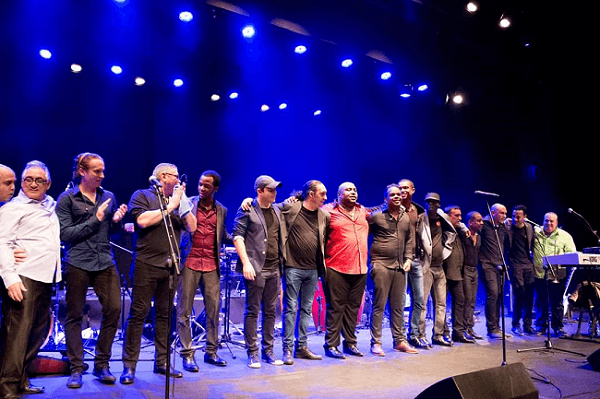
16 personas en un escenario
Ticket prices vary between £30 and £100.

Alexander Abreu spent his childhood in the city of Cienfuegos (Cuba) where he began playing the trumpet at the age of ten and has currently become one of the most versatile and acclaimed Cuban musicians of Afro-Cuban music. “I have always seen Havana D’Primera with 15 people on stage and everyone said that it was impossible, that it would be too expensive, too difficult to move… This is how we started: 14 or 15 of us and a lot of positive energy, now we are stronger than ever.” Abreu commente.

Havana D’ Primera (HDP) is a Cuban timba band founded by Alexander Abreu in 2007 and made up of 17 of the best Cuban musicians. The orchestra is led by the main composer Abreu, who has stood out for his melodic voice and ability to fuse genres through Salsa such as Jazz, Funk, and other Afro-Cuban rhythms.

“Since its inception, the band has released five studio albums and one live album. The debut album release was Making History with EGREM in 2009 and their first release for the Páfata Productions record label. 2012’s Pasaporte received favorable reviews from the international press and was voted one of the best Latin alternative albums of that year.

Since then, they have followed the success of “Pasaporte” with four more albums, released through Páfata Productions and the last one in co-production with the Cuban Producciones Abdala.

HDP released “La Vuelta al Mundo” in 2015 and “Haciendo Historia LIVE” arrived in 2016. “Cantor del Pueblo” in early 2018, earning the band a Latin Grammy nomination for Best Salsa album. We cannot forget “A Romper el Coco” with the participation of Mayito Rivera released in 2019, and the single Quiero Verte Otra Vez (2020) which won the Special Prize at the 2020 Lucas Awards gala and was also cataloged by the French newspaper “Le Monde” as one of the favorite songs of Latin music.

Finally, in 2021 the album “Será Que Se Acabó” was released, as a tribute to Cuban popular music of the 80s and 90s. Discography extracted from the Biography of Havana D’ Primera.

You can read: Where to go dancing Salsa in Paris?

  • « Go to Previous Page
  • Page 1
  • Interim pages omitted …
  • Page 3
  • Page 4
  • Page 5
  • Page 6
  • Page 7
  • Interim pages omitted …
  • Page 15
  • Go to Next Page »

International Salsa Magazine (ISM) is a monthly publication about Salsa activities around the world, that has been publishing since 2007. It is a world network of volunteers coordinated by ISM Magazine. We are working to strengthen all the events by working together.