• Skip to primary navigation
  • Skip to main content

International Salsa Magazine

  • HOME
  • Previous editions
    • 2026
      • ISM / May 2026
      • ISM / April 2026
      • ISM / March 2026
      • ISM / February 2026
      • ISM / January 2026
    • 2025
      • ISM / December 2025
      • ISM / November 2025
      • ISM / October 2025
      • ISM / September 2025
      • ISM / August 2025
      • ISM / July 2025
      • ISM / June 2025
      • ISM / May2025
      • ISM / April 2025
      • ISM / March 2025
      • ISM / February 2025
      • ISM / January 2025
    • 2024
      • ISM / December 2024
      • ISM / November 2024
      • ISM / October 2024
      • ISM / September 2024
      • ISM / August 2024
      • ISM / July 2024
      • ISM / June 2024
      • ISM / May 2024
      • ISM / April 2024
      • ISM / March 2024
      • ISM / February 2024
      • ISM / January 2024
    • 2023
      • ISM / December 2023
      • ISM / November 2023
      • ISM / October 2023
      • ISM – September 2023
      • ISM – August 2023
      • ISM July 2023
      • ISM Edition June 2023
      • ISM – May 2023
      • ISM April 2023
      • ISM March 2023
      • ISM February 2023
      • ISM January 2023
    • 2022
      • ISM December 2022
      • ISM November 2022
      • ISM October 2022
      • ISM September 2022
      • ISM August 2022
      • ISM July 2022
      • ISM June 2022
      • ISM May 2022
      • ISM February 2022
      • ISM January 2022
    • 2021
      • ISM December 2021
      • ISM November 2021
      • ISM October – 2021
      • ISM September 2021
      • ISM August 2021
      • ISM July 2021
      • ISM May 2021
      • ISM April 2021
      • ISM June 2021
      • ISM March 2021
      • ISM February 2021
      • ISM January 2021
    • 2020
      • ISM December 2020
      • ISM November 2020
      • ISM October 2020
      • ISM September 2020
      • ISM August 2020
      • ISM July 2020
      • ISM June 2020
      • ISM May 2020
      • ISM April 2020
      • ISM March 2020
      • ISM February 2020
      • ISM January 2020
    • 2019
      • ISM December 2019
      • ISM November 2019
      • ISM October 2019
      • ISM Septembre 2019
      • ISM August 2019
      • ISM July 2019
      • ISM June 2019
    • 2016
      • ISM December 2016
      • ISM November 2016
  • Spanish
  • Download Salsa App
    • Android
    • Apple

Search Results for: Timba

Omar Ledezma Jr. shares with us the new from his project with Azesu

Today’s guest needs no further introduction because you know him very well. This is the talented Venezuelan percussionist and singer Omar Ledezma Jr., with whom we have been able to talk about his latest projects, one of which gets him focused and excited in equal parts. 

Omar talks to us about his projects
Percussionist and singer Omar Ledezma Jr. talks about his new project with Azesu

What is Omar Ledezma Jr. up to now?

After showing his gratitude for the latest of many invitations we have made to him in International Salsa Magazine, Omar went on to describe the new phase of his career, in which production plays a major role. We are talking about a project he has been involved in since 2011 called Azesu, which includes great musicians and is led by Cuban percussionist Orestes Vilato.

Although the initiative had progressed considerably, Omar and the rest of the group are still waiting for official communication from the social media of the organization that will fund the project by the artists who have applied for it. The group is awaiting approval, although they already have promotion, photos, and a series of details ready to be released once the financing becomes a reality.

What was required of Omar and the rest of the team to present the project

At the beginning, the idea of a recording was floated because this was one of the categories in which artists could apply for funding, so Omar and the others chose to pay tribute to Orestes Vilato. The organization loved the idea, which led them to be one of the groups chosen to receive this financial aid, and they are very happy about that.

However, not everything was rosy, as the members of Azesu could not find the right moment to start recording due to personal situations of some of them and the arrival of the pandemic. After overcoming all that, Jonathan Alford, the group’s pianist and overall director on the project, came to Omar with the idea of recording a second album (they had already recorded one in 2011, also called Azesu) to resume the project they had left behind.

It was then that the Venezuelan artist came up with the idea of paying tribute to Orestes and, in turn, bringing to life some of the lyrics written by his father, who passed away two years ago.

The material also seeks to be a tribute to that generation that is quickly departing, which is why Azesu tries to recreate those concepts and that way of making music, but at this time. 
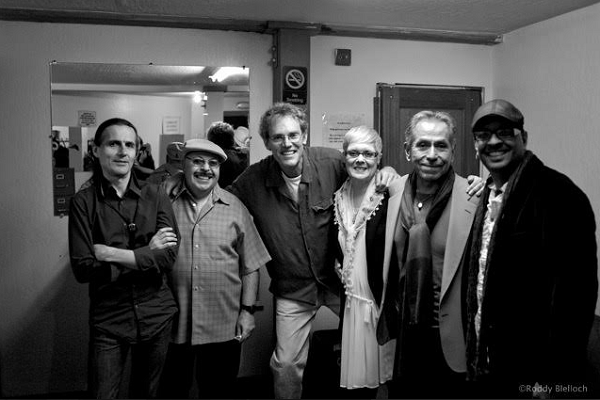
Omar and the rest of Azesu
These are the members of Azesu from left to right: Sheldon Brown (Saxophone), Orestes Vilató (Percussion), Jonathan Alford (Piano), Maria Marquez (Vocals), David Pinto (Bass), and Omar Ledezma Jr. (Percussion and Vocals). Photo taken by Roddy Blelloch

Timeline and objectives for the project

When Azesu released his first album in 2011, it all started with Orestes calling some of the group’s members, who were pianist Jonathan Alfort, Venezuelan singer María Fernanda Vázquez, Peruvian bassist David Pinto, and American saxophonist Sheldon Brawn.

The project is not conceived as a commercial album in every sense of the word, but as a hymn to Las Americas that has a little bit of everything, including jazz, folklore, popular music, dance music, and many more elements coming together to create a unique and different result.

It is also important to note that Azesu’s new album, next to release in 2016, will feature new tracks and covers with completely new versions in the style of Azesu, some of which will be sung and others instrumental. In addition, the new music was composed and arranged by Jonathan and David, although Omar also played an important role in the creative process when it comes to lyrics and melody. It is anticipated that they will enter the studio to start recording in about three weeks, and the album is expected to be released before the summer of 2026.
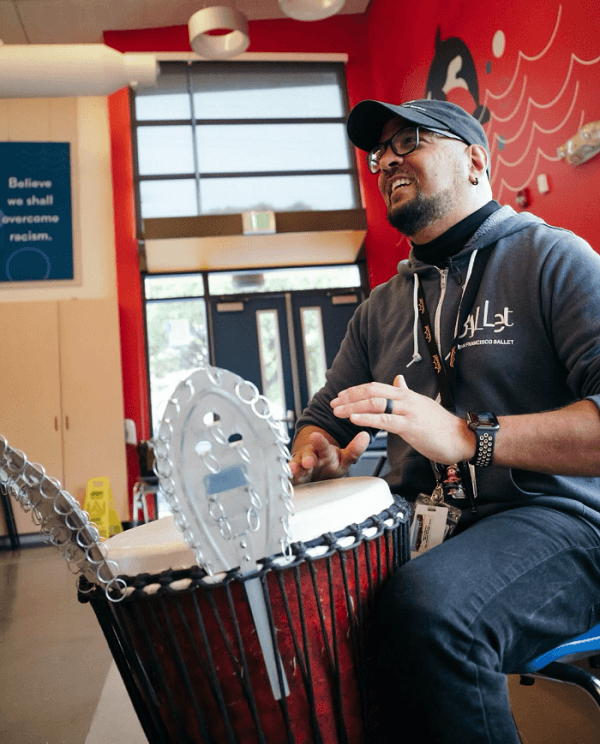
Omar teaching
Omar Ledezma Jr. teaching at the San Francisco Ballet School

Omar and teaching

We have already addressed the issue of Omar and his role as a teacher in previous editions, so we wanted to know if he is still teaching and which capacity he is using. The musician replied that the teaching part has been and will remain very important in his overall project as an artist, as he believes that, due to his profession, he has a great responsibility to showcase the music he grew up with and the instruments that have allowed him to develop his career.

He currently teaches Latin percussion at the California Jazz Conservatory at Berklee, which is basically a summer ensemble where students learn to play congas, timbales, and bongos. During the rest of the year, he focuses on specific instruments and developing the tumbadora curriculum.

He also offers private lessons in which students can enjoy a much wider range of instruments to learn, such as drums, cajón, bongos, timbales, and much more.

Omar concluded this important topic by saying, “I always take on the idea of remaining a student. Just as I teach classes, I want to continue acquiring knowledge and taking classes with teachers who know many things I don’t.”

Read also: Caesar Vera Y Su Sexteto NuevoSon, traditional Cuban music with a touch of modernity

Trumpeter Davián Raúl Launches Solo Career with “Despierta Salsero” Album

Davián Raúl has released his debut production, Despierta Salsero, available now in digital format and on CD. The young Puerto Rican salsa artist is currently on a promotional tour for the album.

Davián Raúl is no stranger to the salsa scene. He’s been playing the trumpet since he was ten years old, starting with the Banda Sinfónica de Toa Baja. He eventually became a trumpeter for Sonora Ponceña, thanks to the support of Papo Lucca, director of “Los Gigantes del Sur.” To reach his current position, Davián Raúl pursued an education in Music Education and Performance, with the trumpet as his primary instrument. He is a graduate of the Interamerican University of Puerto Rico and is currently a music teacher at a school in Comerío, Puerto Rico, where he mentors students from pre-kindergarten through sixth grade.

Trumpeter Davián Raúl launches his solo career with the album Despierta Salsero.

Before joining one of the most important and iconic salsa orchestras—one that heavily emphasizes the trumpet’s sound—Davián was a trumpeter for the orchestras of Nino Segarra, Primi Cruz, Osvaldo Román, and Anthony Cruz, to name a few. He was also part of Conjunto Chaney shortly before auditioning for La Ponceña. During his time as a backing musician, he traveled the world, playing his instrument in major venues and gaining the experience necessary to make his leap. Davián Raúl makes his debut as a solo singer with Despierta Salsero, bringing a solid hard salsa proposal aimed at satisfying the taste of true salsa aficionados.

Album Details

The album features 10 tracks encompassing hard salsa, romantic salsa, rumba, bolero, and son. The recording includes: ‘Al que nace pa’ salsero,’ ‘Tengo que marcharme,’ ‘La campana’ (a song dedicated to Cali, Colombia, known as “the salsa capital of the world”), ‘Ahora me extrañas,’ ‘Coño, despierta salsero,’ ‘Mientras me sigas necesitando,’ ‘Mi salsa no muere,’ ‘La pachanga,’ ‘Te traigo el son,’ and ‘Ten compasión.’ The orchestration was arranged by Raúl Berríos Raymundí, with arrangements by talented musicians such as Ramón Sánchez, Ernesto “Tito” Rivera, Ángel “Pajay” Torres, and Andy Guzmán. Nine of the ten compositions are original works by Raúl Berríos Raymundí and Irvin Raúl Berríos López. The tenth track, ‘Mientras me sigas necesitando,’ is a renowned song by the celebrated Camilo Sesto.

Musical Production and Guest Artists

The musical execution was handled by a carefully selected group of great Puerto Rican and international musicians. The congas feature “Pequeño” Johnny Rivero, Kachiro Thompson, Gadwin Vargas, Charlie Padilla, and Sammy García. Japhet Rodríguez, Pete Perignon, Edwin Clemente, Pablo Padín, and Diego Camacho play the timbal. Alexandra Albán, Luisier Rivera, Javier Oquendo, and Richard Carrasco perform on the bongos. Richard Bravo is on drums, while Raúl Berríos Raymundí, Sergio Múnera, Ricardo Lugo, Ramón Vázquez, and Pedro Pérez provide the rhythm on bass. Andy Guzmán, Ramón Sánchez, and Carlos García play the piano. The trumpet section showcases David “Piro” Rodríguez, Angie Machado, Jesús Alonso, Marito Ortiz, Dante Vargas, Pedro Marcano, Yoandy Vera, and Davián Raúl himself. José Berríos Raymundí and Irvin Raúl Berríos López contribute on trombones. For the choruses, the voices of Carlos García and Jorge Yadiel Santos alternate with those of Raúl, Irvin, and Davián himself. The sound engineering team responsible for mixing and mastering included Papo Sánchez, Andy Guzmán, and Rolando Alejandro. With this impressive lineup, Davián Raúl, one of the youngest members of the Berríos dynasty, makes his debut, confidently declaring that “salsa is still in control.”

Davián Raúl released his first production available in digital format and on compact disc, Despierta Salsero.

Endorsements

Recently, “El Caballero de la Salsa,” Gilberto Santa Rosa, endorsed Davián Raúl’s debut production via a video clip shared on social media. Santa Rosa stated, “Davián Raúl is a tremendous young talent whom you must listen to… so that true salseros know there’s plenty of salsa for a long time to come. Davián Raúl: Go for it!” In response, Davián Raúl commented on his Facebook page, “Infinite thanks (…) for making this dream possible. You didn’t just give me space, you gave me an opportunity worth gold! This is just the beginning… and may the salsero awaken throughout the world!”

Bella Martinez Puerto Rico


Also Read: Bella Martinez, the irreverent Salsa writer

Israel “Cachao” López, a Cuban musician and composer, has been hailed as “the Inventor of Mambo”

Born in Havana on September 14, 1918, and passing away in Coral Gables, Miami, on March 22, 2008, Israel “Cachao” López, often known simply as “Cachao,” was a Cuban musician and composer.

Israel Cachao López musico y compositor cubano, ha sido definido como el Inventor del Mambo

He became a legend in Cuban music with his masterful handling of the double bass and was renowned for his performances in mambo and Latin jazz.

His talent earned him two Grammy Awards (in 1995 and 2005), a Latin Grammy in 2003, an honorary doctorate from Berklee College of Music, and a star on the Hollywood Walk of Fame.

He has been described as “the inventor of mambo” and is considered a master of descarga (live improvisations).

He began by playing various instruments until he settled on the double bass, which allowed him, as a teenager, to join the Havana Philharmonic Orchestra, where his father and older brother also played.

“Cachao” left Cuba in 1962 with a long list of successes and stated in a 2007 interview that if it weren’t for his compatriot and colleague Dámaso Pérez Prado, “mambo would not have been heard worldwide.”

Israel Cachao López nacido en La Habana, un 14 de septiembre de 1918 y falleció en Coral Gables un 22 de marzo de 2008 en Miami

His first stop was Madrid, where he stayed for a year before emigrating to the United States. In the U.S., he resided in New York City, Las Vegas, and Miami.

López also played acoustic bass with his brother, the multi-instrumentalist Orestes López. They literally composed over 3,000 songs together and were highly influential in Cuban music from the 1930s to the 1950s.

They created the “nuevo ritmo” (new rhythm) in the late 1930s, which transformed the danzón by introducing African rhythms into Cuban music, ultimately leading to mambo.

He won several Grammy Awards for both his own work and his contributions to albums by Latin music stars, including Gloria Estefan. In 1995, he won a Grammy for Master Sessions Volume 1.

In 2003, he won a Latin Grammy for Best Traditional Tropical Latin Album alongside Bebo Valdés and Patato for El Arte Del Sabor. He won another Grammy in 2005 for his work ¡Ahora Sí!

His nephew, Orlando “Cachaíto” López, became one of the pillars of the famous Buena Vista Social Club.

Cachao performed with artists such as Tito Puente, and his music has been featured in films like The Birdcage and the soundtrack of the video game Grand Theft Auto: Vice City.

The Actor Andy Garcia produced a documentary titled Cachao… “Como Su Ritmo No Hay Dos” in 1993 about his music. He also shared stages with Celia Cruz and her husband Pedro Knight, as well as with trombonist Generoso Jiménez.

Leyendas de Nuestra Musica Latina Pacheco, Puente y Cachao

His last musical collaboration was with Gloria and Emilio Estefan on the singer’s album titled 90 Millas.

López passed away on the morning of March 22, 2008, in Coral Gables, Florida, at the age of 89, due to complications following kidney failure.

Cachao y Su Ritmo Caliente – Monte Adentro (2000)

Tracks:

  1. Monte Adentro (Cógele el golpe) (A. Castillo Jr.)
  2. Goza Mi Trompeta (O. Estivill)
  3. Guajeo de Saxos (E. Peñaver)
  4. Estudio en Trompeta (I. López)
  5. Gozar Timbero (O. Estivill)
  6. Trombón Criollo (O. Portillo)
  7. Malanga Amarilla (S. Contreras)
  8. Controversia de Metales (I. López)
  9. Descarga Cubana (O. Estivill)
  10. Pamparana (A. López)
  11. Sorpresa de Flauta (O. Estivill)
  12. Oye Mi Tres Montuno (A. Echevarria)
  13. La Floresta (O. López)
  14. Avance Juvenil (B. López)
  15. Redención (O. López)
  16. Descarga Mambo (D.P.) 

Musicians:

  • Israel López “Cachao” (Double Bass)
  • Guillermo Barreto (Timbales)
  • Tata Güines (Tumbadora)
  • Rojelio “Yeyo” Iglesias (Bongos)
  • Gustavo Tamayo (Güiro)
  • Alejandro “El Negro” Vivar (Trumpet)
  • Armando Armenteros (Trumpet)
  • Generoso “El Tojo” Jiménez (Trombone)
  • Oreste López (Piano)
  • Enemelio Jiménez (Alto Sax)
  • Emilio Peñalver (Tenor Sax)
  • Virgilio Lisama (Baritone Sax)
  • Richard Egües (Flute)
  • Niño Rivera (Tres)
  • Roliyo y Reyes (Chorus)

Recorded in Havana, 1957-1958

Cachao y Su Ritmo Caliente - Monte Adentro (2000)
Cachao y Su Ritmo Caliente – Monte Adentro (2000)


The tradition of being musicians comes from grandparents and great-grandparents, all the Cachaos are musicians.

By:

Dj. Augusto Felibertt

L’Òstia Latin Jazz

Also Read: Israel “Cachao” Lopez Sobrado in fame and respect in the seventies was dedicated to maintain the tradition at the highest level

Trombone player Lindsey McMurray from the women’s orchestra Las Chikas

Lindsey McMurray, bandleader of the group Las Chikas, has graciously accepted our invitation to talk about the women’s orchestra she is leading, which makes us very happy and pleased, so we invite our readers to enjoy this interview from beginning to end and learn about the musical journey of this young artist.

Lindsay from Las Chikas singing
Lindsey McMurray singing during a concert with Las Chikas

How Lindsey got started in music

Lindsey’s journey to become an artist began very soon at school, when she was just 10 years old and started learning to play the trombone. Prior to this, she had already studied other instruments such as the keyboard and the recorder, but she ended up trying the trombone.

Soon after, at the age of 11, she joined the school jazz band, but it was not until college that she began experimenting with salsa in orchestras that played this genre. Until then, Lindsey had had virtually no contact with Latin music, as she had only listened to typical U.S. rhythms. However, once she discovered Latin American music, she could not escape her love for it and continues to play it to this very day.

It should be noted that the musician does not have any family member who is too. So she would be the first one to make music her profession and, of course, one of the most important areas of her life.

Professional experiences prior to Las Chikas

Before even getting to know of the existence of Las Chikas, Lindsey was on a TV show called ‘’Noches Con Platanito’’ in the musical side, but she did not really lead anything until the bandleaders of the groups who were there left. Her big break came in 2017, when she finally managed to become a bandleader herself and, in turn, started two groups at the same time. 

This is because Lindsey did not want to depend on anyone be called whenever she was required, but, on the contrary, she wanted to go on developing her autonomy to the point of being the one to create jobs for others instead of looking for them somewhere else.

Whitney and Gabby from Las Chikas
Singers Whitney Hernández and Gabby Tamez from Las Chikas in Carson City

Las Chikas

It is important to clarify that Lindsey is not the founder of Las Chikas, but that the group already existed before she joined during the pandemic. The idea of Las Chikas was born during “Noches Con Platanito” as part of the show, but Lindsey and the other members wanted to have activities outside of the show and what the production asked them to do. At that time, the leader and founder of the group was Eliana Rose who during the pandemic wanted to settle in Southern California, so she asked the artist to take her place, which she accepted.

This posed a significant challenge for her, as she had never led a Latin music orchestra in her life. However, the novelty did not make him get cold feet, but on the contrary, it was an experience she wanted to live in order to learn from it.

The current members joined the group thanks to recommendations from friends and other people in the industry. Already at this point, it can be said that they all are her friends, to the extent that they have shared all kinds of special occasions such as birthdays, trips, and much more. 

Why only women in the orchestra

What catches the attention about Las Chikas is that, as its name suggests, it is only composed of women. One of the reasons is that the industry, despite of the recent social changes, continues to be dominated by men, so these young female talents find support between themselves.

What the original founder wanted was to promote the idea that a group of girls could play Latin music without it being perceived as strange. Lindsey shares this vision with hundred percent and hopes new generations of women never think for a moment that their gender is a limitation to achieve what they want in music.

Las Chikas with its certificate
Marina Panzetta, Shirly Ace, Lindsey Murray, Whitney Hernadez, Gabby Tamez, Maria Vega, Mayelin Vazquez, Alisha Ard Vazquez, Dolores Duran-Cefalu, and Anitta Garay from Las Chikas posing for the camera with its certificate from the City of Los Angeles. Photo taken by Craig Cochrane

While acknowledging that there have been positive changes in recent decades, she thinks there are areas that do not have enough female representation such as percussion, bass, production, arranging, among others. It is very common for women to be vocalists in a band, but it is still unusual to see them in other areas of the project.

Las Chikas as a mix of cultures and ethnicities

On the band’s website, it can be read that the group is a mix of diverse cultures and ethnicities. In this regard, Lindsey pointed out that, while it is true that she is not a Latina, she has always sought to create something as authentic as possible that is rooted in Latin culture, of course with great respect. “Latin music is so joyful, intelligent, and capable of being beautiful to the eyes of any human being who hears it. I also want in a certain way to make non-Latinos enjoy this beautiful music as much as I do,” Lindsey added on the subject.

She also said that diversity plays a very important role, as non-Latino audiences tend to feel that they have permission to be part of the joy emanating from this music. In addition to that, the fact that the members have diverse backgrounds helps the band have different perspectives on what they want to do.

Today, Las Chikas is composed of Cuban singer Mayelin Vázquez, Cuban singer Whitney Hernández, American pianist Dolores Duran-Cefalu, bassist María Vega, Mexican timbalera Anita Garay, Mexican conga player Diana Teixeira, American trumpet player Anne King, Mexican saxophonist Marina Panzetta, and Lindsay herself on trombone.

Read also: The best of Cuban music in Tampa with Cuband Son Band

Caesar Vera Y Su Sexteto NuevoSon, traditional Cuban music with a touch of modernity

It is very important for us to show and provide coverage to the most important Latin music artists of today in the United States and now it is the turn of Chicagoan musician Caesar Vera, who very kindly accompanied us in this edition of International Salsa Magazine.

Caesar is the current director of Caesar Vera Y Su Sexteto NuevoSon, which we will talk about later along with other equally important issues for the musician’s career.

Caesar with a bongo
Caesar Vera with his bongos some years ago

How Caesar began his journey in music

Although Caesar has developed his professional life in Miami and currently lives there, he was actually born in Chicago and spent the early years of his life there. His parents arrived from Cuba in 1966 in the freedom flights and, once in the United States, the Catholic Church helped them and placed them in Chicago, where he was born and lived until 1978. Later, the couple divorced and his father went to live in Miami, so Caesar spent long holiday periods together with him in that city.

The path with music for Caesar began in high school, when he became very interested in rock music, to the point of creating a band with some of his classmates. He played the drums and was a huge fan of Led Zeppelin, Kiss, Van Halen, and other groups of that style. 

The only connection the young man had with Latin music was his grandfather, who loved to dance danzón and always played Orquesta Aragón records so that they could both move to the beat music in the living room of his house. Although these moments with his grandfather were very pleasant, he did not yet like this kind of music, but that would change over the years.

In Miami, there was a time when there were many Latin bands playing, and every corner had a nightclub with orchestras playing. Caesar and his friends used to attend these places a lot, which led the young man to finally become interested in these genres. This coincided with the arrival from Cuba of his uncle who was a musician and had a band there, which they talked about constantly, and he even taught his nephew to play instruments such as the tumbadora, bongos, timbales, and all minor percussion.

In 1987, what happened was a turning point for Caesar musically speaking, as he finally decided to take Cuban music more seriously and study its history to understand it better.

Caesar Vera and Luis Bofill
Singer and bandleader Luis Bofill and Caesar Vera

Groups prior to Caesar Vera Y Su Sexteto Nuevo Son

Before creating his own group, the wife of a friend who had a group invited him to play percussion with them, a proposal Caesar accepted, and he started playing the tumbadora with the orchestra. Something new in this case was that he had never played with an established band in formal performances, so it was something new for him.

By 1992, he had met the famous Cuban bongo player Juan Méndez, who had played with the Roberto Faz Orchestra, Roberto Torres, and Luis Santi Y Su Conjunto. Méndez told him that he needed a bongo player in an orchestra he was forming at the time and asked Caesar to fill the vacancy, to which he answered yes and remained in the group until 2003, that is, for around 11 years.

In addition to that, he was a replacement in various orchestras in Miami for a while, one of which was Gilberto Díaz Y Su Conjunto Los Profesionales. He was with them for two years, but by then traditional Cuban music, more specifically Cuban son, had captured his full attention. It just so happens that one of his orchestra fellows told him that Norberto from the group Norberto Y Marcela Y El Septeto Caribe called him because they needed a bongo player and asked if he was interested in the vacancy. Caesar did not think twice and went to play with the orchestra even though he did not have much experience with the bongos, but he took the risk anyway. It was with this group that he started playing traditional Cuban music and prepared to do the same once he became independent.

Caesar and his bandmates
These are the band members from left to right: bongo player Caesar Vera, singer Billy Velazquez, tres player Roberto Acosta, bassist Arturo Senti, conga player Hebert Garcia, and trumpet player Orlando Fraga

Foundation of Caesar Vera Y Su Sexteto NuevoSon

Still playing with Norberto and Marcela, Caesar started having his own creative ideas on how to lead an orchestra, but he could not carry them out because he was only a musician who collaborated with the orchestra, which started to bother him and cause him enormous dissatisfaction. One day, his wife saw him stressed and frustrated by the situation, leading her to ask him why he did not become independent and create his own project. 

That is when he started thinking about it seriously until, in early 2007, he finally founded the group Fusión 4 with Carlos Alberto “El Flaco”, who had previously sung with Fajardo Y Sus Estrellas, Larry Harlow, and La Fania. They managed to play every Saturday at the Deauville Jazz Club for a year.

However, the sextet as we know it today was created just two years ago because it was costing to Caesar much to find work for such a large orchestra, especially after the pandemic when much of the live music scene fell off a cliff. 

Today, some of its members are tres player Roberto Acosta, bassist Arturo Santi, conga player Hebert García, trumpeter Orlando Fraga, and singer Billy Velázquez. 

Read also: Young promise of music Sofia Grace Doellefeld tells us about her dreams

  • « Go to Previous Page
  • Page 1
  • Interim pages omitted …
  • Page 9
  • Page 10
  • Page 11
  • Page 12
  • Page 13
  • Interim pages omitted …
  • Page 69
  • Go to Next Page »

International Salsa Magazine (ISM) is a monthly publication about Salsa activities around the world, that has been publishing since 2007. It is a world network of volunteers coordinated by ISM Magazine. We are working to strengthen all the events by working together.
