Yma América “Every time I go out to play, to sing, I show my training and above all I put the name of Venezuela up and without speaking much.”
Yma América, she reaffirms that; We have done a good job, making our Latin music and culture known.
The trace that many Venezuelan artists, who have decided to settle abroad, are leaving behind is passing through the world, because they distinguish themselves by their achievements and place the name of Venezuela in a big way, making their fellow citizens proud of their successes, such is the case of Yma América Martínez, born in Caracas and based in Germany for almost 30 years.
With a musical vein that he inherited from his parents who points us out, they were the fundamental pillar in his training and career, and why not, for having grown up in one of the most musical parishes in Caracas, the San Agustín del Sur neighborhood, Marín sector, from where great characters have come out including his uncle the choreographer and dancer Carlos Enrique Orta (+), who traveled with his dance company, “Coreoarte” great stages throughout the world.
His musical beginnings were with a group created by his father “Los group created by his father “Los Azulitos Juveniles” where he sang aguinaldos with his sisters and neighbors, and then entered the San Agustín Choir at Don Pedro School “Fe y Alegría”.
(Yma América) She received her academic preparation at the “José Ángel Lamas” School of Music and the “Simón Bolívar” National and Youth Orchestra, to continue her cello studies in Paris at the “Ecole Normale de Musique de Paris” and song and composition at the CODARTS of the World Conservatory of Music in Rotterdam.
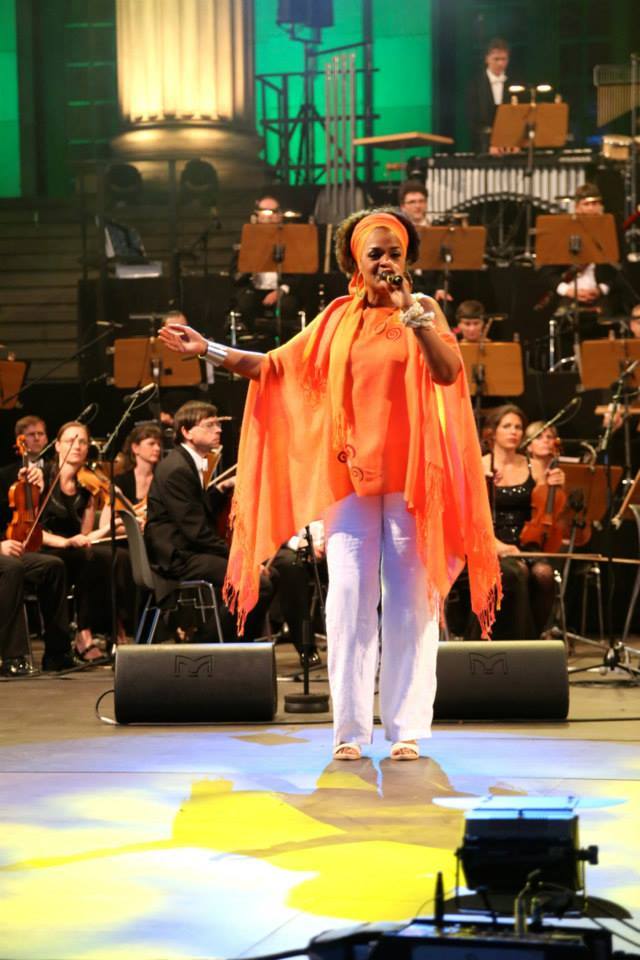
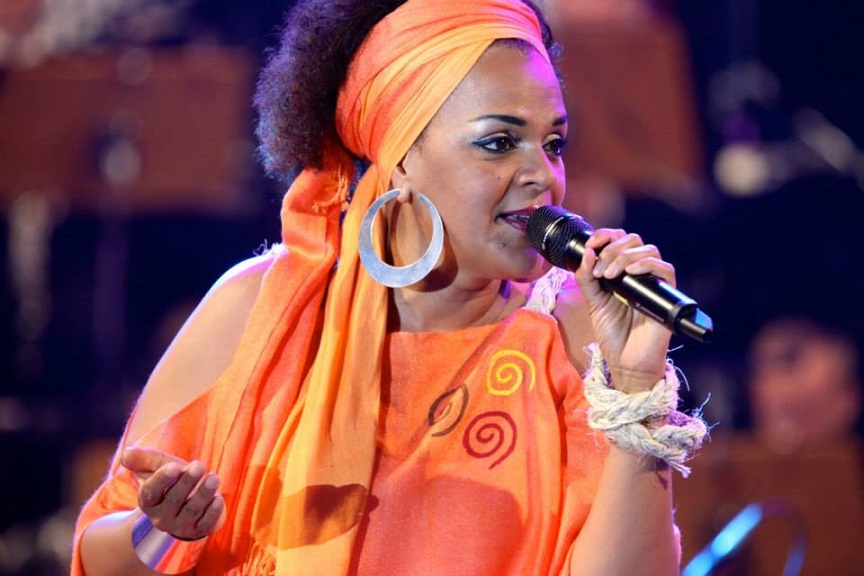
Yma América is a singer, musician, songwriter, arranger, plays the violoncello and the cuatro. It’s clear and powerful voice makes it very popular throughout Europe. He has worked with different groups; Kimbiza, Latin Sampling, Francisco Zumaqué, Connecting Latina, Mirta & The Goalgetters, Duo Ymaya, Cubop City Big Band, among others. He has participated in major jazz and classical music festivals, such as the Ruhr Guitar Festival, the North Sea Jazz Festival, the RuhrTriennale, the MusikTriennale Köln and the Elblandfestspiele. In 2004 his record made her the winner of the international competition “Voice and Guitar” in Saarbrücken – Germany, obtaining the first prize with the Colombian guitarist Andrés Mendoza Villamil.
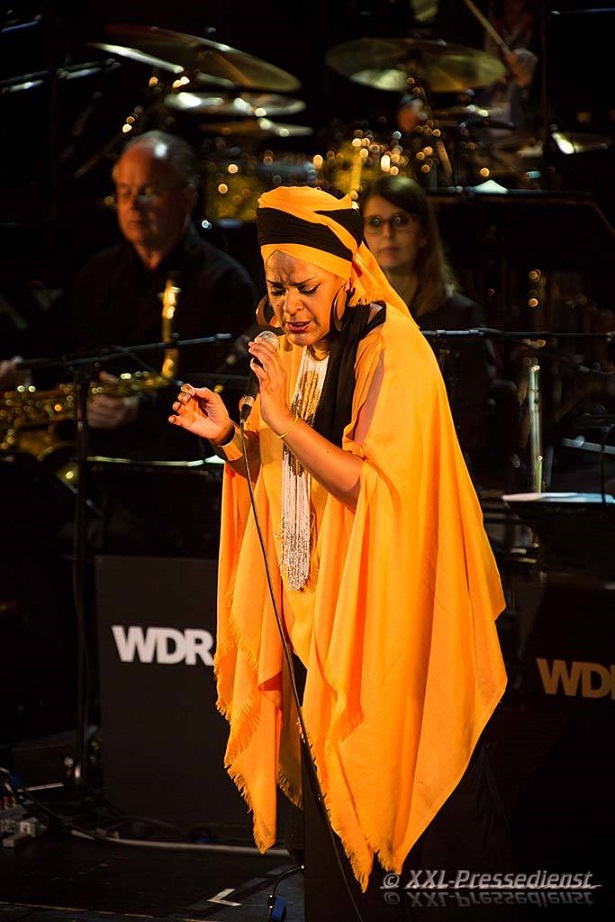
Another relevant fact in the life of this artist can be seen in the song “Play it”, a song that he composed and sang for the commercial of the Bacardi company, which became a success in the summer of 1998 and 2000. He participated in the musical “King of The Lions” with WDR Big Band in the main role of Lilipuz’s children’s concert “Die schlaue Mama Sambona”; and has performed more than 30 times with the production “Adventure Weltumrundung” of the Fly & Help Foundation.
She has on her shoulders the responsibility of a great project that he has in Germany and wishes to perform in his native country, to make music with percussion for deaf people called “FEEL SOUNDS”, due to this proposal in 2010 he was awarded La Disability Policy of the Cologne Innovation Award (KIB).
He assures us that; “The language of music is the same throughout the planet,” with this phrase we enter to discover the virtues, dreams and desires of the interviewee.
How is Yma América defined?
“It is not easy to answer this, but I think I am a very patient and calm person, I would say too much. I do not give myself a bad life, fortunately I have done what I wanted, thanks to the support of my parents and family in general”. “I am a character who, thanks to the gods, things and opportunities have been offered to me, some have taken advantage of them, some have not, there are some that I have not realized in time that they have been there waiting for me and I have lost.
But I can say that I have lived my life, with the ups, downs, good and bad, without involving anyone and thus I have been leading and learning.”
Part of his training was obtained through the Conservatory of Music “José Ángel Lamas” and the National and Youth Orchestra “Simón Bolívar”
What do you thank and how he gives back his training with them?
“I thank you for part of my training as the musician that I am, because the other part I owe to my family and my people where I come from.” “-Retribute-“, I think that every time I go out to play, to sing, I show my training and above all I put the name of Venezuela up and without speaking much”.
What do you think of the phrase “Nobody is a Prophet in his Land”?
“-Sincerely do not know what you mean-“. “I don’t think I would have started singing professionally if I had stayed in Venezuela. I was quiet there, I played Violoncello in the National and Youth Orchestra of Venezuela, I played and made substitutions for cellists in the Philharmonic Orchestra of Venezuela and in the Municipal Orchestra of Caracas, I sang solo of vacilón in each party and family celebration, and Actually I was very calm in my house. ”
“I don’t think I’m a” prophet “where I am, I always do my best and people value it and often criticize it, of course.”
Why did you choose Germany and not another Latin American country? How many years have you lived in German Colony?
“I left Caracas in 1986 to Paris-France, thanks to my grandmother working in a wealthy family home and they offered to help a family member to study abroad, specifically in France because they had relatives there. First my uncle Carlos Enrique Orta – Choreographer-dancer with a lot of international professional career – left, many years before and then I wanted to “take the floor” after a while ”.
“Actually I wanted to study violoncello for 1 year in Paris and return to Venezuela, but at the end of my 1st year of study at the “Ècolle Normale de Musique de Paris”, they offered me to stay and I did not refuse. The last year of studies in Paris I did not have much money to live and in Köln-Germany lived the musicians of ‘COREOARTE’ (Dance company created by my uncle Carlos Enrique Orta with dancers and musicians of San Agustín), at that time I was leaving every weekend, on Fridays after school, from Paris to Köln and I returned on Monday at 6 am and arrived directly to classes in the afternoon.
I did that because we played; Renis Mendoza, Felipe “Mandingo” Rengifo, Charles Peñalver, Orlando “El Diablo” Blanco and I was in the street to collect some money and brighten the streets and faces of the Germans, and with that I could buy food for the whole week in Paris until the following Friday that I was returning to Köln … and so for many months until after finishing my studies, I decided to move to Köln and the first months I lived at the home of Renis Mendoza who shared his apartment with another ‘Coreoarte’ boy and then I got my room sharing an apartment with a German girl. ”
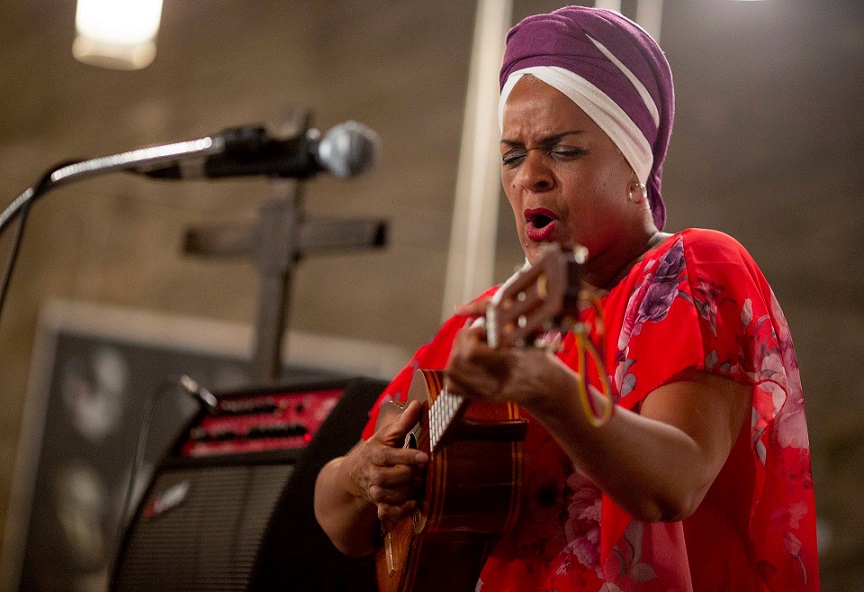
“I lived first in Paris from 1986 to 1990, 4 years and from 1990 to the present day in Köln, next year I am 30 years old based in Germany, I say “I have my bed in Köln “, because in reality I am almost never in my home, thanks to the music and the life that has given me so much ”
“I never thought, nor have I imagined living in another country in Latin America, I think that from here, I’m going to my house … Pa ‘Venezuela (to Venezuela)!”
How has been the receptivity of the German public with Latin rhythms, there was no resistance?
“At this moment there is a stagnation in the development of activities with Latin music, but in the same way there is more and more receptivity, I know we have done a good job, making our Latin music and culture known, there are several Salsa bands with German musicians, there are more and more dancers, more dance classes, many have understood the message and others interpret it to its wave but there is a lot of atmosphere and places with Latin music, with Dj of Salsa-Merengue and the crap they call Reggaeton music”.
“I must say that some years ago there were more Salsa orchestras with German musicians and there were more Salsa Festivals that unfortunately has been reduced by the phenomenon” Salsa Dj “I think and I am almost certain, because it is cheaper and people dance the same. That has done a lot of damage to live music. ”
What memories do you have of being under the baton of these great maestro Abreu, Aldermaro Romero, Carlos Riazuelo and Yehudi Menuhin?
“I don’t really remember at this moment any particular experience or directly with them. Although I had more contact with José Antonio Abreu, the experience was the same as with many of the ONJV members. But of all of them, the security with which they could dominate and control the amount of musicians an Orchestra has, and especially that in style and classical pieces, the feeling that is transmitted is that of the conductor and not that of the conductor musician or performer. Of course they were wonderful experiences. ”
How many compositions have you performed?
“Honestly, not many, about 12 but arrangements have been made, played and recorded, only 4.”
Your parents have been promoters of your career, how do you thank them?
-Chacha! –
“My parents are the reason for my profession, from them is that this Yma America that you are interviewing for my work has come out. Thanks to their way of being, their offspring, their education, I thank them for what I am and what I have done … My life. ”
Are you constantly growing anecdotes of your time at the “Normal School of Music in Paris” and the “Conservatory of World Music”?
“In Paris, I think, having to change the mentality of learning everything little by little and without hurry like in Venezuela, to the need to charge the “batteries” because here they do not wait, I have to go for it and comply daily, in addition to that that impelled me to learn the French language faster ”.
“And in Holland, going from being a student to being the singer of the Cubop City Big Band of the Prof. of the conservatory Martin Verdonk (percussion), Leslie López (bassist) and directed by the drummer Prof. Lucas van Merkwijk that was strong, especially at the beginning that it was to understand how they interpreted Latin music that is something other than Latin Jazz, there we started with Mambo of one, and as Leslie López was the bassist of Puerto Rico there was a balance and there we were learning and obtaining experiences all alike. ”
How do you feel about working alongside the Dutch percussionist and producer Lucas Van Merwijk and being the vocalist of the hit band “Cubop City Big Band”?
-Chévere! – assures us
“Working with Lucas and with those wonderful musicians, people with an extraordinary musical level, is very relaxed, zero stress, there we have all learned, failures and successes have gone hand in hand with everyone. Next year (2020), with CUBOP CITY Big Band we will be 25 years old together and surely something good will be done, something wonderful is being cooked, with maestro Edy Martínez – Colombian pianist, composer and arranger -, of course, also thanks to the Lucas’s wife, Roosje who does a great job, is the organizer/ manager of that crowd and all the tours. ”
Have you surrounded yourself and trained with musicians who, due to their quality and career, are considered the best, what do you think you still have to do?
“I have done and learned many things from life, both personally and musically, I believe and I know that I am missing a lot, now I have to do and learn.”
Hasn’t language been an obstacle?
“No, musically speaking, no, the language of music is the same on the entire planet.” “The French language I had to learn quickly because I came from Venezuela directly to the Conservatory of music, in Holland the classes are in English and I did not have to learn Dutch and the German language has been strong in other daily situations or life in general.”
In which festivals have you participated in both Europe and Venezuela?
– Oh! – “How many exactly I cannot tell you, but in these 30 years living in Germany and making music professionally there have been many, in almost all of Europe.”
There is a project with deaf people in Germany, which we hope can also be carried out in Venezuela. Tell us about that musical project and why did you decide that this topic should be precisely?
“TO FEEL (FEEL) – SOUNDS (SOUNDS), but as my name I put” FEEL SOUNDS “in view of the fact that the sense of touch is much more developed in deaf people and my work is based on making music with percussion, so that the vibration of sound is what they feel. ”
“It is a project that I have had in mind for many years, 1980, when I was studying” Hospitality and Tourism Administration “at the University College of Caracas and doing a field job in San José de Río Chico, at the end of my activity and visiting people, they gave me a party, drums and fulías until dawn, there were 5 drummers, dad and 4 children and in the end dad tells me that one of them was deaf. And the young man played very well, I never imagined he could be deaf, he played perfect and we even danced salsa. And from there I had the idea of working and teaching percussion to the deaf. ”
“After all that time, it was that in one of those turns that gives life, I had the courage and I started studying” German Sign Language “and I planned my workshops, I went to the deaf schools in Köln, many percussionist friends helped me Renis lent me his drums and plays with us each presentation at the end of the workshops, other friends lent me his rehearsal room to teach, my Sign Language teacher supported me looking for money to move on … and so…
This year I will be 10 years of having developed it here in Germany and the experience has been wonderful, every day I learn more and more of that world that I cannot imagine, but seeing everyone’s face when they feel the vibration of the sound when they play a drum – event listeners, people without hearing problems – that feeling is uniquely Fascinating! ”.
Working with children and adults with special conditions is a great challenge. What do you feel when you see that experience come true?
“I feel that I must move on, I have already been invited to several cities in Germany, the Netherlands and Poland and I want to continue doing it, take it to my country and fulfill my desire to develop it there, carry it out, execute it and make it known in my Venezuela.
Although several years ago I attended a conference held by FEVENSOR Federation of the Deaf of Venezuela, with the assistance of several Latin American countries, Spain and Australia, I made an exhibition and presentation of several deaf young people who attended, with the participation and collaboration of Naifer Hernández and Juan Carlos “El Indio”, Betancourt percussionists from San Agustín / Marín, but everything remained there. Of course, I must always be present in order to move forward, it is like that.
I lack the financial support because the program, project, the subjects, the desire, the yearning and the cravings are already there, but I keep moving and insisting, searching and “cursing” until I find the support itself. ”
What new projects are coming?
“We recently started with a new project for the Latin American Music Trio, from Mexico to Argentina, with Prof. Thomas Böttcher, German pianist, Renis Mendoza Venezuelan percussionist, also from San Agustín / Marín and I singing and playing Violoncello, we are in the preparations, making videos, propaganda, looking for program and composing, also in conversations and looking for an agency to sell it and move it forward. The 25th anniversary of Cubop City Big band next year, has finished looking for the musical program for those celebratory concerts. ”
“Continue with my musical project“ FEEL SOUNDS ”, teaching my classes and music workshops to groups of children, youth and deaf adults and from January 1st, start giving talks on this new proposal to students of” Education and Special Pedagogy “to keep moving forward with this and carry it forward until it reaches Venezuela and the entire world. ”
What does the San Agustin parish mean to you?
“It is the neighborhood where I was born, there is all my childhood and adolescence, I love it and I respect its inhabitants very much, besides there is my family whom I love with all my being, there have always been many valuable people, thanks to that work that artists have been doing and all that cultured and fighter generation that lives and has always maintained that training and information contact with the new generations. San Agustín is the good people who live there, the rest is everywhere in the world”.
Venezuela in one word?
“-MUSIC-” in capital letters.

Eiling Blanco Latin America Correspondent