Search Results for: Van Van
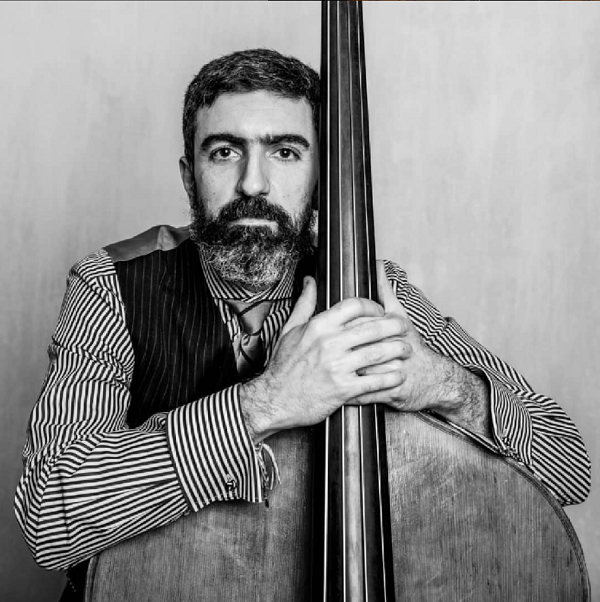
Argentine tango bassist and Latin Grammy winner Pedro Giraudo returned to his roots
Latin Grammy winner Pedro Giraudo spoke exclusively to us for International Salsa Magazine, so we are very pleased to bring you the best of our conversation with the Argentinian bassist and composer. Next, these are the highlights of his beginnings and his exciting career in his native country and in the United States, where he currently resides.

Pedro’s beginnings in music
Pedro comes from a family of musicians. In fact, his father was a bandleader and his mother sang in a choir, so he was surrounded by music practically since he was born. He has memories of him watching his parents rehearse and play instruments when he was very young, so he was always very familiar with this kind of thing.
During his adolescence, he performed recitals with various ensembles, some of which played classical music, jazz, and tango. His professional advancement was very gradual, but he was doing some activities that prepared him for what was to come years later.
His love for this world grew so big that, once he turned 19, he moved to the United States precisely to study music and learn everything he could about what can be expressed through it. His musical interests initially focused on jazz, but that changed over time.
Already at the end of his last year in college in New York, he was working regularly with various groups of different genres.
Interest in tango
Although, as we have said, Pedro comes from Argentina, he had not been particularly interested in tango at first, but his numerous trips around the world made him feel a little uprooted and detached from his beginnings. For this reason, nostalgia made him reconnect with the traditional music of his homeland. In addition, the fact that he was Argentinean encouraged many groups to call him, even though his knowledge of tango was not yet very deep at that time.
After giving himself the opportunity to play tango more formally, he also set to work to study it much more to learn about its most famous composers, its various styles, its ways to write music in the genre, among other things. In addition to that, he started to transcribe a lot of music to know what it sounded like in different styles and to gain practice.
This path eventually led the artist to become part of many tango bands and even to lead some ensembles.

Groups Pedro was in
Pedro’s main goal in arriving in the United States was to become a double bassist, and after finally achieving it, he graduated from college and started to explore his role as a composer and leader of his own ensemble. From there, the band varied for characteristics and changed members and in size over the next 15 years. The last thing was a 17-piece big band.
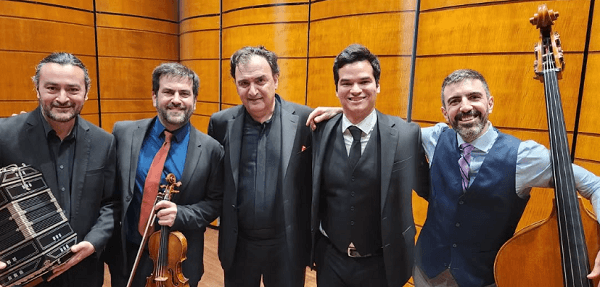
Then, in the year 2014, due to the death of a great friend, Argentine pianist Octavio Brunetti, the Lincoln Center for The Performing Arts asked him to lead an event to celebrate his life and music. Therefore, in 2015, the musician started his tango project, which he would name Pedro Giraudo Tango Quartet, taking this request as a starting point.
Today, he focuses all his efforts on tango ensembles, although he does recognize that he is increasingly angling for the classical side. For example, for his latest album, Pedro used a symphony orchestra, and since the last few months, he has been conceiving his next project with a chamber orchestra.
Great collaborations in his career
Throughout his career, Pedro has been able to work with great music glories such as Paquito D’ D’Rivera, Rubén Blades, Pablo Ziegler, William Cepeda, and many others. One of the nicest things about this work for the Argentine is that he is always surrounded by very talented people from whom he can learn a lot.
One of them was bandoneonist Hector Del Curto, who was one of the first people Pedro started playing tango with in New York. Del Curto, in turn, had the great honor of playing with the greats of the golden age of Argentine music, such as Osvaldo Pugliese.
It was through Hector that Pedro was able to meet and play with Pablo Ziegler, who was the principal pianist of Astor Piazzolla’s Second Quintet and greatly influenced the way tango is played on the piano. In fact, playing along with him on the double bass was an experience of which he learned so much, which he appreciated.

In the case of William Cepeda, the artist made some arrangements for him and he received many valuable lessons from him, such as the importance of keeping musicians engaged with sheet music to prevent them from getting too lax. It was also with Zepeda that he made his first arrangements for a symphony orchestra.
On the other hand, Paquito taught him how to be a practical musician and to make perfect, well done arrangements for any occasion.
Latin Grammy winner
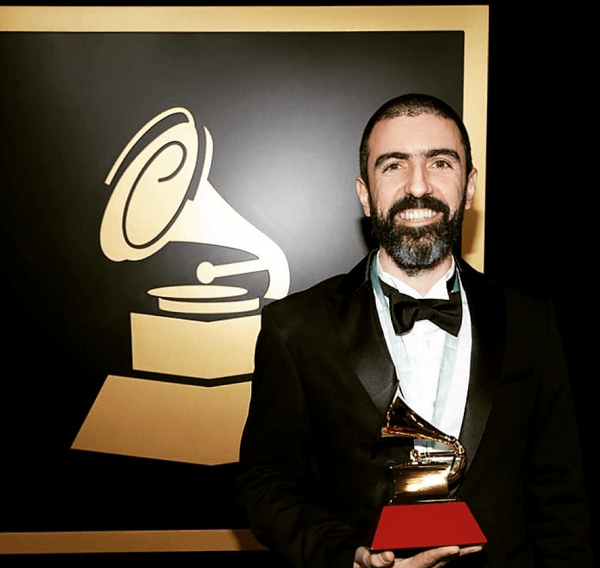
Pedro is fortunate to be a Latin Grammy winner thanks to his album “Vigor Tanguero” in the category Best Tango Album in 2018. When we asked him about his experience, the double bassist said that there are some details he does not fully understand, such as the elements taken into consideration when voting for an artist in a category. However, that did not overshadow the joy of winning such an important award.
He says his victory was a surprise. At the time, he remembers being on tour with Pablo Ziegler, and after a four-hour rehearsal, his phone had about 40 missed calls congratulating him, while he did not even know that the nominations were being announced that day. To his amazement, he was included.
The final event was in Las Vegas, where Pedro finally heard his name and felt a total joy and pride for all he had achieved. In this respect, he said, “I’m not a person who collects awards, but this is a recognition I’m very proud of, to be honest.”
Read also: French flamenco dancer Fanny Ara lets us know the most important details of her career
North America / September 2025
Salsa Sabor
North America / USA /
Salsa Sabor is a voluntary association formed by a group of salsa dancers passionate about sharing salsa with a focus on building New Hampshire’s Salsa Community. With the primary goal of introducing salsa to new people, they strive to provide a place for New Hampshire Salseros to dance without having to go into Massachusetts. They pride themselves on maintaining a friendly welcoming community where all can come to learn to dance.

The members of Salsa Sabor volunteer their time and skills to bring you Copacabana Salsa Nights at the Milly’s Tavern. A free salsa night where people can experience a true salsa night out dancing here in Manchester, NH. They put on events like their annual food drive to support the New Hampshire Food Bank in November to further help the community.
The membership is comprised of a group of experienced dancers, from different backgrounds, each volunteering their time and experience to bring salsa dancing to the community. Every Wednesday the Copacabana Salsa Night starts off with NY On2 club style salsa lessons from 7:45-9pm. Both a Beginner level and an Advanced Beginner/Intermediate level salsa class are taught each night.


On the first Wednesday of the month First Bachata Wednesday is hosted, with a progressive Bachata Lesson before the weekly salsa class in the 6:45-7:45 pm timeslot. No experience is required and no partner is necessary. All you need is the desire to try something new, the willingness to learn and ability to have fun to enjoy your night at Copacabana Salsa Wednesdays.
If you want to know a little more about Salsa Sabor, please go to the following link

http://www.salsasabor.org/ 500 N Commercial St Manchester, NH
Israel “Cachao” López, a Cuban musician and composer, has been hailed as “the Inventor of Mambo”
Born in Havana on September 14, 1918, and passing away in Coral Gables, Miami, on March 22, 2008, Israel “Cachao” López, often known simply as “Cachao,” was a Cuban musician and composer.

He became a legend in Cuban music with his masterful handling of the double bass and was renowned for his performances in mambo and Latin jazz.
His talent earned him two Grammy Awards (in 1995 and 2005), a Latin Grammy in 2003, an honorary doctorate from Berklee College of Music, and a star on the Hollywood Walk of Fame.
He has been described as “the inventor of mambo” and is considered a master of descarga (live improvisations).
He began by playing various instruments until he settled on the double bass, which allowed him, as a teenager, to join the Havana Philharmonic Orchestra, where his father and older brother also played.
“Cachao” left Cuba in 1962 with a long list of successes and stated in a 2007 interview that if it weren’t for his compatriot and colleague Dámaso Pérez Prado, “mambo would not have been heard worldwide.”

His first stop was Madrid, where he stayed for a year before emigrating to the United States. In the U.S., he resided in New York City, Las Vegas, and Miami.
López also played acoustic bass with his brother, the multi-instrumentalist Orestes López. They literally composed over 3,000 songs together and were highly influential in Cuban music from the 1930s to the 1950s.
They created the “nuevo ritmo” (new rhythm) in the late 1930s, which transformed the danzón by introducing African rhythms into Cuban music, ultimately leading to mambo.
He won several Grammy Awards for both his own work and his contributions to albums by Latin music stars, including Gloria Estefan. In 1995, he won a Grammy for Master Sessions Volume 1.
In 2003, he won a Latin Grammy for Best Traditional Tropical Latin Album alongside Bebo Valdés and Patato for El Arte Del Sabor. He won another Grammy in 2005 for his work ¡Ahora Sí!
His nephew, Orlando “Cachaíto” López, became one of the pillars of the famous Buena Vista Social Club.
Cachao performed with artists such as Tito Puente, and his music has been featured in films like The Birdcage and the soundtrack of the video game Grand Theft Auto: Vice City.
The Actor Andy Garcia produced a documentary titled Cachao… “Como Su Ritmo No Hay Dos” in 1993 about his music. He also shared stages with Celia Cruz and her husband Pedro Knight, as well as with trombonist Generoso Jiménez.

His last musical collaboration was with Gloria and Emilio Estefan on the singer’s album titled 90 Millas.
López passed away on the morning of March 22, 2008, in Coral Gables, Florida, at the age of 89, due to complications following kidney failure.
Cachao y Su Ritmo Caliente – Monte Adentro (2000)
Tracks:
- Monte Adentro (Cógele el golpe) (A. Castillo Jr.)
- Goza Mi Trompeta (O. Estivill)
- Guajeo de Saxos (E. Peñaver)
- Estudio en Trompeta (I. López)
- Gozar Timbero (O. Estivill)
- Trombón Criollo (O. Portillo)
- Malanga Amarilla (S. Contreras)
- Controversia de Metales (I. López)
- Descarga Cubana (O. Estivill)
- Pamparana (A. López)
- Sorpresa de Flauta (O. Estivill)
- Oye Mi Tres Montuno (A. Echevarria)
- La Floresta (O. López)
- Avance Juvenil (B. López)
- Redención (O. López)
- Descarga Mambo (D.P.)
Musicians:
- Israel López “Cachao” (Double Bass)
- Guillermo Barreto (Timbales)
- Tata Güines (Tumbadora)
- Rojelio “Yeyo” Iglesias (Bongos)
- Gustavo Tamayo (Güiro)
- Alejandro “El Negro” Vivar (Trumpet)
- Armando Armenteros (Trumpet)
- Generoso “El Tojo” Jiménez (Trombone)
- Oreste López (Piano)
- Enemelio Jiménez (Alto Sax)
- Emilio Peñalver (Tenor Sax)
- Virgilio Lisama (Baritone Sax)
- Richard Egües (Flute)
- Niño Rivera (Tres)
- Roliyo y Reyes (Chorus)
Recorded in Havana, 1957-1958

The tradition of being musicians comes from grandparents and great-grandparents, all the Cachaos are musicians.
By: