• Skip to primary navigation
  • Skip to main content

International Salsa Magazine

  • HOME
  • Previous editions
    • 2026
      • ISM / March 2026
      • ISM / February 2026
      • ISM / January 2026
    • 2025
      • ISM / December 2025
      • ISM / November 2025
      • ISM / October 2025
      • ISM / September 2025
      • ISM / August 2025
      • ISM / July 2025
      • ISM / June 2025
      • ISM / May2025
      • ISM / April 2025
      • ISM / March 2025
      • ISM / February 2025
      • ISM / January 2025
    • 2024
      • ISM / December 2024
      • ISM / November 2024
      • ISM / October 2024
      • ISM / September 2024
      • ISM / August 2024
      • ISM / July 2024
      • ISM / June 2024
      • ISM / May 2024
      • ISM / April 2024
      • ISM / March 2024
      • ISM / February 2024
      • ISM / January 2024
    • 2023
      • ISM / December 2023
      • ISM / November 2023
      • ISM / October 2023
      • ISM – September 2023
      • ISM – August 2023
      • ISM July 2023
      • ISM Edition June 2023
      • ISM – May 2023
      • ISM April 2023
      • ISM March 2023
      • ISM February 2023
      • ISM January 2023
    • 2022
      • ISM December 2022
      • ISM November 2022
      • ISM October 2022
      • ISM September 2022
      • ISM August 2022
      • ISM July 2022
      • ISM June 2022
      • ISM May 2022
      • ISM February 2022
      • ISM January 2022
    • 2021
      • ISM December 2021
      • ISM November 2021
      • ISM October – 2021
      • ISM September 2021
      • ISM August 2021
      • ISM July 2021
      • ISM May 2021
      • ISM April 2021
      • ISM June 2021
      • ISM March 2021
      • ISM February 2021
      • ISM January 2021
    • 2020
      • ISM December 2020
      • ISM November 2020
      • ISM October 2020
      • ISM September 2020
      • ISM August 2020
      • ISM July 2020
      • ISM June 2020
      • ISM May 2020
      • ISM April 2020
      • ISM March 2020
      • ISM February 2020
      • ISM January 2020
    • 2019
      • ISM December 2019
      • ISM November 2019
      • ISM October 2019
      • ISM Septembre 2019
      • ISM August 2019
      • ISM July 2019
      • ISM June 2019
  • Spanish
  • Download Salsa App
    • Android
    • Apple

Search Results for: dance

Legacy of the Cepeda family after eight generations

As all our readers may know, this is a space devoted entirely to the promotion of salsa and other derivative styles, but that does not mean we should leave out other Latin genres that also deserve to be promoted and recognized worldwide. Such is the case of bomba and plena, which we are going to talk about in the next lines.  

Bomba and plena are two Puerto Rican musical genres that initially became popular at the local level, but little by little, they have received international notoriety thanks to certain groups of Puerto Ricans who have devoted considerable effort to take their culture to as many places as possible in the world. This is how we get to the theme of the Cepeda family and all that its members have done for bomba and plena.  

Bárbara and Margarita
Bárbara Liz Ortiz Sánchez and his mother Margarita ”Tata” Cepeda

The Cepeda Family  

The Cepeda family is a cultural institution that has been given the task of promoting bomba and plena for eight generations, so that they can be heard and danced all over the world. Don Rafael Cepeda Atiles, a professional musician and composer with an extensive career who has left a great legacy thanks to his hard work during his lifetime, which keeps current thanks to his descendants. 

When he married Caridad Brenes Caballero, he involved her in all his artistic activities and became a fundamental support for the musician in his work. The lady became a professional bomba and plena dancer, costume designer, and choreographer, which made her shine with her own light in every project directed by her talented husband.  

During his career, Don Rafael created several musical groups and, over the years, he and his wife involved their children and other family members to collaborate in what would become a renowned family business. 

One of the artist’s greatest achievements was the development of a cultural movement around the rescue and preservation of local traditions related to bomba and plena, which were thought to be lost. He was also decorated with the Smithsonian Institute’s National Endowment for the Arts Fellowship for his contributions to music. 

All this legacy remained in the hands of Don Rafael’s family and one of the first to do something about it was his son Modesto, who founded the Escuela de Bomba y Plena Don Rafael Cepeda in Santurce, Puerto Rico. This institution was created in order to teach bomba and plena in the areas of dance and percussion. 

Those who would follow these steps would be Margarita ”Tata” Cepeda, granddaughter of Don Rafael and Caridad, and Barbara Liz Ortiz Sanchez, great-granddaughter of Don Rafael and Caridad. Margarita currently runs the Escuela de Bomba y Plena Doña Caridad Brenes de Cepeda and her daughter, Barbara Liz, runs the Escuela de Bomba y Plena Tata Cepeda in the state of Florida. It was precisely the latter with whom we had the pleasure to talk about this project and the plans she has for the future.  

Bárbara and her bomba custome
Bárbara Liz wearing her bomba attire

Barbara Liz from the Escuela de Bomba y Plena Tata Cepeda 

Barbara Liz belongs to the seventh generation of the Cepeda family and her children, who also dance bomba and plena, would belong to the eighth generation. She says that each family member has tried to endorse Don Rafael’s legacy in their own way. In her particular case, she has spent five years running the Escuela de Bomba y Plena Tata Cepeda in Florida, which she decided to baptize with his mother’s nickname, which is Tata, to pay tribute to her in life.   

Although the operation of her school and his mother’s are different, they usually work together in cases that require it. For example, if for some reason a student cannot pursue his education here because he is going to Puerto Rico, he can continue studying at the school located on the Island of Enchantment without any problem.   

”We didn’t have a curriculum or educational program to follow to teach bomba and plena, but my mom was responsible for creating one so that we could teach dance and percussion with a clearer methodology,” said Bárbara Liz. 

As a result of Hurricane Maria, many Puerto Rican families went to live in Florida due to the loss of their properties and material things, so the students of the school in Puerto Rico became able to enroll in the Florida school instead. It can be said that they are sister schools working together towards the same goal.   

Percussion and dance in bomba and plena  

Something Bárbara Liz wanted to highlight about this point is that many girls are enrolling in her school to learn to play percussion, something that did not happen very often. 

At other times, it was believed that percussion in bomba and plena was exclusively for men and dance for women. In more conservative versions of these genres, women only sang and men were responsible for dancing and playing instruments. 

That has been changing over time. Nowadays, there are many guys who are setting their sights on dancing and many girls are having an interest in the percussion part. Every day, the female part is becoming more and more relevant in the different areas of bomba and plena.  

In addition to all this, the institution’s teachers also teach quite a bit about the emergence and history of these two genres, so that their students are not just dedicated to playing and dancing, but also know the origin of everything they learn now.   

Differences and similarities between bomba and plena 

When we wanted to know a little about the differences and similarities between bomba and plena, Bárbara Liz explained to us that both genres were very different from each other. The rhythms, the instruments used and the ways of dancing have many differences in both.   

In the case of bomba, this is the oldest musical genre and dance in Puerto Rico and is born from a barrel-shaped instrument, which is one of its most representative elements. It is also known as the ”first sung newspaper”.  

Similarly, it is the dancer who sets the pace for the percussionist, not the other way around. The musician should be guided by the footsteps of the dancer, which often gives rise to completely new rhythms.   

Plena was born a few years later with certain variants of bomba and is called the ”second sung newspaper”. It was plena that inspired several of the Cepeda family members to create their own groups such as the Grupo Gracimá (a variant of bomba), which originated in the school owned by Margarita in Puerto Rico.  

In contrast, Bárbara Liz named her professional group Kalindá in honor of one of the most popular variants of bomba. 
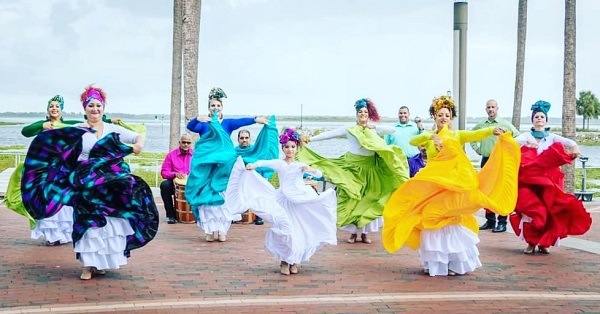
Bárbara and Kalindá
Bárbara Liz and her professional group Kalindá

Tributes 

Something that makes Bárbara Liz very proud is that both she and her mother had the opportunity to go to the Smithsonian National Museum in March to pay tribute to their ancestors and the genres that her great-grandfather promoted so much in life. 

At the time, Don Rafael donated some items related to bomba and plena such as barrels, a güiro and barrels However, some bomba costumes were missing to complete the collection, which were given by Bárbara Liz and Margarita to be exhibited in the institution, so anyone interested in learning more about Puerto Rican genres and musical culture can visit the place and cherish these valuables. 

Read also: Yani Borrell ‘‘El Elegante de La Salsa”
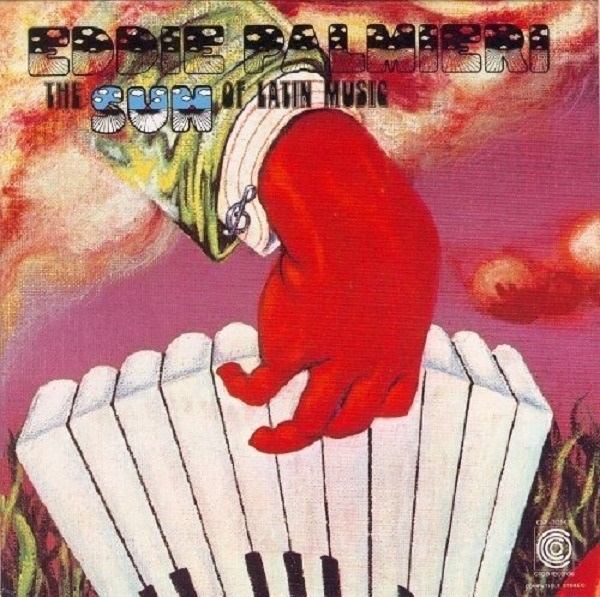
“The Sun of Latin Music” the first Grammy Award for Salsa Eddie Palmieri’s historic album

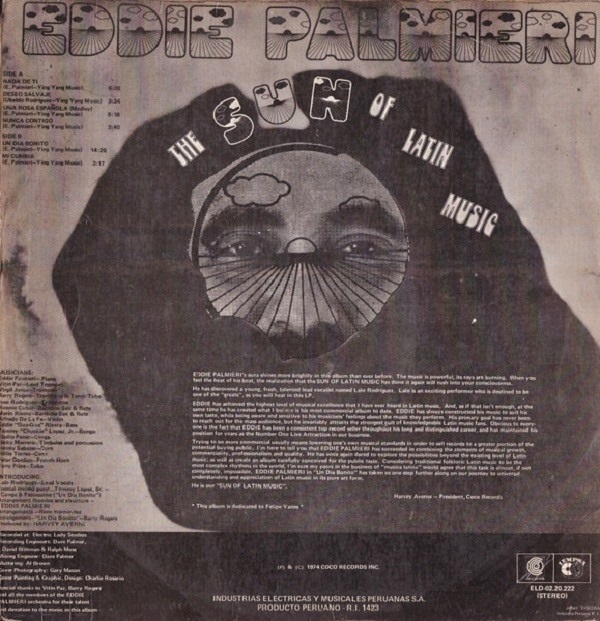
It has been 49 years since “The Sun of Latin Music”, Eddie Palmieri’s historic album, which marked a fundamental milestone in the history of Latin music by becoming the first production to win a Grammy Award in the category of Best Latin Recording, awarded on February 28, 1976.

"The Sun of Latin Music" the first Grammy of Salsa Eddie Palmieri's historic album
“The Sun of Latin Music” the first Grammy of Salsa Eddie Palmieri’s historic album

Recorded in New York at Electric Lady Studios, the album was released by Coco Records on Wednesday, September 18, 1974.

The album featured vocals by Lalo Rodríguez, who was only 16 years old at the time.

It includes: ‘Nada De Ti’, ‘Deseo Salvaje’, ‘Una Rosa Española’, ‘Nunca Contigo’, ‘Un Día Bonito’, ‘Mi Cumbia’.

“The Sun of Latin Music” proved to the world that Latin music, especially Salsa, was an honorable art form and opened the doors for many other Latin artists to receive solid recognition for their talent and work.

Eddie Palmieri

The sun of Latin music

MP, 1990. MP-3109 CD

Recorded in 1975

The Sun of Latin Music was a controversial album. It was too far from the easy formula of the middle salsa boom – what César Miguel Rondón calls the “mtancerization of salsa”.

“Ahead of its time” was one of the comments; “a piece like Un día bonito, had to be mutilated” with a 6-minute piano intro just to be able to play it on the radio; a danzón (Una rosa española) with lyrics by the Beatles; a cumbia that is not very Colombian, despite the name (Mi cumbia) and the chorus that says “very Colombian…”.

Nevertheless, this album represents the strength of the spirit of salsa: the encounter between the harshness of the street and the majesty of the most sophisticated musical sound.

One of the best albums of Caribbean music ever released.

Palmieri was always in search of something new. The Sun Of Latin Music is the culmination of a phase that began with an earlier album, Sentido (1974).

This time he chose the Panamanian Vitín Paz for the trumpet solo, Barry Rogers for his trombone and an unusual tuba, which formed a kind of basso continuo, and besides Barry, José Rodrigues, who for a long time was, and despite his absence still is, his most emblematic trombonist.

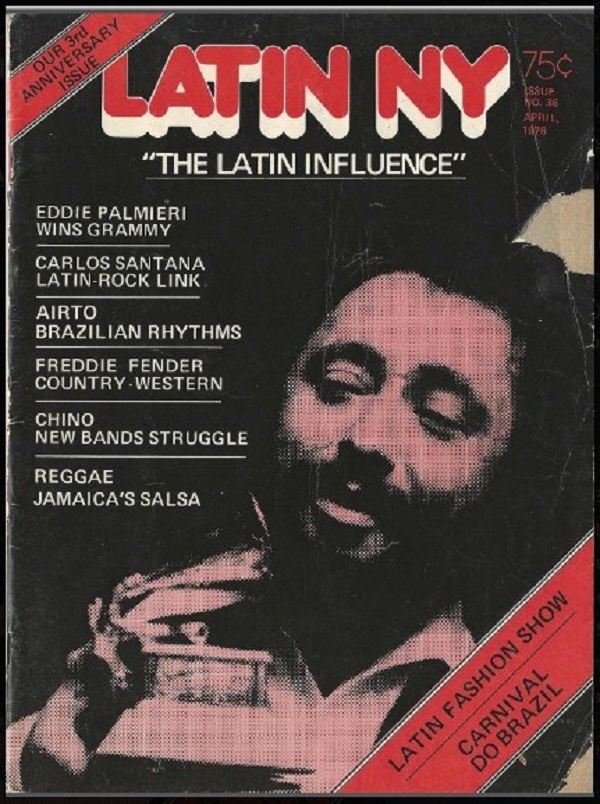
Cover of issue 36 of Latin New York magazine (April 1976) where Eddie Palmieri appears.

Ronnie Cuber and Mario Rivera were chosen as the first saxophonists in a Palmieri orchestra.

For many it is Palmieri’s best album, the most experimental and universal. One that borders on academic music, but without forgetting the dancer.

With spices like the violin of Alfredo de la Fe, who contributes his creativity everywhere, the tuba, the penetrating power of the brass, the overwhelming percussion.

Thus, Una rosa española is a modern danzón that later becomes a montuno that revives the joyful Palmerian game with the dignified uproar of trumpets, saxophones and trombones.

A young man of only 17 years, Lalo Rodríguez, who years later would become the standard-bearer of what was called salsa erotica, was chosen as the singer. Another novelty: the timbre of his voice, with a very high register, and the way he faced the montuno, which did not correspond to his age, caused different reactions.

But the most amazing thing about this 1974 album is the 14:20-minute track Un día bonito, arranged by Barry Rogers, which would keep even the most trained dancers busy. But Palmieri wasn’t just thinking about leg sets or dance floors.

The piece begins with a long piano interlude, the same structure he used in the track Adoración from the album Sentido, which would mark a new musical phase in his career.

It was more than experimental, it had some electro-acoustic music; no one had ever had the audacity to do that on a salsa album. Palmieri made the leap, he could do it, it sounded more like Stravinsky or Milhaud than Puente or Fania.

Suddenly, back in the piece, the orchestra bursts in, harder and heavier than ever, wishing the city of Los Angeles a beautiful day and San Francisco a “warm greeting,” and it is certain that Keruack and Borrough heard the call.

First Eddie Palmieri Grammy

Then Eddie Palmieri was consecrated by the intellectuals and the educated and also by the Grammy.

Eddie Palmieri

The sun of Latin music

Produced by Harvey Averne

Eddie Palmieri: piano

Lalo Rodríguez: vocals

Vitín Paz: trumpet

Virgil Jones: trumpet

Barry Rogers: trombone, tenor tuba

José Rodrigues: trombone

Ronnie Cuber: Baritone Saxophone, Flute

Mario Rivera: Baritone Saxophone, Flute

Alfredo de la Fe: Violin

Eddie Guagua Rivera: Bass

Tommy Chuckie Lopez, Jr.: Bongo

Eladio Pérez: conga

Nicky Marrero: timbales, percussion

Peter Gordon: French Horn

Tony Price: Tuba

Jimmy Sabater: Chorus

Willie Torres: Chorus

Tommy López Sr.: conga

Tracks: Nada de ti; Deseo salvaje; Una rosa española; Nunca contigo; Un día bonito; Mi cumbia

Arrangements by René Hernández and Barry Rogers

One of the most valuable pieces in the exhibition “Rhythm and Power: Salsa in New York”, which will be presented until next November at the Museum of the City of the Big Apple, is the first Grammy in the history of Latin music, awarded in 1976 to Eddie Palmieri for his album “Sun of Latin Music”.

“The Sun of Latin Music”

Sources:

Anapapaya

Salsero Radio

D j. Augusto Felibertt

Also Read: Salsa and its detractors “Caiga quien Caiga”

José Alberto “El Canario” and his orchestra enjoy a great international reputation in the Latin music scene.

His start in music was as a drummer, then as a bongo player, with some 48 years in Latin music and as a sonero, today in International Salsa Magazine through www.salsagoogle.com, José Alberto Justiniano Andújar, better known artistically as José Alberto El Canario, was born on December 22, 1958 in Villa Consuelo in Santo Domingo Dominican Republic.

José Alberto El Canario

El Canario began to have a passion for music from a very young age, first playing drums, bongo and timbales, at the age of 7 his mother Adalgisa, recognized dancer of the golden age of “Radio-Televisión Dominicana”, took him to live on the island of Puerto Rico, as a professional dancer she had to perform in important international theaters.

El Canario began to study in a military school in Las Antillas, then in 1970 he moved with his father to New York, where he began to sing with several orchestras, receiving international attention as the leader of the Típica 73 in October 1977, where he earned 25 dollars for each presentation and recognized it as his university in the life of art.

José Alberto credits his compadre Roberto Geronimo for his successful artistic career. Geronimo discovered him as an artist and managed him for many years. El Canario also sang merengue at the onset of his musical journey.

In 1983, José Alberto established his own band and gained fame as a major Latin star after his debut album Noches Calientes released in 1984.

Jose Alberto is a renowned singer who has recorded numerous chart-topping hits, including “Sueño Contigo”, “Hoy Quiero Confesar”, “Te Voy a Saciar de Mi”, “A Gozar”, “Es Tu Amor”, and “Quieres Ser Mi Amante”, among others, for his 1988 album Sueño Contigo and several others.

His inimitable voice and unmatched improvisational skills have earned him international acclaim. Jose Alberto has collaborated with several contemporary artists such as Johnny Rodriguez, Mario Rivera, Nicky Marrero, Oscar D’Leon, and Celia Cruz.

El Canario began to have a passion for music at a very young age, first playing drums, bongo drums and timbales.

José Alberto “El Canario” has earned multiple gold and platinum records due to his high number of album sales.

He has achieved success not only in the United States and Europe but also throughout Latin America, including his native Dominican Republic, Puerto Rico, Peru, Venezuela, Panama, Colombia, Ecuador, and Costa Rica.

The nickname “El Canario” was bestowed upon him by a New York disc jockey who christened him so in a disco due to his improvisational skills; “Canta canario” was the catchphrase he would belt out through the control microphone.

José Alberto ‘El Canario’ and his Orchestra have gained immense international recognition in the Latin music industry.

His musical prowess and captivating voice make his live shows some of the most thrilling performances.

El Canario, winner of the “Congo de oro” in 2005 – an award given to the best musical groups presented at the Festival de Orquestas del Carnaval de Barranquilla – and of three Latin Grammys in 2013, 2015 and 2018, is one of the undisputed artists of Latin music with a career spanning some 48 years.

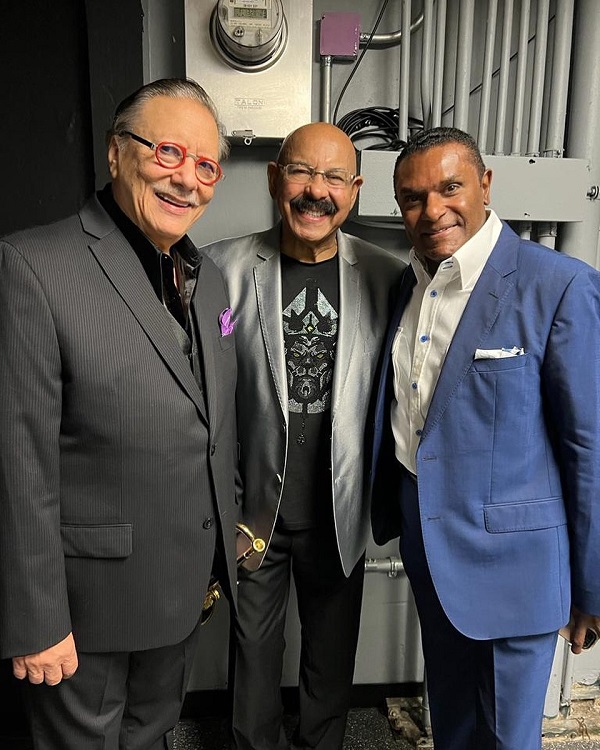
Arturo Sandoval, Oscar D' Leon y El Canario
Arturo Sandoval, Oscar D’ Leon y El Canario

Throughout his career, José Alberto El Canario has gained international recognition for his unique voice and style, but also, according to his biographies, for his improvisations on stage.

José Alberto El Canario y su Orquesta enjoys great international renown in the Latin music scene.

Also Read: Jimmie Morales a conguero for the history of Afro-Caribbean music

Omslig D’ León: “I am the son of the sonero of the world, but I have my own style and I am creating my own musical history

Omslig D’ León enters the world of musical art hand in hand with his father Oscar D’ León, who works functionally as a dancer, choreographer, percussionist, background singer and singer, this young Venezuelan talent has already traveled the world in its breadth and length, through almost all the countries of North America, Europe and Latin America.

Omslig decided to start his career as a soloist and create his own history with new challenges, forming his own orchestra with his own compositions, innovating with his own unique and international style.

Omslig D' León I am the son of the sonero of the world
Omslig D’ León I am the son of the sonero of the world

“He recently toured Europe for more than two months, including performances in Switzerland, Germany, Italy and Istanbul”.

“And with you, the sonero of the world, Oscar D’ León. Any Venezuelan or fan of the emblematic salsero from Caracas would be thrilled to hear such a presentation, but when you carry his blood, the adrenaline is even greater. His son, Omslig, explained it this way.

It was inevitable that I would become a musician. It’s not just my father, Oscar, it’s my mother, it’s my whole family that has music in their blood,” said the son of one of the most important salsa musicians in history.

Omslig, who began his musical career at the age of 16 as a lectern player in his father’s orchestra, with which he toured the world for 23 years, was in Panama to promote his solo career, which recently took him on a European tour that included Italy, Switzerland, Germany and Istanbul, among other countries.

He will stay a while longer in the isthmus, a country that he says has treated him wonderfully, and then he will travel to Peru and Colombia. “People will think that I am 100% influenced by my father.

Although I learned a lot from him, especially responsibility, I have my own style,” said the director of the orchestra La Melena, referring to his musical project in which he covers songs by various artists, including Panamanian Omar Alfano and Venezuelan Frank Quintero.

Omslig D' León I am the son of the sonero of the world, but I have my own style.
Omslig D’ León I am the son of the sonero of the world, but I have my own style.

Not everything is rosy.

Being the son of Oscar D’ León can be very good, but it can also be difficult. He recalled that in the past there were people who “wanted to throw his last name in his face.

“Don’t think that because you’re Oscar’s son it’s going to be easy. I don’t think you sing the same as your father. Things like that have been said to me, but I have moved forward and thank God with his support and a unique style,” he explained.

For those who think that everything has been handed to him on a silver platter, he wanted to leave this anecdote from when he was in Oscar D’ León’s band. “We were in the Canary Islands, we had already finished the show and the next day, very early, we had to take the ferry to another island.

I fell asleep and my dad dropped me off. In the lobby he left me a note saying ‘you have to learn to be responsible’ and that marked me. Then I was able to make it, but I had to pay for everything.

¿Reencuentro de Leones?

Omslig admitted that he would like to reunite with his “soul mate”, his brother Yorman, to start a musical project and, if the opportunity arises, with Iroska, better known as “La Mazucamba”, Oscar’s daughter, who currently lives in the United States.

“A few days ago my dad called me to tell me that why don’t we do something together and the truth is that it would be great. We’ll see, but it was there and something important is going to happen,” he explained.

For now, Omslig is concentrating on his work as a soloist, with several confirmed performances, and continuing his work as a father, already with three children and happily married.

“I will continue to sing my father’s songs, I will continue to keep his name high, but with the tasty and fusion style of Omslig D’ León,” concluded the 42-year-old native of Caracas.

Omslig León enters the musical artistic world hand in hand with his father Oscar D' León.
Omslig León enters the musical artistic world hand in hand with his father Oscar D’ León.

In a few words

One place: Milan, Italy.

One food: lasagna.

Artist: Luis Enrique.

A person you admire: Will Smith.

A musician: Robert Vilera.

Hobby: Painting.

Why Omslig: Oscar, Moises (paternal grandfather) and Ligia (mother).

Also Read: Freddy de Jesús Ortega Ruiz “Coco & su Sabor Matancero”

Sources:

Peggy Blanco (Manager)

Panama El Venezolano

Latin America / November 2023

Omsling D'Leon November 2023

Hildemaro November 2023

José Alberto "El Canario" and his orchestra enjoy a great international reputation in the Latin music scene"The Sun of Latin Music" the first Grammy Award for Salsa Eddie Palmieri's historic album

Déjalo, the latest track by Pedro Conga y su Orquesta Internacional

Metamorphosis: from music to photojournalism, a reinvention without limits.

Calibrated maracas

DIRECTORY OF NIGHTCLUBS

Argentina flag
ARGENTINA

Aruba circular flag
ARUBA

Belize circular flag
BELIZE

Bolivia circular flag
BOLIVIA

Brazil flag
BRAZIL

Chile circular flag
CHILE

Colombia
COLOMBIA

Costa Rica circular flag
COSTA RICA

Cuba circular flag
CUBA

Dominican Republic
DOMINICAN REPUBLIC

Ecuador circular flag
ECUADOR

Guatenala circular flag
GUATEMALA

Mexico Circular flag
MEXICO

Panama circular flag
PANAMA

Peru circular flag
PERU

Puerto Rico circular flag
PUERTO RICO

Venezuela circular flag
VENEZUELA
NOVEMBER 2023 FESTIVALS

Cuba circular flag
CUBA
Baila en Cuba

Memories Miramar La Habana Hotel

Nov 19 2023 – Nov 24 2023

4H56+4VQ, Quinta avenida entre 72 y 76 Fraccionamiento

Miramar, La Habana 11300, Cuba

Mexico Circular flag
MEXICO
Big Salsa Caribbean

Tijuana Dance Open

BIG Salsa Festival Caribbean Cancun

Nov 02 2023 – Nov 06 2023

368C+H7, km 17, Blvd. Kukulcan, Zona Hotelera, 77500

Cancún, Q.R., Mexico


Tijuana Salsa Bachata Kizomba Festival

Nov 09 2023 – Nov 13 2023

Hotel Gamma De Fiesta Inn Otay
Blvd. Tijuana 17226

Tijuana , Mexico, 22430

Uruguay Flag
URUGUAY
USC

Uruguay Salsa Congress

Nov 21 2023 – Nov 26 2023

Punta del Este Convention Center
Av. Pedragosa Sierra esq. Aparicio Saravia

Punta del Este, Uruguay


  • « Go to Previous Page
  • Page 1
  • Interim pages omitted …
  • Page 76
  • Page 77
  • Page 78
  • Page 79
  • Page 80
  • Interim pages omitted …
  • Page 165
  • Go to Next Page »

International Salsa Magazine (ISM) is a monthly publication about Salsa activities around the world, that has been publishing since 2007. It is a world network of volunteers coordinated by ISM Magazine. We are working to strengthen all the events by working together.