• Skip to primary navigation
  • Skip to main content

International Salsa Magazine

  • HOME
  • Previous editions
    • 2026
      • ISM / May 2026
      • ISM / April 2026
      • ISM / March 2026
      • ISM / February 2026
      • ISM / January 2026
    • 2025
      • ISM / December 2025
      • ISM / November 2025
      • ISM / October 2025
      • ISM / September 2025
      • ISM / August 2025
      • ISM / July 2025
      • ISM / June 2025
      • ISM / May2025
      • ISM / April 2025
      • ISM / March 2025
      • ISM / February 2025
      • ISM / January 2025
    • 2024
      • ISM / December 2024
      • ISM / November 2024
      • ISM / October 2024
      • ISM / September 2024
      • ISM / August 2024
      • ISM / July 2024
      • ISM / June 2024
      • ISM / May 2024
      • ISM / April 2024
      • ISM / March 2024
      • ISM / February 2024
      • ISM / January 2024
    • 2023
      • ISM / December 2023
      • ISM / November 2023
      • ISM / October 2023
      • ISM – September 2023
      • ISM – August 2023
      • ISM July 2023
      • ISM Edition June 2023
      • ISM – May 2023
      • ISM April 2023
      • ISM March 2023
      • ISM February 2023
      • ISM January 2023
    • 2022
      • ISM December 2022
      • ISM November 2022
      • ISM October 2022
      • ISM September 2022
      • ISM August 2022
      • ISM July 2022
      • ISM June 2022
      • ISM May 2022
      • ISM February 2022
      • ISM January 2022
    • 2021
      • ISM December 2021
      • ISM November 2021
      • ISM October – 2021
      • ISM September 2021
      • ISM August 2021
      • ISM July 2021
      • ISM May 2021
      • ISM April 2021
      • ISM June 2021
      • ISM March 2021
      • ISM February 2021
      • ISM January 2021
    • 2020
      • ISM December 2020
      • ISM November 2020
      • ISM October 2020
      • ISM September 2020
      • ISM August 2020
      • ISM July 2020
      • ISM June 2020
      • ISM May 2020
      • ISM April 2020
      • ISM March 2020
      • ISM February 2020
      • ISM January 2020
    • 2019
      • ISM December 2019
      • ISM November 2019
      • ISM October 2019
      • ISM Septembre 2019
      • ISM August 2019
      • ISM July 2019
      • ISM June 2019
    • 2016
      • ISM December 2016
  • Spanish
  • Download Salsa App
    • Android
    • Apple

Search Results for: live music

Once again, maestro Bobby Valentín delivers a very daring and innovative musical theme


While it is true that salsa is very much alive, it is also true that it has been enriched through fusions and transformations.  Of course, this is not the first time we see that the salsa sound is transformed to give way to increasingly daring musical themes.   

I’ve said it before and I’ll say it again: “I’m glad there are collaborations where the wallet of other sounds invests in producing music that I enjoy.  Note that the only music I enjoy with the passion I enjoy nothing else is salsa.  This salsa I’m talking about also includes fusions and other inventions, as long as I like them.”

Well, let’s get to the mambo….

During the “Tropical Music Festival” I was backstage and was able to share with the musicians before and after their performances.  That privilege gave me the opportunity to talk to them about their projects, among other things.  On a side note, Oria Rivera graciously let me know about the release that same day of Bobby Valentin’s latest single.  As soon as I got home I listened to the song via You Tube.

Once again, maestro Valentín delivers a very daring and innovative song. I know that “chinchas” are going to fall on me as usual; but without being repetitive, you know that I am one of those who believe that Valentin is never wrong. 
Let’s establish that boogaloo or bugaloo is a Latin music and dance genre that was popular in the United States in the 1960s. It originated in New York City, mainly among Hispanic and Latin American teenagers. The style was a fusion of popular African-American rhythm and blues (R&B), in turn combining soul music with mambo and son montuno.

In the 1950s and 1960s, African Americans in the United States listened to various styles of music, including jump blues, R&B and doo-wop. Latinos in New York City shared those tastes, but also listened to genres such as mambo and cha-cha-chá. There was a mix of Puerto Ricans, Cubans and African-Americans in clubs, whose groups tried to find common musical ground. In the end, boogaloo or bugaloo was the common musical ground, a fusion of many styles cooking American son montuno, guaguancó, guajira, guaracha, mambo, R&B and soul on the same stove.  That must have been the reason why the boogaloo or bugalú allowed Spanish and English on equal terms.

As you can see, fusions are not a recent fad.

Well then.  The time has come to tell you what my salsa ears have heard, since there will be those who say that this is not a salsa song.  Well, the truth of the matter is that it is not suitable for salseros without musical appreciation skills.

From the first bars of this song, Bobby Valentín’s musical arrangement highlights the bass, accompanied by trumpets and saxophones in an arrangement that sounds great.  In the first thirty seconds of the song you can appreciate the vocal part of the composer -Bobby Valentín- ultra well accompanied by his most recent acquisition for the front of his orchestra: Leró Martínez. And for the most skeptical, Bobby and Leró sing in impeccable English.

The song is perfect, since in three minutes it opens up a range of musical possibilities in “English without barriers”.  Despite the brevity of the song, it lacks nothing.  Nor does it feel or sound like musical creativity was curtailed by trying to shorten the time.  The track flows naturally from the prelude, to the mambo, to the closing. At one and a half minutes, the saxophones provide the melody and the trumpets the breaks.  At the fiftieth minute, the trumpets play challenging the rhythm section, formed by:  Victor Roque on the tumbadoras, Kevin Vega on the timbal and Javier Oquendo on the bongo. Ceferino Cabán’s piano complements the “king’s” bass in a masterful way.

Shortly after the second minute (2.19), Victor “Yuca” Maldonado’s baritone saxophone sets the stage for Julito Alvarado and Angie Machado’s trumpets to firmly establish their presence.  This second minute also highlights the dynamism of the trombone by Eliut Cintrón. Let’s not forget that the composer, arranger, producer and bassist of this song was a trumpet player in his beginnings. At exactly 2.40 the bass takes command of the orchestra with more forcefulness, melodically allying itself with the sound of the trumpets and saxophones. Well into the second minute (2.44) the electric guitar in command of Javier Perez begins a correspondence with the bass, which is maintained until the closing of the song.

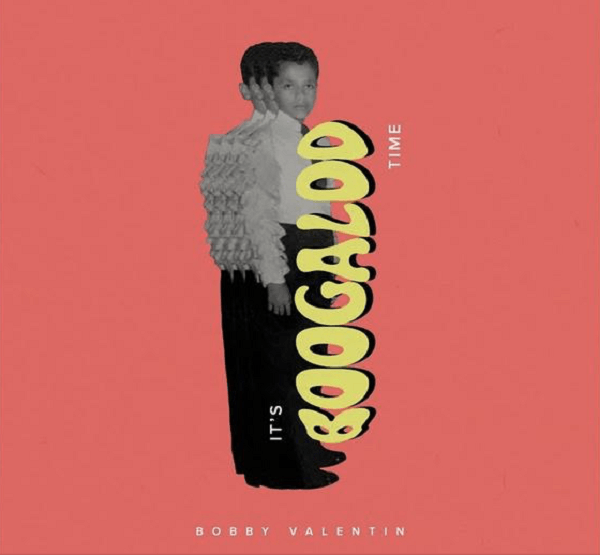
As for the cover art, it features a childish Bobby Valentine dressed as a musical celebrity.  The boy wears dark pants and a white shirt with those stylish puffed sleeves that scream mambo.  The title letters, which read It’s Boogaloo time are superimposed over the child’s image.  The style of the yellow letters that inscribe the word Boogaloo over the image described above make me imagine letters in some liquid material. The composition of the artwork rests on a rather garish salmon-colored background. According to the credits, both the graphic design and art direction were created by Orialis Valentin. Brava!

If you are one of those who say you are tired of the same old same old, I challenge you to listen to this gem, just as I recommended El Twist a while back. 
Salsa lives! I hope I have dispelled your doubts, if you had any.  If you still have any doubts, I confirm that you are not ready for this salsa conversation.

Musical Director: Bobby Valentín

Audio Recording & Mixing: Play Bach Studio

Engineer Carlitos Velázquez and Ramón Martínez

Mastering: WAVEM Acoustic LLC; Eduardo Ramos

Producer: Bobby Valentín

© 2022, Bronco Records, Inc. (Artist: Bobby Valentín)


By Bella Martinez, ISM Correspondents, San Juan, Puerto Rico


Once again, maestro Bobby Valentín delivers a very daring and innovative musical theme

While it is true that salsa is very much alive, it is also true that it has been enriched through fusions and transformations.  Of course, this is not the first time we see that the salsa sound is transformed to give way to increasingly daring musical themes.   

I’ve said it before and I’ll say it again: “I’m glad there are collaborations where the wallet of other sounds invests in producing music that I enjoy.  Note that the only music I enjoy with the passion I enjoy nothing else is salsa.  This salsa I’m talking about also includes fusions and other inventions, as long as I like them.”

Well, let’s get to the mambo….

During the “Tropical Music Festival” I was backstage and was able to share with the musicians before and after their performances.  That privilege gave me the opportunity to talk to them about their projects, among other things.  On a side note, Oria Rivera graciously let me know about the release that same day of Bobby Valentin’s latest single.  As soon as I got home I listened to the song via You Tube.

Once again, maestro Valentín delivers a very daring and innovative song. I know that “chinchas” are going to fall on me as usual; but without being repetitive, you know that I am one of those who believe that Valentin is never wrong. 

Let’s establish that boogaloo or bugaloo is a Latin music and dance genre that was popular in the United States in the 1960s. It originated in New York City, mainly among Hispanic and Latin American teenagers. The style was a fusion of popular African-American rhythm and blues (R&B), in turn combining soul music with mambo and son montuno.

In the 1950s and 1960s, African Americans in the United States listened to various styles of music, including jump blues, R&B and doo-wop. Latinos in New York City shared those tastes, but also listened to genres such as mambo and cha-cha-chá. There was a mix of Puerto Ricans, Cubans and African-Americans in clubs, whose groups tried to find common musical ground. In the end, boogaloo or bugaloo was the common musical ground, a fusion of many styles cooking American son montuno, guaguancó, guajira, guaracha, mambo, R&B and soul on the same stove.  That must have been the reason why the boogaloo or bugalú allowed Spanish and English on equal terms.

As you can see, fusions are not a recent fad.

Well then.  The time has come to tell you what my salsa ears have heard, since there will be those who say that this is not a salsa song.  Well, the truth of the matter is that it is not suitable for salseros without musical appreciation skills.

From the first bars of this song, Bobby Valentín’s musical arrangement highlights the bass, accompanied by trumpets and saxophones in an arrangement that sounds great.  In the first thirty seconds of the song you can appreciate the vocal part of the composer -Bobby Valentín- ultra well accompanied by his most recent acquisition for the front of his orchestra: Leró Martínez. And for the most skeptical, Bobby and Leró sing in impeccable English.

The song is perfect, since in three minutes it opens up a range of musical possibilities in “English without barriers”.  Despite the brevity of the song, it lacks nothing.  Nor does it feel or sound like musical creativity was curtailed by trying to shorten the time.  The track flows naturally from the prelude, to the mambo, to the closing. At one and a half minutes, the saxophones provide the melody and the trumpets the breaks.  At the fiftieth minute, the trumpets play challenging the rhythm section, formed by:  Victor Roque on the tumbadoras, Kevin Vega on the timbal and Javier Oquendo on the bongo. Ceferino Cabán’s piano complements the “king’s” bass in a masterful way.

Shortly after the second minute (2.19), Victor “Yuca” Maldonado’s baritone saxophone sets the stage for Julito Alvarado and Angie Machado’s trumpets to firmly establish their presence.  This second minute also highlights the dynamism of the trombone by Eliut Cintrón. Let’s not forget that the composer, arranger, producer and bassist of this song was a trumpet player in his beginnings. At exactly 2.40 the bass takes command of the orchestra with more forcefulness, melodically allying itself with the sound of the trumpets and saxophones. Well into the second minute (2.44) the electric guitar in command of Javier Perez begins a correspondence with the bass, which is maintained until the closing of the song.

As for the cover art, it features a childish Bobby Valentine dressed as a musical celebrity.  The boy wears dark pants and a white shirt with those stylish puffed sleeves that scream mambo.  The title letters, which read It’s Boogaloo time are superimposed over the child’s image.  The style of the yellow letters that inscribe the word Boogaloo over the image described above make me imagine letters in some liquid material. The composition of the artwork rests on a rather garish salmon-colored background. According to the credits, both the graphic design and art direction were created by Orialis Valentin. Brava!

If you are one of those who say you are tired of the same old same old, I challenge you to listen to this gem, just as I recommended El Twist a while back. 

Salsa lives! I hope I have dispelled your doubts, if you had any.  If you still have any doubts, I confirm that you are not ready for this salsa conversation.

Musical Director: Bobby Valentín

Audio Recording & Mixing: Play Bach Studio

Engineer Carlitos Velázquez and Ramón Martínez

Mastering: WAVEM Acoustic LLC; Eduardo Ramos

Producer: Bobby Valentín

© 2022, Bronco Records, Inc. (Artist: Bobby Valentín)

Liveri Music Festival and its 7 great musical groups.

After several days of confinement for many of us internationally, the entertainment world has managed to stay alive in one way or another, such as: the emergence of online events that was a new and experimental experience for many since Most of us enjoy a live event, but distraction and enjoyment were achieved through social networks in a safe way for its spectators, inside their homes, however after almost 2 years the organizers of musical events They already know what are the security measures against the Covid-19 pandemic which are being applied everywhere, especially vaccination with this terrible disease.

Liveri Music Festival flyer
Liveri Music Festival 2021 Flyer

Latin America little by little began to come out of the shadows and open the premises, academies and the performance in events including Mexico, Argentina, Colombia, among others. In November of this year (2021) in Venezuela the Liveri Music Festival 2021 was held at the Soccer Field of the Simon Bolivar University (USB) in Caracas on November 27 thanks to the production of Evenpro and its hosts (Copa Airlines, Corona , Vincenti, Diablitos Underwood, Venemergencia, Cacique, Pepsi, Digitel, Ridery, La Mega and Universidad) where great DJs of the country were presented and there were also great international musical artists, which are Rawayana, Guaco, Nacho, Caramelos de Cianuro, Sixto Rein , Public Disorder, Akapellah.

Although a more spaced schedule of activities had been organized (3 days of event “25, 26 and 27”), it ended up taking place only on November 27, being a very busy day with a great variety of themes and musical genres in the Simon Bolivar University .

For this great day, the participation of the artists was enjoyed starting at 12 pm, all participants followed all the corresponding biosafety protocols (temperature check, antibacterial gel and / or alcohol, N95 mask), the event was not will ask to present a negative PCR or the vaccination certificate.

Liveri Music Festival 2021
Liveri Music Festival 2021- Photo far from the stage

Unlike other events, their tickets were limited (where you could pick it up in liver and cinex) so there were fewer people at the event and even so this great concert resonated everywhere both from musical groups and / or DJs as well as of the sound of the crowd clapping and singing.

The schedule of activities was carried out at the Liver Music Festival as follows:

  • 12:00 pm – Start the Liver Music Festival with good music thanks to the DJs (they will be there throughout the event).
  • 2:00 pm – Nacho
  • 3:30 pm – Sixto Rein
  • 5:00 pm – Ben Aler
  • 6:00 pm – Akapellah
  • 7:00 pm – Rawayana
  • 8:45 pm – Caramelos de Cianuro
  • 10:30 pm – Desorden Público
  • 12:15 am (28 de Noviembre) – Guaco
  • 1:30 am (28 de Noviembre) – After Concert

The public gathered in groups where they danced, chatted and in turn enjoyed consumer and beverage services such and a huge screen to better see the artists playing, not to mention the almost warm weather in the afternoon and cold in the afternoon. the night.

Liveri Music Festival photo
Photo from Liveri Music Festival USB

If you would like to know when an upcoming event will be held or would like to know other details of this festival or of the artists, follow them through the following means:

  • WebSite: https://liveri.com.ve/ticket/
  • Instagram: @evenpro

Wherever a musician lives, Salsa Superior will arrive.

International Salsa Magazine and its Miami Correspondent Diana Marie present Richard Román one of the most recognized and respected announcers of Salsa Dura on On-Line Radio in Miami.

His name is Ricardo Román Zapata; he has 40 years as a show promoter, 26 years as producer and host of his Superior Salsa Program in Miami.

As a promoter began in a series of events in Ventanilla Beach in 1981, his activities were known in Lima and Callao, so much so that Dr. Luis Delgado Aparicio came to my place in Ventanilla and made a program of Maestra Vida in which he gave me a plaque with the logo of Channel 9 Television and the name of Dr. Delgado Aparicio. Delgado Aparicio in 1984, in the years 1986 and 1988 I organized the First and Second Festival of Salsa Playa de Ventanilla where Orchestras of Lia and Callao participated with unpublished songs in lyrics and music.

Richard Román says Wherever a Musician Lives, Salsa Superior arrives

The winner in 1986 was Carlos Orozco y La Fragua with the theme “ESTAS LLORANDO” of the authorship of Carlos Orozco in tribute to Chabuca Granda, in 1988 the winner was El Combo Espectáculo Creación with the song “CONVERSEMOS” by Ricky Tosso, in homage to the problem of the Petisos (street children), in 1995 I started the Salsa Superior Program in Ventanilla Estéreo FM.

Wherever a Musician Lives, Salsa Superior will Arrive
His name is Ricardo Román Zapata

In 1997 I moved to Radio Pirata FM del Callao, in 2007 we started transmitting via www. radiosalsasuperior.com to date, in 2015 we started the delivery of plaques of recognition to musicians, composers and personalities of music in Peru, United States, Puerto Rico, Dominican Republic, Colombia, Venezuela, Ecuador, Cuba, Panama and our motto is “WHERE A MUSICIAN LIVES THERE WILL COME SALSA SUPERIOR”, The particularity of the plates is that in all this our National Flag, highlighting our beloved country and its people.

The District of Ventanilla

It is one of the seven districts that make up the constitutional province of Callao in Peru. It is the largest of them and the second in population.

It has gone through a process of economic, social, cultural, political, and urban changes, mostly unplanned, presenting itself as a district with a mostly poor population, territorially disjointed, disorderly, with worrying levels of environmental pollution and that has grown at rates that have exceeded the capacity of local management.

Ventanilla
The District of Ventanilla
It is one of the seven districts that make up the constitutional province of Callao in Peru.

Chimpùn Callao

Callao is a port city located in the constitutional province of Callao, in central-western Peru and in turn on the central coast of the Peruvian coast and in the central-western part of South America. It has the Pacific Ocean to the west and 15 kilometers to the east the Historic Center of Lima.

Most of its territory extends in a wide bay protected by the islands of San Lorenzo, El Frontón, Cavinzas, and the Redondo islet, south of the mouth of the Rímac River, but also reaches the northernmost part of the bay of Lima.

Both bays are separated by a peninsula known as La Punta. It covers an area of 148.57 km², including 17.63 km² of islands. It is located 5 meters above sea level.

Since colonial times, the port of Callao has been the largest seaport, the most important in Peru, and one of the most important in America.

ERMOZO BALENARIO LA PUNTA CALLAO – LIMA
Chipum Callao
Callao is a port city located in the constitutional province of Callao, in central-western Peru.

Today it is the main port of the country and the Jorge Chávez International Airport, making it the main gateway to Peru. These in turn are the ‘natural’ port and airport of the city of Lima.

In terms of population, Callao is the third-largest city in the country, with more than 1 million inhabitants (only behind Lima and Arequipa).

It has a floating population of approximately 500,000 inhabitants who visit daily for family, tourist, educational and business reasons, among others. Callao has always had the privilege of receiving military visitors, especially sailors, merchants, immigrants, tourists, and other types of social currents.

Richard Roman
.Jimmy Delgado, Heriberto Rios, Mauricio Smith Jr, Luis J Cruz, Jorge Leureyro, Roberto Rodriguez Jr.. Luis Mangual, Clara Colon, José Luis Mangual Jr., Leopoldo Pineda, Lewis Kahn, Bomberito Zarzuela, Richard Roman de Salsa Superior y Nicolas Condor

Salsa Superior Radio (Live)

Facebook: Richard Roman

Article of Interest: Ralph Irrizary, a well-known percussionist, is considered one of the most “Swing” timbaleros in the world.

Home

How Artificial Intelligence changed the music biz forever

Since very recently, there has been a tool that gives machines and systems the ability to mimic many of the things humans do, such as writing texts, drawing, analyzing data, recognizing information, making decisions, among many others. Of course, we are talking about Artificial Intelligence. 

One of the areas in which artificial intelligence has definitely impacted is music, reaching the point where it may even compose entire songs, write lyrics, and generate voices so realistic that they could easily be confused with those of humans. Because of the impact this set of technologies has had on the art world, we cannot stop talking about such an important issue that, whether we like it or not, has significantly changed and will continue to change the music landscape significantly.

Imagen created by Artificial Intelligence
This is an image about AI in music created by AI

AI and Music

Even when this could cause discomfort, it is not a secret for anyone that every day there are more facilities for those who make music without having the necessary knowledge to produce something of high quality in many cases, so they ride on all possible resources to make their job easier and simpler. 

Artificial intelligence makes producing, composing, mixing, and mastering much less complex processes, and in many cases, human intervention is not necessary. Artists and all kinds of music professionals now have a much wider range of possibilities with which they can cross boundaries technology did not allow before. For this reason, it is imperative that they are trained as best as possible in these tools so they can get the most out of them, but trying to keep the human touch that every artistic product needs.

Benefits of using Artificial Intelligence in music

As we have made quite clear, artificial intelligence offers numerous advantages to all those who learn to use it, but what would be some of them?

  • Less chance of making mistakes: by limiting to the minimum human intervention, the chances of making a mistake that could harm the final result is very slim, delivering greater levels of confidence throughout any process.
  • Speed and efficiency in the processes: anyone who has had the opportunity to compose or knows someone who does understands that it can be a rather slow and arduous process, but artificial intelligence can make things easier beyond imagination. Something that usually lasts days or even weeks can suddenly happen in seconds, making this technology a huge draw for any music creator.
  • Greater creative possibilities: Because AI offers the ability to mix up styles and genres that an artist would not consider by himself, opening up a wide range of creative possibilities and helping to create unique and experimental songs.
  • Highest adaptability: another of the virtues of AI is the ability to create lyrics, adjust them, and adapt them to existing melodies. 
AI has some disadvantages
AI offers many advantages, but also some disadvantages artists take into account

Challenges facing artists with artificial intelligence

So as we mentioned some of the virtues of AI, it is needed to be honest and admit that it can bring some problems when not used correctly. For an artist, there are certain things that can be harmful if he does not have the right training and a clear idea of what he/she wants to achieve:

  • Little originality: this is one of the aspects that most concerns those who criticize excessive use of AI in music, since this technology is based on pre-existing data. While it is true that AI can generate new things, its production only comes from previously made content. 
  • Low emotional depth: one of the main criticisms against AI in the realm of artistic creation is the lack of emotional depth it sometimes offers. Music has been understood as one of the most emotional and human expressions an artist can convey, but unfortunately AI is occasionally unable to replicate it with the same intensity. These platforms cannot always grasp this emotional component, which is so necessary to create music with the level of authenticity and depth required to touch the hearts of audiences.
  • Concerns about job security of musicians: due the legal gray areas over which AI still navigates, there are many worries about job security of artists. Because this technology is capable of reproducing vocals and compositions that may well compete with those of humans, this could mean that the livelihoods of many workers of the music industry could be seriously affected. 

Copyright law in relation to Artificial Intelligence

One of the most common doubts regarding AI is how the matter of copyright is handled, especially in the music industry, where there have been more than one scandal involving this topic. According to Intellectual Property Law, any copyrightable work should be completely original and created by a natural person. Could we say that an AI-powered song is original? Well, let’s see.

Given that originality has no clear definition in the law, the courts and the legal literature have set up the term, which results in the objective approach and the subjective approach.

Cover created by AI
Cover of NostalgIA with the voices of Daddy Yankee, Bad Bunny, and Justin Bieber. The song was made by the artist prototype Flow GPT

The subjective approach holds that a work is original if it is a true reflection of its author’s personality, while the objective approach makes references to creating something that did not exist before. The predominant approach in most countries that have enacted appropriate legislation on this matter is the subjective one, making it difficult for works created using AI to be protected by law. However, companies that provide this technology generally point out that the rights to the material created by their AI belong to them.

In view of the above, the law is very clear that the author must be a natural person, making it impossible for a work created with AI to be legally protected. It is for the same reason that, even if the objective approach predominates at some point, it would still be very difficult to protect this material.

What can we conclude from all this?

It is clear that Artificial Intelligence is here to stay and change the music industry forever, so struggling against it and its use is absolutely useless. For this reason, it is important to see it as an ally in improving what was done and not as an enemy to fight. 

Although these platforms may have some disadvantages that have already been mentioned, proper training of artists can lower the chances of falling in the lack of human sensitivity and help integrate them into their work as effectively as possible, since AI is a reality with no turning back.

Read also: David Frankel pursued music and created Avenida B Band to reconnect with the memory of his father

  • « Go to Previous Page
  • Page 1
  • Page 2
  • Page 3
  • Page 4
  • Interim pages omitted …
  • Page 149
  • Go to Next Page »

International Salsa Magazine (ISM) is a monthly publication about Salsa activities around the world, that has been publishing since 2007. It is a world network of volunteers coordinated by ISM Magazine. We are working to strengthen all the events by working together.