• Skip to primary navigation
  • Skip to main content

International Salsa Magazine

  • HOME
  • Previous editions
    • 2026
      • ISM / May 2026
      • ISM / April 2026
      • ISM / March 2026
      • ISM / February 2026
      • ISM / January 2026
    • 2025
      • ISM / December 2025
      • ISM / November 2025
      • ISM / October 2025
      • ISM / September 2025
      • ISM / August 2025
      • ISM / July 2025
      • ISM / June 2025
      • ISM / May2025
      • ISM / April 2025
      • ISM / March 2025
      • ISM / February 2025
      • ISM / January 2025
    • 2024
      • ISM / December 2024
      • ISM / November 2024
      • ISM / October 2024
      • ISM / September 2024
      • ISM / August 2024
      • ISM / July 2024
      • ISM / June 2024
      • ISM / May 2024
      • ISM / April 2024
      • ISM / March 2024
      • ISM / February 2024
      • ISM / January 2024
    • 2023
      • ISM / December 2023
      • ISM / November 2023
      • ISM / October 2023
      • ISM – September 2023
      • ISM – August 2023
      • ISM July 2023
      • ISM Edition June 2023
      • ISM – May 2023
      • ISM April 2023
      • ISM March 2023
      • ISM February 2023
      • ISM January 2023
    • 2022
      • ISM December 2022
      • ISM November 2022
      • ISM October 2022
      • ISM September 2022
      • ISM August 2022
      • ISM July 2022
      • ISM June 2022
      • ISM May 2022
      • ISM February 2022
      • ISM January 2022
    • 2021
      • ISM December 2021
      • ISM November 2021
      • ISM October – 2021
      • ISM September 2021
      • ISM August 2021
      • ISM July 2021
      • ISM May 2021
      • ISM April 2021
      • ISM June 2021
      • ISM March 2021
      • ISM February 2021
      • ISM January 2021
    • 2020
      • ISM December 2020
      • ISM November 2020
      • ISM October 2020
      • ISM September 2020
      • ISM August 2020
      • ISM July 2020
      • ISM June 2020
      • ISM May 2020
      • ISM April 2020
      • ISM March 2020
      • ISM February 2020
      • ISM January 2020
    • 2019
      • ISM December 2019
      • ISM November 2019
      • ISM October 2019
      • ISM Septembre 2019
      • ISM August 2019
      • ISM July 2019
      • ISM June 2019
    • 2016
      • ISM December 2016
  • Spanish
  • Download Salsa App
    • Android
    • Apple

Search Results for: live music

Grupo Batachá, Houston’s Premier Latin band

Latin talent has been spreading across the United States over the years and every day more salsa bands and orchestras are becoming better known in states where we never would have imagined before. Such is the case of Grupo Batachá, known as ”Houston’s Premier Latin Band”, which is established in the state of Texas and whose director, Oscar Larrañaga, was kind enough to give us some minutes of his time to answer some questions regarding his career and the group lead by him.   

Oscar, Founder of Batachá
Oscar Larrañaga, founder of Grupo Batachá, playing the güiro in a concert

Oscar’s beginnings in the music world 

Oscar has told us that as a child he always knew he was meant to devote himself to music. Even since he was in preschool, he showed signs of how would be his future in music by showing interest in certain instruments and styles.   

The musical figure who has inspired him most in his family was his great-grandfather, who was part of a philharmonic. Oscar heard many stories about the musician, the way he played and how good he was at what he did, which led his great-grandson to want to be like him someday.    

It should be noted that, at all stages of his formation, he never obtained any academic training related to music. Everything he knows about the job he has learned on his own through constant practice and attention to everything he wanted to emulate.    

However, it was in 1990 that his career officially began many years later in the United States. It was there when he finally decided to create a project with a few musicians he began to perform at Latino family events such as weddings, quinceañeras, birthdays, among other events. This gave him the necessary experience to know how an orchestra works on stage and, of course, fitted for what was to come next in his career.   
Oscar in a performance with Batachá
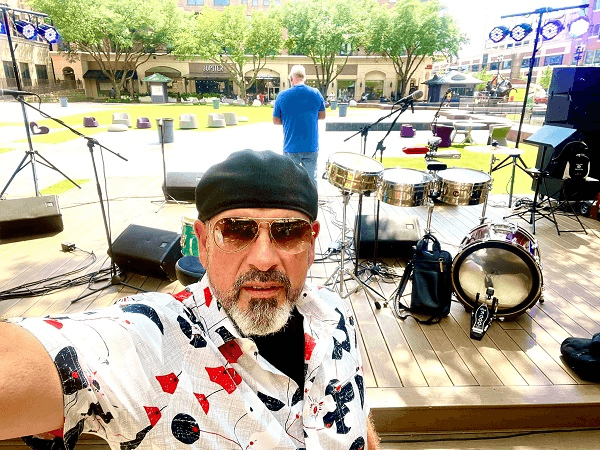
Oscar Larrañaga showing the stage where Grupo Batachá would perform that day

How Grupo Batachá began   

Oscar revealed to us that Grupo Batachá was founded in 1997 in Houston, Texas, and made up of the artist and four other members who joined him at that time. They all decided together that Oscar was the best choice to lead the band and chose him as their director, a position he still holds today. Many members have come and gone, but he has always managed to ”keep the ship afloat” at all times despite the changes.   

He explained to us that the name ”batachá” is a term that comes from Cuba and its literal meaning is ”fun times”. In addition, when he was in his early twenties, Oscar met the members of a group with the same name in Guatemala and liked it very much from the first time he heard it. For him, ”batachà” is synonymous with fun and having a good time, things he sees represented in his work with the band. That is why his album is called ”Batachando” and would be something like ”disfrutando” in Spanish.   

Languages played by Grupo Batachá   

While it is true that Grupo Batachá makes music in several languages such as Spanish, English and Portuguese, Oscar wanted to make it very clear that everything he and his bandmates do is aimed at salsa influenced by the typical Cuban flavor that comes from drums and Yoruba culture, elements that are primarily handled in Spanish. This is why the main language of the group is and will continue to be Spanish.   

In terms of clave, it is much easier for the group to get into the correct rhythm in Spanish for what we have explained above. For the same reason, English, Portuguese and any other language are not a priority for Batachá at this time.    

Batachá is influenced by the Cuban Flavor
Grupo Batachá’s music is influenced by the typical Cuban flavor that comes from drums and Yoruba culture

How Grupo Batachá manages its performances 

During the band’s 15-year trajectory, Grupo Batachá has performed at more than a hundred weddings, quinceañeras, birthday parties, anniversaries, corporate events, among others. In each and every one of these performances, Oscar and his bandmates have always stood out for their professionalism and great musical quality, so they have no problem to obtain contracts and clients of this kind very often.   

As for the method the band uses to select their clients, there is not much to explain. Oscar simply gives priority to the client who agrees on a date first and then tries to reach an agreement with the one who makes his request later, although he emphasized that this does not happen very often.   

About this, he said he feels very lucky to bring joy to different types of public with what he likes more than anything in the world, which is music. It makes him really happy to be able to live from what he loves and, by extension, to transmit that same happiness to those who have the opportunity to attend one of his shows. 

Read also: Don Perignon and La Puertorriqueña are prides of Puerto Rico 

Medusa Pop Band delights its fans with a pretty interesting mix of rhythms

Medusa Pop Band is a group based in the city of Calgary, Canada, that is mainly focused on the Spanish language and Latin rhythms of the 80s and 90s, so it has some very particular characteristics that distinguish it from other bands that can be found in the aforementioned country.  

As we found everything about the Medusa Pop Band very interesting, we contacted its manager to talk to some of its members and know a little more about the band. This is how we have managed to have a wonderful conversation with Lorena Galindo, Eduardo Infante and Willy García, who talked a bit about their beginnings, styles and future projects.   

Medusa’s members
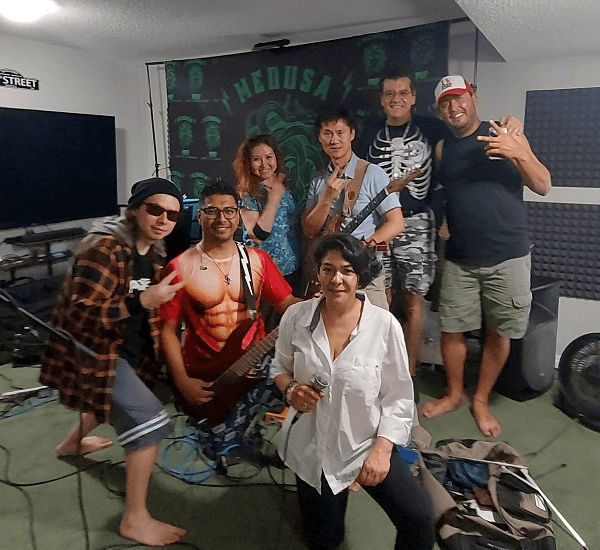
Medusa Pop Band from right to left: bass player Eduardo Infante, drummer Cristian Gonzalez, keyboardist Lee Que Long, lead singer Lorena Galindo, guitarist Kalvin Ma, and percussionist Willy Garcia

Musical backgrounds of the current members of Medusa Pop Band 

As is the case with most bands like this, its members have already been part of other groups until they met and came together to do completely new things. This is how Lorena, vocalist and founding member of the group, who has been working with versatile music for more than 40 years, explains that she had the idea to create this project just two years ago. She even worked with the famous actress and singer Lucero and belongs to the musicians’ union in Mexico City.   

In Eduardo’s case, he has more than 25 years of experience in rock in his home country Mexico, until he decided to move to Canada to try his luck. That was when he met Lorena and was invited to join Medusa Pop Band as the lead bass player.   

On the other hand, Willy has five years of experience in music, so he would be the one who has the least time in this world, which does not diminish the importance of the role he plays. He was in a group called De Cajón, but when receiving the proposal of Medusa Pop Band, he decided that this was what he was looking for and accepted to be the percussionist and be in charge of ”embellishing” the songs, as he himself describes it. 

How Medusa Pop Band was created 

Eduardo heavily emphasizes that the one who started the whole project and put together the team is Lorena, and subsequently, the rest of the team joined his idea. In his case, he saw an advertisement on the internet saying that a group was looking for new members and he was postulated to be part of Medusa. He mentions that what attracted him to this proposal was the style of pop handled by the group and the possibility of playing the bass, which he loved being able to do since he had always played the guitar and it represented a challenge for him. 

Willy commented that he lived very near to Lorena’s home and they already had a friendship for a long time. When he found out that Lorena was also a musician, he was invited to rehearse with the rest of the band and loved the kind of music he listened to and professionalism of the musicians there, so he stayed with them.  

With regard to the name of the band, Lorena explains that she had always wanted to do something with the famous figure from Greek mythology Medusa, in addition there was a nightclub called 

Medusa in Mexico City the singer liked a lot, so it all added up to being the name chosen for her band. In the end, the word ‘‘pop” was added because of the main genre on which the group bases its discography. 

Medusa Pop Band performing
Medusa Pop Band performing live in Calgary, Canada

Why choose Canada to establish Medusa Pop Band? 

‘‘We have chosen Canada to establish the band basically because we all live here and it was in this country that we all met. There was no way for Medusa Pop Band to be born in any other country but this one” said Lorena about the reasons why to establish the band in this country.  

On this, Willy added that the diversity of nationalities in the group has been a great advantage for them in Calgary, as that has allowed each member to bring their own essence to the music they are doing. ‘‘It’s very important for us to have more diversity in the rhythms we choose to make more people happy and please a wider audience. I think Canada is an excellent country for that” said the percussionist. 

Receptivity of the Canadian public towards Medusa Pop Band’s Spanish-language music  

Eduardo has said that the reception from the Canadian public towards them has been warm and has come from less to more. In fact, he commented that the amount of assistants to their shows has been growing exponentially and every day the band are gaining more and more fans at the local level.  

”Currently, we only have music in Spanish because we are focused on the Latin American and Spanish-speaking community, but we also have a musical amalgam of different countries and cultures, which makes Medusa Pop Band even more magical. We are always looking to please all types of audiences” Eduardo continued explaining. 

Lorena also added that she and her bandmates have found that many Canadians love Spanish, to the point that they have learned that many fans have started taking Spanish classes to understand their lyrics, which makes them extremely happy and motivates them to keep creating more and better music.   


Medusa Pop Band rehearsing
Medusa Pop Band rehearsing for a show

Challenges Medusa Pop Band has had to face 

Eduardo took the floor again to affirm that one of the biggest challenges facing the band has been finding Spanish-speaking musicians because there are not many in Calgary and the vast majority of them already have their own projects and bands, so getting the necessary elements for the group has not been an easy task. 

To these words, Willy adds that the hardest thing to find are singers who speak Spanish, so he is glad Lorena handles that part. Faced with these challenges, he ended up by saying that the support of their families has been fundamental in order to move forward, and like any other band, its members spend many hours rehearsing each day of the week. That is why the understanding of their partners and children has made it much easier for them to follow this difficult path to the success they have achieved. 

Nationalities in Medusa Pop Band 

One of the most interesting things about Medusa Pop Band is that its members come from very diverse countries like Mexico, Peru, Colombia, Vietnam and China. This makes the group have elements with a variety of musical cultures so diverse that it could complicate the picture when agreeing to work on their music. 

What Willy has to say about this is that the Latin musicians have a certain ”feeling” to play the music, while the Asians have a completely different one, so guitarist Kalvin Ma and keyboardist Lee Que Long have gone the extra mile to engage with the rest of the team and play their instruments as is required. 

In this regard, Lorena stressed that both Calvin and Lee have done a great job all these years and their contribution to the group has been immeasurable, since they also propose techniques and add different sounds to those already known. 

What has made things difficult for the aforementioned musicians is the language, as they do not speak Spanish and the rest of the band can only communicate with them in English, but that is no impediment to fulfill their role to the fullest. 

Lorena from Medusa Pop Band
Lorena Galindo is the founder and lead singer of Medusa Pop Band

What makes them call themselves an eighties and nineties band? 

Once again, Lorena took the floor to explain that the group describes itself as an eighties and nineties band because many fans of their work who are contemporaries with them, but that does not stop them from playing music of all kinds and all eras, either from the 80s or this same year. What they seek is to make different arrangements so that their covers sound different than their original versions. 

It can be said that the age group that most often follows them goes from 18 to 50 years old, giving Medusa Pop Band a huge range of action. Additionally, the word ”pop” is too general and gives them the possibility to choose from a large range of genres and rhythms that captivate an ever wider audience. 

Read also: Venezuelan businesswoman Joanna Torres is an example to follow 

Here we have Brazilian bandleader and composer Paula Maya

Today we have an exclusive that makes us very happy, since it is a talented artist from a country we had never talked about in this section: Brazil. We are talking about none other than the award-winning bandleader, composer, pianist, keyboardist and singer Paula Maya, with whom we had the privilege to talk by Zoom. 

Paula has a very interesting background, since she was born in the South Zone of Rio de Janeiro, the birthplace of the world famous bossa nova genre and the popular composer, pianist and singer Carlos Antonio ”Tom” Jobim. It is clar that this had much to do with artistic inclinations that the woman would show later in her life.   

Under her belt, she has several nominations and awards she received thanks to her talent and effort of so many years as her nomination to the Focus Web News Brazilian International Press Awards in the category of Best Brazilian Musician living in the US, her nomination to the Austin Chronicle Music Awards in the category of Top Ten World Music Bands, Winner of the Seattle Weekly Awards in the category of Best Brazilian Composer, her nomination to the Seattle Hot Rocks TV Show Music Awards in the category of Best Female Singer, among others. 

Here are the most important topics we touched with lovely Paula about her life and career.  

Singer Paula Maya
Brazilian bandleader, composer, pianist, keyboardist and singer Paula Maya

Paula’s early interest in music 

Paula first developed an interest in music when she was only four years old or even younger, as she had musical toys such as pianos or keyboards she used to play with all the time. To this it is added that her mother always listened to classical music, which she already found beautiful back then.   

What is interest about his direct family is the fact that there were no musicians in it. In fact, her father was a lawyer and her mother was a dancer and yoga instructor, but a cousin of hers was a bandleader, composer and music teacher who traveled to the United States and developed quite a big reputation at the time, so he became an example for Paula, who would end up following in his footsteps in the future. 

When she turned 10 years old, she began taking piano lessons, which was her first formal experience with music. Since then, she has continued to learn about a lot of instruments and areas related to this art, which she assures that it is so rich and diverse that you never stop learning new things.  

Paula’s mentors in music 

Paula has been very fortunate to be mentored by some of the most talented musical celebrities in Brazil and one of them was producer and percussionist Teo Lima, with whom she has continued to work on her latest album to the present. Paula met this Brazilian legend in Seattle, where she lived for 17 years, and music led them to form a great friendship that has lasted until today. 

They had wanted to make an album together for many years and it has finally happened, which was a dream for Paula, as she grew up listening to his greatest hits and dreamed about one day meeting him. Not only did she meet him, but also she became his friend and worked with him.   

Another name we can leave out is guitarist Baden Powell, whom Paula met in her early twenties and describes him as someone who supported her a great deal in her career and even came to her shows to watch her sing. 

Another artist who was important in her training was Luizihno Eça, who was one of the greatest exponents of bossa nova at the time and a great reference for all musicians who wanted to follow in his footsteps.  

Paula at ONE-2-ONE BAR
Paula Maya performing at ONE-2-ONE BAR in Austin, Texas

Music theory and the Brazilian Conservatory of Music 

Paula comments that, before entering the Brazilian Conservatory of Music, she had an excellent teacher who was a concert pianist of name Luis Magalhães, who taught her the best piano techniques that she uses today in her performances, meaning that she was admitted to the hous of studies with a solid foundation of knowledge that helped her a lot.  

In addition to that, music theory has been very useful for Paula at the time of teaching her classes, since she is a music teacher and thinks that all this knowledge is fundamental for an artist’s education, since music is very logical and occasionally you must look for quick answers to certain situations that certainly require studying and academic training. 

She also told us that she usually uses music theory when composing because of the theoretical part, but not always.   

Paula as a bandleader, pianist, keyboardist and singer   

When we asked Paula how she has developed and performed in all these areas of music, she laughs and says that this is just the beginning, as she is also in charge of producing, composing, recording her albums, running the business part, making booking arrangements, among other things. ”That’s the life of a musician nowadays, especially when you don’t have a machinery behind you to back you up” Paula said on this topic.   

This means that, apart from all the musical knowledge Paula has, she also takes care of all the details regarding her work, but they do not have to do with her profession directly. She does not have a large team of assistants to back her up, so she manages everything related to her career herself. 

Since there are so many things she should do, she has a calendar in which she arranges the day and time to do every activity and always follows it to the letter. The artist says that the hardest thing about this is finding the time to be inspired and compose, since so many occupations, sometimes, do not let her clear her mind. However, she has learned to take full advantage of those few spaces.  

Paula playing the keyboard
Paula Maya playing the keyboard at Barton Creek Farmers Market in Austin, Texas

Paula’s role as a Grammy Award voting member 

For some time, Paula was a Grammy Awards voting member in its version in English and Spanish, so we could not very well not ask her about this important issue. 

She told us that, although it is true that she is no longer part of the committee responsible for voting, social networks and these new forms of communication have made things much easier, since judges and committee members have groups on Facebook, WhatsApp and other platforms where they can conduct the necessary discussions. 

In her particular case, what she considered when the time comes to vote for a nominee was talent and how much she liked a type of performance, but all member had their own particular approach to choosing a specific artist. 

Something that Paula definitely did not like was that the majority of votes to an artist did not necessarily reward talent, but rather the popularity of the moment and promotion. She thinks this is not entirely fair, since talent, music skills and preparation do not always go hand in hand with popularity, but she is also aware that the ”game” is as well and she had to adapt to it. 

Paula Maya & Bosa Nova Plus 

Paula says laughing that everybody in Seattle expected her to play bossa nova because she was Brazilian, but she refused to do so. Eventually, she ended up doing exactly what the public expected and started playing bossa nova when she moved to Austin, Texas.  

The fact that this Texan city has so many residents and musicians from Brazilian descent living in Austin has been an advantage for this genre to continue to become more popular and this niche to develop more and more. This led her to meet the musicians who have accompanied her in the band, who also came from playing bossa nova and other genres during their respective careers. 

Read also: The Conga Room closes its doors, but says goodbye in style 


Julio Vilchez and his orchestra conquer Miami

Peru continues to give us something to talk about thanks to all the salsa talent coming out that country in recent years and today we had the opportunity to talk with one of them, which is the producer, composer and singer Julio Vilchez. 

After we communicated with Vilchez via email and WhatsApp to schedule an interview, we have managed to have a great conversation in which we knew a little more about the artist’s beginnings in this fascinating world that is music.   

singer Julio Vilchez
This is Peruvian producer, composer and singer Julio Vilchez

Childhood and musical roots in the Vilchez family 

It is not surprising that Vilchez took that parth of life considering that his father, Juan José Vilchez Sanchez, was a talented actor, comedian and professional dancer who carried music in the blood and ran some of the most famous salsa clubs in the city of Lima, which served as a stage for important national and international groups and singers of all genres.   

Having referred with admiration to his father because of all that he achieved in life thanks to music, he assured that music definitely ran through the veins of his family and had always been a very important part of his childhood and youth. 

Seeing all this, the years were not many when Vilchez became interested in musical instruments such as maracas, the bongo bell and the güiro, which led him to participate in groups such as Raíces, La Fragua and Soy Calidad.   

Salsa and other genres 

A large majority of Peruvian artists whom we had the honor to interview have typically ventured in Peruvian Creole music before getting involved in salsa, but not Vilchez. In fact, he pointed out to us that his country was heavily influenced by Cuba musically speaking and there used to be a time when groups from the island visited Peru such as La Sonora Matancera and Los Compadres. Peru also received influence from Colombia, Venezuela and Puerto Rico, although to a lesser extent. 

The artist also remembers that, at home, he and his family always used to listen to Venezuelan singers and orchestras such as La Dimensión Latina, Oscar D’ León, Luisito Quintero, Nati Y Su Orquesta, among others. In the case of Puerto Rico, of course Vilchez and his family used to listen to La Fania All Stars.  

Vilchez was part of Raíces, La Fragua and Soy Calidad
Julio Vilchez was part of groups such as Raíces, La Fragua and Soy Calidad

Formal beginnings of Julio Vilchez in music 

In the neighborhood Vilchez and his family lived in, the singer made friends with other local boys and met up with them to sing in a completely amateur way. In addition to that, he liked to participate in school talent shows, in which he delighted the crowd performing songs from Oscar D’León, Rubén Blades and Willie Colón. 

After attaining the age of 17, he began working alongside his father in the business of running clubs, which gave him the opportunity to spend time with the members of the orchestra La Progresiva del Callao, who performed on Tuesdays, Wednesdays and Thursdays in one of those places.   

Since Vilchez loved to dance and the orchestra focused a lot on its choreographies, the young man identified himself a lot with the group and began to learn the steps the singers performed on stage. One day, the boys saw him dancing and invited him to sing with them in one of their shows, in which he danced very well, but he did not sing in the best way. For this reason, he got the opportunity to stay permanently in the orchestra, but only as a dancer for the moment.   

Over time, he was grabbing experience on stage and getting over stage fright until he managed to keep up with the rest of his orchestra fellows with the passing of days.  

Julio Vilchez with Cano Estremera
Julio Vilchez with Puerto Rican salsa singer Cano Estremera

Vilchez’s time in Venezuela 

Vilchez made friends with a group of Venezuelan musicians who accompanied Oscar D’ León in one of his concerts and invited him to travel with them to Venezuela because they wanted him to be part of the sextet they were going to create, which was meant to perform at a tavern in Caracas. 

Seeing that things were going well in Venezuela at that time, Vílchez decided to accept the invitation and immigrate to the South American country to try his luck. Once there, he spent a lot of time alone because the boys from the sextet traveled a lot, something which took advantage to get to know other groups, one of them being La Selecta de Cúa. One day, Vilchez was walking down the street and heard this orchestra rehearsing, but it needed a singer. That is when Vilchez proposed himself as an option, was admitted and worked for about two years in this orchestra. 

Although he did well in Venezuela, he ended up returning to his native country because he missed his homeland and his father could not get used to having him away, so he packed suitcases and decided to return.   

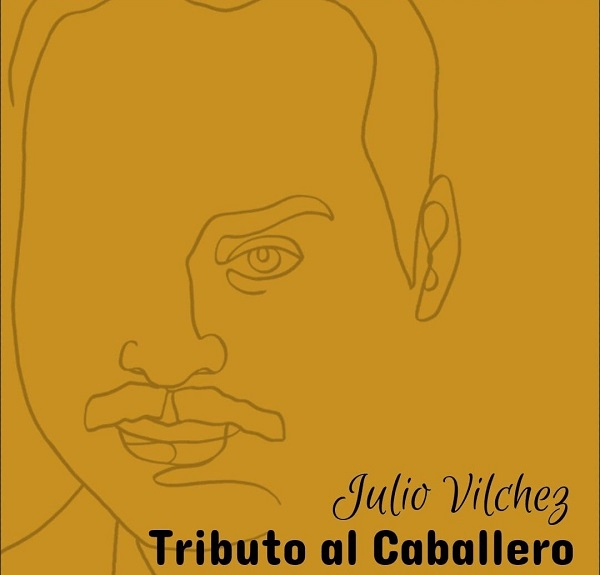
Tributo al Caballero by Julio Vilchez
Cover of the album Tributo al Caballero by Julio Vilchez

Life in the United States 

One of the songs he released in 1995 led him to make a video clip, which started to become very popular on music channels and shows, giving him the recognition Vilchez aimed for so long.  

Since things were not going as he expected on his solo career, he joined the Orquesta La Novel to continue working on music for the next two years. Although his name was not as well known as Vilchez needed it to be, his song was still sounding loud internationally for quite some time, which led him to receive a proposal to perform eight shows with his orchestra in the United States in 2000. 

When Vilchez and the rest of the musicians traveled to Miami, about nine members of the orchestra received proposals to stay in the country and decided to accept. It was there where the artist gathered his courage and says to himself ”I’m staying too”. That was over 24 years ago now.   

At that point, the Peruvian had to look for other musicians to replace the others in order to finish the concert tour they had scheduled. It was then when he contacted José Alberto ”El Canario” through a Peruvian colleague of his to use his band for the remainder of the tour and so he did. Vilchez did two or three shows with this band and stayed in Miami from 2001 to 2004.   

Given the lack of musical proposals, he spent a few years in New York, but returned to Miami some time later to work both with music and with a business sector linked to gastronomy, since living only from music is complicated. In addition to that, his children live in Miami and he wanted to spend more time with them, so this was also a powerful reason to return.   

Read also: Argentine-American composer and guitarrist Alejandro Meola kindly talked to us 

Nolita Golding Soulful Latin

Europe / Reino Unido/ Londres

Nolita Golding has a new single & video with the amazing collaboration of Latin Grammy-nominated Tony Succar & LUKAS winner Alex Wilson

With her powerful, compelling voice, to kick off 2019 Nolita Golding launches her new single “There Must Be An Angel”  This single release is a step-change up in her career, cementing her reputation as a world class vocalist who can seamlessly weave between Soul and Latin in both English and Spanish.

The 80’s hit “There Must Be An Angel” (penned by Annie Lennox & David A. Stewart) has been deliciously arranged by Alex Wilson into a Soulful Latin version full of Caribbean flavour and laced with Gospel. Driven by Nolita’s power vocals and personality, she sets the scene for a definite hit in 2019! Soulful Latin… the new wave to hit the dance floors!

At present there is a musical trend focussed on the wonderful cultural revolution of the 60s in New York, when Latin America’s sounds were fused with jazz, soul and rock. This gave birth to fresh new styles such as boogaloo, spearheaded by luminaries such as Pete Rodriguez, Ricardo Ray, Joe Bataan and Joe Cuba.

Nolita Golding
Nolita Golding

Nolita Golding carries the soul of those pioneers and her unmistakable style proves it.  In her constant search for excellence, Nolita completed this new single at Wincraft Music Studios, owned by Steve Winwood. The production was masterminded by award-winning producer Alex Wilson and features special guest and Latin Grammy-nominated Tony Succar on timbales. In addition, Venezuelan percussion master Edwin Sanz and Cuban rock guitar powerhouse, Dany Labana, have added their magic … this band is simply smoking!

The creative process has been a unique and magical experience, resulting in a track fully loaded with rhythm, positive energy, Caribbean flavor and mucho sabor!

As ever, the impressive power of Nolita Golding’s voice combined with her bilingual skills has her in continuing high demand as the session vocalist who consistently delivers the goods!


We invite you to enjoy this new single, which comes out at the beginning of this month…
It was created just for you and we guaranteed you will fall in love with it!

Don’t miss the opportunity to experience Nolita Golding Soulful Latin live concerts during her Europe Tour 2019.


  • « Go to Previous Page
  • Page 1
  • Interim pages omitted …
  • Page 77
  • Page 78
  • Page 79
  • Page 80
  • Page 81
  • Interim pages omitted …
  • Page 149
  • Go to Next Page »

International Salsa Magazine (ISM) is a monthly publication about Salsa activities around the world, that has been publishing since 2007. It is a world network of volunteers coordinated by ISM Magazine. We are working to strengthen all the events by working together.