• Skip to primary navigation
  • Skip to main content

International Salsa Magazine

  • HOME
  • Previous editions
    • 2026
      • ISM / August 2026
      • ISM / July 2026
      • ISM / June 2026
      • ISM / May 2026
      • ISM / April 2026
      • ISM / March 2026
      • ISM / February 2026
      • ISM / January 2026
    • 2025
      • ISM / December 2025
      • ISM / November 2025
      • ISM / October 2025
      • ISM / September 2025
      • ISM / August 2025
      • ISM / July 2025
      • ISM / June 2025
      • ISM / May2025
      • ISM / April 2025
      • ISM / March 2025
      • ISM / February 2025
      • ISM / January 2025
    • 2024
      • ISM / December 2024
      • ISM / November 2024
      • ISM / October 2024
      • ISM / September 2024
      • ISM / August 2024
      • ISM / July 2024
      • ISM / June 2024
      • ISM / May 2024
      • ISM / April 2024
      • ISM / March 2024
      • ISM / February 2024
      • ISM / January 2024
    • 2023
      • ISM / December 2023
      • ISM / November 2023
      • ISM / October 2023
      • ISM – September 2023
      • ISM – August 2023
      • ISM July 2023
      • ISM Edition June 2023
      • ISM – May 2023
      • ISM April 2023
      • ISM March 2023
      • ISM February 2023
      • ISM January 2023
    • 2022
      • ISM December 2022
      • ISM November 2022
      • ISM October 2022
      • ISM September 2022
      • ISM August 2022
      • ISM July 2022
      • ISM June 2022
      • ISM May 2022
      • ISM February 2022
      • ISM January 2022
    • 2021
      • ISM December 2021
      • ISM November 2021
      • ISM October – 2021
      • ISM September 2021
      • ISM August 2021
      • ISM July 2021
      • ISM May 2021
      • ISM April 2021
      • ISM June 2021
      • ISM March 2021
      • ISM February 2021
      • ISM January 2021
    • 2020
      • ISM December 2020
      • ISM November 2020
      • ISM October 2020
      • ISM September 2020
      • ISM August 2020
      • ISM July 2020
      • ISM June 2020
      • ISM May 2020
      • ISM April 2020
      • ISM March 2020
      • ISM February 2020
      • ISM January 2020
    • 2019
      • ISM December 2019
      • ISM November 2019
      • ISM October 2019
      • ISM Septembre 2019
      • ISM August 2019
      • ISM July 2019
      • ISM June 2019
      • ISM May 2019
      • ISM April 2019
      • ISM March 2019
      • ISM February 2019
      • ISM January 2019
    • 2018
      • ISM December 2018
      • ISM November 2018
      • ISM October 2018
      • ISM September 2018
      • ISM August 2018
      • ISM July 2018
      • ISM June 2018
      • ISM May 2018
      • ISM April 2018
      • ISM March 2018
      • ISM February 2018
      • ISM January 2018
    • 2017
      • ISM December 2017
      • ISM November 2017
      • ISM October 2017
      • ISM September 2017
      • ISM August 2017
      • ISM July 2017
      • ISM June 2017
      • ISM May 2017
      • ISM April 2017
      • ISM March 2017
      • ISM February 2017
      • ISM January 2017
    • 2016
      • ISM December 2016
      • ISM November 2016
      • ISM October 2016
      • ISM September 2016
  • Spanish
  • Download Salsa App
    • Android
    • Apple

Search Results for: salsa in venezuela

Dance. The best of America United in a Single Project

Latin America / Cuba / La Habana

Since the 1950s, a very humorous genre called the casino dance was born in Cuba, a style based on dancing the Cuban music of the moment between couples. This lies in history since the fashion of Mambo and Cha Cha Cha in the most aristocratic clubs and in the fraternal halls of poor blacks of the beautiful island, they danced on Saturdays, Sundays or special parties on specific days, for the moment the rhythms sounded de la Aragon, Chapotin, Orquesta Casino, el Benni, among others, without leaving aside rhythms such as rock and roll, sounds of the time that fought for a space in the fans.

Social Photo
Social Photo

From the mixture and the dance relationship of those attending the clubs is born that change of couples in circular formation called the Rueda de Casino, a name that we will be developing in other editions of the magazine.

In America, especially in the south of this continent, Salsa Casino, as it is called in many places, has managed to lay firm foundations, much more than what is known in Europe or North America, in some countries becoming the reference number 1 of the Salsa dance modality. We have the best example in Venezuela, land of casinos par excellence, where we can add a great hundred dance schools nationwide, without leaving behind how strong it is in Colombia and Peru, among some countries that also use this discipline. as a strong influence on young and old.

It is incredible to see the great differences in styles and forms between the casinos in Europe and those in South America, but always the same concept, joining several couples to enjoy a good timba or a good son.

From the foregoing, the Cubashow Project arises, born with the primary objective of generating a training and development channel for the new generations that venture into the beautiful world of dance, mainly those linked to Cuban Salsa and its roots in popular music or traditional Cuban music, folklore and its Afro tendencies, all in relation to the strong wave of this discipline that is developing in the main capitals of many American countries.

they danced cha cha cha

BAILA QUE BAILA AMERICA a concept of union between southern countries to extend the dissemination of Salsa Casino in the continent brings together some of the best instructors from each country with the sole intention of conducting national and international training tours in all trends of the dances of Cuban culture, in this way we obtain from the best exponents classes, seminars, talks, forums, workshops and shows that can be viewed through the social networks of @BailaQueBailaAmerica the different schools, academies or instructors registered to the project.

Professional dance teams are structured based on their local projections, the work they do within each of their countries. An event of great proportions is expected for the month of June where we will be able to have the best instructors from all over South America together in a high caliber event, we just have to be attentive to social networks and future reports of this great magazine to join us. to this casual wave.

“Orquesta Zodiac” Its name came about due to the fact that in the early 70’s the ‘Walter Mercado’ program and the Zodiacal Signs were all the rage

In June 1971 what we know today as the Zodiac Orchestra was organized in the town of Loíza. Its name came about due to the fact that in the early 1970’s the Walter Mercado and the Zodiacal Signs program, which was broadcast on Channel 2 in Puerto Rico, was in vogue.

Tony Escobar’s uncle (the orchestra’s declamationist) suggested the name because it was an eye-catching and “new” name.

The Zodiac Orchestra was organized with members of a group called Loíza Power directed at that time by Paquito Pérez, who was 14 years old. In addition, it was nurtured with the best musicians of Loíza Sound of Javier Calcaño.

“Orquesta Zodíac” Su nombre surgió debido a que para principios de la década del '70 estaba de moda el programa de “Walter Mercado” y los Signos Zodiacales
“Orquesta Zodíac” Su nombre surgió debido a que para principios de la década del ’70 estaba de moda el programa de “Walter Mercado” y los Signos Zodiacales

The idea of recruiting these musicians was Paquito’s, since he grew up with José Luis Vizcarrondo and Tony Escobar.

Through Loiceño composers Carlos José Cirino (Tata) and Floren Ayala, the recording was achieved, as they approached Dario Gonzalez of Borinquen Record who contributed to make possible the release of the first 45 and LP. Tata’s “El Adiós” and José Feliciano’s “Las Costumbres” (1971) were part of this musical proposal that was very well received by the public.

This album became one of the best selling LPs. Other musical proposals of the group that would become hits were: “Panteón de Amor”  by Angel Laureano (1973), “Sinceridad” by Samuel Cirino, “Mi Guitarra” by Angel Laureano, among others. These great hits are frequently requested today on the Salsa Z-93 radio station.

After the initial success, many of the musicians dedicated themselves to work and to finish their studies, since they were married and were looking for security and economic stability for their respective families.

The Zodiac had the opportunity to travel to different cities in the United States such as: Boston, Connecticut, Philadelphia, New York, among others. They also traveled to other countries such as Colombia and others.

Orquesta Zodiac
Orquesta Zodiac

During these years, several orchestras were at their peak, such as: La Fania, La Selecta, Lebron Brother, La Corporación Latina, El Gran Combo, La Lupe, Chivirico Davila, Bobby Valentín, Tomy Olivencia, Ismael Miranda, Ricardo Rey, Roberto Rohena, Roberto Anglero, Justo Betancourt, among others.

In 1997 Paquito decided to retake and regroup the orchestra, and for some years he dedicated himself to reunite with the musicians and organize them again.

In 1999 he managed to restart La Orquesta Zodiac at the Z-95 festival in Mayagüez. Later they performed at the National Salsa Day dedicated to Cheo Feliciano in 1998.

These two presentations were made at the invitation of Pedro Arroyo (director of Z-93) to Paquito, and were a great success. El Gran Combo, Rubén Blades, Jimmy Zabater, La Solución, among others, also played in the tribute to Cheo.

The members of the current orchestra are young, and most of them were music students of Paquito Pérez, who worked as a music teacher for 30 years in the town of Loíza (before retiring).

José Luis Vizcarrondo, Tony Escobar and Paquito Pérez were schoolmates for years. The director of the orchestra in the beginning was José Luis, also collaborating with him were Tony Escobar (saxophonist and declamation player), Freddy Ayala (conguero) and Paquito Pérez (singer). All of them contributed ideas for the arrangements. Currently Víctor Pérez (Paquito’s brother) is the director of the wind section.

Orquesta Zodiac en el pueblo de Loíza

In 2010 the orchestra played in the National Salsa Day and in 2012 the orchestra played again in the same activity, but this time the activity was dedicated to La Orquesta Zodiac and La Corporación Latina. In which Z-93 gave them a well-deserved recognition and Paquito, José L, Tony, Tata, Laureano, and the rest of the new members of the orchestra were present.

Currently the orchestra meets periodically to practice, and are available for all kinds of activities.

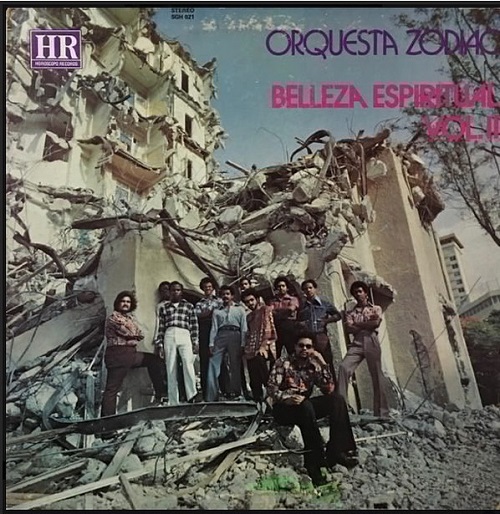
Did you know that…! In June 1971 what we know today as the “Zodiac Orchestra” was organized in the town of Loíza in Puerto Rico. Its name came about due to the fact that in the early 70’s the program “Walter Mercado” and the Zodiacal Signs, which was broadcasted on channel 2 in Puerto Rico, was in fashion. Tony Escobar’s uncle (declamationist of the orchestra) suggested the name because it was a striking and “new” name …Referring to the image of the post belongs to the second production of this Puerto Rican group entitled “Spiritual Beauty Vol. II” published in 1973 under the label “Horóscopo Récord” and directed by the founder, arranger, pianist and saxophonist Mr. José Luis Vizcarrondo. It is worth mentioning that this production includes the classics: Montuno de Oriente, Vicio de Amor and Belleza Espiritual”. Another important fact about the group is that it is still in force with musicians of the new generation, but with the same Swing and musical concept.

Segunda producción de dicha agrupación boricua titulada “Belleza Espiritual Vol. II” publicada para el año 1973

It is worth mentioning that the main responsible for making Orquesta Zodiac publicly known in Venezuela, Latin America and the Caribbean was Mr. Ali Delgado. Mr. Ali Delgado, for the year 1985 under the record label Performance Records, Delgado comments in detail that for the date of publication of this production the only popular sector (neighborhood) of Caracas where the Zodiac Orchestra was known was in Pinto Salinas.

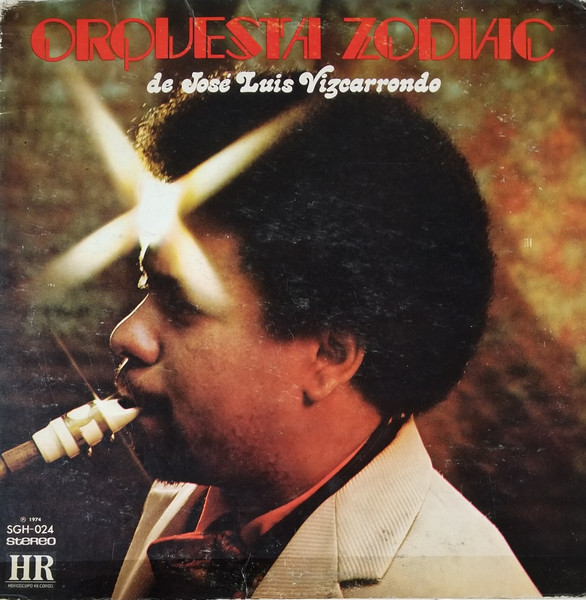
Orquesta Zodiac De José Luis Vizcarrondo

Delgado is a music producer, music lover, collector, director and founder of the projects Salsa de La Mata and Jazz con Clave in Caracas.

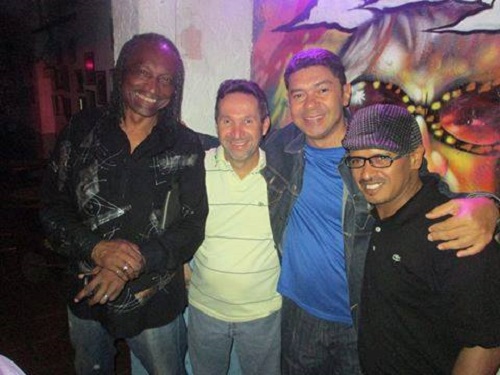
Dj. Augusto Felibertt y Ali Delgado

Also Read: Sessions from La Loma brings together salsa fans from all over the world in Puerto Rico

Cheo Linares is a Singer, Composer, Sonero, Poet and Caraqueño

National Culture Award 2023-24 and the Artistic Glories of Venezuela Award.

José Gregorio Linares Carrasco is one of the great singers, composers and defenders of Venezuelan Salsa,

Cheo Linares born in the city of Caracas-Venezuela, he has been part of groups such as La Salsa Mayor, Salsa Mágica, el Trabuco Venezolano and Saxomanía.

José Gregorio Linares Carrasco es uno de los grandes cantantes compositor y defensor de la Salsa Venezolana

He is one of the most important composers of Venezuela.Linares has just been distinguished with the National Culture Award 2023-24 in the music category, so it is his first musical release since this important recognition, which surely is an encouragement to continue his work.

Last Saturday, January 11, 2024, Venezuela’s Minister of Culture, Ernesto Villegas, announced the winners of the National Culture Award 2023-24 and the Artistic Glories of Venezuela Award 2024.

The names of the artists, teachers and researchers favored by the jury as winners of the 2023-24 National Culture Award were announced by Venezuelan Minister of Culture Ernesto Villegas.

In the Music Mention, the flute master Antonio Toñito Naranjo stood out “for his career as a performer and trainer of generations of Venezuelan flutists and for his contribution to Venezuelan culture”, according to Villegas.

Antonio Naranjo is an extraordinary musician, composer and musical director, as well as a member of the group El Cuarteto, which he formed together with his brother Telésforo Naranjo and brothers Miguel and Raúl Delgado Estévez (+).

Also linked to music, but in the Popular Culture category, the National Culture Award was granted to Rafael Salazar “for his long and uninterrupted career as researcher, musicologist, composer and cultural promoter”.

It is worth mentioning that Rafael Salazar has been one of the most outstanding researchers, compilers and disseminators of Venezuelan popular culture, in addition to being the author of books dedicated to folklore.

Cheo Linares es un Cantante, Compositor, Caraqueño, Sonero y Poeta

Several extraordinary musicians received honorary mentions in the National Culture Award, such as cuatrista Daniel Enrique Gil Rosado, llanero singer Cristóbal Jiménez, master composer Henry Martínez, oriental singer Hernán Marín, and members of Los Guaraguao, Eduardo Martínez, José Gerardo Cordero and José Manuel Chachata Guerra.

Artistic Glories of Venezuela

The Artistic Glories of Venezuela award deserved a special mention, which was given to great singers such as Cecilia Todd, Lilia Vera and Biella da Costa. The first two are part of the living history of Venezuelan folklore and their voices are part of the national heritage. Biella da Costa is one of the leading figures of jazz in Venezuela.

The award was also presented to Jesús Sevillano, a singer who was part of the historic Quinteto Contrapunto. It was also received by the stupendous composer and salsa singer Cheo Linares and the popular singer José Montecano, brother of Alí Primera.

Orlando Watussi, Jose G. Acero, Cheo Linares y Dj, Augusto Felibertt

Mario Díaz, an enormous exponent of the central joropo, was also recognized as an Artistic Glory of Venezuela, as was the great composer and oriental singer Perucho Aguirre.

The same award went to the Simón Bolívar System of Children’s and Youth Choirs and Orchestras, and groups such as the parranda La Flor de Cojedes, the Teatro Negro de Barlovento or Los Cañoneros, excellent representatives of merengue rucaneao, were not left behind.

In the world of rock ‘n’ roll, the group Los Tres Tristes Tigres, the mythical Ivo, and more recently, the singer Colina, famous for his pop hits in the 80’s, shone.

Tags: Antonio Toñito Naranjo, Biella da Costa, Cecilia Todd, Chachata cultura, Eduardo Martínez, Ernesto Villegas, Glorias Artísticas de Venezuela Hernán Marín Jesús Sevillano, José Gerardo Cordero, José Montecano, lilia Vera, Los Guaraguao, Mario Díaz, Perucho Aguirre. National Culture Award and Rafael Salazar.

Cheo Linares was not even 20 years old when something unexpected happened to him. Another young man, Gonzalo Martinez, came to his house looking for him to invite him to sing with La Salsa Mayor. It was perhaps 1983.

Cheo says that his aunt was the one who opened the door and then told him: “Hey, Cheo, they are looking for you. They are asking if you want to sing in La Salsa Mayor…”. Cheo, shirtless, came out. He couldn’t believe it.

Cheo Linares y Dj, Augusto Felibertt

“Venezoa is a term I created to name the Venezuelan salsa music lover, to whom I dedicate this production, which in turn I extend to the salsa brothers of the planet, this CD was made with all the love, mysticism and professionalism of the musicians, technicians and designers who participated in it, to them I present my most sincere and expressive thanks for the support provided. Grateful to all the people who have supported my career, especially journalists, announcers, DJs, collectors and promoters, for all, blessings, love and light …”.

Cheo Linares.

Source: Radio Café Atlántico

Also Read: Marcial Isturiz from Capaya with soneos and melodic phrases and his popular “Agua pa’ los Gallos “Puerto Rico

15 Panama Jazz Festival

Latin America / Panama / Panama

Once again, Panama makes its appearance beginning the year at the City of Knowledge and Casco Antiguo – Panama Jazz Festival in its 15th edition, thanks to the “Danilo Pérez” Foundation, where it gives us the opportunity to enjoy music in a healthy way, once again becoming the The largest Jazz stage in the Region, where musicians and fans from different countries such as Costa Rica, Colombia, Chile, USA, Mexico, among others, will participate from January 15 to 20.

15 Panama Jazz Festival

Its director Danilo Pérez mentions “From the heart of America to the world” giving us a message, which is not just to make and carry out a festival but to show everyone his dedication worldwide by showing us his cultural project that consolidates creativity, exchange and talent. , with a strong commitment to Panamanian education and social welfare, returns with a strong artistic billboard.

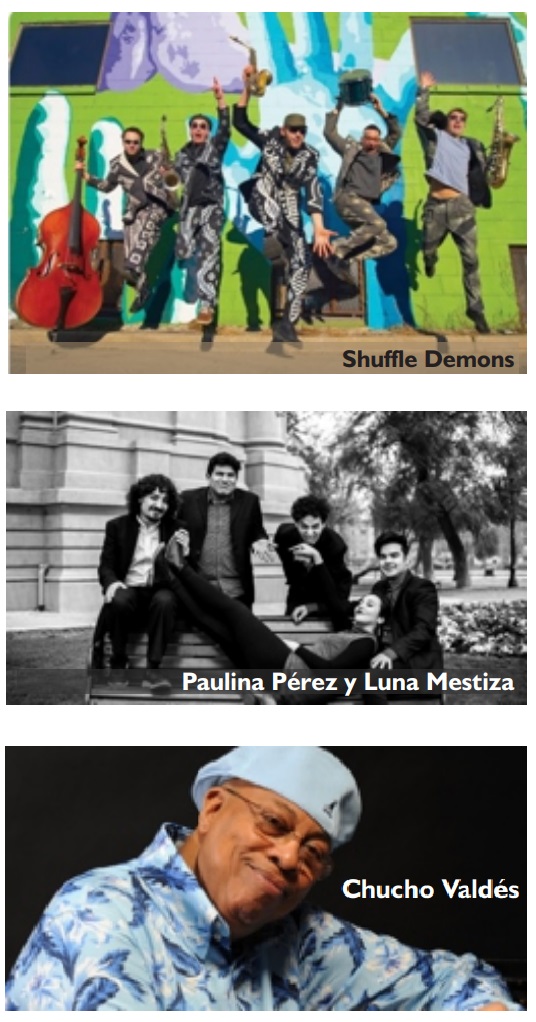
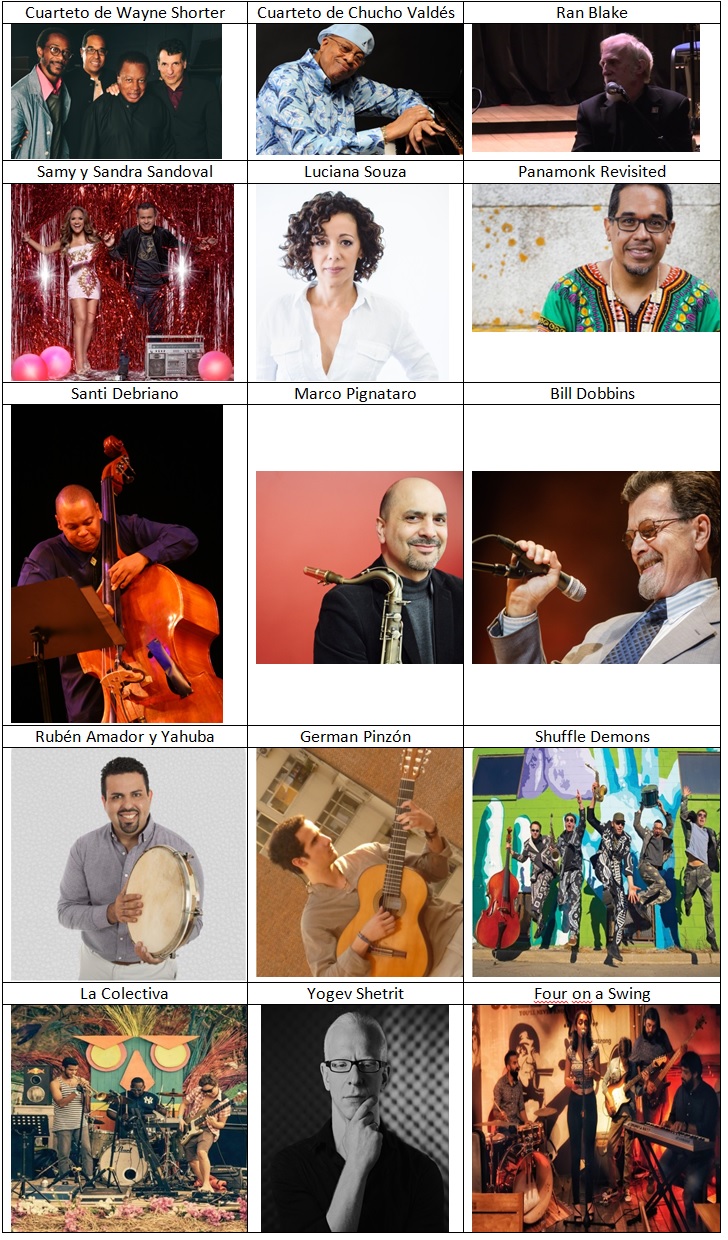
Performing artists include the Wayne Shorter Quartet; Latin jazz legend Chucho Valdés; the Brazilian singer, Luciana Souza; the legendary American pianist, Ran Blake, the master composer and pianist, Bill Dobbins accompanied on stage by the Global Jazz Big Band and the Panamanian cumbia patrons, Samy and Sandra Sandoval. Not to mention that the musical billboard is also strengthened with the participation of Panamanian bassist Santi Debriano along with saxophonist Craig Handy, pianist Bill O’Connell and drummer Will Calhoun, as core members of this musical banquet.

Others that will perform are the Panamonk Revisited trio, made up of maestro Pérez together with the Grammy-winning percussionist, Terri Lyne Carrington and bassist Ben Street, who will share this celebration with other renowned ones such as the Italian saxophonist Marco Pignataro and his Almas Antiguas quartet, with the Panamanian saxophonist Carlos Agrazal as a special guest; the Panamanian saxophonist Luis Carlos Pérez, and the famous Pan-African Jazz Project, made up of the Chilean saxophonist Patricia.

Collash of the 15th Panama Jazz Festival

Zárate Pérez, the Panamanian Luz Acosta (voice and bass) and Graciela Núñez (violin) and the Egyptian musicians Hesham Galal and Balquei.

The Global Stage will be back this year, which will be a stage to enjoy in style with bands from different latitudes such as Rubén Amador and Yahuba (Puerto Rico), The Shuffle Demons (Canada), Paulina Pérez and Luna Mestiza (Chile), Josean Jacobo & Tumbao (Dominican Republic), Marco Pignataro (Italy), Yogev Shetrit Trio (Israel), Fundación Armonía Colectiva (Costa Rica), Four On a Swing (India) and Shea Welsh (United States); and Panamanian talents German Pinzón Jiménez, Tambo Jazz Collective, Digger Descendants Calypso Band, Proyecto Shuruca and Pureza Natural.

In addition, there will be highly prestigious educational institutions, Berklee College of Music, Berklee Global Jazz Institute, New England Conservatory, Thelonious Monk Institute of Jazz, New York Jazz Academy and Crossroads High School, which offer great support every year.

And of the institutes that will be: Berklee Global Jazz Institute, New England Conservatory, Thelonious Monk Institute Of Jazz and New Yorl Jazz Academy.

Artists of the 15th Panama Jazz Festival

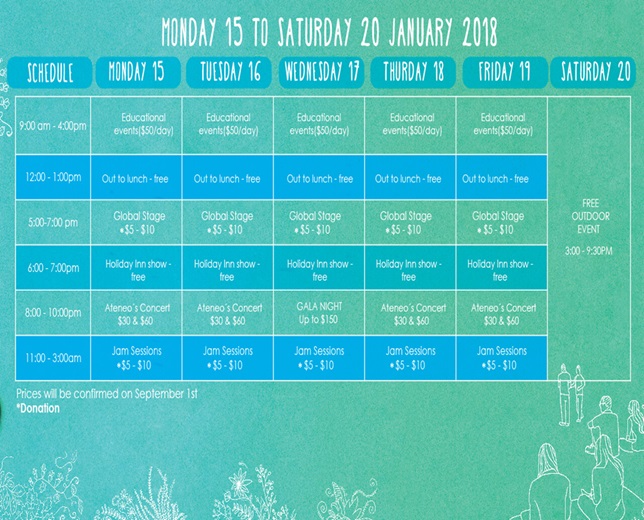
And the schedule of activities to be carried out are:

Schedule of the 15th Panama Jazz Festival

One of the most important details of the festival is that auditions, countless educational clinics, as well as the VI Latin American Music Therapy Symposium, the I Classical Music Exchange Program and the II Symposium of Musical, Artistic and Cultural Expressions will be held. of Afro-descendants in Panama with the main theme El Calypso:

A unique Latin rhythm being known as an African and Afro-American music that began in Trinidad and Tobago, later being very popular in the highlands of Venezuela, San Andrés and Providencia in Colombia, Trinidad and Tobago, Puerto Rico and others from the Antilles, where they use instruments such as the stellpan (steel drums), trumpet, trombone, flute, Spanish guitar, electric bass, saxophone, congas, bongos, maracas. This rhythm varies depending on the country where it is performed, giving a unique touch to studying Calypso to all fans or interested in it.

For more information about the Festival, you can contact them through:

  • WebSite: http://panamajazzfestival.com/
  • Facebook: https://www.facebook.com/PanamaJazzFest/
  • Instagram: https://www.instagram.com/panamajazzfestival/
  • Twitter: https://twitter.com/PanamaJazzFesti
  • Email: [email protected]
  • Phone: +507 317-1466


Maite Hontele in CONCERT!

Europe / France / Utrecht

A great musician is someone who can enlighten the stage only with his/her presence, this is the case when Maite Hontele is on stage. Full-house, the stage full of colors and all the audience is ready to dance and enjoy the best rhythm: SALSA!

International Salsa Magazine had the honor to be part of the last concert of Maite Hontele, the incredible dutch trumpeter, in Caracas, Venezuela.

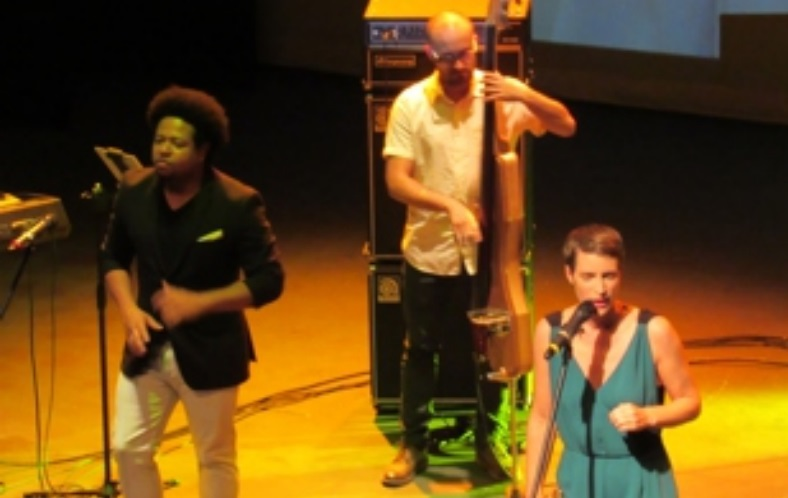
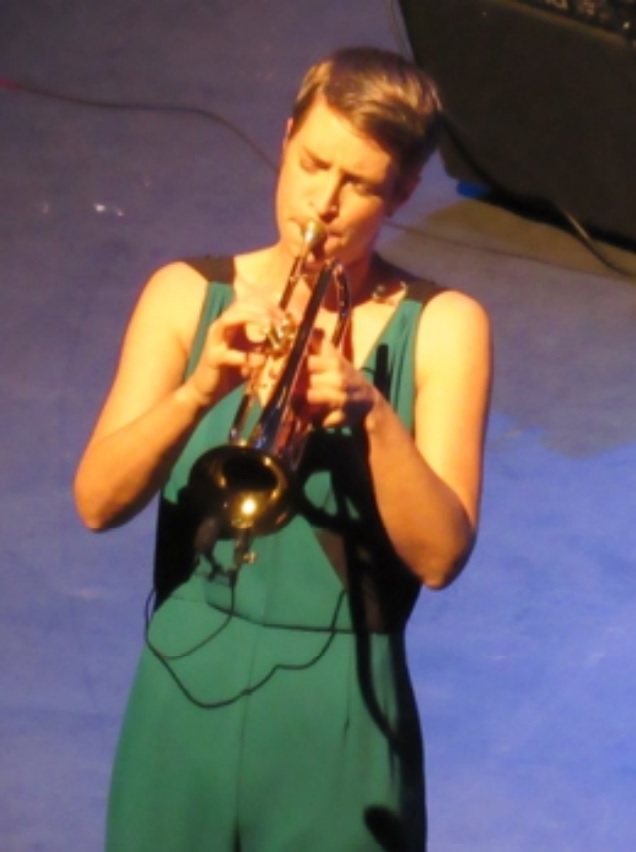
Maite Hontele in concert

The silence is interrupted with the beautiful sound of a characteristic trumpet playing a melody, the stage gets full of musicians and Maite comes out with the biggest smile that characterize her.

She starts with a speech where she explains how thankful she is for being there, talks a little bit about Colombia, and then the party starts! Two hours full of hits of herself, Oscar d’ Leon, and many other artists, with the performance of her Colombian band by her side.

Maite Hontele
Maite Hontele

But let’s get deeper in who is her. Maite Hontelé is a trumpeter who was born in Utrecht, Holland, and was raised with music. Her parents owned a huge collection of salsa and son Cubano, and every day she would listen to Latin music, quite unusual for a Dutch girl. After playing a few years with the local brass band, she decided to become a musician, and studied latin and jazz trumpet at the Conservatory of Rotterdam.

Her first big tour was life-changing. She went to Colombia, the country where she now lives. In 2004, Maite Hontelé toured with the world-famous Buena Vista Social Club. In 2009 Maite launched her first album, Llegó la Mona, a salsa-tribute to Colombian music. This album was made with the purpose to tour more in Colombia. Among the gigs she played was the Medellin Jazz Festival.

That year has been very important for her. Not only did Maite record her first album, she also found the place where she wanted to continue to live and make music. That’s when she decided to move to Medellin, Colombia.

Maite Hontele
Maite Hontele

In 2010, she released her second production, Mujer Sonora. The album is focused on oldschool styles such as son and charanga, but also contains some spicy salsa-tracks. This album was presented at the 2010 North Sea Jazz Festival, and on various international tours. In 2011 and 2012 Maite toured many countries with her band, and was a guest with Ruben Blades, Yuri Buenaventura, Issac Delgado, Diego Galé (DVD-recording), Juan Carlos Coronel, Oscar D’León, and many others.

Her 3rd album, Déjame Asi, was released in April 2013. She is currently touring Europe and Latin America.

“My Outlaw Loredo is the most elegant gig-bag in the universe. A perfect match for me!” Maite Hontelé

Maite Hontele in concer - Photo
Maite Hontele in concert – Photo

The show ends with the best energy. Maite Hontele is not only an amazing trumpeter, but also a great singer and composer. We are glad to be part of his musical journey.

  • « Go to Previous Page
  • Page 1
  • Interim pages omitted …
  • Page 38
  • Page 39
  • Page 40
  • Page 41
  • Page 42
  • Interim pages omitted …
  • Page 100
  • Go to Next Page »

International Salsa Magazine (ISM) is a monthly publication covering salsa activities around the world and has been publishing since 2007. It is a worldwide network of volunteers coordinated by ISM Magazine. Together, we work to strengthen salsa events around the world.