• Skip to primary navigation
  • Skip to main content

International Salsa Magazine

  • HOME
  • Previous editions
    • 2026
      • ISM / May 2026
      • ISM / April 2026
      • ISM / March 2026
      • ISM / February 2026
      • ISM / January 2026
    • 2025
      • ISM / December 2025
      • ISM / November 2025
      • ISM / October 2025
      • ISM / September 2025
      • ISM / August 2025
      • ISM / July 2025
      • ISM / June 2025
      • ISM / May2025
      • ISM / April 2025
      • ISM / March 2025
      • ISM / February 2025
      • ISM / January 2025
    • 2024
      • ISM / December 2024
      • ISM / November 2024
      • ISM / October 2024
      • ISM / September 2024
      • ISM / August 2024
      • ISM / July 2024
      • ISM / June 2024
      • ISM / May 2024
      • ISM / April 2024
      • ISM / March 2024
      • ISM / February 2024
      • ISM / January 2024
    • 2023
      • ISM / December 2023
      • ISM / November 2023
      • ISM / October 2023
      • ISM – September 2023
      • ISM – August 2023
      • ISM July 2023
      • ISM Edition June 2023
      • ISM – May 2023
      • ISM April 2023
      • ISM March 2023
      • ISM February 2023
      • ISM January 2023
    • 2022
      • ISM December 2022
      • ISM November 2022
      • ISM October 2022
      • ISM September 2022
      • ISM August 2022
      • ISM July 2022
      • ISM June 2022
      • ISM May 2022
      • ISM February 2022
      • ISM January 2022
    • 2021
      • ISM December 2021
      • ISM November 2021
      • ISM October – 2021
      • ISM September 2021
      • ISM August 2021
      • ISM July 2021
      • ISM May 2021
      • ISM April 2021
      • ISM June 2021
      • ISM March 2021
      • ISM February 2021
      • ISM January 2021
    • 2020
      • ISM December 2020
      • ISM November 2020
      • ISM October 2020
      • ISM September 2020
      • ISM August 2020
      • ISM July 2020
      • ISM June 2020
      • ISM May 2020
      • ISM April 2020
      • ISM March 2020
      • ISM February 2020
      • ISM January 2020
    • 2019
      • ISM December 2019
      • ISM November 2019
      • ISM October 2019
      • ISM Septembre 2019
      • ISM August 2019
      • ISM July 2019
      • ISM June 2019
    • 2016
      • ISM December 2016
      • ISM November 2016
  • Spanish
  • Download Salsa App
    • Android
    • Apple

Latin Music

John and Liz reveal details of the 16th annual SF Salsa Festival

As is tradition every year, we went back in touch with the organizers of the San Francisco Salsa Festival, John Narváez and Elizabeth Rojas, who treated us with the kindness and affection of always. The dancers and dance instructors once again spoke about the details of the festival’s organization and one or another incident that did not become public, so fans of salsa and such events cannot miss it.

They also talked about how they have done since the 2025 edition and what they will do from now until next year’s edition.

John and Liz dancing
John and Liz dancing at the San Francisco Salsa Festival

What John and Liz have done since the 2025 San Francisco Salsa Festival

After the 2025 edition, John described the rest of the year as sensational because his dance studio has maintained the expected success and his company enjoys the work of of new members who have contributed with their talent to help it grow. In addition to that, their classes are full of people eager to learn to dance, take care of their bodies, keep their minds healthy, and have a more active social life. 

He also recognizes that the Bad Bunny phenomenon helped them a lot, as they’ve welcomed many people who want to learn to dance salsa after the the boom caused by a Super Bowl full of latinidad everywhere. This has also made the celebrated ones at weddings and other family events to celebrate with salsa, so guests do not want to be left behind and seek to dance it as well as possible.

When an event has been organized for 16 years in a row, those involved already have a system by which they are ruled, so there are few surprises that John and Liz could find thanks to so much experience under their belt. However, there may be things that catch them off guard and ,in this case, it was the economy. This time, they found that everything was much more expensive.

After reviewing expenses, they noticed that the flights of the artists and hotel costs were much higher than in previous years, so they were forced to take certain actions, such as hiring fewer dance artists. They were careful to bring only the best they could find to do a tremendous show, which fortunately occurred.

John and Aura dancing
John Narvaez and dancer Aura Moreno dancing at the San Francisco Salsa Festival

They also noticed that many people could not attend the festival, so they offered numerous discounts, press passes, and the opportunity to volunteer for the organization.

Visa problems

The main disadvantage faced by John and Liz last year was the delay in the approval of visas for the members of La Máxima 79, so we wanted to know how it had gone this year. Well, as it turns out, it did happen again and two couples of dancers were unable to attend because their visas were denied, so they had no choice but to invite residents of the United States to prevent that headache. 

Of course, it must be added that bringing people from other places implies additional costs that do not do any good to them right now. For the same reasons, other festival organizers are doing the same thing.

Principal guest artists

The main attractions at this festival were Charlie Aponte, Edgardo Cambón, and Cabanijazz, who of course, did a magnificent job. The big surprise of the festival was definitely Charlie Aponte, with whom they managed to have contact through a well-known Mexican promoter who acted as a link between the dancers and the artist. 

The agreement was made as recently only in January, that is, a couple of months before the event. That is when John contacted Jeannette Santiago, Charlie’s manager and wife, told her who he was, and mentioned the mutual friend they had in common. He then managed to close the deal with her and have the Puerto Rican singer at the event, which came as a very pleasant surprise to those who had been planning to attend for months.

Edgardo Cambón playing
Edgardo Cambón playing at the San Francisco Salsa Festival

Preparations for next year

As every year, after an edition is completed, John and Liz are already thinking about what they will do for the next one. In fact, just the day before this interview, they had a work meeting to start planning everything and thinking about who they will invite for 2027.

They are thinking about inviting La Máxima 79 again. In fact, they have already talked to their lawyer responsible these matters and agreed to carry out the relevant procedures to finally have them at the festival, as they have wanted for a long time. In case the invitation is not given effect, they also have their eyes on Jimmy Bosch and Hermán Olivera. Both have performed in previous editions prior to the pandemic and were sensational, so they are held in good esteem by the organization.

They also mentioned that the venue for the next two editions will continue to be the Marriott Hotel Waterfront, as the location is beautiful and very suitable for an event of this magnitude.

Cabanijazz playing
Cabanijazz Project playing at the San Francisco Salsa Festival

Read also: Uruguayan composer and multiinstrumentalist Sebastián Natal and his band Grupo Sensación

Nossa Kizomba. International Amsterdam Festival 2016

Europe / Netherlands / Amsterdam

Nossa Kizomba. International Amsterdam Festival 2016 (16, 17, 18 DECEMBER Brasa Dance Studios Zuidoost)

Nossa Kizomba Amsterdam Festival is an event focusing on dance, culture and real talent. At our festival you will enjoy workshops by some of the best International teachers in a variety of dance styles including Kizomba, Semba, Tarraxinha, Kizomba fusion, Afro House, Hip Hop and Funk.

Nossa Kizomba. International Amsterdam Festival 2016

There will be of course parties and shows.

But this is not all, because we want to give you an all-round experience of the Angolan culture with:

  • An African fashion show
  • A documentary about Angolan music
  • Typical food
  • Palestras allowing you to learn and discuss about dance styles with experts
  • Afro House battle
Nossa Kizomba. International Amsterdam Festival 2016 - Flyers
Nossa Kizomba. International Amsterdam Festival 2016 – Flyers

Eduardo Paim

LIVE IN CONCERT

Special Guest!

Music producer

Eduardo Paim
Eduardo Paim

Eduardo Paim has proved not only a performer but also a composer and music producer from multiple sources. It should be noted that the music producer, record producer also known, is the figure responsible for the completion of a recording that is considered finalized for release.

In this sense the process of the first productions of Eduardo Paim has included recording, advice from musicians, writing, including the supervision of the mixing process and can be considered the pioneer in the use of synthesizers and other similar procedures, as the box rhythms, learning who had the undeniable contribution of techniques already dominated by Ruca Van-Dunem.

Is that too much, that the musical aesthetics of Eduardo Paim, as producer, had great importance in the careers of singers and important in the course of Angolan popular music itself, later.

Eduardo Paim - 2
Eduardo Paim – 2

Paul Flores, Diabik, Clara Miller, Nelo Paim (the promising younger brother Eduardo Paim) Mamborró, Tchipa Jacinto Moniz de Almeida, Tropical Band and Van-Dúnem Ruca, we cite the most important, are examples of the influence and focus Radiator keys Eduardo Paim, whose electronic sound, has undergone a substantial part of the music of the past twenty years.

The early career of Paul Flores had the production and contribution of Eduardo Paim. Topics such as: “Cheri”, “Kapuete kamundanda” and “This wedding is” the first compositions of Paul Flores, resulted from an invitation by Carlos Eduardo Paim Open Flores, father of Paul Flores.

Eduardo Paim dancing

Discography

Eduardo Paím

Also known as General Kambuengo (stubborn, resolute), Eduardo Paim has obtained during his career, three discs of gold and silver awards granted for publishing Portuguese, assigned by the sum of fifty thousand copies sold, with the albums “Kambwengo” (1994), “From kayaya” (2002), and “There is still time” (1996).

The song “Baila Rose” from the album “Kambwengo,” one of the paradigms of discography Eduardo Paim, which portrays the typical Angolan woman, was in the charts of Radio Television Portugal (RTP) for months.

Nossa Kizomba. International Amsterdam Festival 2016 con Eduardo Paim- Flyers

“Luanda my band” (1990), “Mujimbos” (1998), and “Maruvo Cup” (2006), is a whole album, more than twenty year career. His latest CD, much more involved, was contributed by singers such as Fernando Girão, Nancy Vieira, Bonga, Vote Gonçalves, Don Caetano, Angelo Boss, Black, and Matias Damasio Bué. The CD “Luanda my band,” proved, likewise, a success unprecedented in the career of Eduardo Paim, an album that aligns the themes: “My Neighbor,” “Kutonoca,” “It’s So Good” “Luanda My Band”, “Sound of the Band,” “Nagibo” and “Kizombada.”

On this record, Eduardo Paim has worked with the Guinean guitarist and singer Justin Delgado Guilherme Silva, a Mozambican artist who has shared the stage with artists such as Julio Iglesias, Tina Turner, Juan Luis Guerra, Cesaria Evora, Tito Paris and Rui Veloso.

Eduardo Paim - 3
Eduardo Paim – 3

The economy of instrumental means, one of the merits of Eduardo Paim, in close collaboration with guitarist Simmons Mancini, revealed itself as one of the strategies of this album, as well as the use of synthesizers, whose functionality was ultimately the only recourse at that time.

For an artist with a long artistic career, Eduardo Paim argues that “when you have no followers, you do not reach the target, but when there are many, we can lose ourselves among those who follow us.”

TICKETS: https://www.dizizid.com/events-registration/index.html?officeId=47

Eduardo Paim - 4
Eduardo Paim – 4

Pietro’s

North America / USA/ Miami

Pietro’s: Italian Restaurant & Party House

Created in 1979, Pietro’s is a restaurant suitable for going to enjoy exquisite Italian food, good drink and a unique dance night in a friendly atmosphere where you can relax and forget the stress of your everyday life.

Pietro is characterized by its classic pastas and signature, including the number one pasta West Michigan, fettuccine Michael. As soon as you walk through the doors of Toscana you can enter the aroma of freshly baked bread and handmade ravioli, made in its pasta factory every day.

Pietro's: Italian Restaurant & Party House
Pietro’s: Italian Restaurant & Party House

Pietro’s

There are large portions on the menu with affordable selections as Delmonico, tender veal scallopine, salmon fish with hook and hand cut homemade mozzarella. Soups and pizzas are also freshly prepared with the freshest ingredients made from zero.

In this restaurant, located in the heart of Grand Rapids, you can find a service dinner family style perfect for any meeting and special event in the private party rooms and recently refurbished semi-private.

Pietro's: Italian Restaurant & Party House - Photo 2
Pietro’s: Italian Restaurant & Party House – Photo 2

Also, in this place the dance floor gets hot with tropical music every Saturday night from 22:00 to 2:00 with Sergio and Cecilia. Contemporary and traditional salsa, bachata and merengue music are the most sound about.

The requirements to attend and enjoy this party Saturday are a few: be 21 years old and comply with the dress code. This way you can meet with a group of friends, people from different countries, socialize and have a good time with the music that you like in a dance track wide and safe environment. The kitchen is open until midnight.

Pietro's: Italian Restaurant & Party House - Photo 3
Pietro’s: Italian Restaurant & Party House – Photo 3

So you know, you told ISM. Visit Pietro’s Italian Restaurant & Party House. You’ll love it!

Address: 2780 Birchcrest Dr SE, Grand Rapids, MI 49506, USA. Open: Monday – Thursday: 11:00-22:00; Friday – Saturday: 11:00-02:00 and Sunday: 11:00-21:00

www.pietrosgr.com Facebook: Pietro’s Italian Restaurant

Pietro's: Italian Restaurant & Party House - Photo 4
Pietro’s: Italian Restaurant & Party House – Photo

‘‘El Griego Rumbero’’ visited the Salsa Museum and donated some objects

The artist we will talk about today is a very particular case, since he comes from a country which is not usually related to salsa or Latin music in general. However, the passion for these rhythms has captivated people from all over the world, so it is not surprising that our guest has experienced the same thing.

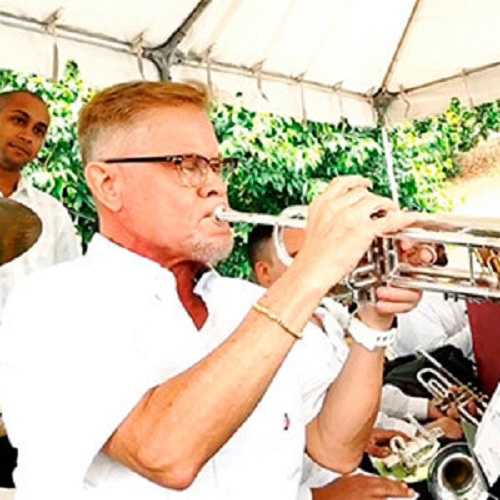
We’re talking about the Greek-born trombonist and composer Demetrios Kastaris, whom El Rubio Boris and I were fortunate to welcome at the Salsa Museum. Here’s a little of his fascinating story.

Demetrios Kastaris playing
Demetrios Kastaris playing the trombone

Demetrios’ early years

Demetrios was born in Thessaloniki, Greece, but moved with his family to the United States when he was just two years old. After living in Ohio for a few years, the family moved again, but this time to St. Louis, Missouri, a place that would be critical to the training of the Young man in the times to come.

The first contact of the boy with music was in elementary school during a live performance by a classical music quintet, but what really captivated him was a demonstration of a slide trombone by a member of the St. Louis Symphony Orchestra. It was at that instant the aforementioned instrument inspired Demetrios to take trombone lessons and join the school concert band.

More importantly, as Demetrios grew older, he spent countless hours practicing the trombone, especially in summer when he was free from school work. Finally, On reaching the age of 17, his perseverance began to bear fruit, and he got the opportunity to rehearse with the Stan Keaton Jazz Orchestra, which was the first great experience for the teenager. Just one year later, he sang as a soloist at the Classical Rimsky-Korsakov Concerto. 

Other than that, Demetrios received the John Philip Sousa Band Award just before graduating from high school. He then studied music education at the University of Missouri-St. Louis, when he played in the jazz band and won several awards with the group.

Cover of the album ''El Griego Rumbero''
Cover of the album ”El Griego Rumbero” by demetrios Kastaris

Moving to New York

Two years after having studied in Missouri, Demetrios moved to New York, where he received a scholarship that allowed him to attend New York University and take more steps in his musical career. While completing his studies, he met a bandleader on the subway and was invited to a rehearsal where he was given the opportunity to arrange Afro-Cuban jazz pieces for the first time in his life.

Latin music and its rhythmic features made such an impression on Demetrios that he began attending concerts by many of its great exponents, such as Willie Colón, Eddie Palmieri, Ray Barretto, Tito Puente, Mongo Santamaría, and many others. This led him to transcribe and conscientiously analyze these artists’ songs to satisfy his curiosity and learn more about these rhythms.

After graduating with honors, he earned a masters degree in jazz from the Manhattan School of Music. Soon after, he was already teaching in public schools while performing with one of the bands of the Concord Resort Hotel.

Other important details of his career

For over 50 years of artistic career, Demetrios has had the opportunity to perform with big Latin stars such as Tito Puente, Luisito Quintero, Alfredo De La Fé, Ray Barretto, Charlie Palmieri, Herencia Latina, Oscar Hernández from The Spanish Harlem Orchestra, and many others. 

Already in the decade of 1980, the artist founded the Latin-Jazz Coalition and recorded several of his original compositions in genres such as Brazilian and Afro-Cuban jazz. In certain Circles, his work has earned him the nickname of “El Griego Rumbero”, a moniker by which he is still known today.

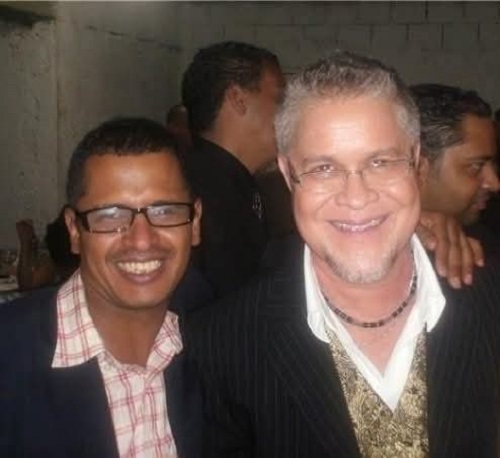
Johnny Cruz, Demetrios Kastaris and El Rubio Boris

Much more recently, Demetrios was invited to play with Los Leales de Cuba at the Buena Vista Curry Club and also to rehearse with Los Muñequitos de Matanza, which was a very learning afternoon and a memorable experience for him. Thereafter, he traveled to Cuba on several occasions to learn much more about this music.

Visit to the Salsa Museum

Just two years ago, Demetrios visited the Spanish Harlem Salsa Museum directed by yours truly and spent an enjoyable time with our entire team but he did not come alone. He brought us his photograph and a poster of the Latin Jazz Coalition, which were mounted on a wall alongside many other photographs of stars such as The Fania All Stars, Hector Lavoe, Tito Puente, Celia Cruz, El Gran Combo de Puerto Rico, Larry Harlow, and many others. 

His childhood trombone was also added to our extensive display of objects donated by artists and their families. This took place on March 20, 2024, and the instrument remains at our institution to this day as a reminder of a Greek man’s love for our music and a thank you to his dedication over the years.

Johnny Cruz ISM

Read also: Rey Ruíz visits the Salsa Museum and talks about his prolific career

Jairo Varela Music, Identity, and Social Narrative

The BE MORE publishing house is proud to announce the release of the new book by journalist and music researcher Robert Téllez M.

The work offers a deep dive into the social and narrative dimensions of the compositions of Jairo Varela, founder of the world-renowned Grupo Niche. It illustrates how his lyrics transcend music to become chronicles that interpret Latin American reality.

More than just a repertoire of songs, Jairo Varela’s legacy serves as a testament to memory and identity, born from his profound Afro-descendant roots. From this perspective, the book develops a discourse analysis that explores the symbols and meanings structuring his lyrics within a historical and social context.

Categorized within the field of ethnomusicology, the literary work proposes a rare perspective in Salsa studies: understanding Jairo Varela as a narrator of social reality.

“Through his lyrics, Jairo Varela challenged indifference, exposing what many preferred to keep silent,” states author Robert Téllez M.

To develop this research, the author brought together an interdisciplinary team of specialists in anthropology, communication, law, education, history, linguistics, music, journalism, and poetry from across Latin America. This diversity shapes a study organized into seven chapters, where symbols, metaphors, and narrative structures within Varela’s songwriting are analyzed and deconstructed.

“With an honesty that never yielded to artifice, Jairo Varela mapped the social landscape of everyday life; he narrated the intimate without betraying the collective, all in an effort to better understand the world,” Téllez notes.

As an innovative feature, the book Jairo Varela: Music, Identity, and Social Narrative incorporates QR codes that lead directly to Maestro Varela’s compositions. Each code allows the reader to use their mobile device to access the songs analyzed via Grupo Niche’s profile on Spotify, enhancing the connection between the written word and musical creation.

The publication also includes a prologue by writer Bella Martínez, illustrations by Frank Rosado, and photographs from the Varela family archive—elements that provide essential context to the composer’s creative universe.

Jairo Varela: Music, Identity, and Social Narrative is now available to the public on Amazon, with worldwide shipping.

The Book: Jairo Varela. Music, Identity, and Social Narrative

Jairo Varela (1949–2012)

Varela was the creator and founder of the iconic Grupo Niche and one of the most influential figures in Colombian Salsa. It was Jairo Varela who built the prestige of this orchestra through his artistic vision and his talent as a composer and director. With those five letters Niche Varela changed the course of Salsa made in Colombia, elevating it to a level of international respect.

Jairo Varela. Música, Identidad y Narrativa Social

Throughout his musical career, Jairo Varela wrote hundreds of songs and produced dozens of albums for his group. His compositions including “Cali Pachanguero” (recognized by Billboard magazine as one of the 50 most important songs in the history of Latin music), “Buenaventura y Caney,” “Mi pueblo natal,” “Ana Milé,” “Un caso social,” and “Han cogido la cosa” have traveled the world and become classics. In his lyrics, Varela portrayed everyday Latin American stories and the identity of Afro-descendant communities.

When Grupo Niche’s music plays, there is something for every listener. Behind that diversity lies the creative intuition of Jairo Varela, a composer who knew how to turn local stories into universal emotions. For this reason, from its beginnings in the late seventies to its international acclaim, the group has brought the rhythmic power, joy, and character of its culture to stages worldwide.

About the Author

Robert Téllez M. is a social communicator, radio and TV broadcaster, and producer with over 20 years of experience. He is an accomplished interviewer, journalist, and music researcher.

His analyses and reflections have been published in outlets such as Revista Semana, El Espectador, El Tiempo, El País, La República, and Agencia EFE, among others. He has also contributed to the scientific journal Nómadas of the Universidad Central de Colombia.

Robert Téllez is also the author of Ray Barretto: Giant Force (2016), whose English translation won a silver medal for Best Translation (Spanish to English) at the 2021 International Latino Book Awards.

In 2019, he presented the authorized biography Willie Rosario: The King of Rhythm, with a second edition released in 2024. He served as a judge for the annual international minimalist poetry contest for the anthology titled Siglema 575: Say What You Want to Say (2024).

As a result of his extensive research, Robert Téllez serves as a consultant and lecturer on topics related to the appreciation of Salsa music.

Press Contact: [email protected]


Roberto Tellez

Also Read: Willie Rosario, El Rey del ritmo by journalist and music researcher Robert Téllez M.

  • « Go to Previous Page
  • Page 1
  • Interim pages omitted …
  • Page 3
  • Page 4
  • Page 5
  • Page 6
  • Page 7
  • Interim pages omitted …
  • Page 85
  • Go to Next Page »

International Salsa Magazine (ISM) is a monthly publication about Salsa activities around the world, that has been publishing since 2007. It is a world network of volunteers coordinated by ISM Magazine. We are working to strengthen all the events by working together.