





Directory of North American nightclubs |
||
|
|
||
|
|
|
|
|
|
||

CALIFORNIA |
|

ILLINOIS |

MICHIGAN |

NEW JERSEY |

NEW YORK |
|
|
|
|
|
|
|
|


Directory of North American nightclubs |
||
|
|
||
|
|
|
|
|
|
||
|
CALIFORNIA |
|
ILLINOIS |
|
MICHIGAN |
NEW JERSEY |
NEW YORK |
|
|
|
|
|
|
|
|
Javi Jiménez from Barrio Manouche graces us with his presence in this July 2025 edition after several months of wanting to talk to the artist. After witnessing one of his wonderful shows at Cascal Restaurant, where the group performs regularly, we have checked the high quality of Javi’s work and that of his bandmates, so we could not miss the opportunity to share the most important aspects of his career, both in his native Spain and in San Francisco.

The first contact with music in Javi’s life was made thanks to his parents, and in the neighborhood where he grew up, music was always present. From an early age, he and his brother listened to all kinds of genres at home, which awoke in them an interest in this art form beyond seeing it as simple entertainment. He remembers that since he was six, he saw his uncle playing the guitar until a few years later, when he turned 10, his uncle gave him this instrument so that he could play it himself.
Although his family did not have many musicians, he mentioned a cousin of his who was a bassist and actually wrote him his first chords on a piece of paper so that he could experiment with his new guitar and he did.
He describes his taste in music after the age of 12 as an “obsession,” and at that time, he was very into rock and punk, nothing to do with what he plays today. He then started hanging out with several schoolmates who shared his hobby of playing music, which ended up giving rise to his first band, Mulatask. Currently, there is nothing about this online, as the internet did not exist at that time, so all evidence that this alternative rock and grunge band ever existed is on CDs and MP3 files that are not public.
In addition to that, the music his parents listened to continued to influence him to some extent. Among their favorite artists were Silvio Rodríguez, Victor Jara, Canción Protesta and Paco Ibañez. These singers impacted him so much that he began to study a little the classics and play them, but rock and electric guitar were still his favorites above all else. In fact, his favorite artists were Jimmy Page of Led Zeppelin, Pink Floyd, Jimmy Hendrix, among others.

This was the kind of music he played with his friends in the neighborhood and they even gave small recitals in front of audiences of 200-300 people when they were 15 or 16 years old at the time, which made the teenage Javi love to show his art to the world.
Javi’s transition to gypsy jazz (inspiration for the name of his future band), modern jazz, and flamenco began when he moved to Barcelona, where he studied at a jazz and modern music conservatory. There he discovered a lot of genres and styles he had never heard before, one of which was bebop, also known simply as bob, which is a jazz style developed in the United States during the 1940s. At that time, he also discovered Charlie Parker, John Coltrane, Thelonious Monk, Dizzy Gillespie, among others.
Although Javi did not really identify with that language, he wanted to truly understand music so he could interpret it as best as possible. He did everything he could to understand bebop, but he found it very difficult until he started listening to Belgian gypsy jazz guitarist of Roma descent, Django Reinhardt, who was also a fan of Louis Armstrong. When he listened to Armstrong, he wanted to play the same thing, but with his own Roma touch, so he formed a band with two guitars, a bass, and a violin.
One of this band’s favorite genres is gypsy jazz manouche, which Javi loved and was passionate about since the first time he listened to it, to the point that he would name his future group Barrio Manouche (Gypsy jazz in Spanish).
On the side of flamenco, there were many gypsies and immigrants in his home neighborhood, including the Porrina family, which consisted of world-renowned percussionists such as Ramón Porrina, who has played with Concha Buika and Israel Suarez ‘‘El Piraña’’, a flamenco guitarist who was in Paco de Lucía’s last lineup.

Javi tells us this to show that flamenco was very present in the environment he grew up, largely because there were many migrants. In his family’s case, they came from Andalusia and Cordoba.
He continues to insist that he still did not like it very much and his thing was rock. It was in California that he finally had nostalgic about the music of his homeland and wanted to reconnect with his roots in foreign lands.
Javi had never thought about trying his luck in California until he met Adam Rouch, a Californian tattoo artist and musician who became his friend and with whom he toured Europe. In 2009, Adam had to return to his city because his parents were not in good health, and he told his Spanish friend to go with him to see how he liked the place.
Although the artist was not convinced by the idea, he ended up accepting and discovered in San Francisco fun, cultural exchange, diversity, and many things that fascinated him. The best thing was the opportunity for its inhabitants to express themselves through practically any type of art or genre without fear of judgment, which made him decide to definitely stay living and finally become an American citizen.

After he met with many musicians and made many contacts, Javi and his brother Luis, who is also part of the group on cajón and percussion, met Salvadoran percussionist Marcos Odara, French saxophonist Cyril Guiraud, violinist Magali Sanscartier, bassist Chris Bastian, his future replacement Gary Johnson, and guitarist Ross Howe. Finally, they included Colombian bongo player and flutist Iván Rondón, with whom they collaborated until he became a permanent member of the band.
The previous artists make up the instrumental part, but the dancing part includes Fanny Ara and Brazilian dancer Emaye Ama.
Thanks to the huge number of nationalities and cultures present in the group, they have managed to get a unique sound Javi describes as a “bomb” due to the mixture of elements that are so diverse from one another.
He says he feels a deep appreciation and respect for each of them, which makes the unity of the group stronger and more lasting despite the crises and the passage of time.
Read also: Sizzling Summer Nights dancer April Connella breaks silence on Orlando Delgado and her career
Latin America / Colombia / Bogota

The Macarena Sector in Bogotá – Colombia offers us a great variety of gastronomic spaces, a reference sector for international food, for this reason we could not help but bring us closer to the best Cuban food space in the city, the great Ilhe Habana, a space of great tradition that takes you to enjoy a themed plaza of old Havana.


From Sunday to Sunday from 12:00 to 4:00 pm, it opens its doors to a particular base of high caliber typical Cuban foods, we can get a great gourmet line, it is easy to get dishes such as old clothes, black beans, Moorish rice and Christians, yucca with mojo, habanero mincemeat, habanero shrimp, sea bass, squid rings, among others that delight your palate, arrival night from Wednesday to Saturday from 6:30 p.m. to 10:00 p.m.

It offers us a space decorated with groups and singers of the music of the island, letting the enjoyment roll until 12:00 am on Fridays and Saturdays to enjoy boleros, sones, danzones and even guarachas of this Latin American musical icon.


Ilhe refers to the word house or land according to the Yoruba language, something well defined with the Afro-Cuban culture, for this reason Ilhe Habana seeks a concept of old Havana, with a cozy space with brightly colored walls, wooden furniture and a house facade taken of the best Cuban roots.

During our visit we were able to talk with… the owner and cause of this gastronomic fever, he allowed us to enjoy the house specialty, the much-followed Roast Pork, although we noted that the fried cow was highly requested, as was the pork escalope. Located near the city center, on Carrera 3A, # 26B – 72, this Caribbean center offers us a space full of delicious dishes, visit www.ilhehabana.com and find out about a whole world of flavors, surely during your visit to Bogota you will not be able to forget going through this great restaurant.

She is the daughter of the prestigious composer and performer René Márquez. She began her artistic career in 1968.
An exponent of romantic songs, “feeling,” and bolero, she gracefully delved into these genres, performing pieces by prolific authors such as René Márquez, Marta Valdés, Juanito Márquez, Silvio Rodríguez, and Germán Nogueira, among others.
Her mezzo-soprano range has enabled her popular “descents” to low tones, as well as her unexpected and no less appreciated “ascents” to much higher tessituras, without losing her defining style. This style is very appropriate for songs and boleros, genres in which she has remained one of Cuba’s leading cultivators.
She is known as “La Musicalísima.”
We are witnessing the realization of a long-cherished project with which the performer, pianist, and composer Beatriz Márquez settles a debt both on a family level and within Cuban discography.

Given the influence René had on the career of his daughter and grandchildren, this is an album full of love and, above all, gratitude.
While he was best known for his songwriting, it is important to highlight the mark he left as a charanga singer.
Among others, we can mention his work with the charangas of violinist Cristóbal Paulín, Oscar Muñoz Bouffartique, and René Touzet.
He debuted at the Mil Diez radio station with the group led by Julio Cueva, to which he dedicated himself for ten years.
From the late 1930s onwards, the lyrics by the artist from Villa Clara quickly resonated with the public.
“El Inquieto Anacobero” recorded “El disgusto de bigote” with the Sonora Matancera in 1949 and also sang other Cuban songs such as “Soltando chispas,” “A San Lázaro,” and “El granito de maíz.”
René’s songs, among which “El quinqué” cannot be missed, speak of his natural ingenuity for storytelling.
Upon his death at 72, he left a musical legacy that has since been defended by his descendants.
In “La Musicalísima”‘s discography, prior to this material, there were only two phonograms exclusively dedicated to the work of a single author: “Beatriz canta a Juan Almeida” (Egrem, 1978), followed forty years later by “Libre de pecado” (Colibrí Productions, 2018), a tribute to maestro Adolfo Guzmán, thus contributing to the rescue of the island’s musical memory.
“Este encuentro” spans traditional trova and moves from guaracha to son, without forgetting some of the composer’s most notable boleros.
It also allows us to appreciate René Márquez’s interpretive qualities by hearing his voice, rescued from old recordings.
The special participation of singers Evelyn García and Michel Maza, continuators of the family saga, is noteworthy.

Beatriz Márquez – Este Encuentro (2023)
Tracks:
By:
Also Read: Enrique “Culebra” Iriarte, master of the piano and musical composition
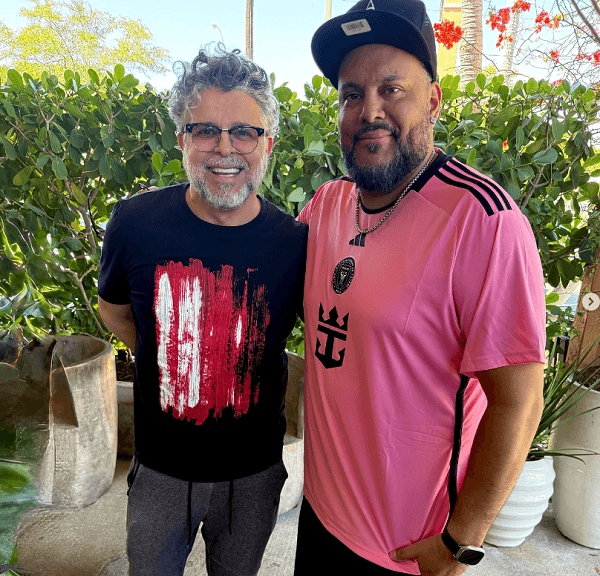
The composer and singer with Nicaraguan roots Carlos Xavier is a very good friend of the house due to his collaboration with the Editor of International Salsa Magazine Eduardo Guilarte and we are extremely pleased to have invited him to this edition and to know him in a more personal way. The artist born in San Francisco talked to us about his musical career, his facet as a composer, his great inspirations, among other relevant topics.

From a very young age, Carlos was already in close contact with music thanks to his father and older brother, since they always sang, played the radio or listened to records they bought. At home, he listened to all kinds of music in both English and Spanish, but it was not until he was 16 years old that he became really interested in singing in a more serious way. He was not accompanied by a teacher to tell him exactly what to do, so he had to start practicing alone and be guided by what he saw in professional singers like Christian Castro, Luis Miguel and Marc Anthony when it was his turn.
As for his musical debut, in 1999, Carlos ventured to look for an orchestra to sing with once he felt ready to prove his vocal skills on stage in front of a crowd. Then, he found Orquesta Caché, which had just been created and was looking for a singer, a post for which he was finally selected and made his first performance with the group that same year. This concert took place at the well known Café Cocomo and, since then, the artist has not stopped.
Although Carlos states that he likes English music and has recorded several songs in English, he also clarifies that his focus is and always has been Latin music. He has worked on other people’s projects in which English is the base, but whenever he releases something of his, he always tries to base it on Latin or salsa music and always in Spanish. It’s a matter of preference.
This is partially thanks to his parents, who always made sure that their children had as much contact as possible with their Nicaraguan roots through the rest of his family, music, food and Nicaraguan culture in general.
In addition, most of his family also went to live in the United States, so he always spent time with them, which helped Carlos to know much more about Nicaragua and the way of life in that country. They always instilled in him the pride of being Latino and he still keeps that feeling intact.

Although Carlos spent many, many years playing with orchestras, he says that becoming a soloist at some point was always his greatest goal. That moment came in 2010 when the singer released his first single as a soloist called ‘’Mientes’’, which was the piece that gave him the confidence to know he could have a solo career and write his own music.
When we wanted to know the biggest challenges faced by him, he replied that he never thought of his solo career that way, but that he was working for a purpose, drawing inspiration from his greatest idols who had already achieved what he wanted. He simply saw his goal as something he had to achieve at some point, not as a challenge that would make the path more difficult for him.
‘’Vive Todo Ahora’’ was the representation of the dream of Carlos, who always wanted to be able to release an album of the same quality as those of Marc Anthony, La India, and Frankie Negrón. The fact that it was his first album did not mean that the singer was going to let his first album reveal his inexperience in this field, so he hit the deck and contacted producer Efrain Davila. At that time, Davila was working with Victor Manuelle, Marc Anthony and Carlos Vives, so Carlos decided to send him a message and show him his song ‘’Mientes’’ to cover it in salsa.
The producer responded enthusiastically that he liked the song and accepted the proposal, leading ‘’Mientes’’ to be released as a single in 2014 and the rest of the album was made and released in the same way. Fortunately, Carlos succeeded in including some of Marc Anthony’s musicians such as bassist Ruben Rodriguez, percussionist Luisito Quintero, backing vocalist Guianko Gomez, among others.
Another facet that has been of vital importance to Carlos’ growth as an artist has been composition and, of course, he has his own creative process, although it is not extremely complex. He simply sits down at the piano and looks for the most beautiful melody he can think of, but it is a creation that is born from the inside of him.
n the year 2000, together with the Orquesta Caché, he had the opportunity to record a cover in Peru, but he told the members of the group that he wanted to write that song in his own hand and they agreed. That is when he created ‘‘Marchate’’ and it was the material they recorded in the aforementioned country.
Even then Carlos showed that he wanted to be original and follow his own ideas, which he finally achieved thanks to his perseverance.
As mentioned above, Carlos worked closely with Eduardo Guilarte at Charley’s LG Club in Los Gatos, California for some time a few years ago. Of that time, Carlos recalls that Guilarte was one of the few people who truly praised him for his talent on stage, which he appreciated today. He mentioned that he always offered him nice words and advice regarding the way the industry works, so he has the best memories of his collaboration with the editor of International Salsa Magazine.
For the time being, he keeps playing at other clubs such as Building 43, Vino Godfather Winery, The Dawn Club, among others.

Read also: Eduardo Ron and his Fondo Blanco Band liven up great events in Miami