• Skip to primary navigation
  • Skip to main content

International Salsa Magazine

  • HOME
  • Previous editions
    • 2026
      • ISM / April 2026
      • ISM / March 2026
      • ISM / February 2026
      • ISM / January 2026
    • 2025
      • ISM / December 2025
      • ISM / November 2025
      • ISM / October 2025
      • ISM / September 2025
      • ISM / August 2025
      • ISM / July 2025
      • ISM / June 2025
      • ISM / May2025
      • ISM / April 2025
      • ISM / March 2025
      • ISM / February 2025
      • ISM / January 2025
    • 2024
      • ISM / December 2024
      • ISM / November 2024
      • ISM / October 2024
      • ISM / September 2024
      • ISM / August 2024
      • ISM / July 2024
      • ISM / June 2024
      • ISM / May 2024
      • ISM / April 2024
      • ISM / March 2024
      • ISM / February 2024
      • ISM / January 2024
    • 2023
      • ISM / December 2023
      • ISM / November 2023
      • ISM / October 2023
      • ISM – September 2023
      • ISM – August 2023
      • ISM July 2023
      • ISM Edition June 2023
      • ISM – May 2023
      • ISM April 2023
      • ISM March 2023
      • ISM February 2023
      • ISM January 2023
    • 2022
      • ISM December 2022
      • ISM November 2022
      • ISM October 2022
      • ISM September 2022
      • ISM August 2022
      • ISM July 2022
      • ISM June 2022
      • ISM May 2022
      • ISM February 2022
      • ISM January 2022
    • 2021
      • ISM December 2021
      • ISM November 2021
      • ISM October – 2021
      • ISM September 2021
      • ISM August 2021
      • ISM July 2021
      • ISM May 2021
      • ISM April 2021
      • ISM June 2021
      • ISM March 2021
      • ISM February 2021
      • ISM January 2021
    • 2020
      • ISM December 2020
      • ISM November 2020
      • ISM October 2020
      • ISM September 2020
      • ISM August 2020
      • ISM July 2020
      • ISM June 2020
      • ISM May 2020
      • ISM April 2020
      • ISM March 2020
      • ISM February 2020
      • ISM January 2020
    • 2019
      • ISM December 2019
      • ISM November 2019
      • ISM October 2019
      • ISM Septembre 2019
      • ISM August 2019
      • ISM July 2019
      • ISM June 2019
    • 2016
      • ISM December 2016
  • Spanish
  • Download Salsa App
    • Android
    • Apple

Search Results for: World Salsa

Today’s feature in “International Salsa Magazine” is multi-instrumentalist Jorge Gregorio Rojas Perozo

The name of the city of Barquisimeto continues to be known as the musical capital of Venezuela.

Characteristic by which, for years, is national and international reference and for proof of this, excellent musicians born in this city, who triumph and shine with their own light, demonstrating quality and versatility in all Latin rhythms stand out.

And today’s character in “Salsa Escrita” is the multi-instrumentalist Jorge Gregorio Rojas Perozo, artistically known as Jorge “El Papi” Rojas, extraordinary tres player, guitarist, bassist, arranger, composer, producer and teacher of Latin rhythms and tumbaos.

Jorge Gregorio Rojas Perozo

“El Papi”, as he is commonly known, was born on November 28th in the city of Crepuscular and from a very young age he started in this wonderful art of music, studying at the Vicente Emilio Sojo Music Conservatory.

Welcome Jorge to “Salsa Escrita”, through International Salsa Magazine, www.salsagoogle.com our readers want to know your wide and successful trajectory.

Thank you Professor Carlos Colmenárez for giving me the opportunity to appear in your well read and well known salsa column.

Jorge, tell us in general terms, with which groups have you been part of?

Professor, in 1986 I was director and founder of Grupo Identidad Caribe, in the salsa genre, then in 1987, founder of Grupo Miyare, also salsa.

From 1988 to 1992, director of the Orquesta Profecía (Christian salsa); 1996 to 2003, director of the Orquesta Monumental. From 2003 to 2008 I was director of the Epsilon Band (rock-pop) with music from the 60’s, 70’s and 80’s and from 2003 to 2010, bass player, accompanying on tours in Venezuela of: Henry Stephen, Trino Mora, Los Tres Tristes Tigres, Carlos Moreno, Los Pasteles Verdes, Los Ángeles Negros, Mirtha Pérez, Tania and Leo Dan; from 2007 to 2009, accompanying musician for singers: Mervin Rodriguez, Aurita Uribarri and Marco Molina.

Jorge “El Papi” Rojas, extraordinario tresista, guitarrista, bajista, arreglista, compositor

In 2012 to the present, tres player of “Sasón Latino”; in 2018, musical director of the Orquesta Siete Mangos y una Flor.

Today I direct the salsa group “Coimbre” and in parallel I am recording my own production of salsa and sones with lyrics and arrangements of my authorship to provide a contribution to Latin music from the state of Lara.

Also, I am giving virtual classes of Latin rhythms and tumbaos in the Cuban tres, bass and guitar, both nationally and internationally.

Very interesting and admirable your trajectory; Jorge, by the way, I remember a performance of you with the “Orquesta Profecía”, alternating with the “Estrellas de Fania” in the Municipal Coliseum of Barquisimeto, how was that experience? Well professor, it was an unforgettable experience, to be sharing the stage with Ismael Miranda, Larry Harlow, Bobby Valentin, Richie Ray, Bobby Cruz, Pete “Conde” Rodriguez and Jhonny Pacheco; in an unforgettable night, where we opened that concert, taking pleasant impressions from the audience and salsa specialists.

Jorge “El Papi” Rojas

And I tell you professor, besides alternating with Fania here in Barquisimeto, we also did it in the Poliedro of Caracas, in a tour made by them in our country in 1993.

And as for international tours, which countries have you visited? Professor Carlos, I had the honor of performing in the brother country of Neogranadino with the salsa group “Coimbre”, where the Colombian salsa public enjoyed the Afro-Caribbean music, made by musicians from Barquisimeto; visiting the cities of Cucuta and Medellin.

Recently we accompanied the sonero Ramoncito Mendez in his show at the end of 2019, here in the state of Lara. Current projects “Papi”, what do you have out there? Friend Carlos, at the moment, as I told you at the beginning, I am finishing my production and simultaneously I am teaching online classes, with people from abroad.

What are your digital platforms? They are, Facebook: Jorge El Papi Rojas; phone +58 426 3531337; email: [email protected]. Finally, on behalf of Salsa Escrita, we would like to congratulate you for your vast and interesting artistic career and we hope you continue to succeed in our country and abroad, with the help of God Almighty.
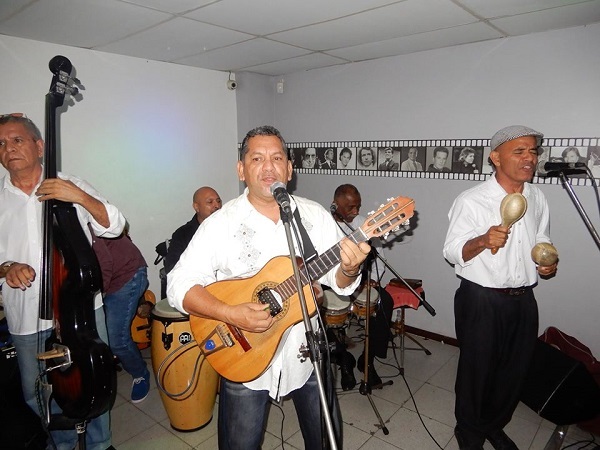
Multi-instrumentista Jorge Gregorio Rojas Perozo

Thank you Professor Carlos Colmenárez, for the interview in your salsa column, very grateful and I wish you long life to continue supporting and projecting the musicians from Barquisimeto, Venezuela and around the world.

Jorge El Papi Rojas

You can read: Henry Valladares, a brilliant, versatile, and disciplined percussionist

Michel “El Buenon” is a singer, composer and considered the most sought-after salsa singer in the Dominican Republic

On September 7th in the province of Baharona in Batey 7, Dominican Republic, Michel Batista or better known as Michel “El Buenon” was born, he is a singer and composer.

Considered the most sought after salsa singer, he is a man with a big heart and a story worth admiring, because despite all the vicissitudes he went through during his childhood and youth, he became great, as his grandmother Dona Crisiana instilled in him.

From a very young age he attended Sunday school at the Baptist church with his mother Crisiana Abraham, with whom he attended the evangelical church shepherded by herself, where he also sang in the church choir on Sundays.

In elementary school she participated in a music festival where she won first place at only 8 years of age.

Later she competed in a regional festival in the town of Barahona in the radio station Radio Barahona, winning first place at the age of 12.

He then migrated from the south to the city of Santo Domingo, where he began singing in bars, nightclubs and hotels like the Sheratton, Napolitano, El Embajador.

In addition to the resorts Talanquera, Casa de Campo Sosua, Puerto Plata, among others.

At the beginning he was part of the Tabú Combo, a group from Puerto Príncipe based in New York City, recording hits such as “Inflaciones General”, “La Llave”, “Relimen” and composing the song “Apipi”, known in French and in Spanish as “El Jardinero”, which he recorded with his friend Wilfrido Vargas.

He would later be part of Johnny Ventura’s orchestra for 5 years, from 1982 to 1987.

He recorded the song “Tuyo Más Que Tuyo” by Bienvenido Fabián, then he joined again the Tabú Combo Superstar orchestra with Adolfo Chanci, its director.

In 1995 he went solo and recorded his first salsa CD titled “Amigo De Qué”, which was played all over Latin America, occupying for 12 weeks the first place of the radio station La Mega in the city of New York.

Later he released his second album “Brujería”, and seven others: “De Ahí Nadie Como Él” (2001), “100% Sabroso” (2002), “Llego Michel El Buenon” (2005), “Víveme” (2005) and “Extrañándote” (2005), which contained ballads interpreted in the rhythm of salsa in the style of “El Buenon”, this production has unpublished songs of Michel himself such as “Que Te Vaya Bonito” and “Yo Que Me Lo Creo”.

Throughout his career he has been winner of the Casandra Awards 2005-2006-2007 and nominated in 2008 and 2011.

Among his languages interpreting songs are English, Portuguese, Italian, Papiamiento, Creole, Spanish and French as he did in the song “Se Finit” by Charles Asnabul and the song Wonderful World in tribute to Mr. Luis Armstrong.

In his repertoire of the most outstanding songs in 2008 are “La Primavera”, “Cuando Los Sapos Bailan Flamenco”, “La Playa”, “Víveme”, “Tú Ni Te Lo Imaginas”, “Hoy Daría Yo La Vida”, “Me Has Echado Al Olvido”, “A La Primer Persona” and “Wonderful World”, all with hits and diffusion in all the radios and discotheques of his country.

Among his most outstanding albums in the last ten years are “Extrañándote”, “Todo Terreno”, “Estilo Y Conciencia”, “Arriba Siempre De Pura Sangre”, “Reserva Especial Impecable”, “El Insuperable De La Salsa” and “Claro, Fino, Nítido, Control Total”.

Throughout his career he has traveled to all of Europe, the United States, the Lesser Antilles, Switzerland, England, Colombia, Panama, Costa Rica, Venezuela, Mexico, Curacao, La Reunion, Tahiti, Africa, Japan, Dubai and Colombia, the latter was where he recorded the video clip of his song “Maldito El Tiempo” written by Alexander Pires.

Michel “El Buenon”

You can read: Génesis de la Salsa, su esencia, características, ritmo, historia y expansión

International Salsa Magazine presents Alexander Abreu and his Habana de Primera

International Salsa Magazine presents a Cuban musician today considered by critics as one of the best trumpet players of the moment in Cuba and probably in the whole world.

He is Alexander Abreu Manresa, born on September 6, 1976 in Cienfuegos.

Owner of innate conditions and a unique talent to play the trumpet in a wonderful way.

Alexander Abreu, in spite of his youth, equals greats of the instrument such as El Guajiro Mirabal, Arturo Sandoval or Dizzy Gillespie, without ignoring that as a singer he has a melodious voice and, as if that were not enough, he also works as a composer and musical director.

He began playing trumpet at the age of ten, he studied music at the conservatory of music in his hometown Cienfuegos and at the National School of Art where he graduated in 1994 and in that same institution has served as a teacher, the impeccable way of playing his instrument allowed him to reach the top in Cuban music with only twenty years of age; he was part of the Cuban jazz group Irakere, worked with exponents of Cuban Timba Paulo FG and Issac Delgado and his Orchestra.

On the other hand, he has made recordings in other genres with musicians, composers and singers such as:

Armando Anthony Corea, known as Chick Corea, is an American jazz pianist, keyboardist and composer.

Arnaldo Rodríguez, young talented arranger, composer, singer and director of the Cuban Musical Group Arnaldo y su talismán, born in Ciego de Avila, Cuba.

Baby Lores, musician, singer and arranger from the city of Cienfuegos, the Pearl of the South.

Hugh Ramopolo Masekela, trumpeter, flugelhornist, cornetist, composer and South African jazz singer from South Africa.

James Morrison Catchpole, English soul and pop rock singer, songwriter and guitarist.

Luís Represas, Portuguese singer and composer.

Ron Sexsmith, Canadian singer-songwriter.

Alexander Abreu created, in 2007, his own group, which he called Havana D’ Primera, with several of the most talented Cuban musicians, the first presentation of the band took place on October 4, 2008 at the Cabaret Turquino of the Habana Libre Hotel in Havana.

With Havana D’ Primera, he has made three albums, they are: Haciendo Historia in 2011, Pasaporte in 2013 and La Vuelta al Mundo in 2015.

He has also released the singles: Rosa la Peligrosa, Me Dicen Cuba and Prohibido. Alexander Abreu Manresa is trumpet and lead vocalist of Havana D’ Primera, as well as composer, arranger and musical director of the group.

This work aims to highlight the enormous and excellent musical career of one of the best musicians of the island of Cuba in the new generation, with just thirty-eight years of age, the music of Alexander Abreu has transcended borders, his recordings exceed one hundred albums in different countries and in multiple musical genres.

From our website, we want to highlight the magnificent musical career of Alexander Abreu Manresa.

Despite his youth, Alexander Abreu’s musical gifts and excellence have allowed him to play and record with a great number of musicians and groups, not only in his native Cuba, but also in other countries of the world, to mention a few, we have then, as far as our music is concerned: Adalberto Álvarez, Amaury Pérez, Andy Montañez, Irakere, Juan Manuel Ceruto, Klimax, Mayito Rivera, Orquesta Sinfónica Nacional, Pablo Milanés, Pachito Alonso, Team Cuba, Teresa García Cataurla, Van Van and Yurumí y sus Hermanos.

Havana D’Primera nominated to the Latin Grammy Awards 2022

“We are nominated once again for the Latin Grammy Awards, this time with the album Será que se Acabó. But it’s not just me. Cuban music is nominated, which is reflected in this album with all the energy. I think it’s the most powerful album I’m going to make in the history of my life.” This is how Alexander Abreu announced the magnificent news.

Será que se Acabó, Havana D’Primera’s latest album, was nominated for the 2022 Latin Grammy Awards in the category of Best Salsa Album.

“At The Latin Recording Academy, we continually strive to support and encourage Latin music creators, and these nominees epitomize musical excellence and represent the great moment our music is going through,” said Manuel Abud, CEO of The Latin Recording Academy.

Alexander Abreu & Habana de Primera

You can read: Yissy García Calzadilla, former member of the Anacaona Orchestra, plays drums, timbal and bongo

A new salsa talent with Latin parents and born in Boston

Why romantic salsa?

So here we have Sebastian Medina or better known as SBM. He is a promising young talent born and based in the city of Boston. How are you, Sebastián? It’s ice to meet you.

Thank you very much for the opportunity, Karina. I’m super happy and pleased to be here with you.

Salsa singer Sebastian Medina, better known as SBM

Why use the acronym SBM as your stage name?

SBM refers to my full name, which is Sebastián Medina. In the genre, there are few artists who use a short, cool and different name. So, I wanted a short and quick name by which people could identify me.

In passing, I wanted to differentiate myself from other artists with an unusual name.

Many young people like you choose urban genres to start their artistic careers. Why did you choose romantic salsa as your main genre?

As a musician I really identify with salsa because of its instruments, its harmony and everything to do with them. Although I really like romantic salsa, I also like hard dura. I like all types of salsa. I have this impulse to play the piano, get into the genre and enjoy it.

As a singer, the situation is different because I have always wanted to be on stage like the greatest artists. Being also a composer, when someone sings my music, I feel very grateful and supported by those who do it. I want to bring that music to all the young people of the world.

Reading a bit about your history, it is clear that you have always liked this genre.

Yes, I am a romantic. I always have been.

Sebastian Medina performing on stage

How was Sebastian selected for his scholarship?

You were selected for a scholarship at the Berkeley College of Music. How was the selection process and the audition? What was your reaction to being selected?

I was a little nervous during the audition. I sang a song in Spanish and very few people sing Latin music here in Boston. So, I went in and sang a beautiful song by Marc Anthony to compete for that scholarship.

Here in the city there is a program called City Music Boston, whose directors saw my talent and followed my progress in high school. I got a message from them, took some classes they had offered me about music, theory and other things and, meet the people in there. When December came, I received an email congratulating me and informing that I had been accepted to the Berkeley College of Music. That’s when I started to wonder how I was going to pay for college, but I was called from the City Music Boston program to inform me that they would offer me the scholarship that would cover my studies.

What do you think are the selection criteria of the Berkeley College of Music for choosing young talents like you? What do you think made you stand out from the rest?

I studied at the Boston Arts Academy, which is the only arts school here in Boston. I am always very dedicated to my music, my learning and what teachers do. I like to learn a lot and absorb all the energy that the music scene has. I think that the judges saw that in me. They saw my hunger and passion for music and composition.

Now that I’m at the Berkeley College of Music, I’m studying to be an arranger because I want to devote myself to arranging my own music and that of others, but always focusing on salsa.

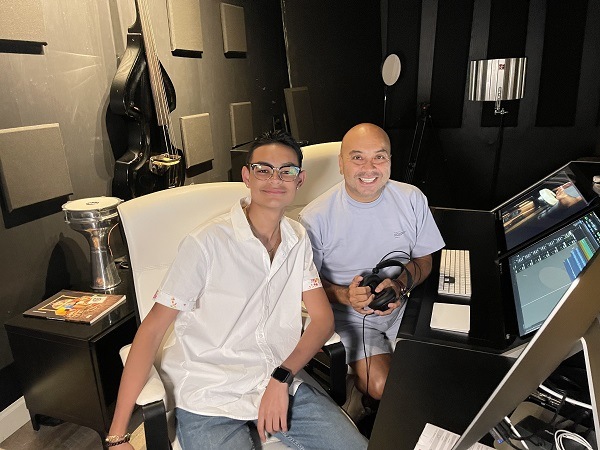
Sebastian Medina with Colombian record producer Diego Galé

I read that you like Marc Anthony and Los Adolescentes, but you also like urban artists such as Nacho and Nicky Jam. How do you reconcile these very different tastes?

As you know, young people don’t identify strongly with salsa today. For that reason, I’m trying to combine salsa with the urban genre to create new sounds. I’m aware that people really like trap and reggaeton, so I want to use those genres to combine them with my music. My goal is to appeal to the very young.

It may happen that I ask a friend of mine if he likes salsa and he replied that his parents and grandparents were the ones who listen to it. It makes me wonder why he can’t enjoy that music too. That has led me to use other sounds and melodies that young people can identify with.

Would you dive into urban genres?

If a recognized artist gives me the opportunity to do so, I would like to try, but now I want to focus on salsa because that is my priority.

What are the age ranges of the people who listen to your music?

According to Spotify, most of the people who listen to my music are between 18 to 30 years old.

Sebastian Medina with Peruvian-American bandleader, and producer Tony Succar

Do you feel there is little unity in salsa?

I think great artists have a legacy built and now it’s up to young artists to create theirs because that’s how music should be. There are not many collaborations at the moment and that must change.

In the case of the urban genre, artists release collaborations almost every week and I don’t understand why salsa singers can’t do the same. I think that a salsa song can have a different arrangement so that it becomes a remix, but unfortunately that is not being done. There is also a part of the public that is a bit narrow-minded, which is why they don’t support new salsa talents, but rather those who already have a consolidated career.

Do you think that this union is what differentiates salsa from urban music?

I think so because there are cases such as Bad Bunny, who when he does a collaboration with a lesser known artist, the latter will automatically get all those streams, views, followers, among other things. That means that he is indirectly lending his support to that artist and his followers are going to support him as well.

You compose and play the piano. What other areas are you developing?

Right now, I’m in my third year of college and I’m learning as much as I can. At this point in my career, I’m taking a lot of music arranging classes. I’m learning how to arrange my music, how to keep two tunes going at the same time and other things. I’m also taking production classes and all kinds of programs that help me shape my ideas.

Sebastian is in his third year of college at present

Read also: Puerto Rican salsa singer Jai Ramos spoke to us of his life and projects

The salsa artisan who made the best cowbells and or timbales and bongo bells

The percussion artisan passed away in New York on June 31, 2017, he was the creator of the “JCR” Calixto “Cali” Rivera bells,

Cali was born in Puerto Rico and came to the United States in 1958. He was first an auto mechanic and years later started in instrument making. He was also a percussionist (he excelled for many years performing with Yomo Toro) and his father made guitars.

One of JCR’s peculiarities was that his instruments were not mass-produced but “handmade”, which is why Rivera was recognized as a reputable percussion artisan, standing out especially for the manufacture of bells, which were “the specialty of the house”.

The cowbell is a percussion musical instrument, it has the shape of a bell and is struck with wooden drumsticks. These can be made of copper, steel or other alloys.

Its use in music is very widespread and we can hear it in the folk music of the North Alpine as well as in the academic music and even in the pop and Latin music of our times.

One of the best manufacturers of cowbells is Calixto “Cali” Rivera who for more than 40 years has forged the metal to manufacture in his small workshop in the Bronx (JCR Percussion), about 10 to 12 pieces per week.

Since its creation, his instruments became a vital part of the recordings of both Salsa Dura and Salsa Suave, from the 70’s until the day of his death.

In the Bronx, there is a man who builds instruments for the great Latin percussionists of the world: Tito Puente, Eddie Montalvo, Giovanni Hidalgo, Bobby Sanabria.

He had no signs, no storefronts, no advertising of any kind, but people from all over the world call him for work.

After all, nothing sounds like one of his handmade cowbells.

Calixto “Cali” Rivera’s father was a guitar maker, and his son picked up the tradition of the craft.

But Cali gravitated to drums – he’s a timbale – and made congas, bongos and other percussion instruments.

These days, he specializes in high-quality cowbells of all kinds.

He is in his late 70s, with only his wife for administrative support, yet he cranks out dozens a week.

Jazz Night In America recently visited Rivera in his JCR percussion workshop to discover how, for nearly 40 years, he transformed strong metal into strong bells.

The Cencerro. What It Is, Origin, Types, Characteristics And How To Play It.

The cowbell is a small instrument which belongs to the family of hand percussion instruments, it is used in various styles of music including salsa and rarely in other genres of popular music. The cowbell is similar to the bell historically used by shepherds to keep track of the whereabouts of cows, hence its name.

Origin

Although the cowbell is currently found in musical contexts, its origin comes from the tracking of animals that roamed freely in the countryside. Likewise, to help identify the herd to which these animals belonged, the shepherds placed these campaigns around the animal’s neck.

As the animals moved in different parts, the ringing of the bell could be heard, which made it easier to know their whereabouts. Although the bells were used on various types of animals, they are typically referred to as “cowbells” due to their extensive use on livestock.

  • « Go to Previous Page
  • Page 1
  • Interim pages omitted …
  • Page 23
  • Page 24
  • Page 25
  • Page 26
  • Page 27
  • Interim pages omitted …
  • Page 189
  • Go to Next Page »

International Salsa Magazine (ISM) is a monthly publication about Salsa activities around the world, that has been publishing since 2007. It is a world network of volunteers coordinated by ISM Magazine. We are working to strengthen all the events by working together.