• Skip to primary navigation
  • Skip to main content

International Salsa Magazine

  • HOME
  • Previous editions
    • 2026
      • ISM / May 2026
      • ISM / April 2026
      • ISM / March 2026
      • ISM / February 2026
      • ISM / January 2026
    • 2025
      • ISM / December 2025
      • ISM / November 2025
      • ISM / October 2025
      • ISM / September 2025
      • ISM / August 2025
      • ISM / July 2025
      • ISM / June 2025
      • ISM / May2025
      • ISM / April 2025
      • ISM / March 2025
      • ISM / February 2025
      • ISM / January 2025
    • 2024
      • ISM / December 2024
      • ISM / November 2024
      • ISM / October 2024
      • ISM / September 2024
      • ISM / August 2024
      • ISM / July 2024
      • ISM / June 2024
      • ISM / May 2024
      • ISM / April 2024
      • ISM / March 2024
      • ISM / February 2024
      • ISM / January 2024
    • 2023
      • ISM / December 2023
      • ISM / November 2023
      • ISM / October 2023
      • ISM – September 2023
      • ISM – August 2023
      • ISM July 2023
      • ISM Edition June 2023
      • ISM – May 2023
      • ISM April 2023
      • ISM March 2023
      • ISM February 2023
      • ISM January 2023
    • 2022
      • ISM December 2022
      • ISM November 2022
      • ISM October 2022
      • ISM September 2022
      • ISM August 2022
      • ISM July 2022
      • ISM June 2022
      • ISM May 2022
      • ISM February 2022
      • ISM January 2022
    • 2021
      • ISM December 2021
      • ISM November 2021
      • ISM October – 2021
      • ISM September 2021
      • ISM August 2021
      • ISM July 2021
      • ISM May 2021
      • ISM April 2021
      • ISM June 2021
      • ISM March 2021
      • ISM February 2021
      • ISM January 2021
    • 2020
      • ISM December 2020
      • ISM November 2020
      • ISM October 2020
      • ISM September 2020
      • ISM August 2020
      • ISM July 2020
      • ISM June 2020
      • ISM May 2020
      • ISM April 2020
      • ISM March 2020
      • ISM February 2020
      • ISM January 2020
    • 2019
      • ISM December 2019
      • ISM November 2019
      • ISM October 2019
      • ISM Septembre 2019
      • ISM August 2019
      • ISM July 2019
      • ISM June 2019
    • 2016
      • ISM December 2016
  • Spanish
  • Download Salsa App
    • Android
    • Apple

Search Results for: live music

Andy Gonzalez started as a musician at the age of 13 in the Latin Jazz Quintet in New York

Andrew “Andy” Gonzalez passed away on April 9, 2020.

Virtuoso bassist, arranger and musical director of Don Manny Oquendo’s “El Conjunto Libre” and Eddie Palmieri’s “La Perfecta”.

Andy has worked throughout his extensive artistic career that spans almost 50 years, with approximately 800 recordings, where he has had the opportunity to be as co-leader, producer, musical director or sideman.

Andy began as a musician at the age of 13 in the Latin Jazz Quintet, a group inspired by the music performed by vibraphonist Cal Tjader and in which he shared with his brother Jerry.

Although long before that, Gerardo Gonzalez, Gonzalez’s father, had already begun his son’s musical

Gerardo was the vocalist of Augie Melendez y Su Combo, an ensemble influenced by the sound of Sexteto La Playa.

Andy Gonzalez virtuoso Bajista, Arreglista y Director musical de “El Conjunto Libre” de Don Manny Oquendo y de “La Perfecta” de Eddie Palmieri

It is worth mentioning that during their time in the Latin Jazz Quintet, the Gonzalez brothers met a person who would change their lives: pianist Llewellyn Matthews, with whom they learned the discipline necessary to “graduate” as professional musicians, both were part of the big band of this decisive leader.

Later came Eddie Palmieri’s La Perfecta, his brother’s Fort Apache Band, the Grupo Folklorico Experimental Nuevayorquino and Manny Oquendo y Libre, 4 groups that changed forever the perception of the music we know today as Salsa.

He collaborated with The Fort Apache Group, Dizzy Gillespie, Tito Puente, Eddie Palmieri, Astor Piazzolla and Ray Barretto.

Andy González is a fundamental reference in the history of Caribbean music and Latin jazz. He has played with almost mythological musicians at times when they left a deep mark on both Latin jazz and dance music.

Andy González se inició como músico a los 13 años en el Latin Jazz Quintet en New York

He has been bassist for Eddie Palmieri, Ray Barreto, Conjunto Libre, Grupo Folklorico Experimental Nuevayorquino, Fort Apache Band, and on some occasions for Ismael Rivera y sus Cachimbos, Cortijo y su Combo and Sonora Matancera.

In this conversation, held in Santiago de Compostela -during the Compostela Millenium Festival in August 2000- he vibrates when talking about his record collection, he declares himself a fan of the study of the roots of the music he makes and reviews his artistic life since when with his band, at the age of 13 and together with his brother Jerry, they imitated the sound of Cal Tjader.

Passion for music      

I’m as much a music fan as I am a musician. Just like any music lover. I’m a fan of the things I appreciate that are important in the history of music. I have studied a lot and that has allowed me to notice the quality and quantity of artists that this music has produced. Great artists, people who have contributed a lot. When you have and study a collection of records like the one I have, you realize that now there are few.

Andrew “Andy” González muere El 9 de abril de 2020ººº
Andrew “Andy” González muere El 9 de abril de 2020

Inspiration

Cal Tjader was my inspiration when I started. Also for Fort Apache Band, because their music had a strong jazz component, but with Cuban rhythms. Good rhythms. We had a great interest in what Cal Tjader was doing.

When we started playing we were copying what Tjader was doing. We were little kids of 13 and 14 years old. We had a very similar repertoire with the same quintet, where Jerry played congas.

Once we even had a dance next to the place where Tjader played, doing the same music. Armando Peraza played congas for Tjader and once he saw us and congratulated us. We always had the support of musicians with more experience, veterans of other generations.

Dj. Augusto Felibertt, Andy Gonzalez, Rafael Muro y Omar Mejias. Centro Cultural La Estancia en Caracas

Main Source: Pablo Larraguibel

Also Read: Roberto Rodríguez fue un trompetista y compositor cubano, autor del éxito de Ray Barreto «Que viva la Música»

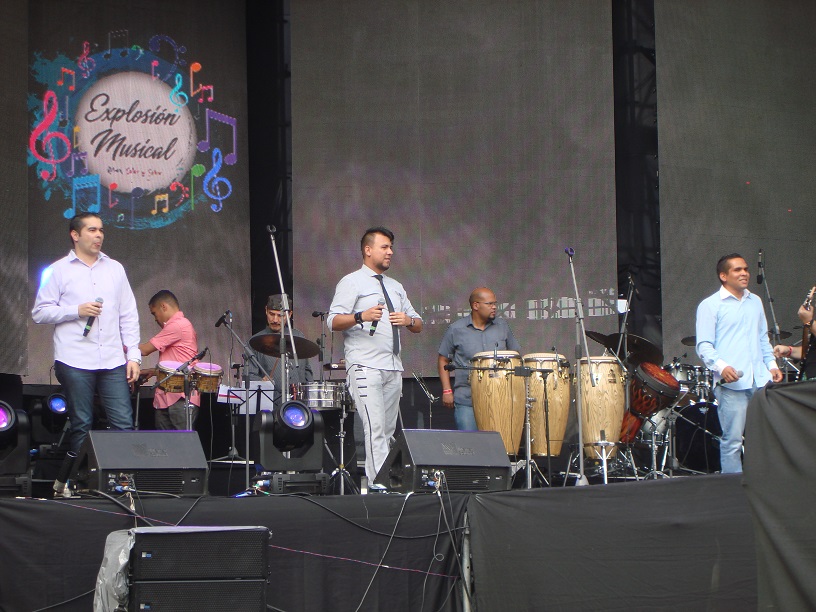
The Guaqueros took the CCCT in the Musical Explosion

Latin America / Venezuela / Caracas

Musical Explosion CCCT

Invershow is known for being a leading company in the organization and production of events, offering the most advanced technology, innovation, qualified personnel committed to meeting the highest standards of quality and safety for its realization; as happened last month (March) in the Musical Explosion held at the CCCT shopping center in Caracas, Venezuela and lasted 3 days (Friday, Saturday and Sunday).

ISM in Musical Explosion - CCCT
ISM in Musical Explosion – CCCT

On the Friday before enjoying the concert, the attendees dedicated themselves to tasting in the kiosks set up for this activity since it began in the afternoon with other musical groups, the audience present was more contemporary due to the musical genre (pop-rock), which was presented at 8 pm Zengarden in honor of U2, being a complete success you could appreciate not only the songs and music they played, but also the quality of the sound, the lighting.

Aloflamenko, Poker y Guaco in Musical Explosion CCCT
La Mama de las Rumbas - Musical Explosion CCCT
La Mama de las Rumbas – Musical Explosion CCCT

Word spread among the people of Caracas who passed near the CCCT, encouraging them to come closer and at the same time, spreading the word to go on Saturday, since other groups are presenting, among them:

Aloflamenco, Póker and finally Guaco; and indeed, on Saturday March 3, the CCCT was filled to be able to listen to the good music of the DJ, dance, participate in raffles on stage, and the most awaited musical group by the Venezuelans Guaco arrived, everyone left their seats to be in front row to see, hear and sing their songs with them, at the end of the event, people were very excited, there was even a couple who gave a surprise taking advantage of the moment to officially get engaged.

Musical Explosion CCCT - Photo
Musical Explosion CCCT – Photo
Musical Explosion CCCT - Photo 2
Musical Explosion CCCT – Photo 2
Musical Explosion CCCT - Photo 2
Musical Explosion CCCT – Photo 3
Musical Explosion CCCT - Photo 4
Musical Explosion CCCT – Photo 4

One of the things that drove the participants crazy was the interaction of the musical group with the public singing their songs together, and as Venezuelans we feel proud of our artists.

Photo 3 Poker - Musical Explosion CCCT
Photo 3 Poker – Musical Explosion CCCT

On Sunday they played Criollo House, Trabuco Contrapunto and closing the event “The Perfect Melody” being a great musical explosion for all its spectators; definitely the name of the event was in keeping with the moments lived by all those who accompanied them these 3 days, a total success, meeting the expectations of the artists and spectators. We thank INVERSHOW for allowing us to participate, promote and enjoy the event, we are sure that your next events or concerts will be sensational like this one.

Photo of Musical Explosion CCCT

On May 4 in honor of mothers, so you know if you want to enjoy a great event, buy your tickets for “La Mama de las Rumbas” at http://www.mitickera.com/Evento/La-Mam% C3%A1-de-las-Rumbas.

Photo 2 of Musical Explosion CCCT

For more information contact them through:

Facebook: https://www.facebook.com/INVERSHOW-197857140255607/

Twitter: https://twitter.com/invershow

Youtube: https://www.youtube.com/channel/UCDTz2TAz4Nqoqye_RWzv0ew

Instagram: https://www.instagram.com/invershow/

E-mails: [email protected] / [email protected] / [email protected]

Phones: +58 212-2835842


Mulatu Astatke, the first African to earn a PhD from Berklee College of Music

Mulatu Astatke (or Astatqé) (Jimma, Ethiopia, December 19, 1943) is an Ethiopian musician, composer and arranger. He is considered the father of Ethio-Jazz.

His musical training took place at the Trinity Laban Conservatoire of Music and Dance in London, where he studied clarinet, piano and harmony, New York and Boston, where he was the first African student and also the first African to earn a PhD from Berklee College of Music; there he was trained in vibraphone and percussion.

Mulatu Astatke, the first African to earn a PhD from Berklee College of Music

Later he combined the influence of jazz and Latin music with traditional Ethiopian music.

My desire to start making Ethio-jazz began in London while I was studying there in the 1950s; then I knew I wanted to be different with my music. I looked for musicians from different African backgrounds and saw that they were successful and promoted the culture of their country.

However, there was very little from East Africa and Ethiopia, so I decided at that point that I would create something unique based on the rich heritage of our music and show how much we have contributed to the world of music in general.

That journey began to take shape at Berklee College in Bastan. I was the first African musician to study there and that period was very important for me.

I learned the technical aspects of many different musical forms and my teachers gave me the confidence to move in my own direction, teaching me that it was okay to be different in my music and try something completely new.

Mulatu Astatke.
Mulatu Astatke.

Ethiopian cultural music is based on four modes  tezeta, bati, anchihoy and Ambassel  and within my music, I knew that those modes could not be played.

They had to remain at the center of my music or the whole character of the sound would change and become distorted. I began to add beautiful colors with chords, voicings, bass lines and rhythm sections, writing progressions that fit together well. It’s very difficult to write 12-note music around the Ethiopian modes without destroying them.

In the mid-’60s I returned to Addis, but I kept going back and forth to the United States.

At that time, no one was fusing Ethiopian music with jazz.

In my country there was the First National Theater Orchestra, and both the police and the army had their own orchestras.

There were also bands like the Echoes and the Ras Band.

Musicians at that time based their melodies strictly on the four Ethiopian modes, using techniques like the “canon,” with melodic lines echoing each other.

With Ethiopian jazz, I consciously wanted to expand and explore the modes in different ways.

Mulatu Astatke (or Astatqé) (Jimma, Ethiopia, December 19, 1943) is an Ethiopian musician, composer and arranger. He is considered the father of Ethio-Jazz.

I formed a group called The Ethiopian Quintet in New York, made up of a mix of Ethiopian, Latino, and African-American musicians (there weren’t many Ethiopian musicians in the United States at that time).

The band included trumpeter and pianist Rudy Houston, who later played with Yambu, and Felix Torres, who played with Sonora Ponceña.

I have always felt a deep connection between Latin and African music; I traveled to Cuba to find out where the first American landed, I heard their musicians play and dance and although they sang in Spanish, the tempo, rhythm and feeling were very similar to aspects of African music.

So, with the Ethiopian Quintet, I wanted to show the African contribution to Latin music and it was my first opportunity to experiment and start developing my vision of Ethio-Jazz with this band.

With the American and Puerto Rican musicians in the group we created a different atmosphere and arrangements.

It was a great opportunity for me and they loved what I was writing and the direction I was trying to take.

We did quite a few concerts, some Spanish weddings, events upstate New York and in Manhattan.

We played at the Village Gate with Dave Pike, a great friend of mine at the time, one of the world’s greatest vibraphone players. He played a lot with Herbie Mann and I remember sitting in to watch one of his recording sessions.

I saw a lot of other great musicians in concert, from Coltrane to Bud Powell and Bill Evans. On the New York live circuit I met a producer called Gil Snapper.

His musical training was at the Trinity Laban Conservatoire of Music and Dance in London,

Gil was a very nice and interesting guy and worked with musicians of many different styles.

He picked up on my music very quickly; we got on well and he invited me to record with The Ethiopian Quintet, so our first albums with him were ‘Afro Latin Soul’ Volumes 1 and 2, both recorded during 1966.

On the first volume, I performed an adaptation of an old Ethiopian warrior song, ‘I Faram Gami I Faram’.

I would have liked to have an Ethiopian singer for the song, but it was sung in Latin and the lyrics were translated to the singer so he could sing it in Spanish.

Nevertheless, it turned out to be a nice combination. The album included other compositions that were important steps for me: ‘Mascaram Setaba’ (Summer is Coming), ‘Shagu’ and ‘Almaz’. On the second volume, Rudy Houston suggested a piece of music that we called ‘The Panther’, in reference to the animal, but also in recognition of the Black Panthers, who were very active in the civil rights struggle in the United States at that time.

On this album, one of my favorites is my composition ‘Girl From Addis Ababa’, which worked very well as a fusion of Ethiopian modes and R&R rhythms, an indicator of the more refined Ethiopian jazz sound of my later album for Worthy, ‘Mulatu Of Ethiopia’ (1972). It also included my new arrangement of the 1950s tune ‘Lover’s Mambo’.

Both albums include nice arrangements also by Oscar Garcia, Rudy Houston and Gil Snapper as well.

I feel proud of the recording when I listen to it again. It was an important moment in my career and it was a very interesting and progressive time to be in New York in the mid-60s.

I was there at the same time as Hugh Masekela, Miriam Makeba and Fela Kuti and, each in their own way, we tried to do our part to put Africa on the map of contemporary jazz.

Mulatu Astatke & His Ethiopian Quintet - Afro-Latin Soul (1966, R-2018)
Mulatu Astatke & His Ethiopian Quintet – Afro-Latin Soul (1966, R-2018)

Mulatu Astatke, April 2018

Mulatu Astatke & His Ethiopian Quintet – Afro-Latin Soul (1966, R-2018)

Tracks: Afro Latin Soul: 01. I Faram Gami I Faram (Mulatu Astatke)

02. Mascaram Setaba (Mulatu Astatke)

03. Shagu (Mulatu Astatke)

04. One For Buzayhew (Mulatu Astatke) ke)

05. Alone In The Crowd (Gil Snapper)

06. Almaz (Mulatu Astatke)

07. Mulatu’s Hideaway (Mulatu Astatke)

08. Askum (Rudy Houston)

09. A Kiss Before Dawn (Gil Snapper & Weiss)

10. Playboy Cha Cha (Oscar Garcia) Afro Latin Soul Vol. 2:

11. The Panther (Boogaloo) (Rudy Houston)

Konjit (Pretty) (Oscar Garcia)

Soul Power (Rudy Houston)

Lover’s Mambo (Traditional, Arr. Mulatu Astatke)

Love Mood For Two (Rudy Houston)

Jijiger (Rudy Houston)

Girl From Addis Ababa (Mulatu Astatke)

Karayu (Oscar Garcia)

Raina (Rudy Houston)

Musicians:

Mulatu Astatke (Vibraphone, Piano, Drums)

Rudy Houston (Piano, Trumpet)

Robert Cuadrado (Bass)

Felix Torres / John Perez (Congas / Bongos on Vol. 1)

Pete Iglesias (Congas on Vol. 2)

Tony Pearson (Timbales)

Information provided (October 5, 2024)

Also Read: Flora Purim has earned her two Grammy nominations for Best Female Jazz Performance

Edgardo ‘‘El Bambino’’ and his extensive and interesting musical career

Edgardo ”El Bambino” Otero Lugo is the one to whom we want to dedicate some of the lines of this edition in International Salsa Magazine. The talented Puerto Rican vocalist has given us a few minutes of his time to talk exclusively about his beginnings, his career and other unpublished details that are not read in other media.   

dgardo ‘’El Bambino’’
This is Puerto Rican singer Edgardo ”El Bambino” Otero Lugo

Edgardo’s childhood and music   

As Edgardo’s childhood took place in his hometown of Vega Baja, Puerto Rico, the artist recalls that he would sit on the balcony of his house and play with buckets and sticks to pretend to play music. His mother, fed up with the noise he made, decided to enroll him in the school choir so that he could explore his curiosity about music in a more professional way. That was when he was in the fifth grade of the elementary school.   

As the years went by, the boy’s love for music just kept growing, until he got his first big opportunity thanks to singer-songwriter Edwin Crespo, who had already written for famous groups such as La Sonora Ponceña at the time. Back then, Edgardo was only 14 or 15 years old, so he still needed a lot of guidance on these issues, so maestro Crespo was the ideal person for that. 

It just so happenes that Pedro Crespo, Edwin’s father, was the founder of his own orchestra and grandfather of some of Edgardo’s cousins. Since they all lived nearby, Edwin heard him singing one day and liked his voice, so he offered to teach him how to sing professionally and invited him to join his Orquesta Ética, which is where it all began.   

By being part of the Orquesta Ética, Edwin decided to spend two or three days a week explaining to Edgardo what to do and how to do it so that everything would go wonderfully for the young vocalist, and that is exactly what happened. So much so that Edgardo spent about three years singing for the group, in which he claims to have learned much of what he knows today.   

Edgardo ‘’El Bambino’’ next to Frankie
Edgardo ”El Bambino” next to ”El Sonero del Barrio” Frankie Vazquez

The Rukanos   

After having left Orquesta La Ética, Edgardo was also part of Orquesta Los Rukanos, which was much bigger, had more instruments and more musicians. Therefore, it represented a bigger and more complex challenge. 

In 1981, he was invited to join the group by a Guyanese friend and colleague named Ferniand Pudia, who asked Edgardo to join him in a musical project he was working on, which he would name Los Rukanos, paying homage to the term used to refer to peasants and working class men in the South American country.    

Alongside with this orchestra, of which Edgardo was also one of the founders, he managed to perform in completely new stages and to follow his path in the learning of this complex and rich world that is music.   

Conjunto Quisqueya   

During a concert in his hometown, the members of Conjunto Quisqueya heard Edgardo singing and liked his voice so much that they invited him to play with them in a project for Nelson García, who at that time was the second trumpet of the orchestra.   

Having accepted the offer, the group recorded a whole LP called ”Nelson García y Merengue ’86”, which was a very nice experience for Edgardo since he had never had the opportunity to record in a studio before and finally he was able to do so. And it was not just any studio, but one of the most important in Puerto Rico, which was Tele-Sound Recording Studios.   

”Playing with the members of Conjunto Quisqueya was a spectacular experience. Their musicians are wonderful human beings with whom I still have very strong friendship bonds” said Edgardo about his experience in the ensemble.   

Edgardo ‘’El Bambino’’ in the army
Edgardo ”El Bambino” singing during his time in the army

Orquesta La Nueva Época de Ángel Rivera 

There were some years that merengue was gaining a lot of popularity in Puerto Rico, so the artists and groups of the moment had to adapt to fulfill the musical taste of the audience. Such was the case of saxophonist Angel Rivera, also originally from Vega Baja, who created an orchestra and invited several musicians to play with him, including Edgardo.    

The result was good acceptance from the public to the extent that the orchestra participated in competitions and won some awards thanks to the work done.    

This was very useful for Edgardo’s career, since he succeeded in diversifying his rhythms and learning to play new things and genres, which made him acquire a lot of knowledge. Until such time as he played with Conjunto Quisqueya, he had only done salsa, so trying merengue was really enriching for the musician.   

Service time in the army   

Edgardo was in the Puerto Rico National Guard for about 24 years in total and he remembers a time when he was mobilized to the Iraq War in 2006, the year in which he met Edwin ”El Calvito” Reyes, who was part of the 3rd Infantry. El Calvito” had a group whose lead singer could not speak Spanish, so he learned the lyrics phonetically in order to perform them.   

The chemistry between all the members was so great that they even played a few times at the U.S. base in Baghdad, where he stayed until 2008. It was then that he returned to Puerto Rico to adapt gradually to civilian life again, during which time he met Raphy Santana and joined his Tribute Orchestra, which made music to pay homage to maestro Héctor Lavoe.   

Permanent move to the United States   

In 2019, both Edgardo and his wife were retired from their jobs, so they thought it was a good time for a change of scenery, as they felt that nothing interesting was going on musically. This led them to move to the United States to settle permanently there, although he continued to travel to Puerto Rico to meet some commitments with La Corporación Latina, of which he was still part at that time. 

Read also: Momotombo SF with former members of Malo and Santana 

Ronald Borjas is a Venezuelan singer, musician and composer

Ronald Borjas is currently considered one of the greatest exponents of salsa in Venezuela with an international projection that grows every year.

He is a Venezuelan singer, musician and composer, born in Maracaibo, the capital of the state of Zulia, on November 19, 1981.

Ronald Borjas is a Venezuelan singer, musician and composer

At the age of 10, his love for the timbal was born, a few years later, at the age of 14, he began singing as a soloist in the Bochinche Orchestra. Throughout his adolescence he stood out as a soloist in bands such as: Caribe, Asterisco, VHG and Bacanos.

He completed higher education at the Cecilio Acosta University (UNICA) where he obtained the degree of Bachelor of Music – Musical Education in 2002. In the same year he went on stage with the Venezuelan Super Band GUACO, where he debuted as a soloist and composer with the song “Te vas” from the album “El Sonido de Venezuela”.

Not only did he develop as a composer, Ronald also plays other percussion instruments such as the bass, the guitar and also the trumpet.

After 11 years as one of the main voices of Guaco, in 2014, Ronald decided to take another path and that is when the great project of his life began, developing his career as a soloist in genres such as Salsa, Bachata and Pop.

Ronald debuted as a soloist with the song “Te Doy Mi Voz” dedicated to his fans, with which he received the nomination for the Latin Grammy for “Best Tropical Song”. That same year, his musical godfather, Salsa legend Oscar D´ León invited him to his show at Madison Square Garden in New York, where he introduced him to thousands of people and baptized him as his “godson”.

That same year, he released “Te Encuentraré” a song that reached #1 on the Venezuelan radio charts Record Report and its video clip, filmed in New York, managed to enter the ranking of the most viewed videos on the HTV channel.

In 2015 he began his musical expansion to other borders, achieving success in countries such as Ecuador and Colombia where his third single titled “Dame Tu Amor” was positioned in the first places of the radio stations as well as in his native Venezuela, while in Peru, it was named the “tropical song of the summer”.

Ronald Borjas is currently considered one of the greatest exponents of salsa in Venezuela with an international projection.

At the end of that year he officially released his first album “Da Capo” with an event that brought together in Caracas, Venezuela a hundred figures of the national show, as well as the press, radio and TV of the country in an unprecedented event. This release in its first weeks, managed to accumulate more than 10,000 digital downloads on his official website www.ronaldborjas.com.

“Da Capo” had valuable collaborations and a first featuring with his godfather Oscar D´León, with whom he recorded “La Quiero Para Mi”. In addition, this album has songs by Amaury Gutierrez, Robert Vilera and his uncle Neguito Borjas, among others.

In 2016 he began releasing his song “Cántalo” which quickly became an anthem of joy and managed to position itself in the first place on Venezuelan radio. That year he won several national awards of great importance such as “Mara de Oro Internacional”, “Cacique De Oro”, Explosión Creativa and Supremacy, all of which recognized him as the “Salsa Singer of the Year”.

That same year he signed a contract with Sony Music as an artist from the Andean Region and embarked on his first international concert tour entitled “Da Capo tour” with which he visited Aruba, Panama and several cities in the United States.

In 2018, he released “Loco por Volverte a Ver” a song he wrote with Nacho Mendoza, Cáceres and Sharo Torres. He also made his second featuring with the “Caballero de la Salsa” Gilberto Santarosa with whom he released “Ellas te van lleva” the first collaboration with an international artist that also managed to position itself as number one on the radio charts.

Ronald Borjas is currently considered one of the greatest exponents of salsa in Venezuela

Shortly after, in 2019, he received a double nomination for “Album of the Year” with the song “Lo que pase aquí” as one of the songs on Tonny Succar’s album titled “Más de Mi” and “Salsa of the Year” with the song “No Queda Nada”. In addition to the collaboration he did with “Quintero´s Salsa Proyect” which was nominated for “Salsa Album of the Year”.

Also in 2019 he released his second album entitled “Bailamos Otra Vez” where he recorded songs of his own, as well as those of Servando Primera, Oscarcito and Amaury Gutiérrez. From this album come hits such as “Amor Demente” “Estoy Dispuesto” “Tu y Yo Tenemos” “Te Quiero para Mi” among others.

Shortly after he announced his collaboration with another former Guaco partner, Nelson Arrieta with whom he released the song “Sobran Los Momentos” which also gives name to the tour they would do together where they traveled through countries such as Argentina, Chile, Ecuador, Mexico, Colombia, Spain, Peru, Panama and the United States achieving great acceptance by the public.

He started the year 2020 with several collaborative releases. “Para Ustedes” from the album origenes where he participated as a guest and achieved #1 on the radio in Venezuela, then he released the song “Juegos Eróticos” with Victor Muñoz and promoted it in his country with great acceptance.

The “pandemic” stage begins and confinement did not stop him. In March he releases the version of the song “María Antonia” by the Venezuelan singer Gualberto Ibarreto, in April he releases “Aunque Parezca Extraño” with Manuel Petit who invites him to this collaboration. In May, together with his uncle Neguito Borjas, Jorge Luis Chacín and Nelson Arrieta they join in a project entitled “Los Mágicos”. In June “Ahora Me Llama” comes out, a song he had recorded for Rumberos del Callejón.

As if that were not enough, in July he records an intimate concert where he invites Victor Muñoz, his uncle Neguito Borjas and Nelson Arrieta to release it as a gift to his fans through his YouTube channel.

He closes the last months of 2020 with the song “Mía” written by Ronald and Salvador Solano that became the anthem of the ´Zumba´ reaching several places in the world. After this, he released one of his songs, “Ya Lo Decidí,” with which he again achieved first place on the radio and was accepted by the entire public.

He started 2021 as a special guest at Gilberto Santarosa’s concert at the Filmore Theater in Miami, where they performed the song “Ellas Te Van Llevando” together. Months later, he released the song he recorded as a duet with José Alberto “El Canario” entitled “A Mi Me Gusta” which quickly managed to position itself on the main playlists of digital platforms in the world. He closed that year with the song “Dime Cómo Hago” which he recorded with Nelson Arrieta and Oscarcito, a salsa that took over the public’s taste and today is one of the most chanted in his concerts.

2022 started with another important collaboration with Motiff, a song titled “Me Descontrola” which quickly entered the top spots on radio billboards and digital platform listings, and was also the song chosen by the renowned company Zumba to use as the official song at its world events.

In 2022, he also launched a very ambitious musical project that he carried out with his friends and fellow countrymen Adelmo Gauna and Nando De La Gente called “Los Pikis” with which they released a series of videos where they compiled erotic salsa hits from the 80s and 90s. Such was the success that in just two months they achieved more than a million views on YouTube.

In May 2022, the live concert titled “Sobran Los Momentos” premieres where Nelson Arrieta and Ronald Borjas invite the founder and lead voice of Guaco, Gustavo Aguado, and together perform several of the hits of the Venezuelan super band, such as “Vivo” “Pídeme” “Eres Más” and “Lo Eres Todo”. Oscarcito was also there performing his hit “Si Tu Me Besas” and the one he has with Arrieta and Borjas “Dime Cómo Hago”. All this incredible material can be enjoyed on the official YouTube channel of Ronald Borjas and Nelson Arrieta.

To close the year, he released the song “Se prende el Parampampan” with his musical friend, Acosta, a fun salsa that unites their musical styles, which together with a video recorded in Puerto Rico, managed to enter the public’s taste, turning this song into an anthem for Venezuelan parties. For his part, Ronald Borjas released a solo single titled “Los Vecinos” which is accompanied by a humorous video directed by Alex Galán.

2023 began for Ronald Borjas with his third featuring with an international artist, this time with the Puerto Rican legend, Tito Nieves. A romantic salsa titled “Te Busqué” that was accompanied by a video where the two singers can be seen in a performance and story. The video currently has more than half a million views on Ronald’s official YouTube channel.

Ronald Borjas
Ronald Borjas

Months later, Ronald reunited with his cousin Luis Fernando Borjas and recorded the song “Cuestión de Tiempo”, which was widely accepted by the public, surpassing two and a half million views of the video and positioned itself as one of the most listened to songs by “Lo Borjas” on digital platforms. This name gave rise to a joint tour with which they have traveled to the main cities of Venezuela, achieving sold out in each one of them.

He closed the year with a great concert “Live in Miami” where he reunited several of his musical colleagues and friends, such as Oscarcito, Victor Muñoz, Motiff, Los Pikis and for the first time since their separation, Toto and Beet from the group Caibo joined together with Ronald, performing the hits “La Despedida” and “La Promesa”. This great reunion of artists can be found on Borjas’ YouTube channel and has also surpassed more than 600,000 views in less than a year.

2024 began with his fourth song in a duet with an international artist, this time with the Nicaraguan, “the prince of salsa” Luis Enrique with whom he recorded “Y Si Mañana”. A great launch was made through the media in Venezuela and it has been a song that quickly became the favorite of the public of both singers and in a few weeks it was positioned in the main salsa lists on Spotify.

After this success, Ronald begins his “Tour LATAM 2024” through Colombia, Chile, Argentina, Peru, Panama and Uruguay, countries where he managed to sell out all his performances and reunite with his public after several years. The success of this tour will soon take him to Europe where he will be performing several shows in Spain and other countries that have not yet been announced.

Also Read: Tribute to Johnny “Dandy” Rodríguez Jr. His first recording was professionally with Tito Puente in 1964 and was titled “Exciting Rhythm of Tito Puente”

  • « Go to Previous Page
  • Page 1
  • Interim pages omitted …
  • Page 8
  • Page 9
  • Page 10
  • Page 11
  • Page 12
  • Interim pages omitted …
  • Page 149
  • Go to Next Page »

International Salsa Magazine (ISM) is a monthly publication about Salsa activities around the world, that has been publishing since 2007. It is a world network of volunteers coordinated by ISM Magazine. We are working to strengthen all the events by working together.