• Skip to primary navigation
  • Skip to main content

International Salsa Magazine

  • HOME
  • Previous editions
    • 2026
      • ISM / May 2026
      • ISM / April 2026
      • ISM / March 2026
      • ISM / February 2026
      • ISM / January 2026
    • 2025
      • ISM / December 2025
      • ISM / November 2025
      • ISM / October 2025
      • ISM / September 2025
      • ISM / August 2025
      • ISM / July 2025
      • ISM / June 2025
      • ISM / May2025
      • ISM / April 2025
      • ISM / March 2025
      • ISM / February 2025
      • ISM / January 2025
    • 2024
      • ISM / December 2024
      • ISM / November 2024
      • ISM / October 2024
      • ISM / September 2024
      • ISM / August 2024
      • ISM / July 2024
      • ISM / June 2024
      • ISM / May 2024
      • ISM / April 2024
      • ISM / March 2024
      • ISM / February 2024
      • ISM / January 2024
    • 2023
      • ISM / December 2023
      • ISM / November 2023
      • ISM / October 2023
      • ISM – September 2023
      • ISM – August 2023
      • ISM July 2023
      • ISM Edition June 2023
      • ISM – May 2023
      • ISM April 2023
      • ISM March 2023
      • ISM February 2023
      • ISM January 2023
    • 2022
      • ISM December 2022
      • ISM November 2022
      • ISM October 2022
      • ISM September 2022
      • ISM August 2022
      • ISM July 2022
      • ISM June 2022
      • ISM May 2022
      • ISM February 2022
      • ISM January 2022
    • 2021
      • ISM December 2021
      • ISM November 2021
      • ISM October – 2021
      • ISM September 2021
      • ISM August 2021
      • ISM July 2021
      • ISM May 2021
      • ISM April 2021
      • ISM June 2021
      • ISM March 2021
      • ISM February 2021
      • ISM January 2021
    • 2020
      • ISM December 2020
      • ISM November 2020
      • ISM October 2020
      • ISM September 2020
      • ISM August 2020
      • ISM July 2020
      • ISM June 2020
      • ISM May 2020
      • ISM April 2020
      • ISM March 2020
      • ISM February 2020
      • ISM January 2020
    • 2019
      • ISM December 2019
      • ISM November 2019
      • ISM October 2019
      • ISM Septembre 2019
      • ISM August 2019
      • ISM July 2019
      • ISM June 2019
    • 2016
      • ISM December 2016
  • Spanish
  • Download Salsa App
    • Android
    • Apple

Search Results for: live music

Eduardo Ron and his Fondo Blanco Band liven up great events in Miami

Once again, the Venezuelan talent in the United States is a source of inspiration for the subject of these lines and it is the turn of Venezuelan musician, sound engineer and DJ Eduardo Ron. The artist has kindly taken a few minutes of his time to answer our questions about his career and group, so here are the most important topics of our conversation.

Eduardo playing the keyboard
Eduardo Ron playing the keyboard during an event

How Eduardo started in music in his native country

Since Eduardo was just a five-year-old boy, he proved to have a very capable hearing at home and already liked music very much, so his parents decided to enroll him in piano lessons, although he confessed that the instrument was not his thing. At school, he became part of bands with which he gradually found his preferred style and genres.

With these groups, he even competed in school band contests in Caracas, which are very common in the city. Over time, the only one of his close friends who ended up devoting himself to music was him, to the point that he became a ‘’one-man band’’ who took care of almost everything in his own musical project.

It was until 20 years ago where he began to include singers, percussionists and other musicians to be part of his group. That is when he changed the name to ‘’Fondo Blanco’‘, taking Eduardo’s last name, which is Ron (rum in Spanish), as inspiration.

What things Eduardo learned besides the piano

From a very young, Eduardo always liked to have contact with the part of the audio and equipment, which led him to study sound engineering at the Taller de Arte Sonoro. In addition to that, although he loves percussion and masters it to some extent, he was a keyboardist and singer for many years. He is no longer doing either at the moment, as he has decided to devote himself entirely to music production, mixing and mastering.
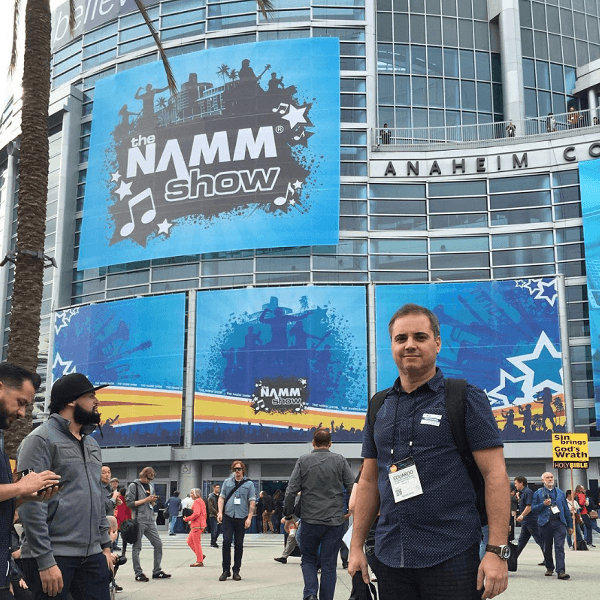
Eduardo at The NAMM Show
Eduardo Ron at The NAMM Show in 2016

When Eduardo decided to move to the United States

About 14 or 15 years ago, Eduardo decided to move to the city of Miami due to the political and economic situation in Venezuela at that time. For the same reason, he had no choice but to start from scratch with the project in these new lands and return to play, something he had not done for years, but the situation warranted.

The artist describes the Miami music market as complicated, since the competition is fierce. A huge advantage he had was that he studied English since he was very young, so the language issue was not a problem for him, but that did not make the other drawbacks easier to solve. 

One of the first surprises Eduardo got was that, in Miami, he has done no more than 50 events a year, while in Venezuela he had as many as 140 in a year. This is because the market is gigantic and it is difficult to make a big name in it, not to mention that live orchestras do not have as many bookings as before due to cost reductions.

Two years later, he had already got new artists working with him and his situation had stabilized successfully, although the process was not easy. Moreover, even today, he cannot demand exclusivity from those who work with him because he does not have the economic muscle for that, so he has a long list of musicians whom he calls for certain events. One of the first ones he always calls is Army Zerpa, whom he described as one of the best bassists and arrangers he knows, which is why he has become a key person for his project. 

Artists with whom Fondo Blanco has shared the stage 

Fondo Blanco has been fortunate to share the stage with great artists such as Oscar D’ León, Ricky Martin, Gilberto Santa Rosa, Marc Anthony, among others. Of course, the contact with these luminaries taught Eduardo many things and he assures that one of the best shows he offered was during a Santa Rosa concert, where there were more than 12,000 people. He assures that this is one of those days he will never forget.

Eduardo and Omar
Eduardo Ron next to Omar Ledezma Jr. at The NAMM Show in 2016

However, just as he has had very positive experiences as the previous one, obviously not everything is rosy. The Venezuelan told us that one of those not so good days was during a Ricky Martin concert, an event he had to open that day. It turns out that his equipment was damaged two hours before his turn and he had to try to fix it in front of the crowd of 30,000 people who came to see the Puerto Rican superstar, but nothing he did worked and the audience began to hiss.

That same day, Ricky Martin’s keyboardist asked him to borrow his keyboard because his was damaged and, when returning it, it was totally messed up and what Eduardo had there had been deleted.

Today, although he remembers this with humor, the experience was so unpleasant that it led him not to accept other proposals due to fear that the same thing could happen again. However, once these fears were overcome, he continued to play with his band and has managed to adapt to what the Miami market required both locally and internationally, which shows that the goals and targets should not be disregarded no matter however difficult the circumstances become and Eduardo Ron is a great example of that.
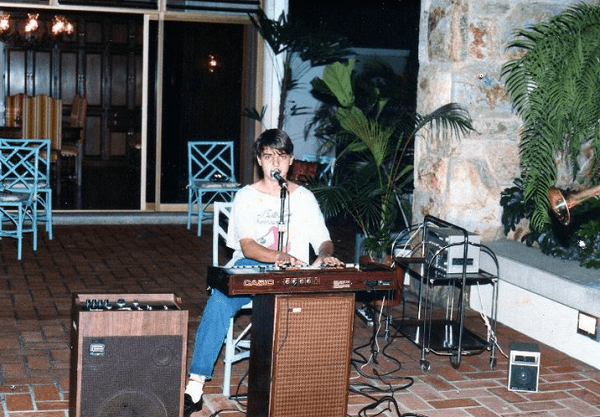
Eduardo rehearsing
Eduardo rehearsing for the gaitas contest at Claret School, Caracas

Read also: What a pleasure to talk to Pablo Pérez ‘‘El Alcalde de La Salsa’’

The multifaceted Aymée Nuviola delivers her ‘Corazón Sonero’ to Puerto Rico, at the historic Tapia Theater in Old San Juan

Pete Perignon’s orchestra kicked off Aymée Nuviola’s concert, entitled Corazón Sonero, with a powerful Latin jazz introduction. During the first minute, the instrumental melody settled into a salsa key, giving way to the voices of Lorna Marcano and Ricely Colón, who chanted: “Yo te invito a bailar y a gozar con Aymée, la sonera del mundo” (I invite you to dance and enjoy with Aymée, the sonera of the world). The chorus duo of Marcano and Colón prepared the theater for the triumphant entrance of the voice of La Sonera del Mundo.

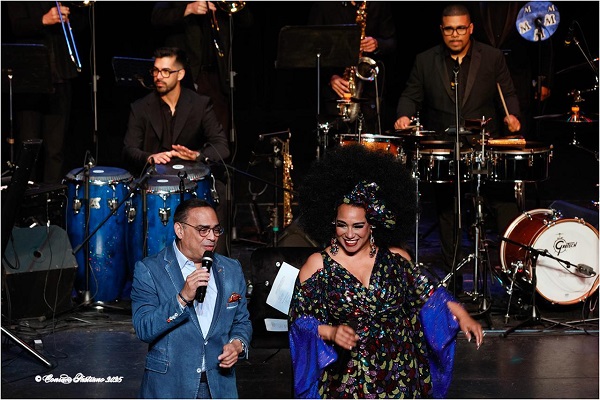
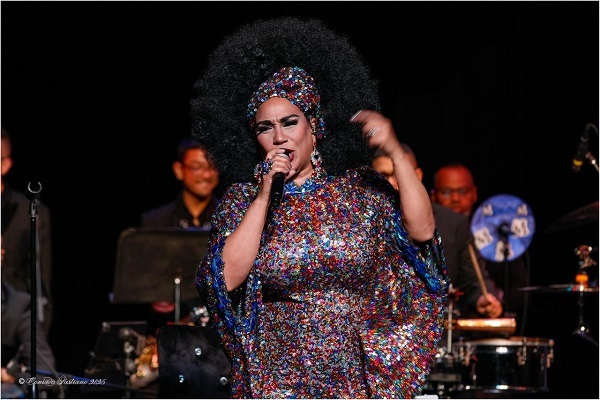
La multifacética Aymée Nuviola Imágenes Conrado Pastrano

As the curtain rose at the historic Alejandro Tapia y Rivera Theater in Old San Juan, the stage design by José “Quenepo” Ramos Vega, which revealed two transparent fabric borders held in the middle by an imposing white star, caught the attention of the audience. The red of the triangle of the Cuban flag was represented by the pendant unfurled to the left of the star, while the cloth representing the Puerto Rican flag was held on the right hand side of the same star. The inspiration of the design demonstrates that the Cuban and Puerto Rican flags are fraternal twins.

The opening lyric that resounded in the theater, which was filled to capacity, with the vocal power of Aymée Nuviola read: “A little bit of good salsa, a little bit of pure salsa, so that new people, get to know our culture”. From then on, the music obeyed Nuviola’s command, singing: “Let the clave get into your body, let the conga and the bongo move the floor”. Sure enough, three hours later we were still letting the stage delivery of the musical team continue to move the floor. Pete masterfully directed: Jean Carlos Camuñas on tumbadoras, Carlos Pagán on bongó, campana, güiro and maracas, Miguel Camilo on piano, Jorge Rivera on bass, Pedro Marcano and Víctor Ambert on trumpets, César Ayala and Léster Pérez on trombones and Saviel Cartagena on tenor and soprano saxophones.

Ten minutes into the music under the direction of the leader of the generation of the present, as timbalero Pete Perignon is known on Puerto Rican soil, Aymée greeted the audience with a heartfelt, “¡Buenas noches, Puerto Rico!” She thanked the attendees in a candid manner for joining her, while making jokes about how heavy her dress was as she elegantly adjusted the flounce and wings of her sleeves. She also commented on the design of the theater, inaugurated in 1832.

Gilberto SantaRosa y Aymée Nuviola Imágenes Conrado Pastrano

That first conversation with the audience served to connect with a: “we are survivors”, in clear reference to the COVID-19 pandemic, shortly before quoting Celia Cruz saying: “As Celia said so well: ‘Thank you Puerto Rico, for lending me your flag’. She also recognized actor Willy Denton, who played Pedro Knight when Aymée impersonated Celia Cruz in the soap opera Celia and who was among those present.

Nuviola boasted of having reached the fifth floor, as she recounted that she was going to record her version of ‘El ratón’ with Cheo Feliciano, whose unexpected death thwarted the long-awaited collaboration. However, Aymée decided to record it anyway, in order to pay tribute to Señor Sentimiento. The evening’s repertoire included: ‘Un poco de salsa’, ‘Salsa con timba’, ‘Yo sé que es mentira’, ‘El ratón’, ‘La tierra del olvido’ and ‘La gota fría’.

Many remember Aymée for her character of Celia Cruz in an acting performance that marked “a before and after” in the singer’s career. This was acknowledged by the actress, shortly before paying tribute to Celia, with her versions of ‘Cúcala’ and ‘Quimbara’, in addition to performing a medley of some of the songs with which Celia was crowned the Queen of Salsa. The medley included ‘Toro mata’ and ‘Bemba colorá’, among others.

The concert included a bohemian part during which Aymée accompanied herself on the classical piano to share with us her passion for the filin. The selected repertoire was: ‘Obsesión’, ‘Bésame mucho’, ‘Me faltabas tú’, ‘Perfidia’ and ‘Lágrimas negras’.

Before performing ‘El espacio’, of her own composition, and accompanied by Miguel Camilo on piano, Aymée said that the song was inspired by “someone else’s skeleton”, as the composer described it. Aymée emphasized that ‘El espacio’ is not dedicated to her husband. Between jokes and laughter, the sonera shared with those present her love story with Paulo Simeón, while acknowledging the presence of Fabio Díaz Vilela, who was the owner of the place where the couple met more than 14 years ago. Aymée expressed her gratitude to Fabio, for also having been a great support for the career of the producer, “from day one”.

Aymée Nuviola Imágenes Conrado Pastrano

The climax of the concert came as the sonera took off ‘El cuarto de Tula’, Gilberto Santa Rosa -who was among the attendees- went up on stage to duet with Aymée, between each soneo to describe the scope of the talent of the Cuban who gave her sonero heart to Puerto Rico. El Caballero de la Salsa was also able to tell La Sonera del Mundo the fascination that the Puerto Rican public has for her. For their part, Aymée’s soneos expressed to Gilberto the admiration she has for him for being “a great maestro”.

The repertoire of this last section included the songs ‘Fiesta’ and ‘El manisero’, which incorporated correspondences between the singer and the pianist. The coda of ‘El manisero’ coincided with the closing of the curtain, while the audience shouted “another, another, another”. The ñapa corresponded to ‘Chan chan’, a song included in the album that won Nuviola a Grammy for his production A Journey through Cuban Music. The interpretation was sprinkled with the strength brought by the trumpets of Pedro Marcano and Víctor Ambert, along with the trombones of César Javier Ayala and Léster Pérez. Chan Chan’ announced the farewell with which Aymée Nuviola’s energetic “God bless Puerto Rico” resounded as the curtain came down on her first solo concert on Puerto Rican soil. For my part, I reciprocate: “God bless Aymée Nuviola and her team (including Paulo Simeón and Luis Solís)”.

Here in the Island of Enchantment we are pleased to know that Corazón Sonero has consolidated this high-end artist, whom we already consider our own.

Bella Martinez Puerto Rico

Images: Conrado Pastrano

Also Read: Mel Martinez I come from Puerto Rico and Puerto Rico is Salsero

Producer, composer, and guitarist Oscar Almonte innovates with Dominican music

The United States is and will remain the land of opportunities for artists from all over Latin America, and Dominican producer, composer, and guitarist Oscar Almonte is one more of those examples of what effort and discipline can achieve on fertile ground. We could talk exclusively with Mr. Almonte about the most important aspects of his prolific career, and we want to make them known to our readers, who always honor us by visiting to our content each month.

Oscar posing for the camera
Oscar Almonte with his guitar posing for the camera

What drew Oscar’s Attention to Music

Oscar began telling us that music as such has drawn his attention since he was very little, more specifically, the ones he was listening to at home and that some relatives played, as several of them are professional and amateur musicians. That mix of rhythms and melodies always intrigued him, especially those from Cuban music, which was very popular at that time.

Family parties were the perfect occasion for the young man to show his strong interest in music, as it was not uncommon for one of his uncles to bring out his guitar, play, and sing to lighten the mood. This was one of the things that led Oscar to learn to play as he saw adults do it.

Not to mention that Caleo López, his grandfather, was a guitar maker and played them as well.

Academic Training in Music

Oscar’s primary education in music was given in a self-taught way, In fact, their parents bought him his first guitar at just nine years of age, and he took some classes with this instrument. He stopped for a while and resumed his interest in the guitar at age 14, which is when he learned his first chords and memorized some rock songs he liked to play them.

When he had the right age, he began studying music at the Culture and Art Institute in his hometown, Santiago de Los Caballeros, where he completed a bachelor’s degree in classical guitar.

Move to New Jersey

Today, Oscar is based in New Jersey City, where he moved for the purpose of seeking new horizons personally and professionally. He wanted to soak up the musical culture that exists in the New York area, which is very close to where he is now.

When asked about the job opportunities he had upon arrival, he told us that he had the fortune of having contacts and friends with whom he had already traveled to the country, which allowed him to play with some bands he knew. However, he does admit that it took him a while to find a balance in his economy, so he had to work in family automotive businesses while his situation stabilized. He was working in that until he could devote himself exclusively to music, just as he did in his country.

Oscar performing at SOB’s
Oscar Almonte performing at SOB’s (Sounds of Brazil) in Nueva York

The main difference he noticed between the music scene in New Jersey and the Dominican Republic is that, in his home country, it is easier to live exclusively from music as a simple artist. There are things that are easier to do because the budget allows it, and certain places where musicians play cover some elements such as sound engineers and show producers. When he arrived to his new destination, he had to learn many of these things to be able to do them himself and not have to spend what he did not have.

Projects Oscar Has Been Involved In

Just as Oscar has taken great pains to make his own project, he has also been involved in others belonging to artists such as Pavel Nuñez, Felle Vega and La Orquesta de Las Danzas Mezcladas, Xiomara Fortuna, Irka Mateo, El Prodigio, and many others.

He has managed to make contact with several of them because they live in the same city as him. It also happens that he played with several jazz musicians through whom he got to know others, something which took advantage to develop contacts and friendships with whom he could work in the future.

Among the most important things he learned from them, one is audience management, repertoire management, certain vocal techniques that he did not know and, mainly, everything that has to do with the responsibilities an artist who is already the head of his own project should have. 

Soberano Awards Nomination 

The artist has also been nominated for the famous Soberano Awards in the category of Merengue of the year in 2012 thanks to the song ”Levántate”, which was recorded by Héctor Acosta ”El Torito”. An interesting aspect of this piece is that Oscar wrote it with the purpose of showing it to Ricky Martin so that he would finally record it, but unfortunately it was not possible to make contact with the Puerto Rican.

Oscar and Daddy Yankee
Oscar Belmonte next to Puerto Rican reggaeton singer Daddy Yankee

Over time, he learned that Héctor was looking for songs to add to his new album ”Corazón Abierto”, so Oscar got down to business and contacted his musical director to see if Acosta would be interested. Fortunately, he was and the song enjoyed very acceptance among the public, so he managed to get the nomination at that time.

Debut as a singer-songwriter

Finally, in the year 2020, Oscar was ready for his debut as a singer-songwriter and, at finally, to do things other than what a simple musician does. Although he was writing since he was 14 years old, always thinking for other artists, he decided to change his approach and focus on himself and his career. 

It is then when he made his debut in this facet with the song ”Mi Tierra”, in which he describes his hometown Santiago de Los Caballeros as the title indicates. Something interesting about ”Mi Tierra” is that it fuses rhythms from many parts of the world with Dominican pambiche.

Oscar defines pambiche as one of the sounds of merengue, but softer and calmer when compared with the more lively merengue.

As for the rest of the colors it has, the artist used elements of African music and very different tempos to those often used in merengue.

He is also promoting the song ”Bermudas” with the young singer Carolyn Rodriguez. A mutual friend introduced them and thought that their voices would work well together, so they gathered and made a romantic song based on urban bachata with hints of reggae and some electronic touches.

Oscar and Carolyn
Oscar Belmonte singing ”Bermudas” next to Carolyn Rodríguez live

Read also: Joshua Levine and his quartet have a lot of Guataca

“DeBÍ Tirar Más Fotos” is not just an album; it is an invitation to reimagine music and the cultural impact it can have in an increasingly interconnected world

Bad Bunny was born as Benito Antonio Martínez Ocasio in San Juan, Puerto Rico, on March 10, 1994. He is a composer and singer of urban music, especially trap and reggaeton.

Bad Bonny DeBÍ TiRAR MáS FOToS

Although he never took formal music classes or studied any instrument, he is a singer, composer and creator of his own songs. The first samples of his art were seen on YouTube, where he slowly began to gain fans.

In mid-2016, Bad Bunny joined Hear This Music, a label created by DJ Luian and Los Mambo Kingz, presenting the hit “La Ocasión,” an anthem of trap music. There he also recorded singles such as “Diles,” “Soy Peor,” and “Tú No Vives Así.”

Bad Bunny has also participated in songs with numerous artists, such as Farruko, De La Ghetto, J Balvin, Maluma, Nicky Jam and Ozuna, among other urban music stars.

In 2017 he conquered Europe, touring with more than 20 concerts in 20 days. Upon his return he sang “Si Tu Novio Te Deja Sola” at the 2017 Billboard Latin Music Awards with J Balvin.

In addition, he sold out concerts at the Luna Park in Buenos Aires on September 8 and 9. In November he released “Sensualidad” with Prince Royce and J Balvin.

The year 2018 began with great success.

On January 12, he released “El Baño”, a collaboration he recorded with Enrique Iglesias.

On February 6, he released “Salimos A Buscarte”.

On the 9th, he presented “Fantasía”, with Alex Sensation.

On the 14th, she released a version of the hit “Báilame” by Nacho, together with Luis Fonsi, Yandel and Daddy Yankee.

On the 15th, she released “Amorfoda”, a new single in which she says “no” to love.

She didn’t wait and on the 22nd, she released “Dime Si Te Acuerdas”.

On March 16, she released a song with Khea, Düki and Cazzu, titled “Loca”.

On the 23rd of that month, “Dime” was released, recorded with Revol, J Balvin, Arcángel and De La Ghetto.

On April 1, she presented “Me Rolié”. In the same month, she released: “Te Boté”, with Ozuna, Nicky Jam, Nio García, Darell and Casper Mágico; and “Explícale”, with Yandel, Noriel Cosculluela and Brytiago.

On May 5, she recorded “Contigo”.

Bad Bunny nació como Benito Antonio Martínez Ocasio

On the 12th, 13th and 14th she presents her songs live, again at Luna Park. In between these concerts she releases “Sólo Avísame”. Then she releases “Quiere Verme”, together with Anuel Aa and “Diles”, with Ledy Medina.

On June 22nd she releases “I Like It”, recorded with Cardi B and J Balvin. On the 28th of the same month she releases the single “Estamos Bien”. She participates in Marc Anthony’s song “Está Rico”, together with Will Smith. On October 11th she releases “Mía”, in a spectacular collaboration with Drake singing in Spanish. On December 8th she releases the hit “Desde el Corazón” and on the 14th of the same month she presents “Sólo de Mí”, whose video reflects gender violence. On the 23rd her debut album goes on sale, under the name “X100Pre”.

On June 28, Bad Bunny & J Balvin present the eight-song album “Oasis” with the first single, “Qué Pretendes” (with special appearances by Mr. Eazi and Marciano Cantero of Enanitos Verdes)

Following the death of basketball player Kobe Bryant, Bad Bunny paid tribute to him with an emotional song titled “6 Rings.”

YHLQMDLG was released by the artist at midnight on February 29, 2020. The title means “I do what I want” and features collaborations with Daddy Yankee, Yaviah, Jowell & Randy, and Ñengo Flow. The album is a tribute to the marquesinas (garage parties) that Bad Bunny grew up attending, and features many nods to reggaeton from the early and mid-2000s

On May 10, 2020, he released his third studio album “Las que no iban a salir,” which features the participation of Don Omar, Zion & Lennox, Nicky Jam, Yandel, among others.

In July, after being the first Latin urban artist to be on the cover of Rolling Stones magazine, El Conejo Malo becomes the protagonist of the first digital cover of the legendary Playboy magazine.

On July 25, he releases the song and video: “Un día (One Day)” with Dua Lipa, J Balvin and Tainy.

On January 3, 2021, he releases the video for his song “Booker T”. That same year, he releases the single and video clip “Lo sentir BB” with Julieta Venegas and Tainy.

Bad Bonny
Bad Bonny

Throughout the year, he publishes several singles and video clips.

On May 5, 2022, he releases the album “Un verano sin ti”.

On June 2, he releases the video clip for the song “Tití mepregunta”.

On November 30, he releases the single “La Jumpa” with the video clip.

On December 22, he released the single “Gato de noche” with Ñengo Flow.

On February 15, 2023, he released the video for “Ojitos lindos” with Bomba Estéreo.

On May 18, he released the single “Where she goes” along with its video.

On July 21, he collaborated with Travis Scott on the single “K-Pop” with The Weeknd.

On September 25, he released the single and video “Un preview”.

On October 13, he released the album “Nadie sabe lo que va a pasará mañana” becoming a hit single.

Becoming the most listened to album of the year in a single day.

“What are we overlooking in Bad Bunny’s ‘DeBÍ TiRAR MáS FOToS’? Beyond reggaeton, a lesson in artistic evolution.”

While social media is boiling with divided opinions about Bad Bunny’s new album, it is worth moving away from the extremes and analyzing “DeBÍ TiRAR MáS FOToS” from a broader perspective.

Beyond being a reggaeton album, this work is an artistic, cultural and strategic manifesto that leaves valuable lessons for all musical genres, including salsa.

Bad Bunny has used his position as a global artist to fuse elements such as salsa with urban rhythms, achieving a musical dialogue that transcends generations and tastes. However, the impact of this project does not stop there.

I’d like to share five key aspects that other artists could learn from this release to innovate and connect more deeply with their audiences.

  1. The power of nostalgia: plastic chairs as a universal symbol

The album cover, with the humble plastic chairs, connects directly with the everyday life of Latin American neighborhoods. These common objects evoke memories of family gatherings, celebrations, and moments of community. The message is powerful: simplicity can be deeply meaningful and resonate globally.

  1. Exclusivity that generates value: “Residencia” concerts

Instead of a world tour, Bad Bunny is betting on “Residencia,” a series of exclusive concerts in Puerto Rico. With this strategy, he not only boosts tourism and the local economy, but creates a “FOMO” (fear of missing out) phenomenon in his fans. This generates massive advance reservations on hotels and flights.

  1. QR codes: intelligent digital interaction

Integrating technology with music is something that Bad Bunny has done masterfully. QR codes in Puerto Rico allow fans to interact with the album in innovative ways, unlocking exclusive content and creating a bridge between the physical and the digital.

  1. Incorporating traditional genres and sounds

Bad Bunny is not afraid to mix salsa with reggaeton, betting on musical arrangements that celebrate his cultural heritage. This shows that genres are not compartments or “silos”, but platforms for dialogue

  1. Expectation and release strategy

From the announcement of the title to the release date, passing through a short film full of cultural references, everything in this project has been designed to create a narrative that maintains the interest of the public. The lesson here is clear: music is not just released, it is experienced as a complete cultural event.

Final thoughts: innovation and evolution

In a world dominated by technology, staying traditional is not an option for artists who want to grow. Tools like Web 3.0, Blockchain, NFTs to offer immersive experiences and AI are revolutionizing the way musicians interact with their audiences and generate income.

While some lose themselves in criticism, others take advantage of these tools to redefine their art and project themselves globally. The lesson is clear: you have to look ahead and dare to evolve.

“DeBÍ TiRAR MáS FOToS” is not just an album; it is an invitation to reimagine music and the cultural impact it can have in an increasingly interconnected world.

Also Read: Sessions from La Loma brings together salsa fans from all over the world in Puerto Rico

Papo Vázquez the Pirate & Troubadour of Our Latin Music

Papo Vázquez Enjoying the Bell.

Angel Vásquez, “Papo Vásquez”, was born on February 24, 1958 in Philadelphia, Pennsylvania, USA.

Papo Vazquez
Papo Vazquez

By age 15, Papo Vázquez was playing with local American bands in Philadelphia and accompanying guest artists such as Eddie Palmieri.

At just 17, he moved to New York and was hired to play for trumpet player Chocolate Armenteros’ band, and soon began playing and recording with other top artists on the salsa scene such as The Fania All-Stars, Ray Barreto, Willie Colón, Grupo Folklórico Neoyorquino, Eddie Palmieri, Larry Harlow, and Hector Lavoe.

Vazquez also became a key player in the burgeoning New York Latin jazz scene of the late 1970s, performing with Jerry Gonzalez, Hilton Ruiz, and more.

He began his studies with Slide Hampton, eventually recording and performing Slide Hampton’s World Trombones.

Papo Vázquez Photo by Ernie Gregory (Gone but not forgotten) Thank you Ernie!PV

A Grammy-nominated trombonist, composer, arranger, NEA Master Artist, he has a 50-plus year career in jazz, Latin and Afro-Caribbean music.

Musical Director of the National Puerto Rican Day Parade Orchestra, (NYC/WABC) 2016, 2017, 2018, 2019.

Commissioned by Wynton Marsalis to compose music for Jazz and Art series, conducted and performed with the J@LC orchestra, CD release August 2019 New York Pops Education, Board of Education certified, 2018 and 2019

New music commissioned for Afro Latin Jazz Alliance for the “Nueva Música” concert series.

Nominated for Grammy for Papo Vázquez’s Mighty Pirates, Marooned/Isolated, 2008

Born in 1958 in Philadelphia, Pennsylvania, although his early formative years were in Puerto Rico.

He went on to play and/or record with jazz luminaries Tito Puente, Dizzy Gillespie’s United Nations Orchestra, Chico O’Farrill, Ray Charles, Slide Hampton’s World of Trombones, Jerry Gonzalez Fort Apache, among many others. By the age of 22, Vazquez had traveled the world.

Papo Vázquez Mighty Pirates Troubadours 2023

Vázquez was deeply moved by jazz from a young age. His appreciation and knowledge of indigenous Caribbean music provides him with a unique ability to fuse Afro-Caribbean rhythms with the freer melodic and harmonic elements of progressive jazz.

Beginnings

After spending his early years in Puerto Rico, he grew up in the heart of North Philadelphia’s Puerto Rican community. He purchased his first trombone from a friend for $5 and joined the elementary school band.

At the age of 14, an uncle recommended him to a local salsa band, where he met trumpeter Jimmy Purvis. Purvis inspired Papo’s lifelong passion for jazz by giving him two records: J.J. Johnson’s Blue Trombone and John Coltrane Live at the Village Vanguard. By 15, Vazquez was performing with local Latin bands in Philadelphia and accompanying visiting New York artists such as Eddie Palmieri.

He was a founding member of Jerry Gonzalez’s Fort Apache and Conjunto Libre, as well as the popular Puerto Rican Latin fusion band Batacumbele.

With Batacumbele he performed, composed, arranged and recorded several albums from 1981 to 1985. Upon his return to New York, he joined Tito Puente’s Latin Jazz Ensemble, traveling with them as principal trombonist and touring Europe with Dizzy Gillespie’s United Nations Orchestra.

Leader, Composer and Innovator.

Vázquez has always been deeply moved by jazz, and specifically cites the music of John Coltrane and J.J. Johnson as having influenced him most. In addition, his appreciation and knowledge of the indigenous music of Caribbean peoples gives him a unique ability to fuse Afro-Caribbean rhythms, specifically those of Puerto Rico, with the freer melodic and harmonic elements of progressive jazz.

During his time in Puerto Rico with Batacumbele in the 1980s, he began experimenting with “bomba jazz,” a fusion of jazz and traditional Puerto Rican bomba. In 1993 he recorded his first album as a leader, Breakout. He continued to collaborate with a variety of Latin Jazz artists, contributing Overtime Mambo to Hilton Ruiz’s Manhattan Mambo and Contra Viento y Mareo to Descarga Boricua, Vol. 1.

In 1999, he released a live recording with a number of leading New York Latin and jazz artists, including bassist Andy Gonzalez, saxophonist Michael Brecker, among others. The release of Pirates & Troubadours At the Point, Vol. 1 was followed the next year by At The Point, Vol. 2.

Mighty Pirates Troubadours Songs del Yucayekepor Papo Vazquez
Mighty Pirates Troubadours Songs del Yucayeke
por Papo Vazquez

This project evolved into the Pirates Troubadours, an “Afro-Puerto Rican jazz band” that includes musicians such as Roberto Cepeda of Puerto Rico’s Familia Cepeda folklore group, Milton Cardona and Anthony Carrillo on percussion, and John Benitez, among others. The group performed at festivals around the world and released Carnival in San Juan in 2003, followed by From The Badlands in 2007.

Interest grew as a composer.

He was the first artist to receive a composer commission (Iron Jungle) for the Afro-Latin Jazz Orchestra, then a resident orchestra at Jazz at Lincoln Center.

His first classical composition, Palomita Suite Afro-Caribeña which to date was the first time Bomba y Plena had been performed with a Chamber Orchestra, was commissioned by the Bronx Arts Ensemble and premiered at the Hostos Center for Arts and Culture in the Bronx in 2004.

In 2007, on a commission from the Bronx River Arts Center, he wrote Sube el Río (River Rising) for its Mighty Pirate Orchestra for its 20th anniversary concert “Bronx River Sounds.”

Discography

Papo Vázquez Mighty Pirates Troubadours – Capítulo 10: Breaking Cover, Picaro Records 2020
Cuarteto Papo Vázquez – GV J.S. Bach, Picaro Records 2017
Papo Vazquez Mighty Pirates Troubadours – Spirit Warrior, Picaro Records, 2015
Papo Vazquez Mighty Pirates Troubadours – Oasis, Picaro Records, 2012
Papo Vázquez The Mighty Pirates – Marooned / Aislado, Picaro Records, Nominación al Grammy 2008
Papo Vázquez Pirates Troubadours – From The Badlands, Picaro Records, 2007
El Niño Josele – 2011
Tego Calderon – The Underdog / El Subestimado, Jiggiri Records, 2006
Shakira & Wyclef Jean – Tema de la final mundial de fútbol (“Bamboo”), 2006
Ray Barretto – Normas rican-ditioned, Zoho Music, 2006
Los Pleneros de la 21 Para Todos Ustedes, Smithsonian Folkways, 2005 – Nominación al Grammy,
Bebo Valdes – Bebo de Cuba, Calle 54, 2005 – Grammy, Mejor Álbum de Jazz Latino
Papo Vázquez Pirates Trovadores – Carnaval en San Juan, Cu-Bop Records, 2003
Wayne Shorter – Alegria, Verve, 2003 – Grammy, Mejor álbum instrumental de jazz
Jack Bruce – Sombras en el aire, Sanctuary Records Group, 2001
Freddie Cole Rio de Janeiro Blues, Telarc
Chico O’Farrill “Carambola” Fantasía
Banda sonora de la película Mo ’Better Blues de Spike Lee
Papo Vázquez “Piratas y trovadores – En el punto Vol. I” Cubop
Papo Vázquez “Piratas y trovadores – At the Point Vol. 2” Cubop
Milton Cardona “Cambucha” Clave americana
Arturo O’Farrill “Bloodlines” Fantasy
Chucho Valdés “All Stars Bronx Lebanon New Directions Project” RMM
“Jammin ‘in the Bronx” Papo Vázquez Band, Chucho Valdes & The Machito Orq RMM
Chart Busters con el Dr. Lonnie Smith, Lenny White, Hiram Bullock, Craig Handy, Papo Vázquez, et.al. Chico O’Farrill Fantasía “Pure Emotion”
Steve Berrios Fantasía del “primer mundo”
Descarga Boricua “Descarga Boricua” Tierrazo
Dave Valentin “Tropic Heat” GRP
Juan Luis Guerra 440 “Fogarate” 440
Papo Vázquez “Breakout” Timeless
Ruben Blades “Amor y Control” “Antecedente” & “Caminando” Sony
Hilton Ruiz “Manhattan Mambo” Telarc y “Hands on Percussion”
RMM Tito Puente “Fuera de este mundo” Tito Puente “100” RMM
Jerry Gonzalez Fort Apache Band “Obatala” “Live in Berlin” Enja & “Ya Yo Me Cure” American Clave
New York Latin Jazz All Stars “Feliz Navidad”
Bobby Valentin “Presenta al Cano Estremera” – Bronco Records
Batacumbele “Con Un Poco de Songo” & “En Aquellos Tiempos” Tierrazo
Ray Barretto “Ricanstruction” Fania
Slide Hampton “Mundo de trombones” WEST54
Chico O’Farrill “Calle 54”
Fania All Stars “Habana Jam” Fania
Willie Colon & Ruben Blades “Siembra” Fania
Willie Colon y Celia Cruz Fania
Héctor La Voe “De Ti Depende” – Feliz Navidad, Fania
Mon Rivera “Vuelvo a Vivir” Fania

Sources:

© 2017 por Papo Vázquez. Creado con orgullo.

Textos www.jazzismomedellin.com

Also Read: Eddie Palmieri brought salsa for the first time and live from Sing Sing Penitentiary in New York

  • « Go to Previous Page
  • Page 1
  • Interim pages omitted …
  • Page 6
  • Page 7
  • Page 8
  • Page 9
  • Page 10
  • Interim pages omitted …
  • Page 149
  • Go to Next Page »

International Salsa Magazine (ISM) is a monthly publication about Salsa activities around the world, that has been publishing since 2007. It is a world network of volunteers coordinated by ISM Magazine. We are working to strengthen all the events by working together.