• Skip to primary navigation
  • Skip to main content

International Salsa Magazine

  • HOME
  • Previous editions
    • 2026
      • ISM / April 2026
      • ISM / March 2026
      • ISM / February 2026
      • ISM / January 2026
    • 2025
      • ISM / December 2025
      • ISM / November 2025
      • ISM / October 2025
      • ISM / September 2025
      • ISM / August 2025
      • ISM / July 2025
      • ISM / June 2025
      • ISM / May2025
      • ISM / April 2025
      • ISM / March 2025
      • ISM / February 2025
      • ISM / January 2025
    • 2024
      • ISM / December 2024
      • ISM / November 2024
      • ISM / October 2024
      • ISM / September 2024
      • ISM / August 2024
      • ISM / July 2024
      • ISM / June 2024
      • ISM / May 2024
      • ISM / April 2024
      • ISM / March 2024
      • ISM / February 2024
      • ISM / January 2024
    • 2023
      • ISM / December 2023
      • ISM / November 2023
      • ISM / October 2023
      • ISM – September 2023
      • ISM – August 2023
      • ISM July 2023
      • ISM Edition June 2023
      • ISM – May 2023
      • ISM April 2023
      • ISM March 2023
      • ISM February 2023
      • ISM January 2023
    • 2022
      • ISM December 2022
      • ISM November 2022
      • ISM October 2022
      • ISM September 2022
      • ISM August 2022
      • ISM July 2022
      • ISM June 2022
      • ISM May 2022
      • ISM February 2022
      • ISM January 2022
    • 2021
      • ISM December 2021
      • ISM November 2021
      • ISM October – 2021
      • ISM September 2021
      • ISM August 2021
      • ISM July 2021
      • ISM May 2021
      • ISM April 2021
      • ISM June 2021
      • ISM March 2021
      • ISM February 2021
      • ISM January 2021
    • 2020
      • ISM December 2020
      • ISM November 2020
      • ISM October 2020
      • ISM September 2020
      • ISM August 2020
      • ISM July 2020
      • ISM June 2020
      • ISM May 2020
      • ISM April 2020
      • ISM March 2020
      • ISM February 2020
      • ISM January 2020
    • 2019
      • ISM December 2019
      • ISM November 2019
      • ISM October 2019
      • ISM Septembre 2019
      • ISM August 2019
      • ISM July 2019
      • ISM June 2019
  • Spanish
  • Download Salsa App
    • Android
    • Apple

Search Results for: rhythm

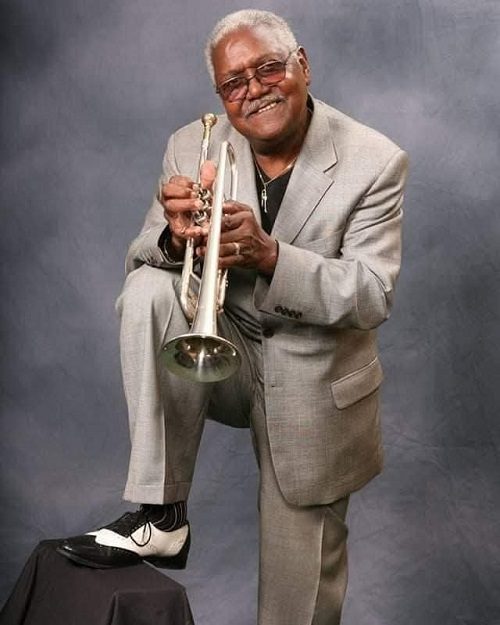
Alfredo “Chocolate” Armenteros: The Golden Legacy of the Cuban Trumpet

The history of Latin music cannot be written without mentioning the metallic brilliance and elegant phrasing of Alfredo “Chocolate” Armenteros.

Regarded by musicologists and peers as the “Latin Louis Armstrong,” Armenteros was more than just a trumpet virtuoso; he was a sonic architect who bridged the gap between traditional Cuban son, New York jazz, and the high-energy explosion of salsa.
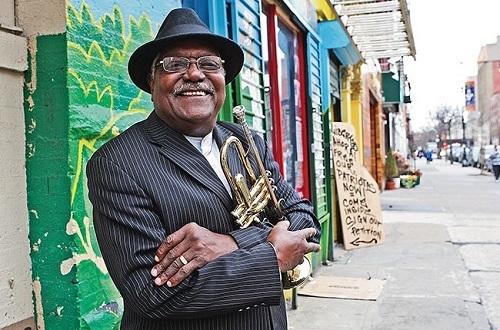
Chocolate Armenteros🇹đŸ‡șfue una leyenda excelsa de la mĂșsica cubana

Born on April 4, 1928, in Las Villas, Cuba, Armenteros carried the soul of his homeland to the world’s most prestigious stages.

His nickname, which became a hallmark of artistic quality, originated from a curious anecdote the musician shared in 2013: a young woman had mistaken him for the famous boxer “Kid Chocolate.”

What began as a case of mistaken identity ultimately became the name of a legend who would deliver his “knockouts” not with fists, but with perfect notes.

The Forging of a Master: From Arsenio RodrĂ­guez to the “BĂĄrbaro del Ritmo”

The career of Chocolate Armenteros serves as a detailed roadmap of the Golden Age of Cuban music. In 1950, he joined the ensemble of the “Blind Marvel,” Arsenio RodrĂ­guez.

Alfredo Chocolate Armenteros el Legado de Oro de la Trompeta Cubana

Under RodrĂ­guez’s tutelage, he recorded essential pieces of the Caribbean songbook such as “Deuda,” “Tengo que olvidarte,” and the iconic “La vida es un sueño.”

This period was vital in defining his style: a fusion of technical discipline and a gift for organic improvisation.

His rise was meteoric. By 1953, he was already a member of Sonora Matancera, the island’s most influential musical institution. That same year, he participated in a historic milestone: the founding of the band led by his cousin, the great Benny MorĂ©.

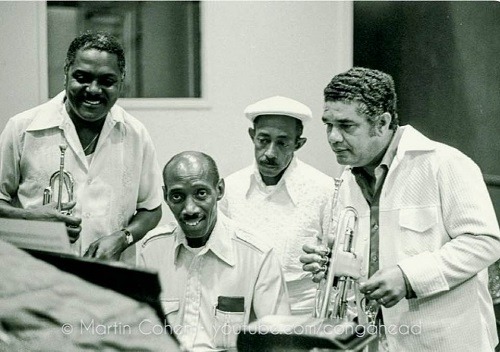
Alfredo Chocolate Armenteros, Lino Frias, Carlos Patato Valdez y el Negro Vivar 1973

The sound of Chocolate’s trumpet was a key gear in the machinery of Moré’s “Tribu,” cementing his status as the most sought-after instrumentalist of his generation.

Conquering New York and the Global Stage

In November 1958, Armenteros’ destiny changed forever. He traveled to New York with the Fajardo y sus Estrellas orchestra for a private performance at the Waldorf Astoria Hotel.

The event carried high-level political weight: it was a gala for the presidential campaign of then-candidate John F. Kennedy. Following this encounter with the Big Apple, the trumpeter decided to settle permanently in the city, becoming an ambassador for Caribbean rhythms at the epicenter of jazz.

In New York, his talent flowed through the most influential groups of the era:

  • The Machito Orchestra (1963): Where he fused Cubop with Afro-Cuban jazz.
  • Eddie Palmieri (70s): Contributing his power to the experimental sound of salsa brava.
  • Tico-Alegre All Stars (1975): Sharing the stage with giants like Celia Cruz, Tito Puente, Ismael Rivera, and Cachao.

An Endless and Eternal Style

In the late 70s and early 80s, Armenteros not only returned to collaborate with Sonora Matancera but also took the definitive step as a bandleader.

Under his own direction, he left behind memorable productions such as Chocolate Dice (1982) and Estrellas de Chocolate (1987), proving that his creative well never ran dry.The most admirable aspect of Armenteros was his artistic longevity. He remained active in festivals and concerts well into his 80s, preserving a privileged embouchure and a sense of timing that seemed to defy the laws of physics.

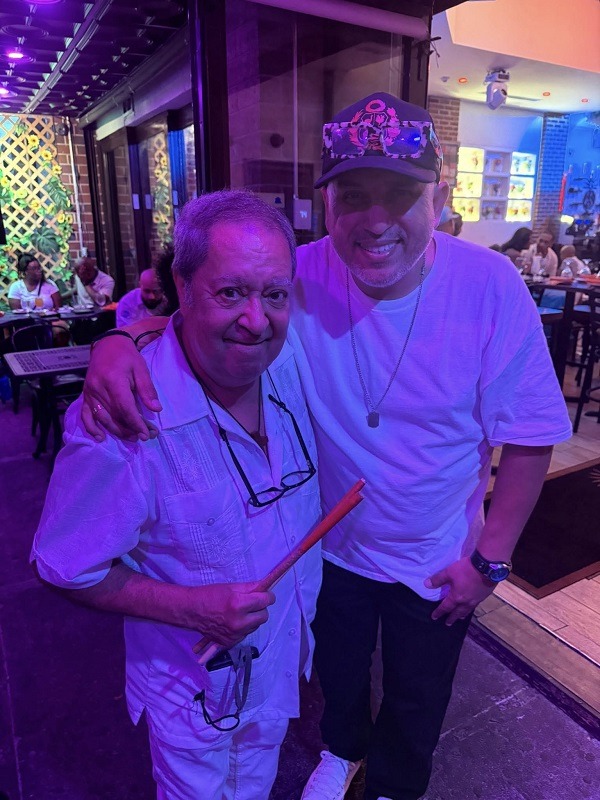
Alfredo Chocolate Armenteros y Eddie Moltalvo

Today, nearly a century after his birth, Alfredo “Chocolate” Armenteros remains the gold standard for trumpeters. His life was a testament to elegance, his music a bridge between nations, and his trumpet an eternal echo of Cuban identity that continues to resonate in every jazz descarga and every salsa step around the world.

Also Read: Larry Harlow and Ismael Miranda: The birth of “Arsenian Salsa,” a tribute to the music of Arsenio RodrĂ­guez the creator of Son Montuno and the “King of GuaguancĂł.”

Ray Pérez The Genius and Vanguard of Venezuelan Salsa

The Journey of a Pioneer Between Piano, Vinyl, and Musical “Madness”

Ray PĂ©rez is, indisputably, one of the primary architects of Salsa in Venezuela. Born in Barcelona, AnzoĂĄtegui, on April 7, 1937, Ray stands as one of the most disruptive and essential figures in the genre’s history.

Ray Pérez: The Genius and the Vanguard of Venezuelan Salsa

His nickname, “El Genio” (The Genius), isn’t just hyperbole; he earned it through his multifaceted mastery as a pianist, arranger, and composer. Above all, he was a visionary who possessed the rare ability to capture the raw “sound of the streets.”

Historical Note: While his official records cite 1937, a fire that destroyed original birth registries has led to speculation that his true birth date may be December 25, 1938.

Music was in his DNA. Ray inherited a deep artistic vein from his father a singer, trumpeter, pianist, and musical director. Ray’s journey began at age twelve playing the tuba in the San Juan Bosco youth band under his father’s tutelage.

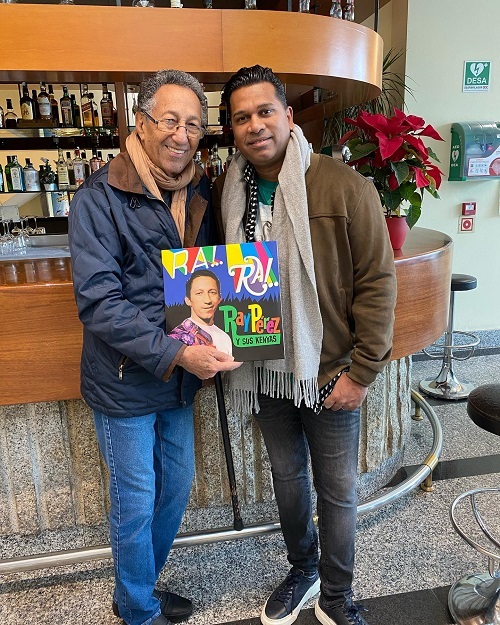
Ray Perez y Dustin Hogg

By seventeen, he had mastered the guitar, the cuatro, and the piano. Following his father’s passing, he balanced work and academics before ultimately deciding to commit his life entirely to his musical passion.

Formative Years and First Steps

Between 1962 and 1965, Ray studied at the Maracaibo Conservatory. His recording debut came via RCA Víctor under the artistic direction of Aldemaro Romero, recording the track “Marcianita” with the Trío Cristal.

After stints with the Trio Hambay and the group Los Bobos del Twist, he officially dove into Caribbean rhythms in 1965 with the creation of Ray Pérez y Su Charanga in the Zulian capital.

The Golden Era: Los Dementes, Los Kenya, and Los Calvos

Throughout his vast career, Ray launched three pivotal projects that secured his place in the Hall of Fame:

  1. Los Dementes (1965): Their debut, Alerta Mundo, Llegaron Los Locos / The Crazy Men (1966), signaled the start of a new era. Under this moniker, he recorded nearly 25 albums for labels like Velvet, Fania, and his own imprint, Pyraphon Records, founded in 1967.
  2. Los Kenya: Alongside the legendary voices of Carlos Yanes “CalavĂ©n” and CarlĂ­n RodrĂ­guez, Ray innovated the sound by replacing traditional timbales with a full drum set. This project produced iconic albums like Ronda del GuaguancĂł, Rai Rai, and Nuevo DĂ­a.
  3. Los Calvos: A bold experiment, again featuring “CalavĂ©n,” which resulted in two essential productions for RCA VĂ­ctor: Estos son los Calvos and Los Calvos
 y quĂ© Calvos.
  4. La periodista y crĂ­tica musical venezolana Lili RodrĂ­guez, el mĂșsico Ray PĂ©rez y Roberto Ernesto Gyemant
    La periodista y crĂ­tica musical venezolana Lili RodrĂ­guez, el mĂșsico Ray PĂ©rez y Roberto Ernesto Gyemant

The New York Chapters and The Return

In 1969, Ray moved to New York City. There, he played piano for Francisco Ángel Bastar “Kako,” collaborated with Rafael Cortijo and Pedro “Rudy” Calzado’s Charanga, and arranged for the “King of Boogaloo,” Pete RodrĂ­guez, composing hits like “Bossa Triste” and “Dame Felicidad.”

Upon returning to Venezuela in 1971, he founded Ray Pérez y su Orquesta, releasing a string of hits such as Aquí estoy de nuevo, Perucho y el loco Ray, and Yo soy el Rey de la Salsa. In 1974, he struck gold again with Grupo Casabe, recording three albums under the CBS label.

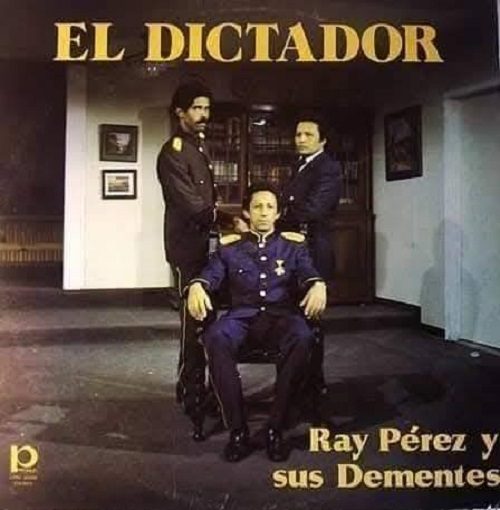
Ray Pérez Y Sus Dementes El Dictador 1981

An Everlasting Legacy

Ray’s prolific career includes collaborations with immortal voices like Perucho Torcat, Nano Grant, Teo HernĂĄndez, and Nelson Navas. He has shared the stage with titans such as “El Pavo” Frank HernĂĄndez, Alfredo Padilla, Alberto Naranjo, and CĂ©sar Monge.

From his massive repertoire, we remember the anthems of the barrios:

  • “No salgas de tu barrio”
  • “Emae Mae”
  • “Pa’ l 23”
  • “AsĂ­ mueren los valientes”
  • “GuaguancĂł en New York”
  • “La montaña”


Colaboración: Fotografías de ©Roberto Ernesto Gyemant

 Read Also: The Conjunto Bailatino “La Resistencia Salsera” again “Antes los ojos del Mundo” and here, “No hay quinto malo”

Rafaelito and his career between Munich and New York

We had a very personable and honest conversation with Rafael Pareja Ibañez, who via WhatsApp has given us a few minutes of his busy schedule to tell us a bit about his fascinating career to date and the group he currently leads, Rafaelito Y Su Tumbao. 

The artist, born in Lima, Peru, has a huge love for music and remains intact to date, so he says it is a pleasure to share the story of how he came to pursue it professionally, no matter how many times he tells it.

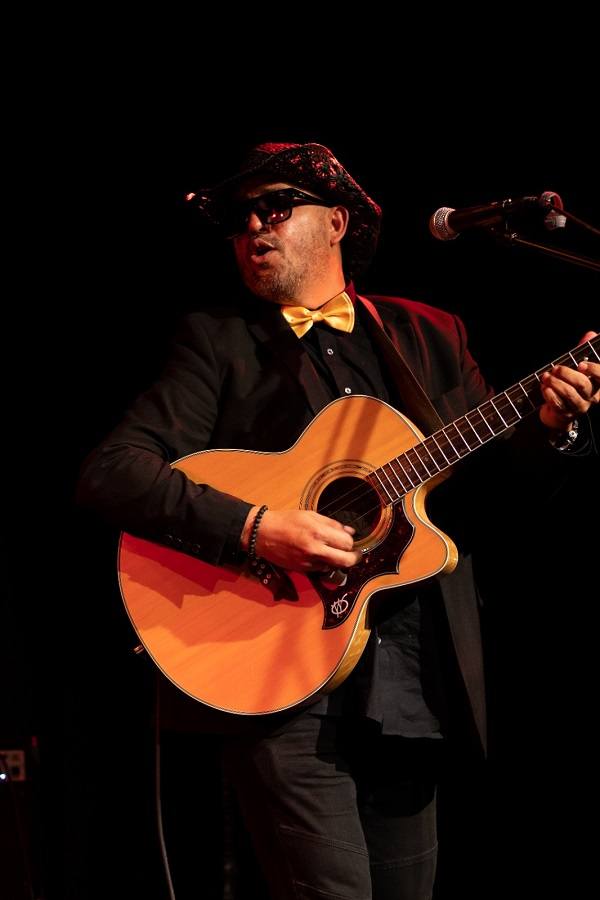
Rafaelito playing
Rafaelito playing the guitar live

Rafael’s beginnings in music

Rafael was first inspired by the artists his parents used to listen to at home, including La Sonora Matancera, Celia Cruz, Tito Puente, and many others. Family social gatherings always featured iconic songs by these stars, so he could not help but be interested in music at the early age of 10.

It all started when his father caught him beating some paint buckets to make it look like he was playing a drum set on the roof of their house, which led him to enroll his child in a music school to take guitar lessons. While it is true that this was the first instrument he learned to play, he also plays the baby bass in salsa and the piano together with all the percussion instruments.

At that time, what the young man played the most was rock and pop because the radio and other media left little room for Latin music. In fact, Rafael formed his first rock band at 16, as this was the genre with which young people identified the most in the 1980s.

Move to Germany

At 20 years of age, Rafael decided to move to Germany, specifically to Munich, where he lived for more than 27 years. It was there that he came into contact with people of other nationalities and had far more access to Latin music, especially Peruvian music, which surprised him greatly. He also got to listen to international stars such as Eddie Palmieri, Miguelito CunĂ­, and Arsenio RodrĂ­guez.

Rafaelito and Nicky Marrero
American Latin jazz percussionist Nicky Marrero and Rafaelito at Mamajuana Cafe in the Bronx

It was also in Munich where he began to have his first professional experience together with major musical groups from there such as the Sexteto Melaza, where he played alongside musicians from different parts of the world. At a student barbecue, Rafael was hanging out with many Latinos, and they began to sing and play instruments together, leading them to form a group, which they named Melaza. During that time, he dedicated himself to play salsa, guaracha, son, bolero, and cha-cha-cha in a sextet format.

The group featured a guitarist, a bassist, a conga player, a timbalero, a bongo player, and a singer. This sums up his first musical experience in Germany, which lasted about a year and a half. It also helped him draw the attention of other musicians in the city’s music scene, who convinced him to join other projects that were being created.

Another of those projects included a trio of young musicians called Madera Limpia which was founded in 2005, when rap, reggaeton, reggae, and many other genres mixed with Latin rhythms such as changĂŒĂ­ or kiribĂĄ were super trendy. It turns out that a Romanian couple traveled to Cuba, produced a film called “ParaĂ­so,” and went on a concert tour through Europe and North Asia. Therefore, they needed to hire many musicians, including the members of Madera Limpia, who contacted Rafael through connections and asked him to be their bassist. The Peruvian accepted the offer and toured all those places with these musicians, an experience he talks about with great affection.

Back in Munich, he met Lou Bega, the creator of the hugely popular swing-pop cover of PĂ©rez Prado’s “Mambo No. 5,” which stayed at number one for 36 consecutive weeks in the United States. When his producer wanted to find a band to accompany him, there were very few Latin musicians in the city and Rafael was one of them. Obviously, they called him and his colleagues to work on some demos featuring Bega’s vocals and trumpet samples. After being selected, he became the director of his live band and accompanied him on many concerts in Europe between 2007 and 2008.

El Canario and Rafaelito
JosĂ© Alberto ”El Canario” and Rafaelito

Rafaelito Y Su Tumbao

Right there in Munich, Rafael finally made up his mind and formed his own musical group, Rafaelito Y Su Tumbao, which currently has branches in Munich, Lima, and New York, where the artist currently resides. Rafael arrived in this city as early as 2020, which is when he got to perform with stars such as Charlie Aponte, Andy Montañez, Jose Alberto “El Canario,” Hildemaro, and many others. When he saw how good the human material was in his new place of residence, he also founded Rafaelito Y Su Tumbao in New York with musicians from there. 

What is striking about his move to New York is that it was motivated by Rafael’s reunion with his childhood sweetheart in Peru, whom he reconnected with in 2019. It turns out that his partner was living in New York, so he jumped on this new opportunity that life offered him and made the romantic decision to cross the Atlantic again and marry her. This radically changed his life both personally and professionally, but he’s glad he did.

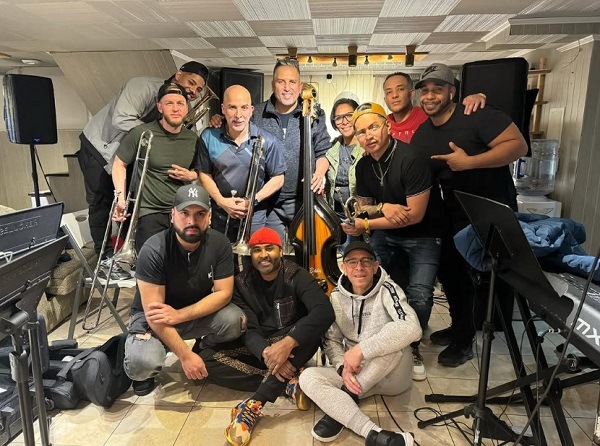
Members of Rafaelito Y Su Tumbao
Members of Rafaelito Y Su Tumbao in New York
Line Up :
Rafael Pareja – Baby Bass
Ray Cabrera – Piano
Andres Garces – Vocal
Karla Olivo Moreno – Vocal
Dennis Hernandez – Trumpet
Christian Gomez – Trumpet
Jimmy Bosch – Trombone
Andre Carpio – Timbal
Hector “ Jereto “ Ferreyra – Congas
Chuito Quintero – Bongo

Read also: Dominican bandleader and musical director Orlando Santana talks about La Makina and his career in general

San Clemente 3rd Salsa Congress

Latin America / Argentina / Buenos Aires
San Clemente 3rd Salsa Congress 2016

San Clemente 3rd Salsa Congress

December 9, 10, and 11, 2016 – San Clemente del TuyĂș, Buenos Aires, Argentina

Kicking off this December, we present the 3rd International Congress of Salsa, Bachata, and Caribbean Rhythms. Widely recognized as the most important congress on Argentina’s Atlantic Coast, the event will take place on December 9th, 10th, and 11th in the town of San Clemente del TuyĂș, located 185 miles (300 km) from the capital, Buenos Aires. The official sponsor is Center Pizza, with additional support from Tandori Indumentaria SYS.

This international congress will bring together dancers, instructors, and aficionados from across Argentina and South America. The event features world-class workshops (professional training) and countless showcases by headlining artists and dance companies from Argentina and neighboring countries. Attendees can also look forward to sets by top-tier DJs and plenty of social dancing.

Dancers - San Clemente 3rd Salsa Congress 2016
Dancers – San Clemente 3rd Salsa Congress 2016

“The following main artists will be performing:”

Stephanie Lucero: Hailing from Buenos Aires, Stephanie is making her first-ever appearance at this Congress. She is widely recognized as one of the most prestigious instructors in the scene, standing out for her ability to dance both lead and follow roles with expertise. Stephanie has refined her skills under world-renowned masters such as Gaston Vidarte, Troy & Jorget, Korke & Judith, Daniel & Desiree, and Ataca & La Alemana. She has also shared the stage with international artists like Daniel Santacruz and Domenic Marte.

Currently, she leads her own all-female choreography group, “Luceros de Fuego.” For this major event, she will be leading two world-class workshops: Partner Bachata and Bachata Ladies’ Styling.

San Clemente 3rd Salsa Congress 2016 Flyers

La Compañía Calambre: Also making their debut at the congress and in the city, Calambre is Argentina’s premier dance company. Widely recognized as 2013 World Champions, they will be hosting three world-class workshops for this massive event. In addition to their incredible showcase, attendees will have the opportunity to enjoy their performances, dance with them, and interact with the team throughout all three days of the congress.

Leandro Erni & Mariela Rondon: Traveling from the city of Mar del Plata, this duo is the reigning Bachata Championship winners. They serve as directors of the Conjunto Clave Academy and are widely recognized as a world-class couple with an extensive international career. Notably, they secured 5th place at the 2015 World Latin Dance Cup in Miami. During the event, they will be hosting two workshops and performing two showcases. You’ll also have the chance to meet them and share the dance floor with them throughout all three days of the congress.

San Clemente 3rd Salsa Congress 2016 Flyers 2
San Clemente 3rd Salsa Congress 2016 - Details
San Clemente 3rd Salsa Congress 2016 – Details

Gustavo Pinat: Originally from Rosario, in the Santa Fe Province, Gustavo has over 19 years of experience in the salsa world. He has trained extensively across Europe and the Americas, including Germany, Switzerland, Spain, Italy, Greece, the U.S., Cuba, and Venezuela. A seasoned professional, he has taught workshops at numerous national and international congresses.

Gustavo is also the organizer of the VIVE CUBA Afro-Caribbean Rhythm Festival held in Rosario. Currently, he serves as the Director of the Bamboleo Salsa Studio in Rosario and leads “RAÍCES,” Argentina’s premier comprehensive training program for Afro-Cuban dance.

Leonel Silva: Hailing from Montevideo, Uruguay, Leonel is ranked among the top seven salsa soloists in the world and is a celebrated figure in his home country. Following his incredible performance at the last event, he returns to the 3rd San Clemente Salsa Congress.

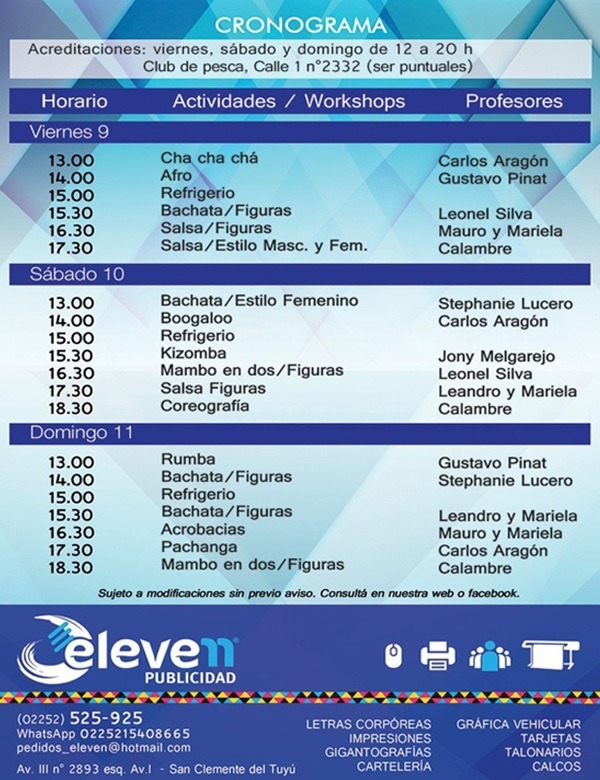
San Clemente 3rd Salsa Congress 2016 - Schedule
San Clemente 3rd Salsa Congress 2016 – Schedule

Carlos Aragon del Carpio: One of South America’s leading figures in the scene, Carlos is a regular at the region’s most prestigious congresses. He is the director of the first South American Mambo “On 2” school in Argentina and has refined his expertise through extensive training in Cuba and the United States.

Our event host will be Silvio GonzĂĄlez, the director of the Argentina and Puerto Rico Salsa Open. A teacher and dancer with an extensive professional career, he is one of the most prominent figures in our country’s dance scene.

We are also proud to feature our Official DJ: GASTON “TIBURON” TABORDA, a nationally and internationally renowned DJ who headlines the most important congresses and competitions throughout Argentina and South America.

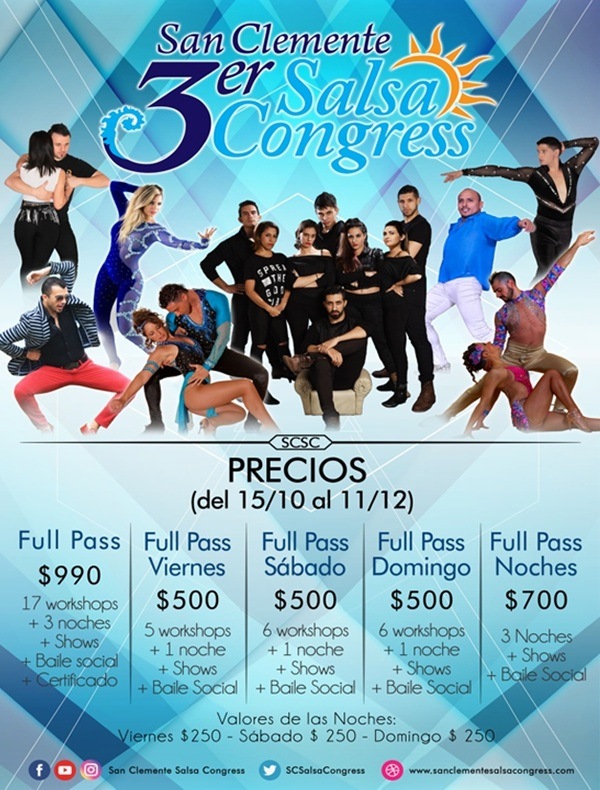
San Clemente 3rd Salsa Congress 2016 - Prices
San Clemente 3rd Salsa Congress 2016 – Prices

You can visit our official website and follow us on social media:

San Clemente 3rd Salsa Congress 2016 - Social Media
San Clemente 3rd Salsa Congress 2016 – Social Media

www.sanclementesalsacongress.com

  • Facebook: San Clemente Salsa Congress
  • Twitter: @scsalsacongress
  • Instagram: San Clemente Salsa Congress
  • YouTube Channel: San Clemente Salsa Congress


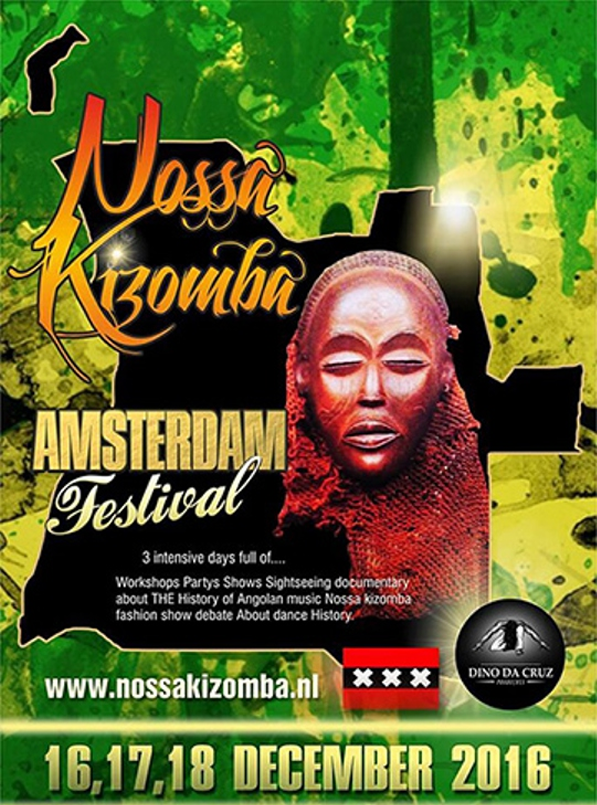
Nossa Kizomba. International Amsterdam Festival 2016

Europe / Netherlands / Amsterdam

Nossa Kizomba. International Amsterdam Festival 2016 (16, 17, 18 DECEMBER Brasa Dance Studios Zuidoost)

Nossa Kizomba Amsterdam Festival is an event focusing on dance, culture and real talent. At our festival you will enjoy workshops by some of the best International teachers in a variety of dance styles including Kizomba, Semba, Tarraxinha, Kizomba fusion, Afro House, Hip Hop and Funk.

Nossa Kizomba. International Amsterdam Festival 2016

There will be of course parties and shows.

But this is not all, because we want to give you an all-round experience of the Angolan culture with:

  • An African fashion show
  • A documentary about Angolan music
  • Typical food
  • Palestras allowing you to learn and discuss about dance styles with experts
  • Afro House battle
Nossa Kizomba. International Amsterdam Festival 2016 - Flyers
Nossa Kizomba. International Amsterdam Festival 2016 – Flyers

Eduardo Paim

LIVE IN CONCERT

Special Guest!

Music producer

Eduardo Paim
Eduardo Paim

Eduardo Paim has proved not only a performer but also a composer and music producer from multiple sources. It should be noted that the music producer, record producer also known, is the figure responsible for the completion of a recording that is considered finalized for release.

In this sense the process of the first productions of Eduardo Paim has included recording, advice from musicians, writing, including the supervision of the mixing process and can be considered the pioneer in the use of synthesizers and other similar procedures, as the box rhythms, learning who had the undeniable contribution of techniques already dominated by Ruca Van-Dunem.

Is that too much, that the musical aesthetics of Eduardo Paim, as producer, had great importance in the careers of singers and important in the course of Angolan popular music itself, later.

Eduardo Paim - 2
Eduardo Paim – 2

Paul Flores, Diabik, Clara Miller, Nelo Paim (the promising younger brother Eduardo Paim) MamborrĂł, Tchipa Jacinto Moniz de Almeida, Tropical Band and Van-DĂșnem Ruca, we cite the most important, are examples of the influence and focus Radiator keys Eduardo Paim, whose electronic sound, has undergone a substantial part of the music of the past twenty years.

The early career of Paul Flores had the production and contribution of Eduardo Paim. Topics such as: “Cheri”, “Kapuete kamundanda” and “This wedding is” the first compositions of Paul Flores, resulted from an invitation by Carlos Eduardo Paim Open Flores, father of Paul Flores.

Eduardo Paim dancing

Discography

Eduardo PaĂ­m

Also known as General Kambuengo (stubborn, resolute), Eduardo Paim has obtained during his career, three discs of gold and silver awards granted for publishing Portuguese, assigned by the sum of fifty thousand copies sold, with the albums “Kambwengo” (1994), “From kayaya” (2002), and “There is still time” (1996).

The song “Baila Rose” from the album “Kambwengo,” one of the paradigms of discography Eduardo Paim, which portrays the typical Angolan woman, was in the charts of Radio Television Portugal (RTP) for months.

Nossa Kizomba. International Amsterdam Festival 2016 con Eduardo Paim- Flyers

“Luanda my band” (1990), “Mujimbos” (1998), and “Maruvo Cup” (2006), is a whole album, more than twenty year career. His latest CD, much more involved, was contributed by singers such as Fernando GirĂŁo, Nancy Vieira, Bonga, Vote Gonçalves, Don Caetano, Angelo Boss, Black, and Matias Damasio BuĂ©. The CD “Luanda my band,” proved, likewise, a success unprecedented in the career of Eduardo Paim, an album that aligns the themes: “My Neighbor,” “Kutonoca,” “It’s So Good” “Luanda My Band”, “Sound of the Band,” “Nagibo” and “Kizombada.”

On this record, Eduardo Paim has worked with the Guinean guitarist and singer Justin Delgado Guilherme Silva, a Mozambican artist who has shared the stage with artists such as Julio Iglesias, Tina Turner, Juan Luis Guerra, Cesaria Evora, Tito Paris and Rui Veloso.

Eduardo Paim - 3
Eduardo Paim – 3

The economy of instrumental means, one of the merits of Eduardo Paim, in close collaboration with guitarist Simmons Mancini, revealed itself as one of the strategies of this album, as well as the use of synthesizers, whose functionality was ultimately the only recourse at that time.

For an artist with a long artistic career, Eduardo Paim argues that “when you have no followers, you do not reach the target, but when there are many, we can lose ourselves among those who follow us.”

TICKETS: https://www.dizizid.com/events-registration/index.html?officeId=47

Eduardo Paim - 4
Eduardo Paim – 4
  • « Go to Previous Page
  • Page 1
  • Interim pages omitted …
  • Page 4
  • Page 5
  • Page 6
  • Page 7
  • Page 8
  • Interim pages omitted …
  • Page 129
  • Go to Next Page »

International Salsa Magazine (ISM) is a monthly publication about Salsa activities around the world, that has been publishing since 2007. It is a world network of volunteers coordinated by ISM Magazine. We are working to strengthen all the events by working together.