• Skip to primary navigation
  • Skip to main content

International Salsa Magazine

  • HOME
  • Previous editions
    • 2026
      • ISM / August 2026
      • ISM / July 2026
      • ISM / June 2026
      • ISM / May 2026
      • ISM / April 2026
      • ISM / March 2026
      • ISM / February 2026
      • ISM / January 2026
    • 2025
      • ISM / December 2025
      • ISM / November 2025
      • ISM / October 2025
      • ISM / September 2025
      • ISM / August 2025
      • ISM / July 2025
      • ISM / June 2025
      • ISM / May2025
      • ISM / April 2025
      • ISM / March 2025
      • ISM / February 2025
      • ISM / January 2025
    • 2024
      • ISM / December 2024
      • ISM / November 2024
      • ISM / October 2024
      • ISM / September 2024
      • ISM / August 2024
      • ISM / July 2024
      • ISM / June 2024
      • ISM / May 2024
      • ISM / April 2024
      • ISM / March 2024
      • ISM / February 2024
      • ISM / January 2024
    • 2023
      • ISM / December 2023
      • ISM / November 2023
      • ISM / October 2023
      • ISM – September 2023
      • ISM – August 2023
      • ISM July 2023
      • ISM Edition June 2023
      • ISM – May 2023
      • ISM April 2023
      • ISM March 2023
      • ISM February 2023
      • ISM January 2023
    • 2022
      • ISM December 2022
      • ISM November 2022
      • ISM October 2022
      • ISM September 2022
      • ISM August 2022
      • ISM July 2022
      • ISM June 2022
      • ISM May 2022
      • ISM February 2022
      • ISM January 2022
    • 2021
      • ISM December 2021
      • ISM November 2021
      • ISM October – 2021
      • ISM September 2021
      • ISM August 2021
      • ISM July 2021
      • ISM May 2021
      • ISM April 2021
      • ISM June 2021
      • ISM March 2021
      • ISM February 2021
      • ISM January 2021
    • 2020
      • ISM December 2020
      • ISM November 2020
      • ISM October 2020
      • ISM September 2020
      • ISM August 2020
      • ISM July 2020
      • ISM June 2020
      • ISM May 2020
      • ISM April 2020
      • ISM March 2020
      • ISM February 2020
      • ISM January 2020
    • 2019
      • ISM December 2019
      • ISM November 2019
      • ISM October 2019
      • ISM Septembre 2019
      • ISM August 2019
      • ISM July 2019
      • ISM June 2019
      • ISM May 2019
      • ISM April 2019
      • ISM March 2019
      • ISM February 2019
      • ISM January 2019
    • 2018
      • ISM December 2018
      • ISM November 2018
      • ISM October 2018
      • ISM September 2018
      • ISM August 2018
      • ISM July 2018
      • ISM June 2018
      • ISM May 2018
      • ISM April 2018
      • ISM March 2018
      • ISM February 2018
      • ISM January 2018
    • 2017
      • ISM December 2017
      • ISM November 2017
      • ISM October 2017
      • ISM September 2017
      • ISM August 2017
      • ISM July 2017
      • ISM June 2017
      • ISM May 2017
      • ISM April 2017
      • ISM March 2017
      • ISM February 2017
      • ISM January 2017
    • 2016
      • ISM December 2016
      • ISM November 2016
      • ISM October 2016
      • ISM September 2016
  • Spanish
  • Download Salsa App
    • Android
    • Apple

Search Results for: violinist

Sr Ortegón is a big success in Hollywood

Our nice talk

Good afternoon, we have here José Miguel Ortegón. He is a music producer, composer, DJ and violinist. Pleasure to meet you, Mr. Ortegón, how are you feeling?

I’m fine. Thank you very much for the invitation.

Your name is José Miguel Ortegón, but you are known as Sr Ortegón in artistic circles. Why?

I think that is a cultural tradition in the Hispanic world. Men are always called by their last name. That was natural and came spontaneously. Taking advantage of that señor is a Latin cliché, it was perfect for the work I was doing.
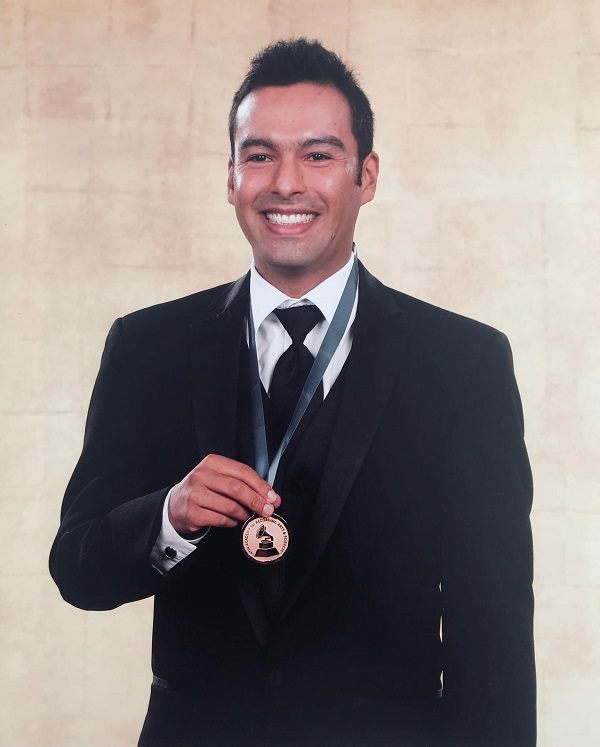
José Miguel Ortegón at the Latin Grammys

What was your first approach to the entertainment world?

I started recording with Guayacán, which is a salsa orchestra from Cali, Colombia. I received a lot of help from maestro Zumaque, who is a musician that does contemporary and classical fusion with Latin American rhythms. This was during my teens.

Then, you ventured into other facets, correct?

That’s correct. I started studying music at the conservatory when I was five years old and was in some rock bands. You know that our culture is divided into two musical styles in Latin America, which are classical and popular music. My first professional recordings came with the first computer we had at home as well as most of my generation. When the first computers came to our homes, the concept of music also changed.

How did you go from playing rock and classical rhythms to boogaloo and urban rhythms? How was that transition?

Cali has always been very linked to pachanga, boogaloo and charanga. Rock comes from blues and boogaloo is more or less part of the same trend, so it’s not uncommon for rockers to want to experiment with those rhythms I mentioned at the beginning. I also had teachers at the conservatory who taught classical music during the day, but played with professional orchestras at night. For me, that transition is inevitable.
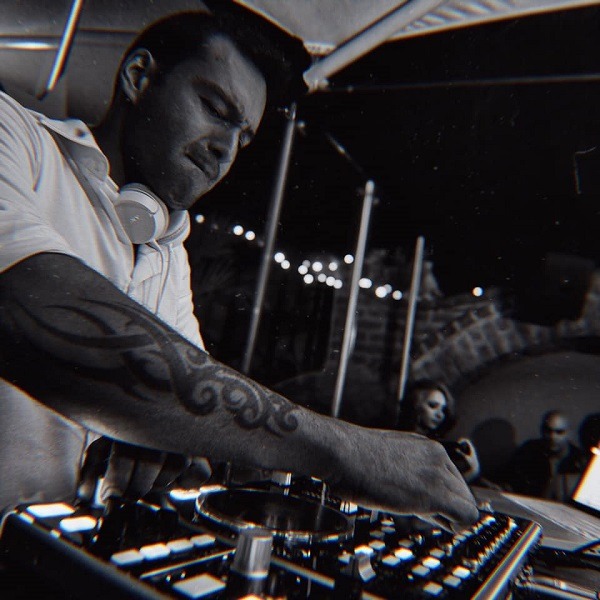
Sr Ortegón doing his job as a DJ

You have created music for series, movies, digital platforms, Disney, Netflix, animated series, etc. Did you think your career would go that far?

Thank you for your words. I make music. I have the same worry since I started in this world, I think I still have a lot to learn and maturing ideas, The truth is I never imagined it. I simply took the opportunity before me in Europe, where I was studying musicology at the Sorbonne. It is true that Latin music is very exotic there because there are not many Latin composers and producers.

At university, I got a chance to make music for a television channel. Subsequently, there was a snowball effect, a colleague who is now working in Hollywood contacted me for one of those jobs and that was my big opportunity. When I got the script, it was a Dominican series, which made me immediately discard salsa and mariachis. I thought about using bachata or something that really belonged to the Dominican Republic.

When you talk about Hollywood, it should be emphasized that there are several generations of Latinos born in the United States of any origin. A Cuban knows that a ranchera is not Cuban but from Mexico. Such a thing happenned a lot in the industry in previous years. The same rhythms and mixes were always used regardless of the Latin country involved in a production like, for example, West Side Story. I love that movie and think it’s excellent, but the music they used doesn’t sound Puerto Rican at all. That’s why I thought I should take this opportunity to respect the rhythms and traditions of each country. I know we all speak Spanish but each country has its own identity, so I respectfully take each rhythm and use it to make it authentic.

Latin music in Hollywood

When you did music for any series or film, were you given parameters to follow or did you have to be free to experiment with your music?

That’s one of the best questions I’ve ever been asked because the vast majority of producers are American and not connected with Latin culture, so salsa and merengue are the same for them. I just tell them to trust me, send me some samples to guide me, we analyze everything and move on. If the director or the editor doesn’t like what I did, we reach an agreement. Nowadays, this process is easier because there is more musical and cultural education on the part of the producers in the United States.

Sr Ortegón at the party in the Jetset Magazine

You were nominated for a Latin Grammy thanks to a mix of boogaloo and urban rhythms that you made. How did you think of it?

I’m 40 years old, so I spent my adolescence at the time when Californian hip hop was in full swing. Cali is one of the most Americanized cities in Colombia, so you were always listening to all those American groups and songs. Mixing all those rhythms with boogaloo has always seemed very interesting to me and I had no idea how to do that until I learned.

Since a mix between hip hop and Latin music is complex to make, a lot of people gsurrended and opted for reggaeton as culture. There are other groups such as Control Machete that have done an excellent job, but I felt they were lacking something. That’s how I started to learn, but it took me a long time because of lack of resources, since I didn’t have the right elements to respect the codes. So, I did a boogaloo song and a hip hop beat to mix them, which made me realize that they are sister rhythms. This work was very popular and even appeared in series and movies.

In fact, I heard about you from an email that included your new album entitled Latin Boogaloo Volume 2. I also listened to Volumen 1 and noticed the difference. What is the main difference between one volume and the other?

Volume 1 includes what I called Boogaflow, which is boogaloo with flow. Volume 2 is pure boogaloo. I tell you this because, for example, salsa is a term, but it’s really Afro-Cuban music made by Nuyoricans in New York if we go back to basics. Prior to that New York sound known as salsa, there was that phenomenon called boogaloo, shingaling or Latin soul.

I had to listen to disco to get to those rhythms because nobody teaches you anything about those genres. Unfortunately, those who created those rhythms are already dead or doing other things like Joe Cuba, Jimmy Sabater, the people from Sexta All Stars, Eddie Pamieri, Ray Barreto and many others. That fashion lasted about six or seven years and that was that. Every time I go to create a boogaloo, I have to listen very well because there are no scores or models to follow. Poncho Sanchez is one of the few who brings up the torch of that sound, although he is inclined more to Latin jazz.

I wanted to do a boogaflow, but my editor David Santiago proposed to me that we make two versions, one boogaloo version and the a little more acoustic one. What we were looking for was to please both audiences, the one who wants something urban and the one that wants something classic.

Which of the two volumes was more successful?

I know you have the answer (laughs). Volume 2 was the most successful. Number one has put me in touch with my salsa friends, but I didn’t want to tell them that I was going to make a volume two because boogaloo is not a very common rhythm.
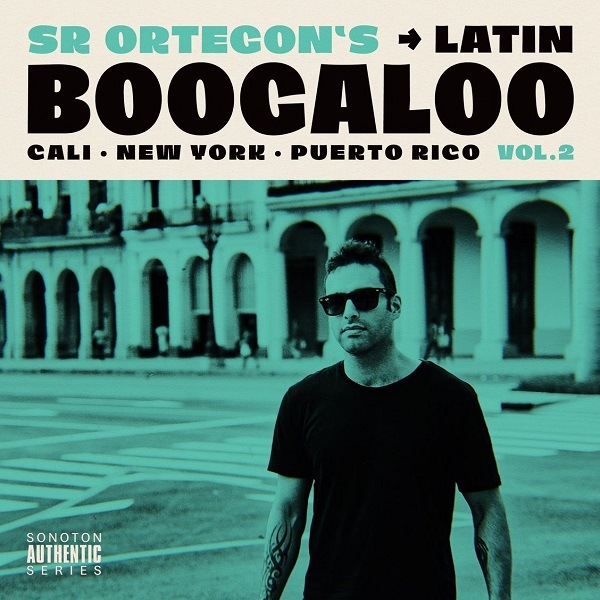
Cover of the album Latin Boogaloo Vol. 2
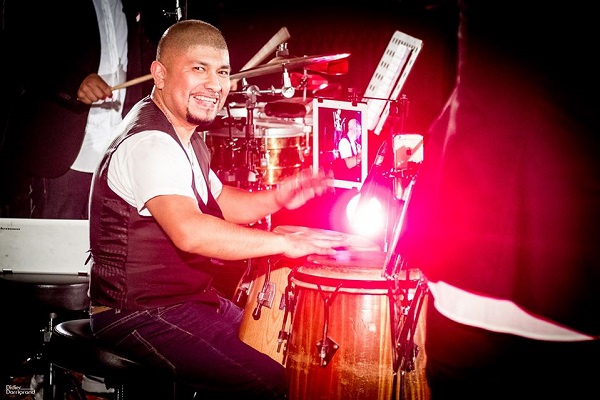
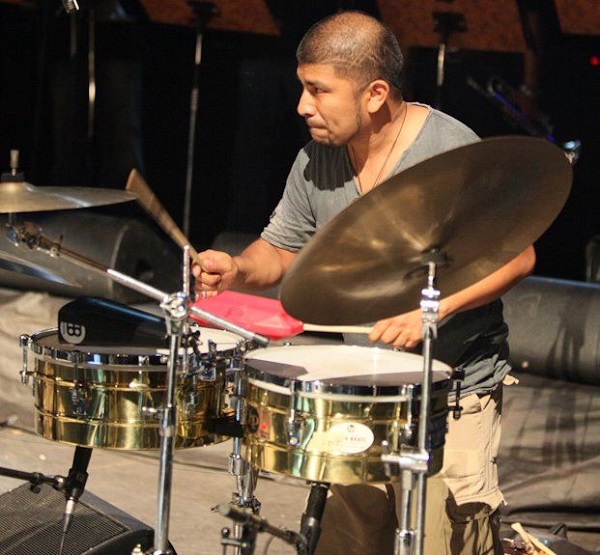
From Peru and based in France we have Wálter Antonio Rebatta Hinostroza is a brand new and spectacular percussionist.

We are honored to present in this new release, one of the most outstanding figures of Latin music, representing the brother country of Peru, who has put the name of the musicians born in Inca lands very high in the world.

With you, directly from France, we have as a special guest Wálter Antonio Rebatta Hinostroza, a brand new and spectacular percussionist, who was born on September 14, 1973, in Bella Vista, Callao, Peru, being artistically known as “El Chato”.

Welcome Wálter to Salsa Escrita “La Columna Salsera de Barquisimeto, Venezuela”. It is a great pleasure to have you as a special guest in International Salsa Magazine, www.SalsaGoogle.com.

Thank you very much to you, my friend, Professor Carlos, for the invitation to your well read and recognized column and I take this opportunity to give a sincere greeting to all Venezuelans who are like my brothers.

How did you start in music? Well, teacher in my neighborhood called Ventanilla, in Peru, I grew up and since I was a child I breathed musical air, where at the age of 6 years old I was already playing “El Cajon”, traditional Peruvian Creole instrument, under the tutelage of my older brother Kike Rebatta, who took me later to learn other percussion instruments and prepare me with music theory, and then enter the music school of the renowned teacher Edelmi Chavez, and thus join the ranks of the most renowned orchestras in my country, such as: La Iniciativa, Orquesta la Grande, Banana Latin Jazz, among others.

Wálter, which international orchestras and artists have you accompanied? I have accompanied and worked with “Los Hermanos Colón” from Puerto Rico and among many groups, I have had the honor of being on stage with my Venezuelan brothers, Hildemaro “El Sonero del Amor”, with whom I have a great friendship, as well as with the master timbalero Alfredo Villamizar, from whom I have learned a lot and from whom I must thank through his column Salsa Escrita. “Chato”, you are currently based in the French city of Grenoble and we would like to know how is the salsa movement, especially in Europe. In fact, professor, in 1995, I came to Europe with the “Orquesta Salsa Perú” and I met Mr. Rodolfo Guerra, with whom a great friendship was born and I became part of the “Orquesta Sincopa Latina”, directed by him, being present in his productions: Salsa que te pasa, Demasiado corazón, Mi bachata, Puerto Rico, Todo, Escándalo, Mi silencio, Mi toque, Habla conmigo and Azafata. Wálter, I have heard that you have accompanied great salsa artists in their presentations, tell me who? I have had the honor of accompanying the late Tito Gómez, Willie González, Luisito Carrión and the great Venezuelan sonero Orlando José Castillo “Watussi”.

Also, let me tell you professor, that I have worked in the Italian television Media Set, in the very popular program “Notte Vola”, also in 2002, I participated in the Tour of the Queen of Salsa, Celia Cruz, along with the orchestra of the prestigious world famous violinist Alfredo de La Fe.

Likewise, my friend Carlos, in 2004, I performed in numerous events with Latin jazz groups, among them “El Royal Cuba”, of the Cuban musician and singer Eduardo Céspedes.

In 2007, I participated in the prestigious and famous festival of San Remo with the singer Daniele Silvestri, with whom I have recorded in his productions. In 2009, I participated in the Italian tour “Terromotati Dil Abruzzo”, conducted by the famous singer Laura Pausini and later that same year I participated again in a tour in the United States for charity with Pausini again.

Excellent Wálter, and what can you tell us about the orchestra you are currently working with and what are your future projects? Professor Carlos, at present I am an official musician of the renowned orchestra “Mercadonegro” and in relation to my projects, is to form my own group and perhaps dabble in bachata, but without leaving aside the salsa, since living in Europe I have met many bachateros. And something very important, my friend Colmenárez, I am also working on the project of my Venezuelan compadre, the musician Edwin Sanz, whom I would like you to interview at some point.

Very good Wálter, congratulations for your career, what are your contacts on digital platforms?  My Facebook is: Wálter Antonio Rebatta Hinostroza and my whatsapp: +41 77 5122633.

We want to wish you the best on behalf of Salsa Escrita “La Columna Salsera de Barquisimeto” and that you continue to put the name of Peru on high in all the stages of the world.

Thank you a thousand times, Professor Carlos Colmenárez, for taking me into account and thus make my career known and offer my greetings, thanks and respect to all the salseros of the world through International Salsa Magazine, www.SalsaGoogle.com and long live salsa, Peru and Venezuela, united forever…!

Live music and other news in the SF Bay Area

Renowned timbalero, composer, bandleader and vocalist Mario Solomon is the leader of one of the hottest groups performing modern Cuban Dance music in the US: Mario Y Su Timbeko.  Although Mario moved from Oakland to Austin, Texas during the pandemic, he hasn’t stopped his original music from coming out.  His latest single “Sola Te Quedaste” follows three singles that he has released during the pandemic: “Llego Lo Que Te Esperabas”, “Lo Mas Grande” and “Nadie Sabe Nada”.  These songs are to be released as an EP in the first quarter of this year.  Mario Y Su Timbeko consisting of bassist Ayla Davila, guitarist David Lechuga, vocalist and keyboardist Jordan Wilson, pianist and recording producer Jason Moen and conguero Carlitos Medrano will be performing a special concert “Timbeko By The Bay at La Peña Cultural Center, 3105 Shattuck Avenue in Berkeley on Saturday, February 12 starting at 8 pm.

Mario explained that the show is like taking a trip with the history of Cuban Music featuring traditional rhythms of Danzon, Cha Cha Cha, Boleros and Changui which will be the focus of the first set.  The second set will feature original music with selections from the new EP.  Many Bay Area-Northern California dancers and listeners alike are big fans of Timbeko’s infectious timba sound which contains elements of RnB, Gospel and Funk.  Mario hopes to have copies of the EP ready to sell at the dance/concert.  There will also be a dance after party with DJ Antonio included in the admission to the show.  For more information on the concert, visit lapena.org.  For more information on Mario Y Su Timbeko, check out their page on Facebook and Instagram.

Mario Mayito Salomón

Montuno Productions will be presenting a Valentine’s Day Concert as part of their Bay Area Latin Jazz Series at Oakland’s fine art deco California Ballroom located on 1736 Franklin Street.  This triple billed show will feature the debut of Cuban jazz vocalist Jessy Diaz accompanied by 4 time Grammy award winner Oscar Hernandez of Spanish Harlem Orchestra, Edgardo Cambon and Candela and ending the show with be the MP All Star Salsa Project directed by pianist Israel “Izzy” Tannenbaum (formerly of Grupo Niche).  I will be your Master of Ceremonies and DJ for the entire evening.  Cuban food will be available for hungry patrons at the concert/dance.  For more ticket information on this dance/concert, you can visit montunoproductions.com

Major cancellations and postponements continue due to the latest Omicron variant of the Coronavirus pandemic.  The Victor Manuelle concert/dance scheduled for the Hyatt Regency in Burlingame has been postponed until Saturday, April 9th per show producers JC Coral and Bosco Vega.  Cuban born Brother-virtuosos violinist Ilmar and pianist Aldo Lopez-Gavilàn protagonists of the film documentary Los Hermanos/The Brothers cancelled their scheduled January 23rd concert at U.C. Berkeley’s Zellerbach Auditorium.  There is no rescheduled date for that show.

On the local club front, Oakland’s own Fresquecito Timba DJ monthly at La Furia Chalaca near Jack London Square produced by DJ Walt Digz was cancelled as well at the beginning of January but the event will be back in February.  The Ramp in San Francisco has temporarily suspended their live and DJ music shows per order of the San Francisco Port.  The Ramp is hoping to resume their live music dates in March.  Other venues such as Space 550 just didn’t reopen in January but will reopen on February 11th with Julio Bravo y Salsabor headlining their Valentine’s Day weekend party.  You may want to double check that the venue is still open and that live music is still going to be presented on the night that you are planning to go out.

This is Julio
Julio Bravo

A scene of many a popular, crowded club night, Lukas on West Grand and Broadway in Oakland the home of Thursday Cuban nights will close at the end of January.  Ahi Na Ma, the production company in charge of the popular Cuban dance night featuring DJ’s Leydis and Antonio have announced that their weekly event will move to a new location soon to be announced.

Ex El Gran Combo vocalist Charlie Aponte will be visiting the SF Bay Area on Friday, April 1 at Roccapulco, 3140 Mission St. in San Francisco.  Jaffe Events will be presenting the show.  Look for Aponte to feature original material from his recordings as well as the many hit songs he recorded with El Gran Combo during his tenure with this great musical institution.  It promises to be a smokin’ show!!

The Seahorse in Sausalito continues to buck the trend and continues to present live music on their outdoors patio stage on Saturday and Sunday evenings starting around 5 pm.  They are featuring Orquesta Taino Feb 6, Karabali with Karl Perazo of Santana and Michael Spiro Feb 12, Louie Romero & Mazacote Feb 13, Salsa Caliente w/Gary Flores Feb 19, Edgardo Cambon & Candela Feb 20 and Braulio Barrera’s Somos El Son on Feb 27th.  KPOO/KPFA DJ Jose Ruiz is the house DJ behind the decks.

Another venue that has stayed open for business in spite of this tough COVID time is the Cigar Bar, 850 Montgomery St. in San Francisco.  You can still enjoy good drinks, fine food and a selection of cigars for your enjoyment.  They have a full schedule on Fridays and Saturdays for February which includes Somos El Son Feb. 4, N’Rumba Feb. 5, Manteca,  Feb. 11, Josh Jones Latin Jazz Ensemble, Feb. 12, La Clave Del Blanco, Feb. 18, Edgardo Cambon y Candela Feb. 19, The Latin Rhythm Boys Feb. 25 and Pacho Y Orquesta Evolution on Feb. 26.  Schedule subject to change due to COVID so check their calendar to confirm acts.  Visit their website at www.cigarbarandgrill.com

This is Edgardo Cambón
Edgardo Cambón

BY LUIS MEDINA, PRODUCER AND HOST OF CON SABOR ON KPFA 94.1 FM AND SABIDURIA CON TUMBAO ON WORLD SALSA RADIO.COM

Orquesta La Moderna Tradición frontman Tregar Otton talked to us

What Orquesta La Moderna Tradición is

Tregar Otton playing
Tregar Otton, founder of the orchestra, playing the violin

Orquesta La Moderna Tradición has been one of the most legendary groups of Cuban music in its entire history. It is a group whose members are based in San Francisco, California, and consists of 11 members who play different genres such as danzón, timba, guaguancó, cha cha chá, son, rumba, charanga, among others. They also mix in elements from American jazz, violins, and Afro-Cuban rhythms.    

The beginning of this orchestra’s story goes back to 1996, since they started to perform throughout the United States to bring the best of traditional Cuban music to every corner of the country and transport Cuban immigrants back to the Havana’s streets and clubs during the 50’s. All the success accumulated allowed them to perform at the San Francisco Jazz Festival, the Smithsonian Institution, the Lincoln Certer and many other venues of high prestige.    

Recently, Orquesta La Moderna Tradición once again displayed their talent at Yoshi’s, a jazz club and restaurant located in Oakland, California, whose reputation in the San Francisco Bay Area is not up for discussion. Our editor Eduardo Guilarte was present at the show to cover the details of the event, which left all those present in awe.  

Conversation with Tregar Otton, founding director of the orchestra 

Tregar Otton and Maru Pérez
Tregar Otton and Maru Pérez-Viana, his wife and an important part of the orchestra

Based on the above, we talked with Tregar Otton, founder, director, composer, and violinist of the group. This talented musician, born in the Marshall Islands and raised in Texas, started to learn about classical music from an early age and joined the Berkeley Symphony while he still was a teenager. By the 1990s, this musical promise worked as a regular part of Virgilio Mart Y Sus Majaderos, La Tipica Novel and the Charanga Orquesta Broadway. 

By the year 1995, Otton founded Orquesta La Moderna Tradición with Roberto Borrell. At the beginning, the group started to become well-known for its soft sounds of Afro-Cuban charanga, which are accompanied by a set of wind instruments and violins that give a unique touch to this group’s music. 

Today, we have the welcome presence of the musician to talk about each and every one of the issues raised in this brief review and anything he wants to reveal to our dear readers. It is such a pleasure to have you here today, Tregar. How are you feeling?  

I am fine here near San Francisco. Good to see you today.

Very good, Tregar. You got started in the world of music at a young age. Could you tell us a bit about your beginnings? 

I started playing violin when I was four years old and my family had a violin teacher as a neighbor. My parents did the laundry for all our neighbors, so we met her and she ended up giving me classes every day. After that, I studied a lot of classical music, bought music when I was about 20 and fell in love with it because it used the violins differently from classical music. I really enjoyed playing dance music because the connection with the public is quite different from that of classical music. In the case of classical music, many people get bored, but Cuban music and salsa music make a much more direct connection to the audience. There is nothing like playing for a floor with dancers. 

We understand that you were born in the Marshall Islands, but grew up in Texas, is that correct? 

Yes. After my dad married my mom, they both moved to Micronesia, the Marshall Islands, in the middle of the Pacific. After that, I grew up in Corpus Christi, Texas, till I was 13 or 14 about when I moved to California.   

I asked because it is very interesting how you set your eyes on Cuban music despite your origins. Where does this interest in Cuban music and the rhythms you play come from? 

For the same reasons I play dance music. It caught my attention when I heard Charanga de La 4 or one of these New York bands. I was impressed that violins were part of the percussion and were making repetitive sounds with the refrain and the son montuno. We are more part of the rhythm section than the melodic section in many of our songs. We can dance while we are on stage. I was also impressed by the improvisations of Cuqui and Alfredo de la Fé. I had many Latin friends I met in college while learning Spanish because no one in my family spoke it. 

How did Orquesta La Moderna Tradición come about and who joined you in its foundation? 

I was working with a group. I was in New York, where I was playing with the Broadway Orchestra and the Orquesta Tipica Novel. I was very lucky to have been in that city because I got to know many veteran musicians in the 80’s like Renato Valdés, Virgilio Martí, and Adalberto Santiago. I visited a Cuban friend from San Francisco named Fito Reinoso, who had a group called Ritmo Y Armonía and he visited us here in New York. I was tired of the cold in New York, so I decided to go to San Francisco, where Tito and I had the idea of creating a group. It was there that I met a great drum instructor and dance teacher Roberto Borrell, who joined us to found Ritmo y Armonía. After two years, we had to be apart, but Roberto and I still wanted to play danzón. At least here in the Bay Area, it is very difficult to get singers. The ones we have are good, but there are not so many. So, we planned to make a danzonera or danzón group. When the orchestra began to work, we only played danzón songs, rehearsed every week and did many tours with this musical genre because there was a boom with swing dancing and dance music during the 40’s. So, we were surfing that wave. So, we were surfing that wave and doing collaborations with swing groups because it was older music. Danzón is a very rich genre, but it is no of interest to many people because they do not know how to dance it, so we started expanding our repertoire to include more modern and dance music. We still play danzones, but only two per set. There are still musicians from the original group in the orchestra including Michael Spiro. Roberto went to Peru about a decade ago, so Michael and I stayed with the group and invited Eduardo Herrera, who is a singer born in Caracas, Venezuela, to perform with us. We expanded the repertoire by doing the best we could with my own creations. Let’s remember I am the arranger of the group, so I do some songs and we have one that is included in the new recording in which I wrote the music and maestro Carlos Caro from Cuba added the lyrics. 

Orquesta La Moderna Tradición performing
Orquesta La moderna Tradición at one of its shows

Although rhythms like danzón are not so popular, did you feel the acceptance of the public? 

There were many people who knew danzón who began to notice that it was a very interesting genre due to the presence of the violins. As Roberto Borrell is a dance teacher, he teaches many of his students how to dance danzón, which is not easy because they should be affixed on each turn they have to make according to the sounds of the instruments.   

Can you go from one genre to another in the same song? 

Yes, we do that a lot. On our new album, we have rhythms with batá drums from music of Santería, which we use for our danzón songs. It sounds complicated when I explain it, but it is easy at the time of listening to it. 

What makes Orquesta La Moderna Tradición different from other Latin music groups in the United States? 

Well, I know no other group that plays danzón or charanga. There are two genres of popular dance music in Cuba that come from son montuno, which uses violins and flutes. In the case of charanga, the musicians use violins and flutes. Since the 70’s and 80’s, charanga is now no longer heard in the United States. In Cuba, neither do you hear danzón much. We are a group that has so many danzones in the repertoire. There are not too many groups that play cha cha chá. Me being an arranger, I try to create cha cha chá songs that are not copies of what was played by Orquesta Aragón and other bands in the 40’s and 50’s.   

Given that music has evolved so much, what reaction do you perceive from the young public when you play charanga, cha cha chá, danzón and other rhythms? 

Interesting question. For young people who do not know and are not salsa fans, our music sounds like salsa because it is difficult to distinguish the genres without knowing them well. However, I work as a music teacher and I have many groups of children, in which there are many salsa fans. They listen to Ray Barreto, Willie Colón, and Hector Lavoe. They also like charanga and understand it well. However, I think danzón is more difficult because it has to be a reflection of what people are feeling in their culture. Cha cha chá is simpler and innocent, but danzón is finer and refined. I think music can influence people and play its part in changing the direction of their culture. 

Can you tell us a little bit about your performance at Yoshi’s? 

Because of COVID-19, for a year and a half, we could not do anything. We could not even rehearse until the vaccine came on the market. We got this date with Yoshi’s because we have played there many times before as well as Yoshi’s in San Francisco. So, they gave us a date and we had the support of local DJs like Luis Medina, Chuy Varela and Jose Ruiz. We also made use of social media to promote us, sell our CDs and attract people to our shows. The staff of Yoshi’s was impressed because it is rare that a local band has been able to sell so many tickets. We were very excited to see so many people loving us and showing how much they love music. We have a large audience that is very loyal to us and has been going wherever we perform for over 20 years.  

Orquesta La Moderna Tradición at Yoshi's
Orquesta La Moderna Tradición performing at Yoshi’s

What are your future projects? 

We get everything ready for the repertoire of the new album. When I was in New York, I was working with Juan Carlos Formell, Juan Formell’s son, who is the bass player and took over his father’s position in Los Van Van. I was one of the first people he met here in the United States and we became very good friends. Then he told me that I could arrange any of his songs without any problem, so I have about four or five of his songs ready and some others that I have not finished yet. We have enough material to make at least two albums, but it is very expensive. One could only cost us about $15 to start with. 

cover art work for the new album El Encantado
Cover art work for the Orquesta La Moderna Tradición new album El Encantado

Your social networks or websites  

Official website: www.danzon.com  

Facebook: https://www.facebook.com/OrquestaLaModernaTradicion  

Bandcamp: https://orquestalamodernatradicin.bandcamp.com/album/encantado-2 

In Buenos Aires I held the Tango Festival and World Cup 2021

Buenos Aires, Argentina, the place where the spirit of Tango was born, so when tourists visit this beautiful city they say that to get to know it you have to immerse yourself in the magic of dance.


Tango is a dance full of sensuality that was born during the 1800s, a musical style that results from the fusion between African culture and the local cultures of the gauchos and native peoples, in addition to the contribution of European immigrants –mainly, Spanish and Italian – and from the Middle East.

The elegant and passionate movement of tango shows the exotic cultural mix of the first tango dancers and the solemn melodies of this music offer the listener a glimpse into the lives of the first Argentine immigrants, and over time the tango later spread to the wealthier areas of Buenos Aires and at the beginning of the 20th century it became a sensation throughout Europe and the United States.

Photo of Tango Dancers
Tango dancers in Buenos Aires

For many years, Tango Festivals have been held in Buenos Aires every year, being a very attractive event for both national and foreign citizens, where many professional Tango dancers participate and compete and this year it is organized again by the Ministry of Culture of the City of Buenos Aires, Tango BA Festival and Mundial who announced the champions in the categories Tango de Pista and Tango Escenario which was filling the Buenos Aires center with magic with more than 4000 people who enjoyed it with the Obelisk on Diagonal Street North as part of the stage.

The Tango BA Festival and Mundial was held from September 16 to 26, where shows, tributes and the best dancers performed on stage; more than 400 couples from Argentina, Brazil, Russia, Italy, Japan, Korea, Taiwan, Spain, Romania, Poland, Malaysia, Turkey, United States, United Kingdom, China, Germany, Colombia, Indonesia, Ecuador, Mexico, Latvia, Georgia , Bolivia, Canada and Switzerland competed in the Tango de Pista and Tango Escenario categories in this edition of Tango BA Mundial.

The inauguration began on Thursday, September 16 at the Auditorium of the Usina del Arte at 7:30 p.m. where a tribute was made to maestro Aníbal Troilo (he was a bandoneonist, composer, orchestra conductor of Argentine tango) with the orchestral direction, arrangements and solo violin by Fabián Bertero, the special participation of the dancers Sandra Bootz and Gabriel Ortega, and the presence of notable guests such as the singer Sandra Luna and the pianist José “Pepe” Colangelo, the special production “Pichuqueando”.

Photo of the dance stage Buenos Aires
Dance stage for the Tango festival in Buenos Aires 2021

September 17:

  • Starting at 5 pm: the Carlos Gardel Museum presents the Fileteadoras Talk, by Patricia Berman and Claudia Medori and in turn an interview by Silvia Brunelli and Mercedes González Bracco.
  • At 6:00 pm: at the Abasto Shopping, the La Juan D’Arienzo Orchestra performed.
  • Starting at 7:00 p.m., Hernán Reinaudo presented his album Toro mañero in the Chamber Room of @usinadelarte
  • 7:30 pm: María Garay presented 80 years of Life and Song, in Concert, at the Auditorium of the Usina, which were an exciting celebration of her career, with Marcos & Louise, Champions of Tango de Pista 2020, as dancers, Also at the same time, “Eternamente Di Sarli” was presented with the Orquesta Típica Misteriosa Buenos Aires on the voice of Eliana Sosa, at the Amphitheater of Parque Centenario. With Carlos Rossi, as special guest, and Carla Rossi and José Luis Salvo, as guest dancers, not to mention that at the same time there was a class and exhibition by Soledad Rivero and Cristian Gallardo.

September 18th:

  • From 2:00 p.m. to 6:00 p.m., Tango BA drinks the Historic Quarter. He toured one of the most emblematic areas of the City while enjoying concerts, guided tours, and dance shows. In addition, throughout the afternoon, “La Calle de la Música” came to life on a stage set up on the corner of Chile and Balcarce: where Ache Rey & Foul Envido Tango performed; Vanina Tagini & Gabriel Merlino Trío; Alfredo Piro and Profética y Fatal.
  • At 7:00 pm: Walter Ríos Quinteto presented El Tango y la Danza in the Amphitheater of Parque Centenario. A musical journey through the history of tango, from its origins to its contemporary expression.
  • At 8 pm: Cantá began at the Festival at the Carlos Gardel Cultural Space, with Alberto Bianco as host. Those who dare will be able to show their talent and love for tango on stage

September 19:

  • 12:30 pm: at the Usina del Arte, the Qualifying Rounds of the Tango World Cup were held, in the Tango Track Category.
  • 5:30 pm: in Sur en Vivo – Cultural Center – Milonga del Pueblo by Oscar Héctor, Cantá took place at the Festival, with Alberto Bianco as host. An open microphone for tango players who want to break it on stage.
  • 6:00 pm: The Emilio Balcarce Tango School Orchestra presented a tribute to Elvino Vardaro, the great senior violinist of tango, at the Centennial Park Amphitheater. Roberto Leiva & Valentina Cipollone will dance.

September 20:

  • 5 pm: Milonga Lo de Celia Photographic show Espíritu Milonguero, by Silvia Rojas and the magazine La Milonga Argentina.
  • 7 pm: Milonga Lo de Celia and there was a talk about the spirit of the Argentine milonga, with Silvia Rojas and guests.

September 21:

  • At 1 pm: in the Auditorium of the @usinadelarte (it is a unique space that brings together people from all over the world through the love of tango and dance) where all the qualifying rounds of the Dance World Cup were seen, in In the Stage Tango Category, here each couple presented themselves individually where they demonstrated all their talent to the whole world both live and on the web (internet)

September 22:

  • 6pm: The Milonga La Nacional begins with the presentation of My life in the milongas, by Oscar Héctor. The dancer, milonguero and organizer of spaces, portrays what he has experienced from the age of 9 to the present in the neighborhood clubs.
  • 8pm: Milonga El Beso and Hugo Mastrolorenzo presents his book: El tango ha died on stage. A dystopian tale about a robotic and cloned tango.

September 23:

  • A concert was held from Italy in tribute to Astor Piazzolla, and another from Japan with a repertoire of classics and new compositions

September 24:

  • There were classes and shows in emblematic milongas, proposals in cultural spaces, and the show Remembranzas, by Corporación Tango, in the Centennial Park Amphitheater. In addition, at the Usina del Arte, José Colangelo celebrated his 80 years with special guests: Gabriela Rey, Laura Colangelo and Fabián Bertero.
Photo of el Obelisco - The Tango BA Festival and Mundial 2021
Photo of the Obelisk on Diagonal Norte street

On September 25 and 26:

The grand finale of the BA Tango World Cup began, which will be enjoyed both live and through social networks from Vivamos Cultura; This final was very striking since for the first time the great stage set up was on Diagonal Norte, with the Obelisk in the background, giving it a unique image and experience, with different shows and tributes that filled the heart of the City with tango mysticism with:

  • Concert by the Sans Souci Orchestra, presented by Porteñisimo with the singers Emiliano Castignola and Walter “Chino” Laborde.
  • An emotional tribute was made to Juan Carlos Copes, who died this year, in which Johana Copes, his daughter, participated.
  • 32 couples took the stage to compete for 1st place in the Tango de Pista category.
  • Pablo Banchero accompanied by a guitar trio presented Serenatas de Arrabal.
  • The Sexteto Mayor, which together with Roxana Fontán, performed a repertoire with classic themes from all periods and compositions by contemporary authors.
  • The dancers María Nieves and Silvia Toscano, “La Cachorra”, met in a public talk in which María Nieves told the story of how she brought tango to the stage.
  • At the end, a tribute show to “Tango Argentino” was held, a show by Claudio Segovia and Héctor Orezzoli, which was decisive in the international recognition of tango. This tribute included exhibitions by important dancers such as Milena Plebs and Fernando Carrasco, Vanina Bilous and Javier Rodríguez, Guillermina Quiroga and Mariano Logiudice and Analía Morales and Gabriel Ponce. The general direction was in charge of Julio Zurita.
Dancing Tango at the Obelisk on Diagonal Norte street
The Obelisk on Diagonal Norte Street – The Tango BA Festival and Mundial 2021

And at the moment of the climax, a great emotion was experienced when Fernando Bravo finally announced the winners in each category, not to mention that the couple chosen by the public was awarded in celebration mode.

“The world champions to the couples formed by Agustín Agnez and Bárbara Ferreyra in Tango de Pista; and Emmanuel Casal and Yanina Muzyka in Stage Tango. ”

Due to the Covid-19 pandemic, many people could not be at this beautiful festival, so the organizers made a great gesture with all their followers and transmitted it live by streaming to the whole world on Vivamos Cultura and the Canal de la City with the conduction of the event was in charge of Carlitos Lin and the awards, in charge of Fernando Bravo, so that he would know how the event was going and they could enjoy it from the comfort and safety of their homes.

The winners of the Festival Tango BA and Mundial 2021- Photo
Tango BA Festival and World Cup 2021-
tango dance champions

If you want more details or videos of the event held:

  • Facebook: @FestivalesGCBA
  • « Go to Previous Page
  • Page 1
  • Interim pages omitted …
  • Page 4
  • Page 5
  • Page 6
  • Page 7
  • Page 8
  • Go to Next Page »

International Salsa Magazine (ISM) is a monthly publication covering salsa activities around the world and has been publishing since 2007. It is a worldwide network of volunteers coordinated by ISM Magazine. Together, we work to strengthen salsa events around the world.