• Skip to primary navigation
  • Skip to main content

International Salsa Magazine

  • HOME
  • Previous editions
    • 2026
      • ISM / June 2026
      • ISM / May 2026
      • ISM / April 2026
      • ISM / March 2026
      • ISM / February 2026
      • ISM / January 2026
    • 2025
      • ISM / December 2025
      • ISM / November 2025
      • ISM / October 2025
      • ISM / September 2025
      • ISM / August 2025
      • ISM / July 2025
      • ISM / June 2025
      • ISM / May2025
      • ISM / April 2025
      • ISM / March 2025
      • ISM / February 2025
      • ISM / January 2025
    • 2024
      • ISM / December 2024
      • ISM / November 2024
      • ISM / October 2024
      • ISM / September 2024
      • ISM / August 2024
      • ISM / July 2024
      • ISM / June 2024
      • ISM / May 2024
      • ISM / April 2024
      • ISM / March 2024
      • ISM / February 2024
      • ISM / January 2024
    • 2023
      • ISM / December 2023
      • ISM / November 2023
      • ISM / October 2023
      • ISM – September 2023
      • ISM – August 2023
      • ISM July 2023
      • ISM Edition June 2023
      • ISM – May 2023
      • ISM April 2023
      • ISM March 2023
      • ISM February 2023
      • ISM January 2023
    • 2022
      • ISM December 2022
      • ISM November 2022
      • ISM October 2022
      • ISM September 2022
      • ISM August 2022
      • ISM July 2022
      • ISM June 2022
      • ISM May 2022
      • ISM February 2022
      • ISM January 2022
    • 2021
      • ISM December 2021
      • ISM November 2021
      • ISM October – 2021
      • ISM September 2021
      • ISM August 2021
      • ISM July 2021
      • ISM May 2021
      • ISM April 2021
      • ISM June 2021
      • ISM March 2021
      • ISM February 2021
      • ISM January 2021
    • 2020
      • ISM December 2020
      • ISM November 2020
      • ISM October 2020
      • ISM September 2020
      • ISM August 2020
      • ISM July 2020
      • ISM June 2020
      • ISM May 2020
      • ISM April 2020
      • ISM March 2020
      • ISM February 2020
      • ISM January 2020
    • 2019
      • ISM December 2019
      • ISM November 2019
      • ISM October 2019
      • ISM Septembre 2019
      • ISM August 2019
      • ISM July 2019
      • ISM June 2019
    • 2016
      • ISM December 2016
      • ISM November 2016
      • ISM October 2016
  • Spanish
  • Download Salsa App
    • Android
    • Apple

Search Results for: Eduardo Guilarte

Career and interesting facts about Venezuelan singer and musician Omar Ledezma Jr.

Venezuelan singer, percussionist and music teacher Omar Ledezma Jr. has already talked to us in the past and has revealed important details regarding his life and career, but this time, our editor Eduardo Guilarte has been in charge of interviewing him and revealing some unknown details about his different facets professionally and personally.  

Is such a pleasure to have the chance to talk to one of the most talented Latin musicians who currently lives in the San Francisco Bay Area and know so many things that the artist had not previously revealed.   
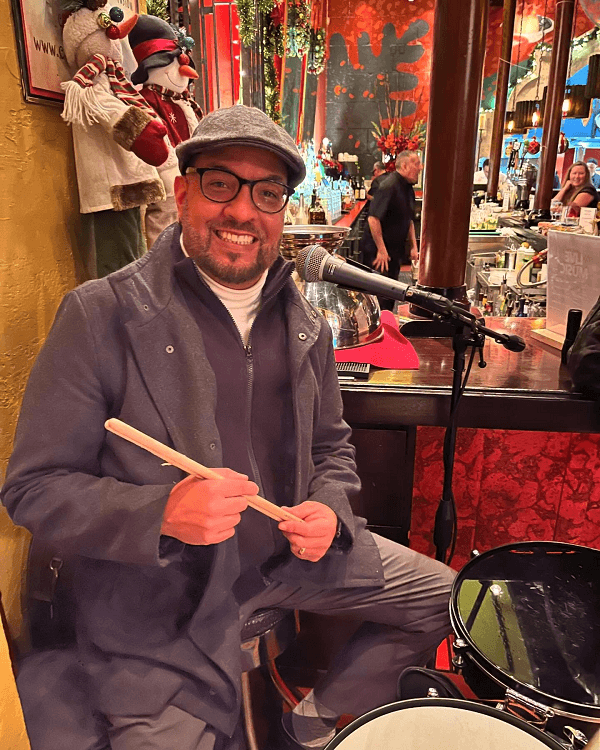
Venezuelan percussionist Omar Ledezma
This is Omar Ledezma Jr., Venezuelan singer, percussionist and music teacher

Omar Ledezma’s beginnings in music and childhood 

Omar Ledezma Jr. was born on February 17, 1972 in Caracas, Venezuela, and was raised in a very close family that gave him a lot of love and care since he was a child. Both the Ledezma and López families were very important in his growth, but it was from the Ledezma’s that he got his musical vein.   

His mother and cousin José Vicente Rodríguez López decided to enroll him in the marching band at the Claret School, where he had his first contact with music by playing the snare drum, an instrument he was first assigned to play. It is also in the band where he started making friends with other teens who were already forming gaitas groups to compete in contests related to this traditional Venezuelan genre.   

When he turned 16, he began to participate in these gaitas inter-school competitions in 1987 and 1988. In 1989, he participated in his first big musical event at the nightclub Mata de Coco. Omar assures that this was the official start of his career in a more professional way. A few years later, going hand-in-hand with his father, he began to take a deeper interest in music as a profession and wanted to experiment with other genres such as Afro-Cuban music and Latin jazz.   

This path led him to join the orchestra La Charanga Clásica led by Mr. Frank Luzón. While playing there, he met several inspiration timbaleros such as Daniel Cádiz (from the Andy Durán Orchestra). 

In parallel with all of the above, Omar was admitted to study in law school at the Santa María University, so he shared his time between his university studies and his professional musical activities. In his spare time outside the university, he played Latin jazz and was formed as a percussionist with his orchestra.   

In 1995, Omar graduated as a lawyer as part of the class ”Honor a Venezuela” ranked in 12th place among his classmates. Although today he is not engage in law at all, he considers that having continued his studies was very important to him as a person because he would have a base on which to stand on in case his plans with music fell through.   

However, the artist never thought about practicing law, since he was very clear that it would be difficult to do so due to the legal situation in Venezuela, so he continued to focus on his great passion, which was music. Besides, after analyzing it, he decided that he did not have a natural talent for that career. 

In parallel, during those years as a law student, he made a trip to Cuba, which he claims changed his life completely. Some friends he made there, when seeing his skills as a musician, told him that he could be studying law, but that his life was and would be music forever.  
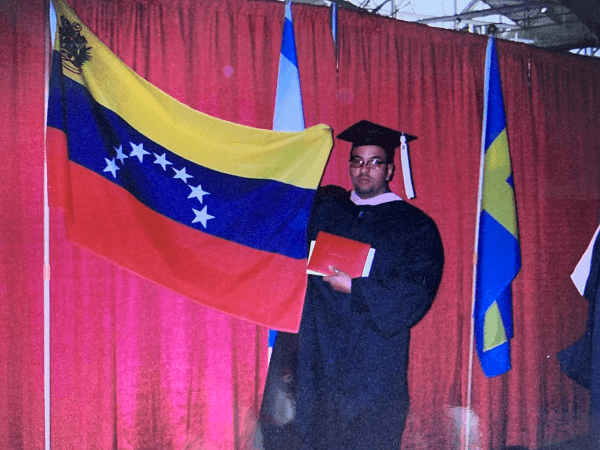
Omar graduating as a lawyer
Omar Ledezma Jr. graduating from Berkee College of Music

The United States and Berklee College of Music 

Just a few years after graduating, specifically in 1998, Omar made the decision to move to the United States looking for new opportunities and describes this trip as an exploring experience because many of his friends, orchestra fellows and acquaintances from the musical environment in general started taking new directions in the mid 90’s. The young man knew he wanted to do the same and chose the city of Boston to settle in at first.   

Although he finally moved to Boston in 1998, already in 1997, his mother gave him the idea of going to the United States with an open ticket so he could decide whether to stay permanently or return. In the end, he opted not to use the return ticket and stayed in Boston to try to enter any music school through a scholarship.   

After checking several options, he chose Berklee College of Music because it was the only college that allowed him to study composition and arranging as hand percussionist, so he auditioned to be admitted and was selected in the fall of 1999. He obtained a 70% scholarship, but he had to work hard to get the remaining 30%. In that sense, Omar assures that the same school helped him to obtain the corresponding permits to work legally in the country and thus be able to pay the percentage that is not covered by the scholarship. 

Omar also told us that it was his friend Gonzalo Grau who helped him do the demo with which he auditioned to enter Berklee and it was a song of his own titled ”Cacao”. Today, he assures that that recording gave him one of the greatest opportunities he has ever had in life, which was to study there. He spent a total of four years studying in that institution and graduated in 2003. 

During his undergraduate studies at Berklee, Omar had the option to study business and intellectual property and his lawyer’s training made it easier for him, but he defines himself as a ”natural born performer” and his life was the stage, so he did not see himself stuck in an office solving cases.   

One of the first jobs Omar had in Los Angeles was replacing the singer from Johnny Polanco’s prestigious orchestra and that one that helped him take that place was Ray Barreto’s flautist, the late Artie Webb. The concert was held at the Mayan.  
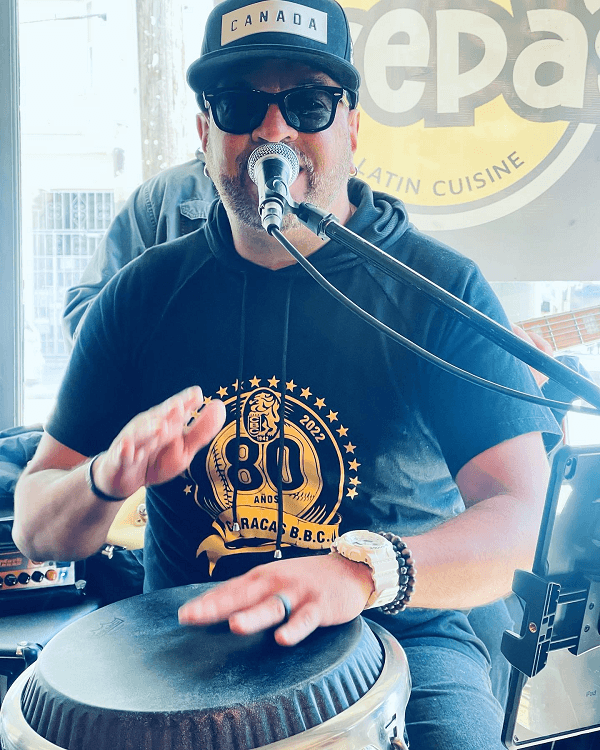
Omar playing the conga
Omar Ledezma Jr. playing the conga in a live performance

Family 

As to the family part, Omar told us that he had married his wife Jennifer Radakovich about seven or eight years ago, but they have no children for the moment. This is because they are still analyzing their opportunities to settle permanently in the state of California, so he assures us that they are still building their future as a couple and as a family. 

Jennifer’s family comes from Serbia and settled in Detroit, Michigan. They had to leave their country, which was then the former Yugoslavia because of the war that went on in the territory at the time. In fact, at a family reunion, his in-laws told him that his wife’s father arrived in the country on the boat anchored in Long Beach, California, The Queen Mary.  

Pacific Mambo Orchestra 

Omar Ledezma started his journey with Pacific Mambo Orquesta practically since its foundation in October 2010, when he started playing at Café Cocomo. Santana’s timbalero Karl Perazzo, who was already included in the lineup of the venue, proposed him to go to this place to play as a percussionist on Monday nights. The problem was that there was no money to pay him for the moment. 

That’s when the directors of Pacific Mambo, Christian Tumalan and Steffen Kuehn, proposed to the owners of Cafe Cocomo to give them some space to have band practice. These Monday meetings ended up being paid rehearsals open to the public in exchange for 10 dollars a night. This lasted some years in which the 20 members of the orchestra were in charge of developing much of the repertoire that has made them famous internationally. 

About this time, Omar said that, on several occasions, he and his orchestra fellows sat down to talk about the continuity of the band owing to the lack of money. The wonderful thing is that everyone always voted in favor of their stay in the group despite the adversities. According to the Venezuelan musician, it was this hunger and desire to succeed that made the orchestra what it is today.   
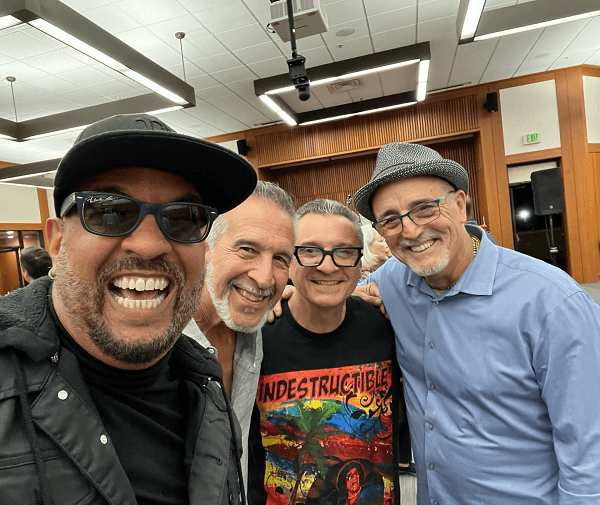
Omar, Eric, Karl, and Edgardo
Omar Ledezma Jr., percussionist Eric Rangel, music producer Karl Perazzo, and bandleader Edgardo Cambon

These efforts worked and Pacific Mambo Orquestra managed to win their first and only Grammy so far in 2014. That year began with the orchestra’s appearance in one of the main banners of the iTunes page for a little over a week, which gave them a lot of popularity at that time and was not common for Latin artists and groups. 

That same year, the group began touring with Tito Puente Jr. in August and were so successful that Omar and five other members of the group decided to begin campaigning for that year’s Grammys via e-mails to all the members of the jury promoting their latest album. Then, on tour, they received the news of their nomination (the second of Omar’s career), but they did not think they would win. 

Much to the surprise of Omar, in January 2014, he received word that Pacific Mambo Orquesta won its first Grammy in the category of Latin Tropical Album of the Year. This event changed the lives of everyone in the group to the extent that large media outlets started looking at them. One of them was world-famous Billboard magazine, which published a piece talking about the band and its talents. 

It is important to stress that, although it was an experience the musician will never forget in his life, he is aware that this is in the past and has to look ahead and focus on his future successes. At this moment, Omar and his companions are focused on making up for time lost during the pandemic and performing all the activities that confinement prevented them from doing. 
Read also: Arranger, composer and pianist Carlos Ordiano 

John Narváez and Elizabeth Rojas from Salsamania

John and Liz from Salsamania  

Between days 23 and 25 March, 2023, the San Francisco Salsa Festival took place, which brought together some of the cream of The Bay Area Latin music scene. One of those attending this great event was the main editor of International Salsa Magazine, Mr. Eduardo Guilarte.   

On site, he had the opportunity to share with other guests and some of the organizers such as Elizabeth Rojas, affectionately known as Liz, and John Narváez. We had the chance to talk with both dance professionals to know more about their beginnings, festivals and projects. Do not miss it!  

John and Elizabeth
Colombian dancers John Narváez and Elizabeth Rojas

Beginnings   

After several attempts to schedule a meeting with John and Liz, we finally managed to talk with these Colombian dancers and entrepreneurs, who began by thanking us for the contact and the opportunity to promote their passion for salsa and the community they represent.   

This love they have for the aforementioned musical genre has much to do with their roots. Both were born in Colombia and left the country when they were 12 years old (they are the same age) because of the violent situation caused by the guerrilla that existed in those years.   

Although those were hard times, John says these were very nice years from which he has fond memories. He remembers almost all his family members singing or playing an instrument, while he was the only dancer. All this influenced him in such a way that Latin music remains his north after so many years.  

Moving to the United States 

Since the social situation did not allow them to live in their country, they decided to move to the United States and apply for political asylum. At the beginning, it was not easy and the focus was on working hard to get ahead in this new country and to learn English. However, all that changed over time. 

With the arrival of economic and family stability, priorities changed. John comments that his interest in music and dance perked back up due to the family gatherings that his relatives celebrated such as birthdays, quinceañeras, weddings, among others. 

Although at the time dancing was not considered a serious profession, both John and Liz began to practice it at amateur level. Once they turned 21, they started going to the most popular salsa clubs, but it was all for recreational purposes. It was years later before they began to analyze all the technical and historical part of dancing to understand it better and take it more seriously.  

John, Liz, and Barbara
John and Liz with Barbara on Despierta América

Dancing as a profession 

John and Liz started to take dancing seriously in 1999. They both attended a three-day salsa event in Los Angeles, but what they did not know is that this was the first world salsa congress in America.   

This gave them the opportunity to share with the best salsa dancers in the world and they saw such impressive things that they were inspired to return next year with a well-established dance team with which they could participate fully in these activities. 

Being full of motivation, they decided to create Salsamania Dance Company and performed with their team at the festival. They started doing the same thing every year, which helped them gain experience and evolve their styles. 

After earning the trust of the festival organizers thanks to their talent and professionalism, they were given the opportunity to start teaching salsa workshops at the aforementioned congress. This is how little by little John and Liz began to build the reputation and credibility they have today.   

 In 2004, it got to a point where John took the important decision to quit his job to devote himself to dancing and Liz was quick to do the same. His resignation came with the opportunity to take a three-month trip to Hong Kong to teach salsa in a community where people did not dance it. 

They managed to build a community from nothing, since at that time, Hong Kong was not a place where people listened to salsa. However, everything went well and the dancers managed to seamlessly connect with the local audience. As John rightly said, ”salsa is a universal language and you don’t have to speak that language to feel the music”. 

On returning to the Bay Area, they began to practice dancing as a profession in the United States. 

On this point, Liz commented that her parents became very upset with her when she quit her job because of dancing, but today, they admit that it was the right decision and support her totally.  

Liz and John dancing
Liz and John during a social dance in Boston

Salsamania Dance Company 

Liz told us that it was difficult to create Salsamania Dance Company because it requires a lot of discipline and healthy coexistance between different types of personalities to create a group like this and keep it together. Fortunately, John is an industrial psychologist, so he helped to prevent these aspects to be a problem. 

Basically, Liz is responsible for the company’s management and John is the one who takes care of the human part of all the staff. 

They started the whole process like any regular company and drew up the contracts for all those who were going to work with them, making Salsamania a much more established, structured and serious project in the eyes of everyone else. Today, it is one of the largest companies in the Bay Area.   

They also took it a step further and built a salsa academic program with a thoroughness and detail that has not been seen in other projects of this kind.   

San Francisco Salsa Festival  

San Francisco Salsa Festival is one of the biggest salsa events in California and the United States in general and we were fortunate to have representation there with our editor Eduardo Guilarte.  

It began to be celebrated in 2008 with the support of international salsa promoter Albert Torres, who was a fundamental piece in the development of the festival and talent recruitment for an event of this size, as there were many things John and Liz had to learn. That is why they are both incredibly grateful for what the congress organizer did for them back then.  

To recruit artists, the dancers only require candidates to be good teachers, to share with the salsa community and to put on a good show for the audience. 

They also often invite colleagues they have known for years and some recommended to whom they give them the opportunity to shine and make themselves known during those days. 

Every year, they look for dancers, dance instructors, DJs and live orchestras. For Liz and John, the thing about live bands is very important, as they are concerned that there are so many clubs and venues that no longer hire these talents. This year, they focused on local bands that play on Thursdays and Fridays in San Francisco and were very happy with the results.  

It is expected that the next San Francisco Salsa Festival is scheduled between days 22 and 24 March, 2024 at the same venue, which is the Marriott Waterfront Hotel.   

The orchestras hired to perform for next year are Cabanijazz, The Latin Rhythm Boys and Orquesta Boyacán. The dancing couples are Alex and Judy from Colombia, Colombians Felipe from Colombia and Kathe and Mauricio and Danny from Mexico.   

John, Liz, and Oscar D’ León
John and Liz with Venezuelan singer Oscar D’ León

Difficulties in the pandemic 

As dancing is an activity with a lot of physical contact and closeness, we were curious to know how they lived the pandemic and what they did to keep their project afloat in this situation. 

Though they admit that those months were not easy, they have always been very disciplined with their money and had enough to resist as long as possible without working.   

They tried to make up for lost time by teaching classes via Zoom as did most of their colleagues and designing new choreographies to apply when they went back to their usual activities. 

In addition to this, both had not spent time with their respective families in a long time, so they also took advantage of the absence of work to reunite with their loved ones and take up those important contacts that were lost due to stress and routine. 

Read also: Here we have Salseros With Attitude 

Luis Medina as a master of ceremonies, broadcaster, DJ and much more

Incredible conversation with Luis Medina

Luis Medina on the radio
This is Luis Medina on the radio

Good afternoon, everyone. We are here with broadcaster, DJ and event producer Luis Medina. Mr. Medina, how are you today?  

I am well and ready to talk to you right now.

Mr. Medina, you have a very long career as a radio presenter. You got started in this business in 1974. What led you to spend so much time in your career on the radio? 

In 1971 I was studying architecture at San Francisco State University, but in 1974 I changed my major to broadcasting and communications in the Department of Radio and Television. When I was a kid, I was always fascinated by broadcasters on TV with their microphones. My parents gave me a toy microphone, and I always imagined I was broadcasting. At the time I was accepted in the broadcasting program, I already loved salsa because my cousin  Stella played popular music for me since I was about 8 years old. I loved all kinds of music. At home, we always had the radio on, and my parents always listened to tropical music, which was very common at that time.

In 1974 my cousin Eduardo invited me to go to a radio station called KBRG to visit some friends who had a program called Venezuela Suya. In another studio in the station, there was a radio producer named Arturito Santiago, who was the master of ceremonies for the Gran Combo de Puerto Rico when they did dances in San Francisco hotels. When I saw him doing his job, I was intrigued. Two months later, my cousin called to tell me that he’d gotten involved in a community radio station called KPOO San Francisco and asked me if I wanted to help him with the show. I brought a stack of LPs, and we did the show from midnight until 6 am. I went a few times to help, but I could not maintain that pace because I was still in college.

A few months later, he called me to tell me that he had a show from 3pm to 6pm on Sundays. He told me he was talking to other people I knew in order to do the show together. I got a segment of 45 minutes to an hour to do whatever I wanted, so I decided to start programming salsa. I helped produce several programs until I had my own show. In 1979, while I had a four-hour show on Saturdays on KPOO, KBRG’s program director, Al Carlos Hernandez, called me. KBRG was a powerful FM station at that time. That gave me the opportunity to do a commercial show.

DJ Luis Medina
Broadcaster Luis Medina with two maracas

I am part Venezuelan and part Mexican, but I grew up in the United States. I spoke Spanish perfectly until I was five years old, but when I started school, I just wanted to speak English in school and at home. When I turned 18, I decided to get my culture back and relearn to speak Spanish again. However, I’m wasn’t completely fluent in Spanish because I have to translate mentally from English. I explained the situation to Al Carlos, and he told me that he did not care. That’s how I became the first radio announcer to do salsa programming in English on a Spanish-speaking station. The program was called Sabor Caliente and it lasted about a year and a half, until they let me go due to philosophical differences. After that, I did specials in KPFA, until Víctor Castro, who produced the program Ahora, invited me to alternate weeks with him. I produced salsa shows on KPFA from 1983 to 1995.

What Medina has to say about all his combined activities

How do you balance your radio activities and event production and your job as a DJ?  

When I was a student at San Francisco State University, I became co-director of the university’s productions to present musical acts. From 1974 to 1976 I presented acts from various genres such as rock, R&B, and jazz, among others. I also presented some salsa and Latin jazz shows, including Pete and Sheila Escovedo, who were part of Roger Glenn’s band, Benny Velarde and others. I became friends with Pete and Sheila before Sheila became Sheila E and I also worked with Pete’s brother, Coke Escovedo in the 70s.

Then I met Roberto Hernandez, who had an organization that helped produced the first major street fairs in the San Francisco Mission district together with a coalition of community agencies. I got involved with the fairs, which presented the famous singer Joe Bataan among others. It was the era of Latin rock, but salsa was also booming. I was part of the renaissance of salsa music that occurred on the radio, but I also had the opportunity to play an influential role in the community in the Mission. In 1977, the Mission Cultural Center opened in a furniture store ran by artists that were organizing it. I became part of the music committee and we presented performances and salsa groups that were growing in fame at that time. I was involved on the activities of the center until the 1980s, when some of us created a production group called CMP (Cultural Music Productions). During the 80s we did a series of dances, in which I worked as master of ceremonies. I already had experience as master of ceremonies because when I was at KBRG, they gave me the opportunity to introduce some great shows with Celia Cruz, La Sonora Matancera, Oscar D’ León, Cal Tjader and La Orquesta Broadway. I was also master of ceremonies for Brazilian carnivals for about five years. With CMP I was involved in dances with Willie Colón, Bobby Valentín, Oscar D’ León, and boxing champion Roberto Durán (who at the time wanted to be a salsa singer).

Eventually I left CMP, and I was contacted by Roberto Hernandez, who offered me the position of entertainment director of his new organization, MECA. I accepted and started to help him program the schedule for events such as the San Francisco Carnival, and the 24 Street Fair. I worked with Roberto until 1994 and we presented Santana, Los Lobos, Eddie Palmieri, Luis Henrique, Willie Colón, Yomo Toro, Mighty Sparrow, The Neville Brothers, Shaggy, and many more. When Roberto Hernandez left the organization, I stayed for four more years and worked with Manny Oquendo and Libre, John Santos, Pete Escovedo and Pancho Quinto. In 1998, the president of the organization Patricia Aguayo and I had some problems, so we stopped working together.

A radio DJ and a party DJ are two completely different things. It took me a little while to adjust to being a live DJ. In the early 1990’s, the producers at the Alta Vista club hired me from time to time. Then, they moved to a ship called Alta Vista del Mar in Pier 3, and occasionally hired me as their DJ.

Event producir Luis Medina
Event producer Luis Medina posing for or the camera

In 1994 I met a very ambitious young Venezuelan by the name of Adrian Goddard and started working with him at his club, 330 Ritch. It was a winning combination of Adrian’s talent as an event producer and my talent as a DJ and MC. I worked there for about nine very successful months, but then I had an opportunity with KPFA and I was forced to leave the club because the schedule conflicted. My priority was to produce my own salsa show (ironically, this program didn’t last long, but in 1997 they offered me the same slot, which would become the program Con Sabor, which I still produced today, 25 years later, at KPFA, on Saturdays from 9-11pm.)

A little later, Kimballs Carnaval hired me as a Latin House DJ, as this rhythm was very popular at that time. I wanted to please them, but it wasn’t a good fit. Eventually I was hired as a salsa DJ by the club Kimballs West. This opened other opportunities and I became the DJ in residence at the most prominent salsa clubs in San Francisco at the time, the legendary Jelly’s Cafe, where I DJ’d until it closed in 2010 and the popular Café Cócomo, which closed in 2014. I now DJ and MC primarily for special events and private parties.

Something very important in my story is that in 1997 I worked with Bill Martinez and Arturo Riera  and they both gave me the opportunity to be master of ceremonies for a very important series of concerts featuring Cuban musicians who were allowed into the States for the first time. I was the first master of ceremonies for a Los Van Van concert in San Francisco and I also represented my show and KPFA for their concert at Stern Grove in 2019. That was one of many times that I worked with that group.  I also was the MC   for Orquesta Aragon, Cubanismo, NG La Banda and other Cuban acts.

During the pandemic, I was offered a show with an online radio station called World Salsa Radio. I started the show Sabiduría con Tumbao on Wednesdays from 5 to 7 pm. What makes this show different from Con Sabor is that Sabiduría Con Tumbao is a conceptual program that focuses on certain musicians, musical themes and movements within salsa and Afro-Latin music. On the other hand, Con Sabor offers a broader perspective of salsa, Latin Jazz and música cubana from the classics to the latest.

Since the pandemic started, I produce all my radio shows at home. I managed to master the technology and built my own home studio. I am not afraid of technology or modern things. I go with the flow because I’ve learned that I should be at the forefront of technology and music. If I do not know something, I am going to research it right away. I keep an open mind and ears and I appreciate and listen to all kinds of music, something that was key when I was music director at KPFA from 2001 through 2014. In terms of my own programs, I really love salsa from the 70s, but I’m not stuck in any time period.

Eduardo and Luis
Our editor Eduardo Guilarte and Luis Medina


Orquesta La Moderna Tradición frontman Tregar Otton talked to us

What Orquesta La Moderna Tradición is

Tregar Otton playing
Tregar Otton, founder of the orchestra, playing the violin

Orquesta La Moderna Tradición has been one of the most legendary groups of Cuban music in its entire history. It is a group whose members are based in San Francisco, California, and consists of 11 members who play different genres such as danzón, timba, guaguancó, cha cha chá, son, rumba, charanga, among others. They also mix in elements from American jazz, violins, and Afro-Cuban rhythms.    

The beginning of this orchestra’s story goes back to 1996, since they started to perform throughout the United States to bring the best of traditional Cuban music to every corner of the country and transport Cuban immigrants back to the Havana’s streets and clubs during the 50’s. All the success accumulated allowed them to perform at the San Francisco Jazz Festival, the Smithsonian Institution, the Lincoln Certer and many other venues of high prestige.    

Recently, Orquesta La Moderna Tradición once again displayed their talent at Yoshi’s, a jazz club and restaurant located in Oakland, California, whose reputation in the San Francisco Bay Area is not up for discussion. Our editor Eduardo Guilarte was present at the show to cover the details of the event, which left all those present in awe.  

Conversation with Tregar Otton, founding director of the orchestra 

Tregar Otton and Maru Pérez
Tregar Otton and Maru Pérez-Viana, his wife and an important part of the orchestra

Based on the above, we talked with Tregar Otton, founder, director, composer, and violinist of the group. This talented musician, born in the Marshall Islands and raised in Texas, started to learn about classical music from an early age and joined the Berkeley Symphony while he still was a teenager. By the 1990s, this musical promise worked as a regular part of Virgilio Mart Y Sus Majaderos, La Tipica Novel and the Charanga Orquesta Broadway. 

By the year 1995, Otton founded Orquesta La Moderna Tradición with Roberto Borrell. At the beginning, the group started to become well-known for its soft sounds of Afro-Cuban charanga, which are accompanied by a set of wind instruments and violins that give a unique touch to this group’s music. 

Today, we have the welcome presence of the musician to talk about each and every one of the issues raised in this brief review and anything he wants to reveal to our dear readers. It is such a pleasure to have you here today, Tregar. How are you feeling?  

I am fine here near San Francisco. Good to see you today.

Very good, Tregar. You got started in the world of music at a young age. Could you tell us a bit about your beginnings? 

I started playing violin when I was four years old and my family had a violin teacher as a neighbor. My parents did the laundry for all our neighbors, so we met her and she ended up giving me classes every day. After that, I studied a lot of classical music, bought music when I was about 20 and fell in love with it because it used the violins differently from classical music. I really enjoyed playing dance music because the connection with the public is quite different from that of classical music. In the case of classical music, many people get bored, but Cuban music and salsa music make a much more direct connection to the audience. There is nothing like playing for a floor with dancers. 

We understand that you were born in the Marshall Islands, but grew up in Texas, is that correct? 

Yes. After my dad married my mom, they both moved to Micronesia, the Marshall Islands, in the middle of the Pacific. After that, I grew up in Corpus Christi, Texas, till I was 13 or 14 about when I moved to California.   

I asked because it is very interesting how you set your eyes on Cuban music despite your origins. Where does this interest in Cuban music and the rhythms you play come from? 

For the same reasons I play dance music. It caught my attention when I heard Charanga de La 4 or one of these New York bands. I was impressed that violins were part of the percussion and were making repetitive sounds with the refrain and the son montuno. We are more part of the rhythm section than the melodic section in many of our songs. We can dance while we are on stage. I was also impressed by the improvisations of Cuqui and Alfredo de la Fé. I had many Latin friends I met in college while learning Spanish because no one in my family spoke it. 

How did Orquesta La Moderna Tradición come about and who joined you in its foundation? 

I was working with a group. I was in New York, where I was playing with the Broadway Orchestra and the Orquesta Tipica Novel. I was very lucky to have been in that city because I got to know many veteran musicians in the 80’s like Renato Valdés, Virgilio Martí, and Adalberto Santiago. I visited a Cuban friend from San Francisco named Fito Reinoso, who had a group called Ritmo Y Armonía and he visited us here in New York. I was tired of the cold in New York, so I decided to go to San Francisco, where Tito and I had the idea of creating a group. It was there that I met a great drum instructor and dance teacher Roberto Borrell, who joined us to found Ritmo y Armonía. After two years, we had to be apart, but Roberto and I still wanted to play danzón. At least here in the Bay Area, it is very difficult to get singers. The ones we have are good, but there are not so many. So, we planned to make a danzonera or danzón group. When the orchestra began to work, we only played danzón songs, rehearsed every week and did many tours with this musical genre because there was a boom with swing dancing and dance music during the 40’s. So, we were surfing that wave. So, we were surfing that wave and doing collaborations with swing groups because it was older music. Danzón is a very rich genre, but it is no of interest to many people because they do not know how to dance it, so we started expanding our repertoire to include more modern and dance music. We still play danzones, but only two per set. There are still musicians from the original group in the orchestra including Michael Spiro. Roberto went to Peru about a decade ago, so Michael and I stayed with the group and invited Eduardo Herrera, who is a singer born in Caracas, Venezuela, to perform with us. We expanded the repertoire by doing the best we could with my own creations. Let’s remember I am the arranger of the group, so I do some songs and we have one that is included in the new recording in which I wrote the music and maestro Carlos Caro from Cuba added the lyrics. 

Orquesta La Moderna Tradición performing
Orquesta La moderna Tradición at one of its shows

Although rhythms like danzón are not so popular, did you feel the acceptance of the public? 

There were many people who knew danzón who began to notice that it was a very interesting genre due to the presence of the violins. As Roberto Borrell is a dance teacher, he teaches many of his students how to dance danzón, which is not easy because they should be affixed on each turn they have to make according to the sounds of the instruments.   

Can you go from one genre to another in the same song? 

Yes, we do that a lot. On our new album, we have rhythms with batá drums from music of Santería, which we use for our danzón songs. It sounds complicated when I explain it, but it is easy at the time of listening to it. 

What makes Orquesta La Moderna Tradición different from other Latin music groups in the United States? 

Well, I know no other group that plays danzón or charanga. There are two genres of popular dance music in Cuba that come from son montuno, which uses violins and flutes. In the case of charanga, the musicians use violins and flutes. Since the 70’s and 80’s, charanga is now no longer heard in the United States. In Cuba, neither do you hear danzón much. We are a group that has so many danzones in the repertoire. There are not too many groups that play cha cha chá. Me being an arranger, I try to create cha cha chá songs that are not copies of what was played by Orquesta Aragón and other bands in the 40’s and 50’s.   

Given that music has evolved so much, what reaction do you perceive from the young public when you play charanga, cha cha chá, danzón and other rhythms? 

Interesting question. For young people who do not know and are not salsa fans, our music sounds like salsa because it is difficult to distinguish the genres without knowing them well. However, I work as a music teacher and I have many groups of children, in which there are many salsa fans. They listen to Ray Barreto, Willie Colón, and Hector Lavoe. They also like charanga and understand it well. However, I think danzón is more difficult because it has to be a reflection of what people are feeling in their culture. Cha cha chá is simpler and innocent, but danzón is finer and refined. I think music can influence people and play its part in changing the direction of their culture. 

Can you tell us a little bit about your performance at Yoshi’s? 

Because of COVID-19, for a year and a half, we could not do anything. We could not even rehearse until the vaccine came on the market. We got this date with Yoshi’s because we have played there many times before as well as Yoshi’s in San Francisco. So, they gave us a date and we had the support of local DJs like Luis Medina, Chuy Varela and Jose Ruiz. We also made use of social media to promote us, sell our CDs and attract people to our shows. The staff of Yoshi’s was impressed because it is rare that a local band has been able to sell so many tickets. We were very excited to see so many people loving us and showing how much they love music. We have a large audience that is very loyal to us and has been going wherever we perform for over 20 years.  

Orquesta La Moderna Tradición at Yoshi's
Orquesta La Moderna Tradición performing at Yoshi’s

What are your future projects? 

We get everything ready for the repertoire of the new album. When I was in New York, I was working with Juan Carlos Formell, Juan Formell’s son, who is the bass player and took over his father’s position in Los Van Van. I was one of the first people he met here in the United States and we became very good friends. Then he told me that I could arrange any of his songs without any problem, so I have about four or five of his songs ready and some others that I have not finished yet. We have enough material to make at least two albums, but it is very expensive. One could only cost us about $15 to start with. 

cover art work for the new album El Encantado
Cover art work for the Orquesta La Moderna Tradición new album El Encantado

Your social networks or websites  

Official website: www.danzon.com  

Facebook: https://www.facebook.com/OrquestaLaModernaTradicion  

Bandcamp: https://orquestalamodernatradicin.bandcamp.com/album/encantado-2 

The man who conquered Hollywood

The magic of a great musician is that he has the key to open your soul.  He takes you to a dimension full of happy emotions, you forget all your pain and troubles and you just dance!  For the Yoruba’s, one of the sons of Obatala, is Changó. He represents strength, virility, drums, music, fire, lightning, dance, justice, the need and joy for living.  If one person was all of that, it was Mr. Johnny Polanco.  Mr. Polanco is dearly remembered by all those whose life he touched.  This June 2nd marks the sixth year of his passing.   Altagracia and Socrates, from Puerto Rico and Santo Domingo were his parents.  They lived in the Bronx in New York.  Socrates was the owner of an auto mechanic shop.  This is probably where Johnny first came into contact with automobile engines.  He developed a passion for working with automobile engines.  Johnny graduated from Alfred E. Smith High School; a school reputed for teaching shops.  It’s very probable that he furthered his knowledge of engines there. His talent grew to engineering levels.  If anyone could fix a problem on an engine, it was Johnny.  All the musicians knew that if there was a problem, it was Johnny who could fix it for them. There’s a story about how DJ Robbie called Johnny at home one such time at around 3:00 am and Johnny got out of bed and went to his aid.   His other passion was music.  Johnny never attended music school.  He mastered a number of instruments, all on his own. Everyone says that around five years of age, he was given a guitar.  But it wasn’t until the age of ten, that he became serious in learning music.  At the age of fourteen, he was already playing with the Steve Colon band. He played with a number of New York groups, Charanga Sensual, Conjunto Saoco to name a few. Johnny had flat feet, but nonetheless in 1979 he enlisted in the United States Marine Corp.  The Marine Corps capitalized on his knowledge of engines and assigned him to the motor pool. His early assignments were in Camp Lejeune, North Carolina, Parris Island, South Carolina, and Okinawa, Japan. Johnny was a patriotic American who loved and served his country.  Just before enlisting in the service at twenty-four, Marion Gonzalez gave birth to Christopher and three years later to Melody.  In 1980 the marines sent Johnny to the west coast, Camp Pendleton, California. Marion and Johnny married, but their union did not survive. Marion and Johnny had joint custody. Johnny’s visitation turn was usually from Fridays after school to Monday morning, returning them to school.  In 1984 Johnny was playing at the New Porter Inn, in Newport Beach, California.  That night he met Joanna, a lady from Bronx.  They say it was love at first sight.  On January 23, 1987 they married and she remained his companion for the rest of Johnny’s life.  Joanna worked as a Registered Nurse and had two children of her own, Angela and Anthony Wheaton.  They made their home in Lakewood, California, where they had all their four children together on the weekends.  They were fortunate, because the kids all got along well. Some called them the Brady Bunch.

Johnny Polanco and Conjunto Amistad
Johnny Polanco and the rest of the members of Conjunto Amistad.

The long full gear marches and Johnny’s flat feet became a problem. In 1987, with the rank of E-5 sergeant, Johnny decided to be a full-time musician and separated from the Marines.  Close to their Lakewood home Johnny took a daytime job working for Mr. Tom Scott a Union 76 service station owner. Johnny stayed with Tom for next six years, when Tom sold in 1992.  The job was conveniently within walking distance of his Lakewood home.

In this gas station Johnny Polanco worked many years
Union 76 gas station where Johnny Polanco worked for many years.

In Hollywood, there was a Vietnam disabled veteran who had been studying business, Armando Castro.  Completing his studies, Armando opened a small restaurant. Although of Nicaraguan origin, Armando decided to serve Cuban food and named the restaurant El Floridita. On Monday nights they started to play Salsa.  Cali Aleman was the first band that played.

Armando Castro Floridita owner
Armando Castro owner of El Floridita

In 1993 Orquesta Versatil was playing on Monday nights. It was then that Armando Castro introduced Johnny to the band leader, Carlos Navarro.  At the time Versatil was a popular, strong, well liked band and Johnny fitted right in.  Then things started to happen, the band leader Carlos had to fly to Venezuela, also the arranger Niño Jesus Alejandro went to Canada. So, they held a meeting with Armando.  “mete mano Johnny, put a band together and take over.”  For the next 22 years Johnny played Monday night with his Conjunto Amistad at El Floridita.   Johnny’s band was in demand.

Carlos Navarro leader of Orquesta Versatil
Carlos Navarro band leader of Orquesta Versatil.

Albert Torres was a consultant and MC to over 50 yearly Salsa Congress’ around the world.  Albert had a lot of connections and started to manage Johnny for some 15 years.  With Albert’s connections the band played in Japan, England, Italy, Spain, China, Thailand, Mexico, Costa Rica to name a few.  Everyone was busy with little time to spare, eventually Johnny started handling his own bookings and the relationship with Albert just disappeared.

Albert Torres manager of Johnny Polanco
Albert Torres managed Johnny Polanco for 15 years.

In business they always say location, location, location! Nothing could be truer than that for “El Floridita.”  You see folks, this little restaurant in a small strip mall, is just across the street from … Pickford Center.  What’s Pickford Center? It’s the film industry Academy of Arts.  You know the “Oscars!”  The clientele boasted of directors, writers, producers, actors like Patrick Swayze, Jay Leno, Jennifer Lopez, Nicole Kidman, Robert Duvall, Mick Jagger, Edward Olmos to name a few.  They didn’t just go there to eat; it was the film industry’s connection to Salsa and the work just poured in.  Johnny played for Hugh Heffner at the Playboy mansion and also the Playboy Jazz Festival. Prince chose Johnny to be his opening act in Las Vegas.  Johnny did the music for countless films (see bio).    When a victorious general was paraded in Rome, above his head, a slave would hold the laurel reave, while at the same time continuously whispering “this too shall pass.” The idea was to keep him grounded. Johnny didn’t need that.  He was a man who saw the injustice in the world and was always looking out for the little guy, the underdog.  He was a man who shared the wealth.  Many remember how Johnny would call them to give their bands work.  To this day many a story is told about how Johnny helped them out.  He was a man who in his car, would carry cat food and milk to feed the strays.  May God bless you in heaven Johnny.  We remember you as a kind man who loved and cared for the poor.   His accomplishments were so many that we created a link for you to view the photos and also his biography of recognitions and accomplishments.

Changó

The magic of a great musician is that he has the key to open your soul.  He takes you to a dimension full of happy emotions, you forget all your pain and troubles and you just dance!  For the Yoruba’s, one of the sons of Obatala, is Changó. He represents strength, virility, drums, music, fire, lightning, dance, justice, the need and joy for living.  If one person was all of that, it was Mr. Johnny Polanco.  Mr. Polanco is dearly remembered by all those whose life he touched.  This June 2nd marks the sixth year of his passing.  Altagracia and Socrates, from Puerto Rico and Santo Domingo were his parents.  They lived in the Bronx in New York.  Socrates was the owner of an auto mechanic shop.  This is probably where Johnny first came into contact with automobile engines.  He developed a passion for working with automobile engines.  Johnny graduated from Alfred E. Smith High School; a school reputed for teaching shops.  It’s very probable that he furthered his knowledge of engines there. His talent grew to engineering levels.  If anyone could fix a problem on an engine, it was Johnny.  All the musicians knew that if there was a problem, it was Johnny who could fix it for them. There’s a story about how DJ Robbie called Johnny at home one such time at around 3:00 am and Johnny got out of bed and went to his aid.
His other passion was music.  Johnny never attended music school.  He mastered a number of instruments, all on his own. Everyone says that around five years of age, he was given a guitar.  But it wasn’t until the age of ten, that he became serious in learning music.  At the age of fourteen, he was already playing with the Steve Colon band. He played with a number of New York groups, Charanga Sensual, Conjunto Saoco to name a few.
Johnny had flat feet, but nonetheless in 1979 he enlisted in the United States Marine Corp.  The Marine Corps capitalized on his knowledge of engines and assigned him to the motor pool. His early assignments were in Camp Lejeune, North Carolina, Parris Island, South Carolina, and Okinawa, Japan. Johnny was a patriotic American who loved and served his country.  Just before enlisting in the service at twenty-four, Marion Gonzalez gave birth to Christopher and three years later to Melody.  In 1980 the marines sent Johnny to the west coast, Camp Pendleton, California. Marion and Johnny married, but their union did not survive. Marion and Johnny had joint custody. Johnny’s visitation turn was usually from Fridays after school to Monday morning, returning them to school.
In 1984 Johnny was playing at the New Porter Inn, in Newport Beach, California.  That night he met Joanna, a lady from Bronx.  They say it was love at first sight.  On January 23, 1987 they married and she remained his companion for the rest of Johnny’s life.  Joanna worked as a Registered Nurse and had two children of her own, Angela and Anthony Wheaton.  They made their home in Lakewood, California, where they had all their four children together on the weekends.  They were fortunate, because the kids all got along well. Some called them the Brady Bunch.

The long full gear marches and Johnny’s flat feet became a problem. In 1987, with the rank of E-5 sergeant, Johnny decided to be a full-time musician and separated from the Marines.  Close to their Lakewood home Johnny took a daytime job working for Mr. Tom Scott a Union 76 service station owner. Johnny stayed with Tom for next six years, when Tom sold in 1992.  The job was conveniently within walking distance of his Lakewood home.

In Hollywood, there was a Vietnam disabled veteran who had been studying business, Armando Castro.  Completing his studies, Armando opened a small restaurant. Although of Nicaraguan origin, Armando decided to serve Cuban food and named the restaurant El Floridita. On Monday nights they started to play Salsa.  Cali Aleman was the first band that played.

In 1993 Orquesta Versatil was playing on Monday nights. It was then that Armando Castro introduced Johnny to the band leader, Carlos Navarro.  At the time Versatil was a popular, strong, well liked band and Johnny fitted right in.  Then things started to happen, the band leader Carlos had to fly to Venezuela, also the arranger Niño Jesus Alejandro went to Canada. So, they held a meeting with Armando.  “mete mano Johnny, put a band together and take over.”  For the next 22 years Johnny played Monday night with his Conjunto Amistad at El Floridita.   Johnny’s band was in demand.

Albert Torres was a consultant and MC to over 50 yearly Salsa Congress’ around the world.  Albert had a lot of connections and started to manage Johnny for some 15 years.  With Albert’s connections the band played in Japan, England, Italy, Spain, China, Thailand, Mexico, Costa Rica to name a few.  Everyone was busy with little time to spare, eventually Johnny started handling his own bookings and the relationship with Albert just disappeared.

In business they always say location, location, location! Nothing could be truer than that for “El Floridita.”  You see folks, this little restaurant in a small strip mall, is just across the street from … Pickford Center.  What’s Pickford Center? It’s the film industry Academy of Arts.  You know the “Oscars!”  The clientele boasted of directors, writers, producers, actors like Patrick Swayze, Jay Leno, Jennifer Lopez, Nicole Kidman, Robert Duvall, Mick Jagger, Edward Olmos to name a few.  They didn’t just go there to eat; it was the film industry’s connection to Salsa and the work just poured in.  Johnny played for Hugh Heffner at the Playboy mansion and also the Playboy Jazz Festival. Prince chose Johnny to be his opening act in Las Vegas.  Johnny did the music for countless films (see bio).
When a victorious general was paraded in Rome, above his head, a slave would hold the laurel reave, while at the same time continuously whispering “this too shall pass.” The idea was to keep him grounded. Johnny didn’t need that.  He was a man who saw the injustice in the world and was always looking out for the little guy, the underdog.  He was a man who shared the wealth.  Many remember how Johnny would call them to give their bands work.  To this day many a story is told about how Johnny helped them out.  He was a man who in his car, would carry cat food and milk to feed the strays.  May God bless you in heaven Johnny.  We remember you as a kind man who loved and cared for the poor.
His accomplishments were so many that we created a link for you to view the photos and also his biography of recognitions and accomplishments.

Film Academy of Arts Center
Pickford Center in front of El Floridita.

By: Eduardo Guilarte & Karina Garcia

Home

  • « Go to Previous Page
  • Page 1
  • Page 2
  • Page 3
  • Page 4
  • Go to Next Page »

International Salsa Magazine (ISM) is a monthly publication covering salsa activities around the world and has been publishing since 2007. It is a worldwide network of volunteers coordinated by ISM Magazine. Together, we work to strengthen salsa events around the world.