• Skip to primary navigation
  • Skip to main content

International Salsa Magazine

  • HOME
  • Previous editions
    • 2026
      • ISM / April 2026
      • ISM / March 2026
      • ISM / February 2026
      • ISM / January 2026
    • 2025
      • ISM / December 2025
      • ISM / November 2025
      • ISM / October 2025
      • ISM / September 2025
      • ISM / August 2025
      • ISM / July 2025
      • ISM / June 2025
      • ISM / May2025
      • ISM / April 2025
      • ISM / March 2025
      • ISM / February 2025
      • ISM / January 2025
    • 2024
      • ISM / December 2024
      • ISM / November 2024
      • ISM / October 2024
      • ISM / September 2024
      • ISM / August 2024
      • ISM / July 2024
      • ISM / June 2024
      • ISM / May 2024
      • ISM / April 2024
      • ISM / March 2024
      • ISM / February 2024
      • ISM / January 2024
    • 2023
      • ISM / December 2023
      • ISM / November 2023
      • ISM / October 2023
      • ISM – September 2023
      • ISM – August 2023
      • ISM July 2023
      • ISM Edition June 2023
      • ISM – May 2023
      • ISM April 2023
      • ISM March 2023
      • ISM February 2023
      • ISM January 2023
    • 2022
      • ISM December 2022
      • ISM November 2022
      • ISM October 2022
      • ISM September 2022
      • ISM August 2022
      • ISM July 2022
      • ISM June 2022
      • ISM May 2022
      • ISM February 2022
      • ISM January 2022
    • 2021
      • ISM December 2021
      • ISM November 2021
      • ISM October – 2021
      • ISM September 2021
      • ISM August 2021
      • ISM July 2021
      • ISM May 2021
      • ISM April 2021
      • ISM June 2021
      • ISM March 2021
      • ISM February 2021
      • ISM January 2021
    • 2020
      • ISM December 2020
      • ISM November 2020
      • ISM October 2020
      • ISM September 2020
      • ISM August 2020
      • ISM July 2020
      • ISM June 2020
      • ISM May 2020
      • ISM April 2020
      • ISM March 2020
      • ISM February 2020
      • ISM January 2020
    • 2019
      • ISM December 2019
      • ISM November 2019
      • ISM October 2019
      • ISM Septembre 2019
      • ISM August 2019
      • ISM July 2019
      • ISM June 2019
    • 2016
      • ISM December 2016
  • Spanish
  • Download Salsa App
    • Android
    • Apple

Search Results for: Dancing

This is Roger Danilo Páiz Pérez from Danilo Y Su Orquesta Universal

Why is he called Danilo?

We will start a conversation with bandleader, percussionist, and singer Roger Danilo Páiz Pérez. Pleased to meet you, how are you doing?

I’m fine thanks, Karina. Sitting here and ready to be interviewed by your magazine. I have a lot of information about what has happened in my life being a musician here in the Bay Area since the 70’s.
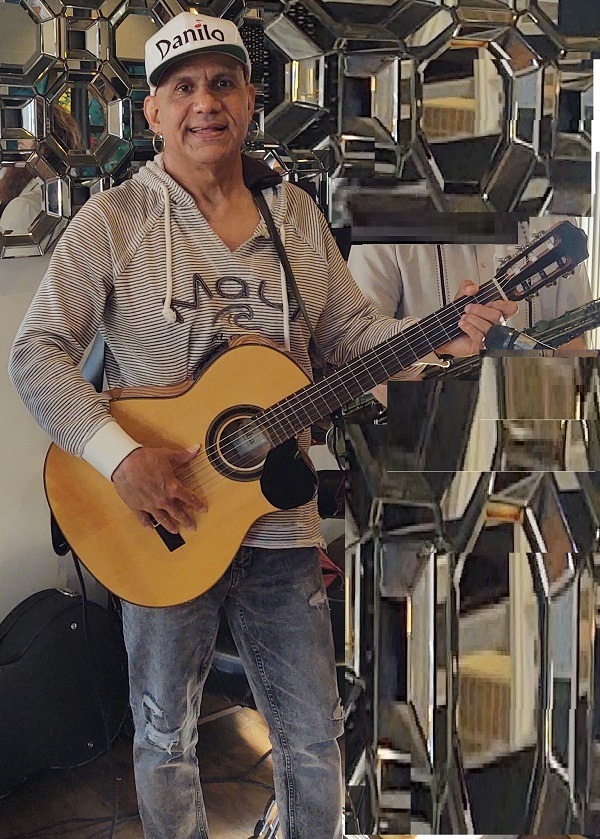
Danilo on guitar at one of his frequent restaurant performances

You are Francisco Pancho Perez’s grandson. Did your grandfather serve as inspiration for the path you would take in music?

Definitely he did. I remember being about four or five years old when I used to hear my grandfather play with his big band, which was composed of 15 or 14 musicians. I always listened to them practicing in our house and started dancing, so my grandfather used to call me cha cha chá. It was a great inspiration for me.

He played music similar to American jazz, and that’s where the inspiration for the music I play today comes from. The salsa that I write is inspired precisely by that kind of jazz.

Where does the name Danilo come from? Also, why is your orchestra called Danilo Y Su Orquesta Universal?

I have to make it clear that Danilo is my middle name since I was born. This is not a nickname as many believe. Some people even think that I have changed my name, but I didn’t. Roger Danilo Páiz Perez has always been my name.

Everyone called me Roger Páiz in the past, that is to say, people called me by my first and last name. In fact, when I played with Rubén Blades in 1989, the album we recorded has me in the credits as Roger Páiz. But when I founded my own orchestra in the 1990s, I thought Danilo was better suited to Latin music, so I started using my middle name to call my orchestra Danilo Y Su Orquesta Universal.

The word universal comes from the fact that I am a Buddhist. I practice the religion of Nichiren Daishonin (monk in Buddhism from Japan in the 13th century and founder of the branch of Nichiren Buddhism) for more than 30 years. That word is widely used in the Buddhist scriptures, and I am very involved in that.

Roger Páiz getting ready to hit with Josh Jones’ band

Your country of origin is Nicaragua. Is Nicaraguan salsa similar to Californian salsa? Are they different? Do you combine them?

Since I was very young, I listened to a lot of Cuban orchestras. I remember my dad tuning in to Celia Cruz, La Sonora Matanzera, among others. From that experience, I picked up all those things since childhood.

Here in the United States, the style was much more modernized. However, I grew up listening to El Gran Combo de Puerto Rico and many other orchestras in the ‘60s and ‘70s. My biggest inspirations were Héctor Lavoe, Oscar De León, Rafael de Jesús, Cheo Feliciano and many others from those years. I paid a lot of attention to how they sang and the melodies that they used.

What Danilo has learned from his musical references

You have made contact with Latin music stars such as Ray Barretto, Rubén Blades, Benny Velarde Y Su Super Combo, Andy Narell, Ray Obiedo, Cheo Feliciano, Oscar De León and many others. What did you learn from all these musical references?

For example, I shared a gig with Cheo Feliciano in Puerto Rico while I was with Rubén at a concert. (Luis Enrique was actually at that concert as well.) Cheo taught me how to phrase with the clave, since this is a very important detail in singing Salsa.

In the case of Héctor Lavoe, I learned a lot from the melodic part. When he sang, the melody was very interesting and appealed to me a lot.

Another singer I liked a lot was Rafael de Jesús, because his style tended to sound like jazz. Sometimes he sang some lines that sounded very jazzy, but he never lost his style as a Salsa singer. That’s one of the main things I liked about him.

Another singer I liked a lot was Rafael de Jesús because his style tended to sound like jazz. Sometimes he sang some lines that sounded very jazzy, but he never lost his condition as a salsa singer. That’s one of the main things I liked about him.
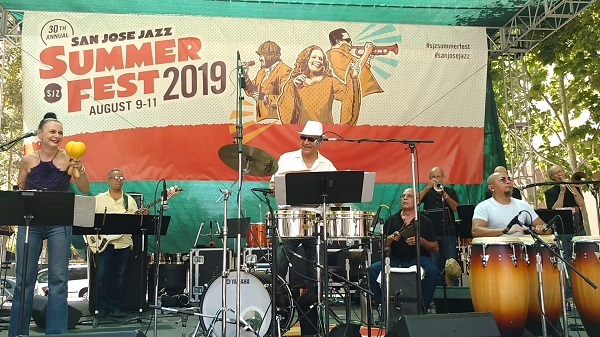
Danilo y Su Orquesta Universal at the San Jose Jazz Summer Fest 2019

Did he receive academic training in music?

I took classes  in Oakland, California, learning music theory, piano, singing, and much more. These studies helped me a lot to better prepare myself musically speaking.

Studying music is important because it enhances the way you perform, sing, and play on stage. That’s when people can tell whether you are a musician who has studied and analyzed music. I’ve met musicians who learned everything by ear and they never progress to the next level.

Of course, there were also things I learned on the stage, in the studio and in rehearsals. I’ve unified all this knowledge to do my job to the best of my ability.

I saw that you have some dates to perform in the Bay Area and other places, can you tell us a little bit about that?

In 1995, I got the opportunity to take a group to Singapore (to be the house band at the Hyatt Regency Hotel). What I did was to find the best six musicians who could play the music I was asked to play. We rehearsed, traveled to Singapore, and stayed there about three months, all expenses paid. It was an amazing experience and I was honored to present my music in that country.

Danilo with Tito Puente, Jr.

What about your current performances?

We just played at La Peña here in Berkeley. It was really good, a lot of people showed up there and they recorded the whole show. Fans sent me some videos as well, so I have to start editing them.

We also played at The Ramp, El Rio, The Turf Club, Kimbara, among others. Coming up, we will be playing at the Cigar Bar.

Let’s talk about your latest album Perseverando.

I decided to call this album Perseverando because of my experience of overcoming the difficulties of maintaining a music career.

Turning to Buddhism, the word perseverando is very important, because life puts barriers in your way and you have to persevere to overcome them. It was common for record labels to say that they were saturated and couldn’t sign me, but I kept writing and recording original music despite the difficulties. The first album is called Vivencias and the second one is called Avanzando. They are titles that have had a lot to do with my life experiences.

I made a video for one of the songs on this álbum, Rumberos de la Bahia, which is on YouTube: https://youtu.be/z3E7K_5SLJo

What other projects do you have pending?

I’m thinking about putting out an album that will be a combination of songs that have not been released yet with some remixes of songs on my albums. Although a dream of mine is to be nominated for a Grammy, that is not why I créate music. Music is my life and my passion.

Cover of the album Perseverando


Home

Europe July – 2022

Joseíto Mateo “They call me the Negrito del Batey, because work for me is an enemy”

Joseito was a consecrated Dominican merenguero who began his career in the 1930’s, better known as “El rey del merengue, El diablo Mateo”.

As a child he learned to sing and dance. He sang at the “Fiestas de la cruz” and at wakes, since at that time the deceased were prayed to with songs.

Mateo began his career as a singer during the 30’s, a period in which he was gaining the public’s favor.

Some time later he was requested by the record label “SEECO” to join the cast that in Havana would record with the Sonora Matancera.

Those were the years of the Trujillo Era in which Dominicans required an exit permit to travel abroad.

At first, this document was denied to Joseito.

As a consequence, in Havana, once the record was contracted and the pieces that would be part of it had been selected, including “El negrito del batey”, Joseito’s place was taken by the Dominican singer Alberto Beltrán, who was known since then by the Cuban public as “El negrito del batey”, instead of his true inspirer.

He was born on April 6, 1920 in Santo Domingo (Dominican Republic).

In one of his later trips, he decided to stay in Cuba to sing in CMQ, together with Celia Cruz and La Sonora Matancera, a very popular group at that time.

After the assassination of Rafael Trujillo on May 30, 1961 and the end of his dictatorship, Joseito decided to try his luck in Puerto Rico.

In 1962, Joseíto participated as vocalist in the first tour of the “Gran Combo” to Panama, to promote the album ‘El Gran Combo con Joseíto Mateo’.

There he met the young singers Pellín Rodríguez and Andy Montañez, who ended up replacing him in the Puerto Rican group.

“El Gran Combo was very good to me, I adapted to sing plena, bomba, guaracha, boleros, but then I had to return to Santo Domingo to clear my name.

They were falling behind all those who were with Trujillo, and in the Republic they said I was a spy and was on the run”.


Mateo’s professional work has spanned more than 70 years and constitutes an important reference of the Dominican musical culture.

He was nourished by the roots of merengue and became a singular exponent of it. His innovative style was characterized by a stage participation enriched by his particular way of dancing and singing.

Some of his best known songs are Madame Chuchí, Dame la visa, La cotorra de Rosa and La patrulla, among others. Joseito is known as “El Rey del Merengue” (The King of Merengue).

On November 11, 2010, Mateo was recognized at the 11th Latin Grammy Awards with the Latin Recording Academy’s Musical Excellence Award for his contributions to Latin music.

He retired in 2001, close to his 82nd birthday and after recording 50 “elepes”.

Joseíto Mateo passed away on June 1, 2018 at the age of 98, due to leukemia. He spent his last days in the Hospital de las Fuerzas Armadas.

Source:

https://www.buscabiografias.com/biografia/verDetalle/8662/Joseito%20Mateo

Chantel Collado: a Canadian star of Latin descent

La Princesa de La Bachata

I am talking today with La Princesa de La Bachata Chantel Collado (https://www.facebook.com/chantelcolladoficial), who is an immensely talented artist. I understand she is a resident of Canada and is of Dominican descent. Thank you so much for accepting our invitation, Chantel. We learned that you are in Italy at the moment, what are you doing there?

First of all, thank you for the invitation. The pleasure is mine. Certainly, I grew up in Canada, but I’m on tour around Italy and pleased to bring my music to this beautiful country.

Chantel Collado was born in Canada, but her parents are Latino

Wonderful! How has reception towards your music in Italy?

It was amazing! Actually,I’m proud to see how both Italians and foreigners dance to bachata and enjoy it. Bringing this music to a country like Italy makes me very proud. It is a blessing to be able to travel, come, sing my lyrics and see how the audience loves them.

The nickname people you are given caught my attention. Where does La Princesa de La Bachata come from?

People give me that name when I went to London to give a concert. In view of the lack of women in the genre, I think it was easy for the public to call me that. For me, it’s a great honour for me to represent the genre, being a woman and a Dominican, since there aren’t many women who sing bachata.

Precisely because there weren’t a lot of women in the genre, did you feel a strong competition? Did you feel like you weren’t taken seriously?

Being a woman can complicate a few things. Thank goddness, men in the genre have also given me the opportunity and supported me, such as my musical godfather Frank Reyes, who is someone I admire. He is a bachata icon in the Dominican Republic and an example of a man who has supported me in my career. I had the opportunity to record a song and a music video with him.

I have received a lot of support from my colleagues and I am very happy to receive that support.

Who have been your musical references in and out of bachata?

I really like Romeo Santo, The King of Bachata. I grew up listening to exponents of Dominican bachata like Frank Reyes, Luis Vargas, Hector Acosta and Juan Luis Guerra. Outside of bachata, I have always liked Beyonce because of her stage presence. Regarding artists in this generation, I also really like Karol G.

Chantel Collado on stage

Have you experimented with urban or more modern rhythms?

Of course! I love to experiment and change from time to time. From a very early age, when I started singing in a competition in Los Angeles, I sang a cumbia by Selena titled Como La Flor. I have an urban song called Así. I’ve also sung salsa and I have merengues. What I like most is bachata, but for my generation, I listen to much urban music.

According to your biography, you decided to pursue a career in music after a talk you with your father, who also supported you very much in this regard. Can you describe that moment?

I grew up watching my father on stage as a director, musician and singer. From a very early age, I went on stage and sang with him. My brother is also a musician, so I think it just was natural for me. I didn’t know it’d like it or take it seriously as a career, but it was when I turned 15 that we decided to focus on music.

I was also performing and participating in musical theater, so I was singing, performing and dancing at the same time. When I turned 15, we decided as a family to focus on only one thing, which would be music. That’s how I started writing songs with my brother and we’ve been going at it for the last 14 years.

Latin descent

Your father is Dominican and your mother is Uruguayan. Do you think that coming from a Latin family has pigeonholed you or on the contrary?

Quite the opposite! It expanded my horizons. I grew up in Canada, speak English and, try to incorporate this language into my music. I’m of Uruguayan stock and even if people don’t listen to bachata in that country, I chose that genre because I listened to it all the time and I love it. I think that all this mix of countries expanded my horizons and I don’t feel that singing bachata is an obligation for me because I love doing it.

Her father and brother supported her a lot during her career

What did you do during the pandemic?

The pandemic was very difficult for me and all the artists in general, but I tried to focus on writing new music. I don’t know where I got the inspiration, but I recorded a music video with my mobile, which was made for my song Contigo o sin ti that you can find on YouTube. I did my own makeup and my own hairstyle for that day, put my IPhone on a tripod and got it all. I had to find thae encouragement to move regardless the situation.

Fortunately, I returned to the stage to sing for the public after two years.

In which countries are you touring now?

I am touring only in Italy. We’ve already been to two cities and we have two more to go to complete the tour. Then I will return to Canada, rest for a week and travel to the United States to continue touring.

Do you plan to tour Latin America?

I’ll be happy to do so. In fact, we already have some tentative dates in countries such as Colombia and Mexico. Let’s just hope that everything will happen because it would be the first time I brought my music to those corners.

How is urban bachata different from traditional bachata?

I think urban bachata is a movement that is starting to develop. My generation listens to a lot of urban music and an example of this is Bad Bunny, who is killin’ it right now. If we want bachata to evolve a little bit, we have to add a little urban touch and that’s what we’re doing. I think traditional music will never die because it is our main genre in the Dominican Republic, but it can also be made enjoyable for present generations, adding a little urban touch.

Speaking of urban artists, who do you want to collaborate with someday?

At the moment, I would love to collaborate with Bad Bunny. I love Bad Bunny and his new album. I had the great honor of opening for him in Toronto, Montreal, a few years ago. I also had the honor of meeting him, but I haven’t had the chance to collaborate with him yet, though I would love to.

As for traditional genres, I would like to collaborate with Anthony Santos on a more traditional song in my genre, bachata.

A message for young girls who want to dedicate themselves to the same as you.

I’d advise them to follow their dreams. I started in the music industry at a very young age I have achieved many things in the last 10 years. As a woman, I’d tell them to keep going because we are living in a time when women have more attention than ever before. We’re strong, independent and we can do anything we want.

Chantel at a photo shoot

Salsa in Israel

Europe / Israel / Tel AvivSalsa in Israel

Salsa in Israel. This ancient land is as exciting as the many stories it tells. It is the land of Abraham father to Isaac and his half brother Ishmael the patriarchs of the Arabs and the Jewish people. Patriarchs born of Sarah and Hagar. It is the land of Jesus and his many stories. It is the land where all three groups claim Jerusalem as holy.

For the Jewish it is because of King David, King Salomon, the two temples, the tomb of King David and the Western Wall. The Muslims regard it as the place from where the prophet Mohammed ascended to heaven in the birthplace of Christ, the via dolorosa and the cruciction. Each group has a “gate”. Why even the hamburger chain McDonalds seems to have gotten their “golden arcs” from one of the gates.

At 71 years of age, Israel is one of the youngest countries in the world. Needless to say the country is deeply divided, with serious challenges facing its leaders. A majority is required to govern effectively. While 80 % is said to be secular (non-religious ethnic) and 16% ultra-orthodox, the ultra-orthodox control the swing vote. To be Jewish you must be born of a Jewish mother, or converting. Around 500,000 Latinos are Jewish citizens.

This is around 5% in a country of 8.5 million people. The population is very diverse. Listening to people talk, at times I felt that I was in Russia. The migration from the former USSR comprised for over a million immigrants. The Roman Empire could not afford rebellion in Judea as it was the crossroads between Europe, Africa, Asia and the Middle East. Massada is the conformation of the determination to be a free people.

Ultra orthodox 16%

As a new nation the argument that tradition, culture and religion had to be nurtured and recaptured was presented by the ultra-orthodox. As its fi­rst Prime Minister it is said that David Ben-Gurion gave some 50 persons a waiver from obligatory military service. Much to the displeasure of many seculars, the ultra-orthodox have since grown in numbers and receive government assistance so that they are free to do nothing else than to study. However with the control of their swing vote, the ultra-orthodox continue to be exempt from obligations. After fi­nishing mandatory school, all citizens must render military service, two years for the women and three years for the men.

ISRAEL ARCHITECT

Although the official capital is Jerusalem, the modern city is TelAviv, followed by its Port City of Haifa. The Tel Aviv nightlife goes way beyond 2 a.m. The city is very modern, and everything seems to work right on schedule.

The architecture speaks of free growing ideas

ISRAEL FOOD


Diverse migration is accompanied with the cuisine of the immigrants. As a result, Tel Aviv boasts of a wonderful variety of cuisine.

The women walk the streets in the wee hours of the night without a care, which speaks of the public safety. Tel Aviv was voted “friendliest gay city in the world.” It is said that the annual gay pride parade was attended by more than 250,000.

250,000 people attend the LGBT community friendly parade

When visiting Bethlehem, the church of the Nativity, West Wall, and tomb of King David, you have to enter into Palestinian controlled territory. Our Israeli tour guide explained that they had entered into an agreement of cooperation with the Palestinian tour guides

Palestinian tour guides

An Israeli bus took us to the border and we then transferred to a Palestinian tour bus. The Palestinian tour guide took over and gave us our tour, a visit to their gift shop and then returned us to the border where the Israeli bus and guide were awaiting for us.

Man dressed in black dancing with woman in white top

For those of you who are always looking for a place to go dance Salsa, our recommendations are two places only, Salsa Carlos and Havana Club.

Havana Club caters to those new salsa dancers with a large main fl­oor and three or four side rooms for specialties like Bachata, Cumbia, etc. For those of you looking to find a more Latino place, then “El Propio” is Salsa Carlos.

What got you going in Salsa? Carlos says that he grew up hearing Salsa in Cali. It runs in his blood and his heroes were El Gran Combo, Los Hermanos Lebron and Beny More. Even the bell in grammar school to signal recess, played in Salsa. In Israel some Colombian friends asked him to organize a Salsa event and it was successful. To his knowledge, he is the first person to introduce Salsa in Israel. Since then Carlos has been organizing events in Tel Aviv at places like the “Old Port”. Apart from special events, he holds every Friday night at 11:30 pm, Salsa Carlos at Carlbach 3, Tel Aviv. He is accompanied by DJ Manuel.

  • « Go to Previous Page
  • Page 1
  • Interim pages omitted …
  • Page 41
  • Page 42
  • Page 43
  • Page 44
  • Page 45
  • Interim pages omitted …
  • Page 66
  • Go to Next Page »

International Salsa Magazine (ISM) is a monthly publication about Salsa activities around the world, that has been publishing since 2007. It is a world network of volunteers coordinated by ISM Magazine. We are working to strengthen all the events by working together.