• Skip to primary navigation
  • Skip to main content

International Salsa Magazine

  • Home
  • Previous editions
    • 2025
      • ISM / November 2025
      • ISM / October 2025
      • ISM / September 2025
      • ISM / August 2025
      • ISM / July 2025
      • ISM / June 2025
      • ISM / May2025
      • ISM / April 2025
      • ISM / March 2025
      • ISM / February 2025
      • ISM / January 2025
    • 2024
      • ISM / December 2024
      • ISM / November 2024
      • ISM / October 2024
      • ISM / September 2024
      • ISM / August 2024
      • ISM / July 2024
      • ISM / June 2024
      • ISM / May 2024
      • ISM / April 2024
      • ISM / March 2024
      • ISM / February 2024
      • ISM / January 2024
    • 2023
      • ISM / December 2023
      • ISM / November 2023
      • ISM / October 2023
      • ISM – September 2023
      • ISM – August 2023
      • ISM July 2023
      • ISM Edition June 2023
      • ISM – May 2023
      • ISM April 2023
      • ISM March 2023
      • ISM February 2023
      • ISM January 2023
    • 2022
      • ISM December 2022
      • ISM November 2022
      • ISM October 2022
      • ISM September 2022
      • ISM August 2022
      • ISM July 2022
      • ISM June 2022
      • ISM May 2022
      • ISM February 2022
      • ISM January 2022
    • 2021
      • ISM December 2021
      • ISM November 2021
      • ISM October – 2021
      • ISM September 2021
      • ISM August 2021
      • ISM July 2021
      • ISM May 2021
      • ISM April 2021
      • ISM June 2021
      • ISM March 2021
      • ISM February 2021
      • ISM January 2021
    • 2020
      • ISM December 2020
      • ISM November 2020
      • ISM October 2020
      • ISM September 2020
      • ISM August 2020
      • ISM July 2020
      • ISM June 2020
      • ISM May 2020
      • ISM April 2020
      • ISM March 2020
      • ISM February 2020
      • ISM January 2020
    • 2019
      • ISM December 2019
      • ISM November 2019
      • ISM October 2019
      • ISM Septembre 2019
      • ISM August 2019
      • ISM July 2019
      • ISM June 2019
      • ISM May 2019
      • ISM April 2019
      • ISM March 2019
      • ISM February 2019
      • ISM January 2019
    • 2018
      • ISM December 2018
      • ISM November 2018
      • ISM October 2018
      • ISM September 2018
      • ISM August 2018
      • ISM July 2018
      • ISM June 2018
      • ISM May 2018
      • ISM April 2018
      • ISM March 2018
      • ISM February 2018
      • ISM January 2018
    • 2017
      • ISM December 2017
      • ISM November 2017
      • ISM October 2017
      • ISM September 2017
      • ISM August 2017
      • ISM July 2017
      • ISM June 2017
      • ISM May 2017
      • ISM April 2017
  • Download Salsa App
    • Android
    • Apple
  • Spanish

Search Results for: Son

This is Roger Danilo Páiz Pérez from Danilo Y Su Orquesta Universal

Why is he called Danilo?

We will start a conversation with bandleader, percussionist, and singer Roger Danilo Páiz Pérez. Pleased to meet you, how are you doing?

I’m fine thanks, Karina. Sitting here and ready to be interviewed by your magazine. I have a lot of information about what has happened in my life being a musician here in the Bay Area since the 70’s.
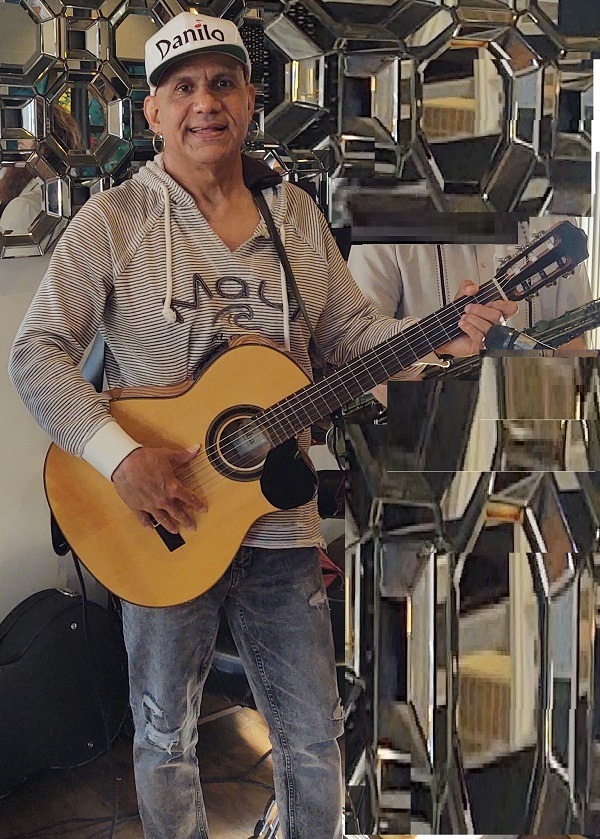
Danilo on guitar at one of his frequent restaurant performances

You are Francisco Pancho Perez’s grandson. Did your grandfather serve as inspiration for the path you would take in music?

Definitely he did. I remember being about four or five years old when I used to hear my grandfather play with his big band, which was composed of 15 or 14 musicians. I always listened to them practicing in our house and started dancing, so my grandfather used to call me cha cha chá. It was a great inspiration for me.

He played music similar to American jazz, and that’s where the inspiration for the music I play today comes from. The salsa that I write is inspired precisely by that kind of jazz.

Where does the name Danilo come from? Also, why is your orchestra called Danilo Y Su Orquesta Universal?

I have to make it clear that Danilo is my middle name since I was born. This is not a nickname as many believe. Some people even think that I have changed my name, but I didn’t. Roger Danilo Páiz Perez has always been my name.

Everyone called me Roger Páiz in the past, that is to say, people called me by my first and last name. In fact, when I played with Rubén Blades in 1989, the album we recorded has me in the credits as Roger Páiz. But when I founded my own orchestra in the 1990s, I thought Danilo was better suited to Latin music, so I started using my middle name to call my orchestra Danilo Y Su Orquesta Universal.

The word universal comes from the fact that I am a Buddhist. I practice the religion of Nichiren Daishonin (monk in Buddhism from Japan in the 13th century and founder of the branch of Nichiren Buddhism) for more than 30 years. That word is widely used in the Buddhist scriptures, and I am very involved in that.

Roger Páiz getting ready to hit with Josh Jones’ band

Your country of origin is Nicaragua. Is Nicaraguan salsa similar to Californian salsa? Are they different? Do you combine them?

Since I was very young, I listened to a lot of Cuban orchestras. I remember my dad tuning in to Celia Cruz, La Sonora Matanzera, among others. From that experience, I picked up all those things since childhood.

Here in the United States, the style was much more modernized. However, I grew up listening to El Gran Combo de Puerto Rico and many other orchestras in the ‘60s and ‘70s. My biggest inspirations were Héctor Lavoe, Oscar De León, Rafael de Jesús, Cheo Feliciano and many others from those years. I paid a lot of attention to how they sang and the melodies that they used.

What Danilo has learned from his musical references

You have made contact with Latin music stars such as Ray Barretto, Rubén Blades, Benny Velarde Y Su Super Combo, Andy Narell, Ray Obiedo, Cheo Feliciano, Oscar De León and many others. What did you learn from all these musical references?

For example, I shared a gig with Cheo Feliciano in Puerto Rico while I was with Rubén at a concert. (Luis Enrique was actually at that concert as well.) Cheo taught me how to phrase with the clave, since this is a very important detail in singing Salsa.

In the case of Héctor Lavoe, I learned a lot from the melodic part. When he sang, the melody was very interesting and appealed to me a lot.

Another singer I liked a lot was Rafael de Jesús, because his style tended to sound like jazz. Sometimes he sang some lines that sounded very jazzy, but he never lost his style as a Salsa singer. That’s one of the main things I liked about him.

Another singer I liked a lot was Rafael de Jesús because his style tended to sound like jazz. Sometimes he sang some lines that sounded very jazzy, but he never lost his condition as a salsa singer. That’s one of the main things I liked about him.
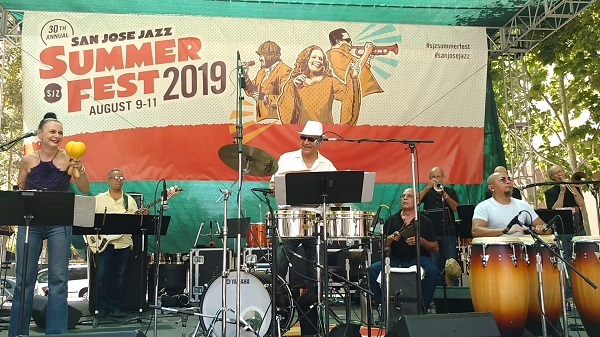
Danilo y Su Orquesta Universal at the San Jose Jazz Summer Fest 2019

Did he receive academic training in music?

I took classes  in Oakland, California, learning music theory, piano, singing, and much more. These studies helped me a lot to better prepare myself musically speaking.

Studying music is important because it enhances the way you perform, sing, and play on stage. That’s when people can tell whether you are a musician who has studied and analyzed music. I’ve met musicians who learned everything by ear and they never progress to the next level.

Of course, there were also things I learned on the stage, in the studio and in rehearsals. I’ve unified all this knowledge to do my job to the best of my ability.

I saw that you have some dates to perform in the Bay Area and other places, can you tell us a little bit about that?

In 1995, I got the opportunity to take a group to Singapore (to be the house band at the Hyatt Regency Hotel). What I did was to find the best six musicians who could play the music I was asked to play. We rehearsed, traveled to Singapore, and stayed there about three months, all expenses paid. It was an amazing experience and I was honored to present my music in that country.

Danilo with Tito Puente, Jr.

What about your current performances?

We just played at La Peña here in Berkeley. It was really good, a lot of people showed up there and they recorded the whole show. Fans sent me some videos as well, so I have to start editing them.

We also played at The Ramp, El Rio, The Turf Club, Kimbara, among others. Coming up, we will be playing at the Cigar Bar.

Let’s talk about your latest album Perseverando.

I decided to call this album Perseverando because of my experience of overcoming the difficulties of maintaining a music career.

Turning to Buddhism, the word perseverando is very important, because life puts barriers in your way and you have to persevere to overcome them. It was common for record labels to say that they were saturated and couldn’t sign me, but I kept writing and recording original music despite the difficulties. The first album is called Vivencias and the second one is called Avanzando. They are titles that have had a lot to do with my life experiences.

I made a video for one of the songs on this álbum, Rumberos de la Bahia, which is on YouTube: https://youtu.be/z3E7K_5SLJo

What other projects do you have pending?

I’m thinking about putting out an album that will be a combination of songs that have not been released yet with some remixes of songs on my albums. Although a dream of mine is to be nominated for a Grammy, that is not why I créate music. Music is my life and my passion.

Cover of the album Perseverando


Home

In Barrio Marianao in Havana, Cuba was born Armando Peraza was a Latin jazz percussionist

Peraza (May 30, 1924-April 14, 2014) was a Cuban Latin jazz percussionist.

Thanks to his collaborations with guitarist Carlos Santana, jazz pianist George Shearing and vibraphonist Cal Tjader between 1950 and 1990, he is internationally recognized as one of the most important figures in the field of Latin percussion.

Known primarily as a conguero and bongocero, Peraza is also a skilled dancer and composer. He has appeared on recordings by Pérez Prado, Machito, George Shearing, Charlie Parker, Tito Puente, Cal Tjader and Carlos Santana. Performances with Santana, Shearing and Tjader brought him international fame.

He was inducted into the Smithsonian Institute and had three “Armando Peraza Days” from the city of San Francisco.

One of the most important and respected figures in the world of percussion.

He is a legendary master on both congas and bongoes, whose unorthodox style and story are an inspiration to countless young musicians.

He began his artistic career in the early 1940s, played with singer Alberto Ruiz’s Kuvabana ensemble where he played the bongo and moved to San Francisco in 1949.

At the New York World’s Fair he played congas in an African pavilion with a Nigerian.

This African arrives and says to me: “Man, what part of Africa are you from? I told him, I am from Cuba. He said: “Don’t tell me” He later worked with the orchestras of Paulina Álvarez and Dámaso Pérez Prado, and the Bolero group.

In 1947 he moved to Mexico, where he joined with Mongo Santamaría the ensemble Clave de Oro, and in 1948 they both traveled to New York as percussionists accompanying the dance couple Pablito y Lilón.

At the end of that year, Peraza joined Slim Gaillard’s jazz combo with which he traveled throughout the United States. After arriving in New York in 1949, Armando became a sought-after musician, especially in the contemporary Bebop and Latin Jazz scenes.

Armando built a reputation for impressively fast and complex hand technique, experimental techniques and great talent for entertaining. He flourished in progressive atmospheres that combined jazz with Afro-Cuban styles and was at the center of a new expression called “Cubop”.

He has played on more than 100 albums and is the composer of more than 40 songs. Some of these works include collaborations with Mongo Santamaria, George Shearing, Cal Tjader and Carlos Santana.

Settled in San Francisco, California, in the early 1950s, Peraza began working with pianist George Shearing’s quintet, where he demonstrated his mastery as a player of the tumbadora and bongo; also in this period he recorded several albums of Cuban folk music with Mongo Santamaria.

In the 60’s he joined the quintet of vibraphonist Cal Tjader, with whom he remained for several years and with whom he popularized Chano Pozo’s Guachi guaro. In the 1970s, he joined Mongo Santamaría’s orchestra, with which he participated in the Montreaux Jazz Festival in Switzerland.

Later he worked with Carlos Santana’s rock band, in which he remained for 17 years, until his retirement from artistic life in the 90s.

He possessed a great capacity to obtain the most unusual sounds of the bongo and the tumbadora, and distinguished himself for his extraordinary solos on both instruments.

He died on April 14, 2014 in California, United States, as a result of pneumonia.


Fuente: https://kripkit.com/armando-peraza/

Joseíto Mateo “They call me the Negrito del Batey, because work for me is an enemy”

Joseito was a consecrated Dominican merenguero who began his career in the 1930’s, better known as “El rey del merengue, El diablo Mateo”.

As a child he learned to sing and dance. He sang at the “Fiestas de la cruz” and at wakes, since at that time the deceased were prayed to with songs.

Mateo began his career as a singer during the 30’s, a period in which he was gaining the public’s favor.

Some time later he was requested by the record label “SEECO” to join the cast that in Havana would record with the Sonora Matancera.

Those were the years of the Trujillo Era in which Dominicans required an exit permit to travel abroad.

At first, this document was denied to Joseito.

As a consequence, in Havana, once the record was contracted and the pieces that would be part of it had been selected, including “El negrito del batey”, Joseito’s place was taken by the Dominican singer Alberto Beltrán, who was known since then by the Cuban public as “El negrito del batey”, instead of his true inspirer.

He was born on April 6, 1920 in Santo Domingo (Dominican Republic).

In one of his later trips, he decided to stay in Cuba to sing in CMQ, together with Celia Cruz and La Sonora Matancera, a very popular group at that time.

After the assassination of Rafael Trujillo on May 30, 1961 and the end of his dictatorship, Joseito decided to try his luck in Puerto Rico.

In 1962, Joseíto participated as vocalist in the first tour of the “Gran Combo” to Panama, to promote the album ‘El Gran Combo con Joseíto Mateo’.

There he met the young singers Pellín Rodríguez and Andy Montañez, who ended up replacing him in the Puerto Rican group.

“El Gran Combo was very good to me, I adapted to sing plena, bomba, guaracha, boleros, but then I had to return to Santo Domingo to clear my name.

They were falling behind all those who were with Trujillo, and in the Republic they said I was a spy and was on the run”.


Mateo’s professional work has spanned more than 70 years and constitutes an important reference of the Dominican musical culture.

He was nourished by the roots of merengue and became a singular exponent of it. His innovative style was characterized by a stage participation enriched by his particular way of dancing and singing.

Some of his best known songs are Madame Chuchí, Dame la visa, La cotorra de Rosa and La patrulla, among others. Joseito is known as “El Rey del Merengue” (The King of Merengue).

On November 11, 2010, Mateo was recognized at the 11th Latin Grammy Awards with the Latin Recording Academy’s Musical Excellence Award for his contributions to Latin music.

He retired in 2001, close to his 82nd birthday and after recording 50 “elepes”.

Joseíto Mateo passed away on June 1, 2018 at the age of 98, due to leukemia. He spent his last days in the Hospital de las Fuerzas Armadas.

Source:

https://www.buscabiografias.com/biografia/verDetalle/8662/Joseito%20Mateo

“Tabaco y sus Metales” the legend of Salsa made in Venezuela

On May 30, 1995, Carlos “Tabaco” Quintana died in Caracas, Venezuela, the city where he was born on September 15, 1943.

Charismatic Timbalero, Sonero and Director of “Sexteto Juventud” and “Tabaco y sus Metales” the legend of Salsa made in Venezuela”

Former member of  “Sexteto Juventud”, founder of the orchestra  “Tabaco y sus Metales”. He was born on September 15, 1943 and began his musical training in the corners of San José.

Youth took him hand in hand with the street salsa brava, the rebellion of Palmieri and Mon Rivera’s trombones and the castinglés sound of Joe Cuba’s sextet.

And it was so long that they began to call him “tabaquito”, a tabaquito who waited for the day to be over to find the musical flavor far from the chore of shoeshine boy and town crier.

He never forgot that he used to go out to 23 de Enero to listen to the rehearsals of a group that was being formed there.

Years went by and rehearsals went by while Tabaquito got to know one by one the members of that group until 1963, when he was twenty years old, his friend Elio Pacheco recommended him to Olinto Medina, the leader of that band.

Olinto was about to rehearse “Guasancó” and the singer was not in tune with him.

Elio’s recommendation took effect and “Tabaco” did its thing, very well. Thus the Sexteto Juventud had a new voice and something more, because Carlos Quintana was able to walk through all the instruments of the group.

He had an almost magical vocal timbre. His voice was astonishingly similar to Ismael Rivera’s and we already know what that meant at a time when Maelo was the obligatory reference from the ranks of Rafael Cortijo’s Combo.

With Quintana the Sexteto Juventud had moments of true glory because although it reflected the influence of Joe Cuba they created a style that continues without copy.

In addition to his vocal art, Tabaco was a good composer, with a good vibe and reciprocity in the town. Every September he would go to play for the prisoners, on the day of Las Mercedes. He felt what a captive felt and that is why he composed “La Cárcel” (Qué malo es estar/ estar entre rejas/ y qué soledad/ qué soledad se siente).

Along with this song he released “Mi Calvario”, a piece that became a classic.

(Quisiera saber/ cuál fue la causa/ de nuestro olvido.And so, between recordings and toques, Tabaco, in the Sexteto Juventud, saw the arrival of José Natividad Martínez, Naty, the flutist and friend. Naty sold the idea of the brass to Quintana and Quintana, buying, suddenly came up with “Tabaco y sus metales” and recorded Pablo Alvarez’s “Una sola bandera” which was a smash hit, “Agua de mayo” and his tribute to the rumberos, “Tuntuneco”.

In May 1984 we published a very rich interview with Tabaco in El Nacional’s Feriado. Almost immediately they called to locate him. He was invited to the Managua 84 festival. It was the first time he left the country by air.

He performed for 30,000 people with Son 14, Amaury Pérez, Pupi Legarreta and Tania Libertad, among others. On his return he told me that the Cubans were astonished because they thought that in Venezuela there was only Oscar D’ León, and that he almost fainted when Daniel Ortega approached him to ask for an autograph, and that he touched the sky when Adalberto Álvarez and Son 14 went up on stage with him to sing “Una sola bandera”.

His dreams: He had two: To record an album as a tribute to Ismael Rivera, and to make another one with boleros. Once in Macuto he sang with Ismael Rivera and for both of them it was a tremendous experience. In Guarenas, the musical and brave, specifically in “Menca de Leoni” was cooking the dream.

With Naty’s help, he began to record Maelo’s on an album that the Sonográfica label did not take care of releasing afterwards. He could not finish it because cancer took him to the hospital where Joe Ruiz was also hospitalized.

That album was vocally completed by Ángel Flores. He, who admired Cheo Feliciano and Tito Rodríguez so much, could not make the bolero album either.

Naty says that in more than one night he managed to get Tabaco out of the hospital to advance the tribute album to Maelo. She knew that Tabaco wanted to do it, and pleased the friend, who also, looking for spiritual relief to his physical pain, went to Los Teques, where he was surprised by death on May 30, 1995.

“Tabaco” Chronology of his musical life 1.943 Carlos Quintana was born on September 15 in the San José neighborhood of Caracas, Venezuela.

1.955 as a child he worked as a shoeshine boy and began to be interested in music.

1.959 in his adolescence he attended the rehearsals of a musical group in the 23 de enero neighborhood of Caracas, because of his skinny body and stature they began to call him Tabaco.

1.962 on May 13 was founded the group called Conjunto Rítmico Juventud, which eventually gave rise to the Sexteto Juventud, composed of Olinto Medina as director and bassist, Elio Pacheco on the Tumbadora, Carlos Croquer on drums, Arturo Lopez singer, Juan Medina on guitar and Isaias on bongo.

1.963 musician Elio Pacheco introduces Olinto Medina leader of the group to his friend Carlos Quintana.

1.967 “Tabaco” joins the group and in a short time he becomes the vocalist of the group in his first recording titled “Guasanco”, a 45 rpm single whose reverse side was titled “Cautivo”, this happened on February 22nd of that year.

SB1 Publications

Besides having a voice similar to that of Ismael Rivera, Carlos Quintana performed well on the bongo and other instruments.

On June 11, 1967, the first album of Sexteto Juventud was released, entitled “Guasanco”, it was recorded for the Velvet label and the name of the album was due to the success of its first single “Guasanco”, other songs on the album were “La Jibarita”, “Bógalo” and “Consejos de mamá”.

The same year 1967, this time on September 24th, their second album is announced: “Mas Guasanco”.

A new production of the sextet is called “A bailar juventud”, which contains the songs “Guasanco número 3”, “Hermanos con salsa”, “Soy el Bravo” and “Guajira Sentimental”.

The Sexteto releases the album “Mala” for the same Velvet label, where the numbers “Capricho antillano”, “La calle 10”, and “El Nuevo Guasanco” were recorded.

Two new records that were pressed for Velvet are: “Sabroso tumbao” and a work with the voices of Carlos Quintana and Oscar Mijares who was nicknamed “El chino” titled “La juventud se impone” for the Velvet label, in which they developed rites such as: Guaguancó, Jala jala, Guajira, Guaracha and Mozambique with hits such as “La cárcel” and “Jala jala Navideño” in the voices of Carlos Quintana and Oscar Mijares.

1.971 a new Sexteto album was released, entitled “La magia del sexteto”, which included songs such as: “Con todas las banderas”, “Sandra Mora” which would later be recorded by Naty y su Orquesta, “Caramelo y Chocolate” and “Virgen de los cuatro vientos”.

Also in this year they recorded an album called “A todo ritmo” in which they included “Caramelo Tumbao”, “De nuevo Borinquen” and “Comand Bógalo”, they were awarded a gold record by the Velvet music label.

1.974 On April 22nd without “Tabaco” in their ranks, Sexteto Juventud recorded an LP that we have to mention for its success at the Salsa level, the album was called “Lo espiritual del Sexteto Juventud” with rhythms like “Guaguanco”, “Guaracha”, “Bolero”, “Danzon” and “Guajira” and we highlight the numbers “Espiritualmente”, “Vestida de Blanco” and the homage to the Boricua land with the theme “A Puerto Rico”.

1.975 following the suggestion of his friend and musician the Venezuelan flutist Natividad Martinez, Carlos Quintana creates his own group “Tabaco” and his Sextet. Their first song was called “Una sola bandera” and was very well received by the public.

Also in 1969 he recorded the spectacular album titled “Agúzate”, for Tico Records, with classic songs such as: “Aguzate”, Amparo Arrebato”, in homage to a dancer from Cali, Colombia, “Vive feliz”, “Guaguancó Raro”; “Traigo de Todo” and the bolero “A mi manera”.

Carlos Quintana recorded the album titled “El Sabor de Tabaco” in the Colors studios in Caracas, the album contains songs such as “Maria lienza”, “Pegao”, “Ofrenda” and Yabirongo”.

1.975 records the albums “Tronco e’ baile Tabaco y su Sexteto” for TH records in which appear the themes “Pobre”, “Mata Ciguaraya” by Benny More and the hit “La Libertad”, in which he makes mention of the greats like Benny More, Celia Cruz and Ismael Rivera, half of the themes of the album are authored by Gabriel Carrasco and the other record production of 1. 975 was called “Tabaco y su Sexteto: Mi pueblo – Mi burrita – Nostalgia”, for the Top Hits label, with the production of Tony Montserrat and which has the themes “El Vals de Papa”, the Tango “Nostalgia” and a very salsa number titled “Ponte en Ritmo”.

1.976 his musical work is titled “Tabaco y su Sexteto” with the arrangements, production and direction of Victor Gutierrez, the record was made in Venezuela by La Discoteca CA. And contains a number of authorship of “Tabaco” entitled “Mi Celda”, and other songs like “Amor amor” and “Prefiero mí son montuno”.

1.978 Carlos Quintana changes the name of his group to “Tabaco y sus Metales” and with that title they record for the Top Hits label in the Intersonido CA studios, the album includes songs like “Tristeza y pena”; “Celda de castigo” and “Sinceridad”; both by Carlos Quintana. The orchestra was formed by Pedro Landaeta on Piano, Hector Pacheco on Bass, Pablo Álvarez on Conga, Carlos Quintana Bongo and Percussion, Gabriel Carrasco on Tres, Trumpets by “Pollo” Fuentes and Luís Arias, Natividad Martínez on Flute, Carlos Quintana Singer and the choirs of Gabriel Carrasco, Dimas Pedroza, Álvaro Serrano, Carlos Quintana and Víctor Gutiérrez.

1.979 Tabaco y sus metales publishes a new album under the title “Ni poco ni demasiado” also for the TH label with a number of the same name and other songs such as the big hit “Arrollando”, a version of the song “Todo de los metales”, a version of the song “Todo de los metales”, and a version of the song “Todo de los metales”. a version of the song “Todo el mundo escucha” by Bienvenido Granda and also a number by Markolino Dimond titled “Maraquero”.

With the production, arrangements and direction of  Victor Gutierrez, the recording was made at Intersonido CA in Caracas.

1.980 the musical work of this year was titled “Advertencia”, this work was made in Puerto Rico under TH license, it is a sample of what at that time “Tabaco” meant in Salsa, in this recording participated musicians like Luís Quevedo in the Piano, Polo Huertas in the Bass, Papo Pepín in the Conga and Yayo el Indio and Carlos Santos in the choirs.

The musical direction and arrangements were in charge of Ray Santos. Among the songs on the album are “Agua de mayo” by Pablo Álvarez, “Que ironía” by Carlos Quintana and “Alegría” by Naty Martínez. Regarding this work, Rafael Rivas, Disc Jockey of Radio Aeropuerto, wrote: “Latin music in Venezuela has had several variants, some aimed at fulfilling a certain time, others evidencing the spirit and reality, the daily life with success; precisely to this current or trend belongs Tabaco.

The commitment to sing what he carries inside, to expose with his natural style the things he feels, even his motivations, leads us to reflect on the figure of Tabaco.

It is he, and no other, in our country, who has dedicated himself to present with passion what he suffers, what he sees, what he truly feels.

Tabaco says, his naturalness allows that balance between what he sings and lives, he seems to conjugate, and perhaps that is the truth, to take for himself, what we have logically lived.

Tabaco’s life is here, and we respect his criteria: without a tenacious diffusion Tabaco has managed to sell, to surpass the best; and there is a reason for it: Tabaco has the strength.

He is interested in singing, in carrying a message, and in his own way he has exposed it with sense, with full authenticity.

Tabaco commented to me one afternoon at the Airport: “Tigre, I believe that the important thing is to define ourselves, to express our reality and denounce at the same time: that is why Rafael believes in you, because you are the message, the truth of our movement”.

Tabaco was referring to the content of the songs; he believes in the possibilities of music, in its magic to undertake behaviors and to present the rage, love and passion of our spirit.

Later Tabaco pointed out to me: “What is indispensable is to sing, the way things are felt, the way the people communicate, that is why I make Salsa”.

And that is why Tabaco has a name, a special public, that has known how to understand him, because he has reached us, with sense and commitment. He is the voice of the people aimed at interpreting their process, their experiences, their daily work. Therein lies the reason for his inspiration, the context of his themes.

When he inspires, he shows his capacity to value, his speech evidences his thoughts, his aspirations, and also his repudiation. He hides nothing and what emotion we feel, when he unloads on the timbales, when his voice rises and blends with the rhythm, telling truths, encouraging the spirit, if I understand the dancer, generating relief to the heart, living the cadences, demonstrating his skills as a sonero. He created his own style, and this has consecrated him.

Now we have the new Tabaco, with more maturity, and the experience of the arranger who at this time has a special prestige: Ray Santos.

Ray’s commitment went beyond what we originally thought; Tabaco was a challenge for Ray; he had Santos in front of a marvel, as he described him, the people turned to the figure of Tabaco, who felt he had the best time to undertake the melody.

Ray prepared the arrangements with a concentration that he had never achieved before, he understood the commitment, and Tabaco knew how to respond to the requirements.

Ray confessed that Tabaco is gifted with possibilities, so his work demanded the maximum. For the first time, Tabaco appears with a superband, with a different orchestration, and it was necessary to do it, the time demanded it, his voice has the right to sound to the four winds, it is time that our best (Tabaco) interprets reaches the Caribbean, with height.

Tigres y tigressa, with this LP we will have special music; its quality, its conception, will lead us to take it into account, not only for our rumbas but to enjoy it all our lives.

The producers knew perfectly well the intention of recording with Ray Santos, they knew that Tabaco would keep to his style, without any change or twist that could deviate his personality as an interpreter; what they were basically looking for was perfection in the orchestration, that magic touch that would allow him greater expressive freedom; that is the reason for recording in Puerto Rico.

The best thing that could have happened to Tabaco this year was to meet Ray Santos, and for us, that unity represents the most audacious and wonderful thing that has been done so far. I believe, despite the express prohibition to advertise cigarettes, that this Tabaco is the purest, most inimitable in its Venezuelan flavor, and most authentic of the Caribbean. What are you waiting for? Light it up now! Tabaco y sus metales 1.981 was his next production for Top Hits records, with arrangements by Jorge Millet and Natividad Martínez, in which the songs “Si la envidia fuera Tiña” by Jorge Millet and Carlos Quintana: “Mi Celda” and “A Millet” were recorded.

In 1982 he recorded an album called “Cosa Linda”. The themes of the album are: “Cosa linda”, “Tremendo guaguancó”, “Fiebre de ti”, “El callo”, “De mi rancho a tu casa”, “El cafetero”, “Camarera de amor”, “Consejo a las mujeres”.

(H3) 1.983 Produces the album “Homenaje a los bravos”, also for TH records, which includes “Baranda” by Justi Barreto, “El Timbalito” by Tito Puente and “La Culebra” by Obdulio Morales.

1.984 in this opportunity the album was called “El Timbalero, Tabaco y sus Metales”, which includes two numbers by Justi Barreto: “Timbalero” and “Barito”, the song “Casamiento” by Rafael “Chivirico” Dávila and a song written by Carlos Quintana: “Contestación a mi calvario”, production, direction and arrangements by Andy Duran.

  1. 988 Tabaco y su grupo futuro, recorded for the Velvet label in which they recorded songs like “El taxista” and “El Temporal”, with arrangements by Félix Suárez and Víctor Santana, the members of the group are Carlos Quintana singer, Fidel Antillano pianist, Jesús Torres on bass, Cruz Armando Quintana on bongo, Alirio Castillo on Timbal, Alberto Vergara on Vibraphone, Victor Santana on tres and guitar, Jorge Ruiz on conga, Tambora and guiro in charge of Jorge Orta and the choirs of Carlos Quintana, Felix Suarez, Victor Santana, and Pablo Alvarez.

On May 30, 1995, the Venezuelan musician, composer and singer Carlos Quintana, known in the salsa world as “Tabaco”, died in the city of Caracas, victim of cancer. His voice died, but his legacy of thirty-two years of artistic life remains for all the followers of his musical work in Venezuela, Colombia, Latin America and the world.

The Tambor, Tumbadora or Conga is a percussion instrument of great importance in Latin music

The drum, tumbadora or conga as a soloist instrument in Cuban music or jazz bands, had as its first figure Chano Pozo, who, upon receiving the invitation of Mario Bauza and Dizzy Gillespie to participate in his big band, turned the world of jazz upside down.

This explosive union resulted in compositions such as Manteca or Tin Tin Deo.

They also created the roots of what is known today as Latin Jazz, which was originally called Afro Cuban Jazz “Cubop”.

After the surprising death of Chano Pozo, figures such as Cándido Camero, Carlos “Patato” Valdés, Mongo Santamaría, Armando Peraza, Tata Guines and Ray Barretto emerged who gave development and personality to the conga drum as a solo instrument.

It should be noted that Ray Barretto was born in New York and is of Puerto Rican descent.

He would be the first important figure in the world of conga drumming not born in Cuba. As a teenager, Barretto took care of his siblings in the evenings while his mother worked and spent hours listening to the radio.

There he was influenced by jazz and, in addition, his mother listened to Cuban and Puerto Rican music at home. This is how he formed his taste and love for music.

Mario Bauzá

He was a saxophonist in Justo Azpiazu’s orchestra and trumpet player in the Machín Quartet. Later, he joined Chick Webb’s orchestra as principal trumpet. In 1933 he was named director of the orchestra, and remained as such until 1937. Between 1937 and 1939 he played with the orchestras of Don Redman and Fletcher Henderson. And in 1938 he joined Cab Calloway’s band.

We can also affirm that Mario Bauzá is the musical godfather of two great jazz legends: Ella Fitzgerald and Dizzy Gillespie. Because it was Bauzá who made Calloway meet the then young trumpeter John Birks Gillespie, and Chick Webb incorporated Ella Fitzgerald into his band.

Chano Pozo

Luciano Pozo González, better known as Chano Pozo was born in Havana Cuba on January 7, 1915 and died in New York, December 3, 1948, was a Cuban percussionist, half brother of trumpeter Félix Chapolín.

Percussion instruments are instruments that produce sound when struck, shaken or percussed in some way.

This percussion can be done with drumsticks, with metal bars, with the hands, with keyboards or by striking two bodies against each other. This wide variety of possibilities allows for a wide range of sounds and types of instruments.

He shined shoes and sold newspapers, played music in many places and even danced in the well-known Havana comparsa of “Los Dandy”.

He belonged to the Abakuá Secret Society, which explains the perfect mastery he had of the drums of the rite. He had the habit of playing sacred rhythms on his congas, as well as singing Abakuá and Yoruba songs.

He worked in the public transmissions of the radio station Cadena Azul, together with figures of the stature of Charlie Parker and Dizzy Gillespie, being with Dizzy when he popularized the well-known theme of “Manteca”.

Dizzy Gillespie

He was born on October 21, 1917 in Cheraw, South Carolina.

Son of a bricklayer and occasional musician who treated him very badly.

The young Gillespie hit on everyone: “I was a devil, a strong devil”.

At the age of fourteen, he began playing the trombone, but soon switched to the trumpet, which he was already playing proficiently when his family moved to Philadelphia in 1935. There he got his first important contract with Frank Fairfax’s orchestra.

His life changed as he transformed from a thug in his youth to a true citizen of the world, supporting social causes such as racial integration.

Ray Barretto

Of Puerto Rican parents from Aguadilla, Raymundo Barretto Pagan was born on April 29, 1929 in Brooklyn, New York. He spent his childhood and youth in the Bronx and Spanish Harlem.

He grew up with his mother Dolores Pagan and his siblings Cecilia and Ricardo.

As a child, when he was only 10 years old, he listened to Arsenio Rodríguez, Machito, Duke Ellington, Benny Goodman, Harry James, Los Panchos, Pedro Flores, Daniel Santos and Miguelito Valdez.

At the age of 17, in 1946, he joined the U.S. Army.

In Germany he discovered his taste for music represented in Bebop, listening to the songs “Shaw Nuff” by Charlie Parker with Dizzy Gillespie and “Manteca” by Dizzy Gillespie with the Cuban Chano Pozo, who became his source of inspiration. It was at that time that he became thoroughly acquainted with jazz.

“The word percussion comes from the Latin percussio, a variation of the word percussus, which refers to the action of striking, shaking or vibrating something repeatedly.”

Percussion instruments have a great importance in music because, within a group of instruments, their usual function is to mark the rhythm of the piece. This means that they are often seen as the heartbeat of a musical composition.

Because of their primary role in creating and maintaining the rhythm of a piece, percussion instruments often work in conjunction with bass instruments, including the double bass or electric bass.

There are a large number of percussion instruments that can be classified according to different criteria. In this article you can find the most important classifications used today.

Many of these instruments are simple and rudimentary. It is due to their simplicity that percussion instruments are the oldest in the history of mankind.

The evolution of technology and music gradually allowed the development of more complex instruments, among which are wind instruments and stringed instruments.

Sources:

https://www.instrumentosdepercusion.com/

http://clasica.latinastereo.com/Salsero-del-mes/Mario-Bauza

http://old.latinastereo.com/html/genteLatina/salseroMes/RayBarretto/cronologia.shtm

  • « Go to Previous Page
  • Page 1
  • Interim pages omitted …
  • Page 167
  • Page 168
  • Page 169
  • Page 170
  • Page 171
  • Interim pages omitted …
  • Page 247
  • Go to Next Page »

International Salsa Magazine (ISM) is a monthly publication about Salsa activities around the world, that has been publishing since 2007. It is a world network of volunteers coordinated by ISM Magazine. We are working to strengthen all the events by working together.