• Skip to primary navigation
  • Skip to main content

International Salsa Magazine

  • HOME
  • Previous editions
    • 2026
      • ISM / June 2026
      • ISM / May 2026
      • ISM / April 2026
      • ISM / March 2026
      • ISM / February 2026
      • ISM / January 2026
    • 2025
      • ISM / December 2025
      • ISM / November 2025
      • ISM / October 2025
      • ISM / September 2025
      • ISM / August 2025
      • ISM / July 2025
      • ISM / June 2025
      • ISM / May2025
      • ISM / April 2025
      • ISM / March 2025
      • ISM / February 2025
      • ISM / January 2025
    • 2024
      • ISM / December 2024
      • ISM / November 2024
      • ISM / October 2024
      • ISM / September 2024
      • ISM / August 2024
      • ISM / July 2024
      • ISM / June 2024
      • ISM / May 2024
      • ISM / April 2024
      • ISM / March 2024
      • ISM / February 2024
      • ISM / January 2024
    • 2023
      • ISM / December 2023
      • ISM / November 2023
      • ISM / October 2023
      • ISM – September 2023
      • ISM – August 2023
      • ISM July 2023
      • ISM Edition June 2023
      • ISM – May 2023
      • ISM April 2023
      • ISM March 2023
      • ISM February 2023
      • ISM January 2023
    • 2022
      • ISM December 2022
      • ISM November 2022
      • ISM October 2022
      • ISM September 2022
      • ISM August 2022
      • ISM July 2022
      • ISM June 2022
      • ISM May 2022
      • ISM February 2022
      • ISM January 2022
    • 2021
      • ISM December 2021
      • ISM November 2021
      • ISM October – 2021
      • ISM September 2021
      • ISM August 2021
      • ISM July 2021
      • ISM May 2021
      • ISM April 2021
      • ISM June 2021
      • ISM March 2021
      • ISM February 2021
      • ISM January 2021
    • 2020
      • ISM December 2020
      • ISM November 2020
      • ISM October 2020
      • ISM September 2020
      • ISM August 2020
      • ISM July 2020
      • ISM June 2020
      • ISM May 2020
      • ISM April 2020
      • ISM March 2020
      • ISM February 2020
      • ISM January 2020
    • 2019
      • ISM December 2019
      • ISM November 2019
      • ISM October 2019
      • ISM Septembre 2019
      • ISM August 2019
      • ISM July 2019
      • ISM June 2019
    • 2016
      • ISM December 2016
      • ISM November 2016
      • ISM October 2016
  • Spanish
  • Download Salsa App
    • Android
    • Apple

Search Results for: Spanish in the United States

Know everything about Oscar Hernádez and Spanish Harlem Orchestra

Spanish Harlem Orchestra and its beginnings

Spanish Harlem
Logotype of Spanish Harlem Orchestra

Spanish Harlem Orchestra is for many one of the best Latin jazz and salsa bands in the world due to its long career, impressive relevance and numerous awards throughout its 19 years of existence. This Latin music orchestra based in the United States was created by producer Aaron Levinson and producer, composer and arranger Oscar Hernandez, who gave birth to a legendary group, which was Grammy winning twice and whose style has differentiated it from many others of its kind. 

It all started with a call from Levinson to Hernandez to offer him the opportunity to join an ambitious project he had in mind, which consisted of the creation of a Latin jazz orchestra with a very peculiar sound and style. The producer could not resist such a proposal, so he agreed to lend his talent to the nascent initiative. This is how they debuted their first album Un Gran Día en el Barrio in 2002, thanks to which they received their first Grammy nomination for Best Salsa Album. After their first singles, the new group began to garner major success and to offer great performances all over the world. 

One of the main objectives of the members of the band is to set for themselves is to keep salsa dura alive in order to be lasting and to reach as many lovers of good music as possible. This is how the Spanish Harlem Orchestra, or SHO as its fans affectionately call it, has managed to preserve the best of traditional salsa, but from a fresh and innovative perspective.   

Its centerpiece Oscar Hernandez 

This is Oscar Hernández
Oscar Hernández playing the piano

Its most famous member Oscar Hernandez got his taste for music in the vicinity of Harlem’s Latin Quarter, where he spent his early childhood that would mark his professional future. As a young boy of 12, he became a trumpet player, but it would not be long before he decided to switch to the piano. He spent much of his adolescence playing with many Latin Jazz artists of the time. One of those great stars with whom Hernández had the opportunity to explore his talents was Rubén Blades, for whom he worked as a producer, arranger and pianist. 

In the 90’s, the musician produced the album Dance City, for which he received good reviews in the New York Times and was called by singer and composer Paul Simon for his Broadway show. 

Today, we are fortunate to have the pleasant presence of Oscar Hernádez to tell us about his beginnings and the path he had to take to join the project for which he is best known today by many of his fans, Spanish Harlem Orchestra   

Mr. Hernandez, reading your story, we noticed that Spanish Harlem started with a call from Aaron Levinson in 2000, could you tell us a little about that? 

Aaron Levinson is the producer. I did not know him. I have to make it clear that he is not a musician, but a DJ with a lot of connections and was called to make a record with the Warner Bross label with a specific concept. They thought he was the right person for that. He called me to help him with the musical part. Everything related Spanish Harlem Orchestra I owe to him because that is how I joined the project. That was what had to happen in terms of my fate. That is how God told me to wake up and understand that this was what I had to do. Until such time, I had only been a producer, arranger and pianist, so Levinson came to me and I accepted. We talked about the tracks and he picked some that I did not want to do. To make a long story short, we recorded the album, but Warnes Bross said they did not want to release it, so they gave it back to Aaron. A year and a half later, he sold it to a small company whose owners were friends of his and it was nominated for a Grammy. Since then, I started with the orchestra in 2002. The orchestra is almost 20 years and has been a great blessing for me. It was intended that he called me to put my personal stamp on that record with my brain and my heart, so I could create all the music that I have made these 20 years. Aside from that, we have gotten incredible reviews all over the world and won three Grammys. People know how good the orchestra is and how good the concepts we have recorded are because it is all documented. Listen to any of the albums and you will immediately note our quality, integrity, professionalism and musical concept. Obviously, I have very good musicians helping me, but final decisions start and end with me.  

After you decided to carry out the project, how did you combine what you already had with Spanish Harlem Orchestra? 

It was a moment in time that things were changing. I did not have anything stable at that time, as I had just finished working with Paul Simon in a stage play which was quite a large process. I was freelancing, so I was working for whoever called me. The perfect time came when I had the chance to create the orchestra and it was not easy because I had no ambitions for a career as a bandleader. It was not something I wanted to do, but I had to learn a lot of things after I became one like dealing with people, with musicians and with situations that were not easy. During that process, I had to get rid of a lot of people because I realized that I had good intentions, but that is not enough. You have to have willpower and be clear about the concept musically and in terms of business. I always try to deal with musicians in the best way because I was one before anything else. I try to be transparent and understand all situations, but there are also selfish people who want to enjoy all the advantages for themselves and I am not in that plan. My plan is to look for what is in the best interest of all of us as a group. At my age, I do not have time for anything but high quality and professionalism. I lasted seven years with Ray Barreto and recorded six albums. I lasted 12 years with Rubén Blades and we also recorded six or seven albums. What do I say? I have already worked with many people like Juan Luis Guerra, Paul Simon and many others who have left an important mark on me as a musician and as a director.

Oscar with his piano
Oscar Hernández next to his piano

What do you consider to be the most valuable thing you have learned from the artists you have worked with? 

I think all these people have love for music, which is the most important thing. I remember my times with Barreto, who listened to all the mixes we made and drove musicians crazy in search of perfection. Like Rubén Blades, who was a transparent person and always wanted to do his best as a musician. It is not just one thing I have learned, but several because they are all important. I believe that love, professionalism and willingness to work with musicians. I remember that Rubén was the bandleader, but he always considered our views as musicians. I was even the arranger and my musical value was respected from the beginning. I respect my musicians very much and I give them all the value they deserve. 

You told me earlier that you were on tour in New York. Could you tell us how it went? How did the audience respond? How did it feel to be back on stage after such a long time? 

It was incredible. Our first concert with the orchestra was in the very heart of of New York City on 42nd Street in Manhattan. There is a place called Brian Park and there were about 10,000 people there, as the event was free to the public. It filmed live and virtually streamed. I mentioned to the audience that this was the first time we played live and that we had only one rehearsal the day before. It was an amazing experience because I felt that musicians were in the best position to make a first-rate performance and they did. The audience warmly and gratefully applauded. When you do something all your life and suddenly it stops for a year and a half, you realize many things.   

What other events are you going to do? Are you planning on touring outside the United States? 

We are scheduled to have a tour in June in Europe, but it remains to be seen what will because COVID is still present and countries are evaluating how things are going to go in the next few months to specify dates and cities. In December, we will have four shows, two in Santa Fe, one in Albuquerque (California) and one in Costa Mesa (California). We are no longer touring as such, we are doing dates. It had been years since we have toured like we used to. The new album is done and sounds amazing. Last week, we were in New York finishing the vocals with the three singers, who are some of the best and it was a pleasure for me to share with them. They are clear that they have to do their part in what is going to be another great record.  

Oscar with his Grammy Award
Oscar Hernández with his Grammy Award

Questions from a lifelong admirer of Oscar Hernandez   

Augusto Felibertt, international director at International Salsa Magazine, professional DJ and collector, asked Oscar Hernandez some very interesting questions to learn more about his past as a musician.  

I want to know your feeling about your time with Grupo Libre de Manny Oquendo and Grupo Folklorico y Experimental Nuevayorquino. 

Associating with Andy and Jerry Gonzalez was an incredible experience for me as a young musician in New York. They were an important part of my development. They were a little older than me, but I remember Andy came up tome and presented himself when I was playing with Ismael Miranda in a club. He told me it was nice to meet me and that we sounded great. Since then, we became friends and he invited me to his house. When I arrived, it turned out he lived with Jerry in an apartment below his father’s and had an incredible record collection. We would spend many hours listening to music I had never heard and arguing about musicians. We would debate about who was the most important, who else we liked. It was a very nice time from which Conjunto Libre de Manny Oquendo emerged. I was the founding pianist of the group that recorded the first three albums. The image of Grupo Folklorico y Experimental Nuevayorquino also emerged. That group composed of of Andy, Jerry and René López became larger with other musicians who joined later such as Alfredo Chocolate Armenteros, Virgilio Martí, Heny Álvarez, Willie García, Milton Cardona, among others. There were so many musicians that the image of what a jam was (a spontaneous concert in which an artist or group performs before a small group of spectators) was expanded.  

Ray Barreto’s album Reconstrucción, a musical jewel for the salseros of the world. I want to know about your experience on that recording. 

Reconstrucción was one of the most important recordings of that time because the elements that Rey used to design the concept resulted in something incredible. I am very proud of that record with more than 40 years old. I was 25 years old when we made it and it went down in history. I am very grateful to Ray Barreto because he gave me the opportunity to work as a pianist and arranger on that recording. Even today, many musicians tell me that they listened to that album every day and were inspired by it.  

I would like to know about your time with Carabalí. 

Carabalí was the group of Raúl Primo Alomar, who was a conguero, and percussionist Rey Colón, who was a bongo player. They wanted to make a septet and called me to join as a producer. He was the producer of the two albums. I am very proud of that experience because I can be anywhere in the world and people still call me Carabalí wherever I go. Aris Martinez, the singer of the group, was about 20 years old at the time and I kept correcting him in the studio all the time. Nowadays I listen to him and he sings very well. However, it got to the point where we had a disagreement, so I left the group and wished them luck.   

You recorded an album entitled Como Nunca with Orlando Watussi, could you tell me a little about it? 

I do not remember much about the details, but Watussi has always been in the music business and has been considered one of the best singers. We don’t talk much, but he is a great person and a lifelong friend. That was a great opportunity for us and another example of how I have done my bit in the music scene with what I feel in my heart. 

Oscar Hernández with friends
Oscar Hernández, Rubén Blades, Eddie Montalvo, and Ralph Irizarry
Oscar Hernádez and his las recording
Oscar Hernández’s last recording entitled Visión

Link to Spanish Harlem Orchestra’s official website: https://www.spanishharlemorchestra.com/

Latin Music Revolution in United States: Record labels that bet on producing Latino Artists

North America / United States

Record labels that bet on the first Latin singers in the United States

Currently, visiting a nightclub in the US and listening to a bachata or merengue song is totally normal. The assistants, regardless of their nationality, will end up dancing and chanting the melodies. However, a few years ago it was not this way. Find out which labels made this a reality.

Latin music came to the United States around 1930 thanks to the bolero. Its growth continued to rise within its borders passing through salsa, chachachá and merengue; until genres such as bachata and Latin jazz became popular in order to position themselves as they are today. To a large extent, social networks have contributed to the projection of today’s artists. For the most part, they create strategies that increase their reach by improving their sales and reproductions. In 2019, on the Billboard Hot 100 chart, which measures the most popular songs in the United States, there were more Latin songs than ever. A true historical record!

Record Labels in Latin Music
Record Labels of Latin Music

These data were revealed by Leila Cobo, Billboard’s vice president for the Latin market.

In 2018, Latin music rose to the fifth place with the highest demand in the United States, according to the music statistics firm BuzzAngle, in charge of rankings for Rolling Stone magazine.

For many, it is a cause for astonishment and they cannot imagine what the previous story is. The first Latin singers had to go a long way, being rejected in some opportunities but, finally, achieving success on American soil. There is a long list of characters who paved the way for other Latin musicians such as: Héctor Lavoe, Celia Cruz, Rubén Blades, among others.

Another curious fact worthy of consideration corresponds to the companies that were behind these releases: the record companies. Those record labels that dared to try a foreigner with a proposal in a language other than the United States; They trusted and believed in his talent. Part of this musical revolution, it is thanks to them and their directors.

Record labels that bet on the first Latin singers in the United States

Fania Records

In 1964 this project was born in New York City. It was founded by the American businessman, producer and promoter, Jerry Masucci and the Dominican musician Johnny Pacheco.

Pacheco is one of the most influential figures in Caribbean and Latin music. He is a composer, director, arranger; he specializes in Cuban and Caribbean music such as salsa. This singer also had to go step by step within the US market, train in its streets and go after recognition. In 1960 Pacheco y su Charanga was created, a band that reached more than 100,000 copies on its first album. Alegre Records was the label they signed with. His fame led him to visit countless countries. His experience in the industry made his wish he could help others. After creating Fania Records, he was recognized for promoting the careers of many young artists.

The name of Fania Records was taken from a Cuban song by Reinaldo Bolaño. In part, their great popularity was due to their promotion of salsa. The label supported the greats of the show such as: Rubén Blandes, Willie Colón, Tito Puente, Bobby Valentin, Ray Barretto and Héctor Lavoe, among others.

Alegre Records

It was founded in 1956 by Al Santiago, the owner of a record store in the Bronx. It specialized in products born in the 1950s.

Alegre Records represented, for the most part, Latin music singers. In addition, opening its doors to greats such as Tito Puentes, Johnny Pacheco, founder of Fania Records, Eddie Palmieri. In 1975 it was acquired by Fania Records.

Capitol Records (EMI Latin)

It is an American record company that opened its doors in 1942. Its founders were Johnny Mercer and Buddy DeSyIva, American singers. Today it is owned by Universal Music Group, one of the world’s leading record labels. In most cases, it focused on genres typical of its borders. However, they gave their support to the American with Mexican roots, Selena and the Dominican Juan Luis Guerra.

Discos CBS International

CBS Record Label
Record Label of Latin Music

At first it was located in Coral Globes and then it was transferred to the city of Miami. Discos CBS supported bands like Miami Sound Machine, in which the renowned singer and songwriter Emilio Estefan participated. In 1991, it was acquired by Sony. It is one of the best known for being part of the CBS television network (Columbia Broadcasting System, Inc). It was founded in 1962 by Harvey Schein. Discos CBS is active despite the number of years since its inception. He is dedicated to different genres, without neglecting music in Spanish.

Warner Music Latina (WEA Latina)

Warner Music Latina
The world of Latin Music Record Labels

It is a label belonging to Warner Music Group, one of the world powers in the field. Warner Music Latina emerged in 1987 and focused on Latin productions, giving the opportunity to artists such as the Puerto Rican, Olga Tañón. It was the label that gave her her first opportunity as a solo artist with the album Sola (1992), making her a Platinum Record recipient. At present, it has branches in different countries of the world. It has production and publication of music, recorded music and services for artists.

RMM Records

It was an independent record company that operated in New York City until the late 1990s. It focused on salsa, merengue, and Latin jazz productions. He worked with artists such as Marc Anthony, Tito Puente, Cheo Feliciano, Tito Nieves, Celia Cruz, Óscar D´León, among others. RMM Records went bankrupt due to legal problems with artists and a millionaire lawsuit filed by singer Glenn Monroig. In 2001 Universal Music acquired the RMM records catalog. A lot of

Over the years, the American music industry was increasingly influenced by songs in Spanish. Those who do not speak the language have commented that they are attracted to the catchy rhythm and do not hesitate to dance them non-stop. The US public has become less skeptical of Latin rhythms. Recording industry experts say it is due to the rhythms and their proximity to the songs in English.

The creation of platforms such as YouTube and the appearance of streaming platforms has given greater openness to the market. More and more Latinos are succeeding in the US and record companies are deciding to finance their projects.

Merlin, a specialized agency, has been in charge of bringing together different independent record companies and managing the collection of income derived from streaming platforms. Half of the record labels associated with Merlin are American. On the other hand, the number of clicks and visits obtained by Latin songs on video platforms such as YouTube and Vevo are increasing, especially in the case of audiences in the US The number of new immigrants and young people must also be considered. Born to Latino or Latin American parents.

The market continues to bet on Latin music. In fact, in the United States there are a large number of stations focused on this type of music. Users can request the songs of their choice and enjoy them at any time of the day.

What will be the next step for songs in Spanish within the United States?

Home

6 artists who helped make Latin Music successful in the United States

The success of Latin Music in the United States

Some artists have taken Latin music to another level. They fell in love with the public on American borders and helped shape the market as we know it today. We will tell you more details!

Latino immigrants who made their way into the United States gave way to Hispanic music as it is known today.

The Argentine tango, for example, was a success in the US in 1930 and is considered the first Latin genre to have participation on American soil. As you can imagine, from then on a movement was born that is here to stay. At the end of the 90s, this musical boom finished exploding. The numbers were increasing and more and more artists were honoring their Latin roots.

Currently, the industry numbers give prominence to Latin artists, having a greater incidence when they present their songs in Spanish. Also, there are a large number of versions that have been translated into English and are heard in renowned venues. In fact, it is enough to go to a nightclub or a Latin concert in iconic venues such as Madison Square Garden, located in New York or American Airlines Arena in Miami to check acceptance by the public. How much ground have they gained to have a leading role in the most powerful country in the world?

La Guarachera del Mundo - Latin America
Celia Cruz is well known all around the latin world

The road has not been easy, it has been marked by countless artists who, little by little, were making known the rhythms of Caribbean countries. Salsa, for example, was one of the most popular rhythms at the time. Starting in 1960, it was catapulted into the United States, paving the way for Latina artists who are now considered legends of the genre. Celia Cruz, Willie Colón, Héctor Lavoe, Rubén Blades, Johnny Pacheco, among others, marked a before and after in the industry.

Today we want to talk about some famous singers who set the tone and promoted the careers of other Hispanics.

6 Latino artists who paved the way for new generations

Emilio Estefan, Cuba

The Cuban was born in 1953 and arrived in the United States at the end of 1960, from Spain. Estefan always had musical interests. Although, in principle he had to work in other areas. He formed the band “Miami Latin Boys”, which would later be called “Miami Sound Machine”. Thanks to his different presentations, he met Gloria Fajardo, today known as Gloria Estefan, who accompanied them as vocal reinforcement. No one imagined that this singer would become their life partner.

Despite the success of the group, it is other achievements of the artist that place him in this category. Emilio Estefan soon established himself as a producer for Latin American artists and contributed to Gloria Estefan’s success as a soloist. He quickly became known within the industry, working with artists such as Charliee Zaa, Cristian Castro, and Carlos Vives.

In 2002, Estefan became a producer for the Latin Grammy Awards, an annual event that awards artistic excellence for productions in Spanish, Portuguese or other languages ​​of Hispanic countries.

Emilio Estefan and his wife have been awarded the Presidential Medal of Freedom from the United States, the highest honor in the country, due to their work in the training of artists and projection of Latin music in the world.

Celia Cruz, Cuba

Celia Cruz, began her career in her native Cuba. She excelled in tropical music and was known as “The queen of salsa.” During her first years of career, she stood out in her country, and later ventured into Mexico and the United States. She moved to the US and at the end of the 70s she joined the Fania All-Stars, along with other artists, fully joining salsa. In 1987, her star was debuted on the Hollywood Walk of Fame.

Cruz is part of a legacy that will continue throughout history. Her songs remain current and are part of the heritage of Latin America. She was nominated for two Grammys and three Latin Grammys.

The Postal Service of the United States included it in a selected group of five stamps, destined to the greats of Latin music; together with Selena, Tito Puente, Carmen Miranda and Carlos Gardel.

Selena, Mexico

The singer was born in the United States and was of Mexican descent. Her genre leaned toward ranchera, Mexican cumbia, and ballads. Selena is known as “the queen of Latin music” and has exceeded 70 million records worldwide.

In the 1990s, the US Billboard magazine named her “the most influential and best-selling Latin artist.” In addition, she is credited with catapulting Latin music in the United States and the world. Selena featured five albums ranked on the Billboard 200 at the same time. Her album Live (1993) won a Grammy for best Mexican-American music album, leaving behind the paradigms of those who considered the Tejano musical style as exclusive to men.

Selena was murdered in 1995. A great loss to show business. Her fans still regret her departure and imagine what she could achieve thanks to your talent. However, it leaves a very broad legacy for Latinos. After her death, she continues to be an example and inspiration for those who want to enter the market.

Juan Luis Guerra, Dominican Republic

The Billboard Winner Juan Luis Guerra
An Artist who help the genre in USA

Juan Luis Guerra is one of the most recognized Latin artists in the world. In the United States, he has been the recipient of 24 Latin Grammys, three Latin Billboard Awards and two American Grammys. He has recorded in Portuguese, English and, of course, in Spanish.

She trained at the largest private music college in the world, Berklee College of Music, in Boston. Earning a degree in jazz composition.

Guerra has made different tours of the US obtaining a box office record. He is a recognized exponent in the genre of merengue and bachata. In 2015, he collaborated with the financing of the Juan Luis Guerra Scholarship, presented by the Latin GRAMMY Cultural Foundation for a low-income student.

The singer is of Dominican origin and today he works as a composer, arranger, musician and producer.

Héctor Lavoe, Puerto Rico

Considered one of the best salseros of all time. He is credited with helping to bring about the genre’s golden age in New York. In addition, to expand the popularity of salsa in the 60’s, 70’s and 80’s.

In New York City, he takes his first steps as a bolero vocalist to make his way in what would be a great musical career. The Puerto Rican’s success kept on rising, he sang with the famous Willie Colón and together they toured different stages. Lavoe was also part of the Fania All Stars, a salsa and Latin music group. The Singer, as he was also baptized, died on June 29, 1993. He left an unforgettable musical legacy in the United States and the world; his songs and style are inspiration for many salsa performers today.

Marc Anthony, United States

For many, it could come as a great surprise that an American artist has such a marked and extraordinary Latin musical rhythm. However, his parents are Puerto Rican and he grew up with part of this culture. Marc Anthony is a singer of ballads, pop, salsa and bolero; ambassador of Latin music and culture.
When he began his career, many doubted whether he would be successful in Latin music.

“My career was not easy at first, because I neither looked nor sounded like the ‘typical salsero’. My sound was not considered usual for purists, ”he told The Associated Press.

The singer and actor has sponsored young talents such as Luis Figueroa, a Latino who was just beginning his career in the artistic medium. In addition, it has sold more than 30 million records around the world. Received 2 Grammys and 7 Latin Grammys. Marc Anthony has many fans worldwide. However, Latinos have a very special appreciation for him. In 2012, he started the Maestro Cares Foundation, to raise funds to build orphanages in Latin America.

If we wanted to mention those musicians to whom the expansion of Latin music is due, the list would be endless. Infinity of people who overcame cultural barriers to carry the name of their country, its rhythms and culture high. Currently, the city of Miami is considered as the starting point. The first contact of the young musicians, before venturing to the rest of the country. In addition, the same experts call it “the epicenter of the Latin industry.” This is due to the number of media, producers, multinationals and locals that are willing to open their doors to them and boost their talent.

Latin music represents an industry that does not stop, is profitable and is taking more and more space in the United States. Therefore, a decline is not expected in the coming years.


Home

It is a pleasure to welcome Erim Kardes and Gustavo del Pino from Los Calicubanos to ISM

We are very happy to share a little with musical director, Erim Kardes, and pianist, Gustavo Del Pino, of the band Los Calicubanos, from whom we had the pleasure to hear a bit about their individual careers and the foundation of their current group.

The interview, conducted in both English and Spanish, touched on some very interesting topics about music in general, and we hope all who read it will enjoy it.

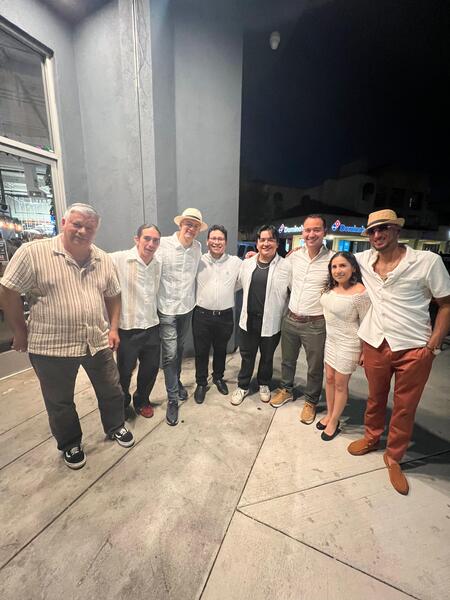
Erim and the rest of the band
From left to right Jim Miranda on Congas, Arturo Ramirez on Timbales, Erim Kardes on bass, Mark Trejo on Trumpet, Andy Garcia on Trombone, Gustavo Del Pino on piano, Marisol Echegoyen on Vocals, Luis Jimenez on vocals

Erim and Gustavo’s beginnings in music

The first to take the floor was Gustavo, who told us that he started playing piano at the age of six. His father played the saxophone and his mother played the piano, but they saw music only as a hobby and were not professional musicians. Throughout his childhood in Peru, he listened to a lot of Latin music at family gatherings, so six years later, at about age 12, he was already performing in front of crowds. Among his family’s most loved artists were El Gran Combo from Puerto Rico, Héctor Lavoe, and Rubén Blades.

After that, he studied classical music in a conservatory, and when he finally moved to the United States and met Erim and the rest of his bandmates, he studied at Berklee College of Music in Boston.

In Erim’s case, he said he started playing the guitar when he was 14 years old in Turkey, the country where he grew up. Like Gustavo, no one in his family was a musician, but that did not stop them from listening to Turkish music all the time, and it was from there that he started to like it beyond entertainment.

By the age of 20, he became interested in Latin music and began experimenting with it. He was in graduate school studying engineering in Los Angeles, where he had been living for some time, and taking some jazz courses at the University of California. One of his professors was the one who finally introduced him to Latin music, and he liked it so much that he never separated from it again. One of his most important teachers was legendary bassist from the band Weather Report, Alphonso Johnson.

Erim and the rest of the band
From left to right Jim Miranda on Congas, Arturo Ramirez on Timbales, Erim Kardes on bass, Mark Trejo on Trumpet, Andy Garcia on Trombone, Gustavo Del Pino on piano, Marisol Echegoyen on Vocals, Luis Jimenez on vocals
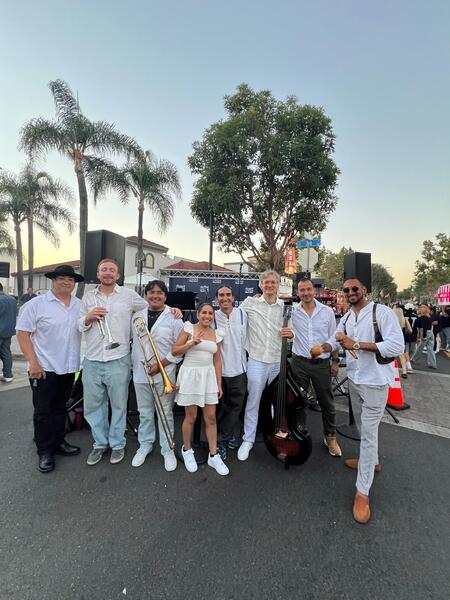
Erim and the band
From left to right: ERNESTO VALENZUELA on Congas, Joseph Dubois on Trumpet, Andy Garcia on Trombone, Marisol Echegoyen on Vocals, Arturo Ramirez on Timbales, Erim Kardes on bass, Gustavo Del Pino on Piano, Luis Jimenez on Vocals

Professional start for both

Coming back to Gustavo, he told us that when he completed his studies at Berklee, he began to get his first jobs as a professional musician. He started making small tours with some of the classmates alongside whom studied there and was involved in the recording of a few albums, but as a session musician. He did not yet have a formal band to be part of, but he did play with some Argentine, Colombian, and Peruvian artists and musicians. Some of them were Colombian singer Alejandra Jimenez “Alea” and the Peruvian band Perú Meztizo.

On the other hand, Erim told us that he first played bass in rock bands in college. He also played funk and jazz in Los Angeles for some time.

Foundation of Los Calicubanos

Erim created the idea of Los Calicubanos and eventually founded the band. The group, as it is known now, was officially launched in August 2025, i.e. that this month would be its first anniversary. Once he knew what he wanted, he placed online ads looking for a pianist to join him, which is when Gustavo contacted him and was tested until finally staying with the job.

At that same time, he met percussionist Arturo Ramírez, so the three of them got together in June 2025, and officially launched Los Calicubanos in August of the same year. They were later joined by conga player Jim Miranda, singer Luis Jiménez, singer Marisol Echegoyen, trombonist Andy García, trumpeter Mark Trejo, and trumpeter Joseph Dubois.

Musical director Erim Kardes
This is music director for Los Calicubanos Erim Kardes

Erim has been in California for the last 25 years and also traveled twice to Cuba, which led him to discover rhythms that fascinated him and changed his perspective on music completely. Therefore, he decided to combine “California” with “Cuba” because of the mix he wanted to make as a result of the music he discovered in both places.

Upcoming events

Los Calicubanos do not have any tours scheduled at this time, but they do have many important performances, such as the LA Jazz Festival, concerts at restaurants, and a few private events.

As for new releases, they are currently writing completely original music and making new arrangements, but they want to have a fair amount of material ready before entering the studio to record.

Read also: Puerto Rican Trombonist and percussionist Arturo Vazquez Jr. from Projecto 7 Salsa & Latin Jazz Band

North America / August 2026

https://salsagoogle.com/elizabeth-meeker-from-las-sabrosas-latin-orchestra/

https://salsagoogle.com/riverita-tells-the-story-of-how-he-created-noche/

https://salsagoogle.com/erim-kardes-and-gustavo-del-pino-los-calicubanos/

August 2026 FESTIVALS

United States flag
UNITED STATES


Eduardo Dance Class 7 2026Canto Tropical 2025Luis Medina

Spaha 06 2026Las Maracas promo

Martinez attorney

Directory of North American nightclubs

Canada flag
CANADA

Ontario, Canada
ONTARIO

Canada, Vancouver
VANCOUVER

United States flag
UNITED STATES
California US circular flag

CALIFORNIA

Florida circle flag
FLORIDA
Illinois circle flag

ILLINOIS

Michigan Circle flag

MICHIGAN

NJ circle flag

NEW JERSEY

New York Cicle flaga

NEW YORK

Ohio State
OHIO

Pennsylvania Circle Flag
PENNSYLVANIA

tEXAS CIRCULAR FLAG
TEXAS

Virginia Cirular Flag
VIRGINIA

Washington DC circle flag
WASHINGTON DC


  • « Go to Previous Page
  • Page 1
  • Page 2
  • Page 3
  • Page 4
  • Interim pages omitted …
  • Page 23
  • Go to Next Page »

International Salsa Magazine (ISM) is a monthly publication covering salsa activities around the world and has been publishing since 2007. It is a worldwide network of volunteers coordinated by ISM Magazine. Together, we work to strengthen salsa events around the world.