
| DIRECTORY OF NIGHTCLUBS | ||
|
|
|
|
|
|
|
|
|
|
|
|
|
|
|
|
|
|
|
|
|
|
|
|
| DIRECTORY OF NIGHTCLUBS | ||
|
|
|
|
|
|
|
|
|
|
|
|
|
|
|
|
|
|
|
|
|
|
|
|







| DIRECTORY OF NIGHTCLUBS | ||
|
|
|
|
|
|
|
|
|
|
|
|
|
|
|
|
|
|
|
|
|
|
|
|
Latin America / Colombia / Cali
La Topa Tolondra & its Salsa with Criterion ¨ A magical place in a unique space in Santiago de Cali¨
Because what matters is the music and its only and great protagonist “la salsa” a whole universe of happy individuals united by the melody, and all this happens because the salsa is tattooed in the hearts of many caleños and visitors to the area who It becomes evident on the dance floor, where you can find that visiting salsa public from all over the world that dances professionally, there are also those who dance well and those who don’t dance, but who doesn’t give a damn? “nothing”.
Those who are stung or guilla of dancers, those who go in sandals, those who go with tennis, those who go with heels, those who go elegant, those who go relaxed, the dreadlocks with long hair, those with afros, the gentleman and the lady, the chickens, the urban cyclists and even the rockers… and the list is endless because what matters is the music and its only and great protagonist “salsa”
“Lovers of Salsa and Bolero romantics attend weekly without age limits” To the rhythm of the Charanga, the Pachanga, the Boogaloo, the Guajira and the Son Cubano, it is enjoyed every night at the Topa Tolondra. Something unique happens in that magical place and that is that everyone forgets what they will say and they enjoy it from start to finish. In addition, local and international artists such as:
Esteban Copete y su Kintelo Paci co, Habana con Cola, Los Hermanos Lebrón, Clandestina Orquesta, Africali, Ebano y Marl, Bailatino, La Negramenta, Bobby Valentín and among others. For special dates ¬these and events such as Halloween that is approaching are organized. In “La Topa” as it is already known in Cali, sounds resound that arrived in the city between the 50s and 70s, where Salsa shapes the body and bolero its spirit, and going a little deeper we also perceive inclusive energies.
“Having fun is the only requirement to attend” “The Environment” For an unforgettable night you need two halves. The first is a table, chairs, water and drinks. And the second, and perhaps the most important: music and hit.
In Topa Tolondra there is plenty of space for gozadera, to sit down, to toast. Time does not run and there is no decache… “La Música” Here they marry the old guard of Los Hermanos Lebrón, Ángel Canales, La Sonora Ponceña, Frankie Dante and La Flamboyán.
The curatorship of its owner Carlos Ospina, its disc jockey and owner, is to learn it. It is not at all about impressing, it is about knowing how to find the subject at the right time.
¨Variety¨ Mondays are for foreigners. On Tuesdays there is a cinema-forum space and separate classes that are included with the 3 for 1 promotion (for every 3 Salsa songs, one bolero). Wednesdays are the best dancers in the city, Thursdays are dedicated to live salsa.
Finally, Fridays and Saturdays are reserved for these traditional Topa. “To Many Degrees” If your hair is long, bring something to tie it up with. If you are wearing a long-sleeved shirt, roll up the sleeves. If you are one of those people who is not used to consuming water, be prepared to drink what has not been drunk in a year. In La Topa you feel the harsh heat, so it is necessary to establish breaks to go outside to cool off “the heat outside will seem cool to you.”
For a round night, the ideal combination is beer, brandy and water, in dosed sips. Does the temperature exhaust? Yes, but it doesn’t matter if the song that is playing touches your ¬bras and reaches your heart. If you don’t know La Topa Tolondra, be sure to go and if you want to get a clearer idea before visiting, visit their fan page on Facebook www.facebook.com/Latopabar but don’t stay intrigued! Location of La Topa Tolondra. Cl. 5 #13-7, Cali, Valle del Cauca, Colombia Telephone: +57 323 5972646
The salsa museum has received several of the greatest artists and their families, who have donated valuable objects related to their careers. Today, it was the turn of Ángel Tomás Olivencia Rodríguez, who is artistically known as Tommy Olivencia Jr.
Tommy Olivencia Jr. is a percussionist and timbalero born on March 19, 1969 and is the son of the famous Puerto Rican musical icon and director of the Primerísima Orchestra Tommy Olivencia, from whom he inherited his great talent and has left his family’s name very high.
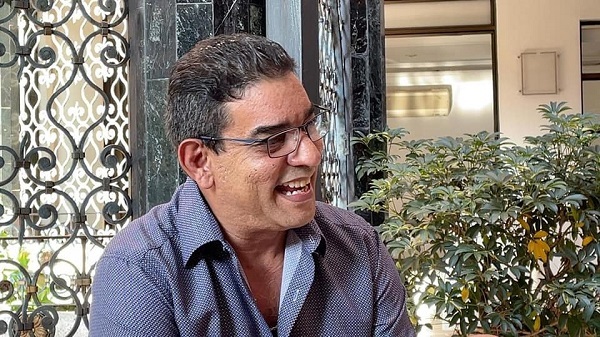
Eager to find his own way and make his own name in the industry, the artist made his debut with the recording ”Planté bandera de nuevo”, which was carried out in his native country and presents a total of nine tracks, some of them created by composer and percussionist Jerry Ferrao.
A very important fact during this period is that the timbalero made his official debut for AJ Records, Inc. in the framework of the 40th anniversary of Tommy Olivencia Y Su Orquesta at the beginning of this millennium, making this event even more special.
It is also important to highlight that this colorful musical work included the participation of figures such as Luis ”Perico” Ortiz. Máximo Torres, Tito Rivera, Pedro Bermúdez and many others. All these big talents made it possible for Tommy Olivencia Jr.’s first step as an artist to be on the right foot.
Once the incomparable Tommy Olivencia passed away, his son took the lead on the Primerísima Orchestra, which represented a great professional challenge for his career considering that many of his father’s hits are already salsa classics worldwide.
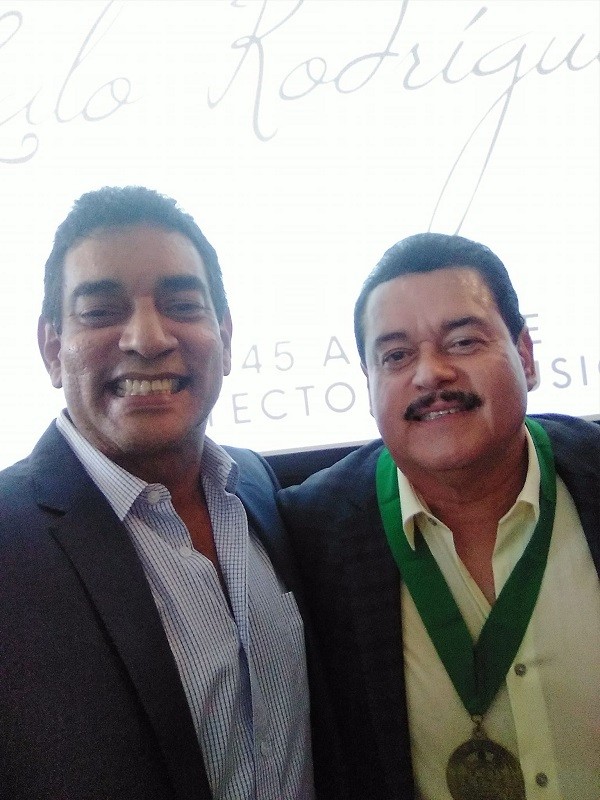
At the beginning, ”Tomito”, as he is also affectionately known, wanted to keep alive his father’s legacy with his most famous songs such as ”El Son Cubano”, ”Trucutú” or ”Doroteo”. However, there came a point where Olivencia and the rest of the members of La Primerísima had to get to work with new songs to join the previous hits.
When asked about these changes he had to make, he said that he has always worked on his father’s original repertoire, since the audience always asks for those songs in his performances. However, he says he is very happy to be able to contribute his grain of sand with the song ”Mi Querido Viejo”, which was dedicated to Tommy Olivencia senior and of which he is proud for the strng impact that it has had.
Something that made him very happy is that he was finally able to record his first video clip with the orchestra and other great artists such as Gilberto Santa Rosa, Lalo Rodriguez, Sammy Gonzalez, among others.
Although he feels quite pleased to be able to continue with the steps taken his father, he is very proud to offer completely new songs to join the already prolific repertoire of La Primerísima. Among the new songs are ”Un Legendario de Pueblo” and ”Evelio”.
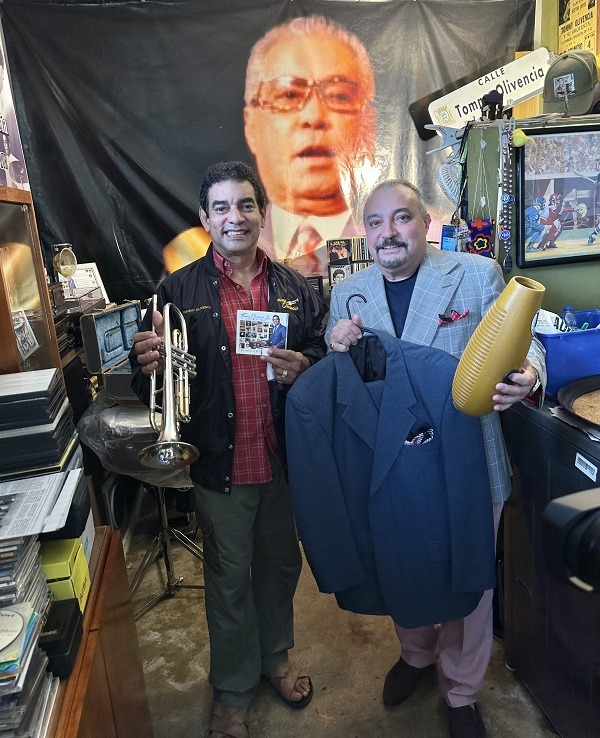
As well as a good number of other stars and their families, we were fortunate to enjoy the pleasant presence of Tommy Olivencia Jr. at the Spanish Harlem Salsa Museum, where he and the president of the institution, Johnny Cruz, had a nice chat and walk around the facilities of the place.
At these visits, it is very common for visitors to make donations to contribute to the extensive collection that the museum has to present and this was no exception. ”Tomito” donated a suit and the güiro of maestro Tommy Olivencia that whosoever visits the museum has the opportunity to appreciate some of the elements that his father used during his career.
From this space, we really thank his visit and his contributions and we wish him the greatest success in all the projects he undertakes both professionally and personally, especially what has to do with music.
Read also: Joe Bataan’s music remains in force

By Johnny Cruz, ISM Correspondent, New York, New York City


“If people dedicate themselves to this, it is because we are doing it well.” This nice phrase arose from the pleasant and attractive telephone conversation about the history of the pioneer of Salsa Casino in Venezuela, the charismatic Cuban-Venezuelan musician and instructor Pedro González.
This affable musician and Salsa Casino instructor told us that he carved out his career from a very young age. He was born in Havana (Cuba) in 1966 and began his musical studies at the National School of Arts in the Havana capital at the age of ten, graduating in the specialty of Guitar (Short Course of 8 years) in 1984.
He comes from a musical family, his grandmother was the soprano Rosa “La China” and his mother (teacher and school principal) Zoe Portuondo Suarez, a distant relative of the singer Omara Portuondo.
“…Since I was little I liked to dance, I would dance everywhere. I learned with my cousin… I went to places like Playa… Besides, my mother danced a lot and my grandmother was a singer and she was also linked to the world of art…” Pedro commented.
His first job was as a music teacher in the Pinar del Río city, three hours from Havana. A short time later, he joins the Caranday group, and they play Son Cubano every night at the luxurious Hotel Nacional De Cuba.
After 45 days from his first presentation with the group, they meet the Venezuelan businessman Martín Gutiérrez, who takes them to Venezuela in 1993 to perform at private parties in the Falcón state.
Due to the few opportunities he had in Cuba, he decided to stay in Venezuela and formed the Latino Son band, made up of four Cuban musicians, and in turn began to be members of the Tropicana-style Cuban Fiesta Magazine (Show with a range of musical genres, interaction with guest singers, and dancers) in nightclubs of the Capital.
In Moments of pause with the musical magazine (1997), he undertook a tour with the Latino Son group with whom he traveled for almost all of Venezuela and toured the main stages of large national festivals such as La Feria del Sol (Mérida), Feria de San Sebastián (San Cristóbal), and La Feria de la Chinita (Zulia) among many others.
“We played permanently at La Giralda… At La Giralda we organized a party playing the Cuban Timba, then, there they called us “The Cuban Orchestra” in 1996, 1997, and 1998…”
During the ’90s and already residing in Venezuela, Pedro became the first Salsa Casino instructor in Venezuela without planning it as a life plan, and in 2000 he founded his homonymous academy that has graduated thousands of fans of this style of salsa dance.
Dancing is one thing that keeps you active. That is good for the body. If you have a problem in two hours or an hour and a half dancing you forget it. For my part, I like to teach… And, I like people to have fun.” Pedro González

One night at the end of the 90s, Pedro along with his friend Milan (Medical and Countryman) began to remember the Dance of the Casino in La Giralda (old venue to listen to live music and enjoy various drinks on the Boulevard de Sábana Grande – Caracas) after his customary presentation with the Latino Son group.
Both began to stand out on the dance floor with the genre of La Timba and for a way of dancing Salsa different from the one practiced in Venezuela. “We began to dance with two Venezuelan girls in the Rueda style (which was not a Rueda because there must be 3 couples)… I began to say Milan “Give me one”, “Plugin”, “The Hat”, and we began to dance the Casino Style”. Pedro “El Cubano” told us between laughs during the interview.
The two ladies were so impressed by that way of dancing that they did not hesitate for a moment to ask Pedro for dance lessons. After so much insistence, “El Cubano” agreed for the first time to give Salsa Casino classes in the capital of Venezuela in an improvised and reduced space with his first five couples. “I am from the Cerro municipality, which is the closest to Old Havana. I used to go to Playa (Municipality of Havana) a lot to dance and I learned many dances and turns…”
And so Salsa Casino began spontaneously in 1999. By the following year (2000), Pedro had 20 couples and a larger room to teach.
The evolution of him in his rise during this year was impressive. Due to the influx of students, he began to teach in the blue auditorium of the Faculty of Economic and Social Sciences (Faces) of the most prestigious University in the country, the Central University of Venezuela (UCV) through Reinaldo Mijares, Director, and choreographer of the contemporary dance “Mudanza” attached to this institution and where González assures that this movement grows.
From there, he gave way to the Casa Monagas club, a place located in the Las Acacias sector (west of Caracas) behind the UCV with the capacity to hold up to 1,000 people. Here, Pedro’s students had more space to rehearse, and Salsa Casino Parties began to be organized monthly.

With this overwhelming success, the creation of the Academia Salsa Casino in Caracas was imminent. It had massive attendance, national impact with graduate students, and attendance at national and international festivals such as Curacao Salsa Tour, Festivals in Cuba, and an amazing show at the Amador Bendayán Theater.
With more than 20 years of teaching Salsa lessons, Pedro has graduated more than 2000 students and changed its name to Academia Pedro González. It currently has five locations: Sábana Grande (main location), Chacaíto, San Antonio de los Altos (Los Teques), Capitolio, and El Cafetal.
The classes are aimed at children and adults. The call is open, so you can sign up without a partner and don’t worry because the essence of the Rueda remains. The estimated graduation time is three years with four basic levels, four intermediate levels, six advanced levels, you will also receive a triple casino level, two dance technique levels, and to complete the process a final choreographic exam is done.
Every dance lesson is fun because of Pedro’s ability to teach. The names of each step such as “Pégale un Cacho” are adapted to the colloquial vocabulary of the Venezuelan so that it is easy and fast to learn.
Due to Covid-19, the Pedro González Academy makes the use of the mask and antibacterial gel an essential requirement for permanence within the institution, as well as reducing the maximum number of couples per level to only ten.

At the main headquarters, there are four instructors. One of them is Vanessa Lovera, a graduate instructor from the academy. For Pedro, she has been unconditional support in difficult moments of the institution. Vanessa teaches Salsa Casino and Ballroom Dance. You can also find her at the El Cafetal headquarters, but if you prefer the main headquarters, the address is as follows: Sábana Grande Boulevard, Fénix building, 5th floor, next to the Gran Café.
For this 2022 and if there is a return to normality, the Cuban instructor and musician residing in Venezuela hopes to resume the lost spaces in Caracas such as discos, nightclubs, presentations in theaters, once again hold large Salsa Casino parties in large rooms, the return of national competitions, and the continuation of the training of instructors in person (it is only online currently).

According to the friendly instructor Pedro González, the origin of Salsa Casino on the island of Cuba has a unique story that begins like this…
Since 1956 numerous Cuban orchestras have been registered that played very popular and contagious musical genres such as Cha Cha Cha, Guaracha, Mambo, and Son. Rhythms that invited the young inhabitants of Cuba of this time to just want to dance and have fun all night with these melodies, but they not only wanted to do it with their partners but also with those of their friends, acquaintances, and strangers. However, for this decade that was not allowed because the rules of the strict and conservative society dictated it.
In this way and with the pursuit of that goal, the gentlemen created this style of dance. A style that did not require constant practice and where partners could be exchanged using keywords such as “Plugin” to perform the movement and for the theory to be carried out perfectly without altering society. The place where this event was recorded was Casino Deportivo, a private summer vacation club located in the Miramar residential area in Havana.
“We (in Venezuela) call it Salsa Casino because it is the commercial name already used in the United States. In Europe they call it Salsa Cubana, but the original name is Baile Del Casino”. Pedro Gonzalez
That is why at the end of 1950 this style of dance began to be generated that people internationally associate with the style of gambling performed in a Casino because it is a dance in Rueda.
The popular expression of most people in Cuba every time they saw this peculiar way of dancing was to say “Ah! But you are dancing like the people of the Casino (Casino Deportivo Club)” that each day was shortening the expression until reaching the Baile Del Casino.
The peculiarity of this dance style is that it does not have a musical genre, that is, no melody that identifies it. For example, a Danzón is danced with the music of the Danzón, the same happens with the Cha Cha Cha, Mambo, Son, and Bolero. There is no rhythm called Casino, therefore this style acclaimed in the world and preferred by Cubans began with the music that existed in this glorious decade of the ’50s.