
 |
 |
 |
 |
 |
|
 |
|
 |
|
 |
|
 |
|
 |
|
 |
|
 |
|
| “We are the Real Latin music world network” | |
 |
 |
Latinoamerica / Colombia / Cali
Latin percussionist born in Cali, Colombia. Since she was little she felt passion for music, singing, dancing and playing percussion. At the age of 17, she was invited by her cousin to a rehearsal and since she saw the Timbal she knew she had to undertake ‘the conquest for him’.

The first orchestra with which he worked was called Tumbadora, made up of women. Three years later she joined the Canela Orchestra, made up of 13 women and internationally recognized. Thanks to the tutelage and trust of percussionists from the most important groups in Colombia, such as Grupo Niche, Orquesta Guayacán, la Identidad and others, she was able to move forward and thus demonstrate that women, with effort, passion and dedication can conquer any instrument of percussion.

Elizabeth has had the opportunity to travel the world and share the stage with renowned artists such as Gilberto Santarosa, Andy Montañez, la Sonora Ponceña and the Gran Combo de Puerto Rico. With the latter two, he had the opportunity to share Timbal solos at the Bacardi Salsa Congress in Puerto Rico.

She recorded on the first album of Grupo Kemade Colombia directed by one of the most important musical producers in Colombia, José Aguirre, former director of Grupo Niche, Son de Cali and Yuri Buenaventura. In the educational field, Elizabeth founded the Percussion Academy in Cali which she directed for four years. In it children and adults received instruction.

Elizabeth has been based in Tampa, Florida for four years, where she develops as an independent musician. There he has shared the Timbal with renowned musicians such as Chago Martínez (timbalero and musical director of Víctor Manuelle), La India, Isidro Infante, Ramón Sánchez, Jerry Rivera and Michael Stuart. He is currently part of the Sol Caribe Orchestra.


Elizabeth has always proudly played the Timbale LP ‘Stainless Steel’, model Tito Puente. In her own words “I’m happy with my Timbale! I feel safe, calm and I love its sound”.


Facebook: https://www.facebook.com/pg/elisabethtimbal/posts/?ref=page_internal
Christmas is a time of joy where one of the most important elements is music, so we believe this is the best opportunity to feature some of the best Christmas salsa songs that we can remember. Here are the most cheerful songs in Latin music to listen to during the most beautiful time of the year.
”Aires de Navidad” is a great song which is part of the Christmas album ”Asalto Navideño Vol. I” from 1971. In the same year, Lavoe and Colón were already making preparations to record an album entirely dedicated to the festivities, indeed, they already had some songs recorded, but they knew that there were still details to finish.
Then, Héctor asked musician Roberto García to join the project that was underway, as they needed a guitarist to accompany them. Garcia accepted the proposal almost immediately and got excited about the project that he even proposed Yomo Toro to join them, to which Hector and Willie agreed with no problems.
The day they agreed to record the material, Toro came in first and began playing a Puerto Rican cuatro when he was scheduled to play the electric guitar. However, Johnny Pacheco, upon hearing the sounds, liked the arrangement and approved it without question.
That is how the four artists set out and recorded what would soon become one of the greatest Christmas hymns in recent times, and it will surely be in thousands of homes around the world this month.

”La Fiesta de Pilito” is included in the album ”Nuestra Música” by El Gran Combo de Puerto Rico, which was recorded in 1985 as a tribute to the most beautiful and endearing of the Island of Enchantment during the Christmas holidays. Back then, any musical work created by El Gran Combo always became a resounding success once it was released and its members were sure that this would be no exception.
It is then when the composer of one of the main songs of ”Nuestra Música” came on the scene, and we are talking about Luis ”Pilito” Cruz, who would become part of the internationally acclaimed salsa group that same year.
What is known in the first instance about the song is that it did not have a specific name, so it was baptized as ”La Fiesta de Pilito” honoring the composer of its first two verses. Subsequently, the piece was completed with pregones and soneos created by the rest of the orchestra members.
Additionally, they received the support and collaboration from ‘‘El Caballero de La Salsa” Gilberto Santa Rosa, who served as a guest artist for the legendary recording.

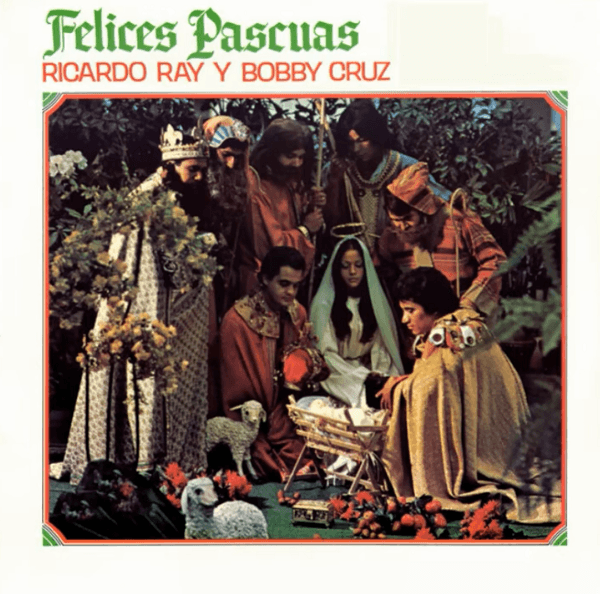
”Bembé En Casa de Pinki” is a Christmas song written by the famous duo Richie Ray and Bobby Cruz, which was released in 1971 and is the first single from the Christmas album ”Felices Pascuas”.
The song’s title comes from someone who would be very important in the career of the two aforementioned artists and that was the Panamanian-born diplomat named José Rogelio ”Pinki” Arias. The gentleman was a close friend of Richie and Bobby and, at the same time, director of the Panamanian Institute of Tourism. He used his friendship with the vocalists to invite them to various events in his country, knowing that they would be a complete success with the presence of the duo.
Such was the affection both exponents had for ”Pinki” that they dedicated to him two songs from their extensive repertoire, which were ”Bembé en Casa de Pinki” and one belonging to the album ”El Diferente”.
Among other songs, ”Felices Pascuas” also includes tracks such as ”Bomba en Navidad”, ”Mi Niñez”, ”San José”, and ”Aguinaldo Navideño”.
Another group that never misses a chance to offer their talent to please their fans and make them enter the Christmas atmosphere during the holiday season, leaving great classics that can not be missing every year in our homes and one of them is ”Estelita”.
Something that can never be missed in a Christmas album is that colorful character who always brings playfulness and good humor to the atmosphere. In this case, it is Estelita, who is a party neighbor who always sneaks into the Christmas parrandas in her neighborhood, something that many people will surely feel identified with in various parts of Latin America.
The song was written by the late maestro Joe Torres and was part of the album ”Otra Navidad Criolla!” along with ”Opera Gandinga”, ”Vamonos Pa’l Campo”, ”La Vengo Siguiendo”.
Read also: Luis Guillermo Rangel the great friend of everyone
Edgardo ”El Bambino” Otero Lugo is the one to whom we want to dedicate some of the lines of this edition in International Salsa Magazine. The talented Puerto Rican vocalist has given us a few minutes of his time to talk exclusively about his beginnings, his career and other unpublished details that are not read in other media.

As Edgardo’s childhood took place in his hometown of Vega Baja, Puerto Rico, the artist recalls that he would sit on the balcony of his house and play with buckets and sticks to pretend to play music. His mother, fed up with the noise he made, decided to enroll him in the school choir so that he could explore his curiosity about music in a more professional way. That was when he was in the fifth grade of the elementary school.
As the years went by, the boy’s love for music just kept growing, until he got his first big opportunity thanks to singer-songwriter Edwin Crespo, who had already written for famous groups such as La Sonora Ponceña at the time. Back then, Edgardo was only 14 or 15 years old, so he still needed a lot of guidance on these issues, so maestro Crespo was the ideal person for that.
It just so happenes that Pedro Crespo, Edwin’s father, was the founder of his own orchestra and grandfather of some of Edgardo’s cousins. Since they all lived nearby, Edwin heard him singing one day and liked his voice, so he offered to teach him how to sing professionally and invited him to join his Orquesta Ética, which is where it all began.
By being part of the Orquesta Ética, Edwin decided to spend two or three days a week explaining to Edgardo what to do and how to do it so that everything would go wonderfully for the young vocalist, and that is exactly what happened. So much so that Edgardo spent about three years singing for the group, in which he claims to have learned much of what he knows today.

After having left Orquesta La Ética, Edgardo was also part of Orquesta Los Rukanos, which was much bigger, had more instruments and more musicians. Therefore, it represented a bigger and more complex challenge.
In 1981, he was invited to join the group by a Guyanese friend and colleague named Ferniand Pudia, who asked Edgardo to join him in a musical project he was working on, which he would name Los Rukanos, paying homage to the term used to refer to peasants and working class men in the South American country.
Alongside with this orchestra, of which Edgardo was also one of the founders, he managed to perform in completely new stages and to follow his path in the learning of this complex and rich world that is music.
During a concert in his hometown, the members of Conjunto Quisqueya heard Edgardo singing and liked his voice so much that they invited him to play with them in a project for Nelson García, who at that time was the second trumpet of the orchestra.
Having accepted the offer, the group recorded a whole LP called ”Nelson García y Merengue ’86”, which was a very nice experience for Edgardo since he had never had the opportunity to record in a studio before and finally he was able to do so. And it was not just any studio, but one of the most important in Puerto Rico, which was Tele-Sound Recording Studios.
”Playing with the members of Conjunto Quisqueya was a spectacular experience. Their musicians are wonderful human beings with whom I still have very strong friendship bonds” said Edgardo about his experience in the ensemble.

There were some years that merengue was gaining a lot of popularity in Puerto Rico, so the artists and groups of the moment had to adapt to fulfill the musical taste of the audience. Such was the case of saxophonist Angel Rivera, also originally from Vega Baja, who created an orchestra and invited several musicians to play with him, including Edgardo.
The result was good acceptance from the public to the extent that the orchestra participated in competitions and won some awards thanks to the work done.
This was very useful for Edgardo’s career, since he succeeded in diversifying his rhythms and learning to play new things and genres, which made him acquire a lot of knowledge. Until such time as he played with Conjunto Quisqueya, he had only done salsa, so trying merengue was really enriching for the musician.
Edgardo was in the Puerto Rico National Guard for about 24 years in total and he remembers a time when he was mobilized to the Iraq War in 2006, the year in which he met Edwin ”El Calvito” Reyes, who was part of the 3rd Infantry. El Calvito” had a group whose lead singer could not speak Spanish, so he learned the lyrics phonetically in order to perform them.
The chemistry between all the members was so great that they even played a few times at the U.S. base in Baghdad, where he stayed until 2008. It was then that he returned to Puerto Rico to adapt gradually to civilian life again, during which time he met Raphy Santana and joined his Tribute Orchestra, which made music to pay homage to maestro Héctor Lavoe.
Permanent move to the United States
In 2019, both Edgardo and his wife were retired from their jobs, so they thought it was a good time for a change of scenery, as they felt that nothing interesting was going on musically. This led them to move to the United States to settle permanently there, although he continued to travel to Puerto Rico to meet some commitments with La Corporación Latina, of which he was still part at that time.
Read also: Momotombo SF with former members of Malo and Santana
José Ernesto Parra was born in Santurce and grew up in Bayamón, Puerto Rico. From a very early age, he was an admirer of the music of La Sonora Ponceña and El Gran Combo de Puerto Rico. Later, Héctor Lavoe, Frankie Ruiz and Luisito Carrión became his references.

Before deciding on singing, he was captivated by percussion, focusing on the conga and drums.
Eventually, he began to explore his vocal ability, with the help of composer and music teacher Rafy Monclova. This training led him to become a singer, while helping him develop his distinctive interpretive style.
In 1989, José Ernesto Parra joined the orchestra of singer Viti Ruiz, just at the time when the latter was beginning to enjoy success with the hit ‘Caricias Prohibidas’. For two years, José Ernesto was part of Viti’s orchestra, which allowed him to perform his first shows outside of Puerto Rico, marking the beginning of his career in the international music scene.

Later, the renowned musician and producer Julio “Gunda” Merced identified José Ernesto Parra’s talent, selecting him as a backing vocalist for a series of recordings of artists belonging to the Musical Production M.P. label. During that period, José Ernesto’s voice was recorded in important projects for artists such as Anthony Cruz, Giro, Los Hijos de los Célebres, Luisito Carrión, Pedro Conga, Tito Gómez and Tito Rojas, among others. Thus, he was able to hone his skills as a vocalist while collaborating with the production team in the creative process behind some of the greatest salsa hits.
In addition, José Ernesto Parra stood out as the lead singer in the short-lived but innovative group Salsa 2000, expanding his experience in the salsa field, demonstrating his versatility and interpretive abilities. He also played an important part in the album Con el golpe de siempre, with which Pedro Conga’s La Internacional orchestra celebrated its 35th anniversary. For the latter, José Ernesto sang the songs ‘Contigo estaré’, ‘Si me vuelvo loco’, ‘No quiero, no puedo’, ‘El ritmo que pica’ and ‘Parece’.
That stage laid the groundwork for the creation of his record production Así es la vida, published under the M.P. label. The album included songs by renowned composers such as Harry Suárez, Mimi Ibarra, Pedro Jesús and Rando Tamasta. In addition, it featured arrangements by the talented Julio “Gunda” Merced, Ramón Sánchez and Rafael “Bodo” Torres. Among the songs on the album are ‘Morir por amar’, ‘Solo por ti’, ‘Un amor así’ and ‘Cosas bonitas’.

Later, and for a brief but significant period, José Ernesto further expanded his professional horizon by collaborating with the Don Perignon orchestra and with Tommy Olivencia’s La Primerísima. These interventions offered him the possibility of interacting with different musical styles and approaches, strengthening his versatility within salsa.
Social Networks
José Ernesto Parra (Singer)
jose.ernesto.parra
To book José Ernesto Parra you can contact him at (787) 309-2958 or write to the email: [email protected]

Also Read: Robert Tellez is undoubtedly “El más que sabe de salsa” (The one who knows the most about Salsa)