• Skip to primary navigation
  • Skip to main content

International Salsa Magazine

  • HOME
  • Previous editions
    • 2026
      • ISM / July 2026
      • ISM / June 2026
      • ISM / May 2026
      • ISM / April 2026
      • ISM / March 2026
      • ISM / February 2026
      • ISM / January 2026
    • 2025
      • ISM / December 2025
      • ISM / November 2025
      • ISM / October 2025
      • ISM / September 2025
      • ISM / August 2025
      • ISM / July 2025
      • ISM / June 2025
      • ISM / May2025
      • ISM / April 2025
      • ISM / March 2025
      • ISM / February 2025
      • ISM / January 2025
    • 2024
      • ISM / December 2024
      • ISM / November 2024
      • ISM / October 2024
      • ISM / September 2024
      • ISM / August 2024
      • ISM / July 2024
      • ISM / June 2024
      • ISM / May 2024
      • ISM / April 2024
      • ISM / March 2024
      • ISM / February 2024
      • ISM / January 2024
    • 2023
      • ISM / December 2023
      • ISM / November 2023
      • ISM / October 2023
      • ISM – September 2023
      • ISM – August 2023
      • ISM July 2023
      • ISM Edition June 2023
      • ISM – May 2023
      • ISM April 2023
      • ISM March 2023
      • ISM February 2023
      • ISM January 2023
    • 2022
      • ISM December 2022
      • ISM November 2022
      • ISM October 2022
      • ISM September 2022
      • ISM August 2022
      • ISM July 2022
      • ISM June 2022
      • ISM May 2022
      • ISM February 2022
      • ISM January 2022
    • 2021
      • ISM December 2021
      • ISM November 2021
      • ISM October – 2021
      • ISM September 2021
      • ISM August 2021
      • ISM July 2021
      • ISM May 2021
      • ISM April 2021
      • ISM June 2021
      • ISM March 2021
      • ISM February 2021
      • ISM January 2021
    • 2020
      • ISM December 2020
      • ISM November 2020
      • ISM October 2020
      • ISM September 2020
      • ISM August 2020
      • ISM July 2020
      • ISM June 2020
      • ISM May 2020
      • ISM April 2020
      • ISM March 2020
      • ISM February 2020
      • ISM January 2020
    • 2019
      • ISM December 2019
      • ISM November 2019
      • ISM October 2019
      • ISM Septembre 2019
      • ISM August 2019
      • ISM July 2019
      • ISM June 2019
      • ISM May 2019
      • ISM April 2019
      • ISM March 2019
      • ISM February 2019
      • ISM January 2019
    • 2018
      • ISM December 2018
      • ISM November 2018
      • ISM October 2018
      • ISM September 2018
      • ISM August 2018
      • ISM July 2018
      • ISM June 2018
      • ISM May 2018
      • ISM April 2018
      • ISM March 2018
      • ISM February 2018
      • ISM January 2018
    • 2017
      • ISM December 2017
      • ISM November 2017
      • ISM October 2017
      • ISM September 2017
      • ISM August 2017
      • ISM July 2017
      • ISM June 2017
      • ISM May 2017
      • ISM April 2017
      • ISM March 2017
      • ISM February 2017
      • ISM January 2017
    • 2016
      • ISM December 2016
      • ISM November 2016
      • ISM October 2016
      • ISM September 2016
  • Spanish
  • Download Salsa App
    • Android
    • Apple

Search Results for: La Sonora Ponceña

National Zalsa Day in its XXXIX edition a total success

Sunday, March 19, 2023, the 39th edition of National Zalsa Day returned to the date established in 2000 with the approval of Law No. 100, which decrees the third Sunday of March of each year as National Salsa Day.

This edition of the activity of worldwide importance, which has almost reached four decades since its first edition at the José Pepito Bonano Park in Guaynabo, demonstrated Z-93’s support for the proposals of the new generation. That promise, made in its 38th edition, has been fulfilled.

The day began at about eleven in the morning. The Orquesta del Rey de Puerto Rico, winners of the contest held in Panama to select the talent to be presented yesterday on the DNZ stage, was in charge of the ignition.

Orquesta del Rey de Puerto Rico after the performance that kicked off the National Zalsa Day

As soon as this first intervention culminated; the orchestra of Robert Burgos shone in a change of rhythm something more cubaneao. When the sun was at its hottest moment, Maelo Ruiz arrived on stage for the first time as a soloist, accompanied by the musical direction of his nephew, the outstanding percussionist of the so-called nueva cepa: Jean Carlos Camuñas.  Pirulo arrived on stage with his usual urban charisma, stealing the hearts of the new salsa

The fifth intervention marked the arrival of the Orquesta del Día Nacional, led by the multifaceted Isidro Infante.  The orchestra backed Nino Segarra, who enchanted the audience with Entre la espada y la pared and Porque te amo; Yolanda Rivera, who performed Se formó and Hasta que se rompa el cuero as well as a descarga in front of the timbal; Luigui Texidor, who sang Boranda and Moreno soy.
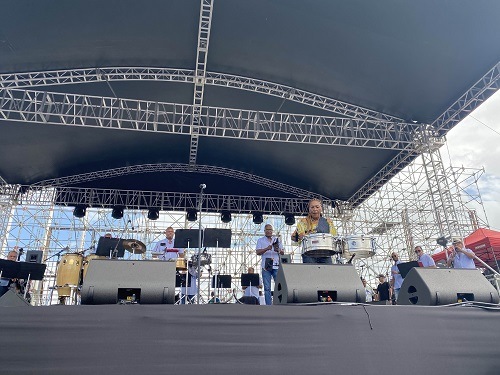
Yolanda Rivera performing a timbal solo

Next, “El Niño Bonito de la Salsa”, Ismael Miranda arrived accompanied by his family and Pastor Alex D’ Castro to receive from Néstor Galán -better known as “el búho loco”- the well-deserved Estrella Award, instituted as part of the annual salsa day.
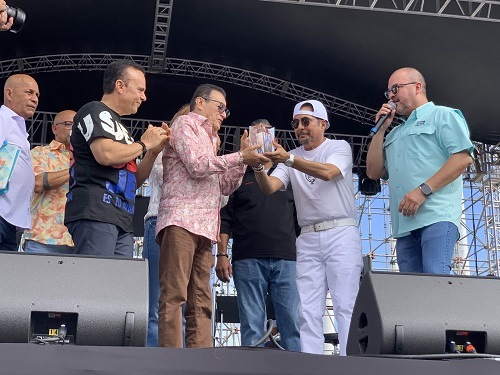
Ismael Miranda receives Estrella Award from Néstor Galán

Once the Estrella Award was presented to Miranda, Pichie Pérez sang El sonero del bailador and a medley of the songs that consolidated him as a singer when he was part of the giants of the south, the Sonora Ponceña. These were: Hacheros pa’ un palo, Fuego en el 23, El pío pío and Yambeque.

After Pichie finished his performance, Alex D’ Castro took the stage and gave the evening its climax with Te fuiste, Como si nada and Si no fuera por ti. Alex was followed by the new promise of salsa, already recorded, published and released by Sony Music Latin: Luis Figueroa.

As part of the tribute to the 50th anniversary of the establishment of Típica 73, there was a reunion on stage of singers Tito Allen, Adalberto Santiago and José Alberto “El Canario”; backed by the manager of Típica 73, Johnny Dandy Rodríguez. Tito Allen performed Guancona and Guaguancó de los violentos. Adalberto Santiago showed off his voice with Mañoño and La candela. For his part, “El Canario” arrived with his usual scenic mastery with A la hora que me llamen voy, Esta noche pinta bien, Xiomara -a theme in which he was accompanied by Tito Allen and Adalberto Santiago- and Baila que baila.
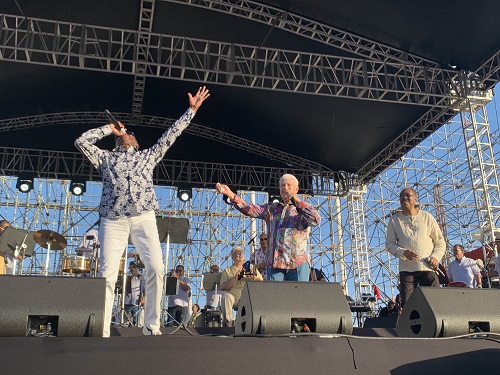
José Alberto "El Canario", Adalberto Santiago and Tito Allen joined Johnny "Dandy" Rodríguez in tribute to Típica 73
José Alberto “El Canario”, Adalberto Santiago and Tito Allen joined Johnny “Dandy” Rodríguez in tribute to Típica 73

After the segment in which the three singers came together again, bongos player Johnny Dandy received the tribute on behalf of Típica. The first intervention of the DNZ Orchestra closed with Domingo Quiñones in an energetic interpretation of Salsumba, a song with which he participated in the production El número 100 of the “King of the Timbal”, Tito Puente.
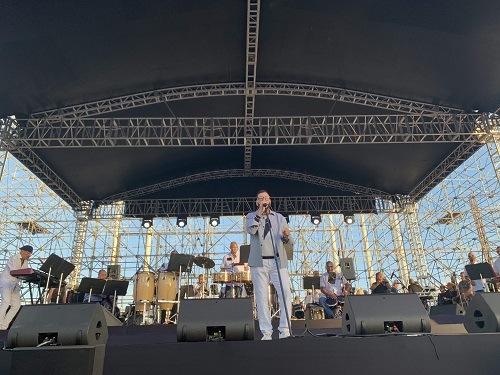
Domingo Quiñones performed Salsumba, a song he recorded with El Rey del Timbal for his production 'El número 100'
Domingo Quiñones performed Salsumba, a song he recorded with El Rey del Timbal for his production ‘El número 100’

When the afternoon wanted to give way to the night, Charlie Aponte’s orchestra was in charge of keeping the audience in the necessary mood to continue with salsa. The songs that Charlie kept the audience captive were Arroz con habichuelas, Se nos rompió el amor, Teléfono, Esos ojitos negros, Goyito Sabater and Gracias salsero.
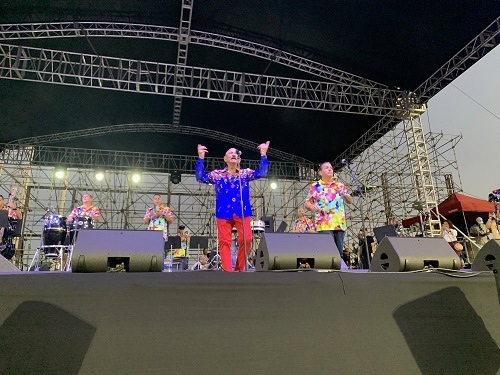
Charlie Aponte and his orchestra

Preceding the tribute to the “King of the Timbal”, on the 100th anniversary of his birth; India showed off her interpretative quality, evidencing her well-earned title. Yes, India is “la más que canta”. Her interpretation of Vivir lo nuestro, Dicen que soy -a song for which she was accompanied by Sergio George on piano shortly after he brought her a birthday cake on stage-, Ese hombre and Mi primera rumba showed her vocal virtuosity.
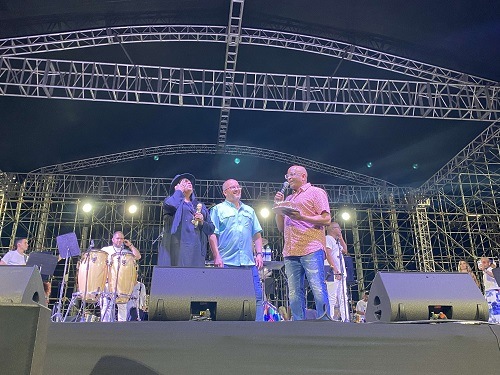
Sergio George celebrated India's birthday within the framework of DNZ 2023
Sergio George celebrated India’s birthday within the framework of DNZ 2023

The concert was closed by Tito Puente, Jr. surrounded by timbaleros Nicky Marrero, Endel Dueño and Orestes Vilató, under the musical direction of timbalero José Madera.  Tito’s guest singers for the closing were Frankie Figueroa, Frankie Morales and Melina Almodóvar.
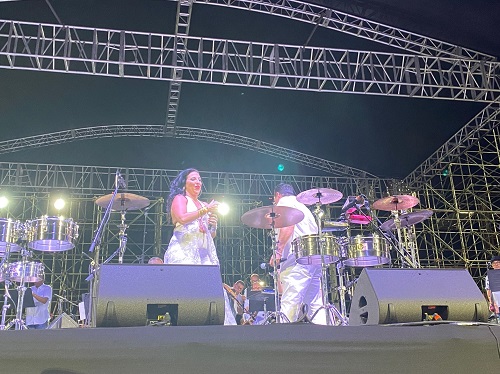
Melina Almodóvar fue una de las invitadas de Tito Puente, Jr.


Bella Martinez
Writer, Afro-Caribbean Music Researcher
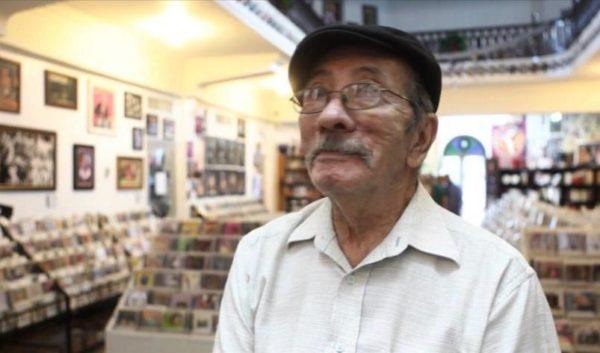
On March 19, 1928, in Guaynabo, Puerto Rico, Rafael Viera Figueroa was born.


Excellent Music Promoter. Remembered for promoting the LP Siembra by W Colón and R Blades. He founded Viera Discos, “Cathedral of Latin Music”.

He was considered one of the main disseminators of salsa in Puerto Rico, Rafael Viera, also creator of Viera Discos, one of the most important points of the movement until 2016, year in which it was closed.

Viera Figueroa was, from the late sixties to the eighties, Fania’s representative on the island. Why? He was the one who brought the music of the label founded by Pacheco and Masucci to the land of Ismael Rivera, when it was mainly distributed in the United States.

He was the promoter of the first Fania All Stars concert in Puerto Rico in 1973 and was in charge of bringing to Puerto Rico the films ‘Our Latin Thing’ and ‘Salsa’, which packed the local theaters in the seventies. According to Primera Hora, he was the one who inaugurated the Roberto Clemente Coliseum in San Juan.

In 2014 Viera suffered a stroke that kept him in intensive care. On that occasion his son, Richie Viera, gave these words to the aforementioned media: “I am a man of faith, and in God I trust that Dad will recover and will be able to continue with us for many more years, offering us his wisdom, his anecdotes and promoting and collaborating so that new talents will have a place in Latin music”.

Viera was known for the famous Casa del Coleccionista store, which he ran for more than 60 years in Santurce, for Viera Discos and for the Catedral de la Música.

He was also one of the driving forces behind the salsa boom at the time of Fania Records, where he worked as producer and promotion manager of the conglomerate of record labels; Fania Records, Vaya Records, Tico Records, Alegre Records, Cotique Records, Éxito Records, International Records and Música Latina, among others.

He was also involved in the success of the careers of artists such as Willie Colón, Larry Harlow, Cheo Feliciano, Richie Ray and Bobby Cruz, Celia Cruz, Ismael Miranda, Sandro, Sabú, Willie Rosario, Miki Vimari, Sonora Ponceña, Tommy Olivencia, La Lupe, Tito Puente, Eddie Palmieri, Ismael Quintana, Justo Betancourt, Héctor Lavoe, Tito Rojas, Frankie Ruiz, Corporación Latina, Junior Toledo, Viti Ruiz, Guillo Rivera, Ray Barreto, Willie Rosario, Orquesta La Terrífica, Roberto Roena y su Apollo Sound, Johnny Pacheco, Pete “El Conde” Rodríguez, Impacto Crea, Ismael Rivera, Raphael, Wilkins, Trio Los Condes, Joan Manuel Serrat and the most important conglomerate of musicians in the history of Latin music known as Fania All Stars, among others. In 1973, he was the promoter of the first Fania All Stars concert in Puerto Rico, which inaugurated the Roberto Clemente Coliseum in San Juan.

In the field of cinema, Viera brought to Puerto Rico the film “Our Latin Thing” and Salsa, films that crowded the local movie theaters.

He passed away on January 13, 2019 in Puerto Rico, may he rest in peace and eternal glory to Rafael Viera!


By Bella Martinez, ISM Correspondents, San Juan, Puerto Rico


On March 19, 1928, in Guaynabo, Puerto Rico, Rafael Viera Figueroa was born.

Excellent Music Promoter. Remembered for promoting the LP Siembra by W Colón and R Blades. He founded Viera Discos, “Cathedral of Latin Music”.

He was considered one of the main disseminators of salsa in Puerto Rico, Rafael Viera, also creator of Viera Discos, one of the most important points of the movement until 2016, year in which it was closed.

Viera Figueroa was, from the late sixties to the eighties, Fania’s representative on the island. Why? He was the one who brought the music of the label founded by Pacheco and Masucci to the land of Ismael Rivera, when it was mainly distributed in the United States.

He was the promoter of the first Fania All Stars concert in Puerto Rico in 1973 and was in charge of bringing to Puerto Rico the films ‘Our Latin Thing’ and ‘Salsa’, which packed the local theaters in the seventies. According to Primera Hora, he was the one who inaugurated the Roberto Clemente Coliseum in San Juan.

In 2014 Viera suffered a stroke that kept him in intensive care. On that occasion his son, Richie Viera, gave these words to the aforementioned media: “I am a man of faith, and in God I trust that Dad will recover and will be able to continue with us for many more years, offering us his wisdom, his anecdotes and promoting and collaborating so that new talents will have a place in Latin music”.

Viera was known for the famous Casa del Coleccionista store, which he ran for more than 60 years in Santurce, for Viera Discos and for the Catedral de la Música.

He was also one of the driving forces behind the salsa boom at the time of Fania Records, where he worked as producer and promotion manager of the conglomerate of record labels; Fania Records, Vaya Records, Tico Records, Alegre Records, Cotique Records, Éxito Records, International Records and Música Latina, among others.

He was also involved in the success of the careers of artists such as Willie Colón, Larry Harlow, Cheo Feliciano, Richie Ray and Bobby Cruz, Celia Cruz, Ismael Miranda, Sandro, Sabú, Willie Rosario, Miki Vimari, Sonora Ponceña, Tommy Olivencia, La Lupe, Tito Puente, Eddie Palmieri, Ismael Quintana, Justo Betancourt, Héctor Lavoe, Tito Rojas, Frankie Ruiz, Corporación Latina, Junior Toledo, Viti Ruiz, Guillo Rivera, Ray Barreto, Willie Rosario, Orquesta La Terrífica, Roberto Roena y su Apollo Sound, Johnny Pacheco, Pete “El Conde” Rodríguez, Impacto Crea, Ismael Rivera, Raphael, Wilkins, Trio Los Condes, Joan Manuel Serrat and the most important conglomerate of musicians in the history of Latin music known as Fania All Stars, among others. In 1973, he was the promoter of the first Fania All Stars concert in Puerto Rico, which inaugurated the Roberto Clemente Coliseum in San Juan.

In the field of cinema, Viera brought to Puerto Rico the film “Our Latin Thing” and Salsa, films that crowded the local movie theaters.

He passed away on January 13, 2019 in Puerto Rico, may he rest in peace and eternal glory to Rafael Viera!

North America – May 2022

Maestro Jorge Anselmo Barrientos Silva, conductor, arranger and composer

He is one of Mexico’s most important musicians and cultural heritage, recuerdos del Son with Jorge Anselmo Barrientos Silva.

Jorge Barrientos was born on November 14, 1953 in Mexico City. He studied music at the Escuela del Sindicato Único de Trabajadores de la Música del Distrito Federal. Groups and orchestras in which he has worked: Mocambo, Horóscopo Tropical, Jorge y su Boogaloo, Sonora Brasilia, Sonora Mayoral, Yímbola Combo, La Justicia, Sonora.

In 1980 he founded Recuerdos del Son (director, arranger, and composer), whose group is already part of our cultural heritage of Afro-Caribbean music in Mexico. This group has participated in festivals, conferences, concerts, and courses, in the most important auditoriums and theaters of the CDMX and the interior of the country. It is worth mentioning that it has been the only Mexican group invited to Nicaragua.

Within his musical career he has been a commentator on radio stations such as Radio D, Radio Educación, La Tropi Q and XEB. He has published several works on Afro-Antillean music and especially on Cuban Son -among others- El Son Raíz y evolución, La Clave en el Son cubano, Método de Tres and a didactic disc on the variants of Son.

 Jorge Anselmo Barrientos Silva y Erika Muñoz

Jorge Anselmo Barrientos Silva y Erika Muñoz

Regarding pre-Hispanic music, he published the research: ANALOGÍA ENTRE LOS INSTRUMENTOS DE PERCUSIÓN PREHISPÁNICOS Y LOS DEL SON CUBANO (ANALOGY BETWEEN PRE-HISPANIC PERCUSSION INSTRUMENTS AND CUBAN SON). He has given conferences, concerts and workshops in several cultural spaces such as Faculties of the Universidad Autónoma de México, Cultural Centers in Mexico City, as well as in the interior of the Republic.

He has participated in the Cervantino Festival twice, the Caribbean Festival in Managua, Nicaragua in 1984, Festival de las Artes in Monterrey, Nuevo León, Tabasco, Querétaro, San Luis Potosí, etc, etc. Jorge A. Barrientos Silva was an advisor in the Chamber of Deputies, and commissioner of the Musicians Union.

He has been Secretary of Political Action and in charge of the Legal Department. In the Musicians Union, he was a founder of the Afro-Antillean music workshop, besides having given countless lectures on the Cuban Son and its variants.

Jorge, how many productions have you recorded?

FIRST PRODUCTION OF MR. GENARO ÁLVAREZ (R.I.P.D.)

Jorge Anselmo Barrientos Silva
First production of Mr. Genaro Álvarez (Q.E.P.D.)

He is one of Mexico's most important musicians and cultural heritage

INDEPENDENT PRODUCTION, OWN BRAND, EL SON RECORDS

Record pressed in Pentagrama brand, production Jorge Barrientos
Independent production for the company's own brand, discs Son
Independent production for the company’s own brand, discs Son
Record pressed at the pentagram brand, production Jorge Barrientos

Among those productions, which is the one that has left a mark in your musical history?

All of them have been important and, for example, the album HOIMENAJE PEREGRINO, is a product that record collectors look for and has a special value.

The album, recorded live at the Teatro de la Ciudad, is a document that contains compositions and arrangements by the members, including music and piano solos by Mexican jazzman Héctor Infanzón.

We know that you participated in a festival in Nicaragua, can you share with us about that great experience?

It was something special, since several groups from all over the world participated, among them, Italians, Venezuelans, Cubans, etc. and when playing “al tocar al tú por tú”, the Mexican musicians did not shrink.

You participated in several recordings of your musical partners, to mention a few Tony Camargo, Linda Vera, Wuelfo Gutiérrez, (former member of the legendary Sonora Matancera), what did these great musicians leave you as a musician?

Participating with great music legends is an unforgettable experience since they ask you to interpret the scores, according to the recordings that have left their mark.

Were you in the golden age of Afro-Antillean music, how did Afro-Antillean music develop in those years?

Without underestimating the work of today’s musicians, the era I lived in was very special, because each group tried to put its “stamp” on each performance, nowadays, regularly and with honorable exceptions, most of them “sound the same”.

In the present time, do you consider that Afro-Antillean music has transcended?

Yes, it has transcended, but, with the globalization of culture, sometimes there are few novelties.

Jorge, which show do you remember that alternated with the salseros from abroad?

In the fever of the ’80s, fortunately, the businessmen looked at us to alternate with the great figures, among these I can mention: Irakere, Orquesta Aragón, Gran Combo, Sonora Matancera, Sonora Ponceña, Son 14, Adalberto y su Son, etc.

In the fever of the 80's, fortunately, businessmen looked at us to alternate with the great figures
In the fever of the 80’s, fortunately, businessmen looked at us to alternate with the great figures

¿Recuerdos del Son is already a cultural heritage of the CDMX did you imagine that someday it would happen?

The work in the cultural area has been the goal of our efforts. How nice to receive the affection and recognition of the people, who are ultimately the ones who make our career.

As director and musician of your own orchestra, has it been difficult to get to where you are?

Music and being in the show business is a daily battle, and if it has been difficult, of course, no one has the formula for success, we will continue in the daily struggle, preparing ourselves and presenting our new productions,

How did your love for the guitar, the bass and the Cuban tres come about?

First, I am a descendant of a bohemian family, where the guitar was never missing, then with time my love for the bass and then the Cuban tres began.

Are you still performing?

I’ve been performing on Saturdays at the Salón Caribe and other dance halls for 4 years. The cultural activities have been suspended for some time now (by covid) but, hopefully, the presentations in festivals and theaters will be reactivated.

Do you still feel the same adrenaline rush when you step on a stage?

Fortunately, it’s the same emotion, you never know if the public is receptive or ignores your efforts.

In your musical career, have you been honored or received recognition?

Yes, I have received countless recognitions, both for the trajectory of RECUERDOS DEL SON and for the research work I have done.

Jorge before saying goodbye we want to thank you for being and existing as the cultural heritage of the CDMX.

Would you like to close this talk with a few words?

Some say that Son is dead, Don Ignacio Piñeiro used to say: “Son is the most sublime thing for the soul to have fun, it should die, who for good does not judge it.

MAY THE SON NOT DIE, WITH CLAVE AND BONGO, MEMORIES OF THE SON.

Facebook: Jorge Anselmo Barrientos Silva

Article of Interest: Fabián Rosales Araos Chilean singer-songwriter, native of the city of Valparaíso

  • « Go to Previous Page
  • Page 1
  • Interim pages omitted …
  • Page 15
  • Page 16
  • Page 17
  • Page 18
  • Go to Next Page »

International Salsa Magazine (ISM) is a monthly publication covering salsa activities around the world and has been publishing since 2007. It is a worldwide network of volunteers coordinated by ISM Magazine. Together, we work to strengthen salsa events around the world.




