• Skip to primary navigation
  • Skip to main content

International Salsa Magazine

  • HOME
  • Previous editions
    • 2026
      • ISM / August 2026
      • ISM / July 2026
      • ISM / June 2026
      • ISM / May 2026
      • ISM / April 2026
      • ISM / March 2026
      • ISM / February 2026
      • ISM / January 2026
    • 2025
      • ISM / December 2025
      • ISM / November 2025
      • ISM / October 2025
      • ISM / September 2025
      • ISM / August 2025
      • ISM / July 2025
      • ISM / June 2025
      • ISM / May2025
      • ISM / April 2025
      • ISM / March 2025
      • ISM / February 2025
      • ISM / January 2025
    • 2024
      • ISM / December 2024
      • ISM / November 2024
      • ISM / October 2024
      • ISM / September 2024
      • ISM / August 2024
      • ISM / July 2024
      • ISM / June 2024
      • ISM / May 2024
      • ISM / April 2024
      • ISM / March 2024
      • ISM / February 2024
      • ISM / January 2024
    • 2023
      • ISM / December 2023
      • ISM / November 2023
      • ISM / October 2023
      • ISM – September 2023
      • ISM – August 2023
      • ISM July 2023
      • ISM Edition June 2023
      • ISM – May 2023
      • ISM April 2023
      • ISM March 2023
      • ISM February 2023
      • ISM January 2023
    • 2022
      • ISM December 2022
      • ISM November 2022
      • ISM October 2022
      • ISM September 2022
      • ISM August 2022
      • ISM July 2022
      • ISM June 2022
      • ISM May 2022
      • ISM February 2022
      • ISM January 2022
    • 2021
      • ISM December 2021
      • ISM November 2021
      • ISM October – 2021
      • ISM September 2021
      • ISM August 2021
      • ISM July 2021
      • ISM May 2021
      • ISM April 2021
      • ISM June 2021
      • ISM March 2021
      • ISM February 2021
      • ISM January 2021
    • 2020
      • ISM December 2020
      • ISM November 2020
      • ISM October 2020
      • ISM September 2020
      • ISM August 2020
      • ISM July 2020
      • ISM June 2020
      • ISM May 2020
      • ISM April 2020
      • ISM March 2020
      • ISM February 2020
      • ISM January 2020
    • 2019
      • ISM December 2019
      • ISM November 2019
      • ISM October 2019
      • ISM Septembre 2019
      • ISM August 2019
      • ISM July 2019
      • ISM June 2019
      • ISM May 2019
      • ISM April 2019
      • ISM March 2019
      • ISM February 2019
      • ISM January 2019
    • 2018
      • ISM December 2018
      • ISM November 2018
      • ISM October 2018
      • ISM September 2018
      • ISM August 2018
      • ISM July 2018
      • ISM June 2018
      • ISM May 2018
      • ISM April 2018
      • ISM March 2018
      • ISM February 2018
      • ISM January 2018
    • 2017
      • ISM December 2017
      • ISM November 2017
      • ISM October 2017
      • ISM September 2017
      • ISM August 2017
      • ISM July 2017
      • ISM June 2017
      • ISM May 2017
      • ISM April 2017
      • ISM March 2017
      • ISM February 2017
      • ISM January 2017
    • 2016
      • ISM December 2016
      • ISM November 2016
      • ISM October 2016
      • ISM September 2016
  • Spanish
  • Download Salsa App
    • Android
    • Apple

Search Results for: salsa in venezuela

Edwin Sanz ‘Overflow’ Album Launch Night

Europa / England / London

'Overflow' by Edwin Sanz
‘Overflow’ by Edwin Sanz

In the London Latin Jazz Fest, at Pizza Express Jazz Club (Soho). Double Show on 30th Sep 2016, 7:30 pm and 10:30 pm

Book tickets at:

https://www.pizzaexpresslive.com/whats-on/ edwin-sanz-san-agustin-salsa-orchestra

Hard hitting salsa, soulful gospel and latin-funk grooves would sum up the night that Edwin Sanz brings to the London Latin Jazz Fest with the launch of his new album “Overflow”.

This is really cutting-edge stuff and the band will come from fresh their Glastonbury show this year ready to hit the London Latin Jazz Fest with some serious heat!

Edwin Sanz
Edwin Sanz

Edwin Sanz was born in Caracas, Venezuela in the district of San Agustin del Sur.

His passion for the artistic world was transmitted to him by his family native from Barlovento where the afro-venezuelan culture is very strong and present and, more particularly, by his uncle Reinaldo Mijares, himself a professional dancer and choreographer.

When Edwin was 6 years old and until his 18 years old, Edwin evolves within he joined the group “Grupo Madera”, as a dancer. It is also during this period that he began to study the percussion. The ‘Grupo Madera’ promotes the afro-caribbean and afro-venezuelan culture through the dance, the song and the music. The company travelled all around Venezuela as well as other South American countries and Europe. The company has also participated in various and important television’s shows.

The 12 travelling years spent in this group were of primary importance to him as a school of life. This gave him the experience and the training needed for his future solo artistic professional career

During the year 2000, Edwin decides to stand on his own two feet and to dedicate himself only to the music as a percussionist. In order to extend his experience and to develop his artistic career he takes off for Europe. He arrives at first in Paris-France where he lives few years and get settled finally in Geneva-Switzerland.

Since then Edwin plays with many bands, gives classes and also enjoys recordings.

Read more:

http://www.edwinsanz.com/bio-spanish/bio-english/

Alex Wilson presents

The London Latin Jazz Fest 27th September – 1st October 2016

Jazz Club Soho, 10 Dean Street, Soho, London

“Cuban piano royalty, new generation salsa- soul, flamenco-jazz, cutting edge Cuban son and an Indian vocalist have all been infused into the fourth edition of our festival…” Alex Wilson. Curator, London Latin Jazz Fest

http://www.londonlatinjazzfest.com/

The other Festival Shows:

Tuesday, 27th September

Marc Halbheer’s Madrid Edition with special guest Alex Wilson

Pure Flamenco tradition flows from guitarist Miguel Linares fingers and Cuban bass player & singer Dany Noel. Marc Halbheer’s drumming adds an exceptional touch of Jazz and together they reach an existing blend and provide a thrilling musical experience to the listener.

Wednesday, 28th September. Ivan ‘Melon’ Lewis Trio

Cuban born and Spanish based pianist and producer, Ivan “Melon” Lewis is a Latin Grammy nominee who is recognized as one of the most talented and influential pianists of his generation. In the 90s “Melon” was noted for his work with the Cuban singer Issac Delgado, establishing an era with an inimitable sound. Ivan “Melon” Lewis will perform by first time with his trio at London Latin Jazz Festival. The artist will visit his afro-cuban roots in a warm journey through boleros, danzones and much more!

Thursday, 29th September. Son Con Swing

Son is the name for traditional Cuban music made famous by the Buena Vista Social Club, and was the precursor of Salsa music. Son Con Swing (Son with Swing) consists of the newest generation of Cuban musicians who have taken their love of traditional Son music and added a modern vibe. Son Con Swing brings you the best Salsa, Son, Cha Cha Cha, Bolero, Rumba rhythms and more for a lively and fun evening of entertainment.

Saturday, 1st Oct Alex Wilson & Friends

Alex has a reputation for delivering exciting shows of consistently excellent music and always adds an unexpected twist to keep the audience on their toes. For this end-of-festival show, Alex will bring together friends from various collaborations including the virtuoso Indian vocalist Unnati Dasgupta in a delicious Afro Cuban setting which will include Venezuelan percussion virtuoso Edwin Sanz.

Read more at: http://www.londonlatinjazzfest.com/concerts/

 

Maná – Biography / Discography

Latin America / Mexico / Guadalajara

Maná is a Mexican quartet founded in 1987 in Guadalajara, Mexico, whose sound is based in Latin rhythms, Latin rock, Latin pop and rock in Spanish. The band features members: Fernando Olvera (rhythm guitar, harmonica and vocal), Juan Calleros (Bass and double bass) Alejandro González (drums and vocals) y Sergio Vallín (lead Guitar and vocals).

Maná - Orchestra
Maná – Orchestra

Originally, towards the end of the 70s, Maná had the name “The Green Hat Spies” and played covers of groups they admired, including The Beatles, Led Zeppelin, The Police, The Rolling Stones, among others.

This band soon changed the name to the Green Hat abbreviation and finally in 1980 the quartet adapted to Spanish as Sombrero Verde. Its members Fher Olvera, such as voice; Gustavo Orozco, electric guitar; and Calleros brothers:

Juan on bass, Ulysses the electric guitar and Abraham on drums played in bars in his hometown (Guadalajara-Mexico), as the band will play rock in their own language, being the first groups to venture to compose their own songs, even when the rock in Spanish was not a global trend.

Under the latter name recorded 2 musical productions, which failed to achieve much popularity.

Maná - Orchestra - Photo
Maná – Orchestra – Photo

Currently, the group has won multiple awards: 4 Grammy, 8 Latin Grammy, 5 MTV Video Music Awards Video Latin America, 5 Juventud Awards, 19 Billboard Latin Music and 15 Lo Nuestro Awards. In addition, addition, the band has sold over 40 million records worldwide, making it the group’s most successful of all time Latin rock and taking international commercial success in Mexico, Australia and Spain, and so then gaining popularity and exposure throughout Latin America, United States, Western Europe, Asia and the Middle East.

Current Members

  • José Fernando Emilio Olvera Sierra (Fher): Vocal, guitar y harmónica
  • Juan Diego Calleros Ramos (Juan Calleros): Bass
  • Sergio Vallín Loera (Sergio Vallin): Guitar, choirs
  • Alejandro González Trujillo (Álex “el Animal” González): Drum, vocal, choirs and percussions
Maná - Orchestra - Photo 2
Maná – Orchestra – Photo 2

Discography of international Mexican band Maná, are composed of 8 studio albums, 3 live albums, 6 compilation albums, 5 video albums, 54 singles and 37 music videos.

DISCOGRAPHY

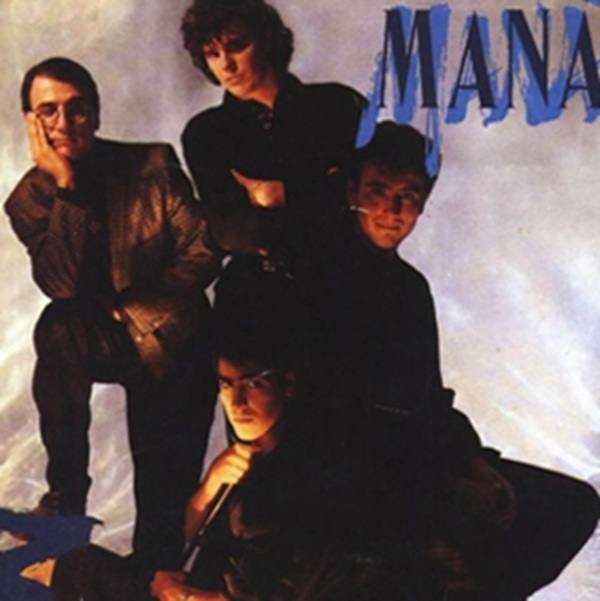
Maná (1987)

In search of his international projection: Maná, the name of the group was elected by the significance of the word in the Polynesian language: “Positive Energy”, signed with Polygram record and they released its first album and third -in general- of the band Maná, going on sale on May 12, 1987, an album that would strengthen the Rock movement in Spanish.

Maná (1987)
Maná (1987)

Among its 10 singles are: Robot, Mentirosa, Bailando, México, Entré por la ventana, Cayó mi nave, Mueve tus caderas, En la playa, Lentes de sol y Queremos paz. The total duration of this production is 35:20.

Despite some success, that first recording as Maná not entirely satisfied left the group. Various friction with the seal by the desire to maintain the identity of the group against the commercial interests, led Mana to sign

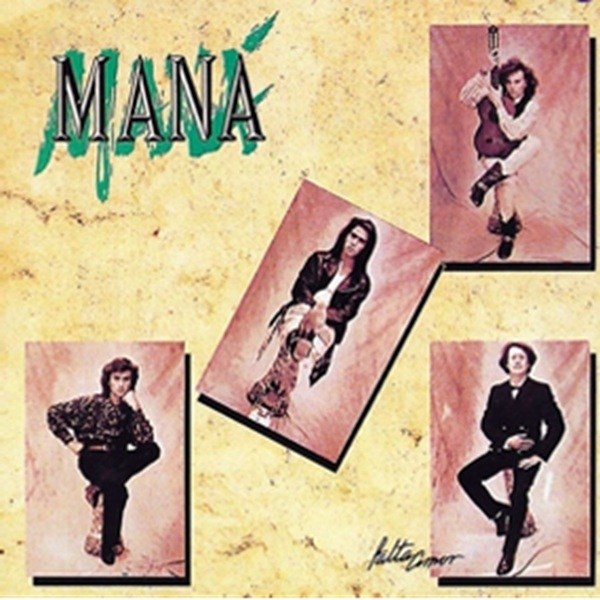
Falta amor (1989)

This album was released on July 2, 1990, under the seal Warner Music. Includes single known Rayando el sol. After the bad experience of the first album, Fher and Alex were aware of the risks involved in getting into the hands of a producer who saw the group as a purely commercial concept, so chose to start on a path from which there has been sectioned since: they assume production of all discs.

With that in mind recorded the album that does not get success until a year after its release thanks to the single “Rayando el sol”, which becomes the first big hit for Maná; singles “Pérdido en un barco”, “Estoy agotado” and “Buscándola” also come to like people. On the other hand, this album also highlights two songs that are characterized by its high degree of social commitment: “Falta amor”, dedicated to street children, and “La puerta azul” which presents their opposition to drugs.

Maná - Falta amor (1989)
Maná – Falta amor (1989)

The group performed 112 presentations in Mexico and their first massive concert outside the borders of their country, in the Coliseo General Ruminahui of Quito, Ecuador.

“Falta Amor” album sold nearly 1 million copies, had 10 gold records, 5 platinum, 2 Double Platinum and 1 Triple Platinum, besides been recognized by Billboard as the Best Album and give its authors recognition as best Pop-Rock Group.

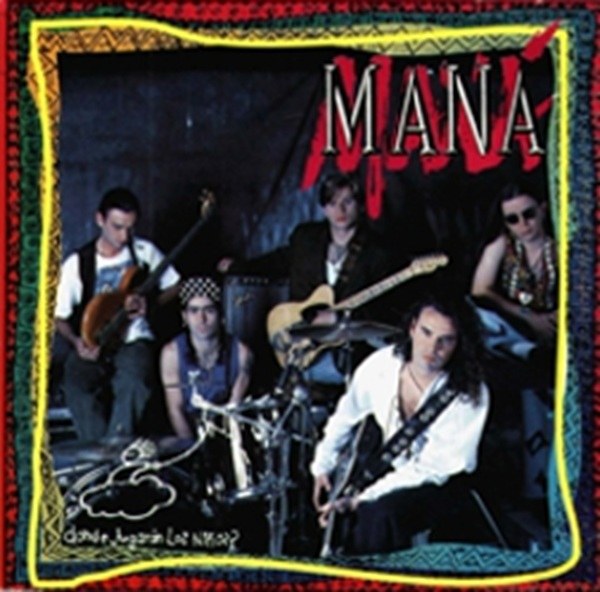
¿Dónde jugarán los niños? (1992)

In 1991 Maná facing the first change in its lineup with the departure of Ulises Calleros, who since then is the manager of the group. This meant the arrival of two new members: keyboardist Iván González and guitarist César “El Vampiro” López.

With this new formation recorded in Los Angeles in 1992 ¿Dónde Jugarán Los Niños?, album is a real milestone in the history of the group and the rock in Spanish, staying for 97 weeks on the Billboard list of albums more sold in Latin America. The album was released for sale on 27 October 1992. Currently, ¿Dónde Jugarán Los Niños?, it has sold over 10 million copies worldwide making it the bestselling album in the history of Rock in Spanish.

Maná - ¿Dónde jugarán los niños? (1992)
Maná – ¿Dónde jugarán los niños? (1992)

8 singles simple of this production of 12 songs topped the charts of popularity throughout the Spanish-speaking America and have become classics from their repertoire: “Vivir sin aire”, “¿Dónde jugarán los niños?”, “De pies a cabeza”, “Como te deseo”, “Oye mi amor”, “Cómo diablos”, “Te lloré un río” y “Me vale”.

Maná globalization begins in 1993 with a promotional machinery of first level and a series of 268 concerts in more than 17 countries. The tour was a success and positioned the band between the Latino community in the US and in markets like Chile and Argentina.

Argentina and Spain, two historically difficult terrain to reach for non-native Latin artists were also conquered by the phenomenon Maná thanks to the song “Vivir sin aire” reached first place in the charts of both countries, which do not it had happened in 26 years. This single is a worthy prize at MTV Latino Video Music Award for best video of the year.

This album was the only race Mana as a quintet. ¿Dónde jugarán los niños? Was relaunched with two remixes on February 15, 1994.

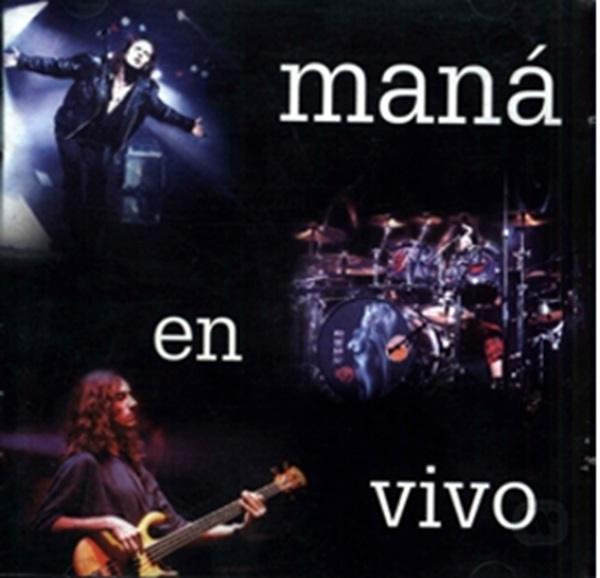
Maná en vivo (1994)

With its new status in the international scene of Latin pop rock, the trio Fher, Alex and Juan released the live album Maná (1994) with the idea of capturing the energy and every moment they live during their performances.

The double album was recorded between August and September 1994, during the group presentations at the Universal Amphitheatre in Los Angeles, the San Diego Sports Arena in San Diego, the Aragon Theatre in Chicago, the Teatro Gran Rex in Buenos Aires, the Stadium Nacional de Chile in Santiago and the Standard room in Barcelona. Again, Billboard magazine honored with the award for Best Rock/Poplive Album of the year.

Maná en vivo (1994)
Maná en vivo (1994)

CD1 has 10 singles: De pies a cabeza, Oye mi amor, Refrigerador, ¿Dónde jugarán los niños?, Soledad, Huele a tristeza, Te lloré un río, Estoy agotado, Perdido en un barco y Buscándola.

Likewise, the CD2 has 8 singles: La chula, El rey (José Alfredo Jiménez Cover), Como diablos, Me vale, Rayando el sol, Como te deseo, La puerta azul (Acoustic) (Bonus Track) y Vivir sin aire (Acoustic) (Bonus Track).

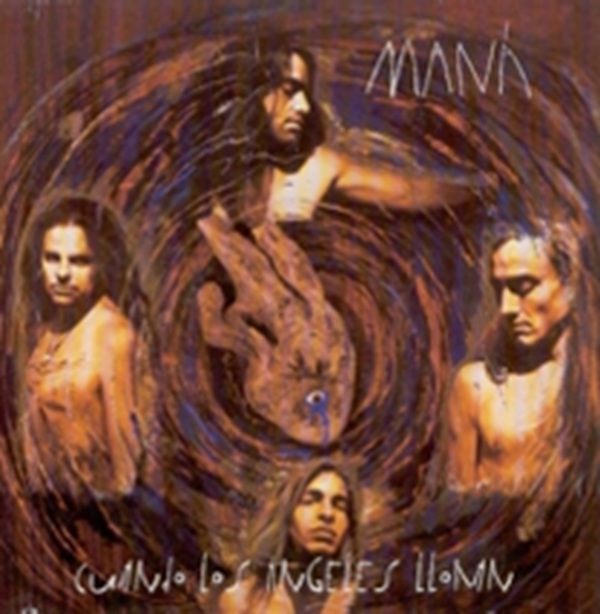
Cuando los ángeles lloran (1995)

Anxious to return to their original quartet format, Maná has the third and final change in their lineup. The band auditioned more than 80 guitarists from Mexico, Argentina, Chile and the United States, until finally in Aguascalientes (Mexico) find the talent they were looking, Sergio Vallin, whose sensitivity, technique and versatility to give a luster different sound guitar in the productions of the band. With this new lineup recorded and released the album Cuando los ángeles lloran (1995) between Los Angeles (USA) and Puerto Vallarta (Mexico).

This production is distinguished by a remarkable evolution in the lyrics and the sound of the group. The singles “Déjame entrar”, “No ha parado de llover” and “Hundido en un rincón” not only represented a success in the radio, if not that the corresponding video had a great rotation in the music channels and won several awards for their quality.

The album gave them their first American Grammy nomination and the Billboard Award for Best Rock Album / Latino Pop, which set a record of 6 Billboard Awards received over a period of 3 years.

Maná - Cuando los ángeles lloran (1995)
Maná – Cuando los ángeles lloran (1995)

With this new album the group began its tour on May 12, 1995, with a total of 52 concerts in 13 countries, this in a period of less than five months, which showed the phenomenon Maná means.

During their visit to Spain in the same year, the group performed at the Plaza de Toros de Las Ventas with absolute plenty in each place they visited.

Cuando los ángeles lloran with their respective concert tour meant for the band other achievements, such as: the inclusion of Maná at the festival Montreaux Jazz and the Midem conference, which took place in Switzerland and France, respectively, something never before achieved. And they also participated with a theme in the film My Family, at the request of director Francis Ford Coppola.

In mid-April 1996, Maná continued an extensive and expected tour throughout Mexico and the United States. This tour earned them important articles in prestigious magazines such as Rolling Stone, Time, Details, People Magazine, Newsweek and Pollstar.

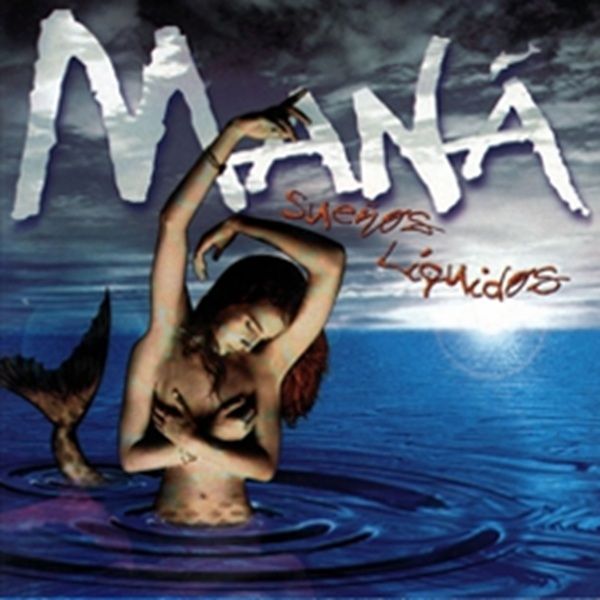
Sueños líquidos (1997)

This production was recorded in a beautiful house overlooking Banderas Bay, in Conchas Chinas. The result was an energetic mixture of rock, pop and Latin rhythms that go from Bossanova to Flamenco, through the Caribbean cadence of reggae. Important singles like “En el Muelle de San Blas”, “Hechicera”, “Clavado en un bar” y “Como dueles en los labios” emerge from this album.

The album was released in October 1997 and was released simultaneously in 36 countries; debuted in the first place on the Billboard Hot Latin 50 Chart.

On 30 January 1998 the band began its most ambitious tour, Sueños Líquidos World Tour in Chile, later visited Uruguay and Mexico.

Among the presentations that stand out in the Sueños Líquidos Tour 98 are those of Bolivia, Colombia, Peru, Costa Rica, Nicaragua, Venezuela, Chile, Puerto Rico, Honduras, and El Salvador.

Maná - Sueños líquidos (1997)
Maná – Sueños líquidos (1997)

Other presentations most important are the concerts at the National Auditorium, room in which Maná broke the record, because it was the first time that a band of this genre is presented seven consecutive times on this stage.

Maná signed with the agency Creative Artists Agency (CAA) and thus joined the impressive list of represented that included Bon Jovi, Alanis Morissette, Eric Clapton, Madonna, Depeche Mode, Carlos Santana, Bob Dylan, George Michael, among others.

Their first tour with CAA began August 21, 1998 in Los Angeles and covered more than 30 cities with a total of 36 concerts in arenas and amphitheaters, most of them with sellout. Important presentations took place at the Universal Amphitheatre in Los Angeles and at the Rosemont Horizon Arena, where broken record by becoming the first Latin pop rock group in supply lasts. This tour was the biggest by a Latin pop rock group in America.

The band is nominated for the sixth consecutive time the prizes awarded by Billboard magazine for Sueños Líquidos, in the category Best Pop Rock Album of the Year, taking the coveted prize. On 24 February 1999 they had the first American Grammy awarded to a Mexican pop rock band.

Also in December 1998, Fher receives an invitation from Carlos Santana to participate in his new album. Fher composes “Corazón espinado”, a theme which open borders to the Latin music, after putting this single in the top of Europe, Asia and America. The recording was made in the cities of Los Angeles and San Francisco (California), where was born a great friendship between the two musicians.

As a result of this collaboration, Alex and Fher receive the Grammy award as producers and writers of the song, in addition to performing with Santana toured the United States and Mexico. The group shared arenas, auditoriums and stadiums in the United States and Mexico with Carlos Santana, on an extensive tour that started from 29 July 1999 until December of that same year with a total of 43 presentations.

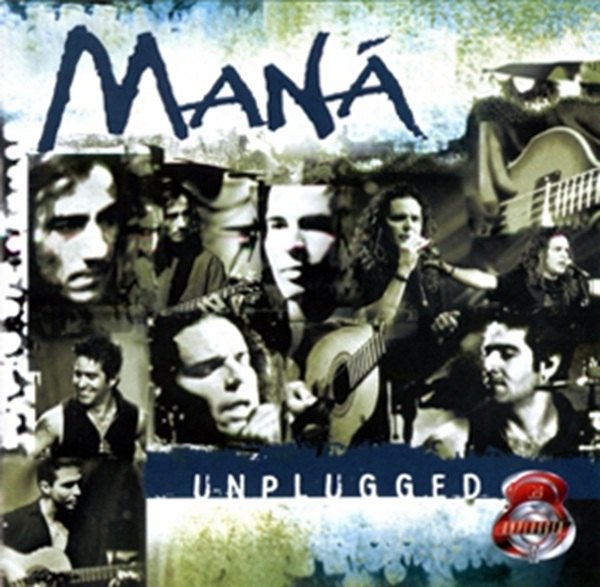
MTV “Unplugged” (1999)

Maná - MTV "Unplugged" (1999)
Maná – MTV “Unplugged” (1999)

The MTV video chain had spent several years asking Maná their participation in the series of recordings Unplugged, without the band could have access to the request because of commitments that meant their recordings and extensive touring.

Finally the conditions for the project were given, so the March 9, 1999 the band recorded a Maná Unplugged in Miami intimate before an audience of 70 lucky fans. In this material the group includes hits from their repertoire, plus 3 versions in acoustic mode; it also contains the musical interlude Coladito, the percussion duel between Alex Gonzalez and guest musician Luis Conte, where you could appreciate the skill of both performers.

On 22 June 1999 the material is released for sale simultaneously throughout the American continent, reaching the top of sales in the TOP 50 Latin Billboard magazine, which the band repeated the feat of being the only group Latin rock to do so. So far, this album remains one of the best sellers for television, plus it was the first Latin artist to release a material of this type (CD/DVD).

The first single came off of this production, original theme of Juan Gabriel, “Se me olvidó otra vez” remained for more than 5 consecutive weeks in first place in the radio charts for much of Mexico and Latin America. “Te solté la rienda”, by composer Jose Alfredo Jimenez was another hit single that was obtained from this recording.

In early January 2000, Maná receives the news of their nomination for a Grammy in the category of Best Latin Pop Album for their album Unplugged, this was the third consecutive time that the group was nominated for the prestigious awards.

In mid-April in the city of Miami were celebrated the Billboard Awards Latin Music, in which Maná got 2 major awards, the first for Best Rock Album Pop Latino for their production MTV Unplugged, and the second award to the Black Forest for Ecological Foundation, called Spirit of Hope which is given only to those artists who have distinguished themselves by performing altruistic for the environment and human rights.

In these same dates the group receives a recognition granted to them for the first time, the prize awarded by the chain of rental and sale of videos and largest US and music, BlockBuster Award for Best Latin Artist.

In September the group attends the first annual Latin Grammy in which was winning 3 Grammy for their participation in the album by guitarist Carlos Santana.

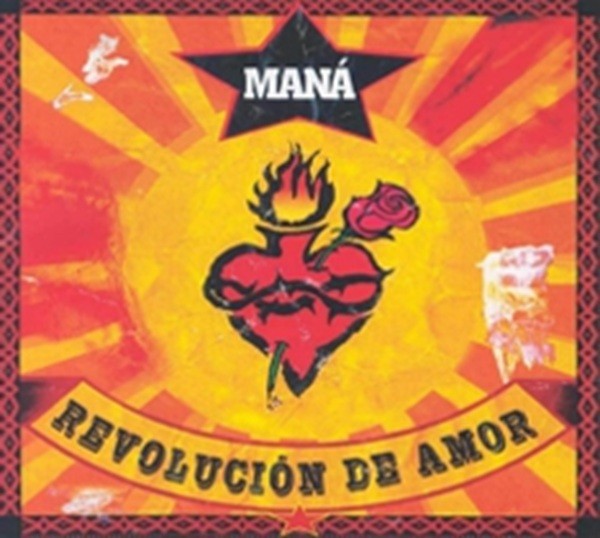
Revolución de amor (2002)

In early 2002 the band encloses to compose and make demos of what would be their next studio album five years after the launch of Sueños líquidos. Revolución de amor was launched the August 20, 2002, album in which the search for the band shows its essence by mixing with rock sound of the sixties and seventies, and other fusions of Latin music.

Maná - Revolución de amor (2002)
Maná – Revolución de amor (2002)

This, their sixth studio album, was shot entirely in Los Angeles between February and May 2002 and was attended by Carlos Santana and his guitar on “Justicia, Tierra y Libertad”, as well as Ruben Blades in “Sábanas frías”. Notably, the guitarist Sergio Vallin, participated, singing the theme “¿Por qué te vas?”, Dedicated to his parents.

Revolución de amor reached the first place in sales in Spain, Latin America and the United States for five consecutive weeks. It had the most outstanding singles “Ángel de amor”, “Eres mi religión” y “Mariposa traicionera”.

Thanks to its success in Italy, the singer Zucchero invited to participate in the song “Baila morena” duet is a success both in America and in Europe. Maná returns the gesture singer to invite him to participate in the song “Eres mi religión” but now in Italian, which was then, included in a special edition of the album Revolución de amor edited in Europe.

On September 29, 2002 Maná adventured to a new two-year tour that would like never before into the international market. The tour took the group not only to cities in the United States, Mexico, Latin America and Spain, also new places like Italy, France, Germany and Brazil. In total, the group performed more than 100 concerts in 24 countries.

During their stay in Europe, the band participated in the special Pavarotti & Friends alongside Zucchero, where they were presented with stars like Bono, Eric Clapton, Lionel Ritchie, Queen, Deep Purple, Ricky Martin and Andrea Bocceli. Maná received two nominations in the 4th annual Latin Grammy that took place in Miami on September 3, 2003, taking the award for Best Rock Album by a Duo or Group.

Esenciales (2003)

Maná - Esenciales (2003)
Maná – Esenciales (2003)

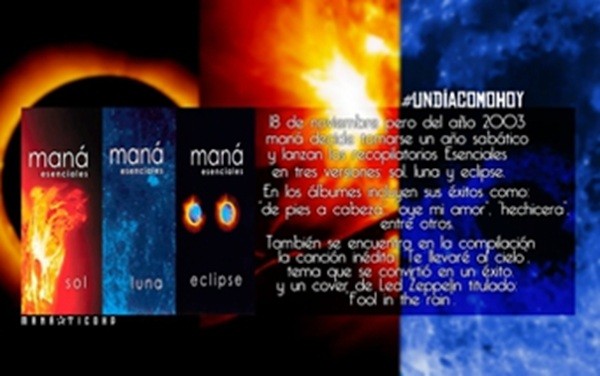
Esenciales is a compilation in CDs released by Maná on 18 November 2003. Three CDs with its most important songs until that year, divided into three themed discs: Sun, with its danceable songs; Moon, its themes with romantic touch; and, Eclipse, the best of their themes in general (which only came out in the Americas). The discs contain an unreleased track: “take you to Heaven”; and Cd Sun contains a cover of Led Zeppelin’s “Fool In The Rain”, recorded by Maná in the disc tribute to the band.

By way of gratitude to their fans, decide to put on sale on December 12, 2004 the DVD called “Acceso Total”, which includes images Revolución de Amor Tour (2002- 2003), never before seen in dressing rooms, allowing the fans have “full access” to experience living Maná on tour.

Amar es combatir (2006)

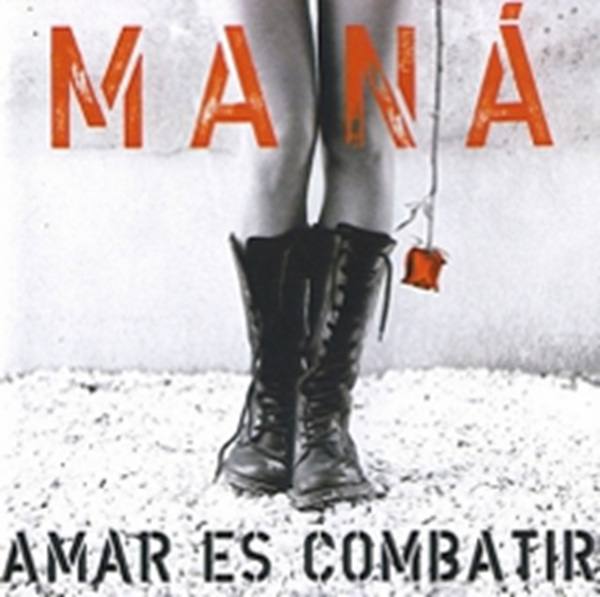
Miami was the recording of this CD with the band performed a fusion of rock, pop, Latin music, reggae, drum and bass. Produced by Fher and Alex, like their previous albums, Amar es combatir was released on August 22, 2006 and is published in 40 countries worldwide, reaching number 4 on the Top 200 Albums of Billboard magazine in the United States, a record for a production only reached entirely in Spanish for the album Fijación Oral Vol. 1 Shakira.

Their first single, “Labios compartidos”, remained for eight consecutive weeks at the top of the Latin charts radio and is named among the most recognized Latino US media as one of the most heard songs and awarded 2006.

The singles that followed, “Bendita tu luz” (a duet with Juan Luis Guerra), “Manda una señal” and “Ojalá pudiera borrarte” are also positioned at the top of the charts. These add a fifth single, “El rey tiburón”, which is managed to stand out because it is becoming less common than a 5 easy production derived therefrom, given the difficult situation being experienced by the industry.

Maná - Amar es combatir (2006)
Maná – Amar es combatir (2006)

in November 2006 the group participates in the 7th edition of the Latin Grammy Awards, where in addition to performing with Juan Luis Guerra with an excellent interpretation of their successes, which earned them a heartfelt ovation from those attending the event and which was one of the climactic moments of the evening, are honored for career achievement and accomplishments in music.

In February 2007, after receiving 5 nominations for the awards Billboard Latino, 4 nominations for the awards Lo Nuestro and American Grammy for Best Album Alternative or Urban Rock, Maná began their “Amar es combatir” Tour, with the increased production the group has had so far (more than 60 tons of equipment), which would give 116 concerts over a period of a year and a half.

Among the most prominent awards that the band obtained by this production is an American Grammy in the category of Best Album Alternative Rock or Urban, 3 awards Lo Nuestro for Rock Album of the Year, Rock Artist of the Year and Song Rock of the Year; 2 Latin Billboard Alternative Rock Album for the Year and Pop Airplay theme of the Year Duo or Group.

Arde el cielo (2008)

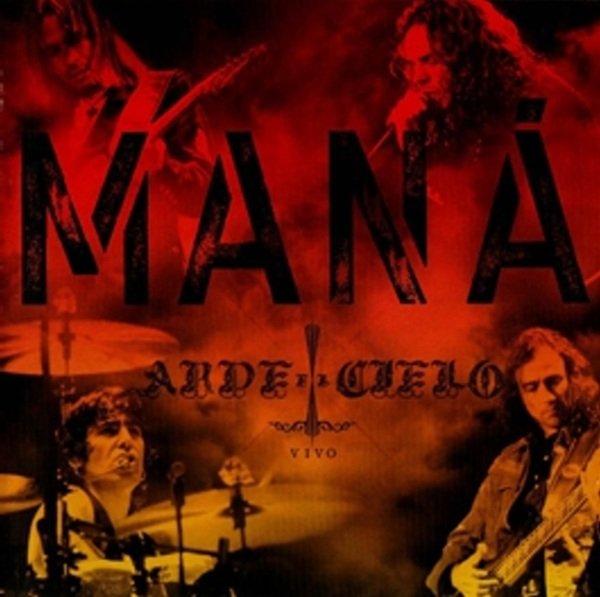
On April 29, 2008 Maná presented in Los Angeles on CD / DVD called Arde el cielo, which was recorded during Amar es combatir Tour in the Jose M. Agrelot Coliseum of Puerto Rico in March 2007.

Maná - Arde el cielo (2008)
Maná – Arde el cielo (2008)

The material contains 12 live tracks that represent and review the history of Maná, from “Rayando el sol” to “Labios Compartidos” through “El rey” and songs as well known as “En el muelle de San Blas” or “Vivir sin aire”, and two previously unreleased studio recordings. The first of these new songs is “Si no te hubieras ido”, a song by Marco Antonio Solis and versioned by other artists, but in which Maná was able to put their unique stamp.

The second new song on the CD is “Arde el cielo” a theme composed by Fher and produced in conjunction with Álex González. Both themes were hits in 2008.

Drama y luz (2011)

Drama y luz represents a milestone in the career of Maná. This is an album gestated for over 1.000 days with their thousand and one nights.

The project began to take shape in June 2008 and ended in early April 2011. During those 34 months were composed, arranged and recorded more than forty demo songs. Only a rigorous selection of thirteen saw the light.

Maná - Drama y luz (2011)
Maná – Drama y luz (2011)

The first single of Drama y Luz is “Lluvia al corazón”, a theme that carries a message of hope in the dark clouds of an uncertain future by living in a half-dead planet, where humanity must not lose faith.

The second single is “Amor clandestino” a theme that became another new hit Maná. The third single “El verdadero amor perdona” is another success that sounded on the radio in its version with Prince Royce, which reached the top Latin songs and Latin Pop Airplay. Their fourth and final single of this production Drama y Luz is called “Mi reina del dolor”, a track that gradually climbed famous for its great rhythm, guitars and drums.

Exiliados en la bahía (2012)

Maná - Exiliados en la bahía (2012)
Maná – Exiliados en la bahía (2012)

Exiliados en la bahía is a compilation that was released on August 28, 2012 in which include the successes that the band has had throughout their 20 year career, it has two live tracks, Lluvia al corazón and El verdadero amor perdona that were recorded in the Drama y Luz World Tour in Buenos Aires, Argentina.

The first single is “Hasta que te conocí”, a cover of Juan Gabriel. Also, it contains “Un nuevo amanecer” an unreleased track.

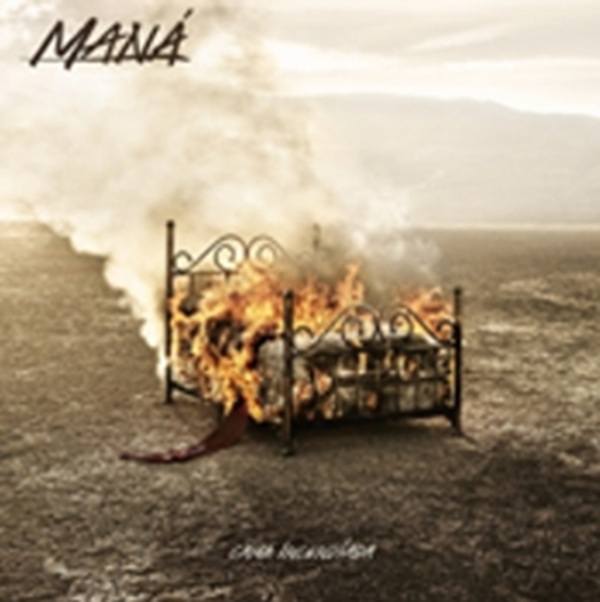
Cama incendiada (2015)

This is the ninth studio album (and eleventh overall) of the band. It was released for sale on April 21, 2015.

Maná - Cama incendiada (2015)
Maná – Cama incendiada (2015)

The first single was Mi verdad which has the support of the Colombian singer Shakira, the second single is the prison after the July 24 came a version electronic with American DJ Steve Aoki breaking completely with the musical patterns that we had used the band. The third single from the album is the theme Ironía, the official video was released on October 12.


Willie Colon

North America / USA / New York

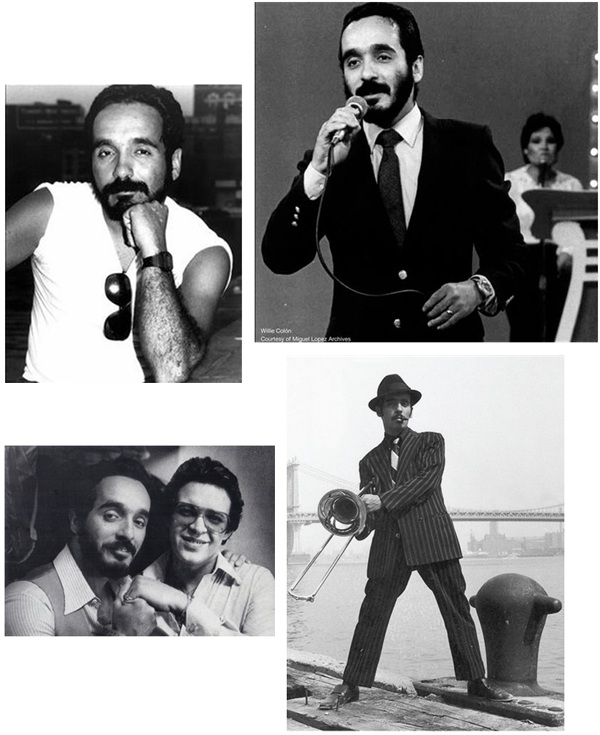
William Anthony Colón Román, better known as Willie Colon, was born in New York (USA) on April 28, 1950.

Willie Colon
Willie Colon

This American musician of Puerto Rican descent. Master trombone and fusion of various Caribbean, African rhythms and urban music, formed with vocalist Hector Lavoe one of the most important couples in Latin music of the seventies, and is considered, one of the pioneers in the development genuine salsero movement in the late sixties and early seventies.

Grandson of Puerto Rican immigrants, Colón grew in the Latin Quarter district of the Bronx, a fact that has marked much of his personal and artistic career, which implies rebellion and transgression of the rules. After studying trumpet and clarinet, his admiration for Mon Rivera led him to opt for the trombone at age fourteen, thus initiating his professional career playing in community centers with fellow high school.

Willie Colon - Photo 1
Willie Colon – Photo 1

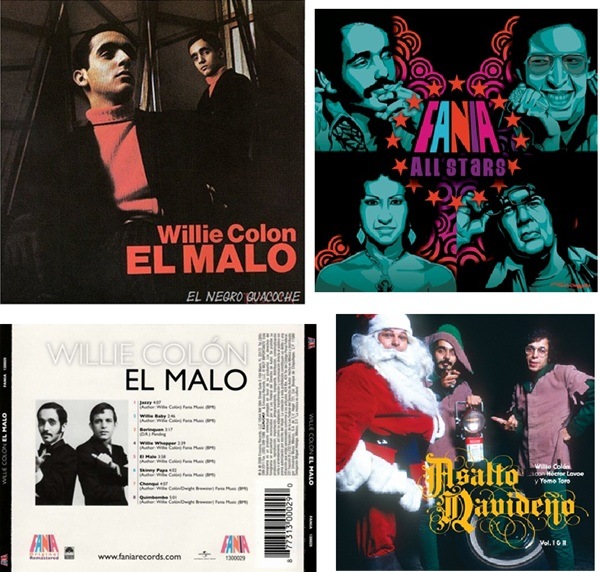
A year later when he was 15 years old, he signed a contract with the Fania record label. Two later, in 1966, he recorded his first album with the significant title of El Malo, which sold 300,000 copies.

In this first work already he had the unmistakable voice of Hector Lavoe and introduced elements of Puerto Rican folk music, especially the pump, mixed with own hurtful and harsh rhythms of the trombone, what were good examples topics as successful as Jazzy and I wish I had watermelon.

Willie Colon - Photo 2
Willie Colon – Photo 2

Along with other prominent musicians of Caribbean origin as Ray Barretto, Bobby Valentin, Reynaldo Jorge and self-Héctor Lavoe, he participated in 1971 in the concert recording of the FANIA All Stars, considered the event that launched the salsa movement in New York.

That same year, his masterful rendition of Piranha, consisting of Tite Curet Alonso, he shot to fame and became one of the icons of the musical movement.

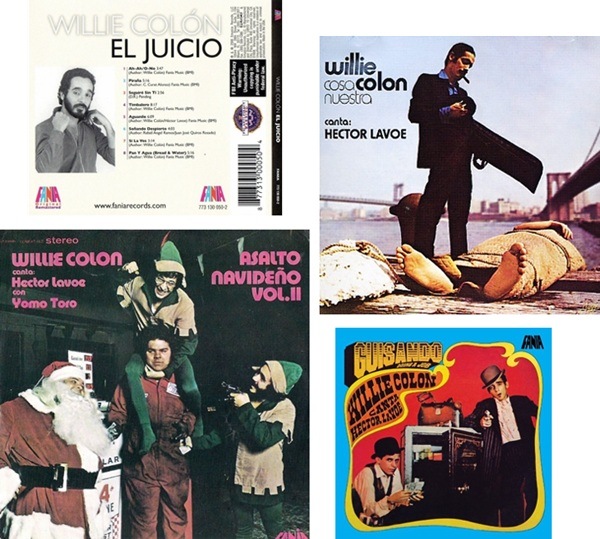
Under this record label and with Hector Lavoe recorded over a dozen albums until 1975, among which were Guisando (1969), Cosa Nostra, El Juicio and Asaltos Navideños (1972), in this last album this expert and risky arranger, combined rhythms and styles to help create music that would be known today as the sauce. He incorporated elements of Puerto Rican Jibaro and thus created hit singles that became popular among Puerto Rican listeners.

Willie Colon - Photo 3
Willie Colon – Photo 3

In 1975 he recorded The Good, the Bad, the Ugly. All their albums show genuine urban or what came to be known as “sounds of the neighborhood,” the most faithful sample of Puerto Rican immigrant feeling in the great metropolis New York salsa. After his work with Fania his fame spread among the Hispanic community in the US and much of Latin America; in 1975 he had the opportunity to play alongside his idol Mon Rivera.

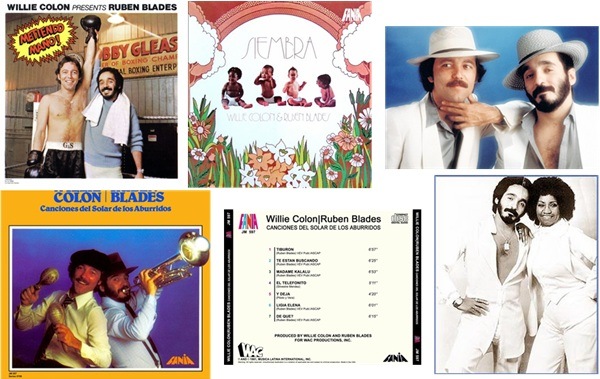
In the late seventies, his rebellious spirit led him to develop along the Panamanian singer Ruben Blades what became known as salsa awareness, songs denouncing the political and social situation in Latin America and the Caribbean; conjunction with Blades was especially fortunate, with high quality work as Metiendo Mano (1977) and Siembra (1978). Canciones del Solar de los Aburridos album in 1982 was awarded a Grammy.

Willie Colon - Photo 4
Willie Colon – Photo 4

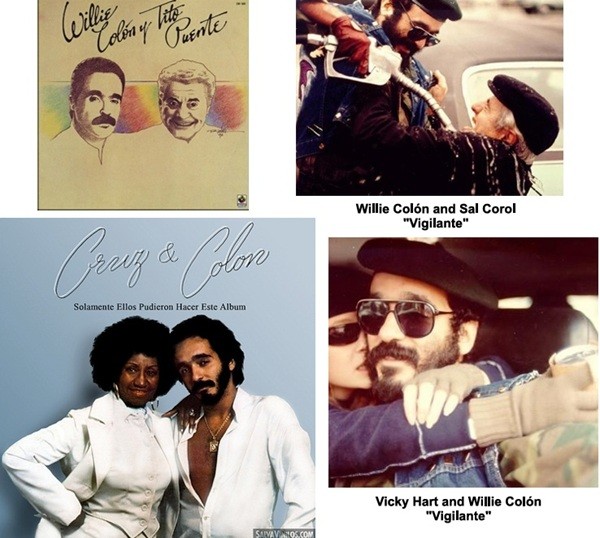
Willie Colón has worked throughout his career, in addition to those already mentioned, with artists like Celia Cruz, Tito Puente and David Byrne, and played some roles in Mexican television such as: Demasiado Corazón, La Intrusa y Corazón Partido. Furthermore, it could also be seen in the films “Vigilante”, “The Last Flight” and “It Could Happen to You”.

From the nineties his artistic side gave way to intense activity in social life and American politics, according to its commitment to the Hispanic community: thus, in 1966 Willie Colón was named by Hispanic Business Magazine as one of the 100 most influential Hispanics in the US; in 1993 it was presented to the primaries in the State of New York; in 1995 he became the first Hispanic ASCAP entered in the National Council; and in 1999 he was part of the delegation was received at the Vatican by Pope with the Jubilee 2000, in addition to regularly collaborate with humanitarian organizations like the United Nations and Amnesty International.

Willie Colon - Photo 5
Willie Colon – Photo 5

As a musician, it has been characterized by the fusion of rhythms such as son, mambo, guaracha, cha cha cha, guajira, Colombian cumbia, rumba and Venezuelan joropo, among others.

His music, which has been a big influence on the modern Latin Jazz, reflects a traditional lyric rhythm, and goodbye and hope forced to leave their land to settle in the US generates.

In his 42 year career, Columbus has released more than 45 albums, among which we can mention “Crime Pays”, “The Baquine of Angelitos Negros”, “49 Minutes”, “Solo”, “Fantasmas”, “The Last Fight”, “Contrabando Especial No. 5”, “Honra y Cultura”, “Tras la Tormenta”, “Demasiado Corazón”, “Idilio” y “El Malo 2”, this latest album which was released in 2008.

Willie Colon - Photo 6
Willie Colon – Photo 6

In his career, Willy took 11 nominations for the Grammy Awards and received 15 gold records and 5 platinum.

Añá The Divine Voice of the Batá Drums and Their Ancestral Heartbeat

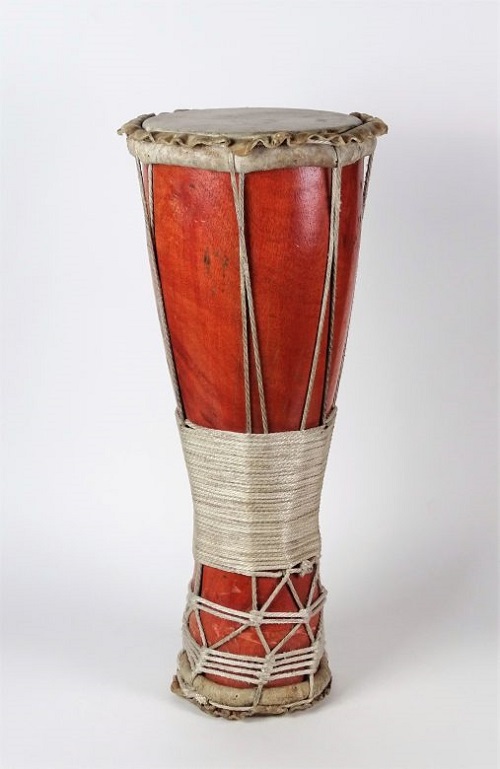
In the vast universe of Afro-Cuban spirituality and Yoruba tradition, batá drums are not merely musical instruments: they are living, consecrated entities.

Tambores Añá La Voz Divina de los Batá y su Latido AncestralTambores Añá La Voz Divina de los Batá y su Latido Ancestral

The soul that resides within these sacred drums is known as Añá (or Aña), the deity (orisha) of divine sound and primordial vibration. To speak of the Añá drums is to enter a direct channel of communication between the earthly realm and the spiritual world.

Origin: The Secret Born in Yoruba Land

The presence of Añá dates back to the ancient Yoruba Empire (in present-day Nigeria and Benin). In Yoruba mythology, the deity Añá represents the divine voice and breath through which Olodumare (the Creator) ordered the cosmos.

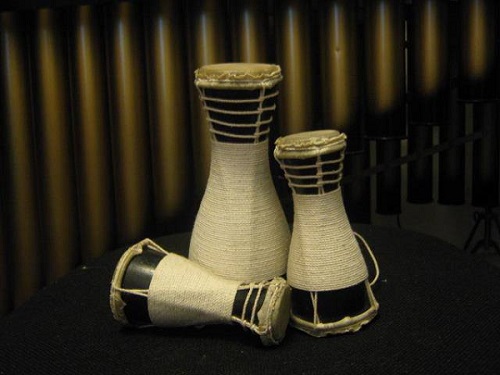
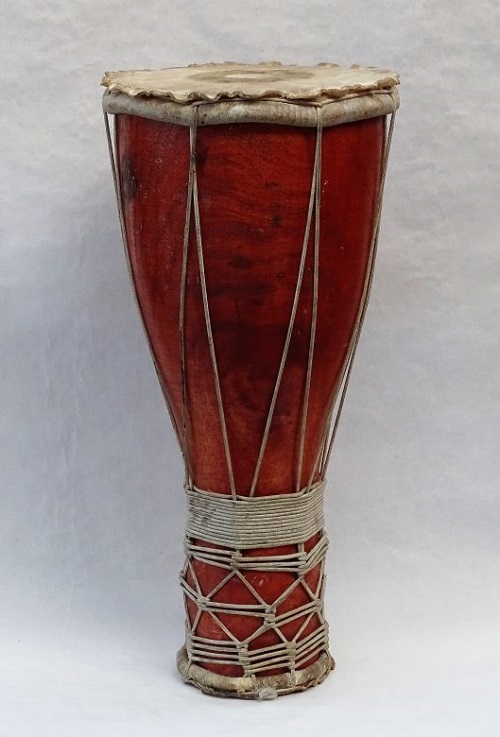
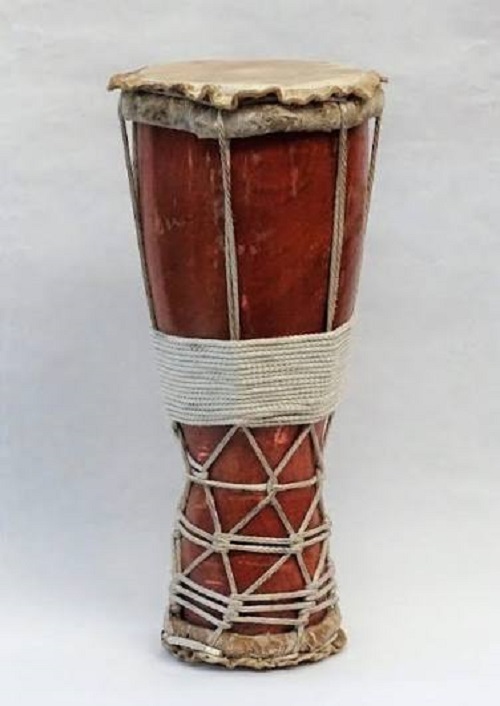
To encapsulate this force, a sacramental trio of hourglass-shaped, hand-carved wooden drums was structured:

Iyá: The mother drum, lowest in pitch, responsible for leading the liturgy and performing improvisations.

Iyá El tambor madre
Iyá El tambor madre

Itótele: The medium drum, which engages in a direct dialogue with the Iyá.

Itótele El tambor mediano

Okónkolo: The smallest drum, responsible for holding down the rhythmic foundation.

Okónkolo El más pequeño

Consecrating a set of batá drums with the fundamento (sacred core) of Añá requires strict liturgical rites involving sacred botany (omiero), prayers, and offerings so that the deity takes permanent residence within the wood. Only sworn priests, known as Omo Añá or Oluwos Batá, are authorized to play these sacred instruments.

Evolution: The Transatlantic Journey and the Cuban Flourishing

Through the transatlantic slave trade during the colonial era, Yoruba scholars arrived in the Caribbean primarily in Cuba under the Lucumí designation. Despite the oppressive conditions, practitioners fiercely preserved the secret of Añá.

Toward the second half of the 19th century, in the town of Guanabacoa (Havana), the first set of Añá drums consecrated on American soil was consecrated and baptized. In this new sociocultural environment, the ancestral rhythms remained intact within the liturgy of Regla de Ocha (Santería).

The drumming patterns evolved into a complex system of tonal languages where the drum does not merely accompany, but speaks to and summons each orisha through specific rhythmic phrasing.

Significance: A Tonal Language Between Humanity and Orishas

The importance of the Añá drums lies in their mystical function: they serve as the sacred bridge that harmonizes the Ori (an individual’s head and destiny) with the deities and ancestors.

In Lucumí cosmogony, Añá’s vibration possesses the power to alter the state of consciousness of the initiated, facilitating spiritual trance or possession through which the deity descends to earth.

“Añá does not play to entertain the human ear, but to summon the spirit and maintain cosmic balance through sound.”

Furthermore, on a musical level, it represents one of the most complex rhythmic legacies on the planet. Its polyrhythmic technique has had an immeasurable influence on the development of Afro-Cuban music, Latin jazz, and salsa.

Present Day: Preservation of Faith and Global Expansion

Today, the Añá tradition experiences a dual phenomenon: the rigorous preservation of its rituals and a remarkable global expansion.

Although the secrets required to consecrate a legitimate Añá remain closely guarded under strict priestly discretion, Santería worship and admiration for batá percussion have transcended the borders of Cuba and Nigeria.

Today, there are consecrated Añá drum sets established by babalawos and Omo Añá in countries such as the United States, Venezuela, Mexico, Spain, and Puerto Rico.

Los Tamborea Bata son entidades vivas y consagradas

While non-sacred batá drums (known as aberikuló, which do not carry the secret of Añá) are used freely on secular stages, true Añá drums remain reserved exclusively for private ceremonies, keeping alive the voice of an ancient deity.

To visually understand how the drum’s sound articulates the liturgical call within the tradition, check out the resource “The Function of Añá Within Batá Drums.”


Also Read: Pancho Quinto Is Considered One of Cuba’s Great Rumberos

International Salsa Magazine Recommends:

Añá Loógúnsi Fundamento Drum

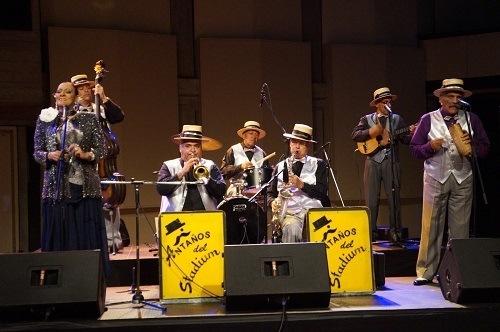
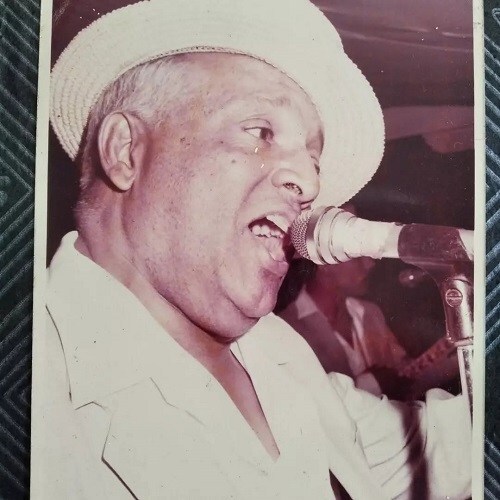
The Antaños del Stadium: Echoes, Memory, and Rhythm of Cañonera Caracas

From the Baseball Diamond to Venezuela’s Musical HeartVenezuelan popular music preserves one of the most cherished and iconic pillars of its urban identity: Los Antaños del Stadium.


Los Antaños del Estadio Ecos Memoria y Ritmo de la Caracas Cañonera

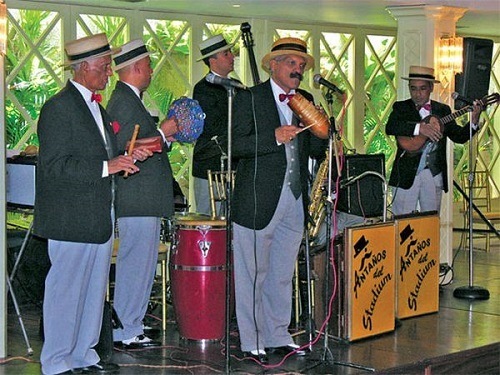
Emerging in the mid-20th century, this ensemble not only rescued the musical traditions of early 20th-century Caracas, but also transformed merengue caraqueño, guasa, and pasodoble into a living bridge between the city’s colonial past and the nation’s modernity.

Origins: Born on the Baseball Field

The group’s history dates back to 1946, when musician and athlete Jacobo Espinoza decided to assemble a group of instrumentalists to liven up baseball games at the former San Agustín Stadium home to the legendary Cervecería Caracas team.

It was in that setting, where a passion for sports met a festive atmosphere, that the group was born under its original name: Los Cañoneros del Estadio.

Notas Nacidas en el Campo de Juego

The ensemble adopted the aesthetic and sound of the old cañonero bands, which swept through the streets, plazas, and dance halls (mabilas) of Caracas in the early 20th century, announcing local festivities to the beat of the bass drum, cymbals, saxophone, and snare drum.

What began as an initiative to entertain fans in the stands took deep root in Venezuelan popular culture.

Evolution: Consolidating the Cañonero Sound

Over the decades, the group expanded from sports stadiums to radio airwaves, television, and studio recordings. Under the musical direction of the distinguished saxophonist Aníbal Escobar who defined the group’s signature melodic style for over 50 years—and the leadership of Jacobo Espinoza, the ensemble forged an unmistakable sound.

Jacobo Espinoza el ensamble definió un estilo inconfundible

Traditional genres that were at risk of fading into obscurity—such as merengue rucaneao (characterized by its infectious 5/8 time signature), the pasodoble criollo, guasa, polka, and waltz—found in Los Antaños del Stadium a vehicle for their preservation and renewal.

Following the founder’s passing, his children, Enrique and Nicol Espinoza, took over the reins, staying true to the iconic acoustic and instrumental format that defined the group.

Significance: Guardians of Venezuelan Heritage

The legacy of Los Antaños del Stadium lies in having immortalized the soundtrack of “The Caracas of the Red-Tile Roofs” (La Caracas de los Techos Rojos). With a discography spanning more than 20 albums, they immortalized essential pieces of the national songbook, such as “Carmen la que contaba 16 años,” “El Norte es una Quimera,” and “Alma Cumanesa.”

Antaños del Stadium llevan el sonido caraqueño al Centro Cultural BOD Escrito por Team Aliado Publicado 26 Jul 2019
Antaños del Stadium
llevan el sonido caraqueño al
Centro Cultural BOD
Escrito por Team Aliado
Publicado 26 Jul 2019

In 1996, marking a half-century of uninterrupted artistic work, the group was declared Musical Cultural Heritage of the City of Caracas.

Their legacy goes far beyond mere performance: they serve as a historical and methodological benchmark for all generations and música cañonera ensembles formed in Venezuela over recent decades.

Today: A Living Legend in the 21st Century

With over seven decades of continuous history, Los Antaños del Estadio remain active as one of the longest-running groups in Venezuelan music.

Although the urban landscape of Caracas has changed, the group continues to perform at festivals, cultural centers, and heritage events, proving that merengue caraqueño retains its vitality and festive charm.

.

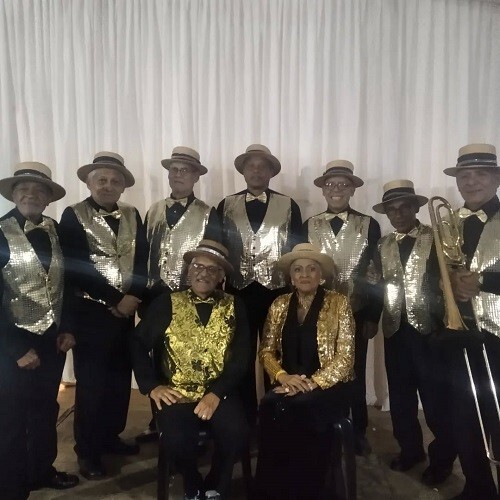
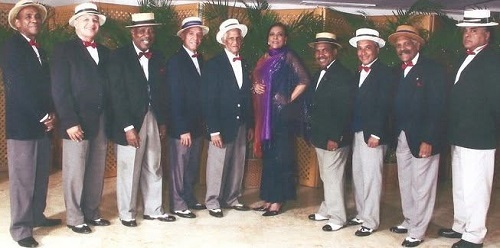
Antaños del Estadio
Antaños del Estadio

From left to right:

Rafael Escobar: Bajo

Prof. Carlos Espinoza: Bombardino

Maestro Aníbal Escobar: Saxofón y Director Musical

José Gregorio Ascanio, “Melao”: Tumbadora

Miguel La O Álvarez: Cantante

Sra. Nikol Espinoza Mata: Cantante

Juan Ramón Pedrón: Batería

Luis Alfredo Planas: Cuatro

Enrique Espinoza Mata: Cantante y Percusión

Andrés Romero, “Tapón”: Trompeta

Today, the Espinoza family’s legacy stands as a testament to cultural resilience and popular joy. Los Antaños del Stadium represent far more than mere nostalgia for the past; they are living proof that a city’s musical memory can remain vibrant, energetic, and resonant across generations.

This live performance of the group playing their classic merengue rucaneao perfectly showcases the style, festive energy, and traditional sound that have defined them throughout their long and storied career.

Also Read: Porfi Jiménez The Master of Rhythm Who United Two Nations

  • « Go to Previous Page
  • Page 1
  • Interim pages omitted …
  • Page 22
  • Page 23
  • Page 24
  • Page 25
  • Page 26
  • Interim pages omitted …
  • Page 100
  • Go to Next Page »

International Salsa Magazine (ISM) is a monthly publication covering salsa activities around the world and has been publishing since 2007. It is a worldwide network of volunteers coordinated by ISM Magazine. Together, we work to strengthen salsa events around the world.